50,000 at Hiroshima remembrance rally, opposing nuclear weapons and nuclear power
Nuclear fears focus attention on Hiroshima anniversary, THE HINDU, 6 Aug 12, Interest in the anniversary of the US atomic bombing of the western Japanese city of Hiroshima was heightened on Monday amid growing public frustration with the country’s decision to restart atomic reactors after last year’s nuclear accident.
Most participants at the 67th anniversary commemorations expressed their opposition to nuclear power generation. Those attending also included people who once lived near a nuclear plant in Fukushima prefecture in north-eastern Japan that was the site of the 2011
meltdowns of three reactors.
Such attendees included Tamotsu Baba, the mayor of Namie town, all of whose residents were forced to leave after the accident.
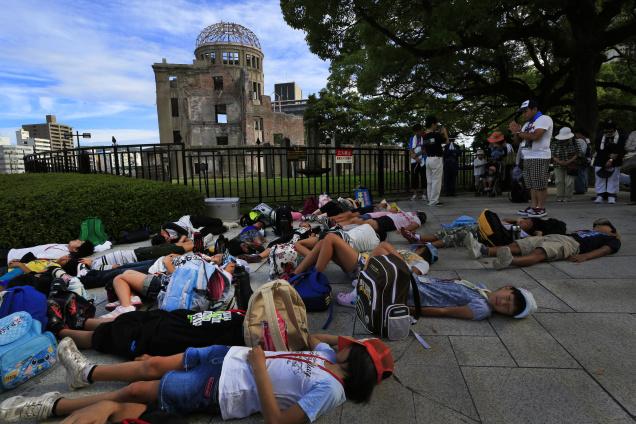 Students lie down symbolising deaths from nuclear wars and accidents
About 50,000 people attended the observance in Peace Memorial Park near ground zero, Hiroshima’s city government said. Mayor Kazumi Matsui called for the elimination of nuclear weapons at the ceremony…. http://www.thehindu.com/news/international/article3733249.ece
Remembrance of Nuclear Energy Disaster Victims
heres a video with Paul Gunter from Beyond Nuclear and others making statements and prayers at the New York memorial.. the introduction is very interesting
http://www.youtube.com/watch?v=oKiUteVBrR8
Discrimination, mental health issues, among Fukushima’s brave clean-up workers
 Doctors: Japan Nuclear Plant Workers Face Stigma By MALCOLM FOSTER Associated Press abc News, TOKYO August 5, 2012 (AP) A growing number of Japanese workers who are risking their health to shut down the crippled Fukushima Dai-ichi nuclear power plant are suffering from depression, anxiety about the future and a loss of motivation, say two doctors who visit them regularly.
But their psychological problems are driven less by fears about developing cancer from radiation exposure and more by something immediate and personal: Discrimination from the very community they tried to protect, says Jun Shigemura, who heads a volunteer team of about ten psychiatrists and psychologists from the National Defense Medical College who meet with Tokyo Electric Power Co. nuclear plant employees. Continue reading
Call for Russian accountability in nuclear power reactors sold to India
Bring Russia under N-liability clause: Activists http://timesofindia.indiatimes.com/india/Bring-Russia-under-N-liability-clause-Activists/articleshow/15370086.cms TNN | Aug 6, 2012, CHENNAI: People’s Movement for Nuclear Energy (PMANE) on Sunday demanded that the Centre scrap the 2008 Inter-Governmental Agreement (IGA) with Russia as it puts the onus on the Indian government and the Nuclear Power Corporation of India Limited (NPCIL) for any damage in the event of an accident occurring at the Kudankulam Nuclear Power Plant (KNPP) site in Tamil Nadu.
PMANE convenor S P Udayakumar, in a letter to MPs from TN and other states, stated that the agreement in effect boiled down to the Russian government or their companies having no liability whatsoever for their technology and the equipment used at the site.
He said that under Article 13 of the IGA, the operator of the power plant units at the site would be fully responsible for any damage within and outside the Indian territory caused to any person and property. This simply allows the polluter to go scot free.
He said any blanket waiver to the foreign suppliers would make the Nuclear Liability Act a cruel joke. “Russians claim that the Kudankulam reactors are the best and the safest in the world. If that is so, why should they shy away from offering any liability for their technology and components, but keep insisting that the Indian operator, NPCIL, is responsible for all damages?” he asked.
PMANE’s reaction comes in the wake of Prime Minister Manmohan Singh questioning the department of atomic energy’s decision not to exercise its ‘right to recourse’ in the event of a nuclear accident in the up-coming units 3 and 4.
Much uncertainty in predicting cancer deaths from Fukushima radiation
Trying to Tally Fukushima, NYT, By MATTHEW L. WALD, 19 July 12 “….In the slippery question of “How bad was Fukushima,” two Stanford University researchers have published a paper that casts the accident in a new light. It still seems hazy, though …… The study’s significance is not clear. The International Commission on Radiological Protection, the body from which the United States draws most of its radiation limits, warned of the limitations of such predictions in a 2007 position paper.
It said that calculating the collective radiation dose of the whole population and then trying to derive numbers on risks from it presented problems. “Collective effective dose is not intended as a tool for epidemiological risk assessment,” the group said, “and it is inappropriate to use it in risk projections.”
“The aggregation of very low individual doses over an extended time period is inappropriate, and in particular, the calculation or the number of cancer deaths based on collective effective doses from trivial individual doses should be avoided,” that paper added…
India’s secret escalation of the nuclear arms race
India’s Secret Nuclear Weapons Program, The Market Oracle, by Marya Mufty, Aug 05, 2012 If there was any arms race in the region, India has won it, at whatever the cost may be. But the claims to have good neighbourly relations, with MFN-status, no-war pact or no-first-use nuclear arsenal are just a dream seemingly never to come true.
In April this year India yanked open the door of the exclusive ICBM (International Ballistic Missile) club with the first test of Agni-V. Now, if DRDO is to be believed, India has quietly gate-crashed into an even more exclusive club of nuclear-tipped submarine-launched ballistic missiles (SLBMs).
The most ironic part of this achievement on part of India is that New Delhi had been able to successfully keep it as a secret ‘black project’. Continue reading
Political instability in Japan, as anti nuclear sentiment grows

 Nuclear energy wild card in Japan poll which Democrats likely to lose Asahi Shimbun REUTERS 4 Aug 12, Growing Japanese opposition to nuclear energy after the Fukushima disaster will be a wild card in a general election many expect within months, but politicians on both sides of the aisle agree on one thing: the Democratic Party is likely to fall from power just three years after its historic landslide win….
….Whatever the timing, the DPJ risks facing an anti-nuclear backlash as protests grow against Noda’s decision to restart two atomic reactors to avoid blackouts, despite
safety fears after an earthquake and tsunami crippled the Fukushima nuclear plant in March 2011 the world’s worst nuclear disaster since Chernobyl in 1986……. Continue reading
Fukushima reactor No 1 refuelling floor too radioactively hot for humans to enter
 Former Fukushima Daiichi Worker: My best guess is explosion had to blow lid off pressure vessel at Reactor 1 http://enenews.com/former-fukushima-daiichi-worker-my-best-guess-is-explosion-had-to-blow-lid-off-pressure-vessel-at-reactor-1 August 2nd, 2012 By ENENews Chris Canine has 15 years experience as a Health Physics Technician, Chemist and Radiation Safety Instructor. He has worked at over 20 plants throughout the United States, Japan and Mexico — including Fukushima #1 and #2 in the late 1970′s.
August 1, 2012 comment on ‘Tepco planning to float a balloon inside Reactor 1 in early August — Inspecting top floor with spent fuel pool‘
Tepco is basically saying that the refueling floor is still too radioactively hot for any human to enter. There was no fire in that spent fuel pool, and we never heard that it was like unit #3 and blew the lid off the pressure vessel. So why are radiation levels so high? During normal operations there is little radiation on the refueling floor because there is really nothing there. The fuel in the pool is under water with no dose on the surface, and the reactor is buried under cement and steel. My best guess is that the hydrogen explosion had to blow the lid off this reactor also. With radioactive gasses and particulates coming out of the reactor the cover was put on the building to limit the releases out onto the site. But as the cover kept in a lot of this radioactive material the refueling floor is so contaminated that it is no longer a place where humans can work or even walk through.
Find the answer why they put a cover on only this building and that will tell you the condition of this unit.
Siddharth Malik’s success story in solar power for India
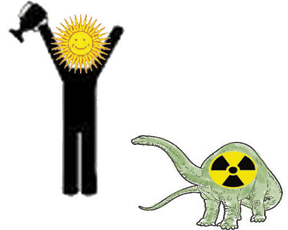
 How seven young entrepreneurs defied hurdles to develop clean renewable energy http://economictimes.indiatimes.com/news/emerging-businesses/entrepreneurs/how-seven-young-entrepreneurs-defied-hurdles-to-develop-clean-renewable-energy/ 4 AUG, 2012, SHREYA JAI,ET BUREAU articleshow/15347643.cms Renewable energy in India has always been a risky business, be it due to high input cost, unsteady market or lack of government support. But these seven young entrepreneurs defied all this and much more.
At a time when even big companies are reluctant to enter the renewable energy market due to the huge costs involved, they have come up with innovative solutions to develop clean energy, which brings down the costs and is accessible by the commons, even village folks, reports ET.
‘SWADES’ STORY IN REAL Siddharth Malik, 30 Megawatt Solutions, Delhi
AN engineering and management degree fromUniversity of Pennsylvania, a flourishing career with energy-focused companies in the US where the base package is a sinful $1,00,0000 per annum. What more can you ask for?
Well, Siddharth Malik had ideas. This passionate 30-year old left all this to come back to India and start his own renewable energy venture amalgamating high-performing solar-thermal systems with fossil fuels.
He started Megawatts Solutions in 2010, which provides concentrated solar-thermal solutions. “At least when sun is shining, fossils need not be fired,” says Malik, adding, “this simple idea creates long-term economic value for industry owners.” Its 0.5-mw pilot project in Guragon provides a hybrid solution by integrating solarthermal with fossil fuel that offers considerably higher value than stand-alone solar thermal plants.” It has resulted in up to 25% more efficient performance than competing technologies , which makes a drastic improvement in economics of solar,” adds Malik.
MS’ solutions are based on home-grown concentrated solar thermal technology and its role ranges from designing to manufacturing, installing and commissioning industrial-scale solar thermal projects. It has four projects in the pipeline including a 3 mw solar thermal heating project in Gujarat – the largest ever in India.
?TV program “NEWSROOM” reveals truth about Fukushima event?
New Episode of HBO’s ‘Newsroom’ Centered on Fukushima Cover-up: “It’s a lot worse than they’re telling you” — Level 5 vs Level 7 is “the difference between life and gruesome death” August 3rd, 2012 By ENENews Title: The Newsroom
Source: Salon.com
Author: Willa Paskin
Date: July 31, 2012
Sunday’s episode was set during the meltdown of the Fukushima nuclear reactor. Sloan — who, like Munn, speaks fluent Japanese — learned from a spokesperson of the nuclear plant, off the record, that the problems with the reactor would likely be upgraded from a Three Mile Island-size disaster to a Chernobyl-size one. Filling in for an anchor on one of the prime-time news shows, Sloan, all fired up by a pep talk from Will McAvoy, manhandled and bullied her two guests, the spokesperson and his translator, repeatedly correcting the translator’s translations, eventually breaking into Japanese herself, and finally revealing the information she had gotten off the record without any on-air confirmation that this was actually true. Continue reading
Plan to “fix” Fukushima site may cause more problems
US nuclear experts were concerned over Japan’s plan to ‘goop’ Fukushima Daiichi with ‘Fix It’ — “Can form a glue-like material (peanut butter!) and may cause more problems” http://enenews.com/us-nuclear-experts-were-concerned-over-japans-plan-to-goop-fukushima-daiichi-with-fix-it-can-form-a-glue-like-material-peanut-butter-and-may-cause-more-problems August 2nd, 2012 By ENENews Title: April 5th, 2011 – Japan Plans to “Goop” the Site With a Material Called “Fix It” – As a Way to Fix Ground and Building Loose Contamination Source: Enformable Date: August 2, 2012 Japan Team and Consortium 3:00 am Phone Call (RST log 2040) INPO Bob Ryan EPRI Steve Modine Japan Team
Japan plans to “Goop” the site with a material called “Fix It” it is purported to be used as a way to fix ground and building loose contamination. TEPCO Japan is planning to perform this action in the future. RST has some preliminary product information and has passed this to the
Consortium.
RST and Consortium 11:00 am Phone Call
INPO:
Organic compounds like the one suggested by the Japanese when exposed to radiation. can form a glue-like material (peanut butter!) and may cause more problems
water is the best solution for now
???: Any other compound available?
TEPCO is planning a test before using their compound – INPO’s concern is that it will take time for radiations effects (-few days?)
INPO: Concern with this method are (1) impact on heat transfer in the spent fuel pool, and (2) effect on the remote devices
IAEA’s conflict of interest in advising about radiation and health
 In fact, researchers have been surprised to find that genetic damage, and above all perigenetic damage, which is responsible for genomic instability, to descendants is far worse than to parents; and this risk increases from one generation to the next.
After a year, [for Fukushima’s children] the damage caused by the mixture of internal and external radiation to children should be measured, by comparison with data from before 2011 in the same areas, or by comparing data with communities further away, that were spared the radioactive fallout. Birthweight, incidence of stillbirth, perinatal mortality up to 28 days, birth deformities (heart problems should be investigated later), and among the genetic diseases, Down’s syndrome, should all be studied.
In order to achieve its objectives, the IAEA cannot admit that these serious and common illnesses were caused by ionising radiation, because once known, it would prevent the development of the nuclear industry throughout the world.
The IAEA is therefore a poor source of advice for national health authorities
 Fukushima, Precious Time Has Been Lost http://readersupportednews.org/opinion2/303-211/12736-fukushima-precious-time-has-been-lost RSN, By Dr. Michel Fernex, The Fukushima Collective Evacuation Trial 02 August 12
It is a privilege to be able to lend personal support to the Fukushima Evacuate Children Lawsuit. There is no better measure of the moral health of a society than how it treats the most vulnerable people within it, and none or more vulnerable, or more precious, than
children who are the victims of unconscionable actions. For Japan, and for all of us, this is a test that we must not fail. (Noam Chomsky 12 Jan. 2012)
What should WHO have done after Chernobyl?” asked Dr Nabarro in 2002 when he was Acting Director-General of the World Health Organization. I replied immediately, and then confirmed it in writing: “Convene a Scientific Working Group on Ionising Radiation and Genetics” like the one in 1956, and add the words “and Genomic Instability”. Continue reading
Fukushima children – physical and mental health issues
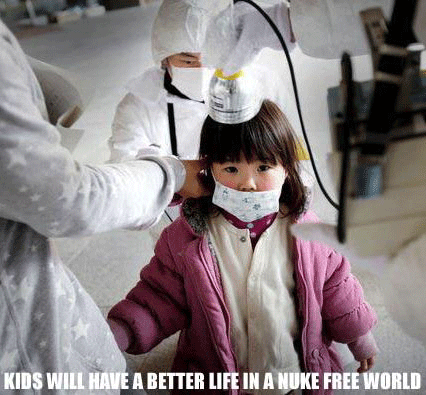 Kids’ safety key worry in Fukushima,Japan Times, Attendees of latest public hearing on energy fear low-level radiation, By NATSUKO FUKUE, 3 Aug 12, FUKUSHIMA — A year and half after the start of the nuclear crisis, many who attended the government’s latest public hearing on energy policy in Fukushima on Wednesday still expressed concern about the impact of radiation on their children……what concerns many parents in Fukushima is their children’s exposure to low levels of radiation…..
A 50-year-old woman living in Koriyama, Fukushima Prefecture, told The Japan Times after the public hearing that she fears young people will be harmed by the radiation, and that discrimination against Fukushima residents will continue.
“I’ve tried to prepare myself mentally for the discrimination my son may face when he looks for a job or when he gets married, just because he was in Fukushima last March,” said the woman, who withheld her name. Continue reading
Decentralised solar power made poor Indian villagers the winners!
 Solar Power Helped Keep the Lights On in India By David Biello | August 1, 2012 Every day, at least 400 million Indians lack access to electricity. Another nearly 700 million Indians joined their fellows inenergy poverty over the course of the last few days, or roughly 10 percent of the world’s population.
Oddly enough, some of the formerly energy poor—rural villagers throughout the subcontinent—found themselves better off than their middle-class compatriots during the recent blackouts, thanks to village homes outfitted with photovoltaic panels. In fact, solar power helped keep some electric pumps supplying water for fields parched by an erratic monsoon this year.
That monsoon is partly to blame for the blackouts as well. A lack of rain has meant a reduction in power from India’s hydroelectric dams. Pair that with problems with the supply of coal to burn and the northern half of India found itself with not enough electricity supply to meet demand. One ironic anecdote illustrates this conundrum nicely: coal miners in northern India were trapped when their electric lifts failed as a result of the blackout exacerbated by a lack of coal….. http://blogs.scientificamerican.com/observations/2012/08/01/solar-power-kept-the-lights-on-in-india/
“Scrap Nuclear Power!” – Fukushima public hearing
Fukushima residents say resounding “no” to nuclear energy , Aug 1 2012
*Public hearings could affect nuclear policy decision
* Fukushima prosecutors launch probe after residents complaints
* Reactor restarts galvanise anti-nuclear movement (Adds Prosecutors
launch two probes against Tepco execs, officials)
By Kiyoshi Takenaka FUKUSHIMA, Japan, Aug 1 (Reuters) – Get out of nuclear power and do it fast, angry Fukushima residents told Japanese government officials on Wednesday at a public hearing on energy policy held in an area ravaged by a nuclear disaster that has whipped up opposition to atomic power.
The Fukushima hearing, the ninth out of 11 planned nationwide, sought to gather views on n uclear power’s role in the nation’s energy mix as the government struggles to cover a power shortfall by that could threaten economic growth….. “I want all the reactors in Japan shut
immediately and scrapped,” a grey-haired woman, who introduced herself as a farmer living 65 km (40 miles) from the Fukushima plant, said at the public hearing in the prefecture capital.
“Many people are now aware that the government’s talking of ‘no immediate risk to health’ is tantamount to ‘long-term health risk’,” she said to the applause of about 200 residents packed in a small concert hall.
Goshi Hosono, minister in charge of the response to the nuclear crisis, was heckled as he apologised for the suffering of people in Fukushima….. http://www.reuters.com/article/2012/08/01/japan-nuclear-fukushima-idUSL4E8J143E20120801
The secret, corrupt, and unaccountable face of India’s nuclear establishment
On account of the reluctance of the national media, print and electronic, to take up investigative journalism in the nuclear field , the Indian public has been deprived of a fair and full opportunity to know the true face of the Indian nuclear establishment.
Who Benefits From Nuclear Power Plants In India? By Buddhi Kota Subbarao. Ph.D. 02 August, 2012 Countercurrents.org The rest of the world is moving towards renewable energy and away from nuclear power. But India is pouring most of its energy budget into
establishing more and more nuclear power plants. It raises two compelling questions. Why is the present Union Government of India committing an enormous portion of its energy budget to imported nuclear power plants? Who benefits from these nuclear power plants?
The answers to these questions are not difficult to find. The secrecy that surrounds nuclear issues affords the Union Government to deal with vast sums of money in an easy way. Corrupt practices in the nuclear field do not get exposed as easily as in other fields. Big
money and political ambitions go hand in hand. This is one part of the answer. The other part is the way the Indian nuclear establishment functions.
Indian nuclear establishment has some unique features. Pursuit is more for administrative power and less for knowledge in science and technology. Consequently, pretence to knowledge grew over the years. Accountability is conspicuous by its absence. Mediocre results and at
times even nil results are proclaimed as outstanding achievements. The cleverness of the Indian nuclear establishment is from the way it can claim indigenous development and at the same time devise methods to import foreign technology. Continue reading
1 This Month

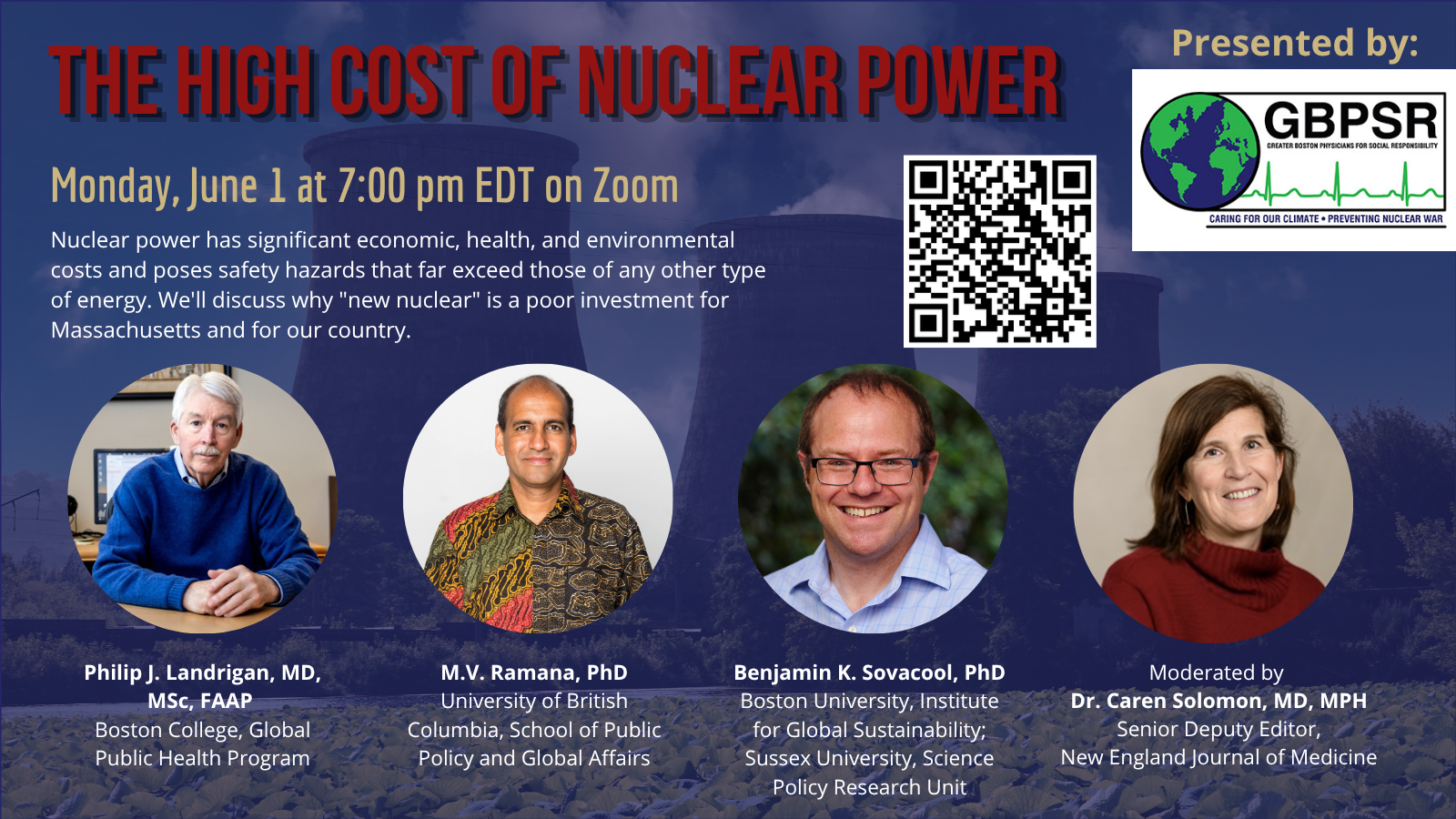
1 June Webinar – The High Cost of Nuclear Power – Register


of the week– Nuclear Reactor Information Task Force
To see nuclear-related stories in greater depth and intensity – go to https://nuclearinformation.wordpress.com
-
Archives
- May 2026 (235)
- April 2026 (356)
- March 2026 (251)
- February 2026 (268)
- January 2026 (308)
- December 2025 (358)
- November 2025 (359)
- October 2025 (376)
- September 2025 (257)
- August 2025 (319)
- July 2025 (230)
- June 2025 (348)
-
Categories
- 1
- 1 NUCLEAR ISSUES
- business and costs
- climate change
- culture and arts
- ENERGY
- environment
- health
- history
- indigenous issues
- Legal
- marketing of nuclear
- media
- opposition to nuclear
- PERSONAL STORIES
- politics
- politics international
- Religion and ethics
- safety
- secrets,lies and civil liberties
- spinbuster
- technology
- Uranium
- wastes
- weapons and war
- Women
- 2 WORLD
- ACTION
- AFRICA
- Atrocities
- AUSTRALIA
- Christina's notes
- Christina's themes
- culture and arts
- Events
- Fuk 2022
- Fuk 2023
- Fukushima 2017
- Fukushima 2018
- fukushima 2019
- Fukushima 2020
- Fukushima 2021
- general
- global warming
- Humour (God we need it)
- Nuclear
- RARE EARTHS
- Reference
- resources – print
- Resources -audiovicual
- Weekly Newsletter
- World
- World Nuclear
- YouTube
-
RSS
Entries RSS
Comments RSS
 nuclear-news