Japan’s nuclear lobby trying to keep nuclear power off the election topics
Japanese Professor: All the nuclear interests want to do is avoid making nuclear power a central election issue — Gundersen: Gov’t trying to frighten public http://enenews.com/japanese-professor-all-the-nuclear-interests-want-to-do-is-avoid-making-nuclear-power-a-central-election-issue-gundersen-govt-trying-to-frighten-public
September 6th, 2012
By ENENews Title: Japan stresses cost of ending nuclear power as decision loomsSource: REUTERSAuthors: Linda Sieg and Aaron Sheldrick; Additional reporting by Risa Maeda, Kentao Hamada and Tetsushi Kajimoto; Editing by Robert Birsel
…..a forecast [by Japan’s government said] that household energy bills would by 2030 rise by nearly double 2010 levels if Japan abandoned nuclear power.
But that has been disputed. Continue reading
Five years or more before Fukushima nuclear plant safe enough to fully investigate
Suicide bombers aimed for Pakistan nuclear plant

 Three would-be nuclear power plant assaulters killed in Bhakkar blast: Police http://tribune.com.pk/story/432428/3-killed-as-explosives-go-off-in-bhakkar-house/ By Owais Jafri September 6, 2012 PUNJAB: Police recovered bodies of three suicide bombers from a building near the border of Bhakkar district about 30km away from a nuclear plant in Garot, Khushab district on Thursday. The men, DPO Saifullah Khan Khattak said were terrorists and were planning to attack the nuclear plant.
The bodies were recovered from a devastated building next to a mosque in the village 46 D/B of Ali Khel area near the Bhakkar border. The area is deserted and the mosque and the building served as temporary residence for travellers.
Police officials estimated that the terrorists may have had more companions who had left the area before the police arrived as footprints of more than 12 people along with tracks of heavy vehicles could be seen at the site of the incident.
Police had arrived at the spot almost 11 hours after there were reports of a blast and had initially denied the reports. They had blamed the media for propagating terror in the area, but later confirmed the blast.
According to details, the terrorists were killed when three suicide jackets, each carrying 0.5 kg of explosives, went off as they were planning to leave their temporary residence.
Police have identified two of the terrorists as Mawia Tariq and Omar Irfan, both belonging to Mandi Bahauddin, and have shifted the bodies to DHQ Bhakkar for post mortem.
Investigations are under way to trace the companions of the terrorists and security has been tightened at all entrances of Bhakkar and Khoshab.
Earlier, intelligence reports had suggested that the Taliban were planning an assault on the nuclear power plant in Khushab, following which security around the plant had been beefed up.
The very real threat of nuclear terrorism in Pakistan
Nuclear safety http://tribune.com.pk/story/432507/nuclear-safety/ The Express Tribune, September 7th, 2012. The scenario drawn up by think-tanks in the US, of Pakistan’s nuclear weapons falling into militant hands, may just be more real than we think. This, of course, is a terrifying thought. So far, the possibility of such an event has been dismissed at home — but the high-level security alert put in place around Dera Ghazi Khan and the large-scale nuclear facility there, engaged mainly in mining and processing uranium, should force us to think otherwise.
The local police chief of Dera Ghazi Khan, Chaudhry Saleem, has confirmed that a heavy contingent of police and army personnel has been placed around the facility after the ISI intercepted a telephone call suggesting an attack was planned on the site housing nuclear material. Experts point out that these kinds of conversations picked up by intelligence agencies have proved to be accurate in the past.
It is also a fact that just weeks ago, a daring attack was made on the Kamra air base, which also houses our nuclear assets. The ability of the militants to enter high-security facilities is terrifying. It appears that in the latest case, the attacks are intended to act as revenge for the death of Abdul Ghaffar Qaisarani, killed in an encounter with the Dera Ghazi Khan police some time ago. Information about Qaisarani’s whereabouts had apparently come after the capture of other terrorists.
What is alarming, though, is the fact that key nuclear installations are becoming definite targets of the Tehreek-e-Taliban Pakistan (TTP). Despite the death of Qaisarani, which weakened the TTP considerably in the area, it is said to have been able to regroup, and in some parts of southern Punjab, is stated to be growing stronger and more dangerous. This also raises questions about why more action was not taken in the past to defeat the TTP in Punjab and prevent the southern part of the province from becoming what many say is a safe haven for militants — no less so than the tribal areas in the north. It has become essential that we deal with the pockets where extremist groups gather. The possibility of nuclear weapons somehow falling into their hands is one we simply cannot afford. We appear to be getting closer to this horrific reality by the day.
Lynas rare earths gets temporary license, but strong opposition persists
 Protests Promised Over License for Malaysia Rare Earth Plant NYT, By LIZ GOOCH KUALA , 6 Sept, LUMPUR — Activists who have waged a lengthy campaign against a rare earth refinery in Malaysia refused to back down Thursday after the authorities gave the Australian company behind the project the green light to proceed.
One group has vowed to blockade the port in the Malaysian town of Kuantan, near the plant, if the company, Lynas, tries to import raw earth materials from Australia.
“We are prepared to paralyze the whole port until the raw materials leave our port,” said Wong Tack, chairman of the group, Himpunan Hijau. “The world will witness one of the biggest civil disobedience events in this nation.”…. Lynas said that it would address the “principal cause of the community anxiety” — what to do with the radioactive byproducts from the plant — by turning the material into “processed co-products” for use mainly in manufacturing, like materials for roads and buildings. The materials would be exported, the company said. The company’s statement did not say to which countries it might export the products……
activists are not satisfied that the plant, estimated to cost 2.5 billion ringgit, or $802 million, will be safe.
“We will not allow an ounce of raw material to reach our shores,” said Mr. Wong, adding that Himpunan Hijau would recruit “thousands of people” to block the port 24 hours a day when the raw earth material arrived.
“We need to send the strongest warning to Lynas — don’t even dream about operation. This is an all-out war,” he said.
Another group, Save Malaysia Stop Lynas, said it was considering filing for a court injunction to try to stop the plant from operating.
Tan Bun Teet, the group’s chairman, said Save Malaysia Stop Lynas had already obtained leave from the courts for a judicial review of both the Atomic Energy Licensing Board’s approval of the temporary operating license and of the decision by the minister of science, technology and innovation not to revoke the license.
He insisted that the board should have waited for the outcome of those judicial reviews before issuing the license…… The committee’s findings — that Lynas should receive the license because it had fulfilled legal provisions and standards more stringent than international standards — were dismissed by activists who claimed the committee was an attempt to “whitewash” the issue. http://www.nytimes.com/2012/09/07/business/global/protests-promised-over-license-for-malaysia-rare-earth-plant.html?_r=1
Serious threat to Pakistan nuclear facility from Taliban
 Sources in the military and Punjab Police, on condition of anonymity, told The Express Tribune that the nature of threat at the nuclear installation is ‘serious,’ with an 80% chance of occurrence.
Taliban threat; nuclear site in D G Khan cordoned off, Express Tribune, Pakistan,By Abdul Manan : September 6, 2012, LAHORE: It could be the first-ever security threat to a nuclear facility in Pakistan, and the Army and security forces are taking no risks.
Following ‘serious’ security threats from the homegrown Taliban, the Army and Punjab police have deployed heavy forces at one of Pakistan’s largest nuclear facilities in Dera Ghazi Khan (DG Khan), credible sources told The Express Tribune.
Besides the deployment inside and around the nuclear installation, three divisions in South Punjab have also been asked to launch a crackdown against banned outfits, sources added.
“DG Khan houses one of the largest nuclear facilities in the country, and has faced the first-ever serious security threat from the Tehreek-e-Taliban Pakistan (TTP),” said a high ranking military officer currently serving at the installation.
According to an official who works at the Pakistan Atomic Energy Commission, a key military and civilian fuel cycle site is located 40 kilometres from DG Khan. The site comprises uranium milling and mining operations, and a uranium hexaflouride conversion plant. Continue reading
No radiation dose records kept for over 3,000 Fukushima cleanup workers
 Over 3,000 workers at Fukushima Daiichi have no dosimetry records
http://enformable.com/2012/09/over-3000-workers-at-fukushima-daiichi-have-no-dosimetry-records/ 5 Sept 12, Some 3,077 workers at TEPCO’s crippled Fukushima Daiichi nuclear power plant have no records of the radiation levels that they may have been exposed to during the first 3 weeks of the nuclear disaster. These workers were dispatched in work groups, with only representatives of the entire group wearing dosimeters.
Earlier this summer, it was discovered that other workers had covered their dosimeters with lead shields to lower their recorded radiation exposures in order to not exceed the national limits. Source: JiJi Press
Confusion in Aomori Prefecture about importing radioactive waste
 Aomori Pref. mulling rejecting nuclear waste The Yomiuri Shimbun , 6 Sept 12, AOMORI—The Aomori prefectural government is considering refusing to accept highly radioactive
  waste scheduled to be returned from reprocessing overseas if the central government abolishes its nuclear fuel cycle policy.
The prefectural government was likely prompted to act by recent moves by the central government toward abandoning nuclear power generation.
The village of Rokkasho in the prefecture is home to a spent nuclear fuel reprocessing plant that is considered to be the foundation of the nuclear fuel cycle, in which plutonium and uranium are extracted from spent fuel to be reused.
The plant has yet to begin operating, and spent nuclear fuel from the nation’s nuclear reactors are currently stored at nuclear power plants or at the Rokkasho facility. Some spent nuclear fuel is reprocessed in France and Britain. Vitrified radioactive waste, the highly radioactive waste that is produced in the reprocessing process, has been shipped from Europe to the Vitrified Waste Storage Center at the Rokkasho facility. So far, the plant has received 1,414 containers of vitrified waste, and 28 more are scheduled to be shipped from Britain in October at the earliest. Continue reading
TEPCO again alters photo of damage at nuclear reactor
Tepco Alters Again: “We replaced photo for physical protection of nuclear materials” September 5th, 2012 By ENENews FirstTepco released the badly altered photo, which was deleted and replaced with an alteration of the original alteration. Now Tepco has altered their original statement on the alterations.
Perhaps they will elaborate on what ‘nuclear materials’ are visible in that area around Unit 4, and why the materials need ‘physical protection’.
Source: TOKYO ELECTRIC POWER COMPANY – Photos and Videos Library
Date: September 4, 2012…… http://enenews.com/tepco-admits-we-replaced-photo-for-physical-protection-of-nuclear-materials
Photo tampered with by TEPCO to minimise damage at Fukushima Unit 4
Report: Tepco reveals damage to Unit 4 near ‘photoshopped’ area (PHOTO)  http://enenews.com/report-tepco-reveals-damage-to-area-near-photoshopped-location-at-fukushima-unit-4-photo September 5th, 2012 By ENENews Title: TEPCO Soundness Report On Unit 4 Admits Larger Failures Source: SimplyInfo Date: Sept 5, 2012
TEPCO released two reports in Japanese last week on order of NISA to explain the soundness of unit 4.
[…]
The new reports make some key admissions. The west and south walls are degrading and also may have been worse than TEPCO had previously admitted. Floor damage is also expanded from what was previously reported. Cracks on the inside of the west wall was also reported for the first time. It appears some of this is building degradation and some is new findings as they gain access to more areas of the building for closer inspections.
[…]
The August 2012 report in Japanese shows the west wall […] 4th floor as failed with the entire 3rd floor now failed with half of the 2nd floor now partially failed. In May 2011 the 2nd floor was assumed sound. This newly declared partially damaged area is above the garage door opening TEPCO has attempted to photoshop out of recent images.
TEPCO worried about finances with nuclear power’s uncertain future
Tepco Head Fears End of Nuclear in Japan, WSJ, By MARI IWATA, September 5, 2012, TOKYO—The new head of Japan’s biggest electric company aired concerns about the possibility that Japan could phase out nuclear power, saying such a move would necessitate a “complete” revamping of its investment and fuel-procurement plans and could be detrimental to the country’s energy security as well…..
Mr. Hirose’s comments come the week before the administration of Prime Minister Yoshihiko Noda is expected to announce a long-awaited decision on Japan’s future energy mix, following last year’s devastating accident at the Fukushima Daiichi nuclear-power plant. Continue reading
National forest site for Japan’s nuclear waste disposal
Tochigi forest eyed as N-waste disposal site http://www.yomiuri.co.jp/dy/national/T120903003600.htm4 Sept 12, Jiji Press The Environment Ministry said Monday it has selected a national forest in Yaita, Tochigi Prefecture, as a candidate site for final disposal of waste contaminated by radioactive substances from last year’s nuclear accident.
It was the first time the ministry has unveiled a candidate site for refuse incineration ash, sludge and rice straw that are tainted with radioactive substances from Tokyo Electric Power Co.’s Fukushima No. 1 nuclear power plant, which was crippled by the March 2011 earthquake and tsunami.
The ministry is also working on selecting final disposal sites in Miyagi, Ibaraki and Chiba prefectures.
The central government is required to dispose of such waste that contains radioactive cesium of more than 8,000 becquerels per kilogram under special legislation for dealing with radioactive materials from the nuclear accident. The amount of such waste is estimated to top 50,000 tons across the country. Tochigi Prefecture is projected to have about 9,000 tons.
The ministry chose the national forest in Yaita as the candidate site after considering the topography and effects on nearby areas, officials said.
The government plans to start construction there of a final disposal facility covering 3 to 4 hectares in fiscal 2013 for completion by the end of fiscal 2014.
Shut down Japan’s 2 operating reactors – call from Osaka governments
Kyodo: Gov’t calls for shut down of Japan’s only 2 operating reactors http://enenews.com/kyodo-government-calls-for-shut-down-of-japans-only-2-operating-reactors
September 4th, 2012 By ENENews
( (Subscription Only) Title: Osaka pref., city gov’ts call for halt to 2 Oi plant reactors
Source: Kyodo News
Date: September 4, 2012
The Osaka prefectural and municipal governments on Tuesday called for a halt to the operation of two reactors at the Oi power plant in Fukui Prefecture ahead of the end Friday of this summer’s more than two-month power-saving period.
[…]
Kansai Electric […] restarted the Nos. 3 and 4 reactors at the four-reactor Oi plant in July
[…]
In a joint statement adopted at their meeting on energy earlier in the day, the two local governments said the two reactors should be shut down, noting the demand-supply situation for electric power is not so tight and that many Japanese nationals now want a nuclear-free Japan.
The decision to restart the Oi reactors does not respect people’s wish for a nuclear-free Japan, it said.
Youtube: nuclear waste dump for Tochigi, Japan
 NHK – Japan proposes radioactive disposal site in Tochigi http://www.youtube.com/watch?v=5Whe6frtDdo Sep 3, 2012 by NHKReloaded NHK World News —- The Japanese government has proposed a site in Tochigi Prefecture, north of Tokyo, to dispose of radioactive waste from the accident at the Fukushima Daiichi plant. It is the first time the central government has made such a proposal to a prefectural government.
Senior Vice Environment Minister Katsuhiko Yokomitsu made the proposal to Tochigi Governor Tomikazu Fukuda on Monday.
The central government is responsible for disposing of more than 42,000 tons of radioactive ash and mud in 9 prefectures. Levels of Cesium in the waste are above the government standard of 8,000 becquerels per kilogram.
Tochigi Prefecture is already temporarily storing about 9,000 tons of radioactive waste at sewage treatment and other facilities.
The Environment Ministry says a 4-hectare national forest in Tochigi’s Yaita City is large enough for the purpose and far enough from the closest residential area and water source.
The ministry will brief people living near the site on the need and safety of the planned facility.
Continuing danger and ever escalating costs at the Chernobyl and Fukushima cleanups
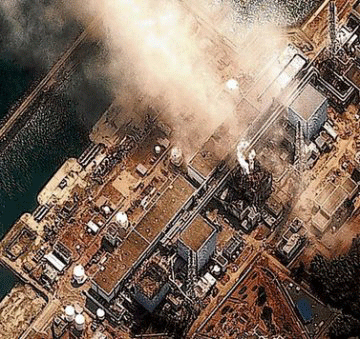 It will be especially dangerous to remove the remaining nuclear fuel because of the high levels of radiation that such substances emit.
conditions [at the Chernobyl plant] are still dangerous for the 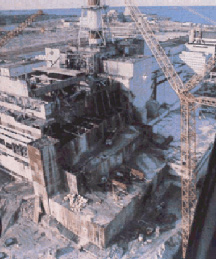 3,500 workers now cleaning up the site. And some 200 tons of nuclear fuel still remain at the bottom of the reactor.
When reactors die, costs keep climbing. Fukushima Diiachi costs to go through the roof.http://nuclearhistory.wordpress.com/2012/09/03/when-reactors-die-costs-keep-climbing-fukushima-diiachi-costs-to-go-through-the-roof/ 4 Sept 12
http://e.nikkei.com/e/fr/tnks/Nni20120815D15HH187.htm Decommissioning Of Fukushima To Be Long, Costly Process FUKUSHIMA (Nikkei)–-The government and Tokyo Electric Power Co. (9501) have made the first revisions to a plan to decommission the crippled Fukushima Daiichi nuclear power plant, but the details remain uncertain.
At the Chernobyl plant, efforts are now in full swing to build a massive shelter to stop the site from releasing radiation into the environment.
Among other matters, the revisions involve adding measures to prevent radioactive water from leaking into the environment. But it is still unclear how much time and money this will actually entail. Continue reading
1 This Month
23-25 October – on Zoom – World BEYOND War’s annual global conferenc


Shut down the radiation-damaged Heysham nuclear reactors now
To see nuclear-related stories in greater depth and intensity – go to https://nuclearinformation.wordpress.com

Say No to NASA’s Reckless Nuclear Reactor on the Moon
Say No to NASA’s Reckless Nuclear Reactor on the Moon
-
Archives
- October 2026 (190)
- September 2026 (339)
- August 2026 (330)
- July 2026 (355)
- June 2026 (287)
- May 2026 (306)
- April 2026 (356)
- March 2026 (251)
- February 2026 (267)
- January 2026 (308)
- December 2025 (358)
- November 2025 (359)
-
Categories
- 1
- 1 NUCLEAR ISSUES
- business and costs
- climate change
- culture and arts
- ENERGY
- environment
- health
- history
- indigenous issues
- Legal
- marketing of nuclear
- media
- opposition to nuclear
- PERSONAL STORIES
- politics
- politics international
- Religion and ethics
- safety
- secrets,lies and civil liberties
- spinbuster
- technology
- Uranium
- wastes
- weapons and war
- Women
- 2 WORLD
- ACTION
- AFRICA
- Atrocities
- AUSTRALIA
- Christina's notes
- Christina's themes
- culture and arts
- Events
- Fuk 2022
- Fuk 2023
- Fukushima 2017
- Fukushima 2018
- fukushima 2019
- Fukushima 2020
- Fukushima 2021
- general
- global warming
- Humour (God we need it)
- Nuclear
- RARE EARTHS
- Reference
- resources – print
- Resources -audiovicual
- Weekly Newsletter
- World
- World Nuclear
- YouTube
-
RSS
Entries RSS
Comments RSS

