AUDIO: Damaged Fukushima reactor No 3 cannot support cover
 Gundersen: Cover at Fukushima Unit 3 looks like a mall superstore — Reactor building so severely damaged it can’t support structure (AUDIO)
http://www.fairewinds.org/content/fairewinds-podcast http://enenews.com/gundersen-cover-fukushima-unit-3-looks-like-mall-superstore-reactor-building-severely-damaged-support-structure-audio November 19th, 2012
Follow-up to: Tepco to construct bulbous cover over Fukushima Daiichi Unit 3 (PHOTO)Fairewinds Podcast, Nov. 18, 2012:
Nuclear Expert Arnie Gundersen, Fairewinds Energy Education: Unit 3 is entirely different than Unit 4 […] they built something that looks like a superstore in a mall, it could easily look like a retail outlet […]
It’s not connected at all to the reactor building or the containment building […]
The real problem is Unit 3 is so severely damaged that it can’t handle the weight of the 100 ton canister, there’s no place in Unit 3 that would be strong enough to brace that heavy crane […] I think Tepco is going to say that the reactor building on Unit 3 has been so damaged that we can’t find a place to brace the heavy duty cranes, and therefore we have to span the whole structure […] Now it’s absolutely obvious that Unit 3 has been so damaged by the explosion that it can’t handle the weight of the larger cask. Now, they’re not telling people that, but clearly that’s what the drawings show.
Host Kevin Hurley: Is this going to slow down the removal of fuel?
Gundersen: Absolutely.
Former Tokyo Governor calls for nuclear weapons for Japan
 Possible kingmaker calls for nuclear-armed Japan Sunday Times Sri Lanka, 20 NOVEMBER 2012 TOKYO, (AFP) – Firebrand former Tokyo governor Shintaro Ishihara, a potential kingmaker in next month’s general election, said Tuesday Japan must acquire nuclear weapons if it wants to be taken seriously.
At very least, avowedly pacifist Japan should examine what it would need to do to join the club of declared nuclear powers, the 80-year-old arch conservative told foreign journalists in Tokyo. “I think Japan should at least carry out an analysis on going nuclear,” Ishihara said.
“The diplomatic voice of countries without nuclear weapons is overwhelmingly weak,” he said.
Ishihara has a long track record of saying controversial things and breaking cultural taboos. He has previously expressed the same thoughts on Japan — the only country on which a nuclear attack has ever taken place — getting atomic weapons.
But his comments Tuesday come just days after he was declared leader of a populist party forged ahead of the December 16 general election with the express aim of challenging the two major forces in Japanese politics.
 Next month’s poll is expected to end without a clear result, with prime minister Yoshihiko Noda’s Democratic Party of Japan (DPJ) and the main opposition Liberal Democratic Party seen likely to fall short
of a majority.
Commentators expect a period of horse trading as a coalition is forged, with Ishihara’s Japan Restoration Party (JRP) a leading contender for a post-election political marriage…….
http://www.sundaytimes.lk/index.php?option=com_content&view=article&id=27076:-possible-kingmaker-calls-for-nuclear-armed-japan&catid=81:news&Itemid=625
Podcast: Tokyo’s highly radioactive soil
 Podcast Gundersen: Tokyo soil so hot it should be sent to nuclear waste dump — Really severe releases hit city http://enenews.com/gundersen-tokyo-soil-hot-be-shipped-radioactive-dump http://www.fairewinds.com/content/fairewinds-podcast
November 19th, 2012
Fairewinds Podcast, Nov. 18, 2012:
Nuclear Expert Arnie Gundersen, Fairewinds Energy Education: : Our readers may remember when I came back from Tokyo back in February, I had 5 samples of dirt that I had taken just randomly around the city. They were all over 7,000 disintegrations per second in a two pound bag (Bq/kg). What that told me was that the releases from the accident were really severe even as far away as Tokyo. And I said then that if this were contaminated ground at a nuclear power plant it would have to be considered as nuclear waste. Well, we took a lot flack for that on the Fairewinds site, but we were right on the mark.
What happened just last week was that in a suburb of Tokyo another sample was taken by citizens and they brought it to the attention of the government that then sampled it. But basically they had a hot spot that was in excess of 10,000 disintegrations per second per kilogram of their sample. So here we are 9 months after I took my samples and citizens are still finding hot spots all over the Tokyo area. I think it speaks to one, the magnitude of the initial release. This was a serious release, not just for Fukushima Prefecture but for Tokyo and its suburbs as well. […]
So if Tokyo could be highly contaminated to the point where its soil should be shipped to a nuclear waste dump […] if Tokyo can have soil so hot that it should be shipped to a radioactive dump, what might happen to our nation’s capitol, the biggest city in the United States, or to L.A. in the event of a nuclear accident? We’re really not prepared. Our policy makers at the NRC have not even envisioned that as a possibility.
Chinese serious radiation problem, uranium ash from coal mining
The environmental hazards caused by radioactive ash has been kept quiet.
 Coal mines near uranium deposits spoiling value of nuclear fuel. Experts say many coal and uranium deposits are co-located and that extraction of the fossil fuel first is ruining the value of
  the nuclear fuel South China Morning Post, 18 November, 2012, Stephen Chen “…… And as China’s nuclear and coal sectors battle over the sites where the radioactive heavy metal lies buried, experts say the uranium is accidentally ending up in coal-fired power stations
– creating radioactive ash that is falling on surrounding cities.
One Canadian firm that declined to be interviewed has built a plant near one coal-fired power station in Yunnan to collect the uranium from the ash….. Continue reading
 Japan Experts: Contamination from Fukushima “is almost irreversible” in coastal sediments http://enenews.com/japan-experts-contamination-is-almost-irreversible-in-coastal-sediments November 17th, 2012
Title: Sedimentation and remobilization of radiocesium in the coastal area of Ibaraki, 70 km south of the Fukushima Dai-ichi Nuclear Power Plant
Authors: Shigeyoshi Otosaka and Takuya Kobayashi, Research Group for Environmental Science, Japan Atomic Energy Agency
Date: 13 November 2012
[…] it can be inferred that dissolved radiocesium advected southward from the region adjacent to the 1FNPP and was deposited to the sediment of the study area in the early stage after the accident. The incorporation of radiocesium into sediments was almost irreversible, and higher concentrations of 137Cs were obtained from the finer-grained fraction of sediments. […]
137Cs levels in sediment decreased considerably between June and August, and then remained at the same level until January 2012. This trend indicates that the initial deposition of 137Cs to the sediment had almost ceased by August, and that the incorporation of 137Cs into sediments was almost irreversible. […]
In conclusion […] it can also be inferred that the remarkable decrease in 137Cs level between June and August 2011 (Table 3) was not caused by dissolution of labile 137Cs but by a physical transport (export) of irreversibly bound 137Cs.
[…] Most of radiocesium in the coastal sediments is incorporated into lithogenic fractions, and this incorporation is almost irreversible. Accordingly, the biological availability of sedimentary radiocesium is relatively low, but continuous monitoring of radiocesium inmarine biota is highly recommended because significant amounts of radiocesium have been accumulated in the sediment.
Japan’s aging, weakening, pro nuclear lobby
 POINT OF VIEW/ Eiji Oguma: Japan’s nuclear lobby will die soon, Asahi Shimbun, 19 Nov Shizuoka’s prefectural assembly has rejected a bill to hold a public referendum that would have put the restart of the nuclear reactors in the prefecture to a yes-or-no vote. The Asahi Shimbun reported on Oct. 12 that some assembly members had yielded to pressure by labor unions
of the electric power industry.
Denryoku Soren (the Federation of Electric Power Related Industry Worker’s Unions of Japan) is believed to be able to mobilize 5,000 to 7,000 voters in Shizuoka Prefecture.
But 165,000 people signed the petition for the public referendum. So what makes 5,000 people more special than the 165,000? I believe I know what the assembly members are thinking: the 165,000 signatures are just a statistic. The politicians do not see mere names as real people. Continue reading
The India Energy [R]evolution – jobs and energy security
The India Energy [R]evolution report jointly drafted by Greenpeace, the Global Wind Energy Council (GWEC) and the European Renewable Energy Council (EREC) focuses on the socio-economic impacts of renewable energy and proposes the pathway to ensure India’s energy security in the long run.
“With consistent and long term renewable energy policy frame work, India could build up a local renewable energy industry with an annual turnover of more than-INR 54,000 crore, creating more up to 24 lakh jobs by 2020.
 Renewable energy can create more jobs: Greenpeace, Electric Light and Power, New Delhi, Nov 17 (IBNS) Replacing fossil fuel with renewable energy can create more jobs and provide cheap electricity, said environmental organization Greenpeace.
Greenpeace has launched the second version of the Indian Energy [R]evolution – a roadmap to secure India’s growing energy needs without having to depend on the depleting and polluting fossil fuels.
The roadmap comes at a critical time when the country is facing massive power shortage due to the inability of fossil fuels to meet its economic aspirations.
Future of India’s growth lies with massive expansion and deployment of renewable energy technologies through key policy reforms and significant investments, without putting any negative impact on its pristine forest and dependent marginalised communities.
The India Energy [R]evolution report jointly drafted by Greenpeace, the Global Wind Energy Council (GWEC) and the European Renewable Energy Council (EREC) focuses on the socio-economic impacts of renewable energy and proposes the pathway to ensure India’s energy
security in the long run. Continue reading
Myanmar to go “respectable” about things nuclear
Myanmar to sign new nuclear safeguards, Herald Sun, AAP November 19, 2012 MYANMAR (Burma) says it will agree to new atomic safeguards that allow inspections of suspected clandestine nuclear sites, ahead of a milestone visit by US President Barack Obama.
The news comes hours after the White House said Myanmar has taken “positive steps” to reduce its military relationship with North Korea. Myanmar was suspected of pursuing military and nuclear co-operation with Pyongyang during long years of junta rule, which ended last year.
A Myanmar government statement said the country would sign the International Atomic Energy Agency’s “additional protocol”, which grants the UN nuclear agency right of access to possible undeclared activities. President Thein Sein has approved the measure, which will now be forwarded to parliament for approval, the statement said.
Allegations of nuclear co-operation between Myanmar and North Korea have been a top concern for Washington. Thein Sein’s government has denied any covert effort to obtain nuclear weapons technology from North Korea, which is locked in a prolonged
atomic showdown with the United States…..
http://www.heraldsun.com.au/news/breaking-news/myanmar-to-sign-new-nuclear-safeguards/story-e6frf7k6-1226519238353
India’s “democracy” – no right for Kudankulam public meeting about nuclear power
 Madras HC dismisses plea for holding public meetings in Kudankulam
http://www.dnaindia.com/india/report_madras-hc-dismisses-plea-for-holding-public-meetings-in-kudankulam_1765500, Nov 16, 2012,Chennai ANI The Madras High Court on Friday dismissed petitions which sought to declare the clamping of ban orders under Section 144 (1) of CrPC in Kudankulam as null and void.
It also refused to grant permission for conducting a public meeting to highlight demands against commissioning of the nuclear power plant. Continue reading
Highly radioactive trout caught in Fukushima river
Kyodo: Radioactive trout over 100 times gov’t limit caught in Fukushima river http://enenews.com/kyodo-radioactive-trout-over-100-times-govt-limit-caught-in-fukushima-river November 16th, 2012
(Subscription Only) Title: Fukushima trout log radioactivity level over 100 times gov’t limit
Source: Kyodo
Date: Nov. 17, 2010
A mountain trout caught in a Fukushima Prefecture river [Niida River in Minamisoma city] returned a radioactive cesium reading of 11,400 becquerels per kilogram, more than 100 times the government-set limit for food items, a survey by the Environment Ministry said Friday. […]
The survey conducted in June and July also found 4,400 becquerels of radioactive cesium in a smallmouth bass and 3,000 becquerels in a catfish in Mano Dam in Iitate village, another municipality heavily affected by the crisis at the Fukushima Daiichi nuclear power plant run by Tokyo Electric Power Co. […]
See also: Asahi: Gov’t worried about highly radioactive fish — Why are radiation readings still 100s of times over official safe
Rip in lining of spent nuclear fuel pool at Fukushima Unit 3 ?
Nuclear Engineer: To me it means Tepco knows about a rip in spent fuel pool liner at Fukushima Unit 3 AUDIO http://enenews.com/nuclear-engineer-curing-material-unit-3-means-tepco-about-tear-rip-spent-fuel-pool-liner-video
November 16th, 2012 Interview with Nuclear Engineer Chris Harris
Nutrimedical Report
Nov. 15, 2012 Chris Harris, former licensed Senior Reactor Operator and engineer: One of the Tepco releases that really intrigued me was that there is something called ‘curing material’.
Now that means, to me it means they know about a tear or a rip in the spent fuel pool liner.
And they don’t come out and say — a lot of this stuff you have to read between the lines — there’s something called ‘curing material’ […] what it means to me is they tried to repair with some sort of epoxy and something that needs to cure or cure time on it before they can proceed. Which means that water’s actually being held in not by the stainless steel liner, but by the concrete structure around, that’s not really a great situation to be in.
They didn’t come flat out and say it but I’m going to stick my neck out and say if they’re trying to seal up cracks and everything else, that’s how I would do it too. And so that’s happening now, we’ll see where that comes and I’ll stay on top of it.
Follow-up to: Tepco to try and remove steel debris on top of fuel racks in No. 3 pool — Concern about liner? (PHOTOS)
Anti nuclear protest, by thousands, in South Korea
 Thousands protest at S. Korean nuclear complex
 Bangkok Post: 16/11/2012 AMOnline news: Asia Thousands of villagers staged a protest outside one of South Korea’s largest nuclear power plants Thursday, voicing growing public concern over safety standards after a series of scares and scandals. Continue reading
Radiation levels not decreasing in seas around Fukushima
Radiation Still High Around Fukushima http://www.the-scientist.com/?articles.view/articleNo/33275/title/Radiation-Still-High-Around-Fukushima/,
Continued leaks, run off from land, and contaminated sediment on the ocean floor are causing radioactivity levels to remain high in the seas around Fukushima. By Dan Cossins | November 15, 2012 Levels of radiation in the seas surrounding the ruined Fukushima Daiichi power plant in Japan are showing no signs of dropping off as expected, according to new data presented last week (November 12-13) at a conference in Tokyo. Scientists believe that continued leaks from the plant in addition to run off from contaminated land and radiation-soaked sediment on the sea floor are responsible. Continue reading
Plan to cover Fukushima Daiichi Unit 3
Tepco to construct bulbous cover over Fukushima Daiichi Unit 3 (PHOTO) http://enenews.com/tepco-construct-bulbous-cover-fukushima-unit-3-photo Enformable, Nov. 14, 2012: TEPCO has released designs for a cover to construct around the crippled Unit 3 reactor building in order to allow the utility to remove fuel rods from the spent fuel pool by crane.
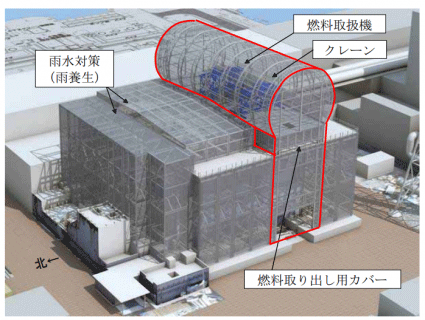
[…] The building will also house ventilation to reduce the radioactive materials being released into the atmosphere.
Low level radiation increased leukaemia risk for nuclear cleanup workers
Chernobyl study shows need for caution in Fukushima
http://www.japantimes.co.jp/text/nn20121114f2.html# UKO27Xhzxqg.twitter Kyodo A study released Thursday by a U.S. research team links protracted exposure to low-level radiation to a higher risk of leukemia among workers engaged in the cleanup of the 1986 Chernobyl nuclear disaster, and points to the need to protect those involved in dealing with the Fukushima crisis.
Continue reading
1 This Month
23-25 October – on Zoom – World BEYOND War’s annual global conferenc


Shut down the radiation-damaged Heysham nuclear reactors now
To see nuclear-related stories in greater depth and intensity – go to https://nuclearinformation.wordpress.com

Say No to NASA’s Reckless Nuclear Reactor on the Moon
Say No to NASA’s Reckless Nuclear Reactor on the Moon
-
Archives
- October 2026 (180)
- September 2026 (339)
- August 2026 (330)
- July 2026 (355)
- June 2026 (287)
- May 2026 (306)
- April 2026 (356)
- March 2026 (251)
- February 2026 (267)
- January 2026 (308)
- December 2025 (358)
- November 2025 (359)
-
Categories
- 1
- 1 NUCLEAR ISSUES
- business and costs
- climate change
- culture and arts
- ENERGY
- environment
- health
- history
- indigenous issues
- Legal
- marketing of nuclear
- media
- opposition to nuclear
- PERSONAL STORIES
- politics
- politics international
- Religion and ethics
- safety
- secrets,lies and civil liberties
- spinbuster
- technology
- Uranium
- wastes
- weapons and war
- Women
- 2 WORLD
- ACTION
- AFRICA
- Atrocities
- AUSTRALIA
- Christina's notes
- Christina's themes
- culture and arts
- Events
- Fuk 2022
- Fuk 2023
- Fukushima 2017
- Fukushima 2018
- fukushima 2019
- Fukushima 2020
- Fukushima 2021
- general
- global warming
- Humour (God we need it)
- Nuclear
- RARE EARTHS
- Reference
- resources – print
- Resources -audiovicual
- Weekly Newsletter
- World
- World Nuclear
- YouTube
-
RSS
Entries RSS
Comments RSS

