For the Pacific Ocean? – 400 tons daily of Fukushima radioactive water
 Bloomberg: Radioactive water from Fukushima reactors to be dumped in Pacific? “It’s obvious they can’t keep storing it forever”http://enenews.com/bloomberg-tepco-to-dump-radioactive-water-from-fukushima-reactors-into-pacific-its-obvious-they-cant-keep-storing-it-forever
Title:Title: Tepco Faces Decision to Dump Radioactive Water in Pacific Ocean
Source: Bloomberg
Author: Tsuyoshi Inajima
Date: Apr 11, 2013
[Tepco]’s discovery of leaks in water storage pits at the wrecked Fukushima atomic station raises the risk the utility will be forced to dump radioactive water in the Pacific Ocean.
Leaks were found in three of seven pits in the past week, reducing the options for moving contaminated water from basements of reactor buildings. […]
Not Ruled Out
Officials at the utility known as Tepco, including President Naomi Hirose, have said the company will not “easily” release radiated water into the ocean, indicating it’s not ruling out the possibility if it runs out of storage.
“It’s obvious Tepco cannot keep storing water forever as it increases by 400 tons a day,” said Hideyuki Ban, co-director of the antinuclear group Citizens’ Nuclear Information Center. That’s why the company won’t rule out discharge into the sea, Ban said in a telephone interview. […]
See also: Tepco: It’s ‘really impossible’ for us to keep storing liquid from Fukushima reactors — We need to think about discharging it into ocean (VIDEO)
Fukushima nuclear plant is NOT stable
 NYTimes: Fukushima plant unstable says official, concern another accident can’t be prevented — “Vulnerable… Very dangerous” http://enenews.com/nytimes-fukushima-plant-unstable-says-official-concern-another-accident-cant-be-prevented-vulnerable-very-dangerous April 11th, 2013
Title: Fukushima Nuclear Plant Is Still Unstable, Japanese Official Says
Source: New York Times
Author: HIROKO TABUCHI
Date: April 10, 2013
[…] a series of recent mishaps — including a blackout set off by a dead rat and the discovery of leaks of thousands of gallons of radioactive water — have underscored just how vulnerable the plant remains.
Increasingly, experts are arguing that [Tepco] cannot be trusted to lead what is expected to be decades of cleanup and the decommissioning of the plant’s reactors without putting the public, and the environment, at risk. […]
“It’s become obvious that Tepco is not at all capable of leading the cleanup. It just doesn’t have the expertise, and because Fukushima Daiichi is never going to generate electricity again, every yen it spends on the decommissioning is thrown away. That creates an incentive to cut corners, which is very dangerous. The government needs to step in, take charge and assemble experts and technology from around the world to handle the decommissioning instead.” -Muneo Morokuzu, a nuclear safety expert at the Tokyo University Graduate School of Public Policy
“The Fukushima Daiichi plant remains in an unstable condition, and there is concern that we cannot prevent another accident.” -Shunichi Tanaka, chairman of Japan’s Nuclear Regulation Authority
See also: Tepco: “Losing faith” in leaking Fukushima tanks — But we don’t have anywhere else to put the radioactive water
World ignores Fukushima radiation at our peril
 Fukushima is currently releasing up to 93 billion becquerels of radioactive cesium into the ocean each day. How much radiation is that? A quick calculation shows that Chernobyl released around ten thousand times more radioactive cesium each day during the reactor fire. But the Chernobyl fire only lasted 10 days … and the Fukushima release has been ongoing for more than 2 years so far.
Indeed, Fukushima has already spewed much more radioactive cesium and iodine 131 than Chernobyl. The amount of radioactive cesium released by Fukushima was some 20-30 times higher than initially admitted.
Fukushima also pumped out huge amounts of radioactive iodine 129 – which has a half-life of 15.7 million years.
Fukushima has also dumped up to 900 trillion becquerels of radioactive strontium-90 – which is a powerful internal emitter which mimics calcium and collects in our bones – into the ocean..
Radiation Is Not On People’s Radar, Dr. Mark Sircus, Activist Post, 9 April 13, In publishing Atomic Suicide Drs. Walter and Lao Russell united with Dr. Albert Schweitzer’s 1957 appeal to the world to end nuclear tests, and in fact any and all use of radioactive elements. In this prophetic book, the Russells explain clearly that with radioactive elements unleashed into our atmosphere, the human race is heading for catastrophe. Giving detailed scientific evidence, they warn that ‘to fail to consider the nature of radioactive elements and their consequences would be a folly for which humanity would have to pay a terrible price.’ Continue reading
USA and Europe not too worried over North Korea’s nuclear threats
Allies dismiss North Korea’s nuclear war threats Radio Australia, 10 April 2013, By Brendan Trembath, The White House and the European Union dismiss North Korea’s claim war is imminent and call on the rogue state to act sensibly.Both the White House and the European Union have described North Korea’s warnings of “thermo-nuclear war” on the Korean peninsula as “unhelpful rhetoric”.
North Korea has told foreign companies, organisations and tourists in South Korea to consider leaving for their own safety.
Warning that events were “inching closer to thermo-nuclear war”, the North’s official news agency said it did not want foreigners to come to harm if war breaks out.
White House spokesman Jay Carney labelled that statement unhelpful, and said it would only serve to “further isolate North Korea”.
European Union delegates meeting in Brussels have drawn up a response to the North Korean warnings, saying it is wrong to proclaim that war is imminent and Pyongyang should heed international demands regarding its nuclear and ballistic missile programs.
The EU’s note, agreed by the bloc’s 27 member governments on Tuesday, is a response to a warning by North Korea last week that it could not guarantee the safety of diplomats in the country after April 10. An EU diplomat said the note underlined the need for North Korea to act sensibly and rejected “its analysis that full-scale war is imminent”. ….
Japan readies missiles Meanwhile, Japan says it has deployed missile interceptors to the centre of Tokyo and will use them to shoot down any missile heading towards its airspace…..http://www.radioaustralia.net.au/international/2013-04-10/allies-dismiss-north-koreas-nuclear-war-threats/1113858
Fukushima’s radioactive water problem – still unmanageable
Japan Plant Forced to Move Tainted Water, WSJ, 10 April 13 Disclosure of Plan to Close Massive Storage Pools Over Leaks Is Latest Problem at Nuclear Facility, Rousing Safety Fears TOKYO—The operator of the Fukushima Daiichi nuclear-power plant on Wednesday said it has to move tens of thousands of tons of radioactive water out of leaky underground reservoirs—the latest in a string of problems and missteps that has spurred a rebuke from regulators and amplified fears that the heavily damaged plant isn’t fully under control.
Tokyo Electric Power Co. 9501.TO +9.47% said it would abandon seven massive underground storage pools where it had been keeping 26,600 tons of contaminated water, after finding that three of the pools had likely sprung leaks.
The discovery of those leaks, which Tepco estimates have spilled more than a hundred tons of radioactive water into the ground, came less than a month after a power outage shut a cooling system for used nuclear fuel, and a few days before two underwater barriers separating the most contaminated parts of the plant from the sea were found to have split….. Continue reading
Japan’s oversight of Fukushima radiation too lax: public concern about food
Japan nuclear safety plans too lax for crowded, quake-prone nation, say nuclear experts The Star, By: Mari Yamaguchi The Associated Press, Apr 08 2013 TOKYO—Experts who investigated Japan’s nuclear crisis said Monday that government oversight of the crippled plant’s operator is still too lax, as public concern has grown over recent safety problems.
A power failure last month caused by a rat that short-circuited a switchboard left the Fukushima Dai-ichi nuclear plant’s fuel storage pools without cooling water for more than a day. Last Friday another cooling failure occurred, and hours later the operator reported a large leak of radioactive water from underground tanks.
The plant’s operator, Tokyo Electric Power Co., revealed Saturday that up to 120 tons of highly contaminated water escaped from a temporary underground tank and a smaller amount from another tank. TEPCO said it believes the water has not flowed into the ocean.
Regulators asked TEPCO on Monday to determine the cause and contain the problem quickly.
But the investigators told parliament on Monday that the recently formed Nuclear Regulation Authority is merely rubber-stamping TEPCO’s work at the plant, Continue reading
Fukushima radiation levels rise in rivers, in food 225 miles away
 Deadly levels of radiation found in food 225 miles from Fukushima: Media blackout on nuclear fallout continues
http://thewatchers.adorraeli.com/2013/04/08/deadly-levels-of-radiation-found-in-food-225-miles-from-fukushima-media-blackout-on-nuclear-fallout-continues/ – Source: NaturalNews By Ethan A. HuffAPRIL 8, 2013 NEW DATA  RELEASED BY JAPAN’S MINISTRY OF HEALTH, LABOR AND WELFARE (MHLW) SHOWS ONCE AGAIN THAT THE FUKUSHIMA DAIICHI NUCLEAR DISASTER IS FAR FROM OVER. DESPITE A COMPLETE MEDIA BLACKOUT ON THE CURRENT SITUATION, LEVELS OF CESIUM-137 (CS-137) AND CESIUM-134 (CS-134) FOUND IN PRODUCE AND RICE CRACKERS LOCATED ROUGHLY 225 MILES (~ 362 KM) AWAY FROM FUKUSHIMA ARE HIGH ENOUGH TO CAUSE RESIDENTS TO EXCEED THE ANNUAL RADIATION EXPOSURE LIMIT IN JUST A FEW MONTHS, OR EVEN WEEKS. Continue reading
TEPCO on a tightrope in attempt to move tons of radioactive water
Japan nuclear safety plans too lax for crowded, quake-prone nation, say nuclear experts The Star, By: Mari Yamaguchi The Associated Press,Apr 08 2013 TOKYO
“…….TEPCO is moving tons of highly radioactive water from the temporary tanks to two similar ones nearby to minimize the leak. They are among seven underground tanks of different sizes which employ the same design.
TEPCO admitted Sunday it had dismissed earlier signs of water loss as within a margin of error and waited until a spike in radiation levels around the tanks was detected. Critics suspect cash-strapped TEPCO built poorly designed underground pits instead of safer and more manageable steel tanks to save money. TEPCO has also been criticized for delaying replacement of makeshift equipment, raising questions about whether the plant is really under control.
The underground tanks, several times the size of an Olympic swimming pool and similar to an industrial waste dump, are dug directly into the ground and protected by double-layer polyethylene linings inside an outermost clay-based lining, with a felt padding between each layer. Officials suspect there were ruptures in the linings due to the weight of the water.
Contaminated water at the plant, which suffered multiple meltdowns after the 2011 disaster, has escaped into the sea several times during the crisis. Experts suspect a continuous leak into the ocean through an underground water system, citing high levels of contamination in fish caught in waters just off the plant.
The contaminated water in the tanks is part of more than 270,000 tons of water used to cool melted fuel at the plant’s reactors damaged in the disaster. So much water has been used that TEPCO is struggling to find storage space. The water is also kept in hundreds of steel tanks.
NRA commissioner Toyoshi Fuketa told reporters Monday that the water leak poses a more immediate threat to the plant’s water management than to the environment. He questioned TEPCO’s risk evaluation in the tanks’ design process, but acknowledged that regulators have to allow TEPCO to use the remaining underground tanks for now.
“Although we need more long-term plans, we have to tackle the most immediate problem first. TEPCO’s decommissioning process is a tightrope situation to begin with,” he said. http://www.thestar.com/news/world/2013/04/08/japan_nuclear_safety_plans_too_lax_for_crowded_quakeprone_nation_say_nuclear_experts.html
North Korea not in a position for nuclear strike to reach USA
 North Korea lacks means for nuclear strike on US, experts say WASHINGTON (Reuters) 8 Apr 13—North Korea’s explicit threats to strike the United States with nuclear weapons are rhetorical bluster, as the isolated nation does not yet have the means to make good on them, Western officials and security experts say.
Pyongyang has slowly and steadily improved its missile capabilities in recent years and U.S. officials say its missiles may be capable of hitting outlying U.S. territories and states, including Guam, Alaska and Hawaii. Some private experts say even this view is alarmist. There is no evidence, the officials say, that North Korea has tested the complex art of miniaturizing a nuclear weapon to be placed on a long-range missile, a capability the United States, Russia, China and others achieved decades ago.
In other words, North Korea might be able to hit some part of the United States, but not the mainland and not with a nuclear weapon. Continue reading
Another water storage tank leaking at Fukushima Daiichi power plant
Second leak detected at Fukushima nuclear plant Reuters | Apr 8, 2013, TOKYO: Radioactive water has apparently leaked from another underground storage tank at the crippled Fukushima Daiichi power plant, Tokyo Electric Power Co (Tepco) said on Sunday.
The volume of the latest leakage was believed to be small, it said. On Saturday, it said as much as 120 tonnes of radioactive water may have %leaked from another nearby storage tank.
The plant’s seven storage tanks are lined with water proof sheets meant to keep the contaminated water from leaking into the soil.The power company has faced a range of problems with leaks and with the plant’s cooling system.
Tepco said on Friday it lost the ability to cool radioactive fuel rods in one of the plant’s reactors for about three hours, the second cooling system failure at the plant in three weeks.
Nuclear fuel, even after use, has to be kept cool to prevent it from overheating and beginning a self-sustaining atomic reaction that could lead to meltdown http://timesofindia.indiatimes.com/world/rest-of-world/Second-leak-detected-at-Fukushima-nuclear-plant/articleshow/19435752.cms
Fukushima Daiichi tank leaks 120 tons of radioactive water
Kyodo: Radioactive leak is up to 120 tons from Fukushima Daiichi tank http://enenews.com/kyodo-radioactive-leak-is-up-to-120-tons-from-fukushima-daiichi-tank-video 7 April 13
Kyodo News April 6, 2013: Tokyo Electric Power Co. said Friday that up to 120 tons of contaminated water may have leaked into soil from one of the seven underground reservoir tanks at the crippled Fukushima Daiichi nuclear power plant. Around 13,000 cubic meters of contaminated water remain in the tank, with TEPCO having begun transferring it to other tanks nearby on Saturday morning, the utility said. It will take roughly two weeks to complete the transfer, TEPCO added. […]
NHK WORLD English: Tokyo Electric Power Company says a small amount of radioactive water may have seeped out of an underground water storage facility at the Fukushima Daiichi nuclear power plant. The water contained strontium. […] The level of radioactivity is considered by the utility to be low. […] The utility recently constructed 7 large-scale underground facilities for storing the water after removing some radioactive substances. Each facility can accommodate up to 14,000 tons of water. […]
RIA Novosti: : The company operating the disaster-hit Fukushima Daiichi nuclear power plant (NPP) in northern Japan warned about the possibility of radioactive water leak, the Kyodo news agency reported on Friday. […] Radioactive substances have been detected in the water that accumulated outside the tank, covered by three layers of waterproof sheets. The exact volume of leak is unknown, but radiation levels in the water stand at about 6,000 Becquerel per cubic centimeter. […]
North Korea’s longstanding fear of a USA nuclear attack
as more nations like North Korea obtain nuclear weapons, and as the US struggles to keep a credible nuclear umbrella over its allies from Asia to Europe to the Middle East, the world needs to find a replacement for the current system of maintaining stability based on the mutual fear of nuclear war.
North Korea’s threats show just how urgent that need is.
North Korea Has Feared An American Nuclear Attack For Decades http://au.businessinsider.com/north-korea-has-feared-an-american-nuclear-attack-for-decades-2013-4 THE CHRISTIAN SCIENCE MONITORTODAY THOSE AMERICANS WHO MAY BE FEARFUL OF NORTH KOREA‘S VERBAL THREATS AND ITS MISSILE-LAUNCH PREPARATIONS SHOULD TAKE NOTE: ITS LEADERS HAVE LONG EXPRESSED A FEAR OF AN AMERICAN NUCLEAR ATTACK.
 As historian Ward Wilson points out in a new book, “Five Myths About Nuclear Weapons,” atomic bombs “were born out of fear, nurtured in and sustained by fear.” Their power to devastate requires a mutual fear to avoid their use.
The current escalation of threats between the US and North Korea illustrates how this reliance on fear can falter. Nations that rely on maximizing fear as a primary tool for defence will find the emotion very difficult to manage in all cases.
The North’s threats, for example, have now led South Korea to consider ending its ban on developing its own nuclear weapons. It is asking for US support to start a nuclear program.
Many in Seoul, South Korea, see the American people as too weary for war and the Obama administration as too eager to reduce the US nuclear arsenal unilaterally. They fear that the American “nuclear umbrella,” which has protected South Korea for 60 years, may no longer be credible enough to deter North Korea from either launching nuclear weapons or using them as blackmail.
MONITOR’S VIEW: Cyberattack on South Korea needs constructive responseFor two decades, the US has tried to talk down North Korea from possessing nuclear weapons by offering hope in place of fear. It tried to convince Pyongyang that the US was not a threat while offering its food aid and oil supplies in return for nuclear disarmament. It hasn’t worked, despite some limited help from China.
Similar persuasion is now being tried on Iran: Give up your nuclear ambitions and instead become a regional power through the strength of your economy, ideas, and culture. In other words, replace the fear that looks to nuclear power for comfort and instead build up your nation’s “soft power.”
President Obama, who came into office with the goal of eliminating the world’s nuclear weapons, has had a difficult time making his case. Instead, he has to now send B-2 bombers near North Korea to assure South Korea of the US nuclear umbrella and as a threat to North Korea. The tit-for-tat of fear only keeps rising.
MONITOR’S VIEW: In Obama trip to Israel, signs of US redirectionHis recent trip to Israel was designed in part to persuade Iran to cease its uranium enrichment. His visit was an attempt to reinforce faith in the US nuclear umbrella for the region, especially Israel. But as with North Korea, the logic of deterrence assumes that the leaders in Iran will be both fearful and rational.
In the past few decades, a dozen countries have given up their nuclear programs or handed over nuclear weapons on their soil. After the breakup of the Soviet Union in 1991, for example,Kazakhstan cooperated with Russia and the US to hand over the weapons in its possession. Most of those nations chose to seek safety in being a nation of peace, goodwill, and prosperity while also relying on an international system that depends to a large degree on the US maintaining it.
And most nations abide by international agreements banning the use of chemical and biological weapons. Fear of those weapons has been largely contained.
Yet as more nations like North Korea obtain nuclear weapons, and as the US struggles to keep a credible nuclear umbrella over its allies from Asia to Europe to the Middle East, the world needs to find a replacement for the current system of maintaining stability based on the mutual fear of nuclear war.
North Korea’s threats show just how urgent that need is.
The North Korean situation – a dangerous game for the West
Kim is simply too new and untested for us to know if he has the self-awareness to avoid inadvertently killing himself. But squeezing him into submission without the costs and casualties of a war will require China’s help
From China’s perspective, even if Kim is losing control of the situation, he has not lost it yet, and so China considers anything short of that to be alarmist. As long as North Korea is not threatening Beijing, this is a prisoners’ dilemma we will be facing on our own
 NORTH KOREA’S NUCLEAR GAME THEORY, New Yorker BY EVAN OSNO, 5 April 13, Foreign diplomats in Pyongyang are facing an absurd choice: Kim Jong-un’s government issued a formal diplomatic warning today that it would be “unable to guarantee the safety of embassies and international organizations in the country in the event of conflict from April 10.”
A few questions come to mind, including but not limited to: Any plans for April 11th that we might want to jot down? And: Is this warning an actual expression of concern, or a way of letting foreign embassies take on the role of ramping up Kim’s threats now that his own propaganda machine is getting diminishing returns? And lastly, and most fundamentally: How realistic is it to imagine a cascade of blunders that lead to a nuclear strike? Continue reading
Failure of Fukushima cooling system due to rat risk
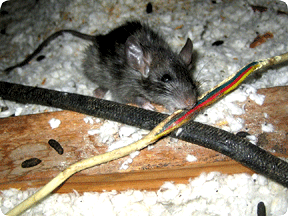 “We were installing wire nets to keep the rats out. But the end of one of the wires may have momentarily come into contact with a live terminal,” said Masayuki Ono, general manager at Tepco’s Nuclear Power and Plant Siting Division. “The next moment, there were sirens.”
Rat Chase Again Bedevils Fukushima Nuclear Plant http://www.nytimes.com/2013/04/06/world/asia/rat-chase-again-bedevils-fukushima-nuclear-plant.html?_r=0 By HIROKO TABUCHI April 5, 2013 TOKYO — Workers at the stricken Fukushima nuclear power plant who were installing wire nets Friday to keep rats away from a vital cooling system instead tripped up that system, causing it to fail for the second time in weeks. The spent-fuel pool at the site’s No. 3 reactor went without fresh cooling water for almost three hours on Friday afternoon, said the plant’s operator, the Tokyo Electric Power Company, or Tepco. Continue reading
North Korea’s missile movement is not targeting USA
Defense chief says North’s missile movement not aimed at U.S. mainland By Kim Eun-jung SEOUL, April 4 (Yonhap) — South Korean Defense Minister Kim Kwan-jin said Thursday that North Korea has moved an intermediate-range missile to its east coast for an imminent test firing or military drill, but it does not seem to be aimed at striking the U.S. mainland.Without specifying the type of missile, Kim said it is believed to be able to reach a “considerable distance,” though it is not able to strike the U.S. mainland.
“The missile does not seem to be aimed at the U.S. mainland,” Kim told lawmakers. “It could be aimed at test firing or military drills.” Although there is slim chance that Pyongyang’s harsh rhetoric could lead to a full-scale war, Kim said the North could launch other forms of provocations, including border clashes and cyber attacks.
“Our military has upgraded several systems and carried out drills under upgraded military readiness status,” Kim said.
According to intelligence analysis by South Korean and U.S. forces, it is believed to be a Musudan missile, which is estimated to have a range of 3,000-4,000 km, putting the U.S. base in Guam within striking….. http://english.yonhapnews.co.kr/national/2013/04/04/96/0301000000AEN20130404009251315F.HTML
1 This Month
23-25 October – on Zoom – World BEYOND War’s annual global conferenc


Shut down the radiation-damaged Heysham nuclear reactors now
To see nuclear-related stories in greater depth and intensity – go to https://nuclearinformation.wordpress.com

Say No to NASA’s Reckless Nuclear Reactor on the Moon
Say No to NASA’s Reckless Nuclear Reactor on the Moon
-
Archives
- October 2026 (170)
- September 2026 (339)
- August 2026 (330)
- July 2026 (355)
- June 2026 (287)
- May 2026 (306)
- April 2026 (356)
- March 2026 (251)
- February 2026 (267)
- January 2026 (308)
- December 2025 (358)
- November 2025 (359)
-
Categories
- 1
- 1 NUCLEAR ISSUES
- business and costs
- climate change
- culture and arts
- ENERGY
- environment
- health
- history
- indigenous issues
- Legal
- marketing of nuclear
- media
- opposition to nuclear
- PERSONAL STORIES
- politics
- politics international
- Religion and ethics
- safety
- secrets,lies and civil liberties
- spinbuster
- technology
- Uranium
- wastes
- weapons and war
- Women
- 2 WORLD
- ACTION
- AFRICA
- Atrocities
- AUSTRALIA
- Christina's notes
- Christina's themes
- culture and arts
- Events
- Fuk 2022
- Fuk 2023
- Fukushima 2017
- Fukushima 2018
- fukushima 2019
- Fukushima 2020
- Fukushima 2021
- general
- global warming
- Humour (God we need it)
- Nuclear
- RARE EARTHS
- Reference
- resources – print
- Resources -audiovicual
- Weekly Newsletter
- World
- World Nuclear
- YouTube
-
RSS
Entries RSS
Comments RSS

