China to reimpose ban on Japanese seafood imports amid row over Taiwan, reports say
Japan Times, By Jesse Johnson, STAFF WRITER, Nov 19, 2025
China will reimpose a ban on imports of Japanese seafood products, media reports said Wednesday, as the diplomatic row over Prime Minister Sanae Takaichi’s recent comments on Taiwan escalated and officials girded for a prolonged dispute.
The ban would effectively be a return to one put in place in August 2023, following Japan’s release of treated wastewater from the Fukushima No. 1 nuclear power plant. Tokyo and Beijing reached an agreement in September last year to resume imports, with Japan confirming the first shipment of seafood to China less than two weeks ago.
NHK said China had explained that the ban was necessary in order to monitor the wastewater being released from the No. 1 plant, with the import halt lasting “for the foreseeable future.”…………………………………………… https://www.japantimes.co.jp/news/2025/11/19/japan/politics/japan-china-relations-marine-products/
US to Own Nuclear Reactors Stemming From Japan’s $550 Billion Pledge.
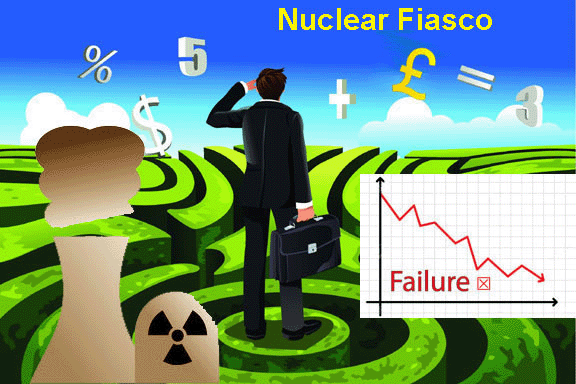
The US government plans to buy and own as many as 10 new, large nuclear reactors that could be paid for using Japan’s $550 billion funding
pledge, part of a push to meet surging demand for electricity. The new
details of the unusual arrangement were outlined Wednesday by Carl Coe, the Energy Department’s chief of staff, about the non-binding commitment made by Japan in October to fund $550 billion in US projects, including as much as $80 billion for the construction of new reactors made by Westinghouse Electric Co.
Bloomberg 19th Nov 2025,
https://www.bloomberg.com/news/articles/2025-11-19/us-to-own-reactors-stemming-from-japan-s-550-billion-pledge
North Korea says Seoul-US submarine deal will trigger ‘nuclear domino’ effect
Daily Mail. By AFP, 18 November 2025
North Korea denounced an agreement between Seoul and Washington to build nuclear-powered submarines, saying in a state media commentary on Tuesday that the deal would cause a “nuclear domino” effect.
South Korean President Lee Jae Myung announced the finalisation of a long-awaited security and trade agreement with the United States last week, including plans to move forward with developing atomic-powered vessels.
Seoul said it had secured “support for expanding our authority over uranium enrichment and spent-fuel reprocessing”.
In its first comments responding to the deal, the nuclear-armed North fired back that the submarine programme was a “dangerous attempt at confrontation”.
The agreement is a “serious development that destabilises the military security situation in the Asia-Pacific region beyond the Korean peninsula and causes the situation of impossible nuclear control in the global sphere,” said the commentary carried by the official Korean Central News Agency (KCNA) on Tuesday.
South Korea’s possession of nuclear submarines “is bound to cause a ‘nuclear domino phenomenon’ in the region and spark a hot arms race”, Pyongyang added. It also said “the DPRK (North Korea) will take more justified and realistic countermeasures,” due to the two countries’ “confrontational intention”.
North Korea’s state media said in October that it had fired the ninth and final test of a ballistic engine, indicating that a full launch of a new ICBM could be conducted in coming months.
The commentary comes just a day after Seoul proposed military talks with Pyongyang to prevent border clashes, the first such offer in seven years.
President Lee has also offered to hold broader discussions with the North without preconditions, a sharp reversal from the hawkish stance taken by his conservative predecessor…………………..
North Korea’s comments show concerns from the nuclear-armed state that if South Korea acquires nuclear-powered submarines, “it could become a stepping stone to the country achieving a semi-nuclear-weapon-state status”, Yang Moo- jin, a professor at the University of North Korean Studies in Seoul, told AFP.
“The move is likely to negatively affect the prospects for holding inter-Korean military talks,” added Yang.
North Korea has yet to respond to Lee’s overtures.
Beijing also voiced caution over the Washington-Seoul deal on nuclear submarine technology on Thursday.
The partnership “goes beyond a purely commercial partnership, directly touching on the global non-proliferation regime and the stability of the Korean Peninsula and the wider region”, Dai Bing, China’s ambassador to Seoul, told reporters last week. https://www.dailymail.co.uk/wires/afp/article-15300649/North-Korea-says-Seoul-US-sub-deal-trigger-nuclear-domino-effect.html
Japan edges towards hosting nuclear weapons
The Strategist, 18 Nov 2025, Rajeswari Pillai Rajagopalan
It looks like Japan will finally cast aside its ban on hosting nuclear weapons—specifically, those of the United States.
Moving towards action she called for last year, Prime Minister Sanae Takaichi is reviewing the three principles that have kept Japan at arm’s length from nuclear weapons since 1967. The ban is the third of those principles, the other two holding that Japan must neither own nor produce nuclear weapons.
Japan is responding to what it perceives as worsening security dynamics in the region, surrounded as it is by three nuclear powers—China, Russia and North Korea—all of which are engaging in aggressive behaviour.
A 14 November Kyodo news report citing government sources noted that any changes in the three principles would constitute a major shift in Japan’s security policy in line with the ‘tough security environment.’ According to the report, the Japanese government sees the ban on placement of nuclear weapons within its territory as ‘weakening the effectiveness of the nuclear deterrence provided by its ally, the United States.’ This is particularly relevant as US considers developing a nuclear-armed sea-launched cruise missile, known as SLCM-N, to strengthened deterrence against China.
Japan’s third nuclear principle was a non-issue after the end of the Cold War, when the US withdrew its tactical nuclear weapons. But Tokyo may need to re-think its position if Washington seeks to field SLCM-Ns………………………..
Any shift in Japan’s non-nuclear principles could invite reactions from the region. China has already responded to news of Japan’s review. Chinese Ministry of Foreign Affairs spokesperson Lin Jian said on 14 November that China remained ‘seriously concerned over Japan’s military and security moves recently …. The Sanae Takaichi administration has been making ambiguous statements about the three non-nuclear principles and implying the possibility of quitting the principles.’ The spokesperson added that China was also concerned about the claims by senior Japanese officials that Japan ‘has not ruled out the possibility of possessing nuclear submarines.’……..https://www.aspistrategist.org.au/japan-edges-towards-hosting-nuclear-weapons/
Coalition of the unlikely: How Australia and China could save the planet.

Cooperation between Australia and China could send a useful message to the Trump regime and other countries around the world about both the possibility of developing alternatives to failing American leadership and the institutional order it did so much to create.
By Mark Beeson | 17 November 2025, https://independentaustralia.net/politics/politics-display/coalition-of-the-unlikely-how-australia-and-china-could-save-the-planet,20387
If we are to survive, unprecedented levels of cooperation are needed, no matter how unlikely. Mark Beeson writes.
GLOBAL GOVERNANCE is failing. Nothing highlights this reality more dramatically than our collective inability to address the degradation of the natural environment adequately. Addressing an unprecedented problem of this magnitude and complexity would be difficult at the best of times. Plainly, these are not the best of times.
Even if climate change could be dealt with in isolation, it would still present a formidable challenge. But when it is part of a polycrisis of intersecting issues with the capacity to reinforce other more immediate, politically sensitive economic, social and strategic problems, then the prospects for effective cooperative action become more remote.
Indeed, the polycrisis makes it increasingly difficult to know quite which of the many threats to international order and individual well-being we ought to focus on. The “we” in this case is usually taken to be the “international community”, which has always been difficult to define, generally more of an aspiration than a reality, frequently more noteworthy for its absence than its effectiveness.
Nation-states, by contrast, can still act, even if we don’t always like what they do. The quintessential case in point now, of course, is the administration of U.S. President Donald Trump. Because it is by any measure still the most powerful country in the world, what America does necessarily affects everyone. This is why its actions on climate change – withdrawing from the Paris Agreement, gutting the Environmental Protection Authority, encouraging fossil fuel companies – matter so much.
But nation-states can also be forces for good and not just for those people who live within the borders of countries in the affluent global North. On the contrary, states that oversee a reduction in CO2 emissions are not only helping themselves, but they are also helping their neighbours and setting a useful example of “good international citizenship”.
When global governance is failing and being actively undermined by the Trump regime, it is even more important that other countries try to fill the void, even if this means cooperating with the unlikeliest of partners. Australia and China really could offer a different approach to climate change mitigation while simultaneously defusing tensions in the Indo-Pacific and demonstrating that resistance to the Trump agenda really is possible.
Friends with benefits
In the long term, if there still is one, environmental breakdown remains the most unambiguous threat to our collective future, especially in Australia, the world’s driest continent. And yet Australia’s strategic and political elites remain consumed by the military threat China supposedly poses, rather than the immediate, life-threatening impact of simultaneous droughts, fires and floods.
One of the only positives of the climate crisis is that it presents a common threat that really ought to generate a common cause. Some countries are no doubt more responsible for the problem and more capable of responding effectively, so they really ought to overcome the logic of first-mover disadvantage. No doubt, some other country will take over Australian coal markets, but someone has to demonstrate that change is possible.
China is possibly at even greater risk from the impact of climate catastrophes because of water shortages and, paradoxically enough, rising sea levels that will eventually threaten massive urban centres like Guangzhou and Shanghai. While there is much to admire about the decrease in poverty in the People’s Republic, it has come at an appalling cost to the natural environment. China also has powerful reasons to change its ways.
Unfortunately, Chinese policymakers, like Australia’s and their counterparts everywhere else, are consumed with more traditional threats to national strategic and economic security. This may be understandable enough in a world turned upside down by an unpredictable administration bent on creating a new international order that puts America first and trashes the environment in the process.
But in the absence of accustomed forms of leadership from the U.S. and the international community, for that matter, states must look to do what they can where they can, even if this means thinking the unthinkable and working with notional foes. China and Australia really do have a common cause when it comes to the environment and they could and should act on it.
Yes, this does all sound a bit unlikely. But if we are to survive in anything like a civilised state, unprecedented levels of cooperation would seem to be an inescapable part of limiting the damage our current policies have inflicted on the environment. In this context, Australia and China really could lead the way by simply agreeing to implement coordinated domestic actions designed to set a good example and address a critical global problem.
Leading by example
As two of the biggest consumers and producers of coal, Australia and China could make an outsize contribution to a global problem that would almost certainly win near universal praise, not to say disbelief. In short, China could agree not to build any more coal-fired power stations and Australia could commit to not opening any more new mines and rapidly moving to close down existing ones.
This would be a challenge for both countries, no doubt, but if we are ever going to address the climate challenge seriously, this is the sort of action that will be needed. There are no easy or painless solutions. But voluntarily abandoning the use of one of the most polluting fossil fuels is a potentially feasible and effective gesture that would make a difference. After all, China is a world leader in the development and use of green energy already, so the transition would be difficult but doable.
Australia has a shameful record of exporting carbon emissions and could live without the coal industry, which produces most of them, altogether. Coal extraction doesn’t employ many people and Australia is a rich enough country to compensate those affected by the loss of what are awful jobs in a dirty industry. If Australia can find $368 billion for submarines that will likely never arrive, to counter an entirely notional threat from China, it ought to be able to find a couple of billion to deal with a real one.
No doubt there would be significant pushback from coal industry lobbyists and politicians who think their future depends on being “realistic”, even if it means wrecking the planet. And yet it is possible, even likely, that such actions on the part of Australia and China would be very well received by regional neighbours, who would directly benefit from their actions and who might also be encouraged to consider meaningful cooperative actions themselves.
Given the failure of regional organisations like ASEAN to tackle these issues, normative pressure could be useful.
China might even get a significant boost to its soft power and regional reputation. President Xi Jinping frequently talks about the need to develop an “ecological civilisation”. Moving away from coal and collaborating with an unlikely partner for the collective good would be an opportunity to demonstrate China’s commitment to this idea, and to offer some badly needed environmental leadership.
If that’s not an example of what Xi calls win-win diplomacy, it’s hard to know what is.
A sustainable world order?
In the absence of what U.S. Senator Bernie Sanders calls a “revolution” in American foreign policy, multilateralism may well be in terminal decline. Indeed, it is an open question whether interstate cooperation will survive another four years of Trumpism, especially when the United Nations faces a funding crisis and politics in the European Union is moving in a similarly populist and authoritarian direction.
Cooperation between Australia and China could send a useful message to the Trump regime and other countries around the world about both the possibility of developing alternatives to failing American leadership and the institutional order it did so much to create. American hegemony was frequently self-serving, violent and seemingly indifferent to its impact on the global South, but we may miss it when it’s gone.
If multilateralism is likely to be less effective for the foreseeable future, perhaps minilateralism or even bilateralism can provide an alternative pathway to cooperation. Narrowly conceived notional strategic threats could be usefully “decoupled” from the economic and environmental varieties. In such circumstances, geography may be a better guide to prospective partners than sacrosanct notions about supposed friends and enemies.
Someone somewhere has to show leadership on climate change and restore hope that at least one problem, arguably the biggest one we collectively face, is being taken seriously. There really isn’t any choice other than to contemplate unprecedented actions for an unprecedented problem. Australia and China may not save the world, but they could make things a bit less awful and inject some much-needed creativity and hope into international politics.
Mark Beeson is an adjunct professor at the University of Technology Sydney and Griffith University. He was previously Professor of International Politics at the University of Western Australia.
US, South Korea to ‘move forward’ on building nuclear-powered submarines
South Korean President Lee Jae Myung says the US supports Seoul’s bid to secure uranium enrichment and spent nuclear fuel reprocessing capabilities.
By Kevin Doyle and News Agencies 14 Nov 2025, https://www.aljazeera.com/news/2025/11/14/us-south-korea-to-move-forward-on-building-nuclear-powered-submarines
The United States and South Korea have released details of a trade agreement that includes a $150bn Korean investment in the US shipbuilding sector, and both countries agree to “move forward” on building nuclear-powered submarines.
Under the agreement, President Lee Jae Myung said on Friday that South Korea will build nuclear-powered submarines as part of a new partnership with Washington on shipbuilding, artificial intelligence and the nuclear industry.
A fact sheet released by the White House said the US gave approval for Seoul to build nuclear-powered submarines and that South Korea will invest an additional $200bn in US industrial sectors in addition to the $150bn in shipbuilding.
South Korea’s official Yonhap news agency said Seoul’s investment was in return for Washington’s lowering of trade tariffs on Korean goods to 15 percent from 25 percent.
“One of the greatest variables for our economy and security – the bilateral negotiations on trade, tariffs and security – has been finalised,” President Lee said at a news conference on Friday, adding the two countries had agreed to “move forward with building nuclear-powered submarines”.
“The United States has given approval for the ROK [Republic of Korea] to build nuclear-powered attack submarines,” Lee said.
Seoul also secured “support for expanding our authority over uranium enrichment and spent-fuel reprocessing”, he said.
The joint fact sheet outlining the deal said both sides would “collaborate further through a shipbuilding working group” to “increase the number of US commercial ships and combat-ready US military vessels “.
Yonhap also reported that South Korea is seeking to acquire “four or more 5,000-ton conventionally armed, nuclear-powered submarines by the mid-2030s “.
South Korea’s development of nuclear-powered vessels would provide a significant boost to its naval and defence industries, allowing Seoul to join a select group of countries with such technological capabilities, analysts say.
China had already voiced concern over a Washington-Seoul deal on nuclear submarine technology.
Such a partnership “goes beyond a purely commercial partnership, directly touching on the global nonproliferation regime and the stability of the Korean Peninsula and the wider region,” China’s Ambassador in Seoul Dai Bing told reporters on Thursday.
North Korea did not immediately comment on the development, but is likely to respond. Pyongyang has consistently accused Washington and Seoul of building up military forces on the North’s borders in preparation for an invasion one day.
Details remain murky on where the nuclear submarines will be built.
US President Donald Trump said on social media last month that “South Korea will be building its Nuclear Powered Submarine in the Philadelphia Shipyards, right here in the good ol’ U.S.A”.
However, Seoul’s national security adviser Wi Sung-lac said on Friday that “from start to finish, the leaders’ discussion proceeded on the premise that construction would take place in South Korea”.
“So the question of where construction will take place can now be considered settled,” Wi said.
COP30 won’t save us, but China might.

From Fix the News, 17 Nov 25
We’ve been writing about China’s renewable energy revolution here for years, so we know it’s not news to you. But it does feel like something has shifted in the last few weeks; that mainstream outlets seem to have finally woken up to what’s actually happening and more importantly, what it means. It’s not just that China is building lots of solar and wind. It’s that China might actually be the country that saves us from climate catastrophe.
This is a difficult thing for many of us in the West to get our heads around. China has been the world’s collective climate bogeyman for so long, the largest emitter, still pumping out coal, refusing to make the commitments everyone else has agreed to. But, as negotiations kick off in earnest at COP30 in Belém, the story has flipped. China’s emissions are plateauing and more crucially, they’re now supplying the technology for the energy transition to everyone else.
The Economist says China is “a new type of superpower: one which deploys clean electricity on a planetary scale;” already home to a terawatt of installed solar capacity, more than double what the United States and Europe have combined. It makes more money from exporting green technology than America (the world’s biggest petrostate) makes from exporting fossil fuels.
Reuters notes that China now dominates clean energy supply chains and files three times more clean-tech patents than the rest of the world combined. “China is now the main engine of the global clean energy transition.”
The New York Times reports that China’s overseas investments in clean energy have exceeded $225 billion since 2011, more than the Marshall Plan, adjusted for inflation. In Pakistan, a standalone panel costs farmers $125, and they never have to worry about buying diesel again. In Nepal, electric vehicles now make up 76% of new car sales because the Chinese Seres Mini EV sells for $10,000. These aren’t moral decisions. They’re economic ones.
But the journalist who captures it best is Ambrose Evans-Pritchard in The Telegraph. He starts with the grim reality that CO2 emissions hit record levels last year, oceans are the warmest ever recorded, and forests are burning at unprecedented rates. Then he introduces the idea of a “second derivative” – the early signs of an energy shift most people are missing.
Global fossil use in industry peaked in 2014. Sales of petrol and diesel cars peaked in 2017. Transport emissions are finally rolling over. China’s coal use appears to have peaked. Its emissions have fallen by 1% this year.
His conclusion is worth repeating: “We may or may not avert a scorching runaway world of two degrees plus, but whether we succeed will have nothing to do with anything said or agreed to by the 50,000 people descending on Belém. It will be decided by geopolitics, market prices and the tidal force of technological change.”
Try not to worry too much about the climate summits. What matters far more is that China is now playing midwife to a clean energy transition that makes economic sense for the 80% of humanity that lives in countries that import fossil fuels. Those 6.4 billion people have no reason to stay dependent on shipments from petrostates anymore, when they can import solar panels made by the world’s first electrostate.
This doesn’t mean the problem is solved, energy is too big and complicated for that. China and India are still building coal plants. Almost every country is building fossil gas. But the trajectory has changed. And it’s changed not because of international agreements or appeals to the better angels of our nature, but because national self-interest is finally aligning with climate action.
US Plans for China Blockade Continue Taking Shape

Brian Berletic. https://sovereignista.com/ November 11, 2025
What was once a theoretical discussion in U.S. military journals about blockading China’s oil supply is now steadily turning into a tangible, multi-layered strategy aimed at containing Beijing and preserving American global dominance.
In 2018, the US Naval War College Review published a paper titled, “A Maritime Oil Blockade Against China—Tactically Tempting But Strategically Flawed.” It was only one of many over the preceding years discussing the details of implementing a maritime blockade as part of a larger encirclement and containment strategy of China.
At first glance the paper looks like US policy thinking considered, then moved past the idea of blockading China. Instead, the paper merely listed a number of obstacles impeding such a strategy in 2018—obstacles that would need to be removed if such a strategy were to be viable in the near or intermediate future—and obstacles US policymakers have been removing ever since.
More contemporary papers published, including those among the pages of the US Naval Institute (here and here), have updated and refined not just an emerging strategy to theoretically confront and contain China, but a plan of action taking tangible shape.
Cold War Continuity of Agenda
Throughout the Cold War and ever since its conclusion, the US’ singular foreign policy objective has been to maintain American hegemony over the globe established at the end of the World Wars. A 1992 New York Times article titled “U.S. Strategy Plan Calls for Insuring no Rivals Develop” made it clear the US would actively prevent the emergence of any nation or groups of nations from contesting American primacy worldwide.
In recent years this has included preventing the reemergence of Russia as well as the rise of China. It also involves surrounding both nations with arcs of chaos and/or confrontation—either through the destruction of neighboring countries through political subversion, or the capture of these nations by the US and their transformation into battering rams to be used against both nations.
Ukraine is an extreme example of this policy in action. The US is also transforming both the Philippines and the Chinese island province of Taiwan into similar proxies vis-à-vis China.
Beyond this, the US seeks to prevent the majority of nations currently outside US dominion from joining with and contributing to the multipolar world order proposed by nations like Russia and China.
This strategy of coercion, destabilization, political capture, proxy war, and outright war has been used to target both Russia and China directly, their neighbors, and a growing list of nations far beyond their near abroad.
The US is demonstrating a clear, unwavering commitment to a multi-layered strategy of containment, coercion, and confrontation designed not just to prepare for conflict, but to make that conflict both inevitable and successful for the singular goal of maintaining global American hegemony
Strengths and Weaknesses of American Primacy
Enabling this strategy is America’s global-spanning military presence facilitated by its “alliance network.” This network of obedient client regimes both hosts US military forces and serves as an extension of US military, economic, and increasingly military-industrial power. US “allies” often pursue US geopolitical objectives at their own expense.
Again, an explicit example of this is Ukraine, which is locked in a proxy war with Russia, threatening its own self-preservation as a means of—as US policymakers described in a 2019 RAND Corporation paper—“extending Russia.”
While conflicts like that unfolding in Ukraine or the US-backed military build-up in the Philippines or on Taiwan has exposed a critical weakness of the United States—its lagging military industrial capacity vis-à-vis either Russia or China, let alone both nations—the US has demonstrated the ability to compensate through geopolitical agility the multipolar world is struggling to address.
This includes the ability of the US to mire a targeted nation in conflict in one location while moving resources across its global-spanning military-logistical networks toward pressure points in other locations, overextending the targeted nation and achieving success in at least one of the multiple pressure points targeted. The US successfully did this through its proxy war against Russia in Ukraine, which tied Russia up sufficiently for the US to finally succeed in the overthrow of the Syrian government, where Russian forces had previously thwarted US-sponsored proxy war and regime change.
It also includes the ability of the US to target partner or potential partner nations of Russia and China through economic, political, or even military means in ways Russia and China are unable to defend against—including through political subversion facilitated through America’s near monopoly over global information space.
These advantages the US still possesses also make potential maritime blockades very difficult for Russia and China to defend against.
Russian Energy Shipments as a Beta Test for Blockading China
France recently announced seizing a ship accused of being part of Russia’s “ghost” or “shadow” fleet—ships refusing to heed unilateral sanctions placed by the US and its client states on Russian energy shipments.
This was just one of several first steps toward what may materialize into a wider and more aggressive interdiction or blockade of Russian energy shipments. This may also be a beta test for implementing a long-desired maritime blockade on China…………………
Setting the Stage for a Blockade of China Has Already Begun
The 2018 US Naval War College Review paper lays out the realities of a potential blockade against China in 2018, noting the various opportunities and risks associated with such a strategy…………………………………………………………………………………………..
Since the paper was published, the US has pursued both continued preparations for a maritime blockade of China itself, as well as build up a number of regional proxies to wage war against China, as the US wages proxy war against Russia in Ukraine and, increasingly, through the rest of Europe……………………………………………………………………..
To understand Washington’s strategy toward China, one should not look to the political rhetoric of “retreat” or “homeland defense” in the Western Hemisphere, but rather to the tangible actions taking place across the Asia-Pacific and beyond—the meticulous encirclement of China’s periphery, the sustained attacks on its critical overland energy and trade links (BRI/CPEC), the calculated incapacitation of Russia as a potential energy supplier, and the establishment of local proxy forces (the Philippines, Japan, separatists on Taiwan) prepared to wage war.
Far from an abstract or “flawed” concept relegated to think-tank papers, the maritime oil blockade—or wider general blockade against China—is being incrementally prepared in real-time. By systematically removing the very obstacles noted in the 2018 Naval War College Review paper, the US is demonstrating a clear, unwavering commitment to a multi-layered strategy of containment, coercion, and confrontation designed not just to prepare for conflict, but to make that conflict both inevitable and successful for the singular goal of maintaining global American hegemony. https://sovereignista.com/2025/11/11/us-plans-for-china-blockade-continue-taking-shape/
Nuclear Tests and Their Legacy of Harms in Asia-Pacific
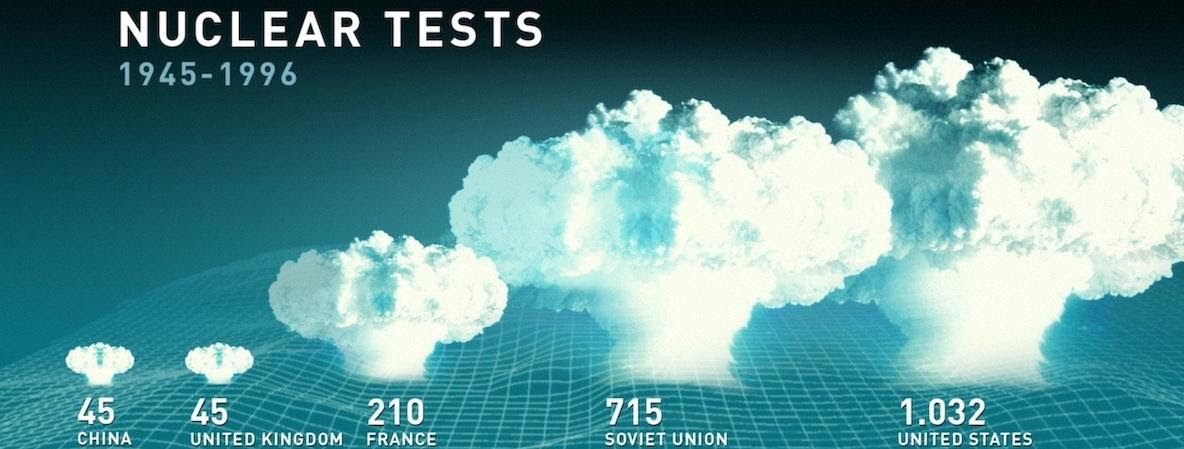
Far from being mere experiments, the detonations of nuclear weapons during such tests are best understood as a global catastrophe
Nuclear “tests” are best conceptualized as environmental disasters with consequences that are still felt today, particularly in Oceania and Central Asia.
By Maxime Polleri, November 05, 2025, https://thediplomat.com/2025/11/nuclear-tests-and-their-legacy-of-harms-in-asia-pacific/
Recently, U.S. President Donald Trump made headlines when he told the Pentagon to resume testing of U.S. nuclear weapons, citing his concerns that countries like China or Russia had supposedly conducted secret underground nuclear weapons tests and that the United States was falling behind. While the president’s post created much controversy around the nature of such tests, the U.S. energy secretary later explained that Trump’s planned tests would not include any actual nuclear explosions, but would encompass “system tests” to verify the state of American nuclear arsenals.
While the fact that the United States does not plan to detonate nuclear weapons is reassuring, the country, as well as China and Russia, have a long history of experimenting with real nuclear weapons to measure the performance of their devastating arsenals. Throughout the 20th century, nuclear testing has taken different forms, such as aboveground nuclear weapon tests, underwater tests, and underground tests. The 1963 Partial Test Ban Treaty prohibited atmospheric, outer space and underwater tests, while some nation states later declared moratoria on underground tests.
Nowadays, nuclear “tests” are done via computers or laboratory scale experiments and do not include actual explosions. However, understanding former nuclear experiments as “tests” is highly misleading, since each atomic and thermonuclear explosion throughout the 20th century released a tremendous quantity of long-lasting radioactive pollutants. Nuclear “tests” are best conceptualized as environmental disasters with long-lasting consequences that are still felt nowadays, particularly in Oceania, as well as Central Asia.
n the early 1950s, the United States began to test numerous nuclear weapons at the Nevada Test Site, releasing large quantities of radioactive fallout that afflicted its own population. People exposed to such fallout became known as “downwinders” and faced a plethora of health problems. Aware of the danger of bombing themselves, many nation states began to “export” nuclear testing to colonial areas, where vulnerable local populations faced the burden of contamination. Testing nuclear weapons in such locations was often a strategic choice, since many of the indigenous local population were already invisible from the public scrutiny or did not have the means to speak back to the dominant power that controlled their territories.
For instance, in March 1954, the U.S. tested a thermonuclear weapon, Castle Bravo, in the Bikini Atoll of the Marshall Islands, an archipelago in Micronesia that was turned into U.S. military bases after World War II. The nuclear fallout heavily impacted residents of the atolls, who were later forced to evacuate their beloved home. In fact, the scope of the fallout was so powerful that a Japanese fishing boat, the Daigo Fukuryū Maru, was contaminated by the test, resulting in cases of acute radiation syndrome for the fishing crew and the death of its radioman.
Much like the United States, France also conducted atmospheric and underwater tests in French Polynesia, resulting in the contamination of many atolls, like Moruroa. Nuclear tests in the Asia-Pacific region created a tremendous legacy of harms, which included the destruction of coral reefs and the death of marine ecosystems, but also forced displacements, contamination of the food chain, destruction of the social fabric, and health issues.
A similar pattern of exporting nuclear tests to vulnerable populations was also apparent in Central and East Asia. For instance, the Soviets repeatedly tested their nuclear weapons in the Semipalatinsk Test Site, a region that was historically dominated by ethnic Kazakhs. Nowadays, as anthropologist Magdalena Stawkowski highlights, Kazakhstan has inherited the remnants of one of the world’s most contaminated landscapes, dealing with contested health issues, precarious economy and marginalization.
Moreover, the People’s Republic of China has historically tested its nuclear weapons in the region of Lop Nur, leading Uyghurs, a Muslim minority ethnic group of northwestern China, to voice concerns about the long-term impact of residual radiation. In many of these instances, issues of national security – such as the health and well-being of local populations – were sacrificed for issues of international security.
Ironically, in each of these cases, humans tested nuclear weapons to prepare for a war that never came – globally contaminating ourselves in the process.
Far from being mere experiments, the detonations of nuclear weapons during such tests are best understood as a global catastrophe. And while a moratorium on nuclear testing ought to be applauded, many people are still grappling with the legacy of past nuclear tests.
The recent movie “A House of Dynamite” has brought up fresh fears of a nuclear war, as well as numerous discussions surrounding nuclear deterrence theories and mutually assured destruction. Instead of focusing our time, energy, and resources on hypothetical strikes that happen in science fiction or game theory, we should delve deeper into the poisoned heritages of the real explosions that occurred in the 20th century and prompt efforts to revitalize communities that are still suffering from its harm.
China denies nuclear testing, calls on US to maintain moratorium
US president claims China, Russia have carried out secret nuclear weapon tests as he seeks to justify return to testing.
Aljazeera, By Adam Hancock and News Agencies, 3 Nov 2025
China has denied it has been secretly testing nuclear weapons, refuting a claim from United States President Donald Trump.
Chinese Foreign Ministry spokeswoman Mao Ning insisted on Monday that Beijing has not broken the informal moratorium that has persisted for decades on the testing of nuclear arms.
Trump claimed on Sunday that, as well as China, Russia, North Korea and Pakistan are all engaged in secret underground testing. He made the comments as he pushes for the US to resume tests.
China has “abided by its commitment to suspend nuclear testing”, Mao said in response to questions regarding Trump’s allegation.
“As a responsible nuclear-weapon state, China is committed to peaceful development, follows a policy of ‘no first use’ of nuclear weapons and a nuclear strategy that focuses on self-defence, and adheres to its nuclear testing moratorium,” she said.
She also said that Beijing calls on the US to uphold the moratorium on nuclear testing, following Trump’s surprise announcement on Thursday that he had ordered the Department of Defense to “immediately” resume tests.
China hopes the US will “take concrete actions to safeguard the international nuclear disarmament and non-proliferation regime and maintain global strategic balance and stability”, Mao continued.
‘The only country that doesn’t test’
Trump made the claims about secret nuclear tests, without offering evidence, in a television interview with CBS.
“Russia’s testing, and China’s testing, but they don’t talk about it,” he said.
“I don’t want to be the only country that doesn’t test,” he continued, adding North Korea and Pakistan to the list of nations allegedly testing arsenals.
The US has not set off a nuclear explosion since 1992. No country other than North Korea is known to have conducted a nuclear detonation for decades. Russia and China report they have not carried out such tests since 1990 and 1996, respectively…………………..https://www.aljazeera.com/news/2025/11/3/china-denies-nuclear-testing-calls-on-us-to-maintain-moratorium
Trump’s bet on US nuclear buildout ropes in Japan

By TIMOTHY CAMA . 10/31/2025
President Donald Trump is eager for the United States to build large nuclear reactors again — with Japanese money.
Administration officials are pulling every lever they can. They’re using trade deals, pulling the China card, and even elbowing into the boardroom of the largest U.S.-based reactor maker: Westinghouse Energy.
“The world is wanting to go and
embrace nuclear power,” Energy Secretary Chris Wright said last week.
“And guess who’s building their reactors? The Russians or the Chinese.”
The president and his loquacious Commerce secretary, Howard Lutnick,
unveiled two agreements during their trip to Asia this week that, at least
on paper, would lead to a nuclear buildout in the United States and could
boost U.S. reactor sales overseas. — One is a $550 billion investment
package folded into a U.S.-Japan trade deal. Under that, Japan will help
finance $80 billion worth of U.S. nuclear projects. — Under a second
deal, the Trump administration and Pennsylvania-based Westinghouse
effectively became business partners this week.
If government investment
leads to profits at Westinghouse, the deal opens the door to American
taxpayers getting a large equity stake in the company.
Politico 31st Oct 2025, https://www.politico.com/newsletters/power-switch/2025/10/31/trumps-bet-on-us-nuclear-buildout-ropes-in-japan-00631233
Some 890 tons of Tepco nuclear fuel kept at Aomori reprocessing plant

Aomori – Nov 1, 2025,
https://www.japantimes.co.jp/news/2025/11/01/japan/tepco-nuclear-fuel-aomori-plant/
Some 890 tons of spent nuclear fuel from Tokyo Electric Power Company Holdings are being stored at Japan Nuclear Fuel’s reprocessing plant under construction in Aomori Prefecture — the first time a specific amount of nuclear fuel at the plant from an individual company has been confirmed.
Also kept at the nuclear fuel reprocessing plant in the village of Rokkasho are about 180 tons of fuel from Japan Atomic Power.
Both numbers were included in the Aomori Prefectural Government’s answer dated Oct. 7 to a questionnaire from a civic organization in the prefecture. The prefecture’s answer was based on explanations from Tepco and Japan Atomic Power
The plant keeps a total of 2,968 tons of used nuclear fuel.
The plant, planned to be completed in fiscal 2026, will start to extract plutonium from used nuclear fuel once it becomes operational.
Under the principle of the peaceful use of plutonium, the Japanese government has a policy of not possessing the radioactive material unless there are specific purposes for it such as use for uranium-plutonium mixed oxide (MOX) fuel, because it can be used to make nuclear weapons.
With none of the nuclear reactors at Tepco and Japan Atomic Power having restarted and neither companies having clear plans to start so-called pluthermal power generation using MOX fuel, there are concerns that a situation may occur in which Japan possesses plutonium without specific purposes.
In the prefecture’s answer to the questionnaire, Tepco said that it “plans to implement pluthermal power generation at one of its reactors based on a policy that it will consume plutonium definitely.”
The firm also said it assumes that some plutonium will be supplied to a nuclear plant of Electric Power Development, better known as J-Power, which is now being constructed in the town of Oma, Aomori Prefecture. The Oma plant is expected to use MOX fuel at all reactors.
“There is no change in our policy to use our plutonium with our responsibility,” Japan Atomic Power said.
Contacted by reporters, Tepco offered the same explanation as that given to the Aomori government.
Meanwhile, Japan Atomic Power said that it plans to conduct pluthermal power generation at the Tsuruga nuclear power station’s No. 2 reactor in Fukui Prefecture and at the Tokai nuclear plant in Ibaraki Prefecture, although when this would start has yet to be decided.
Japan’s seismic history and the Westinghouse deal.
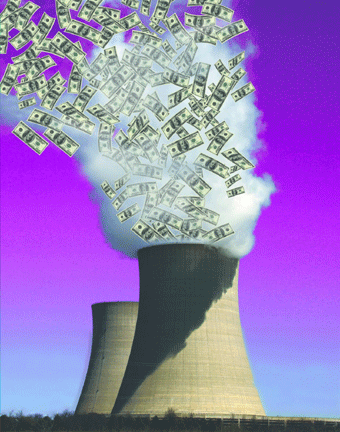
Letter to Ft.com : It almost feels impolite to point out some simple facts regarding your story “Westinghouse and US government strike $80bn nuclear reactor deal”. We are celebrating what Donald Trump hails as its “great friendship” between US and Japan, in addition to the election of our
first female prime minister, and an $80bn nuclear reactor deal — struck
by Washington and funded by Tokyo — all under the bright banner of what
appears to be a new era for our two countries.
Yet the simple fact remains,
whether we like it or not, that Japan is one of the most seismically active
countries in the world, which makes operating nuclear power plants far
riskier there than in the US.
The major nuclear players in both countries
— Westinghouse and Tokyo Electric Power (Tepco) — have faced bankruptcy or financial collapse. All publicly available, reliable data shows that solar power is significantly cheaper than new nuclear energy. Both our
countries’ leaders have issued similarly nationalistic statements on green
energy — President Trump even signed executive orders on “Unleashing
American Energy”, implicitly pointing to a common foe, namely China.
Warren Buffett once wrote that “more money has been stolen with the point
of a pen than at the point of a gun”. These nuclear power plant projects
will consume billions of dollars over the coming decades — long after
today’s leaders have left office. Future generations are being made the
“collateral” for decisions taken today.
FT 31st Oct 2025, https://www.ft.com/content/77769193-1cb0-4d8e-807a-e57936617de9
Donald Trump’s nuclear testing order sparks pushback from Russia, China and the UN.
SBS World News, 31 Oct 25
Trump said the Pentagon will immediately resume testing the US nuclear arsenal on an “equal basis” with other nuclear powers.
United States President Donald Trump has landed back in the US after a surprise directive to begin nuclear weapons testing that has raised the spectre of renewed superpower tensions.
Trump announced the order on social media, just as he was entering a summit with Chinese leader Xi Jinping in South Korea on Thursday.
It came days after Russia declared it had tested nuclear-capable, nuclear-powered cruise missiles and sea drones.
The blunt statement from Trump, who boasts frequently about being a “peace” president, left much unanswered.
Chiefly, it was unclear whether he meant testing weapons systems or actually conducting test explosions — something the US has not done since 1992.
“Because of other countries’ testing programs, I have instructed the Department of War to start testing our Nuclear Weapons on an equal basis,” Trump said in a post on his Truth Social platform.
Trump also said that the US has more nuclear weapons than any other country and that he had achieved this in his first term as president.
The Stockholm International Peace Research Institute said in its latest annual report that Russia possesses 5,489 nuclear warheads, compared to 5,177 for the United States and 600 for China.
In his post, Trump said — minutes ahead of his meeting with Xi — that China was expected to “be even within 5 years”, without substantiating the claim.
China, Russia express concerns
In response to Trump’s announcement, Chinese foreign ministry spokesperson Guo Jiakun urged the US to “earnestly abide” by a global nuclear testing ban.
Russia questioned whether Trump was well-informed about its activities.
“President Trump mentioned in his statement that other countries are engaged in testing nuclear weapons. Until now, we didn’t know that anyone was testing,” Kremlin spokesman Dmitry Peskov told reporters.
Russia’s recent weapons drills “cannot in any way be interpreted as a nuclear test”, Peskov said. “We hope that the information was conveyed correctly to President Trump.”
Peskov then implied that Russia would conduct its own live warhead tests if Trump did it first.
“If someone departs from the moratorium, Russia will act accordingly,” Peskov said.
Russian President Vladimir Putin has repeatedly said that if any country tests a nuclear weapon, then Russia will do so too.
Both countries observe a de facto moratorium on testing nuclear warheads, though Russia and the United States do regularly run military drills involving nuclear-capable systems.
The US has been a signatory since 1996 to the Comprehensive Nuclear-Test-Ban Treaty, which bans all atomic test explosions, whether for military or civilian purposes.
United Nations secretary-general António Guterres said through his deputy spokesman that “nuclear testing can never be permitted under any circumstances”………………………………………… https://www.sbs.com.au/news/article/trump-nuclear-testing-order-pushback/a21zghnl1
Donald Trump says South Korea can build nuclear-powered submarines in US
Donald Trump has said he has given South Korea permission to build
nuclear-powered submarines in Philadelphia, in an announcement that could rattle China as the US president prepares to meet Xi Jinping. “South
Korea will be building its Nuclear Powered Submarine in the Philadelphia
Shipyards, right here in the good ol’ U.S.A.,” Trump wrote on the Truth
Social platform on Thursday during his visit to the US ally and ahead of a
summit with President Xi. Trump said the US-South Korea military alliance
was “stronger than ever” so he had “given them approval to build a
Nuclear Powered Submarine”.
FT 30th Oct 2025,
https://www.ft.com/content/a6ee6741-5a66-41b1-80b6-5e01e4a823a5
1 This Month

of the week – Shut Down Drone Warfare!


Tell the Ukrainian Government to Drop Prosecution of Peace Activist Yurii Sheliazhenko

Petition to revoke the licensing of the Near Surface Nuclear Disposal Facility (NSDF) at Chalk River. https://www.ourcommons.ca/petitions/en/Petition/Details?Petition=e-7247
To see nuclear-related stories in greater depth and intensity – go to https://nuclearinformation.wordpress.com
-
Archives
- March 2026 (237)
- February 2026 (268)
- January 2026 (308)
- December 2025 (358)
- November 2025 (359)
- October 2025 (376)
- September 2025 (257)
- August 2025 (319)
- July 2025 (230)
- June 2025 (348)
- May 2025 (261)
- April 2025 (305)
-
Categories
- 1
- 1 NUCLEAR ISSUES
- business and costs
- climate change
- culture and arts
- ENERGY
- environment
- health
- history
- indigenous issues
- Legal
- marketing of nuclear
- media
- opposition to nuclear
- PERSONAL STORIES
- politics
- politics international
- Religion and ethics
- safety
- secrets,lies and civil liberties
- spinbuster
- technology
- Uranium
- wastes
- weapons and war
- Women
- 2 WORLD
- ACTION
- AFRICA
- Atrocities
- AUSTRALIA
- Christina's notes
- Christina's themes
- culture and arts
- Events
- Fuk 2022
- Fuk 2023
- Fukushima 2017
- Fukushima 2018
- fukushima 2019
- Fukushima 2020
- Fukushima 2021
- general
- global warming
- Humour (God we need it)
- Nuclear
- RARE EARTHS
- Reference
- resources – print
- Resources -audiovicual
- Weekly Newsletter
- World
- World Nuclear
- YouTube
-
RSS
Entries RSS
Comments RSS
 nuclear-news