A thousand tons of radioactively polluted water dumped by TEPCO into Pacific Ocean
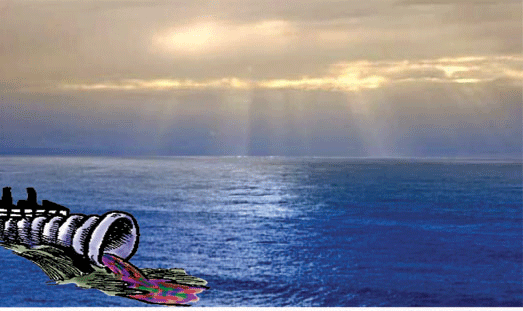 Fukushima Operator Dumps 1,000 Tons Of Polluted Water In Sea http://www.huffingtonpost.com/2013/09/17/fukushima-polluted-water-sea_n_3939014.html Agence France Presse | 09/17/2013 T The operator of the leaking Fukushima nuclear plant said Tuesday that it dumped more than 1,000 tons of polluted water into the sea after a typhoon raked the facility.
Typhoon Man-yi smashed into Japan on Monday, bringing with it heavy rain that caused flooding in some parts of the country, including the ancient city of Kyoto.
The rain also lashed near the broken plant run by Tokyo Electric Power (TEPCO), swamping enclosure walls around clusters of water tanks containing toxic water that was used to cool broken reactors. Continue reading
Fukushima nuclear plant “under control”- who believes this?
 Seemingly, all TEPCO has been doing for the last two and a half years is storing contaminated water in tanks, with no real solution to the problem reached. What the Japanese government is doing is ensuring people in Japan and around the world that Japanese water and food are safe to eat and drink, and that the Fukushima Daiichi nuclear disaster will not affect the 2020 Toyko Olympics. One thing neither Japan nor TEPCO are doing is keeping Japanese citizens or the international community promptly and accurately informed and up-to-date of the contaminated water leaks.
 Japanese ministers miss the point at Fukushima Daiichi http://enformable.com/2013/09/japanese-ministers-miss-point-fukushima-daiichi/ Lucas W Hixson 17 Sept 13, Earlier this month, Japanese Prime Minister Shinzo Abe told the International Olympic Committee in Buenos Aires, that the “effects from the contaminated water have been perfectly blocked within the (artificial) bay” of the wrecked nuclear complex, and said “the situation is under control.” A statement which was questioned strongly by the Japanese media, as experts have continually noted that contaminated water is continually flowing into the Pacific Ocean. Continue reading
Solar power in Japan surpasses the 10 gigawatt mark.
 Solar energy reaches new milestone in Japan http://www.hydrogenfuelnews.com/solar-energy-reaches-new-milestone-japan/8513955/ 17 September 2013.
Japan hits 10GW of installed solar energy capacity
As Japan continues to look for alternatives to fossil-fuels and nuclear power, the country has reached a major milestone concerning solar energy. A recent study conducted by NPD Solarbuzz, a research organization focused on solar energy, found that Japanese photovoltaic installations surpassed the 10 gigawatt mark. This makes Japan only the fifth country in the world to reach this milestone. The other four are Italy, China, Germany, and the U.S. Continue reading
Japanese government and TEPCO being sued by 1000s of nuclear refueees
 More Japanese nuclear refugees sue Tepco, government http://www.japantimes.co.jp/news/2013/09/17/national/more-japanese-nuclear-refugees-sue-tepco-government/#.Ujn0-NJwonE 17 Sept 13, OSAKA – A total of 171 people from Fukushima Prefecture who had to flee their homes because of the crisis at the Fukushima No. 1 nuclear plant sued Tokyo Electric Power Co. and the central government Tuesday for ¥1.62 billion in damages.
The plaintiffs, from 60 families now living in western Japan, filed two suits, one with the Osaka District Court and the other with the Kyoto District Court.
Similar damages suits have been filed with 11 district courts by 3,811 plaintiffs, according to lawyers of the western Japan groups.
In the suit brought to the Osaka court, 80 members of 27 households are seeking ¥1.2 billion in damages, while in the Kyoto suit, 91 members of 33 households are demanding ¥400 million.
They argue that Tepco neglected its duty to prepare the plant for earthquakes and tsunami, while the central government failed to take stringent regulatory steps to prevent the triple meltdown.
No nuclear power restart- say 9000 protestors in Tokyo
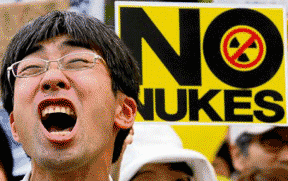 9,000 anti-nuclear advocates protest in Tokyo against reactor restarts http://japandailypress.com/9000-anti-nuclear-advocates-protest-in-tokyo-against-reactor-restarts-1635960/ Sep 16, 2013 About 9,000 anti-nuclear advocates marched in Japan’s capital on Saturday, the day before the last online nuclear reactor in the country would go offline for inspection. They were calling for the end of Japan’s dependency on nuclear energy, reminding the government of the meltdown of the Fukushima nuclear plant more than two years ago.
The anti-nuclear protest was organized by none other than novelistKenzaburo Oe, who won the Nobel Prize for Literature in 1994. “We want to keep telling what is happening at Fukushima even though everybody is talking about the Olympics,” Oe said. At the protest, he reminded everyone to “hand down an environment in which children can live without fear.” The advocates gathered at the Kameido Chuo Park then marched close to JR Kinshicho Station and around theTokyo Skytree.
The claims from Prime Minister Shinzo Abe that the situation in Fukushima is “under control” were also questioned. “Can you say the situation is under control even though contaminated water keeps leaking?” asked writer Keiko Ochiai. Katsumi Hasegawa, another speaker, was among the victims of the disaster, spoke strongly against having nuclear power plants. “With the future of my children tainted, I have realized that radiation and human beings cannot coexist,” said Hasegawa, whose family volunteered to evacuate from the city of Koriyama in Fukushima Prefecture to the city of Fujinomiya in Shizuoka Prefecture.
Typhoon making things worse at Fukushima nuclear plant
 Typhoon Man-yi complicates Fukushima nuclear cleanup (+video), Christian Science Monitor 16 Sept 13 Typhoon Man-yi brought heavy rain and wind to Japan Monday, raising concerns over the fragile cleanup at the Fukushima Daiichi Nuclear Power Plant. Workers already struggle to contain contaminated wastewater, and rain from Typhoon Man-yi adds to the complications at Fukushima.
By David J. Unger, Staff writer / September 16, 2013 The last thing cleanup workers at Fukushima need is a typhoon, but a typhoon is what they’re getting. Heavy rain and winds clocking in at 100 miles per hour slammed into Japan Monday. Typhoon Man-yi caused at least two fatalities and stirred fears at the crippledFukushima Daiichi Nuclear Power Plant. On a typical day, workers have struggled to contain the 400 tons of contaminated water they pump out of the plant. Added rain from Typhoon Man-yi makes matters more complicated.
“The typhoon has little chance of destabilizing the reactors, but it will certainly add more water to a site already crowded with hastily assembled steel storage tanks and relatively poor oversight,” Daniel Aldrich, a political scientist at Purdue University who has been following the Fukushima disaster, wrote in an e-mail.
As rain fell, workers pumped accumulating water from around those storage tanks into the Pacific Ocean in an effort to prevent flooding and radioactive contamination. That rainwater was untainted, according to Tokyo Electric Power Company (Tepco), the plant’s operator. But Japan’s Nuclear Regulation Authority said such a discharge could be subject to nuclear safety rules and was checking radiation levels.
The company also added new walls around the storage tanks to prevent future leaks in the run-up to the typhoon. Workers weighed down cranes and other materials to minimize wind damage. …… http://www.csmonitor.com/Environment/Energy-Voices/2013/0916/Typhoon-Man-yi-complicates-Fukushima-nuclear-cleanup-video
Monju MOX-fueled nuclear plant cut off by avalanche
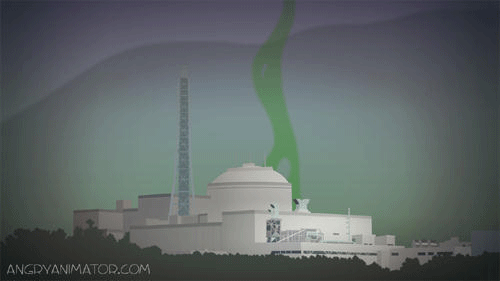 Landslide at MOX-fueled Japan Nuclear Plant — AP: Emergency data transmission from Monju stops as typhoon hits — Kyodo: Can’t access site due to mudslides, reactor temperatures unknown nenews.com/landslide-at-mox-fueled-japan-nuclear-plant-ap-emergency-data-transmission-from-monju-stops-as-typhoon-hits-kyodo-cant-access-site-due-to-mudslides-reactor-temperatures-unknown
Associated Press, Sept. 16, 2013: At Japan’s Monju test reactor site in Fukui, which is currently off-line, an emergency data transmission system went down, apparently due to storm damage, regulators said Monday, an indication of risk management issues at Japanese nuclear facilities even after the Fukushima crisis.
Kyodo News, Sept. 16, 2013: Data transmission from Monju reactor stopped […] There are no prospects for restoration of data transmission for now, with the reactor site in Tsuruga, Fukui Prefecture, inaccessible due to mudslides and fallen trees caused by the typhoon, it said. The Monju reactor has effectively been prohibited from operation because of lax safety management by the operator.
Kyodo News, Sept. 17, 2013: […] Heavy rain attributed to a typhoon caused a landslide near a tunnel entry point within the compound of the prototype fast-breeder reactor complex in Tsuruga city, according to the regulation agency’s secretariat. The cable damage is suspected near that area, it said. Restoration of the transmission of data such as reactor temperatures is expected to take some time […]
See also: Asahi: MOX reactor to restart this month in Japan — Nine fault lines run underneath
International Olympic Committee blind to the radioactive dangers facing Tokyo
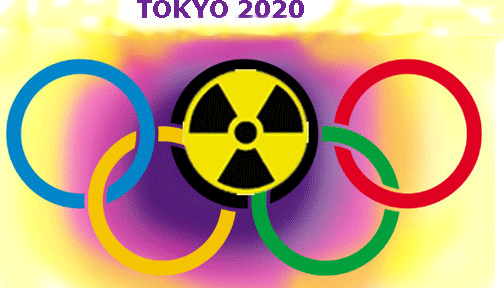 Tokyo Olympics Bid was Fixed by the International Olympic Committee’s Nuclear Lobby Prime Minister Shinzo Abe’s blatant lies about Fukushima radiation leaks being under control By Yoichi Shimatsu Global Research, September 16, 2013
“……….Ladies and Gentlemen, Put on Your Blinders As if wearing blinders, IOC delegates at Buenos Aires ignored media questions about the thousands of tons of radiation-contaminated water leaking from the Fukushima nuclear plant. Arguably worse is the ash from Tokyo’s incinerators that burned Fukushima combustible waste for two years. The highly radioactive cinders were dumped into landfills in Tokyo Bay, which will be the site of the Olympic Village and most of the sports venues.
The Arakawa River, which flows into Tokyo Bay, is also contaminated in its upper reaches by clouds drifting in from the Pacific. The forests around Tokyo’s watershed in Oku-Tama, which provides drinking water to the capital, are dangerously drenched by radioactive rainfall, and the national food supply is so irradiated that regulators have had to raise the food safety level.
The risk of more clouds of radioactive fallout sweeping toward Tokyo is not hypothetical but an inevitable consequence of uncontrollable meltdowns of hundreds of tons of nuclear fuel at Fukushima. The danger is amplified by recurrent earthquakes along Japan’s major fault lines and consequent volcanic eruptions, which pose a constant threat to the nearby nuclear plants at Hamaoka on the seaside below Mount Fuji, Tokai in neighboring Ibaraki, and the twin plants in Fukushima. Another explosion at any of these nuclear sites would force the evacuation of 50 million residents, or one-third of the population.
A major quake or volcanic eruption, long-overdue in the nearby Nankai Trough and Mount Fuji, and even under Tokyo itself, would close the capital’s airports, forcing thousands of Olympic athletes and spectators along with millions of residents to flee in the opposite direction, directly into Fukushima Prefecture. Tokyo is a killing field waiting to happen………..http://www.globalresearch.ca/tokyo-olympics-bid-was-fixed-by-the-international-olympic-committees-nuclear-lobby/5350045
Yoichi Shimatsu, a Hong Kong-based science writer, is former editor of the Japan Times Weekly in Tokyo. http://www.globalresearch.ca/tokyo-olympics-bid-was-fixed-by-the-international-olympic-committees-nuclear-lobby/5350045
Fukushima’s radioactive trash pools are the REAL danger

Top scientists and government officials say that Tepco should be removed from all efforts to stabilize Fukushima. An international team of the smartest engineers and scientists should handle this difficult “surgery”.
The stakes are high
The REAL Fukushima Danger: Failure of Fuel Pools Could Trigger Worldwide Nuclear Radiation By Washington’s Blog Global Research, September 14, 2013
“…… the real problem is that the idiots who caused this mess are probably about to cause a much bigger problem.
Specifically, the greatest short-term threat to humanity is from the fuel pools at Fukushima.
If one of the pools collapsed or caught fire, it could have severe adverse impacts not only on Japan … but the rest of the world, including the United States. Indeed, a Senator called it a national security concern for the U.S.:
The radiation caused by the failure of the spent fuel pools in the event of another earthquake could reach the West Coast within days. That absolutely makes the safe containment and protection of this spent fuel a security issue for the United States.
Nuclear expert Arnie Gundersen and physician Helen Caldicott have both said that people should evacuate the Northern Hemisphere if one of the Fukushima fuel pools collapses. Gundersen said:
Move south of the equator if that ever happened, I think that’s probably the lesson there.
Former U.N. adviser Akio Matsumura calls removing the radioactive materials from the Fukushima fuel pools “an issue of human survival”.
So the stakes in decommissioning the fuel pools are high, indeed.
But in 2 months, Tepco – the knuckleheads who caused the accident – are going to start doing this very difficult operation on their own. Continue reading
Japan’s Prime Minister Abe losing credibility over his statements about Fukushima radiation
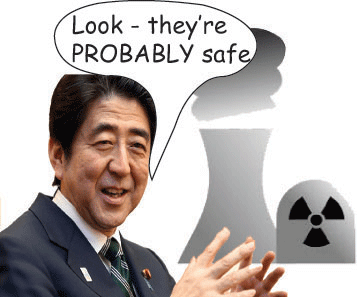 Japan PM’s Fukushima remark backfires HERALD SUN, MARI YAMAGUCHI AAP SEPTEMBER 15, 2013 JAPANESE Prime Minister Shinzo Abe’s reassurance to the International Olympic Committee that contaminated water leaks from the crippled Fukushima nuclear plant are “under control” has backfired at home
Just hours before Tokyo was chosen September 7 to host the 2020 Olympics, Abe gave an emphatic speech declaring that radioactive contaminants from the leakage had no impact to waters outside the bay near the plant and “will never do any damage to Tokyo”.
The Japanese media and opposition lawmakers have suggested that Abe’s comments were overkill.
“Contaminated water ‘control’ running astray,” the nationwide Asahi newspaper said in its front-page top story on Saturday.
“Credibility of prime minister’s message to overseas is shaking.”……….In a meeting with opposition Democratic Party of Japan lawmakers on Friday, senior TEPCO official Kazuhiko Yamashita said the water situation was “not under control,” contradicting Abe.
DPJ leaders said they will demand Abe clarify his IOC speech……….http://www.heraldsun.com.au/news/breaking-news/japan-pms-fukushima-remark-backfires/story-fni0xqll-1226719338622
Japan’s big electricity companies put obstacles in the way of renewable energy
Since there are no regulations defining grid access, the restrictions can be imposed at will by the major utilities.
In a survey by the Japan Renewable Energy Foundation, in Tokyo, as many as 60 solar power providers said they had given up selling power because of the grid access problems.
a major stumbling block for renewable energy,
Renewable energy push blunted as ad-hoc rules stymie private upstarts, Japan Times, KYODO SEP 15, 2013 Ever since Japan kicked off a system to encourage the use of renewable energy for electricity in July 2012, businesses, civic organizations and even local government bodies have been trying to break into the tightly held power market.
Under the so-called feed-in tariff system, utilities are required purchase any generated electricity derived from five types of renewable energy for a fixed price and a set time.
But the momentum seems to be slowing. Several potential power suppliers are dropping their bids after coming face to face with restrictions that make it difficult for them to link to the power grids run by the utilities, which are essentially monopolies. Continue reading
India again tests long range nuclear capable missile

 India boosts arsenal with nuclear-capable missile test (VIDEO) RT.com, September 15, 2013 India has conducted a second test firing of a nuclear-capable missile with a range of 5,000 kilometers. New Delhi is struggling to challenge Beijing in the race for missile dominance in Asia.
“The country has established ICBM capability with the successful second test,” said Avinash Chander, a scientific advisor to Defense Minister AV Antony, adding that the next launch would be canister-based.
‘Agni-V’ long-range ballistic missiles are about 17 meters long, with a diameter of 2 meters and a launch weight of about 50 tons, The Indian Express reported. It can carry a nuclear warhead of over 1 ton.
The missile was test-fired from Wheeler Island, off the coast of Odisha. Missile scientist and ‘Agni 5’ chief designer V.G. Sekaran said the test was an “overwhelming success and showed the reliability and maturity of the sub-systems,” the Hindu newspaper reported.
Only Russia, the US, China, France and Britain, reportedly along with Israel, which has never officially admitted to having an nuclear arsenal of its own, are believed to have such long-range weapons……http://rt.com/news/india-tests-nuclear-missile-882/
South Korea may sue Japan over Fukushima radiation leaks
Law Professor: Damage from Fukushima radiation may be “much larger” than we expect http://enenews.com/law-professor-damage-from-fukushima-radiation-may-be-much-larger-than-we-expect
Title: Korea may sue Japan for mishandling leakss
Source: Korea Times
Author: Kim Tae-jong
Date: Sept. 14, 2013
The government will be able to take legal action against Japanese authorities if the latter continues to leak radioactive water into the ocean which could affect marine life in Korean seas, experts said, Tuesday. […]
“Our government can demand Japan provide us with timely and detailed information about water leaks from the nuclear power plant, and also to stop leaking radioactive water,” said Kim Young-sok, a law school professor at Ewha Womans University. “It is necessary to take every possible precautionary action, as radiation damage can be irreversible and may be much larger than we expect.” […]
“This can be the violation of International Maritime Law (IML),” he said. “Even merchants at local fish markets who have seen a drastic drop in sales due to the perceived health risks from fishery products can be compensated if they can prove they have been affected.” […]
It is obvious that Korea will be affected by the water leak from the tsunami-hit power plant, although there are disputes on the level of the health risk.
The Korea Institute of Ocean Science and Technology, affiliated with the Ministry of Oceans and Fisheries, has recently announced that the radioactive water could affect marine life in Korean seas as early as next year.
TEPCO has been lying for 2 years, about radiation levels at Fukushima
 Tepco admits to reporting false radiation levels for nearly 2 years at Fukushima http://enenews.com/tepco-admits-to-reporting-false-radiation-levels-for-past-2-years-at-fukushima
KBS, Sept. 14, 2013: Japanese media say the Tokyo Electric Power Company (TEPCO) reported lower than actual levels of radioactivity in waters around the Fukushima Daiichi nuclear plant for nearly two years. […] TEPCO said the inaccurate measurements were taken from July 2011 until May this year, resulting in concentration levels of radioactive cesium being reported some becquerels lower than the actual level. It said the measurements were taken one-point-three kilometers south of the nuclear plant. […]
NHK, Sept 14, 2013: TEPCO under-reported cesium measurements […] After being notified of the error by the Nuclear Regulation Authority, TEPCO discovered that its previous per-liter measurements were several becquerels lower than actual figures. TEPCO says the error was due to the wrong assessment of the impact of radiation in the surrounding area. […] Experts at the meeting criticized what they called an elementary mistake. They also said the matter should not be left to TEPCO alone and called for the Authority’s involvement.
The perilous state of Fukushima nuclear buildings Nos 1 to 4
Endless Fukushima catastrophe: 2020 Olympics under contamination threat Dr Helen Caldicott RT.com: September 15, 2013“…….The levels of radiation in buildings 1, 2 and 3 are now so high that no human can enter or get close to the molten cores. It will therefore be impossible to remove these cores for hundreds of years if ever
Buildings 1, 2 & 3
If one of these buildings collapses, the targeted flow of cooling water to the pools and cores would cease, the cores would become red hot and possibly ignite releasing massive amounts of radiation into the air and water and the fuel in the cooling pools could ignite. It is strange that neither the US government in particular nor the global community seem to be concerned about these imminent possibilities and exhibit no urge to avert catastrophe.
Similarly the global media is strangely disconnected with the ongoing crisis. Most importantly, the Japanese government until very recently has obstinately refused to invite and collaborate with foreign experts from nuclear engineering companies and/or governments.
Building 4
This structure was severely damaged during the initial quake, its walls are bulging, and it sank 31 inches (79cm) into the ground. On the roof sits a cooling pool containing about 250 tons of hot fuel rods, most of which had just been removed from the reactor core days before the earthquake struck. This particular core did not melt because TEPCO was able maintain a continuous flow of cooling water, so the rods and their holding racks are still intact, but geometrically deformed due to the force of the hydrogen explosion.
The cooling pool contains 8,800 pounds of plutonium plus over 100 other highly radioactive isotopes. Instead of this core melting into a larval mass like the other three cores, it sits exposed to the air atop the shaky building. A large earthquake could disrupt the integrity of the building, causing it to collapse and taking the hot fuel rods with it. The cooling water would evaporate and the intrinsic heat of the radioactive rods would ignite a fire as the zirconium cladding reacted with air, releasing the radioactive equivalent of 14,000 Hiroshima-sized bombs and 10 times more cesium than Chernobyl……..http://rt.com/op-edge/fukushima-catastrophe-nuclear-olympics-883/
1 This Month
23-25 October – on Zoom – World BEYOND War’s annual global conferenc

To see nuclear-related stories in greater depth and intensity – go to https://nuclearinformation.wordpress.com

Say No to NASA’s Reckless Nuclear Reactor on the Moon
Say No to NASA’s Reckless Nuclear Reactor on the Moon
-
Archives
- October 2026 (160)
- September 2026 (339)
- August 2026 (330)
- July 2026 (355)
- June 2026 (287)
- May 2026 (306)
- April 2026 (356)
- March 2026 (251)
- February 2026 (267)
- January 2026 (308)
- December 2025 (358)
- November 2025 (359)
-
Categories
- 1
- 1 NUCLEAR ISSUES
- business and costs
- climate change
- culture and arts
- ENERGY
- environment
- health
- history
- indigenous issues
- Legal
- marketing of nuclear
- media
- opposition to nuclear
- PERSONAL STORIES
- politics
- politics international
- Religion and ethics
- safety
- secrets,lies and civil liberties
- spinbuster
- technology
- Uranium
- wastes
- weapons and war
- Women
- 2 WORLD
- ACTION
- AFRICA
- Atrocities
- AUSTRALIA
- Christina's notes
- Christina's themes
- culture and arts
- Events
- Fuk 2022
- Fuk 2023
- Fukushima 2017
- Fukushima 2018
- fukushima 2019
- Fukushima 2020
- Fukushima 2021
- general
- global warming
- Humour (God we need it)
- Nuclear
- RARE EARTHS
- Reference
- resources – print
- Resources -audiovicual
- Weekly Newsletter
- World
- World Nuclear
- YouTube
-
RSS
Entries RSS
Comments RSS

