Japan’s Prime Minister energetically marketing nuclear reactors to Asia and Middle East
 Under Abe, the government has also agreed to start discussing a nuclear energy pact with Saudi Arabia ….The government hopes that the contract with Turkey will improve Japan’s chances in winning competition for nuclear power projects in Vietnam, India and Russia,
In a speech at an International Olympic Committee meeting in September before the IOC members picked Tokyo to host the 2020 Games, Abe said, “The situation is under control,” referring to the radioactive water problem.
“How dare he sell nuclear power plants abroad when he has not been able to bring an accident under control?”
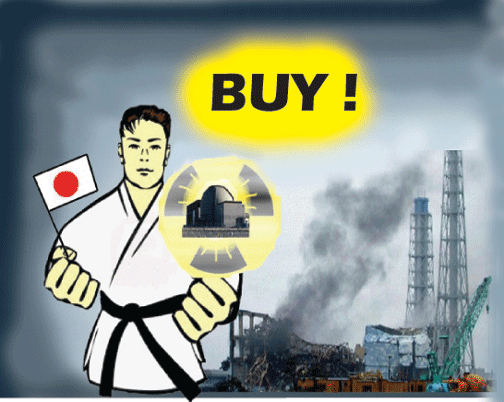 Abe leads nuclear plant exports while problems pile up at home Asahi Shimbun October 31, 2013 As the Abe administration crows about Japan’s first nuclear plant export after the 2011 disaster, it continues to face the daunting tasks of containing radioactive water at the stricken Fukushima plant and cleaning up contaminated communities.
“I’m delighted that commercial negotiations on a nuclear plant contract have been completed and an agreement has been reached,” a beaming Prime Minister Shinzo Abe said at a news conference in Istanbul on Oct. 29. Continue reading
USA to promote nuclear energy at same time as helping fix Fukushima
He [Former nuclear executive, now Energy Secretary, Ernest Moniz] said a U.S.-Japan commission to strengthen co-operation in civil nuclear research and development, as well as Fukushima cleanup, emergency response, and regulatory issues, will meet in Washington next week.
 Fukushima nuclear plant operator to work with U.S. in cleanup effort Mari Yamaguchi, The Associated Press CTV News, November 1, 2013 TOKYO – The utility operating Japan’s crippled nuclear power plant said Friday that it will work with the U.S. Department of Energy in decommissioning the site and in dealing with radioactive water problems.
Tokyo Electric Power Co. President Naomi Hirose said he agreed to accept U.S. help in discussions with U.S. Energy Secretary Ernest Moniz as they visited the Fukushima Dai-ichi nuclear plant on Friday to inspect preparations to remove fuel rods from a storage pool……..Following criticism of its perceived reluctance to accept foreign help, Japan has recently begun to show more willingness to do so.
Operators of the plant are currently making final preparations to remove fuel rods from an uncovered cooling pool at Unit 4 — one of four reactor buildings damaged in the crisis, and the one considered at highest risk. Removing the fuel rods from the cooling pool is the first major step in a decommissioning process at the plant that is expected to take decades.
The fuel removal at Unit 4 was given preliminary approval by Japanese regulators on Wednesday and is to start by mid-November following a final go-ahead……. “As Japan continues to chart its sovereign path forward on the cleanup at the Fukushima site and works to determine the future of their energy economy, the United States stands ready to continue assisting our partners in this daunting yet indispensable task,” Moniz said in a statement late Friday. He said a U.S.-Japan commission to strengthen co-operation in civil nuclear research and development, as well as Fukushima cleanup, emergency response, and regulatory issues, will meet in Washington next week.
Despite public concerns over potential risks of radiation from the plant, Japan’s ruling Liberal Democratic Party has pushed for a restart of the country’s nuclear reactors, which are currently all offline for safety checks. Moniz said he expects nuclear power will remain a crucial part of the energy mix as the world tries to mitigate global warming…… TEPCO also has appointed a former U.S. regulator who led the cleanup of the 1979 Three Mile Island nuclear accident in the United States as an adviser. : http://www.ctvnews.ca/business/fukushima-nuclear-plant-operator-to-work-with-u-s-in-cleanup-effort-1.1523949#ixzz2jWW8FrQZ
Fukushima workers speak out on conditions and criminal connections
Workers include people sent here by yakuzas for their debts and down and out yakuzas themselves. The site is full of yakuzas and rank amateurs…
Anonymous Fukushima Workers: We dumped untested water last typhoon, could be criminal — ‘Landmines’ of extremely high radiation at many locations — Very worrying that I’m getting sick more now — “Site full of yakuza & rank amateurs” http://enenews.com/anonymous-fukushima-workers-dumped-untested-water-during-last-typhoon-could-be-criminal-landmines-extremely-high-radiation-many-locations-very-worrying-im-getting-sick-site-full-yakuza-rank October 31st, 2013
Excerpts from an Oct. 22, 2013 report in Shukan Gendai with translation by EX-SKF:
Worker A, man in his 30s from Kanagawa Prefecture, volunteered to work at Fukushima I NPP right after the accident
The skilled workers […] work closer to the reactors, and they exceed the limit in one to two weeks.
Worker B, man in his 40s from Osaka Prefecture, commutes to the plant from his dorm in Iwaki City
I’m working with […] a former worker at a pub in Shinjuku, a life guard at a swimming pool, a cram school teacher, a truck driver. In other words, rank amateurs. There is no skilled worker. […] Continue reading
The smallest slip up could trigger nuclear catastrophe
VIDEO and AUDIO Fukushima decommissioning slip-up could trigger monumental chain reaction, expert warns One slip-up in the latest step to decommission Japan’s crippled Fukushima nuclear plant could trigger a “monumental” chain reaction, experts warn. ABC NewsWithin days, Fukushima nuclear plant operators will begin what is being described as the most dangerous phase of the decommissioning process so far.
In an operation never before attempted, the Tokyo Electric Power Company (TEPCO) will start removing 1,331 highly radioactive used fuel assemblies from a deep pool which sits high above the ground in a shattered reactor building.
The Fukushima nuclear plant’s reactors were sent into meltdown by an earthquake and tsunami in 2011 in the world’s worst nuclear accident since Chernobyl. Experts around the world have warned ever since that the fuel pool is in a precarious state – vulnerable to collapsing in another big earthquake.Yale University professor Charles Perrow wrote about the number 4 fuel pool this year in the Bulletin of Atomic Scientists.He said one pool contains 10 times the amount of radioactive caesium present in the Chernobyl disaster and warned one slip-up with the removal could trigger a chain reaction.
“This has me very scared,” he told the ABC. ”Tokyo would have to be evacuated because [the] caesium and other poisons that are there will spread very rapidly. ”Even if the wind is blowing in the other way, it’s going to be monumental.”….. http://www.abc.net.au/news/2013-10-31/fukushima-nuclear-meltdown-tepco-tokyo/5059514
Revise inaccurate statement on Fukushima – 64 Japanese organisations ask UNSCEAR and UN General assembly
 Statement: Japanese civil society requests that the reports of the United Nations Scientific Committee on Fukushima be revised
{Title corrected for accuracy – Arclight2011part2]
The United Nations Scientific Committee on the Effects of Atomic Radiation (UNSCEAR) is about to submit a report on Fukushima to the United Nations General Assembly.
Human Rights Now, along with 63 Japanese civil society organizations, has issued a statement requesting UNSCEAR, and the General Assembly Fourth Committee to revise the report and its finding from a human rights perspective.
The statement outlines the case for a more cautious approach to low level radiation exposure in order to help protect the most vulnerable people after the Fukushima nuclear accident.
UNSCEAR_Statement_Submission (PDF)
24 October 2013
Japanese civil society requests that the reports of the United Nations Scientific Committee on Fukushima be revised
1. Concern for the reports of the United Nations Scientific Committee
The United Nations Scientific Committee has inserted the results of investigations on the effects of radiation exposure from Fukushima Nuclear Power Plant Number 1 into its report, which will be submitted to the 68th session being held at the moment.
We, the undersigned civil society organizations in Japan express serious concern that the results of these investigations contain some problems in terms of objectivity, independence, and accuracy, and that the underestimation of the effects of radiation exposure could have negative effects on the human rights and protection of citizens.
We request that the United Nations Scientific Committee and the United Nations General Assembly Forth Committee revise the reports from a human rights perspective to protect the most vulnerable people based on careful and sufficient deliberations.
The parts of the reports which include the foremost concerns of Human Rights Now are outlined as follows: Continue reading
Pregnant women offered free houses if they return to Fukushima

 Japan Professor: Pregnant women get free new houses if they move back to Fukushima — Physician/Mayor: Children being severely harmed, must be evacuated; World has never come across situation like this (VIDEO)
Physician Akira Sugenoya, mayor of the city of Matsumoto interviewed by VoR,, Oct. 30, 2013: “Immediately following the accident at the Fukushima nuclear power plant, I started saying that children should not be allowed to live on the contaminated territory [it] weakens children’s immune system and severely harms their health […] Children are a lot more vulnerable to radiation than adults. […] I want to repeat once again that children should be relocated to clean, radiation-free areas at least temporarily. […] is it feasible to quickly and effectively do away with radioactive pollution? I am absolutely certain that it is unfeasible. […] Compared to Chernobyl, the situation in Japan is further aggravated by radioactive water leakages. The world has never ever come across this kind of situation. […] We should admit that radioactive water is a grave problem. The threat that children may have been contaminated with radioactive materials still looms large. We shouldn’t remain indifferent to the challenges we are facing.”
Hiroko Goto, Professor at Chiba University School of Law & Vice President of Human Rights Now, , Published June 29, 2013 (At 10:00 in): The second one is very problematic — New residential support plan for evacuees from outside Fukushima — this mainly focuses on the pregnant women and the children. If the pregnant women or children decide to go back to Fukushima, Fukushima Prefecture will offer a new, very good house without payment. And this kind of policy they introduce means that the local government wants the people back to their area. So this is a very not good situation for the women’s and children’s health. Watch Professor Goto’s presentation here
Fukushima’s 3 radioactive cores burned through reactor bottoms
 “We’ve opened a door to hell” at Fukushima plant, and may never be able to close it — Radio Host: You mean that even with robots they don’t know where the 3 reactor cores are? (AUDIO) http://enenews.com/radio-weve-opened-a-door-to-hell-at-fukushima-plant-and-may-never-be-able-to-close-it-host-you-mean-that-even-with-robots-they-dont-know-where-3-reactor-cores-are-audio
Title: Discussing Fukushima
Source: Art Bell’s Dark Matter
Date: Oct. 29, 2013
Paul Gunter, nuclear power industry watchdog at Beyond Nuclear:r: We’ve got 3 reactors, the cores have left the vessel. They’ve burned through the bottom of the vessel. We don’t really know where they are, because the radioactive environment even fries robots that Tepco’s been trying to send in there. They have been sending very innovative robotic machinery and sensors in there to get a picture, to get a reading, and these things don’t return. We have opened a door to hell that cannot be easily closed — if ever. We’ve got those 3 cores that are melting, they could be somewhere in the concrete base mat burning their way through, they could have already burned through and entered into the ground. They hopefully have formed a huge solid ‘elephant’s foot’ of highly radioactive material.
Art Bell, host: You mean that even with robotic help, they don’t know where the cores are?
Gunter: Correct. We’ve got 3 molten cores that we don’t have a status report on.
Fear of earthquakes may be prompting the speed up on clearing Fukushima Unit 4
Why are they ‘speeding up’ at Unit 4? — Expert in 2010: Megathrust quake to hit Fukushima ~Nov. 2013… Recurrence interval of 75 years with last rupture Nov. 1938 — Planet’s most powerful type of seismic event — WSJ: Top official concerned quake to destabilize fuel pool http://enenews.com/theyre-rushing-start-unit-4-expert-2010-megathrust-quake-hit-fukushima-nov-2013-recurrence-interval-75-years-last-rupture-nov-1938-planets-powerful-type-seismic-event-wsj-top-official-concern

Wall St. Journal,l, October 30, 2013 (Emphasis Added): Tepco will remove about 1,300 spent fuel rods and 200 new fuel rods […] the 4 meter-long rods will be pulled out of the pool at a time, is considered unprecedented in its scale. Shunichi Tanaka, chairman of the Nuclear Regulation Authority, has expressed concerns about the fragile state of the nuclear fuel left in three reactors and the spent fuel pool in the No.4 building. If improperly handled or destabilized by another major earthquake at the site, the fuel could discharge large amounts of radiation into the environment. […] Continue reading
Mounting radioactive debris reaching West Coast of North America
Those who still say that the Chernobyl disaster was worse than Fukushima may also want to consider that a Woods Hole Oceanographic Institution study conducted in October 2011 concluded that Fukushima had already released up to 100 times more radiation into the environment than Chernobyl at that time. Today, this amount is likely astronomically higher, especially when you take into account all the airborne radioactive plumes that have been detected billowing across the ocean and over U.S. soil.
Radioactive Debris in Pacific Ocean: Fukushima Radiation is Tearing up the West Coast of the US and Canada http://www.globalresearch.ca/radioactive-debris-on-pacific-ocean-fukushima-radiation-is-tearing-up-the-west-coast-of-the-us-and-canada/5355919 By Ethan A. Huff
Global Research, October 28, 2013 As cleanup crews gear themselves up to begin the treacherous task of removing 400 tons of spent fuel from the Fukushima Daiichi Reactor No. 4 in the coming weeks, reports continue to flood in showing that radiation from the stricken plant is still causing major environmental damage all over the world.
Particularly on the West Coast of the U.S., a multitude of strange animal deaths, high radiation readings and other recent anomalies suggest that the Fukushima disaster is far from over. It is simply ludicrous, in other words, for anyone to suggest at this point that these Fukushima woes are dwindling, as fresh evidence suggests that quite the opposite is true. Continue reading
Fukushima nuclear fuel removal may start Nov 8 – a dangerous exercise
Warning from Japan’s Top Nuclear Official: I am “much more worried” about fuel in Fukushima Unit 4 — Rods may break open and release highly radioactive material — Beware risks from debris, a disaster if damaged — Removal may start Nov. 8 http://enenews.com/warning-from-japans-top-nuclear-official-i-am-much-more-worried-about-fuel-in-unit-4-rods-may-break-open-and-release-highly-radioactive-material-beware-risks-from-debris-disaster-if-dama
Associated Press,, Oct. 30, 2013: Japanese regulators on Wednesday gave final approval for the removal of fuel rods [to] start in November […] About 200 of the rods that are unused and safer are expected to be the first […] Nuclear regulatory chairman Shunichi Tanaka, however, warned that removing the fuel rods from Unit 4 would be difficult because of the risk posed by debris that fell into the pool during the explosions. “It’s a totally different operation than removing normal fuel rods from a spent fuel pool,” Tanaka said at a regular news conference. “They need to be handled extremely carefully and closely monitored. You should never rush or force them out, or they may break.” He said it would be a disaster if fuel rods are pulled forcibly and are damaged or break open when dropped from the pool, located about 30 meters (100 feet) above ground, releasing highly radioactive material. “I’m much more worried about this than contaminated water,” Tanaka said. […]
Channel 4 (UK), Oct. 15, 2013: The worst case scenario is if the fuel assemblies are dropped, which could ultimately lead to a partial meltdown […]
VoA News,, Oct. 15, 2013: That hydrogen explosion […] left the inside of the pool littered with debris. […] TEPCO’s first task is to remove the debris. […] The fuel rods must be kept submerged and must not touch each other or break. Nuclear experts warn any mishaps could cause an explosion many times worse than in March 2011.
NHK WORLD,, Oct 30, 2013: […] The firm hopes to begin the removal at the facility’s Number 4 reactor on November 8th. Tokyo Electric plans to check whether the rods are damaged by debris that fell into the pool in March 2011, and to ensure that they do not get caught in the debris during the removal process. […]
Japan’s nuclear regulator OKs removal of fuel rods from Unit 4 Fukushima
 Japan OKs fuel removal from pool at nuclear plant Mail.com, TOKYO (AP) October 30, 2013 — Japanese regulators on Wednesday formally approved the removal of fuel rods from an uncontained cooling pool at a damaged reactor building considered the highest risk at a crippled nuclear plant.
Removing the fuel rods from the Unit 4 cooling pool is the first major step in a decommissioning process that is expected to last decades at the Fukushima Dai-ichi plant, where three reactors melted down after the March 2011 earthquake and tsunami. The Nuclear Regulation Authority said at its weekly meeting that the proposal by the plant’s operator, Tokyo Electric Power Co., is appropriate and that the removal can start in November as planned, following an on-site inspection by regulators. Japanese public broadcaster NHK said the removal would start as early as Nov. 8, but TEPCO said it may not announce the date in advance, citing security reasons…… TEPCO has reinforced the structure around the pool and says the Unit 4 building can survive a major earthquake, but the unenclosed pool on the unit’s top floor, which contains 1,533 fuel rods, has caused international concern. About 200 of the rods that are unused and safer are expected to be the first to be removed……. it would be a disaster if fuel rods are pulled forcibly and are damaged or break open when dropped from the pool, located about 30 meters (100 feet) above ground, releasing highly radioactive material. “I’m much more worried about this than contaminated water,” Tanaka said.
TEPCO has prepared a massive steel structure that comes with a remote-controlled crane to remove the fuel rods, which will be placed into a protective cask and transferred to a joint cooling pool inside a nearby building. To make room for the Unit 4 fuel rods, the company has been moving those already in the joint pool to safer storage in dry casks at a separate plant location.
The utility plans to empty the Unit 4 pool by end of 2014, and remove fuel rods from other pools at three other wrecked reactors over several years before digging into their melted cores around 2020. The Fukushima plant has had a series of mishaps in recent months, including radioactive contaminated water leaks from storage tanks, adding to concerns about TEPCO’s ability to safely close down the plant. http://www.mail.com/news/world/2427376-japan-oks-fuel-removal-pool-nuclear-plant.html
Media denial in Tokyo, about health effects of Fukushima radiation
Tokyo Mother: “Total media blackout” in Japan of lots and lots of people developing symptoms related to Fukushima disaster (VIDEO) — “Many cases of sickness and death among young generations” not reported http://enenews.com/tokyo-mother-total-media-blackout-in-japan-lots-and-lots-of-people-developing-symptoms-related-to-fukushima-disaster-many-cases-of-sickness-and-death-among-young-generations-not-reported
World Network For Saving Children From Radiation, Oct. 26, 2013: […] A case like this is just a tip of iceburg […] Continue reading
Unemployed Japanese tricked into dangerous jobs at Fukushima
‘Nuclear Slaves’ at Fukushima: Workers have debts paid off, forced to stay as ‘indentured servants’ — Foreign workers may soon be needed at plant, official reveals http://enenews.com/nuclear-slaves-at-fukushima-workers-have-debts-paid-off-forced-to-stay-as-indentured-servants-foreign-workers-may-soon-be-needed-at-plant-reveals-tepco-vp
Voice of Russia, Oct. 27, 2013: “Nuclear slaves” discovered at Fukushima […] An in-depth journalistic investigation uncovered that thousands of unemployed Japanese were tricked into working underpaid and highly dangerous jobs on the site of Fukushima’s nuclear disaster. […] Yakuza act as enforcers who keep the “nuclear slaves” from complaining or leaving their jobs. […] Reuters reports that “labor brokers” […] resort to “buying” laborers by paying off their debts and then forcing them to work in hazardous conditions until their debt to the “labor broker” is paid off. Such “employment schemes” are commonly referred to as “indentured servitude” and are a form of slavery […] Lake Barrett, a former US nuclear regulator and an advisor to Tepco, told the news agency that existing practices won’t be changed for Fukushima decontamination: “There’s been a century of tradition of big Japanese companies using contractors, and that’s just the way it is in Japan. You’re not going to change that overnight just because you have a new job here, so I think you have to adapt.”
Asahi Oct. 28, 2013: TEPCO President Naomi Hirose […] explained that it is getting difficult for the utility to secure sufficient manpower at the plant and that it was grappling with tasks the company was not familiar with.
AP,, Oct. 28, 2013: Hirose acknowledged that TEPCO is having trouble finding a stable pool of workers at the plant […] TEPCO Vice President Zengo Aizawa said […] that uncertainty remains over the long-term decommissioning process. “We are not sure about our long-term staffing situation during the upcoming process of debris removal, which requires different skills,” Aizawa told a news conference. Asked if the company may have to consider hiring foreign workers, he said TEPCO is open to that idea even though it’s not an immediate option. […] [Shunichi Tanaka, chairman of the NRA] called on Hirose to implement sweeping steps to safeguard workers from high doses of radiation and other troubles […]
‘Bold and drastic’ action essential at Fukushima
Japan’s nuclear watchdog urges ‘bold and drastic’ action at Fukushima Raw Story, By Agence France-Presse Monday, October 28, 2013 Japan’s nuclear watchdog on Monday urged “bold and drastic” action to fix problems with radioactive water at Fukushima, as it warned of the growing risks over coming months.
Shunichi Tanaka, chairman of the Nuclear Regulation Authority, told the president of operator Tokyo Electric Power (TEPCO) that no expense should be spared in getting to grips with the water leaks that have beset the plant over the last half-a-year.
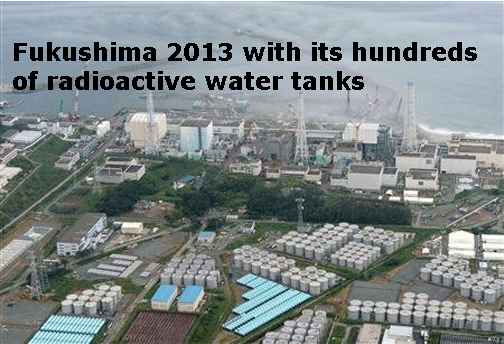
He also told Naomi Hirose that the removal of spent nuclear fuel rods from a cooling pool, which is due to begin next month, would be a difficult and complicated task……. Tanaka also urged TEPCO to exercise the utmost caution when it starts taking used nuclear fuel rods from a cooling pool at Reactor No.4.
In what is widely acknowledged to be the trickiest operation since the overheating reactor cores were stabilized in December 2011, TEPCO plans to take more than 1,000 fuel assemblies (bundles of rods) from the pool using a crane.
The assemblies must be moved one at a time and have to be kept in water to prevent them from spontaneously heating up. “Once a problem occurs, the risks will grow,” Tanaka told the TEPCO chief, according to Ikeda. “I would like you to do it very carefully.”
Hirose said he was fully aware of the possible dangers surrounding the operation, saying the firm would closely work with expert companies on site.
The full decommissioning of Fukushima is likely to take decades and include tasks that have never been attempted anywhere in the world, such as the removal of reactor cores that have probably melted beyond recognition.
Meanwhile, villages and towns nearby remain largely empty, their residents unable or unwilling to return to live in the shadow of the leaking plant because of the fear of radiation. http://www.rawstory.com/rs/2013/10/28/japans-nuclear-watchdog-urges-bold-and-drastic-action-at-fukushima/
Tepco’s ‘institutionalized lying’ might prevent restart of huge nuclear power plant
 TEPCO must address ‘institutionalized lying’ before it restarts world’s biggest nuclear power plant – governor Rt.com October 28, 2013 Tokyo Electric Power Co must give a more thorough account of the Fukushima disaster and address “institutionalized lying” in the company, before it will be permitted to restart the Kashiwazaki Kariwa plant, according to a local governor.
“If they don’t do what needs to be done, if they keep skimping on costs and manipulating information, they can never be trusted,” Niigata Prefecture Governor Hirohiko Izumida told Reuters on Monday, adding that these limitations need to be overcome before the plant is restarted. It is up to Izumida to approve plans to restart the reactor at the TEPCO-run Kashiwazaki Kariwa – the world’s biggest nuclear complex, located on the Japan sea coast, north-west of Tokyo. His personal commission would examine both the causes and handling of the disaster at Fukushima and lay them alongside existing regulatory safeguards to ensure a similar crisis could not reoccur.
If Japanese nuclear safety regulators do lend their approval to the restart plans, Izumida remains able to essentially block TEPCO’s plans for the plant as the facility requires the backing of local officials, allotting Izumida some leverage. …….
Izumida suggested that TEPCO should be fully stripped of responsibility for decommissioning the destroyed Fukushima reactors, and the company subjected to a taxpayer-funded bankruptcy program. Presently, the company remains primarily concerned with funding the process, along with the frequently-occurring and very immediate issue of contaminated water leaking rather than overall nuclear safety.
“Unless we create a situation where 80-90 percent of their thinking is devoted to nuclear safety, I don’t think we can say they have prioritized safety,” he said. ……..
In September, a senior utility expert at Fukushima, Kazuhiko Yamashita, said that the plant was “not under control.” TEPCO downplayed his comments, saying that he had only been talking about the plant’s waste water problem – not the facility as a whole. … http://rt.com/news/tepco-address-lying-governor-879/
1 This Month
19 May – Webinar No To Nuclear: Why Nuclear Power Destroys Lives, Derails Climate Progress and Provokes War

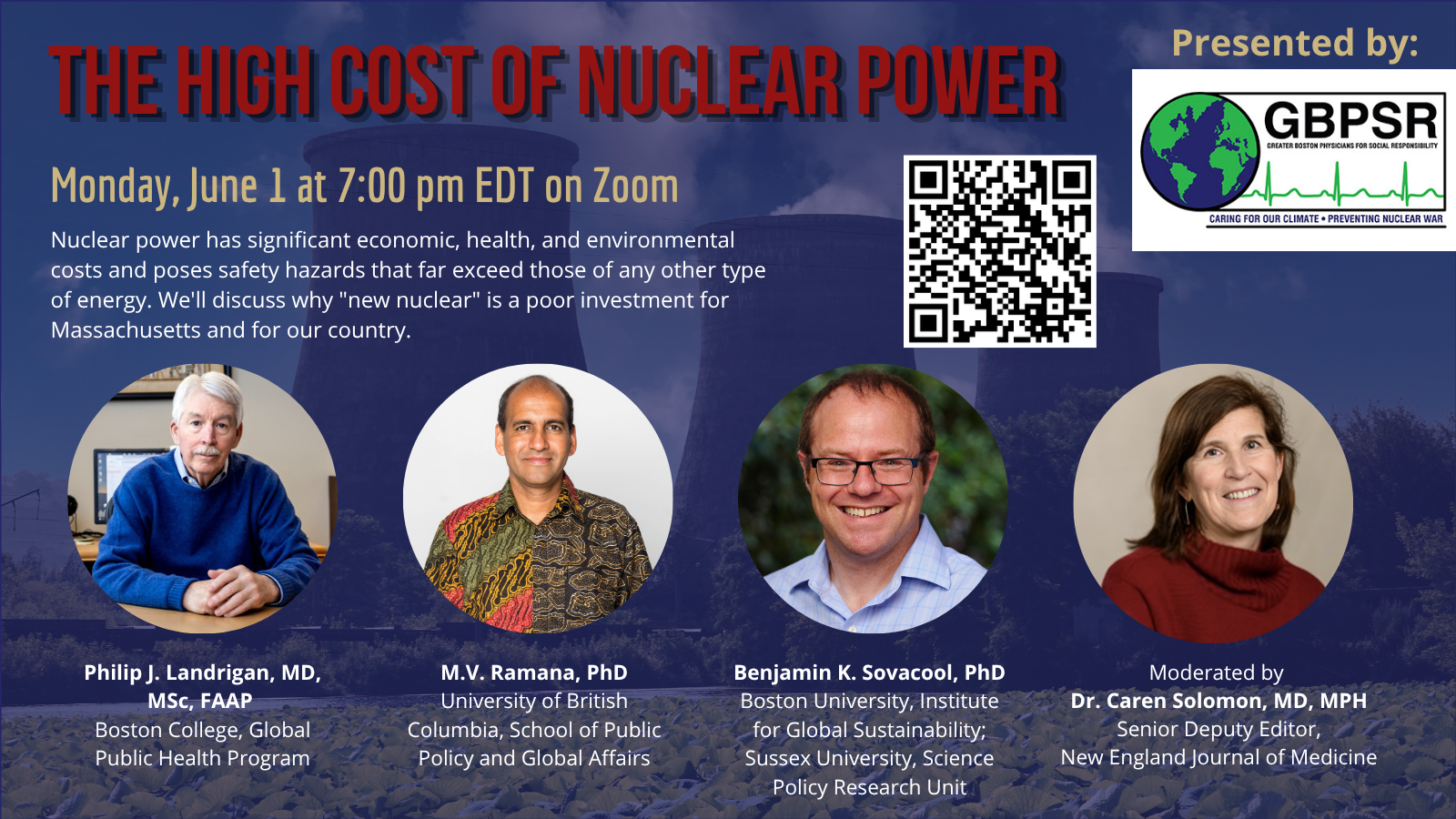
1 June Webinar – The High Cost of Nuclear Power – Register


of the week– Nuclear Reactor Information Task Force
To see nuclear-related stories in greater depth and intensity – go to https://nuclearinformation.wordpress.com
-
Archives
- May 2026 (199)
- April 2026 (356)
- March 2026 (251)
- February 2026 (268)
- January 2026 (308)
- December 2025 (358)
- November 2025 (359)
- October 2025 (376)
- September 2025 (257)
- August 2025 (319)
- July 2025 (230)
- June 2025 (348)
-
Categories
- 1
- 1 NUCLEAR ISSUES
- business and costs
- climate change
- culture and arts
- ENERGY
- environment
- health
- history
- indigenous issues
- Legal
- marketing of nuclear
- media
- opposition to nuclear
- PERSONAL STORIES
- politics
- politics international
- Religion and ethics
- safety
- secrets,lies and civil liberties
- spinbuster
- technology
- Uranium
- wastes
- weapons and war
- Women
- 2 WORLD
- ACTION
- AFRICA
- Atrocities
- AUSTRALIA
- Christina's notes
- Christina's themes
- culture and arts
- Events
- Fuk 2022
- Fuk 2023
- Fukushima 2017
- Fukushima 2018
- fukushima 2019
- Fukushima 2020
- Fukushima 2021
- general
- global warming
- Humour (God we need it)
- Nuclear
- RARE EARTHS
- Reference
- resources – print
- Resources -audiovicual
- Weekly Newsletter
- World
- World Nuclear
- YouTube
-
RSS
Entries RSS
Comments RSS
 nuclear-news