Abe’s second strike against freedoms

 The Abe administration has reportedly started preparations for introducing the “crime of conspiracy” by revising the law on the punishment of organized crime and the control of proceeds resulting from crime. Although it has not been decided when a revision bill will be submitted to the Diet, there is the danger that it will give the government a strong weapon to control civic movements, especially those that oppose government policies.
The recently enacted state secrets law will not only greatly limit people’s access to government information but also punish those who try to get secret information even if they didn’t know it was designated as secret.
The introduction of the crime of conspiracy will further weaken freedoms that have already been hollowed out by the secrecy law. So it is important for citizens to start a widely based action to stop this move by the administration.
If the crime of conspiracy is introduced, one could be punished for joining others to plan a crime even if it is not actually carried out or even if no concrete preparations have been made — a huge departure from the current principle that arrests can be made only when a crime has actually been committed or attempted.http://www.japantimes.co.jp/opinion/2013/12/22/editorials/abes-second-strike-against-freedoms/#.Urhe-6VRGf0
Yet another record radiation level measured at Fukushima nuclear reactor no 2
TEPCO detects record radiation at Fukushima’s reactor 2, new leak suspected http://rt.com/news/fukushima-record-radiation-leak-616/ December 22, 2013 TEPCO has found a record 1.9 million becquerels per liter of beta ray-emitting radioactive substances at its No.2 reactor. Also radioactive cesium was detected in deeper groundwater at No.4 unit’s well, as fears grow of a new leak into the ocean.
The level of beta ray-emitting radioactivity in groundwater around the crippled Fukushima reactor No. 2 reactor has been rising since November, NHK reported.
Previous the highest level – 1.8 million becquerels (bq/liter), of beta-ray sources per liter – was registered at reactor No.1 on December 13.
Meanwhile, TEPCO’s latest examination of deeper groundwater beneath the #4 reactor’s well has raised new concerns that there might be another source of radioactive substances leakage into the ocean. For the first time, the analysis of water samples taken from a layer 25 meters beneath the No. 4 reactor’s well that is facing the ocean has revealed radioactivity in groundwater.
TEPCO investigators detected 6.7 bq/liter of Cesium 137 and 89 bq/liter of strontium as well as other beta ray-emitting radioactive substances. However, the company’s officials said that it is early to talk about a hotspot of radiation leak and more examinations are needed to prove that. TEPCO suggested that current numbers could be wrong because radioactive substances may have been mistakenly mixed during the process of getting the sample.
Leakage of radiation-contaminated water has been the major threat to Japan’s population and environment from the very beginning of the Fukushima disaster in March 2011.
Only in late July 2013 did TEPCO acknowledge the fact that contaminated water is escaping from basements and trenches of the Fukushima plant into the ocean.
Since then, TEPCO reported about two major leaks of highly radioactive water into the ocean from storage tanks – a 300-ton leak in August and 430 liters in October.
Continuing corruption in Japan’s nuclear industry
 Firms linked to municipal assembly members received nuclear facility contracts, Asahi Shimbun, 22 Dec 13, By SATOSHI OTANI/ Staff Writer ROKKASHO, Aomori Prefecture-–With the public alarm over the safety of nuclear facilities following the 2011 Fukushima nuclear accident, municipal assembly members would be expected to monitor closely any local nuclear-related project and avoid any appearance of impropriety.
However, The Asahi Shimbun has learned that did not occur in Rokkasho, Aomori Prefecture, which is home to a number of facilities connected to the nation’s nuclear fuel recycling program.
Five construction companies in the village won construction orders totaling at least 520 million yen ($5 million) in fiscal 2011 and 2012 after the accident at the Fukushima No. 1 nuclear power plant. All five companies were headed by individuals related to incumbent Rokkasho municipal assembly members.
The nuclear fuel recycling facilities are operated by Japan Nuclear Fuel Ltd., which handed out the construction contracts.
The five companies in question are now headed by either the wife, son or younger brother of a Rokkasho municipal assembly member. However, all five assembly members once served as president of the companies and three were the founders……… Continue reading
Critical situation of the decaying Fukushima nuclear buildings
 Experts: Fukushima is “increasingly critical due to decay of buildings… reactor blocks are sinking… alarming cracks in foundation” — “It was built very poorly, Japan cannot deal with problem alone… it’s a big problem” (VIDEO) http://enenews.com/experts-fukushima-is-increasingly-critical-due-to-decay-of-buildings-reactor-blocks-are-sinking-alarming-cracks-in-foundation-it-was-built-very-poorly-japan-cannot-deal-with-problem-a
City of Berkeley City Council Meeting, Dec. 17, 2013 (at 2:25:00 in): Good evening, as many of you know I spent 13 years in the nuclear engineering department at Cal. So I’m very familiar with the construction […] The reactor was designed poorly and also the way it was built was very poor and Japan cannot deal with the problem alone. […] The biggest part of the story is Japan by itself is not capable to fix the problem. We need to get the United Nations, the United States, all the countries — It is a big problem. […]
Article in the German economics paper ‘Deutsche Wirtschafts Nachrichten’ on Oct. 9, 2013translated by pixigirl:Fukushima – German physicist: “The probability that the rescue succeeds goes to zero” […] The German physicist Sebastian Pfugbeil[President of the German Society for Radiological Protection] is extremely pessimistic that an elementary Fukushima disaster can be averted. The consequences would be felt over the entire northern hemisphere. […] Pflugbeil explains the situation in Fukushima: “The situation is becoming increasingly critical due to the decay of the buildings. The fuel rods have not been brought to safety. The reactor blocks are sinking. The ground on which the reactor sits can no longer bear any weight…It is floating. There has been such dramatic shifts that there are 1 meter height differences between one corner to the other which have caused massive cracks in the building structure resulting in alarming cracks in the building foundation and soundness.” […] It requires only a small earthquake or a storm surge or simply the failure of building structures to set this disaster in motion.” […] Watch speaker at the meeting here (starts at 2:25:00 in)
India’s nuclear power system – just not safe!

 Harsh criticism for India’s nuclear safety regime December 21, 2013 Ben Doherty Delhi: India’s nuclear safety regime is “fraught with grave risks”, a parliamentary committee has reported, saying the country’s nuclear regulator was weak, under-resourced and “slow in adopting international benchmarks and good practices in the areas of nuclear and radiation operation”.
The bipartisan Public Accounts Committee tabled a scathing 81-page report in India’s parliament, critical of the decades-long delay in establishing an independent regulator for the nuclear-armed country. Continue reading
Japan’s govt keeps TEPCO afloat with huge funding aid
 TEPCO government aid to be increased to almost 10 trillion yen http://japandailypress.com/tepco-government-aid-to-be-increased-to-almost-10-trillion-yen-1941261/ Dec 19, 2013 Maan Pamintuan The Japanese government’s financial assistance to Tokyo Electric Power Co(TEPCO), the operator of the crippled Fukushima Daiichi nuclear plant, is set to be raised from 5 trillion yen to around 9 to 10 trillion yen to help rebuild the troubled company. The additional funds will be used to guarantee payment to the victims of the 2011 nuclear crisis of Fukushima, most of whom are still displaced due to radiation and decontamination issues in the plant, the site of the world’s worst nuclear accident since Chernobyl.
In July 2012, after donating 1 trillion yen to increase TEPCO’s capital, the government acquired 50.1 % shares of the company, which essentially placed the operator under state control eligible for government-funded rehabilitation. Plans to sell all shares by the 2030s to pay for decontamination work on areas within the nuclear plant are to be decided on a meeting of the Nuclear Emergency Response Headquarters on Friday along with other factors of the company’s special business plan, which includes the Kashiwazaki-Kariwanuclear power plant in Niigata Prefecture that is targeted to go back online by July 2014. This assumes the company a 107 billion yen ordinary profit in 2014 and around 150 billion yen annually, thereafter.
While huge profits are expected to come in next year for TEPCO, the 50 billion yen a year to be paid to the Nuclear Damage Liability Facilitation Fund andcompensation for victims of the nuclear accident for a period of time, made the government decide to raise the upper limit of financial assistance to the company.
Profits left after paying the fund will be spent on refurbishing thermal power plants. Other parts of the new business reconstruction plan include joint procurement of fuel with gas companies and oil wholesalers and a construction of a new coal-powered thermal power plant.
Radiation increase a thousand fold in Fukushima groundwater
 Radiation in Fukushima groundwater skyrockets 3,500+ times over weekend — Just 5 meters from Pacific Ocean — Nothing being done to stop it flowing into sea (PHOTO) http://enenews.com/radiation-in-groundwater-skyrockets-3500-times-over-weekend-just-5-meters-from-pacific-no-steps-being-taken-to-stop-flow-into-ocean-photo[…]
Tepco, Dec. 17, 2013: As a result of the measurement, it was found that the gross-β density in the groundwater observation holeNo.0-3-2 obtained at the east of the Units 1-4 Turbine Buildings on December 16 [was] 63,000Bq/L
Jiji Press, Dec. 17, 2013: Highest Ever Radiation Detected in Fukushima Plant Well […] Some 63,000 becquerels of radioactive materials that emit beta rays, such as strontium-90, per liter have been found in groundwater […] the highest level at the well [Tepco] said Tuesday […] sample [was] taken on Monday from the observation well 5 meters from the coast […] Since the company is not takings steps to prevent tainted water in the well from flowing into the sea […] the water is likely to be reaching the plant’s bay. […] standards require strontium-90 levels to be less than 10 becquerels in water to be released into the sea. […]
See also: Asahi: Radiation levels spike to record high in Fukushima groundwater well nearby ocean — Trench failures to blame, says Tepco — Million times more strontium/beta-ray source than cesium
Tepco resigned to permanent closure of the undamaged nuclear reactors at Fukushima
Fukushima nuclear operator Tepco to shut two more reactors BBC News, 18 Dec 13, The operators of the crippled Fukushima nuclear power plant in Japan are to decommission two reactors that were not badly damaged by the earthquake and tsunami in 2011.
They have bowed to public pressure that the plant be shut permanently……Four reactors were severely damaged by the disaster that struck in March 2011.
Tokyo Electric Power (Tepco) had delayed making a final announcement on the fate of reactors number 5 and 6 at Fukushima while negotiations continued about the financing of the decommissioning process.
The executive board has now accepted the inevitable and acknowledged there will be no attempt to generate electricity from the plant again…….http://www.bbc.co.uk/news/world-asia-25434996
Cancer is clearly increasing in Fukushima children,
Tokyo Press Conference: Cancer is clearly increasing in Fukushima children, many experts starting to get concerned — Tepco has committed a crime; We’re going to the police tomorrow (VIDEO) http://enenews.com/tokyo-press-conference-clear-increase-in-cancer-among-fukushima-children-has-many-experts-concerned-tepco-has-committed-a-crime-and-we-are-going-to-the-police-tomorrow-video
Foreign Correspondents Club of Japan,, Dec. 17, 2013:
Ruiko Mutoh, Representative of Fukushima Nuclear Disaster Plaintiffs: In the thyroid tests which were conducted on people under the age of 18 in 2011 and 2012, of 230,000 children who were tested, 59 have been found to have either thyroid cancer or potential likelihood of such cancer. According to the Fukushima Prefectural Health Survey it’s been one-way declared that these kind of health effects are unrelated to the radiation caused by the nuclear disaster. However this clear increase in the frequency is something that many more scholars and experts are starting to say that we need to look at the causes and the facts behind this more. The effects of this disaster are continuing to expand even today.
At 17:45 in
Mutoh:: So if Tepco had not been concerned with financial considerations, but had at an early stage taken the required measures, then the situation would not have become as serious as it is today, and I believe that this is a criminal act. Tomorrow on behalf of the Fukushima nuclear disaster plaintiffs, we will be taking the second stage of complaints to the Fukushima Prefectural police and this includes complaints on behalf of 6,042 people who submitted them as part of our action.
Watch the full press conference here
A different approach to the very real threat of North Korea
 Hence steps of courage being required at the personal level to change those possible dynamics in history, as history will judge both in retrospect and relentless, on what “we” did to prevent “the North Korean problem” from evolving into a worst case scenario.
 Paul Wolf, February 8, 2013 Tonight once again, once again the same old discussion. The discussion being heard so many times but so little effective action being taken.
The discussion about the pending and increasing dilemmas as to how to deal with North Korea. North Korea perceived as an increasing threat,
– North Kore a being an increasing threat…..
.North Korea in 2001 still the country remaining communist, closely spied by its Government, cut off from almost all outside contacts and over and over armed…….
It is one of those countries who perceive in their isolation threats from the outside world, – perceive their family neighbour from the south as an enemy, – perceive the US as an enemy. And in all this are preparing for conflict, – being both irrational and pointless……. Continue reading
Th world’s worst nuclear pollution – Fukushima radiation
Japan Professor: Damage from Fukushima is unprecedented, a disaster never before experienced in human history; Some say it could affect whole northern hemisphere — Experts: “Very likely the largest nuclear accident which mankind experienced” http://enenews.com/japan-professor-damage-fukushima-unprecedented-disaster-never-before-experienced-human-history-could-affect-northern-hemisphere-experts-ver
The Fukushima Nuclear Disaster : One of the World’s Worst-Ever Cases of Pollution,, Professor Fumikazu Yoshida of Hokkaido University’s Graduate School of Economics, Economic Journal of Hokkaido University, March 2013: The Fukushima nuclear disaster, however, has been responsible for the largest and worst case of pollution to have occurred during the postwar era […] its complexities and scale are greater than anything that has gone before. […] So severe are [the myriad of problems] that we can characterize this disaster as a “second war defeat” since its impact on the nation questions the whole basis of Japan’s postwar society […] [There are] immense dangers that the ‘accident’ still poses […] Rather than simply being a local problem, it has been from the beginning a nationwide and potentially international issue (some say that it has the potential to affect the whole of the northern hemisphere).
If we consider the nature of the devastation and the number of victims […] as well as the extent of affected area […] then we understand that the Fukushima Daiichi Nuclear Power Plant accident has been the cause of injury to human society and the natural environment on a scale that is unprecedentedly wide-spread and lifethreatening in its effects. […] The nuclear disaster at the Fukushima Daiichi nuclear power plant is a “multiple disaster” never before experienced in human history […]
Estimate of Consequences from the Fukushima Disaster, Nordic PSA Conference (nuclear utilities in Finland and Sweden), September 2011: Comparison of results for the Fukushima best estimate and Chernobyl source terms used for the Fukushima site shows that the Fukushima accident, as a whole, is very likely the largest nuclear accident which mankind experienced because estimates of long term fatalities, risks of death and other societal impact based on Chernobyl source terms in Fukushima show lower potential of consequences than Fukushima source terms.
See also: Experts: Fukushima cesium release could be more than triple Chernobyl
Japanese govt to select places for nuclear waste permanent dump
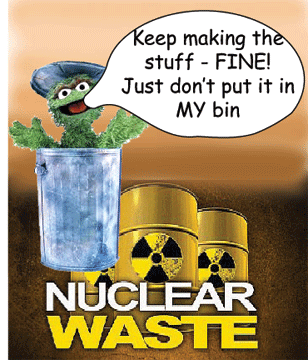 Japan Takes Nuclear Storage Hunt Into Own Hands http://online.wsj.com/news/articles/SB1000142405270230394950457926348056235159 4 Regional Governments Express No Interest By MARI IWATA Dec. 17, 2013 TOKYO—Japan has decided to take matters into its own hands to find appropriate domestic locations to permanently store highly radioactive nuclear waste, after waiting in vain for more than a decade for an offer from a regional government. “The government will play an active role in choosing a permanent place,” Industry Minister Toshimitsu Motegi told reporters at a regular news conference Tuesday. “We’ll abandon the current system of waiting for volunteers to raise their hands.”
Japan, which currently doesn’t have any final disposal sites for high level radioactive waste, has 17,000 metric tons of domestically spent nuclear fuel that dates back to the 1970s. Continue reading
Shock revelations about US sailors exposed to Fukushima radiation
 5 1 Sailors from USS Ronald Reagan Suffering Thyroid Cancer, Leukemia, Brain Tumors After Participating in Fukushima Nuclear Rescue Efforts
Thursday, 12 December 2013 – Crew members in their mid-20’s from the aircraft carrier USS Ronald Reagan are coming down with all sorts of radiation-related illnesses after being deployed less than 3 years ago to assist with earthquake rescue operations off the coast of Japan in 2011. It looks as though the onboard desalinization systems that take salt out of seawater to make it drinkable, were taking-in radioactive water from the ocean for the crew to drink, cook with and bath-in, before anyone realized there was a massive radiation spill into the ocean.
Charles Bonner, attorney representing sailors from the USS Ronald Reagan said “the crew members were not only going to the rescue by jumping into the water and rescuing people out of the water, but they were drinking desalinated sea water, bathing in it, until finally the captain of the USS Ronald Reagan alarmed people that they were encountering high levels of radiation.”
Bonner says that as a result of this exposure, the 51 sailors have come down with a host of medical problems, “They have testicular cancer, they have thyroid cancers, they have leukemias, they have rectal and gynecological bleeding, a host of problems that they did not have before … people are going blind, pilots who had perfect eyesight but now have tumors on the brain. And it’s only been 3 years since they went in.” Bonner pointed out that these service men and women are young people, ages 21, 22, 23 years old and no one in their family had ever suffered any of these kinds of illnesses before.
At present, 51 sailors from the USS Ronald Reagan are named as Plaintiffs in a lawsuit against the Tokyo Electric Power Company (TEPCO) and Bonner says he anticipates adding twenty additional Sailors soon, bringing the total to 70 to 75 because “The Japanese government is in a major conspiracy with TEPCO to hide and conceal the true facts.”
In an utterly shocking admission at a meeting of the Japan Press Club on December 12, 2013, the former Prime Minister of Japan, Naoto Kan, who was in-office when the Fukushima disaster took place, told assembled journalists “[People think it was March 12th but] the first meltdown occurred 5 hours after the earthquake.” This means that the government of Japan KNEW there was horrific radiation being released, but did not tell the U.S. Navy which had deployed the aircraft carrier USS Ronald Reagan to assist with rescue efforts. Our story covering this new aspect of the Fukushima incident is available…..http ://www.turnerradionetwork.com/news/99-pat
Dangerous new nuclear project for Karachi
the nuclear reactor site in Karachi has more people living within 30 km than any other reactor site in the world.
It found there were eight million people living within this distance of the site in Karachi. All of the port city falls within 40 km of the reactor site.
 Pakistani experts raise question about nuclear power project http://www.business-standard.com/article/pti-stories/pakistani-experts-raise-question-about-nuclear-power-project-113121600555_1.html Press Trust of India | Islamabad December 16, 2013 Three leading physicists have raised key questions about the safety, design and cost of Pakistan‘s largest nuclear power plant being built with Chinese assistance in the port city of Karachi. The Karachi complex will have two nuclear reactors with a production capacity of 2,200 MW. Prime Minister Nawaz Sharif inaugurated the project, estimated to cost USD 9.6 billion and scheduled to be completed in six years, late last month.
Japan on the way towards totalitarianism
Abe shows totalitarian bent The “old” Liberal Democratic Party that former Prime Minister Junichiro Koizumi is supposed to have destroyed is making a strong resurgence as is the traditional “triangle” of the LDP, the Ministry of Economy, Trade and Industry (METI) and the Japan Business Federation (Keidanren).
When Prime Minister Shinzo Abe goes abroad, he is often accompanied by as many as 100 business leaders as he busies himself with exporting nuclear reactors and other infrastructural items through “top-level sales campaigns.” Furthermore, defying the traditional practice of determining wage levels through labor-management negotiations, Abe has asked Keidanren Chairman Hiromasa Yonekura to raise the wages of workers and this request has been handed down to Keidanren member corporations. His intervention in wage negotiations clearly indicates that Japan is a nation of highly controlled state capitalism, transcending a free market economy. Moreover, should a constitutional revision come to restrict freedom of speech, Japan would become a de facto totalitarian state http://www.japantimes.co.jp/opinion/2013/12/16/commentary/abe-shows-totalitarian-bent/#.UrBsOWRDtD5
1 This Month
23-25 October – on Zoom – World BEYOND War’s annual global conferenc

To see nuclear-related stories in greater depth and intensity – go to https://nuclearinformation.wordpress.com

Say No to NASA’s Reckless Nuclear Reactor on the Moon
Say No to NASA’s Reckless Nuclear Reactor on the Moon
-
Archives
- October 2026 (149)
- September 2026 (339)
- August 2026 (330)
- July 2026 (355)
- June 2026 (287)
- May 2026 (306)
- April 2026 (356)
- March 2026 (251)
- February 2026 (267)
- January 2026 (308)
- December 2025 (358)
- November 2025 (359)
-
Categories
- 1
- 1 NUCLEAR ISSUES
- business and costs
- climate change
- culture and arts
- ENERGY
- environment
- health
- history
- indigenous issues
- Legal
- marketing of nuclear
- media
- opposition to nuclear
- PERSONAL STORIES
- politics
- politics international
- Religion and ethics
- safety
- secrets,lies and civil liberties
- spinbuster
- technology
- Uranium
- wastes
- weapons and war
- Women
- 2 WORLD
- ACTION
- AFRICA
- Atrocities
- AUSTRALIA
- Christina's notes
- Christina's themes
- culture and arts
- Events
- Fuk 2022
- Fuk 2023
- Fukushima 2017
- Fukushima 2018
- fukushima 2019
- Fukushima 2020
- Fukushima 2021
- general
- global warming
- Humour (God we need it)
- Nuclear
- RARE EARTHS
- Reference
- resources – print
- Resources -audiovicual
- Weekly Newsletter
- World
- World Nuclear
- YouTube
-
RSS
Entries RSS
Comments RSS

