Ignoring science, environmental protection and international law – G7 endorses Japan’s Fukushima water discharge plans

Greenpeace International, 16 April 2023 https://www.greenpeace.org/international/press-release/59193/science-environmental-protection-international-law-g7-japans-fukushima-water-discharge/
Legacy of Fukushima disaster shows nuclear energy is no solution to energy and climate crisis.
Sapporo, Japan – The nations of the G7 have chosen politics over science and the protection of the marine environment with their decision today to support the Japanese government’s plans to discharge Fukushima radioactive waste water into the Pacific Ocean.
The 1.3 million cubic meters/tons of radioactive waste water at the Fukushima Daiichi plant, currently in tanks, is scheduled to be discharged into the Pacific Ocean this year. Nations in the Asia Pacific region, led by the Pacific Island Forum, have strongly voiced their opposition to the plans.[1] Some of the world’s leading oceanographic institutes and marine scientists have criticised the weakness of the scientific justification applied by TEPCO, the owner of the nuclear plant, warned against using the Pacific Ocean as a dumping ground for radioactive contaminated water, and called for alternatives to discharge to be applied.[2]
“The Japanese government is desperate for international endorsement for its Pacific Ocean radioactive water dump plans. It has failed to protect its own citizens, including the vulnerable fishing communities of Fukushima, as well as nations across the wider Asia Pacific region. The aftermath of the nuclear disaster at Fukushima is still strongly felt, and the Japanese government has failed to fully investigate the effects of discharging multiple radionuclides on marine life. The government is obligated under international law to conduct a comprehensive environmental impact assessment, including the impact of transboundary marine pollution, but has failed to do so. Its plans are a violation of the UN Convention Law of the Sea.
The marine environment is under extreme pressure from climate change, overfishing and resource extraction. Yet, the G7 thinks it’s acceptable to endorse plans to deliberately dump nuclear waste into the ocean. Politics inside the G7 at Sapporo just trumped science, environmental protection, and international law,” said Shaun Burnie, Senior Nuclear Specialist at Greenpeace East Asia.
Greenpeace East Asia analysis has detailed the failures of liquid waste processing technology at the Fukushima Daiichi plant and the environmental threats posed by the releases.[3] There is no prospect of an end to the nuclear crisis at the plant as current decommissioning plans are not feasible. Furthermore, the report finds the nuclear fuel debris in the reactors cannot be completely removed and will continue to contaminate the ground water over many decades.[4] Claims that the discharges will take 30 years is inaccurate as in reality, it will continue into the next century. Viable alternatives to discharge, specifically long term storage and processing, have been ignored by the Japanese government.[3]
The Japanese government’s attempt to normalise the Fukushima nuclear disaster is directly linked to its overall energy policy objective of increasing the operation of nuclear reactors again after the 2011 disaster. 54 reactors were available in 2011 compared to only ten reactors in 2022, generating 7.9% of the nation’s electricity in FY21 compared to 29% in 2010.[5] Meanwhile, five of the other six G7 governments led by France, the US and the UK are also aggressively promoting nuclear power development.
The idea that the nuclear industry is capable of delivering a safe and sustainable energy future is delusional and a dangerous distraction from the only viable energy solution to the climate emergency which is 100% renewable energy. The global growth of low cost renewable energy has been phenomenal – but it has to be much faster and at an even greater scale if carbon emissions are to be reduced by 2030. Approval for nuclear waste dumping and nuclear energy expansion sound like the 1970’s but we have no time for such distractions. We are in a race to save the climate in the 21st century, and only renewables can deliver this,” said Shaun Burnie.
34,200 tons of radioactive sewage sludge kept in Kanto area 12 yrs after Fukushima disaster.
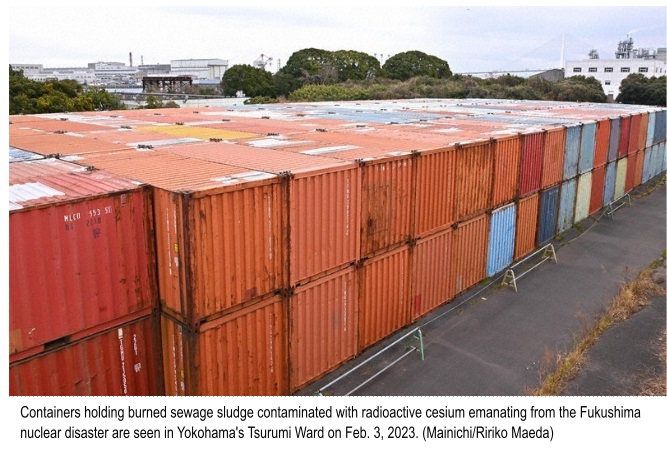
April 10, 2023 (Mainichi Japan)
TOKYO — A total of some 34,200 metric tons of sewage sludge contaminated with radioactive substances emanating from the Fukushima nuclear disaster is still kept in temporary storage by major local bodies in the Kanto region, the Mainichi Shimbun has learned.
The massive tainted waste — a year’s worth of ordinary burned sludge ash generated in Tokyo’s 23 wards — has partially been kept as incinerated ash. Due to difficulties in obtaining local understanding for landfill disposal of radioactive waste in harbors, forests and mountains, some of the waste has nowhere to go even 12 years on since the onset of the disaster.
The finding came after the Mainichi queried major local governments in five prefectures in the Kanto region and other sources about radioactively contaminated sewage sludge accumulated in the wake of the March 2011 Fukushima Daiichi Nuclear Power Station meltdown.
In May 2011, two months after the disaster, radioactive cesium was detected in the sewage sludge in Fukushima Prefecture. This prompted inspections of sewage in other local bodies in the Kanto region, and authorities took measures, such as keeping highly contaminated sludge within their local sewage facilities.
Of these, the Mainichi Shimbun interviewed 15 local bodies — Tokyo and six other Kanto region prefectures, their capital cities, and government-designated major cities in the region — between December 2022 and March 2023, regarding the status of their treatment of sewage sludge in which radioactive substances were detected.
It emerged that the Yokohama Municipal Government, south of Tokyo, had kept approximately 26,600 tons of radioactively contaminated waste within its sewage facilities as incinerated sludge ash as of the end of February 2023, while the Kawasaki Municipal Government, also in Kanagawa Prefecture, had kept 3,435 tons of such waste inside its port areas in the same form…………………………………………..
In the Kanto region alone, a total of some 4,180 tons of radioactive sewage requiring the central government’s treatment remains in Ibaraki, Tochigi, Gunma and Chiba prefectures, according to the Ministry of the Environment and other sources. The national government plans to place this waste under long-term management by setting up treatment facilities in state-owned forests and other sites in accordance with the special measures law on radioactive contamination response. However, the plan remains up in the air as the candidate sites have not been finalized due to protests from local residents and other factors.
Meanwhile, Tokyo, Saitama and Kanagawa prefectures responded to the survey that they have finished disposing of all radioactive sewage sludge under their control. The cities of Mito, Saitama and Chiba also answered the same. Based on the peak amount of radioactive sludge kept by these local bodies, it is estimated that they had disposed of at least some 120,000 tons of such waste.
(Japanese original by Kazuhiro Igarashi and Kaoru Watanabe, Tokyo Regional News Department)https://mainichi.jp/english/articles/20230408/p2a/00m/0na/013000c
The (South) Korean Nuclear Threat
13 APR 2023, By Dr Jeffrey Robertson, Australian Institute of International Affairs
South Korea is in the midst of a debate to secure nuclear weapons and few outside realise the seriousness and level of the debate. Few inside realise the question is much bigger than just South Korea, with great implications for the region, including Australia.
Debate on securing an independent nuclear weapons capacity once sat on the fringe of mainstream politics in Seoul. The extreme left and right, ex-military, religionists, and mavericks seeking attention were its champions. This is no longer the case. Today it is widely accepted, even common. Polls taken over the last year put public support in the 70-80 percent range. Securing nuclear weapons is now mainstream, viable, and if trends continue, even likely.
What makes South Korea want nuclear weapons? There’s a ready response from those pushing the agenda. North Korea’s missile and nuclear tests, Russia’s invasion of Ukraine, and concerns regarding a rising China. Each can readily be used to justify the pursuit of nuclear weapons. Yet, each are just squalls on the surface of the sea. Underneath, more powerful currents are pushing the pursuit of nuclear weapons: national pride, the desire to be more independent, and a healthy dose of domestic political opportunism.
National pride is a core contributor to the decision to pursue nuclear weapons. For both Koreas, there’s a keen sense of historical injustice marked by invasions from all sides, including occupation, and division. For South Koreans, there’s also a competitive streak that stretches from the individual to the national desire to be number one. There’s even speculation that the U.S. would be willing to allow Seoul to secure nuclear weapons in order for it to play a larger role in balancing China, placing South Korea at a new level of partnership with Washington. Among many, securing a nuclear weapons capacity provokes a certain element of national pride: more than just a middle power – a member of the nuclear weapons club.
The desire to be more independent is also an important contributing factor……………………………..
Domestic political opportunism is the icing on the cake…………………………… The current president, Yoon Suk-yeol, has made remarks supporting the acquisition of nuclear weapons, and the Mayor of Seoul – a position that is a stepping stone to the presidency – has also stated his support. Nuclear weapons will see multiple candidates jump on the bandwagon in the lead-up to the April 2024 legislative elections, and likely more than one candidate in the 2027 presidential elections.
Proliferation, from France to North Korea, is a story of national pride, independence, and political opportunism. South Korea is no different.
t is likely the consequences of this momentous decision to pursue an independent nuclear weapons capacity have not been fully thought through. ………………………………..
n the 1960s, Australia made the decision to forego nuclear weapons in the context of a global diplomatic and strategic understanding that proliferation could be controlled. Since that time, debates about Australia securing nuclear weapons have arisen, but they’ve never been mainstream. Debates in recent years have been more brain-storming and speculation than serious policy-specific programming. A South Korean decision to pursue nuclear weapons would substantially transform strategic outlooks across the region and lead to a more serious debate in Australia. The current nuclear submarine debate would look like a Sunday School picnic.
Jeffrey Robertson is an Associate Professor of Diplomatic Studies at Yonsei University and a Visiting Fellow at the Asia Institute, University of Melbourne. He researches the diplomatic practice and foreign policy of middle powers with a focus on the Korean Peninsula. He writes and updates research at https://junotane.com and on Twitter @junotane. https://www.internationalaffairs.org.au/australianoutlook/the-south-korean-nuclear-threat/
After leak of secret documents, South Korea to raise spying allegations with U.S.
https://www.washingtontimes.com/news/2023/apr/9/after-leak-secret-documents-south-korea-raise-spyi/
Leaked papers reportedly show that U.S. gathered signals intelligence from Seoul, a close all
South Korean officials said Sunday they will “come up with our response accordingly” after revelations that the U.S. reportedly spied on its close ally and gathered signals intelligence related to South Korea‘s internal debate over weapons sales to the U.S., and Seoul‘s fears that those weapons would ultimately end up in Ukraine.
Officials in Seoul said they’ll raise the alleged spying — which came to light as part of a major leak of sensitive documents over the weekend — with their U.S. counterparts.
For both countries, the timing is delicate. South Korean President Yoon Suk Yeol is scheduled to visit Washington and join President Biden for a state dinner at the White House on April 26.
We will review precedents and instances involving other countries, and come up with our response accordingly,” a South Korean presidential official said Sunday after being asked about the revelations, according to the country’s Yonhap News Agency.
The New York Times first reported the leak Friday.
US troops to China? Not a good idea, really
Some pertinent comments to New York Post’s rather war-mongering article.
bob bob. 8 April, 2023
No, “Sending Troops” is not on the table. Taiwan is part of China as Puerto Rico is to the US. Imagine China intervening with our island and threatening us. Taiwan recently held elections, based on pro and anti China issues. Voters overwhelming support China regardless of what our own press and politicians say. Any country deciding to put their fate in US hands should take a long look at Afghanistan.
Cronkyte, 8 April, 2023
China has no desire to “invade” Taiwan, which would require a massive military operation and likely destroy the goose that lays the golden egg. China will do everything it can to persuade Taiwan to agree to reunification, most likely by offering semi-autonomous governance as they promised Hong Kong (and just like Hong Kong, they will then renege on those promises).
There is a growing push for reunification on the island, and after former Taiwan President Ma Ying-jeou’s speech upon returning from China, that will likely grow. He describes the choice as “peace or war,” and no one on either side of the Taiwan Strait want to see the island razed. https://nypost.com/2023/04/07/rep-michael-mccaul-us-troops-to-taiwan-on-the-table-if-china-invades/
AUKUS nuclear submarine cooperation seriously jeopardizes peace, stability in Asia-Pacific: embassy

LONDON, April 8 (Xinhua) http://eng.chinamil.com.cn/VOICES/16215442.html
The United States, Britain and Australia have been pressing ahead with nuclear submarine cooperation despite being widely questioned, which creates nuclear proliferation risks and undermines the international non-proliferation system, the Chinese Embassy in Britain has said.
In response to a question concerning the trilateral Australia-UK-U.S. (AUKUS) cooperation on nuclear submarines, the embassy said on Friday that such cooperation will exacerbate the resurgence of the Cold War mentality, trigger a new round of arms race, and further provoke regional security and military confrontation, seriously jeopardizing regional peace, stability and prosperity.
The Asia-Pacific is now the most dynamic and fastest growing region in the world, which hasn’t come easily, the embassy said in a press release. “The AUKUS cooperation is designed to serve the U.S. geopolitical agenda to introduce group politics and Cold War confrontation into the Asia-Pacific with military deterrence. It is aimed at creating a NATO-replica in the Asia-Pacific, which runs counter to peace and stability in the region.”
The AUKUS nuclear submarine cooperation marks the first time for nuclear weapon states to transfer naval nuclear propulsion reactors and weapons-grade highly enriched uranium to a non-nuclear weapon state, it noted.
As the current International Atomic Energy Agency (IAEA) safeguards system is incapable of ensuring effective safeguards, such cooperation poses serious nuclear proliferation risks, seriously compromises the authority of the IAEA, and deals a blow to the agency’s safeguards system, the embassy said.
“If the three countries are set on advancing the cooperation, other countries will likely follow suit, eventually leading to the collapse of the international nuclear non-proliferation regime,” it said.
China urges the three countries to heed the call of the international community and regional countries, discard the outdated zero-sum Cold War mentality and narrow geopolitical mindset, earnestly fulfil their international obligations and do more things that are conducive to regional peace, stability, unity and development, the embassy said.
“This serves the fundamental and long-term interests of regional countries as well as the three countries themselves,” it said. “The UK is not a country in the region and it is unwise to overstretch itself.”
Convincing major powers to abide by ASEAN’s nuclear treaty is challenging
A. Muh. Ibnu Aqil (The Jakarta Post) 9 Apr 23,
While China’s expressed intent to sign the protocol for ASEAN’s nuclear weapon free zone treaty should be supported, convincing other nuclear weapon states to follow suit may be a challenge, experts have said.
In 1995, 10 ASEAN member states signed the Southeast Asian Nuclear-Weapon-Free Zone Treaty (SEANWFZ) or the Bangkok Treaty, designating the region as one free of nuclear weapons.
The treaty also has a protocol open to signature by recognized nuclear weapon states China, France, Russia, the United Kingdom and the United States, but none have signed the protocol, objecting to the inclusion of continental shelves and exclusive economic zones in the nuclear weapon free zone. https://www.thejakartapost.com/world/2023/04/09/convincing-major-powers-to-abide-by-aseans-nuclear-treaty-is-challenging.html
‘Brink of nuclear war’: North Korea warning on military drills
Aljazeera, 6 Apr 23,
Pyongyang’s state media publishes warning as United States and South Korea continue joint military exercises.
North Korea has accused the United States and South Korea of escalating tensions “to the brink of nuclear war” through their joint military drills and promised to respond with “offensive action,” according to state media KCNA.
A commentary published by KCNA on Thursday criticised the continuing exercises as “a trigger for driving the situation on the Korean peninsula to the point of explosion.”
…………………… US and South Korean forces have been conducting a series of annual springtime exercises since March, including air and sea drills involving a US nuclear-powered aircraft carrier as well as B-1B and B-52 bombers, and their first large-scale amphibious landing drills in five years. On Wednesday, B52s were deployed for their first use on the peninsula in a month.
……………………. North Korea views such exercises as a rehearsal for invasion.
Pyongyang carried out a record number of weapons tests last year and has been ramping up its military activity in recent weeks. It has unveiled new, smaller nuclear warheads, fired its longest-range intercontinental ballistic missile – the Hwasong 17 – and tested a nuclear-capable underwater drone that is under development. It also fired cruise missiles from a submarine…………………………………… https://www.aljazeera.com/news/2023/4/6/brink-of-nuclear-war-north-korea-warning-on-military-drills
—
The Other Atomic Concern in Taiwan—Nuclear Reactors
NEWSWEEK, GARRETT EHINGER , CHINA ANALYST, DEFENSE PRIORITIES, 4/7/23
The Ukrainian nuclear reactor at Zaporizhzhia came dangerously close to a meltdown when Russian forces damaged power circuits, affecting cooling systems. This has sparked concern over Taiwan’s nuclear plants amid heightening tensions between China and the U.S. Considering China’s preparations to invade Taiwan, the United States should seek to establish a convention with China that explicitly forbids the intentional assault of nuclear establishments to both protect Taiwan against nuclear devastation, and also to open up much needed dialogue with China that may help relax tensions.
In a wartime scenario, nuclear reactors are something of a house of cards. It’s rather easy for stray ordinance to hit an unintended target, as demonstrated by stray missiles from the Ukraine conflict that landed in Poland, killing two civilians. Taiwanese reactors are not only near major population centers, but they also overlap with many optimal landing sites for Chinese invasion forces, heightening the risks of being damaged by close proximity to battlefronts.
Nick Roth, senior director of the Nuclear Threat Initiative’s Nuclear Materials Security Program, said that the risks of things going wrong either from direct or indirect attacks is “quite high.”
To manage rates of fission reactors rely on control rods to absorb radiation. If the control rods are damaged, there is nothing to limit reaction rates, and a small nuclear explosion can erupt. Cooling systems maintain temperature and pressure in nuclear reactors, and are extremely vulnerable in a warzone. If the power circuits to Taiwan’s Kuosheng reactor cooling systems get damaged, a meltdown could occur where temperatures and pressures reach explosive levels.
Even if these explosions themselves don’t have immediate anti-personnel effects, seasonal winds can still blow their radiation clouds onto large cities, sickening or killing thousands, and costing billions in damages.
Wenchung Liu, deputy minister of the Atomic Energy Committee in Taiwan, said in a September news conference last year that because of these risks of serious collateral damage, a deliberate attack by China on Taiwan’s nuclear power plants was “unlikely.” He claimed that military operations leading to damage and disruption of critical infrastructure were more realistic concerns
But Ian Easton, senior director at the 2049 Research Institute, disagreed. He pointed out that in the People’s Liberation Army (PLA) course manuals the Chinese Communist Party (CCP) stated, “Taiwan’s nuclear power plants represent high-value military targets…[and advise] PLA combat commanders to … [use] helicopter gunships armed with anti-tank missiles” to attack facilities. The manuals also instruct soldiers to “wash off” nuclear radiation and not let it “slow you down as you finish conquering the island,” clearly indicating the CCPs lack of care about radiation damage to their troops.
……………………………………………………………… Ultimately, China and America desperately need détente. On top of absolving risks to Taiwanese nuclear reactors, a collaborative treaty between America and China prohibiting attacks on nuclear facilities could be the olive branch both countries seek. Thankfully, as former U.S. State Department foreign policy expert Bennett Ramberg pointed out, “a perfectly serviceable template already exists” for such a treaty. “In 1988, India and Pakistan, two of the world’s most ferocious adversaries, cobbled together [an adequately detailed] accord” prohibiting attacks on nuclear establishments. He said “this model should be adopted as a universal norm.”
Regardless of the fate of Taiwan’s nuclear energy programs, the risks posed to existing facilities amid heightening cross-strait tensions demands international coordination—coordination that might make room for talks between America and China and a cooling of relations. https://www.newsweek.com/other-atomic-concern-taiwannuclear-reactors-opinion-1792583
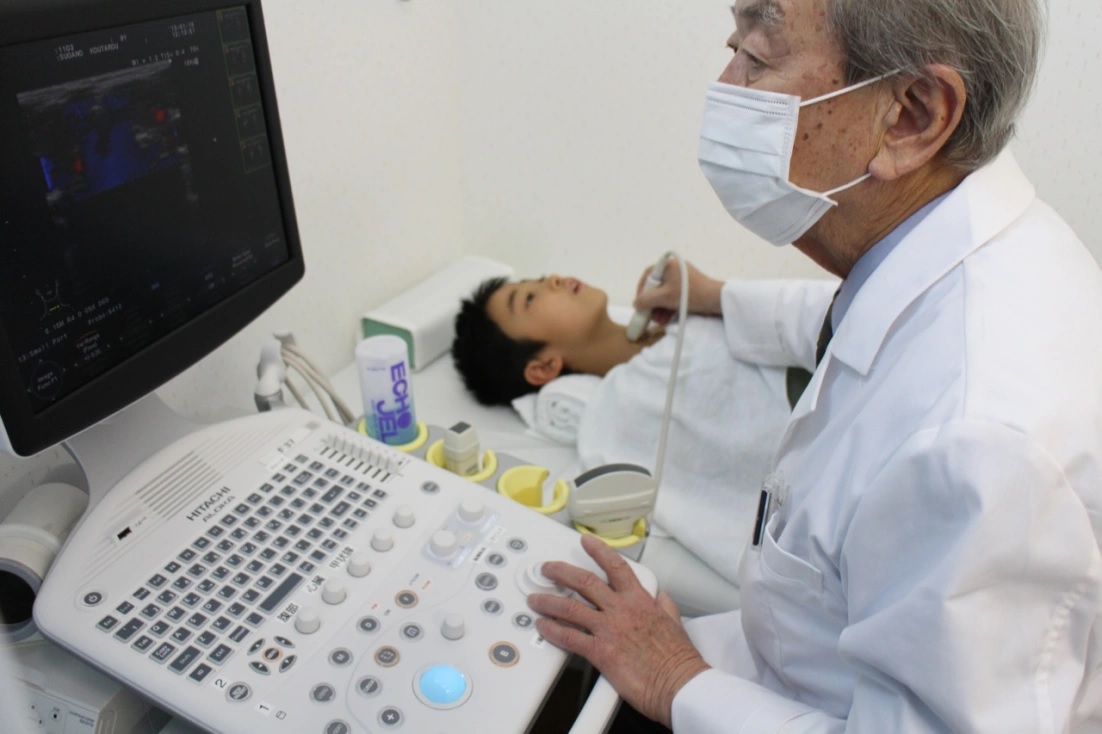
Childhood thyroid cancer cases confirmed in the Fukushima Health Management Survey and others
BY CITIZENS’ NUCLEAR INFORMATION CENTER · APRIL 5, 2023 https://cnic.jp/english/?p=6551
Fukushima Prefecture has been implementing thyroid gland examinations for children (born between April 2, 1992 and April 1, 2012) who were living in the prefecture at the time of the earthquake and nuclear disaster. The results are summarized in the table below: [on original]
In addition to the 295 children with thyroid cancer confirmed in the survey (excluding one with benign nodules), 43 other patients were identified outside of the tally in the cancer registry, bringing the total number of children aged 18 or younger with malignant or suspected malignant thyroid cancer who were living in Fukushima Prefecture at the time of the accident to 338. Note that the screening uptake rate at the age of 25 is low.
Surveys have found thyroid cancer in children at a rate dozens of times higher than normal.
Current State of Post-Accident Operations at Fukushima Daiichi Nuclear Power Station (Jun. to Dec. 2022)

State of the Plant Fukushima Now – Part 2, BY CITIZENS’ NUCLEAR INFORMATION CENTER APRIL 5, 2023 · By Matsukubo Hajime (CNIC)
The water temperature in the containment vessels and the spent fuel pools (SFPs) shows no great variation despite seasonal temperature changes. The state of releases of Xenon-135 (half-life roughly nine hours), released when uranium fuel undergoes fission, is also unchanged and it can therefore be estimated that the state of the reactors is stable. Further, according to an assessment by TEPCO in December 2022, around 10,000 becquerels per hour (Bq/h) of radioactive materials were being released to the atmosphere from the buildings (Fig.1 on original).
At the same time, decay heat has fallen greatly with the passage of time, and thus the volume of cooling water injected into the reactors has been reduced (falling from 7-10m3 per hour in May 2011 to 1.6-4m3 per hour as of December 2022).
The state of removal of spent nuclear fuel from the SFPs is summarized in Table 1 [0n original]. Spent nuclear fuel removal from Units 3 and 4 has been completed. However, as it has not been possible to remove control rods and other high-dose equipment stored in the SFPs, preparatory work has been underway for removal of this equipment from Unit 3 in the second half of FY2022 and removal from Unit 4 will commence in the second half of FY2024. Further, the removal of this equipment from Unit 3 was due to start from late October 2022, but this has now been rescheduled for early March 2023.
Preparations for the removal of fuel debris are also under way…………………………………..
The Unit 2 reactor core isolation cooling (RCIC) system was operating after the accident and for a further three days, including the time when the tsunami arrived at the plant. Uncovering the reason why it ceased functioning has been an issue, but it is inaccessible even now, after approximately 12 years underground………………………………………..
The changes in the average number of workers onsite per day is shown in Fig. 2 [on original] . As of December 2022, the number of workers was 4,410, about half the number it was at its peak. …………………………………
Contaminated water countermeasures at Fukushima Daiichi Nuclear Power Station (FDNPS) can be broadly divided into three areas: 1) Reduction of groundwater flowing into buildings, 2) Reduction of contaminated water flowing into the sea, and 3) Reduction of the toxicity of contaminated water. The main countermeasures to reduce water inflow into the buildings are, from higher elevations downward, ………………………………………………………
In the reduction of the toxicity of contaminated water, cesium and strontium are removed, and after the removal of impurities using a reverse osmosis (RO) membrane, radionuclides other than tritium are removed by the multi-radionuclide removal equipment…………………………………………
The frozen earth barrier consists of about 1600 30-meter freeze pipes buried in the ground, through which coolant at -30°C is circulated to freeze the surrounding soil. The effectiveness of the frozen earth barrier has been questioned since it was first installed, but since 2019 there have been several coolant leakage incidents.
Concerning the issue of releasing contaminated water into the ocean after ALPS treatment, TEPCO’s policy to release the water was authorized at the 25th Meeting of the Nuclear Regulatory Authority on July 22, and the construction was approved by the governor or Fukushima Prefecture and the mayors of both Okuma Town and Futaba Town in August. At present, construction of the release tunnel is ongoing, and the plan is to complete the construction during the first quarter of 2023. ………………………….. A fund of 30 billion yen has already been established as a measure against “adverse publicity.” Additionally, TV commercials, etc. are also being employed as “actions to foster understanding.” On the same day Chairman Masanobu Sakamoto of the National Federation of Fisheries Cooperative Associations released a statement saying, “We have not altered one little bit our opposition to the oceanic release.”
Meanwhile, Secretary General Henry Puna of the Pacific Islands Forum (PIF), an inter-governmental organization that aims to enhance cooperation among 15 countries and two regions of Oceania, announced in a statement on January 18 that PIF will demand a postponement of releases until it has become possible to confirm the safety of all involved [timetable of events shown on original] more https://cnic.jp/english/?p=6553
Fukushima Now Part 1: Railroading the Contaminated Water Release is Unacceptable!
BY CITIZENS’ NUCLEAR INFORMATION CENTER · APRIL 5, 2023, By Ban Hideyuki (CNIC Co-Director)
The Ministry of Economy, Trade and Industry (METI) and Tokyo Electric Power Holdings (TEPH) had decided on a policy of oceanic release of the contaminated water, which continues to build up at Fukushima Daiichi NPS, from an early stage and have been steadily proceeding with preparatory construction work for the release. This work has been proceeding despite written commitments to the National Federation of Fisheries Cooperative Associations and Fukushima Prefecture Federation of Fisheries Cooperative Associations in August 2015 that “(contaminated water) would not be released into the ocean without their agreement.”
This is the plan for how the release work will proceed. …………………………………………………………………..
This resulted in construction costs of 43 billion yen for the first four years and a release period of 30 years or more, a significant increase from the initial estimate of 3.4 billion yen and 88 months. However, the cost is based on an assessment of 800,000 tons, which differs from the current volume, but nevertheless the assessment that the oceanic release method is “cheap and fast” has been destroyed. Fishermen’s groups passed a special resolution at their general meeting in FY2022 to oppose oceanic releases, and their opposition remains unchanged.
………………………………………………………………….. Securing storage space for high integrity containers is a challenge
Wastewater collected during the ALPS treatment and its pre-treatment stage is stored in polyethylene high integrity containers (HICs). As of December 2022, there were 4,192 containers in storage. To prepare for an increase in wastewater, TEPH plans to expand the storage space by 192 units by June 2025 and a further 192 units by about the middle of 2026………………………………………………
As of June 2021, the Nuclear Regulation Authority had pointed out that there were 31 HICs with absorbed doses that had reached the limit of five mega-grays. That means the limit has been reached sooner than TEPCO had predicted, because, unlike TEPH, TEPCO evaluated absorbed doses from the sludge accumulated at the bottom of the waste effluent HIC. ………………………. Given that contaminated water will continue to be generated in the future, it is likely that securing storage space will become even more difficult. https://cnic.jp/english/?p=6562
Researchers simulate damage from nuclear weapons use in Northeast Asia

https://www3.nhk.or.jp/nhkworld/en/news/20230407_41/ A group of researchers from Japan and other countries have simulated direct casualties and delayed deaths that could be caused by the use of nuclear weapons in Northeast Asia.
Nagasaki University in western Japan and other bodies, including a US research institution, jointly conducted a simulation analysis taking into account nuclear strategies of countries concerned and situation in the region.
The joint research project is aimed at ensuring that nuclear weapons are never used again.
The researchers have looked at five possible cases of nuclear weapons use in Northeast Asia and ran a simulation of what could follow if nuclear weapons are used.
In one case, it is assumed that in the Korean Peninsula, three nuclear weapons are used by North Korea and the United States.
In another case involving two nuclear powers fighting over Taiwan, it models what might happen after a total of 24 nuclear weapons are used, including high-yield bombs.
The researchers have quantified the number of deaths based on an analysis of effects such as heat flow caused by a nuclear explosion and radioactive fallout.
Even if only one nuclear weapon is used, the simulation shows 220,000 people, or about 25 percent of the population of the targeted area, would die within several months.
The use of a large number of nuclear weapons, including high-yield ones, could result in deaths of 2.6 million people.
The researchers also simulated effects of firestorms which are multiple fires caused by heat flow merging over a large area driven by powerful wind forces created by the thermal updraft. They found that firestorms could cause a large number of casualties over a wide area.
Radioactive fallout could reach an extensive area depending on weather conditions. Up to 920,000 people could die of cancer over the course of a few decades.
Professor Suzuki Tatsujiro at Nagasaki University’s Research Center for Nuclear Weapons Abolition warns that misunderstanding and a lack of communication between rival nations could lead to the use of nuclear weapons. He says that even if only one is used, it would inevitably cause devastating damage.
Suzuki urges leaders of nuclear powers to face the potential risks and review their defense strategies that rely on nuclear deterrence.
India and Pakistan Must Negotiate Nuclear Responsibilities
South Asia Voices, by Ladhu R. Choudhary, April 7, 2023
In 2019, while addressing an election rally, Indian Prime Minister Narendra Modi stated a fiery public remark, “every other day they [Pakistan] used to say ‘we have nuclear button, we have nuclear button.’ What do we have then? Have we kept it for Diwali (a mega Indian festival celebrated with extensive use of firecrackers)?” His statement is just one example of India and Pakistan’s exaggerated rhetoric around their nuclear rivalry.
…………………………………………… responsible nuclear states should strategize to stigmatize the bomb. Most importantly, these statements undermine the essential ingredients of nuclear responsibilities.
Nuclear responsibilities are defined as a set of extraordinary obligations and reasoning of the nuclear weapon states to exercise restraint in nuclear posturing and proliferation activities to avoid nuclear crises and avert a nuclear arms race. A nuclear responsibilities framework demands that states prioritize behaviors that reinforce credible deterrence postures and doctrines, reduce nuclear risks, and create the conditions for disarmament. Given the catastrophic risks of escalation, the political leadership in both India and Pakistan should refrain from acts of nuclear irresponsibility and demonstrate their respect for nuclear safety and security norms.
………………………………………………. Existing South Asian Nuclear Culture Lacks Nuclear Responsibilities
When politicians in India and Pakistan remind one another of the nuclear button and equate nuclear weapons with Diwali firecrackers, they reinforce South Asian atomic culture. This atomic culture has facilitated the acquisition of nuclear technology with chauvinistic pride and a symbol of supreme power for political independence. It has limited space for negotiating potential threats of nuclear exchanges and shared responsibilities of hostile SNW. For instance, New Delhi and Islamabad have not been able to build robust institutional arrangements for Nuclear Confidence Building Measures (NCBMs).
India and Pakistan need a better cooperation record for joint nuclear doctrine formulations and identifying implementation procedures. Furthermore, their ambiguous doctrines, postures, and accidents may escalate nuclear instability. ……………………………… more https://southasianvoices.org/india-and-pakistan-must-negotiate-nuclear-responsibilities/
Nuclear fusion is a never-ending dream

. “The development of the toroidal [magnetic confinement] nuclear fusion reactor is totally blocked by three challenges:
One, abysmally high cost (trillions of yen more in the future?) and a mind-boggling long time (more than 50 years); two, gigantic and complicated systems (a mega-sized system cannot be handled unless simple); and three, the heat-resistant material and radiation-proof material for the reactor walls are not available on earth.”
BY CITIZENS’ NUCLEAR INFORMATION CENTER · APRIL 5, 2023, By Nishio Baku (CNIC Co-Director)
Green Transformation (GX) Basic Policy proposed by the Japanese government mentions nuclear fusion as one of the next-generation innovative nuclear technologies in its reference information. I doubted my ears when I learned that the Nuclear Energy Subcommittee of the ministerial Advisory Committee for Natural Resources and Energy, which drafted the policy, brought up nuclear fusion as one of the “innovative technologies” to be pursued.
It was a big surprise. That is the very nuclear fusion that, at the Second International Conference for the Peaceful Uses of Atomic Energy of September 1 through 13, 1958 in Geneva, Dr. H. J. Bhabha from India, who chaired the conference, flamboyantly predicted would take shape in 20 years. It has been 64 years since then. The government refers to this vintage technology as “innovative”.
During the decade of the 1980s, various Japanese universities received more budget than previously from the government for nuclear fusion research. The website of professor Takabe Hideaki, Institute of Laser Fusion, Osaka University, notes on September 10, 2014 that, during the days of the Second Oil Crisis, when Gekko XII [the experimental laser fusion apparatus at Osaka University] was completed, the government’s top-down initiative provided the university with a budget of 30 billion yen (in the value of the yen at the time), to build the laser system and a robust building for it.
I find this maybe a special case (another document I have with me says, of the fiscal 1984 national budget, 35 billion yen was given to the then Power Reactor and Nuclear Fuel Development Corporation and a total of 7 billion yen to universities). Uramoto Joshin, a former associate professor at the National Institute for Fusion Science, wrote in his retirement memoir “My Final Words as a NIFS Staff” (NIFS News, May 1998), that he was in a festive mood around the time when he joined the former Plasma Research Institute of Nagoya University, which was one of the founding bodies of the NIFS.
The boom faded, and in 1989, the Plasma Research Institute was reorganized as the National Institute for Fusion Science, an inter-university research institute, into which a part of the Heliotron Plasma Physics Laboratory at Kyoto University and a part of the Institute for Fusion Theory at Hiroshima University were incorporated. The technology that the government refers to is the same nuclear fusion.
In what respect can the nuclear fusion reactor be a “next-generation innovative reactor”? While there is no full-size nuclear fusion reactor, what would a “compact nuclear fusion reactor” look like?
Today, “private-sector nuclear fusion” by venture companies seems to be enjoying a global boom………………………………………………. the project did not seem very practical.
……………………………………………………………. Whatever the case, the ignition lasts only one instant.
How far will the muddy road continue?
This nuclear fusion was mentioned by Prime Minister Kishida in his administrative policy speech on January 17, 2022 with the cryptic reasoning that it would help achieve the 2050 goal of carbon neutrality. Using this as the basis, the government set up the Nuclear Fusion Strategy Expert Panel under the Integrated Innovation Strategy Promotion Council of the Cabinet Office.
The panel had its first meeting on September 30, where Takaichi Sanae, Minister of State for Science and Technology Policy, said: “I have a strong will to accelerate the efforts to commercialize nuclear fusion technology as far as possible.” However, the Innovative Reactor Working Group placed under the Nuclear Energy Subcommittee, states in its “Roadmap for Introduction” (August 9, 2022) that whether the construction of a prototype nuclear fusion reactor should start or not will be determined in the mid-2030s. What would “commercializing nuclear fusion” mean at this point?
I wonder how much longer this fusion boom will continue. “As I am leaving this institute, I breathe a sigh,” Associate Professor Uramoto said in his NIFS retirement memoir. “The development of the toroidal [magnetic confinement] nuclear fusion reactor is totally blocked by three challenges: One, abysmally high cost (trillions of yen more in the future?) and a mind-boggling long time (more than 50 years); two, gigantic and complicated systems (a mega-sized system cannot be handled unless simple); and three, the heat-resistant material and radiation-proof material for the reactor walls are not available on earth.”
For the cost, the Special Committee on the ITER Project of the Japan Atomic Energy Commission bragged about ITER in its report, “International Thermonuclear Experimental Reactor (ITER) Project Forecast” (May 18, 2001): “It is difficult to correctly estimate the cost required to realize a nuclear fusion reactor, …………………………………………………
Of the challenges Uramoto pointed out, the second one, “gigantic and complicated systems (a mega-sized system cannot be handled unless simple)” and the third one, “the heat-resistant material and radiation-proof material for the reactor walls are not available on earth” remain unsolved, despite the passage of so many years.
The pot is calling the kettle black
It is meaningless to compare nuclear fusion with nuclear power generation, but some say: “Nuclear fusion is clean.” In terms of the radioactivity released when a large accident occurs, nuclear fusion technology would emit less radioactivity than a conventional nuclear plant.
However, the daily releases of radioactive materials from nuclear fusion would be greater than those from a conventional nuclear power plant. Nuclear fusion is also more likely to leak tritium and radioactive gas. It will produce four times as much energy as nuclear fission while producing seven times as many neutrons. Workers in the fusion plant would be exposed to radiation, and people in the neighborhood would also be exposed due to sky shine. Plant equipment would be strongly radiated and easily embrittled, requiring frequent replacement, producing a huge amount of highly contaminated wastes……………………………………………. more https://cnic.jp/english/?p=6549
1 This Month

of the week – Shut Down Drone Warfare!


Tell the Ukrainian Government to Drop Prosecution of Peace Activist Yurii Sheliazhenko

Petition to revoke the licensing of the Near Surface Nuclear Disposal Facility (NSDF) at Chalk River. https://www.ourcommons.ca/petitions/en/Petition/Details?Petition=e-7247
To see nuclear-related stories in greater depth and intensity – go to https://nuclearinformation.wordpress.com
-
Archives
- April 2026 (103)
- March 2026 (251)
- February 2026 (268)
- January 2026 (308)
- December 2025 (358)
- November 2025 (359)
- October 2025 (376)
- September 2025 (257)
- August 2025 (319)
- July 2025 (230)
- June 2025 (348)
- May 2025 (261)
-
Categories
- 1
- 1 NUCLEAR ISSUES
- business and costs
- climate change
- culture and arts
- ENERGY
- environment
- health
- history
- indigenous issues
- Legal
- marketing of nuclear
- media
- opposition to nuclear
- PERSONAL STORIES
- politics
- politics international
- Religion and ethics
- safety
- secrets,lies and civil liberties
- spinbuster
- technology
- Uranium
- wastes
- weapons and war
- Women
- 2 WORLD
- ACTION
- AFRICA
- Atrocities
- AUSTRALIA
- Christina's notes
- Christina's themes
- culture and arts
- Events
- Fuk 2022
- Fuk 2023
- Fukushima 2017
- Fukushima 2018
- fukushima 2019
- Fukushima 2020
- Fukushima 2021
- general
- global warming
- Humour (God we need it)
- Nuclear
- RARE EARTHS
- Reference
- resources – print
- Resources -audiovicual
- Weekly Newsletter
- World
- World Nuclear
- YouTube
-
RSS
Entries RSS
Comments RSS
 nuclear-news