Japan wrestling with problem of compensation for victims of nuclear accidents
Panel begins debate on limit of compensation in event of nuclear accident http://www.japantimes.co.jp/news/2016/01/24/national/panel-begins-debate-limit-compensation-event-nuclear-accident/#.VqUt4Jp97Gh JIJI The Japan Atomic Energy Commission has started full discussions by experts on whether to limit the power plant operator’s liability to pay damage compensation in the event of a nuclear accident.

Currently, nuclear plant operators in Japan bear unlimited liability for compensation, but some experts demand that a ceiling be set for their responsibility.
The discussions are expected to be difficult, as limiting the liability would raise the problem of how to compensate affected people and businesses for the damage in excess of the limit.
For the March 2011 triple meltdown accident at Tokyo Electric Power Co.’s disaster-stricken Fukushima No. 1 plant, Tepco shoulders full liability for compensation under the nuclear compensation law.
But as Tepco alone cannot finance all the costs for compensation payments and decontamination work, the government set aside ¥9 trillion in assistance, which has been provided to the company through Nuclear Damage Compensation and Decommissioning Facilitation Corp., a public-private organization. Tepco repays the aid little by little.
Electric power industry people have been pushing for a cap on nuclear plant operators’ liability for compensation. “If the sky’s the limit for compensation, we cannot project an outlook for our nuclear energy business,” a senior official of a major power utility said.
In line with the government’s policy of continuing to use nuclear energy, an expert panel of the Japan Atomic Energy Commission started debate last year on any problems with the current compensation regime.
Some panel members argued for a limited liability system. “Shouldering risks that go beyond the limit of the private sector will impede fund procurement by electric power companies,” one member said.
On the other hand, a separate member said, “Limited liability is not an option, considering the current situation of Fukushima.”
There are also concerns that a narrower scope of responsibility for power companies could be detrimental to their commitment to safety.
With the panel divided sharply, a government official said no conclusion is expected at an early date.
The expert panel plans to produce a report on their discussions next year, and the government will subsequently start working on any necessary amendments to the nuclear compensation law.
Even if the nuclear compensation system is revised, past nuclear accidents will not be covered by a limited liability system.
Among countries that impose limits on an electric power company’s liability of compensation for a nuclear accident, the United States sets the maximum liability at $12.6 billion and Britain has a ceiling of £140 million ($199.7 million), according to the Japan Atomic Energy Commission. Under the U.S. system, if the scale of nuclear damage exceeds the limit, the president proposes a supplementary compensation program to the Congress.
France’s President Hollande visits India, hoping to market nuclear reactors
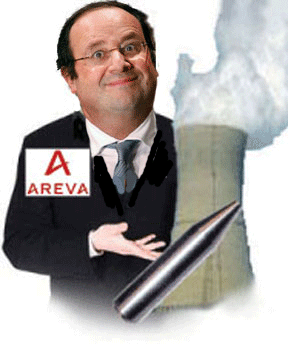 France Signals Rafale, Nuclear Progress as Hollande Visits India, Bloomberg, HeleneFouquet January 24, 2016 France signaled a state-to-state accord with India could be signed on Monday over a deal for 36 Dassault Aviation SA Rafale fighter jets, and that a six-year-old plan to build nuclear reactors in the South Asian nation would see some progress…………
The reactors are planned for Jaitapur, a coastal town in India’s western province of Maharashtra. Areva was seeking further clarity from India on its nuclear liability law before moving ahead with what would be India’s biggest nuclear plant.
The agreement India and the U.S signed recently over insurance-related issues for nuclear plants will help in overcoming certain hurdles, Royal said.
Chinese President Xi Jinping likely to attend nuclear summit in US
Chinese President Xi Jinping tipped to attend nuclear summit in US, South China Morning Post, Sidney Leng sidney.leng@scmp 24 Jan 16 Despite disagreement on North Korea, Beijing and Washington ‘have much common ground’President Xi Jinping is expected to make his second visit to the United States in less than a year to attend the Nuclear Security Summit in Washington in March, according to national defence and military experts from both countries.
During Xi’s state visit to the US in September, the two countries agreed to deepen cooperation on nuclear security. Beijing has not confirmed Xi’s attendance, but several Chinese academics and analysts at a China Energy Fund Committee conference in Hong Kong yesterday said he would probably go.
A White House fact sheet dated September also said the two countries might hold a meeting before the summit to discuss nuclear security.
“The two countries share common interests in intercepting nuclear terrorism, so I think there is plenty of room for cooperation on it, among other issues,” said Zhang Tuosheng, from the China Foundation For International and Strategic Studies.
READ MORE: China will work with US to implement Iran nuclear deal, Xi tells Obama……..
Chinese foreign policy strategists say China has already put enough pressure on North Korea, made denuclearisation a priority in the region and insisted on addressing the issue through dialogue.
“If the six-party talks [involving the two Koreas, Japan, China, Russia and the US] don’t work, then I propose trilateral dialogues, such as ones between China, the US and South Korea. The most important thing is managing a crisis,” Zhang said. http://www.scmp.com/news/china/diplomacy-defence/article/1904776/chinese-president-xi-jinping-tipped-attend-nuclear
Decontamination of minds
A Japanese organization called “declaration of safety in Fukushima” (福島 安全 宣言) or something like that launched a campaign for the “decontamination of minds” (心 の 除 染) to convince that radioactivity is safe.
In a video taken in the twenty kilometers zone, sill evacuated, a person takes radiation readings and states that it is safe as it is well below 100 mSv. But the video avoids the most contaminated areas and confuses microsieverts and microsieverts / hour. When the Japanese authorities say there is no risk below 100 mSv, it is on the whole life span. To compare that value to microsieverts per hour or millisieverts per year is meaningless.
There are also videos of pseudo-scientific conferences to affirm that radiation in Fukushima is safe. The audience seems very small.
The group calls for the lifting of the evacuation orders and the return of inhabitants, and also for the restart of the declared safe nuclear reactors.
Another similar initiative, already presented by the Blog of Fukushima, has been to make children to pick up garbage along the highway 6 that passes thru the forbidden zone. This time, it was an organization called “Happy Road Net” which was the organizer. http://happyroad.net/wordpress/wp-content/uploads/2015/09/Image150915145225.pdf
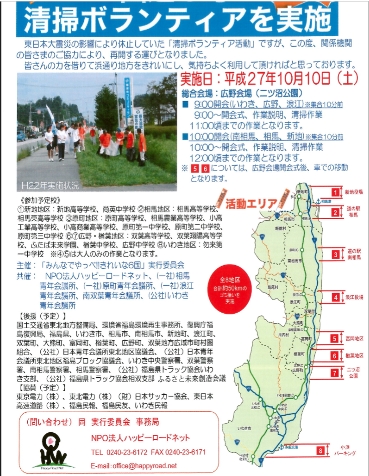
Let us remember that it is internationally recognized that there is no safe limit for radiation and that each radiation dose has an impact that is proportional to it. In such a context, it is recommended that the radiation exposure should be justified by a benefit. What was the benefit for these children?
It’s a safe bet to say that the decontamination of minds will be no more effective than the decontamination of the contaminated territories was …
Source: http://fukushima.eu.org/la-decontamination-de-lesprit/
Radioactive Wild Monkey Poops from Namie-city, Fukushima
January 23, 2016
An example of bio-accumulation of radioactive material in Fukushima:
According to the following post, wild monkey poops from Namie-city, Fukushima had more than 150,000Bq/kg in terms of radioactive Cs137 & Cs134.
Cs137: 133987 Bq/kg
Cs134: 25186 Bq/kg
K40: 225 Bq/kg
The surrounding ground surface was about 500~600cpm.
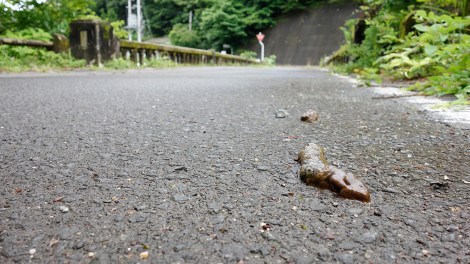
More details at the Japanese blog :
http://www.autoradiograph.org/info/%E6%96%B0%E4%BD%9C35%EF%BC%9A%E3%82%B5%E3%83%AB%E3%81%AE%E7%B3%9E2/
Japan’s nuclear regulator needs to strengthen inspections, says IAEA

 IAEA: Japan’s nuclear watchdog needs to strengthen inspections, staff competency http://www.japantoday.com/category/national/view/iaea-japans-nuclear-watchdog-needs-to-strengthen-inspections-staff-competency By Mari Yamaguchi JAN. 23, 2016 TOKYO —
Japan has improved its nuclear safety regulation since the 2011 Fukushima disaster, but it still needs to strengthen inspections and staff competency, a team of experts from the International Atomic Energy Agency said Friday.
It was the first IAEA review for Japan’s Nuclear Regulation Authority since it was established in 2012. Japan adopted stricter safety requirements for plant operators, but a law regulating on-site inspections remained mostly unchanged.
The 17-member team, which concluded a 12-day inspection that included the wrecked Fukushima plant, said the Nuclear Regulation Authority demonstrated independence and transparency — crucial elements lacking before the disaster, when an earlier agency was in charge.
The Fukushima Dai-ichi nuclear power plant was hit by a massive earthquake and tsunami in March 2011, triggering triple meltdowns. Government, parliamentary and private investigations have blamed complacency about safety, inadequate crisis management skills, a failure to keep up with international safety standards, and collusion between regulators and the nuclear industry.
The IAEA inspection team urged the Nuclear Regulation Authority to enhance inspection competence and the government to amend its nuclear safety law to make on-site safety checks more effective and flexible.
Mission leader Philippe Jamet, a French regulatory commissioner, said Japan’s inflexible inspection rules do not allow inspectors to move freely at nuclear facilities or respond quickly when there is a problem.
“What we found is that the system that is regulating, that is defining the framework of inspection is very complex and very rigid,” Jamet said at a news conference.
Japan has a comprehensive framework but “it doesn’t give enough freedom for the inspectors to react immediately and to provide results,” he said. “At any time and for any plant, inspectors should be allowed to go where they want.”
A final report by the team is expected in about three months.
Japan’s top nuclear commissioner, Shunichi Tanaka, acknowledged the shortcomings and said, “We have to focus on tackling the challenges of inspection system and human resources.”
Masakazu Shima, a Japanese regulator who assisted the inspection team, said the inspection issue was also raised by an earlier IAEA mission in 2007 but Japan never took action.
Renewable energy development hindered in Japn
The powerful nuclear industry, frozen in the immediate aftermath of the disaster, has since reasserted itself.
the so-called “nuclear village” — a term applied to the various intersecting groups with an interest in the industry — has deliberately thwarted renewables progress, through things like grid access refusal and misrepresenting costs.

Despite nuclear fears, Japan solar energy sector slow to catch on, Aljazeera America January 23, 2016by Joe Jackson FUKUSHIMA, Japan — Morihiko Shimamura has a vision for the future, depicted in a cartoonish community map on his partially biomass-powered truck. In the drawing, solar panels sit atop self-sufficient buildings, as waterways generate hydropower alongside wind turbines, and transmission cables are buried underground.
As he drives around this large prefecture, teaching schoolchildren how to make rudimentary photovoltaic cells, the 57-year-old cofounder of an umbrella of not-for-profit sustainability organizations advertises his optimistic vision.
But current reality is very different. The landscape here still bears the scars of a 2011 earthquake, tsunami, and subsequent nuclear reactor meltdown. Piles of black bags containing contaminated topsoil litter hillsides; display panels along an expressway show high radioactivity readings; and some villages remain ghost towns, largely off-limits to residents.
“I want people to know that the technology, we can make it, and then also we can make by ourselves the energy … [and] create the society without nuclear plants,” Shimamura explained through a translator.
Local officials endorse his plan, in theory. They too want Fukushima to get all its energy from renewables by 2040. Solar panels are already visible on rooftops, in backyards and open spaces, while green enterprises and research institutes are encouraged to locate there. Nor is the prefecture is alone in its hope to use the tragedy as the catalyst for change. In opinion polls, a majority of Japanese citizens consistently support the goal of abandoning nuclear power while harnessing more renewable energy. Former prime ministers, leading businessmen and a one-time nuclear industry executive are among those urging rapid transformation. Continue reading
Big anxieties with China and Russia’s plans for floating nuclear reactors
 China and Russia plan to cover the oceans with floating nuclear power plants http://www.marketwatch.com/story/china-and-russia-plan-to-cover-the-oceans-with-floating-nuclear-power-plants-2016-01-21 By JURICADUJMOVIC Jan 21, 2016
And the big problem: Human memory is short, even when it comes to disaster
In an effort to become the largest exporter of nuclear-energy technology, China has started building a reactor housed in a floating vessel, which is scheduled to be finished by 2020. If that sounds alarming, brace yourself: More than 100 additional nuclear reactors are planned for the next decade.
The idea behind this “micro” 200-megawatt reactor (1 megawatt can power 1,000 homes) was to create a mobile energy source for offshore oil and gas exploration, as well as provide electricity, heating, and facilitate desalination for islands and coastal areas.
I don’t know about you, but this certainly gets my Geiger counter beeping with unease. While some dismiss the danger, saying floating nuclear reactors aren’t all that dangerous — nuclear-powered submarines and aircraft carriers basically fit that description — the truth remains that it’s still a freaking nuclear reactor. History taught us the price we have to pay every time “highly unlikely” disasters happen, and now that another 100 of these will be built in the coming decade, the likelihood of yet another nuclear disaster will increase.
The Chinese government did its best to cover up the disaster, silencing local and foreign journalists. Now imagine if it were a floating nuclear reactor. Nothing would change, apart from more dire consequences and even more censorship.
Also looking to join the fun in the radioactive sun is Russia’s Akademik Lomonosov. This floating nuclear power plant will be ready for deployment in October. It’s going to be used to power port cities, industrial infrastructure, and oil and gas drilling rigs and refineries, which, according to Russian Deputy Prime Minister Dmitry Rogozin, will prove to be a great asset in Arctic exploration. The ship is 144 meters long with two reactors capable of producing 70 megawatts of electricity.
Although they have their fair share of nuclear “mishaps,” the Russians are kicking their nuclear efforts up a notch: Akademik Lomonosov is only the first of many floating nuclear power plants that will be built. Vessels will also be available to rent. So far, 15 countries have shown interest in having these power plants for their own use.
Here’s where things get scary: Imagine that out of hundreds of these floating nuclear power plants, just a dozen or so become targeted by terrorists or a military force. Regardless of the scenario, the resulting tragedy would be felt worldwide.
Of course, I could be wrong. Perhaps we’re ushering in a sort of a nuclear renaissance, an age in which nuclear energy really proves to be a safer and better solution than fossil-fuel sources.
But I doubt it. Humanity has proven that it understands the dangers of something only when the worst has already happened, and even then just for a brief while. ..
You can thank the Chernobyl disaster for 20 years of stagnation (1986-2006) during which time fewer nuclear power plants were built. In 2007, however, humanity tried its luck with nuclear energy again. Following a short increase, we saw yet another decline in 2011. Why? You guessed it: That was the year of the Fukushima disaster, and it took the world less than five years to forget the effects of the meltdown. It’s time for another adventure!
But what of Fukushima? As of 2013, the site in Japan remained highly radioactive, with some 160,000 evacuees still living in temporary housing, and tracts of land that will likely remain unsuitable for farming for centuries. The difficult cleanup job will take 40 years or longer to complete, and will cost tens of billions of dollars. Following the disaster, Japan shut down 54 nuclear power plants.
We’ve seen what happens when things go awry with just one nuclear power plant. Now, with hundreds in the making, will we live long enough to finally learn from our mistakes? Let’s hope so.
Kansai Electric plans to restart another nuclear reactor
Japan to restart another nuclear reactor Jan. 29, 1st on MOX fuel, Kyodo News, TOKYO, Jan. 21, Kyodo A nuclear plant in Fukui Prefecture is expected to restart operations on Jan. 29, the first that will run on uranium-plutonium mixed oxide fuel under new safety regulations, sources close to the matter said Thursday.
Final arrangements are under way to restart the No. 3 reactor of Kansai Electric Power Co.’s Takahama plant, the third such case after Japan returned to nuclear power generation last summer following the loss of nuclear energy amid safety concerns in the wake of the 2011 Fukushima disaster.
Last April, a district court banned Kansai Electric from restarting the Nos. 3 and 4 reactors of the Takahama plant citing safety concerns. But since the court lifted the injunction last month, the utility is now making preparations to reactivate the two reactors on the Sea of Japan coast, with the restart of the No. 4 unit planned for late February…..http://english.kyodonews.jp/news/2016/01/393890.html
No response fro India’s PM Modi to Shiv Sena’s report on Jaitapur nuclear plant
PMO yet to respond to Shiv Sena’s report on Jaitapur nuclear plant By PTI | 21 Jan, 2016, MUMBAI: Shiv Sena is yet to receive a response from the Prime Minister’s Office (PMO) on a report it sent more than a month ago detailing “adverse” impact the proposed Jaitapur nuclear power plant would have on the green belt in Maharashtra’ Konkan region.
Nothing Resolved at Fukushima, Japan Must Not Sponsor the Olympic Games

I strongly support “an honorable retreat from the 2020 Olympic Games” which is called for by former PM Hatoyama and a former Japanese Ambassador to Switzerland Mitsuhei Murata.
Hatoyama says, in an interview with the Japan Times, “In a situation in which nothing has been resolved at #Fukushima, Japan must not sponsor something like the Olympic Games.”
Hatoyama also said “There are still many inhabitants of the Tohoku region living in temporary housing. Moreover, the government has yet to admit the truth about the accident despite its having been more severe than Chernobyl. It is regrettable that the government has failed in its duty to inform both the people of Japan and the world about the true situation. The government even goes so far as to deny the increased incidents of thyroid cancer in the Fukushima region are connected to radiation releases from the multiple meltdowns.”
Hatoyama believes the government claimed the situation at nuclear plant was “under control” in order to lure the 2020 Olympic Games to Tokyo. “The government was successful in this ploy,” he says, “but this was a complete lie. Far from having been under control then, it is still not under control even now. This is a grave situation.”
He also shared interesting comments about Okinawa and the US base issues in the following exclusive interview with the Japan Times.
Hatoyama dreams of a Japan anchored within a united Asia
“I wish to apologize to the Japanese people for having betrayed their expectations,” says Yukio Hatoyama halfway through our interview, lowering his head and bowing deeply.
Hatoyama, prime minister for nine months of the Democratic Party of Japan’s three years in power between 2009 and 2012, is discussing the reasons behind his resignation in June 2010 — specifically, his failure to live up to his party’s promise to block the contentious U.S. Marine Corps base construction now underway at Henoko in Okinawa.
Recently, the former DPJ leader has been in the news for other mea culpas in Nanjing and Seoul — apologies made, he says, on behalf of Japanese for colonial-era crimes in Asia. These unsanctioned trips have incensed the ruling Liberal Democratic Party, which has painted Hatoyama as a charlatan and even a traitor for his foreign escapades.
For those having trouble placing Hatoyama among the three DPJ figures who served as prime minister in that brief, heady period when power in postwar Japan changed hands, he is the one who led the DPJ to that historic victory. You know — the “alien.”
Hatoyama, now 68 and retired from politics, has never been able to shake that nickname. Coined by the domestic media in 2001 during his first stint as DPJ leader, the foreign press had a field day with Hatoyama’s extraterrestrial appellation, rejoicing in the fact that they finally had a Japanese leader who stood out from the crowd.
But what was it that made Hatoyama appear so otherworldly? True, his saucer-like eyes did give him a vague resemblance to E.T., but his nickname was not just the product of his looks and his manner; it also owed much to his proposals — proposals that were and remain anathema to Japan’s conservative establishment.
But how did Hatoyama, who came from a well-known, politically conservative family, become a maverick? In an exclusive interview with The Japan Times, Hatoyama discussed a range of issues, including Okinawa, the relationship between the Fukushima No. 1 disaster and the 2020 Tokyo Olympic Games, and his proposal for the creation of an “East Asian EU.” He began by explaining the circumstances that led him to resign the prime minister’s post in 2010 after only nine months in office.
“The DPJ, of which I was leader, proposed a revision of the Japan-U.S. Status of Forces Agreement in our manifesto for the 2009 House of Representatives election. We also proposed the realignment of the U.S. military in Japan, including a review of the state of U.S. bases,” he explains. “As for the relocation of the U.S. Marine base to Henoko, I personally said that at the very least, it should be moved outside (Okinawa) Prefecture. However, as soon as the DPJ took power, bureaucrats close to the U.S. in the Foreign Ministry and Defense Ministry moved to crush my proposal.”
In the end, Hatoyama’s idea went nowhere, and Henoko was confirmed as the proposed site for the new base. Many Okinawans — and DPJ voters — felt betrayed, and the party began to fear defeat in the Upper House elections of July 2010. “So I decided to resign,” Hatoyama confesses. “There was no excuse.”
During his time in office, Hatoyama also emphasized the need for a less lopsided Japan-U.S. relationship.
“I thought that as prime minister, it was only natural for me to seek an equal relationship with the United States. However, there are many (Japanese) politicians and bureaucrats who believe that because Japan is dependent on the U.S. in so many ways, it isn’t appropriate to seek an equal relationship. Once again, my proposal ended in failure.”
This was the first time in the postwar period that a Japanese prime minister had made such a demand. Hatoyama even dared suggest that Japan’s security could be achieved without a permanent U.S. troop presence. None of this was welcomed by those, on both sides of the Pacific, long accustomed to Japan’s subservience to U.S. interests.
Hatoyama was born in 1947 and graduated from the University of Tokyo before going to earn a Ph.D. in industrial engineering at Stanford. Upon graduation, he initially pursued an academic career, but later decided to run for the House of Representatives in 1986.
His lofty aim was to “restore sovereign power to the people, breaking from a system dependent on the bureaucracy,” he says, and to “transform Japan from a centralized state to one of regional and local sovereignty, and from an insular island to an open maritime state.”
During his campaign, Hatoyama took advantage of his experience as a researcher and garnered public attention with his unique appeal for “a scientific approach to politics.” Following his election, he quickly became a controversial figure for, among other things, revealing the huge scale of political campaign funding the LDP was receiving from business interests — even though he was a member of the party at the time.
“I eventually left the Liberal Democratic Party because of repeated incidents involving money and politics, such as the Recruit insider-trading and corruption scandal of 1988 and Shin Kanemaru’s huge tax evasion affair of 1992,” Hatoyama says. “Political reform was urgently called for, but the LDP was unwilling to act.”
A messy political realignment soon followed, eventually leading to the creation of the current iteration of the Democratic Party of Japan in 1998. Hatoyama went on to lead the party between 1999 and 2002, and again from May 2009. The DPJ grew steadily until finally, in September 2009, it succeeded in ousting the scandal-tainted LDP.
Hatoyama became Japan’s 93rd prime minister, though he would not remain so for long. Government bureaucrats, long accustomed to running the country behind the scenes, acted quickly to undermine his administration and hasten its demise.
Hatoyama says that Defense Ministry officials attempted to scuttle his plan to relocate the U.S. Marine Corps’ Futenma air base outside of Okinawa by claiming that any replacement facility must be located within 65 miles (105 km) of the marines’ Northern Okinawa Training Area. “The bureaucrats and ministers who should have been doing their best to support me were in fact attempting to resolve the matter by supporting the U.S.,” Hatoyama says.
The 65-mile requirement effectively precluded moving the base off the main island of Okinawa, which is a convenient 70 miles long. Yet the source of this apparent requirement remains elusive. Hatoyama says the Defense Ministry simply claimed that this figure was included in a U.S. military document. “Whether or not this requirement was expressly stated in the document remains unclear even now,” he notes.
But what about the U.S.? Were American officials also involved in the attempt to derail Hatoyama’s base relocation plans? Apparently not, Hatoyama says.
“No documents on the U.S. side support the claim of Defense Ministry officials. Thus, it can be said their claim was groundless,” he explains. “It’s possible it was just their way of forcing me to abandon my proposal. However, when we consider the feelings of the Okinawan people, there’s no way they would grant permission for the base to be relocated within Okinawa.”
At this point in the interview, Hatoyama bowed and offered his apology.
Another blow to the fledgling DPJ administration came in December 2009, when it was revealed that Hatoyama had received some ¥1.2 billion in political donations that had been improperly reported. Most of the money came from his mother, the wealthy heiress to the Bridgestone empire, though ¥400 million of this was listed as coming from fictitious donors — including some who were deceased.
While Hatoyama denied personal knowledge of the donations, he later apologized to the nation for the scandal and promised to pay more than ¥600 million in gift taxes on donations made to him by his mother that were first deemed as “loans.” Hatoyama recognizes the major impact this issue had on his tenure as prime minister, admitting, “The political donations I received from my mother were the second major reason I had to resign.”
Prosecutors declined to bring charges against Hatoyama, citing insufficient evidence of criminal activity. They did, however, indict two of his former secretaries, resulting in a ¥300,000 fine for one and a suspended sentence for the other. While no question of corporate bribery or political favors was involved, the incident nevertheless served to raise questions in the public’s mind about just how different the DPJ was from the money-tainted politics of the long-ruling LDP.
The media was unforgiving. After all, Hatoyama had already managed to upset both the establishment media and their new-media competitors. The former fought against his proposal to open up the prime minister’s news conferences to journalists from outside the cozy “press club,” and the latter were angry after he failed to follow through on that pledge.
“When I became prime minister, I tried to abolish the press-club system, which had become a vested interest for its members,” Hatoyama explains. “However, I was subject to a fierce counterattack.”
One club-affiliated reporter told Hatoyama that the prime minister’s press conferences were not something he was in charge of but, rather, something the press club sponsored.
Although by March 11, 2011, Naoto Kan was prime minister, Hatoyama was still a member of the House of Representatives, and the multiple disasters — especially the nuclear meltdowns at Fukushima No. 1 plant — affected him deeply. In the December 2011 issue of the magazine Nature, Hatoyama co-authored an article expressing his concerns about both the radioactive and political fallout from the accident.
Titled “Nationalize the Fukushima Daiichi atomic plant,” Hatoyama first pointed out the need “to know precisely what happened (on March 11, 2011) and what is continuing to happen now.” He further argued that only when all the evidence relating to the accident had been gathered and made public “will the world be able to have faith in the containment plan developed by Tepco or be able to judge how it should be modified.”
Hatoyama and two fellow Diet members formed a committee to conduct an independent investigation of the accident. The group reached two major conclusions, outlined in the Nature article. First: “The Fukushima Daiichi nuclear power plant must be nationalized so that information can be gathered openly. Even the most troubling facts should be released to the public.” Second: “A special science council should be created to help scientists from various disciplines work together on the analyses. That should help to overcome the dangerous optimism of some of the engineers who work within the nuclear industry.”
Although Hatoyama is no longer a Diet member, he has not lost interest in this issue. Recently, he joined former Japanese Ambassador to Switzerland Mitsuhei Murata in calling for “an honorable retreat from the 2020 Olympic Games.” Echoing Murata, who was also present at the interview, Hatoyama says, “In a situation in which nothing has been resolved at Fukushima, Japan must not sponsor something like the Olympic Games.”
Hatoyama elaborates: “There are still many inhabitants of the Tohoku region living in temporary housing. Moreover, the government has yet to admit the truth about the accident despite its having been more severe than Chernobyl. It is regrettable that the government has failed in its duty to inform both the people of Japan and the world about the true situation. The government even goes so far as to deny the increased incidents of thyroid cancer in the Fukushima region are connected to radiation releases from the multiple meltdowns.”
Hatoyama believes the government claimed the situation at nuclear plant was “under control” in order to lure the 2020 Olympic Games to Tokyo. “The government was successful in this ploy,” he says, “but this was a complete lie. Far from having been under control then, it is still not under control even now. This is a grave situation.”
Hatoyama’s change of mind is significant because as prime minister in October 2009 he had given a speech in Copenhagen in support of Tokyo’s failed bid for the 2016 Games. At the time, he sought to promote a new image of the Olympics centered on environmental protection, held in harmony with nature and celebrating simplicity.
March 11, 2011, however, changed everything. Again, like Murata, Hatoyama stresses that he is not opposed to the Olympics per se, but asks: Why now, and why Tokyo — especially in the absence of any pressing need to do so? Hatoyama nods in assent when Murata states: “At this point there is no other solution than to stage an honorable retreat from the games. Failure to do so will ultimately lead to a disgraceful retreat, dishonoring our country. The time to act is now!”
Hatoyama’s reservations about Japan’s future are not limited to either Fukushima or the Olympics. Politically and militarily, Hatoyama believes Japan is moving in an ever more dangerous direction.
“Prime Minister (Shinzo) Abe’s recent passage of the collective security bills has made it possible for America to call upon Japan to participate in its wars,” he says. “However, the Constitution states that Japan will never again wage war and, accordingly, rejects the threat or use of force as means of settling international disputes.”
He continues: “Given this, I deeply regret that the road to our participation in war has been opened once again. It may be presumptuous of me to say this now that I am no longer a politician, but in light of the wrong direction our country is currently heading in, I earnestly hope for an end to the Abe regime.”
Just as relations between Tokyo and Beijing were sinking to new lows over historical and territorial issues, Hatoyama infuriated the Abe government with his decision to visit Nanjing in January 2013. At the Nanjing Massacre Memorial Hall, he bowed and offered a silent prayer, later explaining, “As a Japanese, I feel responsible for the tragedy, and I am here expressing my sincere apology.”
While in Nanjing, Hatoyama also urged the Japanese government to acknowledge the dispute between the two countries concerning sovereignty of the islands known the Senkakus in Japanese and Diaoyu in China. “The Japanese government says there are no territorial disputes, but if you look at history, there is a dispute,” he says.
Hatoyama’s comments led Japanese government officials to criticize him for admitting the existence of a territorial dispute with China, something they adamantly deny. The defense minister at the time went so far as to use the word “traitor.”
“If his remarks have been politically used by China, I’m unhappy,” said Itsunori Onodera. “At that moment, the word ‘traitor’ arose in my mind.”
In March 2015, Hatoyama made another controversial trip, this time to Crimea, where he expressed his belief that Japan should “normalize” relations with Russia by lifting sanctions imposed after Moscow’s annexation of the Ukrainian territory. Hatoyama defended the referendum in the region as constitutional, stating, “Crimea wasn’t annexed unilaterally under pressure from Russia. In fact, people reached a conclusion based on their own strong will.”
Once again, Hatoyama’s remarks earned him the condemnation of the Japanese government. “It’s unthinkable that such action and comments came from a person who was once prime minister,” said Chief Cabinet Secretary Yoshihide Suga. Suga also described Hatoyama’s behavior as “extremely imprudent.”
In August 2015, just prior to Prime Minister Abe’s statement commemorating the 70th anniversary of the end of World War II, Hatoyama visited the Seodaemun Prison History Hall in Seoul. He knelt down in front of a memorial stone to apologize to Korean independence activists jailed, tortured and executed during Japan’s colonial control of Korea from 1910 to 1945.
“In the hope that no such mistake is made in the future, I regard, in a spirit of humility, these irrefutable facts of history, and express here once again my feelings of deep remorse and state my heartfelt apology,” he said.
Though Hatoyama’s actions may seem quixotic or even deliberately provocative to some, they are best understood through the prism of his world view, which stands in stark contrast to one of the guiding principles of modern Japan in the years following the Meiji Restoration. Promoted by the famous Meiji educator Yukichi Fukuzawa, this principle is known as Datsu-A Ron or the “Goodbye Asia doctrine.” Fukuzawa maintained, “It is better for us to leave the ranks of Asian nations and cast our lot with the civilized nations of the West.”
While not turning his back on the West, Hatoyama nevertheless seeks to redirect Japan’s focus away from the U.S. and back to its geographical location in Asia. He imagines a Japan at peace with its neighbors — from Russia in the north to China and South Korea — and at ease with its position on the edge of the continent.
With this dream in mind, Hatoyama created the East Asian Community Research Institute in March 2013, with the ultimate goal of creating something resembling an East Asian EU. With membership open to the general public, the institute, through its educational arm, Sekai Yuai Forum, holds lectures and other events to promote Hatoyama’s vision.
All of which brings us back to the issue of the U.S. military presence on Okinawa. Hatoyama continues to be concerned about the struggle of the Okinawan people against the construction of the new U.S. base at Henoko. This led to a series of trips to Okinawa seeking a solution to this intractable problem. As recently as November, Hatoyama visited the island to encourage the anti-base demonstrators at Henoko.
Hatoyama envisions a future for Okinawa not as a “keystone of the Pacific” for the U.S. military but as a “keystone of peace” for the countries of Asia. He has called for the creation of an “East Asian Community” headquartered in Okinawa and composed of the 10 members of the Association of Southeast Asian Nations plus Japan, China and South Korea.
“It is important for the countries of East Asia to become self-reliant, helping one another by developing win-win relationships,” he explains. “Should, however, they engage in a military arms race, it would only lead to a decline in deterrent power.”
“If Europe can do it,” says Hatoyama, pointing to the continent’s postwar integration, “there is no reason East Asia can’t.”
Source : Japan Times
http://www.japantimes.co.jp/community/2016/01/20/our-lives/hatoyama-dreams-japan-anchored-within-united-asia/#.VqFRnFLzN_k
Special credits to Mari Inoue & Libbe Halevy
Nuclear waste deals that fell flat, between Toshiba, USA and Mongolia
 The elephant in the room for Toshiba is nuclear http://www.japantimes.co.jp/news/2016/01/16/national/media-national/elephant-room-toshiba-nuclear/
BY PHILIP BRASOR THE JAPAN TIMES, JAN 16, 2016
Japanese press outlets often cover scoops from competing outlets, but it’s rare to build on a competitor’s story with original reporting, especially when the scoop is a few years old. In December, the weekly magazine Aera, which is affiliated with the Asahi Shimbun, ran an article about a secret meeting that took place between representatives of Japan, Mongolia and the United States almost five years ago. This meeting was first reported by Haruyuki Aikawa in the May 9, 2011, issue of the Mainichi Shimbun.
What interested Aera reporter Atsushi Yamada about the article was Aikawa’s assertion that Toshiba Corp. was on hand for the negotiations. In 2006, Toshiba had bought a majority share in the American company Westinghouse, a manufacturer, like Toshiba, that started out in the home electronics field and eventually expanded into nuclear power plant construction. Japan said it would buy uranium mined in the central Asian country and in return Mongolia would tap Japan’s nuclear energy expertise in building power plants and, more significantly, nuclear fuel reprocessing facilities that would incorporate the acceptance of high-level nuclear waste from Japan and other countries.
Though the Mainichi story received little attention in Japan or the U.S., it was translated and disseminated in Mongolia, thus leading, only three months after the 2011 nuclear meltdown in Fukushima, to citizen protests against the deal, which opponents said would turn their country into a “toilet” for the world’s nuclear waste. Later, the Mongolian government said it might be difficult for it to accept this waste.
Yamada read subsequent emails between Toshiba’s president at the time, Norio Sasaki, and an official of the U.S. Dept. of Energy, which said that negotiations with Mongolia should continue and that any further arrangements be made in a confidential manner. Toshiba’s public relations department confirmed the existence of the emails to Yamada but denied that Toshiba had asked the Mongolian government to receive outside nuclear waste. The negotiations, it said, had more to do with “building on the system of nuclear nonproliferation.”
Aikawa told Yamada that while ostensibly the negotiations were between the three governments, the plans for the deal were drawn up by the U.S. and Toshiba with the aim of selling nuclear power plants to emerging economies under a scheme called Comprehensive Fuel Service. According to this scheme, vendors assure potential customers that they will handle any future nuclear waste produced by power plants the customers buy, which is why Mongolia’s acceptance of such waste is so important. Due to local resistance, neither the U.S. nor Japan has anywhere to dump spent fuel, even their own.
The reason Yamada became so interested in this topic years after the fact is that in the meantime, Toshiba has been caught up in financial scandals that have brought the company to its knees, and he wanted to explore the connection between Toshiba’s nuclear energy business and its fiscal woes.
The connection itself is not a secret. Toshiba spent almost ¥600 billion to buy its share of Westinghouse, which at the time of the purchase was only worth about ¥250 billion. The extra “goodwill” money (norendai) was in anticipation of future revenues that would accrue as Toshiba expanded its nuclear energy business both in Japan and throughout the world with Westinghouse as its “trump card.” But then Fukushima happened, putting a serious damper on demand for plant construction.
The revenues Toshiba envisioned didn’t materialize, and the norendai became a huge liability it tried to hide through bookkeeping. Sasaki, his predecessor and his successor are all now being sued by Toshiba’s management for ordering improper accounting practices after Nikkei Business reported that Toshiba was violating Tokyo Stock Exchange regulations regarding the disclosure of a subsidiary’s losses.
However, at the end of December, the Financial Services Agency, in its investigation of the accounting scandal, did not find Toshiba to be at fault, but rather punished the auditing firm of Ernst & Young ShinNihon for “failure to detect” Toshiba’s improper accounting practices. In a follow-up article in the Jan. 11 issue of Aera, the reporter wondered if this arrangement didn’t smack of “conspiracy,” and an FSA representative told the magazine that the agency “suspected” as much but “could not find any evidence.” For the next three months, ShinNihon is suspended from signing any new business contracts and must pay a “surcharge” of ¥2.1 billion. Though that may sound severe, industry people told Aera that usually in such cases penalized companies are suspended from conducting business altogether.
So why didn’t the FSA accuse Toshiba of accounting fraud, especially given that it’s not uncommon for auditors to revise their findings so as not to inconvenience powerful clients? As Yamada points out, the agency didn’t even mention Westinghouse in its findings.
Perhaps the government still needs Toshiba, since Prime Minister Shinzo Abe has pegged Japanese growth at least partly to the export of nuclear technology. In November, the Asahi Shimbun interviewed the CEO of Westinghouse, who said his company had plans to build dozens of new reactors all over the world, “including Japan.” Abe is selling nuclear technology to Vietnam, Turkey and other countries, and in October he finalized a trade deal with Mongolia.
Ryoko Imaoka, an associate professor at Osaka University and longtime expert on Mongolia, has explained that the U.S., desperate to find a friendly country to accept nuclear waste, was pushing Japan to make a deal with Mongolia. Japan publicly downplays the nuclear part of the trade agreement and Japanese media have obliged, though Mitsubishi Corp. is already developing three new mines there. She says the country’s currently dormant uranium pits remain extremely radioactive and it’s not clear where any nuclear waste would be buried, but in any event there are Mongolians who are ready to sue to shut the whole thing down.

Why is the media ignoring the anti nuclear success in Taiwan’s election landslide?

Many articles on the Net today, about the dramatic win in Taiwan’s elections, for Ing-wen Tsai and her DPP Party . But why so far nary a mention of the role of her anti nuclear stance in that election. ?
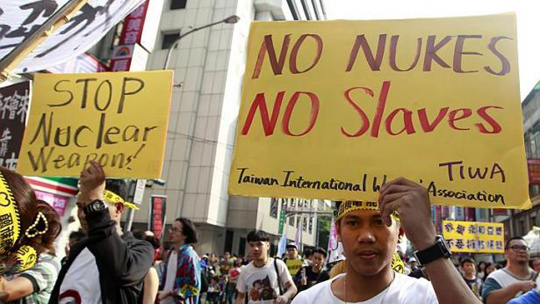
 Independence-minded opposition wins Taiwan election, Irish Times, 17 Jan 16
“…….“Regardless of how you voted, the exercise of democratic expression was the most important meaning of this election,” Ms Tsai said in a news conference.
Ms Tsai unseated Ma Ying-jeou of the Kuomintang (KMT) nationalist party, which has ruled the island of 23 million people since “Generalissimo” Chiang Kai-shek fled there in 1949, with the exception of 2000-2008 when the DPP were in charge.
The DPP win was by a landslide margin. According to the China News Agency, Ms Tsai won the presidency with 56.1 per cent of the vote. The DPP also took control of the Executive Yuan parliament for the first time, taking 68 of the 113 seats compared to the KMT’s 35 seats…….http://www.irishtimes.com/news/world/asia-pacific/independence-minded-opposition-wins-taiwan-election-1.2499792
Taiwan election points to nuclear phase-out by 20231, Climate Home, 14/01/2016,
Ing-wen Tsai, who leads the presidential polls, envisions a ‘nuclear-free homeland’ with a bigger role for energy efficiency and renewables. By Megan Darby
Taiwan is facing a phase-out of atomic power, with nuclear sceptic Ing-wen Tsai tipped to win a presidential election on Saturday.
The island state’s three operating nuclear plants are due for retirement by 2023. A fourth, 90% built, was mothballed last year in response to protests from a public spooked by Japan’s Fukushima disaster.
Opinion polls predict a landslide victory for Tsai, with her Democratic Progressive Party (DPP) in with a chance of its first ever parliamentary majority……
Setting out her green energy platform in September, Tsai predicted NT$1 trillion (US$30 billion) of investment in the renewables sector.
“The time is ripe for Taiwan’s green energy development — what we lack is a government determined to see it through,” she said in remarks reported by the China Post…..
Tze-Luen Lin, energy and climate expert at National Taiwan University, expressed confidence the emissions targets were attainable…..http://www.climatechangenews.com/2016/01/14/taiwan-election-points-to-nuclear-free-future/
N. Korea Offers to Halt Nuclear Tests in Exchange for Peace Treaty
N. Korea Offers to Halt Nuclear Tests in Exchange for Peace Treaty VOA NewsJanuary 16, 2016
North Korea says it will stop conducting nuclear tests in exchange for a peace treaty with the United States and an end to joint military exercises between Washington and Seoul.
The proposal, published in North Korea’s state media late Friday, is similar to previous offers by Pyongyang that have been quickly rejected by the U.S. and South Korea……..
Earlier this week, the U.S. Congress passed legislation that seeks to deny the Pyongyang government the hard currency it needs for its nuclear weapons program by imposing stronger sanctions. http://www.voanews.com/content/north-korea-offers-to-halt-nuclear-tests-in-exchange-for-peace-treaty/3148838.html
US nuclear corporation salivates at thought of selling reactors to India
 Ahead Of PM Modi’s Trip To US, Hopes For A Major Nuclear Reactor Deal, NDTV
A Westinghouse team is already in India to negotiate the deal, Chief Executive Daniel Roderick told news agency Reuters, but talks are likely to go down to the wire, as the crucial issue of nuclear liability insurance for suppliers remains unresolved. The aim, however, was to make a “commercially significant announcement” during PM Modi’s expected US visit in March and sign a final contract later in the year, Mr Roderick said.
A US diplomat said the United States had invited PM Modi to the March 31-April 1 Nuclear Security Summit and that Washington was thinking of turning the trip into a full-fledged official visit, which would give the Indian leader a similar reception as Chinese President Xi Jinping.
The Westinghouse contract would give a big boost to India’s $150 billion nuclear power programme…….
India has given two sites to US companies – Westinghouse and a nuclear venture between General Electric Co and Hitachi – to build six reactors each. http://www.ndtv.com/india-news/ahead-of-pm-modis-trip-to-us-hopes-for-a-major-nuclear-reactor-deal-1266211
-
Archives
- October 2026 (104)
- September 2026 (339)
- August 2026 (330)
- July 2026 (355)
- June 2026 (287)
- May 2026 (306)
- April 2026 (356)
- March 2026 (251)
- February 2026 (267)
- January 2026 (308)
- December 2025 (358)
- November 2025 (359)
-
Categories
- 1
- 1 NUCLEAR ISSUES
- business and costs
- climate change
- culture and arts
- ENERGY
- environment
- health
- history
- indigenous issues
- Legal
- marketing of nuclear
- media
- opposition to nuclear
- PERSONAL STORIES
- politics
- politics international
- Religion and ethics
- safety
- secrets,lies and civil liberties
- spinbuster
- technology
- Uranium
- wastes
- weapons and war
- Women
- 2 WORLD
- ACTION
- AFRICA
- Atrocities
- AUSTRALIA
- Christina's notes
- Christina's themes
- culture and arts
- Events
- Fuk 2022
- Fuk 2023
- Fukushima 2017
- Fukushima 2018
- fukushima 2019
- Fukushima 2020
- Fukushima 2021
- general
- global warming
- Humour (God we need it)
- Nuclear
- RARE EARTHS
- Reference
- resources – print
- Resources -audiovicual
- Weekly Newsletter
- World
- World Nuclear
- YouTube
-
RSS
Entries RSS
Comments RSS

