The State of Nuclear Instability in South Asia: India, Pakistan, and China
LAWFARE Debak Das, Sunday, September 3, 2023,
The uneasy nuclear balance between India and Pakistan is being unsettled by India’s competition with China and China’s competition with the United States.
Editor’s Note: The India-Pakistan nuclear dynamic has long been a concern, indeed a nightmare, for security analysts. The Korbel School’s Debak Das argues that the growing India-China rivalry, and China’s growing nuclear competition with the United States, add new dimensions to this long-standing problem and create additional risks for nuclear escalation.
Prime Minister Narendra Modi’s state visit to Washington, D.C., in June has prompted a debate on the United States’ bet on India as a military partner to check China in the Indo-Pacific. A key part of this debate is the nuclear relationship among India, China, and Pakistan. Twenty-five years ago—in May 1998—India and Pakistan both tested nuclear weapons, initiating a trilateral nuclear rivalry in Southern Asia.
Since then, these three states have steadily increased their numbers of nuclear warheads and their fissile material production. The uneasy strategic stability in the region is also marked by technological advances in missile technology, counterforce capabilities, and an expanding spectrum of nuclear delivery vehicles available to every side. India and China’s repeated border clashes along the Himalayas and broader competition in the Indo-Pacific add a layer of complexity to the problem. This rivalry has led to developments in military technology and organization—especially India’s new Integrated Rocket Force—that increase the risk of escalation in the region. Added with Pakistan’s devolving domestic political environment characterized by renewed civilian-military clashes and India’s statements about abandoning its no-first-use policy, there are a number of different pathways to nuclear instability in the region that should generate broad concern in the international community.
Increasing Vulnerability From Nuclear Modernization
Both India and Pakistan have consistently modernized their nuclear forces over the past two decades. Each is aiming to ensure that they can match each other at lower levels of escalation. These technological advancements have led to increased vulnerability for both sides at different levels of the escalation ladder. This ranges from the ability to use low-yield nuclear weapons in specific battlefields as well as being able to conduct large strategic countervalue strikes on each other’s cities.
Pakistan has adopted a strategy of “full spectrum deterrence” that allows for the use of nuclear weapons in response to low-scale conventional war, even considerably below the nuclear threshold. As a part of this strategy, Islamabad has introduced tactical/battlefield nuclear weapons with short ranges—like the Hatf IX Nasr missile, which has a 60-kilometer range. It has also built a number of ground- and air-launched nuclear-capable cruise missiles, with ranges between 350 and 700 kilometers. Pakistan also introduced its Babur-3 nuclear-capable sea-based cruise missile in 2017 after India commissioned a nuclear submarine.
India, meanwhile, has been reported to be building flexible preemptive counterforce nuclear systems. These include more precise nuclear delivery systems with short ranges, multiple independently targetable reentry vehicle systems on ballistic missiles, and a growing arsenal of cruise missiles. India is also building a new series of surface-to-surface ballistic missiles, Pralay (with a range of 150 to 500 kilometers), alongside its existing land- and sea-based cruise missiles, which have a range of 1,000 kilometers. To increase the survivability of its nuclear forces, New Delhi has built a “triad” of delivery systems with the ability to launch nuclear weapons from air-, land-, and sea-based platforms. It is reinforcing this triad with plans to build three more nuclear submarines—in addition to the one already in service, INS Arihant—presumably with the goal of eventually having a “continuous-at-sea-deterrence” patrol capability, like the navies of the United Kingdom, Russia, the United States, and France.
In their attempts to increase the vulnerability of their adversary, both India and Pakistan have increased the range of their nuclear weapons. …………………………………………………….
Emulating China: India’s New Integrated Rocket Force
Alongside the modernization of its nuclear weapons, India is currently restructuring its ballistic missile forces. New Delhi is creating an Integrated Rocket Force (IRF) that will contain both nuclear-capable and conventional ballistic and cruise missiles. ……………………………..
India’s creation of the IRF is a mistake. The IRF will likely place nuclear-capable and conventional ballistic missiles within the same force; this will change India’s present policy of ballistic missiles being dedicated to only carrying nuclear weapons. Using the same missiles in both conventional and nuclear roles increases the chance of inadvertent escalation…………………………………………………………………………………
China in Nuclear South Asia
In the past two decades, China’s role in South Asia has grown exponentially, especially along India’s border, which has further complicated the nuclear relationship between India and Pakistan.
Sino-Indian altercations along the Line of Actual Control (LAC) in the Himalayas, along with growing naval competition in the Indo-Pacific, have shifted India’s priorities with nuclear weapons modernization toward addressing threats from China. …………………………………………………………………………………………………………….
Indeed, what is at work in the subcontinent is not just a “trilateral nuclear competition”—it is a quadrilateral competition. China is responding to the United States’ nuclear modernization and ballistic missile defense. India is responding to China’s modernization and force expansion. And Pakistan is attempting to ensure that it does not lag behind India by maintaining some form of nuclear parity at all levels of escalation.
Devolving Domestic Politics and No First Use
In addition to expanding nuclear arsenals, both India and Pakistan face different challenges to nuclear stability from their respective domestic politics. The devolving political situation in Pakistan has created new possibilities for ways in which the government could lose command and control of its nuclear weapons. The current state of domestic political turmoil between former Prime Minister Imran Khan (and his party, Pakistan Tehreek-e-Insaf) and the military establishment under army chief General Asim Munir has sparked considerable chaos. …………………………………………
On the Indian side, the government’s increasing ambivalence toward its no-first-use policy is a clear threat to nuclear stability in the region. …………………………………………………………………………………………………………………….
What Washington Must Not Do
Recent calls by scholars such as Ashley Tellis to arm India with thermonuclear weapons and naval nuclear reactor designs present a dangerous policy option. ……………………………………………………………..
Twenty-five years after the overt nuclearization of South Asia, there are enough drivers of strategic instability in the India-Pakistan-China nuclear relationship. The United States needs to be cognizant of this as it crafts an Indo-Pacific policy aimed at countering China. Indeed, it should aim to deemphasize the nuclear dimension of this competition and avoid entangling India in a four-way nuclear competition among the United States, China, India, and Pakistan. https://www.lawfaremedia.org/article/the-state-of-nuclear-instability-in-south-asia-india-pakistan-and-china
South Koreans worry about Fukushima water: more disapprove of President Yoon
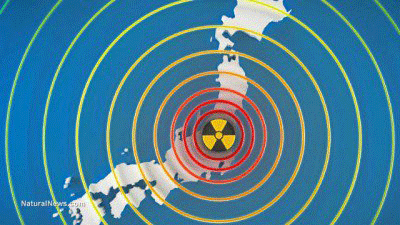
A majority of South Koreans are worried about Japan’s discharge of treated
radioactive water from the Fukushima nuclear plant into the sea despite
efforts by their government to allay fears, a poll published on Friday
showed.
Japan says the water from the wrecked nuclear power plant is safe
and it began releasing it into the Pacific on Aug. 24 despite objections at
home and abroad, particularly from China, Japan’s biggest trade partner,
which banned Japanese seafood.
The South Korean government, however, has
said it sees no scientific problem with the water release, though stressing
it does not approve of it, and banning the import of seafood from waters
off Fukushima, north of Tokyo. President Yoon Suk Yeol has led a campaign
to ease public concern and encourage consumption of seafood. On Thursday,
he visited a major fisheries market to shop and have lunch. Despite such
efforts, South Korean environmental groups and many members of the public
are alarmed and Yoon’s disapproval rating has risen to the highest in
months, a Gallup Korea poll of 1,002 people showed.
Reuters 1st Sept 2023
China Outlines ‘Obstacles’ to Resuming High-Level Military Talks With U.S.
The US has always sold weapons to Taiwan but has never financed the purchases or provided them free of charge until this year. China is opposed to all US arms sales to Taiwan, and the new military aid especially angers Beijing.
A Chinese official mentioned US sanctions on China’s defense minister, US military support for Taiwan, and US patrols in the South China Sea
By Dave DeCamp / Antiwar.com https://scheerpost.com/2023/09/02/china-outlines-obstacles-to-resuming-high-level-military-talks-with-us/
A spokesman for the Chinese Defense Ministry on Thursday outlined “obstacles” that are preventing the resumption of high-level military talks between the US and China.
Secretary of Defense Lloyd Austin and Chinese Defense Minister Li Shangfu both attended the Shangri-La Security Dialogue in Singapore back in June. Beijing declined to hold a meeting between Austin and Li, primarily due to US sanctions that are imposed on the Chinese defense chief.
The US sanctioned Li in 2018, when he was in a lower-level position, and has refused to lift the measures since he became defense minister. Chinese Defense Ministry spokesman Col. Wu Qian outlined other issues impeding high-level military talks, including US support for Taiwan, and US military activity in the South China Sea and the Taiwan Strait.
Wu noted that while there have not been talks at the defense minister level, there are other communications between the US and Chinese militaries. “I want to clarify that military-to-military communication between China and the United States has not stopped,” he said at a press briefing, according to The South China Morning Post.
Wu said that Gen. Xu Qiling, deputy chief of China’s Joint Staff Department of the Central Military Commission, attended a recent US-hosted military conference in Fiji, the 25th annual Indo-Pacific Chiefs of Defense. While at the conference, which took place from August 14-16, Xu met with his American counterparts.
But Wu said that there were a series of “difficulties and obstacles” preventing talks between Austin and Li, including new forms of military aid the US recently approved for Taiwan, which is unprecedented since Washington severed diplomatic relations with Taipei in 1979.
The US has always sold weapons to Taiwan but has never financed the purchases or provided them free of charge until this year. China is opposed to all US arms sales to Taiwan, and the new military aid especially angers Beijing.
Addressing US military activity in the South China Sea and Taiwan Strait, Wu said the US should “mind its own business.”
“China urges the US to stop its military provocations to prevent any extreme events that the world doesn’t want to see happening. We can only have communication and dialogue that is in line with our principles and does not go against our bottom lines,” he said.
Ukraine war: how China can get the world to step back from nuclear Armageddon
China and the US have reached nuclear weapons agreements before. After India and Pakistan launched nuclear tests in 1998, China and the US, in a rare show of solidarity, declared they would not target their nuclear weapons at each other. This led to a joint statement in 2000 from the five nuclear-weapon states of China, the US, Britain, France and Russia that their nuclear weapons would not target each other or any other state.
- Hope lies in getting nuclear powers to agree to a ‘no first use’ policy. If China can persuade the US, then Britain and France are likely to fall in line
- The challenge is getting Moscow on board – which is likely to require Nato to agree to ‘no first use’ against Russia and back down on its eastward expansion
SCMP, Zhou Bo 4 Sept 23
No one knows how long the war in Ukraine will last. But everyone knows what the worst nightmare is: Russia unleashing nuclear weapons. The Russian leadership has repeatedly hinted at this.
Russian scholars such as Sergei Karaganov and Dmitri Trenin have recently joined the chorus, calling for tactical nuclear attacks on a Nato country, say Poland, to break “the West’s will” and convince them that Russia’s nuclear threats are no bluff.
By giving people pause, Russia’s nuclear deterrence seems to be working. But what if Moscow is not bluffing?
With the West nibbling away at its own red lines by sending more sophisticated weapons to Kyiv that were considered taboo at the beginning of the war effort, how can one rest assured that Moscow will not reach for nuclear weapons eventually?
The battle is in a stalemate. Kyiv’s attack drones have reportedly been found in Moscow. Ukrainian President Volodymyr Zelensky recently warned that “war is returning” to Russia. As the threat of an unspeakable horror against humanity looms larger, there is an urgent need to prevent a nuclear fallout.
Perhaps China can persuade the US to agree first to a nuclear weapons policy of “ no first use”, which can then be joined by Britain, France and finally – hopefully – Russia.
China and the US have reached nuclear weapons agreements before. After India and Pakistan launched nuclear tests in 1998, China and the US, in a rare show of solidarity, declared they would not target their nuclear weapons at each other. This led to a joint statement in 2000 from the five nuclear-weapon states of China, the US, Britain, France and Russia that their nuclear weapons would not target each other or any other state.
More recently, in January last year, a month before Russia’s invasion of Ukraine, the five nuclear power powers agreed that “a nuclear war cannot be won and must never be fought”.
So why can’t they pledge a “no first use” policy? Such a stance would neither exclude nuclear retaliation nor neutralise a nuclear power’s ability to deter an attack.
For China, “no first use” has been its ironclad policy since its detonation of a nuclear device in 1964. Relations with Russia will not change China’s time-honoured policy. The Biden administration has declared that it “would only consider the use of nuclear weapons in extreme circumstances to defend the vital interests of the United States or its allies and partners”. This stance is not so far away from that of Beijing……………………………………………………………………………………………………………………… more https://www.scmp.com/comment/opinion/article/3233136/ukraine-war-how-china-can-get-world-step-back-nuclear-armageddon
Young Vietnamese Diplomat Envisions Nuclear-Free World
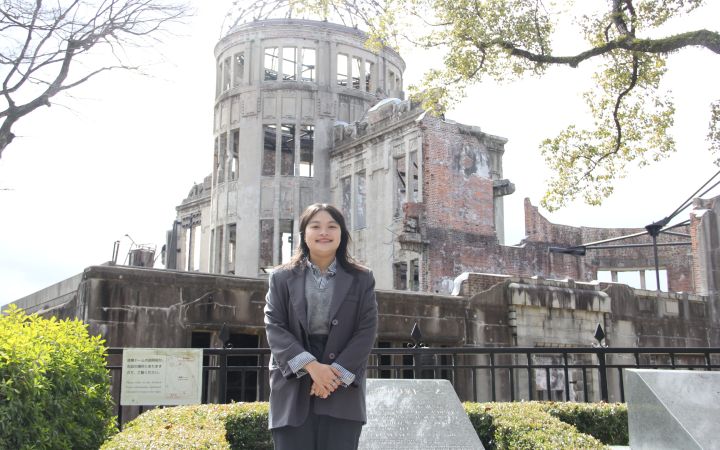
She is proud that Viet Nam has ratified the Treaty on the Prohibition of Nuclear Weapons and is currently at accession level with the NPT.
- Lê Nguyen An Khanh is a young diplomat with the Ministry of Foreign Affairs, Viet Nam. She is passionate about the non-proliferation of nuclear weapons and world peace.
- UNITAR Division for Prosperity trains government officials in Asia to learn about international nuclear disarmament processes and build their communication and negotiation skills.
28 August 2023, Hiroshima, Japan – Lê Nguyen An Khanh is a young official from Viet Nam, working at the Department of International Organisations at the Ministry of Foreign Affairs. She believes that diplomats like her have the responsibility to advocate for nuclear disarmament. But it’s not always easy to keep abreast of the intricacies of the field. “We are constantly having [to] research all the issues, of which nuclear disarmament and non-proliferation is a huge part”, she says………………………………………………………………………………….
Lê has had to learn how to take the uncertainties of global politics and turn them into something surmountable. She is proud that Viet Nam has ratified the Treaty on the Prohibition of Nuclear Weapons and is currently at accession level with the NPT. She wants to make sure her country’s voice is heard on the international stage, that it is seen as a world player. (Plus, she enjoys meeting, learning and working with like-minded people from different backgrounds and cultures.)
Being a young diplomat can come with its challenges: her views and opinions may not be granted the same weight as her older, perhaps more experienced, colleagues. But Lê challenges other young diplomats to be passionate and work hard.
“If you work hard enough, stick to your ideals and you are passionate about what you do and want to do in the future, people will recognize you – especially the seasoned diplomats who have already been there. You have to demonstrate that you are willing and have the capability to deliver. [If] you have a passion, you will be able to overcome challenges”. -Lê Nguyen An Khanh, Vietnamese diplomat and 2023 alumna, UNITAR Nuclear Disarmament and Non-Proliferation Training Programme
Looking to the Future
Lê will incorporate into her work all that she learned in the UNITAR training and expects to share her knowledge with colleagues in other departments and ministries as well. She applauds the UNITAR Hiroshima Office for putting together a well-organized and resourced training programme that she calls “an epitome of a good training programme”.
In the next 20 years, Lê says she wants to see more UNITAR offices around the world and for more people to learn about nuclear disarmament and non-proliferation. “I want to see UNITAR bring people from different regions with different cultures, race, genres to show the similar yet different experiences of their lives.”
Her personal goal is to make sure that she contributes to global peace.
Peace is a universal value. Everybody wants peace. I think peace is the motivation for every country to move towards development and stability. It is only when we have peace that we can move forward and make ourselves stronger.” -Lê Nguyen An Khanh, Vietnamese diplomat and 2023 alumna, UNITAR Nuclear Disarmament and Non-Proliferation Training Programme
About UNITAR
The United Nations Institute for Training and Research (UNITAR) is a dedicated training arm of the United Nations. In 2022, UNITAR trained 396,046 learners around the world to support their actions for a better future. In addition to our headquarters in Geneva, we have offices in Hiroshima, New York and Bonn and networks around the world.
The Division for Prosperity is based in the Hiroshima Office and Geneva. We seek to shape an inclusive, sustainable and prosperous world through world-class learning and knowledge-sharing services on entrepreneurship, leadership, finance and trade, digital technologies, and nuclear disarmament and non-proliferation. We empower individuals from least-developed countries, countries emerging from conflict, and small-island developing states – especially women and young people – to bring about positive change.
United Nations Volunteer Ruhiya Yousuf contributed to this article.
China’s summer of climate destruction
China’s summer this year has seen both extreme heat and devastating floods.
And the flooding this time around has struck areas where such weather has
been unheard of, with scientists – blaming climate change – warning that
the worst is yet to come.
“I’ve never seen a flood here in my whole life,”
says 38-year-old Zhang Junhua, standing next to a vast patch of rice, now
completely useless. “We just didn’t expect it.” His family and friends are
safe, he says, because they were given plenty of warning to get to higher
ground, but everyone in his village now has some tough months ahead. What’s
more, the devastation in north-east China’s Heilongjiang Province has had a
major impact on food supplies for the whole country.
BBC 28th Aug 2023
Nuclear discharge leading tourists to rethink travel plans
By Wang Xiaoyu | China Daily 2023-08-28
Japan’s move to discharge nuclear-contaminated water from the Fukushima Daiichi Nuclear Power Plant into the ocean from Thursday has prompted some Chinese tourists and tourism agencies to reconsider their travel plans to the country.
Japan is among the third batch of countries that are allowed group tourism from China following the easing of COVID-19 restrictions as announced by Chinese authorities on Aug 8. But growing enthusiasm for visiting Japan could be dampened by the wastewater release.
“I have received quite a number of inquiries on trips to Japan in recent weeks, but news of the nuclear-contaminated water will definitely affect tourism to the country,” Di Mingyang, an employee at a travel agency in Beijing, said on Sunday.
…………………………………………. In 2019, 9.59 million Chinese tourists visited Japan, accounting for 30 percent of its foreign travelers, according to Japanese newspaper Asahi Shimbun…………………………… more https://www.chinadaily.com.cn/a/202308/28/WS64ebe54ea31035260b81e760.html
Chinese government acknowledges problems for nuclear power due to climate change
Govt orders new nuclear power plants to carefully consider water intake safety
By Global Times Aug 28, 2023
The National Nuclear Safety Administration (NNSA) has urged China’s newly-built and projected nuclear power plants to fully consider water intake issues, in a bid to ensure the safe operation of nuclear power facilities.
During a recent meeting, the administration emphasized that relevant departments should improve water intake procedures due to changes in climate and sea environment over the years, to further ensure the smooth operation of nuclear power plants. This was stated by NNSA’s official social media account on Monday…………………………………………. https://www.globaltimes.cn/page/202308/1297149.shtml
Respect for hibakusha, and hope in younger generations

Hibakusha, atomic bombing survivors, have been tirelessly exerting themselves toward a world free of nuclear weapons, with their only wish that no one else should go through the sufferings they have experienced
The Bulletin, By Masako Toki | August 22, 2023
For too long, nuclear weapons narratives have been dominated by those who saw the mushroom cloud from afar or above. Or maybe just in photos, TV, or videos. Most absurdly, the voices of people who suffered the most under the mushroom cloud have often been marginalized.
There have been numerous efforts to raise awareness of the inhumane nature of nuclear weapons among hibakusha (atomic bomb survivors), people in Hiroshima and Nagasaki, and more broadly, in the international community. One of the most important milestones came when the 2010 Nuclear Nonproliferation Treaty (NPT) Review Conference adopted a final document that included, for the first time “the catastrophic humanitarian consequences of any use of nuclear weapons.” Since then, the humanitarian initiative for nuclear disarmament has been gaining momentum.
Three conferences on the humanitarian impact of nuclear weapons contributed to the start of the negotiation of the Treaty on the Prohibition of Nuclear Weapons (TPNW) and to adoption of the treaty. Through this process, a wide range of civil society members, along with like-minded governments, energized the humanitarian initiatives and tenaciously supported bringing humanitarian dimensions to nuclear weapons policy discussion.
The adoption of the TPNW has brought a glimmer of hope to nuclear disarmament advocates, although they are fully aware that this is a first step of the long process. Still, this is considered to be one of very few positive developments in recent nuclear disarmament efforts. The world is currently moving backward on nuclear disarmament. The Russian invasion of Ukraine has caused unspeakable human suffering and raised the risk of nuclear war. Today, nuclear threats are at the highest level since the end of the Cold War,
Hibakusha, atomic bombing survivors, have been tirelessly exerting themselves toward a world free of nuclear weapons, with their only wish that no one else should go through the sufferings they have experienced.
As the memories of Hiroshima and Nagasaki are further fading away every year given the advanced age of hibakusha, it is urgent for younger generations to learn more. Time is of the essence. Earlier this year, the average age of hibakusha reached 85.01 years, according to Japan’s Ministry of Health, Labor and Welfare. In addition, the number of hibakusha decreased by 5,286 to 113,649 this year. As the A-bomb survivors continue to age, the issue of how to pass on the message of the catastrophic impact of nuclear weapons to the next generation becomes increasingly pressing. Informing and educating the next generation is how we can ensure that nuclear weapons will never be used again, and eventually, achieve a world free of nuclear weapons.
The time to learn from hibakusha directly is limited and is getting shorter and shorter. The peace declaration this year read by Nagasaki Mayor Shiro Suzuki quoted Sumiteru Taniguchi, one of the late hibakushas who dedicated his life to nuclear disarmament. Taniguchi admonished that “[p]eople appear to be gradually forgetting the suffering of the past. This forgetfulness terrifies me. I fear that forgetfulness will lead to the acceptance of further atomic bombings.”
Keiko Ogura, a Hiroshima hibakusha and an English-Japanese interpreter for peace activities, shared her testimonials with world leaders in May this year at the G7 Hiroshima Summit. She asked the leaders to “relive the struggles in the hearts of hibakusha” that have been felt for so long, and to imagine the invisible wounds, traumas, sorrows, and unspeakable secrets through her eyes and heart. One of the most important abilities you need when you work for nuclear disarmament is to be able to empathize with other’s suffering. Ogura asked the G7 leaders to do precisely this. She also sent a message to Russian President Vladimir Putin through a reporter for one of her numerous interviews, saying, “You don’t know what a nuclear weapon is, the reality of a nuclear weapon. So come here and see.”
Earlier this summer, at a civil society event, Ogura calmly started her atomic bombing testimonial by encouraging the audience to imagine how it feels like to be under the mushroom cloud at the time of the bomb’s detonation. “I was at that time under the mushroom cloud you can see there,” while showing the picture of the mushroom cloud after the bomb was dropped.
Nothing is more powerful and effective than hibakusha testimonials in helping others to understand the horrific reality of the use of nuclear weapons. It is very important to imagine what really happened under the mushroom cloud. When you hear about the Hiroshima bombing or the Nagasaki bombing, the first image that comes to your mind may be the mushroom cloud. But we need to understand that people were under the mushroom cloud. Most of the victims were civilians, including small children.
Every year, the Hiroshima and Nagasaki remembrance days come. These are the days that we have to make efforts to remember and renew our resolve to work for nuclear disarmament. Soon, we will not be able to listen to hibakusha directly. As the hibakusha are aging in the middle of increasing nuclear risks, we cannot do business as usual every year, or think about nuclear disarmament only on these remembrance days……………………………………………………………….more https://thebulletin.org/2023/08/respect-for-hibakusha-and-hope-in-younger-generations/?utm_source=Facebook&utm_medium=SocialMedia&utm_campaign=FacebookPost082023&utm_content=NuclearRisk_HibakushaAndHope_08222023&fbclid=IwAR0hzzEqc_dLq2NN_fF9F4OQl0uI31cz7QW9BA5nL5TPKrLpASBAUt9dRDg
Power-starved North Korea turns to solar energy to keep the lights on
1North Korea is increasingly turning to solar power to help meet its energy
needs, as the isolated regime seeks to reduce its dependence on imported
fossil fuels amid chronic power shortages. Prices of solar panels have
dropped in recent years thanks to an influx of cheap Chinese imports and a
rise in domestic assembly of panels within North Korea, according to the
Stimson Center think-tank in Washington.
This has allowed many North
Koreans to install small solar panels costing as little as $15-$50,
bypassing the state electricity grid that routinely leaves them without
reliable power for months. Larger solar installations have also sprung up
at factories and government buildings over the past decade.
FT 27th Aug 2023
https://www.ft.com/content/cff0639f-e095-465c-a6e9-3e418a7e30cf
Kudankulam Nuclear plant will destroy Southern Tamil Nadu, warns Vaiko
August 28, 2023 https://www.thehindu.com/news/national/tamil-nadu/kudankulam-nuclear-plant-will-destroy-southern-tamil-nadu-warns-vaiko/article67241700.ece
MDMK general secretary Vaiko on Sunday feared that waste water stored in the Nuclear Power Plants in Kudankulam could be released in the future into the Bay of Bengal destroying the coastal villages in southern Tamil Nadu. His apprehension was triggered by Japan’s decision to release stored waste water from the Fukushima nuclear plant into the pacific ocean.
In a statement in Chennai, he said the power plant was a Damoclean sword hanging over Tamil Nadu and closing the plant alone could save the people.
“You may land on the Moon. But I am worried that a part of Tamil Nadu will be destroyed. I would like to warn the Centre which is not bothered about the threat,” he said.
Mr Vaiko said nuclear plants in Russia, Japan and the US had affected a lot of people. “Japan has released waste water in the Pacific Ocean and the people of the country are opposing it,” he said.
At Fukushima Daiichi, decommissioning the nuclear plant is far more challenging than water release.
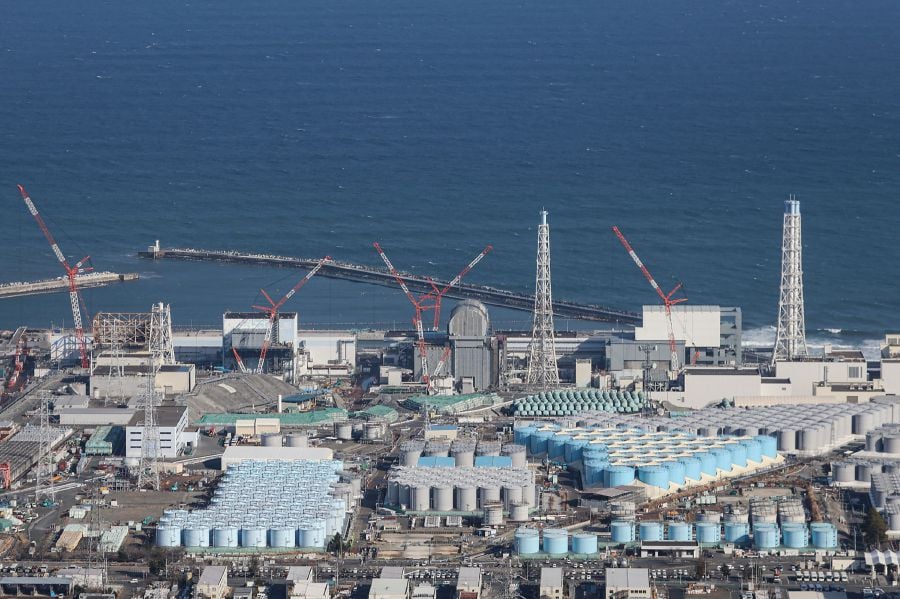
“technical difficulty involving the decommissioning is much higher” than the water release and involves higher risks of exposures by plant workers to remove spent fuel or melted fuel.
Some experts say it would be impossible to remove all the melted fuel debris by 2051 and would take 50-100 years, if achieved at all.
BY MARI YAMAGUCHI, August 27, 2023
FUTABA, Japan (AP) — For the wrecked Fukushima Daiichi nuclear plant, managing the ever-growing volume of radioactive wastewater held in more than 1,000 tanks has been a safety risk and a burden since the meltdown in March 2011. Its release marks a milestone for the decommissioning, which is expected to take decades.
But it’s just the beginning of the challenges ahead, such as the removal of the fatally radioactive melted fuel debris that remains in the three damaged reactors, a daunting task if ever accomplished.
Here’s a look at what’s going on with the plant’s decommissioning:
…………………………………………………… WILL THE WASTEWATER RELEASE PUSH DECOMMISSIONING FORWARD?
Not right away, because the water release is slow and the decommissioning is making little progress. TEPCO says it plans to release 31,200 tons of treated water by the end of March 2024, which would empty only 10 tanks out of 1,000 because of the continued production of wastewater at the plant.
The pace will later pick up, and about 1/3 of the tanks will be removed over the next 10 years, freeing up space for the plant’s decommissioning, said TEPCO executive Junichi Matsumoto, who is in charge of the treated water release. He says the water would be released gradually over the span of 30 years, but as long as the melted fuel stays in the reactors, it requires cooling water, which creates more wastewater.
Emptied tanks also need to be scrapped for storage. Highly radioactive sludge, a byproduct of filtering at the treatment machine, also is a concern.
WHAT CHALLENGES ARE AHEAD?
About 880 tons of fatally radioactive melted nuclear fuel remain inside the reactors. Robotic probes have provided some information but the status of the melted debris remains largely unknown.
Earlier this year, a remote-controlled underwater vehicle successfully collected a tiny sample from inside Unit 1’s reactor — only a spoonful of the melted fuel debris in the three reactors. That’s 10 times the amount of damaged fuel removed at the Three Mile Island cleanup following its 1979 partial core melt.
Trial removal of melted debris using a giant remote-controlled robotic arm will begin in Unit 2 later this year after a nearly two-year delay. Spent fuel removal from Unit 1 reactor’s cooling pool is set to start in 2027 after a 10-year delay. Once all the spent fuel is removed, the focus will turn in 2031 to taking melted debris out of the reactors. But debris removal methods for two other reactors have not been decided.
Matsumoto says “technical difficulty involving the decommissioning is much higher” than the water release and involves higher risks of exposures by plant workers to remove spent fuel or melted fuel.
“Measures to reduce radiation exposure risks by plant workers will be increasingly difficult,” Matsumoto said. “Reduction of exposure risks is the basis for achieving both Fukushima’s recovery and decommissioning.”
HOW BADLY WERE THE REACTORS DAMAGED?
Inside the worst-hit Unit 1, most of its reactor core melted and fell to the bottom of the primary containment chamber and possibly further into the concrete basement. A robotic probe sent inside the Unit 1 primary containment chamber found that its pedestal — the main supporting structure directly under its core — was extensively damaged.
Most of its thick concrete exterior was missing, exposing the internal steel reinforcement, and the nuclear regulators have requested TEPCO to make risk assessment.
CAN DECOMMISSIONING END BY 2051 AS PLANNED?
The government has stuck to its initial 30-to-40-year target for completing the decommissioning, without defining what that means.
An overly ambitious schedule could result in unnecessary radiation exposures for plant workers and excess environmental damage. Some experts say it would be impossible to remove all the melted fuel debris by 2051 and would take 50-100 years, if achieved at all.
‘Animals could become MUTATED’ from the 1.3 million tons of radioactive waste dumped from Japan’s nuclear power plant in the Pacific
Japan started dumping more than 1.3 million tons of radioactive water into
the Pacific Ocean Thursday – and an expert has warned it ‘has the potential
to cause mutations as seen in Chernobyl.
‘The wastewater is currently being
held in the nation’s Fukushima nuclear plant, which is set to be
decommissioned and must be cleaned to prevent accidental leaks. The
contaminated water has been filtered to remove isotopes, leaving only
tritium and carbon-14, which are radioactive isotopes of hydrogen and
carbon that cannot be easily removed from water.
Timothy Mousseau, a
researcher at the University of South Carolina, told DailyMai.com: Tritium
and carbon-14, along with the other radionuclides [that cause cancer] to be
released, all have the potential to cause mutations, cancers and
developmental deformities, as seen in Chernobyl.’
Daily Mail 24th Aug 2023
China outraged at water release from wrecked Fukushima nuclear power plant
Japan started releasing treated radioactive water from the wrecked
Fukushima nuclear power plant into the Pacific Ocean yesterday, a
polarising move that prompted China to announce an immediate blanket ban on
all aquatic products from Japan.
Irish Independent 25th Aug 2023
Fukushima waste-water decision disregards scientific evidence, violates the human rights of Pacific region communities

Japan announces date for Fukushima radioactive water release
Greenpeace International, 22 August 2023 https://www.greenpeace.org/international/press-release/61364/japan-announces-date-for-fukushima-radioactive-water-release/
Tokyo – Greenpeace Japan criticises the Japanese government’s announcement of the start date for radioactive water discharges from the Fukushima Daiichi nuclear station into the Pacific Ocean.
The decision disregards scientific evidence, violates the human rights of communities in Japan and the Pacific region, and is non-compliant with international maritime law. More importantly it ignores its people’s concerns, including fishermen. The Japanese government and Tokyo Electric Power Company (TEPCO) – the nuclear power plants’ operators – falsely assert that there is no alternative to the decision to discharge and that it is necessary to move towards final decommissioning. This further highlights the failure of the decommissioning plan for the nuclear plants destroyed in the 2011 earthquake, stating that tens of thousands of tons of contaminated water will continue to increase with no effective solution.
“We are deeply disappointed and outraged by the Japanese Government’s announcement to release water containing radioactive substances into the ocean. Despite concerns raised by fishermen, citizens, Fukushima residents, and the international community, especially in the Pacific region and neighboring countries, this decision has been made,” said Hisayo Takada, Project Manager at Greenpeace Japan.
The increasing volumes of and the pending release of the radioactive water demonstrate the failure of the decommissioning plan for the Fukushima Daiichi. The contaminated water will continue to accumulate for many years without effective measures to stop it. The Japanese Government and TEPCO falsely claim that discharge is the only viable option necessary for eventual decommissioning. Nuclear power generation, which experiences shutdowns due to accidents and natural disasters, and perpetually requires thermal power as a backup, cannot serve as a solution to global warming.
“The deliberate pollution of the Pacific Ocean through these radioactive waste discharges is a consequence of the 2011 nuclear disaster and Japan’s decades long nuclear power program. Instead of acknowledging the flaws in the current decommissioning plan, the ongoing nuclear crisis, and the massive amount of public funds required, the Japanese government intends to restart more nuclear reactors despite evidence of major earthquakes and safety risks. The current government energy plan fails to deliver secure and sustainable renewables such as wind and solar energy that the climate emergency demands,” said Takada.
As of 8 June 2023, there were 1,335,381 cubic meters of radioactive wastewater stored in tanks[1], but due to the failure of the ALPS (Advanced Liquid Processing System) processing technology, approximately 70% of this water will have to be processed again. Scientists have warned that the radiological risks from the discharges have not been fully assessed, and the biological impacts of tritium, carbon-14, strontium-90 and iodine-129, which will be released in the discharges, have been ignored.[2]
The International Atomic Energy Agency (IAEA) endorsed Japan’s plans for discharge. However, the IAEA has failed to investigate the operation of the ALPS, has completely ignored the highly radioactive fuel debris that melted down which continues every day to contaminate ground water – nearly 1000 cubic meters every ten days. Furthermore, the discharge plan has failed to conduct a comprehensive Environmental Impact Assessment, as required by its international legal obligations, given that there is a risk of significant transboundary harm to neighboring countries. The IAEA is not tasked with protecting the global marine environment but it should not encourage a state to violate it.
“The myth is being perpetuated that discharges are necessary for decommissioning. But the Japanese government itself admits that there is sufficient water storage space in Fukushima Daiichi.[3] Long-term storage would expose the current government decommissioning roadmap as flawed, but that is exactly what needs to happen. The Fukushima Daiichi nuclear station is still in crisis, posing unique and severe hazards, and there is no credible plan for its decommissioning,” emphasized Shaun Burnie, Senior Nuclear Specialist at Greenpeace East Asia.
Member states at the United Nations Human Rights Council in Geneva, as well as UN Special Rapporteurs, have opposed and criticized Japan’s discharge plans.[4] Japan’s discharge plans also disregard the groundbreaking Human Rights Council resolution 48/13, which in 2021 determined that it is a human right to have a clean, healthy and sustainable environment.[5] Furthermore, Japan has failed to comply with its legal obligations under the United Nations Convention for the Law of the Sea (UNCLOS), to protect the marine environment including its legal requirement to conduct a comprehensive Environmental Impact Assessment into the discharges into the Pacific Ocean, given the risk of significant transboundary harm to neighboring countries.[6]
“Instead of engaging in an honest debate about this reality, the Japanese government has opted for a false solution – decades of deliberate radioactive pollution of the marine environment – during a time when the world’s oceans are already facing immense stress and pressures. This is an outrage that violates the human rights of the people and communities of Fukushima, and other neighboring prefectures and the wider Asia-Pacific region,” said Burnie.
1 This Month


10 March A LIVE WEBINAR THE REAL EFFECTS OF NUCLEAR POWER
What the Industry Isn’t Telling Us
1:00 PM Mountain, 2 pm Central, 3 pm Eastern. Live on the Keepers of the Water Facebook page


18 March Webinar @ 1 PM EST: An Assessment of SMR Projects: The Case of Canada
register for the zoom:
https://us02web.zoom.us/webinar/register/WN_o8BIIOUvQ2ONJR1nta65DQ#/registration


of the week – STOP SMALL MODULAR REACTORS IN CANADA
To see nuclear-related stories in greater depth and intensity – go to https://nuclearinformation.wordpress.com
-
Archives
- March 2026 (76)
- February 2026 (268)
- January 2026 (308)
- December 2025 (358)
- November 2025 (359)
- October 2025 (376)
- September 2025 (258)
- August 2025 (319)
- July 2025 (230)
- June 2025 (348)
- May 2025 (261)
- April 2025 (305)
-
Categories
- 1
- 1 NUCLEAR ISSUES
- business and costs
- climate change
- culture and arts
- ENERGY
- environment
- health
- history
- indigenous issues
- Legal
- marketing of nuclear
- media
- opposition to nuclear
- PERSONAL STORIES
- politics
- politics international
- Religion and ethics
- safety
- secrets,lies and civil liberties
- spinbuster
- technology
- Uranium
- wastes
- weapons and war
- Women
- 2 WORLD
- ACTION
- AFRICA
- Atrocities
- AUSTRALIA
- Christina's notes
- Christina's themes
- culture and arts
- Events
- Fuk 2022
- Fuk 2023
- Fukushima 2017
- Fukushima 2018
- fukushima 2019
- Fukushima 2020
- Fukushima 2021
- general
- global warming
- Humour (God we need it)
- Nuclear
- RARE EARTHS
- Reference
- resources – print
- Resources -audiovicual
- Weekly Newsletter
- World
- World Nuclear
- YouTube
-
RSS
Entries RSS
Comments RSS
 nuclear-news