‘True horror’: Japan’s Hiroshima atomic bomb survivor campaigns for a nuclear-free world
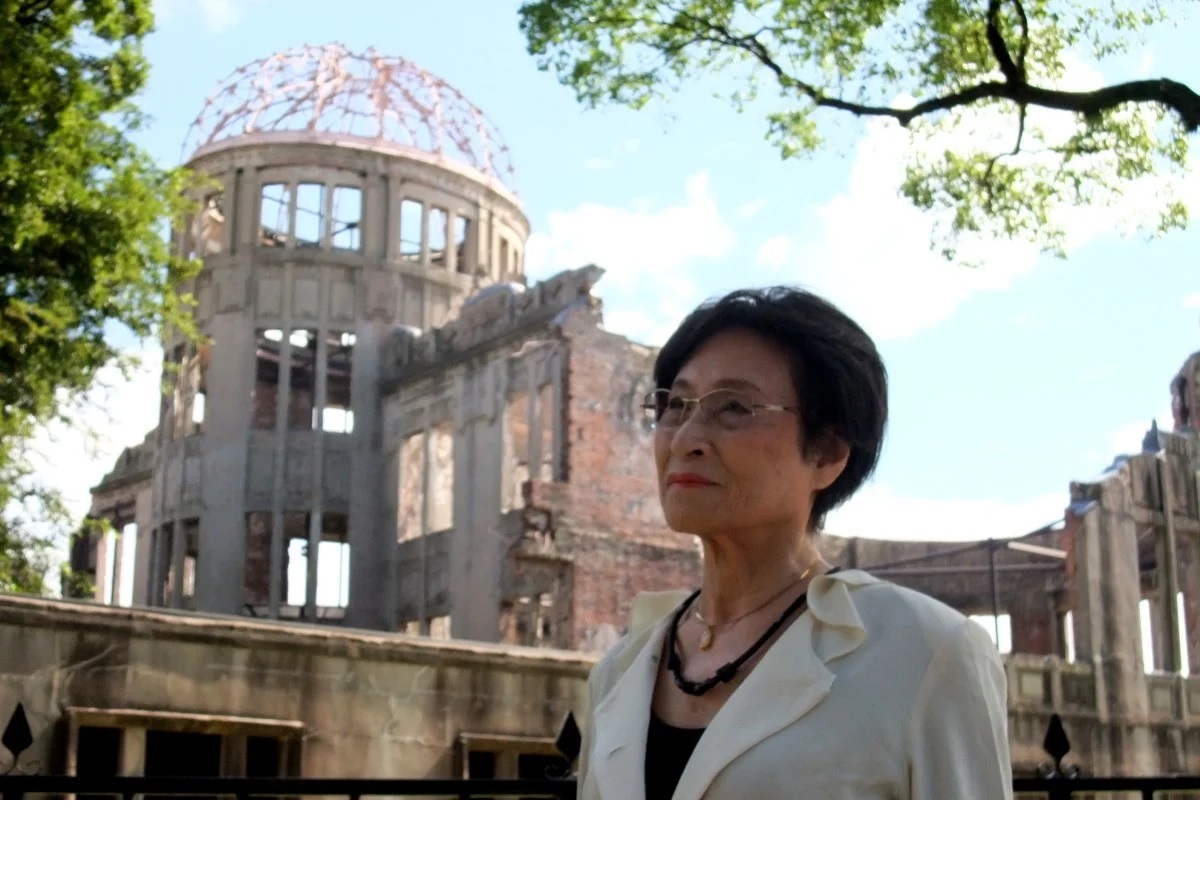
Bun Hashizume, 93, who has written poems about her descent into ‘hell’ after the bombing, has travelled the world to spread her message
Norman Aisbett, SCMP, 3 Aug 24,
What I feel the most about these days is human stupidity,” says 93-year-old Bun Hashizume, from her home in the Japanese temple city of Kamakura.
“I was a victim of the first atomic bomb in human history and I have advocated throughout my life for the abolition of nuclear weapons, but the world leaders still do not understand their true horror.
“Even my poems cannot describe it.”
Rewind to 8.15am on August 6, 1945 in the final throes of World War II.
A US atomic bomb named “Little Boy” was dropped from a B-29 aircraft and exploded at low altitude over the city of Hiroshima. With a blast force equal to 16 kilotons of TNT, it destroyed most buildings and caused mass death and injury.
Then aged 14, Hashizume was a war-mobilised school student working in the four-storey reinforced-concrete Savings Bureau building about 1.5km from the hypocentre of the blast.
Looking back, she recalls a third-floor window being filled “with a sudden flash of light that was so bright I thought the sun had fallen at my feet. A thousand rainbows all at once seemed to explode before my eyes”. And how, after being briefly unconscious and bleeding heavily from a head wound, she staggered downstairs among other workers looking “like a parade of ghosts with wildly dishevelled hair and sooty bodies”.
Once outside the building, it was a regular employee, Tomoyanagi, who “half-carried” her to a nearby Red Cross Hospital, where more shocking scenes and high drama followed.
Hashizume is today the author of The Day the Sun Fell – Memoirs of a Survivor of the Atomic Bomb – translated by Susan Bouterey – which closely details her and her family’s horrific experiences and also explains her present-day opposition to “dangerous” nuclear power plants, which she emphasises during this Australian writer’s long-distance interview with her, via a Japanese interpreter-admirer.
Her drive was such that, at age 70, she began her solo pilgrimages to many countries over 15 years to “become a citizen of the world” and share her anti-nuclear views. With only her aged pension to buy airline tickets and stay in youth hostels, she spoke to anyone or group willing to listen, including schoolchildren. Everywhere, people were also touched by her genuine personal warmth and quiet charm. A small booklet she handed out was entitled, “Fellow Humans! Let Us Foster Love and Wisdom.”
Right now, though, she is homebound due to A-Bomb-related health issues that have plagued her life. She tells of having endured “lifelong” rheumatism, chronic kidney disease, thyroid cancer and more. The past 20 years have also brought numerous breaks of radiation-weakened ribs, collarbones and three compressed fractures of her spine after a fall in Norway in 2003.
She is unable to go outside alone. There are twice-weekly visits to a hospital and three transports per week to a rehabilitation clinic. “Otherwise I’m on my bed reading the newspapers, with care from my eldest son and his family, who live with me.”
Her activist spirit nevertheless endures. She cites recent-times threats of nuclear strikes by North Korea if threatened; by Russia amid the Ukraine war; and an Israeli cabinet minister’s suggestion to nuke Hamas in Gaza The minister was promptly sacked by his embarrassed government which has never admitted that it has nuclear weapons – and subsequent high tensions and conflict between arch-enemies Israel and Iran.
{I believe that nuclear weapons should never be used, stockpiles should be completely abolished, and the Japanese government should join and ratify the Treaty on the Prohibition of Nuclear Weapons as soon as possible,” she says. “It’s no wonder they are being been used as a threat.” She further notes that nine nations have nuclear weapons, but the warheads of only two nations – Russia (5,890) and the US (5,224) – “are enough to destroy all life on Earth several times over”.
A major disappointment for her was the 28th United Nations Climate Change Conference (Cop28) in Dubai when 23 nations including the US and Japan declared they would triple the generation of their nuclear power plants to achieve zero greenhouse gas emissions by 2050.
“It is shocking that Japan joined this dangerous proposal despite the fact that the world’s pervasive emphasis on economic growth, baseless absolute trust in science and technology, and limitless pursuit of energy collapsed in Fukushima in 2011,” she says…………………………………………
After Tomoyanagi left to find her own family, a 16-year-old boy Yoshiaki Iida, who was unknown to Hashizume, helped her outside just before flames engulfed the whole building.
However, she later heard that her brother, Hideo, seven, had died after his back caught fire in an instant when hit from behind by the scorching A-Bomb blast in a school playground. Her other family members survived but with bad injuries and other health problems. Younger sister Shizuko, nine, had been evacuated to a temple when she was struck by the blast wave. Years of radiation sickness caused her suicide at age 19. Older sister Mitsuko, 19, suffered “ghastly” facial wounds at her grandmother’s house.
What does Hashizume remember most after the explosion? She replies: “The complete silence and the smell of burnt corpses that filled the air.”………………………………………………………………………………………………
The Day the Sun Fell – Memoirs of a Survivor of the Atomic Bomb by Bun Hashizume (translated by Susan Bouterey) is published by Austin Macauley Publishers Ltd and also available on Kindle. https://www.scmp.com/week-asia/people/article/3273031/true-horror-japans-hiroshima-atomic-bomb-survivor-campaigns-nuclear-free-world
Behind a Nuclear Cooperation Agreement With Washington -Singapore not committed to nuclear power
Energy Intelligence Group Aug 2, 2024. Author,Phil Chaffee, New York
Singapore this week became the fourth Southeast Asian country to sign a nuclear cooperation agreement (NCA) with the US, although Singaporean government ministers emphasized that the wealthy city-state is by no means committed to launching a civil nuclear power program. Singapore is one of a number of countries across the region that are exploring potential moves into nuclear energy, though all face populations wary, at best, of nuclear energy………………………. (Subscribers only) more https://www.energyintel.com/00000191-1022-d8c8-a3d5-3ce2d4890000
The US might lose a war with China, congressional commission says
Insufficient industry, readiness, innovation, and funding hamper military’s ability to prevail in conflict, key experts find.
By Patrick Tucker, Science & Technology Editor, Defense One, July 29, 2024, https://www.defenseone.com/threats/2024/07/us-might-lose-war-china-congressional-commission-says/398418/
The U.S. military “lacks both the capabilities and the capacity required to be confident it can deter and prevail in combat,” in the judgment of a congressional commission whose new report finds that collaboration between Russia, China, and other autocratic states is increasing the chance of a multi-front conflict—and that the U.S. would have trouble sustaining such a fight.
For more than a year, the former lawmakers, military leaders, and policy experts on the Commission on the National Defense Strategy have studied how well the U.S. military is executing the 2022 national defense strategy. The group released their report on Monday and will present its findings to the Senate Armed Services committee on Tuesday.
The group found big gaps between the Defense Department’s ambitions of deterring or prevailing in a major conflict and reality. One of the reasons they came to that conclusion is the current state of the U.S. defense industrial base compared to China’s.
“Unclassified public wargames suggest that, in a conflict with China, the United States would largely exhaust its munitions inventories in as few as three to four weeks, with some important munitions (e.g., anti-ship missiles) lasting only a few days. Once expended, replacing these munitions would take years,” the report states.
Furthermore, the growing collaboration between autocratic powers make it nearly inevitable that China and Russia would coordinate against the United States in the event of an armed conflict with one or the other.
“The United States should assume that if it enters a direct conflict involving Russia, China, Iran, or North Korea, that country will benefit from economic and military aid from the others. We also believe that this partnership increases the likelihood that a conflict with one would expand to multiple fronts, causing simultaneous demands on U.S. and allied resources,” the report states.
Of the commission’s many recommendations, most are similar to efforts the Pentagon is already undertaking, including reaching out more aggressively to the private sector, particularly new information-technology focused startups, to establish a new industrial base, and reevaluating counterproductive regulatory impediments to buying and selling defense technology.
Other recommendations are more pointed, such as abandoning outdated “programs of record” in order to procure key pieces of equipment, and loosening ship maintenance rules, allowing more maintenance in foreign ports, and being more willing to buy weapons and supplies from other countries.
But for the most part, the commission’s report paints a picture of a situation years in the making that can’t be righted quickly.
“Today, the United States has a DIB with too few people, too few companies, declining and unstable financial support, and insufficient production capacity to meet the needs of the Joint Force in both peacetime and wartime,” the group said.
Nagasaki decides against inviting Israel to commemorate nuclear bombing of Japan amid war on Gaza
In contrast, another US nuclear bomb-hit Hiroshima city has invited Tel Aviv to annual event
Riyaz ul Khaliq 01.08.2024, ISTANBUL https://www.aa.com.tr/en/asia-pacific/nagasaki-decides-against-inviting-israel-to-commemorate-nuclear-bombing-of-japan-amid-war-on-gaza/3290598
The local government in Nagasaki province declared Wednesday it will not invite Israel to its annual conference to commemorate US nuclear bombing of Japan.
Mayor Shiro Suzuki said Israel would “not be invited to the Aug. 9 annual peace ceremony,” Tokyo-based Kyodo News reported.
The decision to not invite Israel to the event comes on a day Israel assassinated Palestinian resistance group Hamas political chief Ismail Haniyeh at his residence in Iranian capital Tehran.
Nagasaki and Hiroshima cities will be commemorating 79th anniversary of 1945 atomic bombing by the US on Japan next month.
Japan has refused to invite Russia and Belarus for similar conference since Moscow waged war on Ukraine in Feb. 2022.
However, local government in Hiroshima has invited Tel Aviv to its event on Aug. 6.
The local authorities in Hiroshima, however, have called for an “immediate cease-fire in the Palestinian territory.”
The Hiroshima government has come under severe criticism for purported double standards and many activists are pressing the authorities to withdraw the invite to Tel Aviv.
Several programs against Israel’s participation have been planned in the run up to Aug. 6.
Japan has witnessed many demonstrations and protests against Israeli war on Palestinian besieged enclave of Gaza, with calls to ceases military relations with Tel Aviv.
Israel, flouting a UN Security Council resolution demanding an immediate cease-fire, has faced international condemnation amid its continued brutal offensive on Gaza since an Oct. 7, 2023 attack by the Palestinian group Hamas.
At least 39,400 Palestinians have since been killed, mostly women and children, and nearly 91,000 injured, according to local health authorities.
Over nine months into the Israeli onslaught, vast tracts of Gaza lie in ruins amid a crippling blockade of food, clean water and medicine.
Israel is accused of genocide at the International Court of Justice, which ordered it to immediately halt its military operation in the southern city of Rafah, where more than 1 million Palestinians had sought refuge from the war before it was invaded on May 6.
Japan continues search for its first nuclear waste disposal site by screening tiny rural town

by undergoing just the first step of screening, the town can receive grants of up to 2 billion yen (US$12.7 million).
Channel Newws Asia Michiyo Ishida, Louisa Tang 31 July 24
Japan has produced more than 19,000 tonnes of nuclear waste since it began generating atomic energy in the 1960s.
GENKAI, Japan: Cattle farmer Hiroshi Nakayama practically grew up with nuclear power in the rural town of Genkai, which has a population of just under 5,000.
The 56-year-old raises 2,000 black-haired wagyu, selling the best as premium and highly sought after Saga beef.
Even though his hometown in southern Kyushu island may one day become Japan’s final destination for nuclear waste, he brushed off concerns that it would affect his business.
Screening began last month to assess if Genkai, which has hosted a nuclear plant for about five decades, is suitable to serve as the country’s first radioactive waste disposal facility.
“Given Japan’s technology, I do not think there will be environmental contamination. Some people say it is dangerous, but no one has died from (the existence of) the nuclear plant,” Mr Nakayama told CNA…………………………
THIRD SITE TO BE SCREENED
Genkai is the third site to undergo screening after two others in Hokkaido which are still being reviewed. It is the only one among them that hosts a nuclear plant.
Japan needs a radioactive waste disposal facility as it has produced more than 19,000 tonnes of nuclear waste since it began generating atomic energy in the 1960s.
This waste will continue to accumulate in interim storage that is dangerous in the long run.
Nuclear waste needs to be stored at least 300 metres underground for about 100,000 years until radioactivity falls to acceptable levels.
Meanwhile, the entire process to select a permanent disposal site will take about 20 years.
Local authorities have the right to pull out at each stage, but by undergoing just the first step of screening, the town can receive grants of up to 2 billion yen (US$12.7 million).
The process begins with the collection of documents describing the town’s geological features. The central government-linked Nuclear Waste Management Organization will then spend two years studying the documents before publishing a report.
Based on that, local leaders will decide whether to move on to the next step.
MAYOR EXPRESSES MISGIVINGS
Some groups in Genkai, including hotel and restaurant associations, had pushed for their town to be screened by submitting petitions. These were approved by the local assembly which represents residents in Genkai.
While the town’s mayor Shintarou Wakiyama gave the green light in May, he said he has misgivings about a disposal site being built there.
One reason he cited was the size of Genkai – just 36 sq km.
“I thought we are too small and not suitable for hosting a final nuclear waste disposal site,” he added……………………………..
By having Genkai undergo screening, he said he hopes other towns will come forward.
He stressed that his decision to approve the screening was not driven by money, noting that the town’s coffers were already in good shape from substantial payouts due to hosting a nuclear plant. https://www.channelnewsasia.com/east-asia/japan-nuclear-radioactive-waste-disposal-site-screening-genkai-town-4513641
Japan nuclear watchdog panel decides against restarting Tsuruga reactor
difficult to determine the safety of the reactor, noting the proximity of a seismic faultline.
The government in Japan, one of the world’s most seismically active countries, does not allow nuclear plants to be situated over active faultlines.
July 27 2024, TOKYO, https://japantoday.com/category/national/japan-nuclear-watchdog-panel-decides-against-restarting-tsuruga-reactor1
A panel of Japan’s nuclear watchdog decided on Friday against restarting a reactor at the Tsuruga nuclear power plant citing seismic risks, paving the way for the regulator to keep the Japan Atomic Power plant shut.
The panel said it was difficult to determine the safety of the reactor, noting the proximity of a seismic faultline. Consequently, it said, the reactor was not deemed compliant with criteria for installation licensing.
“We will conduct an additional investigation. We are not considering decommissioning the plant,” Mamoru Muramatsu, president of Japan Atomic Power, said after the panel meeting, according to Kyodo News Agency.
The government in Japan, one of the world’s most seismically active countries, does not allow nuclear plants to be situated over active faultlines.
The panel is set to report its decision to the Nuclear Regulation Authority (NRA) soon.
If approved, this would be the first case of non-compliance under the stricter safety standards imposed after the 2011 Fukushima nuclear disaster.
The move could hinder the government’s efforts to restart more nuclear power plants to ensure a stable energy supply.
Japan, which had 54 operational reactors before the 2011 disaster, has restarted only 12 of the 33 nuclear reactors it has been considering restarting.
Along with most reactors in Japan, operations at the Tsuruga’s No.2 reactor have been halted since 2011 following triple meltdowns at Tokyo Electric Power’s Fukushima Daiichi nuclear power plant.
On March 11, 2011, Japan’s northeast coast was struck by a magnitude 9 earthquake, the strongest quake in Japan on record, and a massive tsunami, triggering the worst nuclear crisis since Chernobyl a quarter of a century earlier.
US Forces Japan to be upgraded to warfighting command

The shift will move operational control of Japan-based forces east from Hawaii and, officials say, deepen cooperation with the Japanese military.
TOKYO—The Pentagon will upgrade and expand its three-star command in Japan to handle operational control of U.S. forces based there, part of an effort to deepen ties between the U.S. and Japanese militaries and to streamline command and control of joint operations, senior defense officials told reporters traveling with Defense Secretary Lloyd Austin on Friday.
“Secretary Austin plans to announce that the United States intends to reconstitute U.S. Forces Japan as a Joint Force Headquarters, reporting to the commander of U.S. INDOPACOM,” said the senior official. The shift will give USFJ, which is “currently, primarily, an administrative command” more warfighting responsibilities. “They do day-to-day management of the alliance, but not operational command of forces. So it’ll be a significant difference for them.”
The announcement comes as part of the Joint Statement of the Security Consultative Committee (“2+2”) committee meeting taking place in Tokyo between Austin, Secretary of State Anthony Blinken, and their Japanese counterparts.
The command will grow as it adds missions and responsibilities to its current alliance-management functions, the official said, “including some of the planning exercises and commanding of operations, and we’ll be doing those, as I mentioned, side-by-side with Japanese forces like never before.”
Many details of the new headquarters aren’t yet known and officials said that the approach will be phased, with many more discussions about how to implement yet to come. Among the decisions to be made is whether the expanded USFJ will have a command structure that integrates Japanese forces, the way U.S. Joint Forces Korea does for South Korean forces.
“A major part of that phased approach will involve bilateral working groups with the U.S. side, led by INDOPACOM, to work through important implementation factors, including potential resourcing needs, infrastructure, personnel, authorities and ranks,” the official said.
The new Joint Force Headquarters will allow INDOPACOM officers and operators to have daily interactions with Japanese counterparts about how to plan exercises, operations, and how to act on shared intelligence and information, the official said. ……………………..more https://www.defenseone.com/policy/2024/07/us-forces-japan-be-upgraded-warfighting-command/398386/
‘Atomic bomb hell must never be repeated’ say Japan’s last survivors

Atomic People will be broadcast on Wednesday 31 July on BBC Two and BBC iPlaye
Lucy Wallis, BBC News https://www.bbc.com/news/articles/crg5lyd25jno 26 July 24
It was early in the day, but already hot. As she wiped sweat from her brow, Chieko Kiriake searched for some shade. As she did so, there was a blinding light – it was like nothing the 15-year-old had ever experienced. It was 08:15 on 6 August 1945.
“It felt like the sun had fallen – and I grew dizzy,” she recalls.
The United States had just dropped an atomic bomb on Chieko’s home city of Hiroshima – the first time a nuclear weapon had ever been used in warfare. While Germany had surrendered in Europe, allied forces fighting in World War Two were still at war with Japan.
Chieko was a student, but like many older pupils, had been sent out to work in the factories during the war. She staggered to her school, carrying an injured friend on her back. Many of the students had been badly burnt. She rubbed old oil, found in the home economics classroom, onto their wounds.
“That was the only treatment we could give them. They died one after the next,” says Chieko.
“Us older students who survived were instructed by our teachers to dig a hole in the playground and I cremated [my classmates] with my own hands. I felt so awful for them.”
Chieko is now 94 years old. It is almost 80 years since the atomic bombs were dropped on Hiroshima and Nagasaki and time is running out for the surviving victims – known as hibakusha in Japan – to tell their stories.
Many have lived with health problems, lost loved ones and been discriminated against because of the atomic attack. Now, they are sharing their experiences for a BBC Two film, documenting the past so it can act as a warning for the future
After the sorrow, new life started to return to her city, says Chieko.
“People said the grass wouldn’t grow for 75 years,” she says, “but by the spring of the next year, the sparrows returned.”
In her lifetime, Chieko says she has been close to death many times but has come to believe she has been kept alive by the power of something great.
The majority of hibakusha alive today were children at the time of the bombings. As the hibakusha – which translates literally as “bomb-affected-people” – have grown older, global conflicts have intensified. To them, the risk of a nuclear escalation feels more real than ever.
“My body trembles and tears overflow,” says 86-year-old Michiko Kodama when she thinks about conflicts around the world today – such as the Russian invasion of Ukraine and the Israel-Gaza war.
“We must not allow the hell of the atomic bombing to be recreated. I feel a sense of crisis.”
Michiko is a vocal campaigner for nuclear disarmament and says she speaks out so the voices of those who have died can be heard – and the testimonies passed on to the next generations.
“I think it is important to hear first-hand accounts of hibakusha who experienced the direct bombing,” she says.
Michiko had been at school – aged seven – when the bomb was dropped on Hiroshima.
“Through the windows of my classroom, there was an intense light speeding towards us. It was yellow, orange, silver.”
She describes how the windows shattered and splintered across the classroom – the debris spraying everywhere “impaling the walls, desk, chairs”.
“The ceiling came crashing down. So I hid my body under the desk.”
After the blast, Michiko looked around the devastated room. In every direction she could see hands and legs trapped.
“I crawled from the classroom to the corridor and my friends were saying, ‘Help me’.”
When her father came to collect her, he carried her home on his back.
Black rain, “like mud”, fell from the sky, says Michiko. It was a mixture of radioactive material and residue from the explosion.
She has never been able to forget the journey home.
“It was a scene from hell,” says Michiko. “The people who were escaping towards us, most of their clothes had completely burned away and their flesh was melting.”
She recalls seeing one girl – all alone – about the same age as her. She was badly burnt.
“But her eyes were wide open,” says Michiko. “That girl’s eyes, they pierce me still. I can’t forget her. Even though 78 years have passed, she is seared into my mind and soul.”
Michiko wouldn’t be alive today if her family had remained in their old home. It was only 350m (0.21 miles) from the spot where the bomb exploded. About 20 days before, her family had moved house, just a few kilometres away – but that saved her life.
Estimates put the number of lost lives in Hiroshima, by the end of 1945, at about 140,000.
In Nagasaki, which was bombed by the US three days later, at least 74,000 were killed.
Sueichi Kido lived just 2km (1.24 miles) from the epicentre of the Nagasaki blast. Aged five at the time, he suffered burns to part of his face. His mother, who received more serious injuries, had protected him from the full impact of the blast.
“We hibakusha have never given up on our mission of preventing the creation of any more hibakusha,” says Sueichi, who is now 83 and recently travelled to New York to give a speech at the United Nations to warn of the dangers of nuclear weapons.
When he woke up after fainting from the impact of the blast, the first thing he remembers seeing was a red oil can. For years he thought it was that oil can that had caused the explosion and surrounding devastation.
His parents didn’t correct him, choosing to shield him from the fact it had been a nuclear attack – but whenever he mentioned it, they would cry.
Not all injuries were instantly visible. In the weeks and months after the blast, many people in both cities began to show symptoms of radiation poisoning – and there were increased levels of leukaemia and cancer.
For years, survivors have faced discrimination in society, particularly when it came to finding a partner.
“‘We do not want hibakusha blood to enter our family line,’ I was told,” says Michiko.
But later, she did marry and had two children.
She lost her mother, father and brothers to cancer. Her daughter died from the disease in 2011.
“I feel lonely, angry and scared, and I wonder if it may be my turn next,” she says.
Another bomb survivor, Kiyomi Iguro, was 19 when the bomb struck Nagasaki. She describes marrying into a distant relative’s family and having a miscarriage – which her mother-in-law attributed to the atomic bomb.
“‘Your future is scary.’ That’s what she told me.”
Kiyomi says she was instructed not to tell her neighbours that she had experienced the atomic bomb.
Since being interviewed for the documentary, Kiyomi has sadly died.
But, until she was 98, she would visit the Peace Park in Nagasaki and ring the bell at 11:02 – the time the bomb hit the city – to wish for peace.
Sueichi went on to teach Japanese history at university. Knowing he was a hibakusha cast a shadow on his identity, he says. But then he realised he was not a normal human being and felt a duty to speak out to save humankind.
“A sense that I was a special person was born in me,” says Sueichi.
It is something the hibakusha all feel that they share – an enduring determination to ensure the past never becomes the present.
Atomic People will be broadcast on Wednesday 31 July on BBC Two and BBC iPlaye
Nuclear energy not the way to go: coalition Taiwan
By Yang Yin-ting and Jonathan Chin / Staff reporter, with staff writer, https://www.taipeitimes.com/News/taiwan/archives/2024/07/27/2003821385
Relying on nuclear power is the wrong strategy for Taiwan to achieve net zero emissions, a coalition of environmental groups said yesterday, amid rising calls from some lawmakers and government officials in support of it.
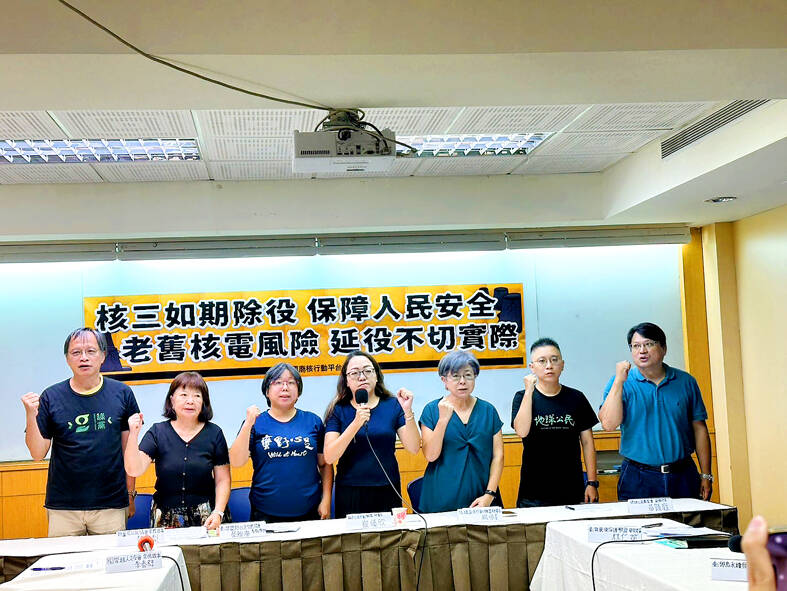
The National Nuclear Abolition Action Platform held a news conference in Taipei yesterday — two weeks before the National Climate Change Response Committee’s inauguration meeting, which is expected to discuss nuclear power.
The Chinese Nationalist Party (KMT) has indicated that it would seek to extend the operations of the nation’s nuclear reactors, including the ones at the Ma-anshan Nuclear Power Plant in Pingtung County, a coalition spokesperson said.
The Ma-ashan plant’s first reactor, which has reached the end of its 40-year service life limit, is to be deactivated today, while its second reactor is scheduled for decommissioning in May next year, it said.
The KMT’s failure to acknowledge the public security risks posed by the nation’s aged reactors or the problem of nuclear waste disposal has exposed the recklessness of the party’s energy policy, it said.
Lawmakers should drop proposed amendments to the Nuclear Reactor Facilities Regulation Act (核子反應器設施管制法) and allow the Ma-anshan plant to be decommissioned as planned, the spokesperson said.
Green Citizens’ Action Alliance secretary-general Tsuei Su-hsin (崔愫欣) said that high operating costs and the lack of suitable sites for waste disposal make the bid to continue generating nuclear power impractical for Taiwan.
Taiwan Environmental Protection Union executive Lin Ren-pin (林仁斌) said that global energy production trends point to a decline in nuclear energy.
China — which has built more new nuclear reactors than any country in the world — reported that renewables experienced faster growth than nuclear energy, he added.
The Ma-anshan plant straddles a geological faultline in the Hengchun Peninsula and has a terrible safety record, Lin said.
The scarcity of land, high population density and propensity to build nuclear power plants on soft rock strata are a recipe for disaster on the scale of the partial meltdown at Japan’s Fukushima Dai-ichi nuclear power plant, he said.
Moms Love Taiwan Association secretary-general Yang Shun-me (楊順美) said that the Jinshan Nuclear Power Plant is practically decommissioned, as the lion’s share of its equipment and transmission towers had already been removed.
The remaining facilities at the power plant has not been maintained for many years, she added.
The Guosheng Nuclear Power Plant has two inoperable reactors, while the Ma-anshan plant cannot resume operations without a full shutdown and replacing critical components, Yan said.
This means none of the nation’s three nuclear power plants stand a chance of contributing to emissions reduction, she said.
Citizen of the Earth Taiwan deputy director Huang Ching-ting (黃靖庭) said opposition lawmakers were making untruthful claims about a purported energy shortage.
Citing Taiwan Power Co’s electricity supply report this month, he said that Taiwan has enough energy to keep the nighttime reserve margin above 10 percent through 2030, which does not indicate a shortage.
Nuclear power plants must obtain safety certifications and replace key components before lengthening their service life, he said, adding that the process is estimated to take five to 10 years.
The Ma-anshan plant is rightly decommissioned since the facility’s reactors generate a marginal amount of electricity compared with the safety risks they represent, he said.
Altogether, there is virtually no chance that Taiwan could get any of its old nuclear power plants back online before 2030, Huang said.
Using nuclear energy to reduce emissions is impractical and impossible to implement in time, he said
Progress is Slow in ASEAN’s Anti-Nuclear Pact: Indonesia
Jayanty Nada Shofa, July 25, 2024, https://jakartaglobe.id/news/progress-is-slow-in-aseans-antinuclear-pact-indonesia
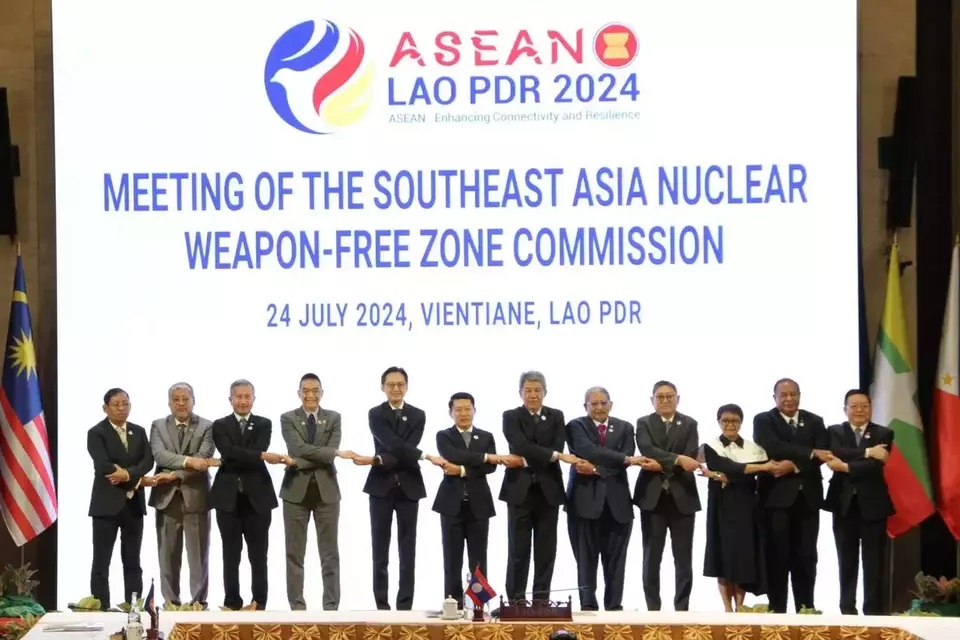
Jakarta. The progress is slow in bringing nuclear-possessing countries to promise that they would keep the Southeast Asian region nuke-free, Indonesia told fellow ASEAN members.
Foreign Affairs Minister Retno Marsudi is currently in Laos to discuss the bloc’s matters with her ASEAN counterparts. The group’s Southeast Asia Nuclear Weapon-Free Zone (SEANWFZ) pact became one of the major themes in the discussions.
The treaty aims to create a peaceful Southeast Asia region that is free from nuclear weapons. The pact has legally binding protocols for the five nuclear-weapon states — China, France, Russia, the UK, and the US — to sign and ratify. By signing, these five countries would promise to not use or threaten to use nukes in the region. Although the SEANWFZ dates back to 1995, no nuclear weapon state has signed the protocol so far.
“There has not been any significant progress from the nuclear-weapon states in regards to the SEANWFZ protocol,” Retno said in a press statement on Wednesday evening.
Amidst the sluggish progress, Indonesia thinks it is about time that ASEAN should involve experts in their efforts.
“Indonesia suggests that we should appoint experts, including legal experts from every ASEAN country, to give their inputs in the next SEANWFZ Commission meeting with a clear and measurable timeline,” Retno said.
Of all five nuclear-weapon states, China appears to be the one who is the closest to signing the pact. Last year, Malaysia’s then-Foreign Affairs Minister Zambry Abdul Kadir said that China had given its word to sign the protocol “unconditionally”.
Kadir made the remarks on the sidelines of an ASEAN foreign ministerial meeting in Jakarta last July. Not long after Kadir’s statement, Secretary-General Kao Kim Hourn also dropped a similar hint that Beijing had shown a “strong desire” to sign the SEANWFZ protocol. But again, China has yet to keep its promise.
Will US defend Japan with nukes or turn it into the line of fire?
By Global Times, Jul 22, 2024
The US, which bombed Japan with nuclear weapons, is reportedly about to protect Japan with nuclear weapons. Reports show that Japan and the US will draft their first joint document on expanded deterrence policy, which will include a clause affirming nuclear weapons will be included in US methods to defend Japan. However, it might be premature if Japan feels moved by this.
Japanese newspaper Yomiuri Shimbun, citing sources, reported that the document will specify measures that the US could take in peacetime and emergencies; as well as conditions under which the US could take retaliatory actions against third countries, and what those measures could be, under the backdrop of so-called threats from China and Russia. The foreign and defense ministers of Japan and the US will discuss the details at a meeting in Tokyo later this month, according to the report. …………………………………………..
Both the US and Japan have their own calculations behind the push for this joint document. Japan wants to boost its deterrent capabilities through military alliance with the US. Washington hopes to make Tokyo a thornier pawn in its “Indo-Pacific Strategy.” Claims of “threats” from China and Russia are merely far-fetched excuse – the US simply wishes Japan to be more proactive toward China and Russia under the nuclear umbrella, so as to alleviate US pressure in countering both countries.
The essence of today’s US nuclear umbrella in the Asia-Pacific region is not about protection. Rather, it serves as a platform for the US to disrupt regional stability among major powers through providing excuses to enhance strategic offensive capabilities of US allies.
Japan, a non-nuclear weapon state, would hardly become a primary target for nuclear strikes, if there will be one. Still, the US is now pulling Japan in its “nuclear protection circle” while mulling to deploy nuclear weapons to Japan. In that scenario, Japan could be viewed as a nuclear-weapon state. The US is pushing Japan to be the next battleground. And by promoting the joint document, Japan demonstrates its readiness to be considered a potential nuclear target due to its alliance with the US…………………………………………………………………… more https://www.globaltimes.cn/page/202407/1316500.shtml
China Stops Arms Control Talks With the US Over Arms Sales to Taiwan
The Chinese Foreign Ministry says the US continues to do things that go against Beijing’s ‘core interests’
Anti War, by Dave DeCamp, JULY 18, 2024
The Chinese Foreign Ministry said Wednesday that Beijing had stopped arms control talks with the US over continued US arms sales to Taiwan and other steps that go against China’s “core interests.”
The US and China held consultations on arms control back in November 2023. A reporter asked Chinese Foreign Ministry spokesman Lin Jian about comments from US officials suggesting China declined to hold another round.
“Over the past weeks and months, despite China’s firm opposition and repeated protest, the US has continued to sell arms to Taiwan and done things that severely undermine China’s core interests and the mutual trust between China and the US. This has seriously compromised the political atmosphere for continuing the arms control consultations,” Lin said.
“Consequently, the Chinese side has decided to hold off discussion with the US on a new round of consultations on arms control and non-proliferation. The responsibility fully lies with the US,” the spokesman added………………………………………………………more https://news.antiwar.com/2024/07/17/china-stops-arms-control-talks-with-the-us-over-arms-sales-to-taiwan/
Fukushima plant ends 7th round of treated water release into sea

Tokyo Electric Power Co. announced that it has completed the third round of
treated radioactive water discharge from the stricken Fukushima No. 1
nuclear power plant in this fiscal year. About 7,800 tons of filtered water
were released from storage tanks into the Pacific Ocean after being diluted
by a large volume of seawater, the company said on July 16. This was the
seventh batch of treated water dumped into the sea since TEPCO began the
discharge program in August last year. The utility plans four more rounds
of discharge before the current fiscal year ends in March.
Asahi Shimbun 17th July 2024
Yongbyon Nuclear Complex: New evidence of increased activity
Night-time lights visible at the Yongbyon radiochemical laboratory suggest that North Korea is covertly importing spent fuel rods for plutonium extraction reprocessing
DAILY NK By Bruce Songhak Chung, 16 July 24
Evidence suggests that North Korea is ramping up production of plutonium and uranium nuclear materials at the radiochemical laboratory and uranium enrichment facility in the Yongbyon nuclear complex, as it has begun full-scale operation of the experimental light water reactor this summer. Recently, major foreign media outlets covering North Korea have debated and verified the reliability of the thermal infrared analysis of the Yongbyon facility presented in a Daily NK column I published in May. This article summarizes thoughts and opinions on this matter, and also examines what is behind the intermittent night lights observed in Yongbyon through night-time luminosity images.
Recent conditions at the Yongbyon reactor and light water reactor area were examined using Maxar’s GeoEye-1 satellite imagery (40 centimeter resolution). In the June 19 satellite photo, heated cooling water from the reactor and light water reactor operation is clearly identified being discharged into the Kuryong River through two pump stations, accompanied by white foam. This marks the 16th cooling water discharge detected this year. As it continues to appear in satellite images since late April, the experimental light water reactor appears to have entered full-scale operation. The South Korean Ministry of National Defense had previously predicted that the Yongbyon light water reactor would enter normal operation in or around the summer months.
Below the second pump station, a yellow substance spread out in a rectangular shape can be seen on the ground. This could be wheat or barley being dried after harvest. In North Korea, mid-June is the peak harvest time for wheat and barley in the fields, followed typically by planting corn as the year’s second crop. Soldiers and workers guarding the Yongbyon nuclear facility appear to be engaging in farming activities in empty spaces within the complex as food rations are insufficient.
Analysis of Yongbyon thermal infrared satellite imagery………………………………………………………………………………………..
Repairs of the boiler room in the Yongbyon thermal power plant ………………………………………………………
Mysterious late night lights at the radiochemical laboratory………………………………………………………….
influential foreign media outlets recently released an assessment about thermal infrared analysis, which is used to determine the operational status of the Yongbyon nuclear facilities. The prominent U.S. North Korea-focused website Beyond Parallel has provided an in-depth analysis of the reliability of thermal infrared data. I read the three articles with great interest. The conclusion of the series of articles evaluated the results of the thermal infrared analysis of North Korea’s Yongbyon nuclear facilities as generally reliable. The outlet explained that after obtaining and comparing Yongbyon facility operation records for over two years held by the U.N., the results largely matched those of the thermal infrared analysis. When high heat was detected in the thermal infrared data, it corresponded with the operation of the Yongbyon facilities. However, the caveat was that facilities operating at low intensity might not be detected due to weak heat emissions. They also recommended drawing comprehensive conclusions by combining thermal infrared analysis with various other data, as there are still imperfections in the analysis. This is valuable advice worth noting.
Please send any comments or questions about this article to dailynkenglish@uni-media.net. https://www.dailynk.com/english/yongbyon-nuclear-complex-new-evidence-of-increased-activity/
–
July 16, 2024
US Ally South Korea Threatens Nuclear-Armed North Korea With Regime Destruction
https://www.newsweek.com/south-north-korea-nuclear-weapons-regime-destruction-1925096, Jul 15, 2024
South Korea said Kim Jong Un‘s regime in the North faces a certain end if it uses nuclear weapons, a strongly worded statement that came after Pyongyang blasted Seoul and Washington for opening the door to further nuclear force deployments to the peninsula.
“If North Korea attempts to use nuclear weapons, the overwhelming response of the South Korea-U.S. alliance will bring about the end of the North Korean regime,” the Defense Ministry in Seoul said on Sunday.
“There is no scenario in which the North Korean regime will survive after using nuclear weapons,” the ministry added.
Kim’s government has stepped up its ballistic missile tests despite existing prohibitions backed by the U.N. Security Council. Amid spiraling tensions on the Korean Peninsula, Pyongyang has threatened to launch a preemptive nuclear strike to defend its territory from what it claims is an impending invasion.
In Washington, D.C., last week, President Joe Biden met South Korean counterpart Yoon Suk Yeol and recommitted “the full range of U.S. capabilities, including nuclear,” to the defense of the longtime U.S. treaty ally.
In a joint statement issued later the same day, the U.S. Defense Department and South Korean Defense Ministry announced the signing of “Guidelines for Nuclear Deterrence and Nuclear Operations on the Korean Peninsula.” This is a move to further integrate U.S. nuclear assets with South Korea’s conventional forces in defense of the alliance.
On Saturday, the North Korean Defense Ministry warned the United States and the South—”hostile states“—that they would “pay an unimaginably harsh price” for increased nuclear cooperation.
The allies were “betraying their sinister intention to step up their preparations for a nuclear war against the DPRK,” read the statement carried by the official Korean Central News Agency. DPRK stands for the Democratic People’s Republic of Korea, North Korea’s official name.
“We come to the conclusion that there is only one option for us to take against such confrontational fanatics,” the ministry said, noting the urgent requirement “to further improve its nuclear deterrent readiness and add important elements to the composition of the deterrent.”
South Korea’s Defense Ministry described the new guidelines as “a legitimate measure,” justified by North Korea’s continued development of nuclear-capable missiles.
The forceful language against Kim was first used by Biden last year during a state visit by Yoon.
“A nuclear attack by North Korea against the United States or its allies or partners is unacceptable and will result in the end of whatever regime, were it to take such an action,” Biden said.
North Korea’s embassy in Beijing did not immediately respond to a written request for comment.
The new guidelines governing when and how American nuclear forces might be deployed and used on the Korean Peninsula were crafted by the U.S.-ROK Nuclear Consultative Group, established after Yoon’s visit to the White House. ROK stands for the Republic of Korea, South Korea’s official name.
South Korea, which has no nuclear weapons, says the contents of the guidelines are confidential.
Analysts say Washington aims to boost the credibility of what it calls “extended deterrence,” the ability of the U.S. military to deter adversaries and reassure allies, particularly with its nuclear arms.
North Korea conducted its first nuclear test in 2006 and is estimated to have around 50 nuclear warheads in its stockpile, according to the Stockholm International Peace Research Institute.
In SIPRI’s annual yearbook released last month, the think tank’s experts described North Korea’s nuclear weapons program as “active but highly opaque.”
“Based on statements by the North Korean leader, Kim Jong Un, and North Korea’s expanding force posture, it seems likely that North Korea intends to increase its nuclear warhead inventory significantly,” the experts said.
1 This Month

26 September – International Day for the Total Elimination of Nuclear Weapons


PLEASE OPPOSE HR 8255 AND S.3639 – bills would accelerate satellite deployment, with no environmental review or safeguards – https://ncstd5li.quorum.us/campaign/169331/
To see nuclear-related stories in greater depth and intensity – go to https://nuclearinformation.wordpress.com
-
Archives
- September 2026 (206)
- August 2026 (330)
- July 2026 (355)
- June 2026 (287)
- May 2026 (306)
- April 2026 (356)
- March 2026 (251)
- February 2026 (267)
- January 2026 (308)
- December 2025 (358)
- November 2025 (359)
- October 2025 (375)
-
Categories
- 1
- 1 NUCLEAR ISSUES
- business and costs
- climate change
- culture and arts
- ENERGY
- environment
- health
- history
- indigenous issues
- Legal
- marketing of nuclear
- media
- opposition to nuclear
- PERSONAL STORIES
- politics
- politics international
- Religion and ethics
- safety
- secrets,lies and civil liberties
- spinbuster
- technology
- Uranium
- wastes
- weapons and war
- Women
- 2 WORLD
- ACTION
- AFRICA
- Atrocities
- AUSTRALIA
- Christina's notes
- Christina's themes
- culture and arts
- Events
- Fuk 2022
- Fuk 2023
- Fukushima 2017
- Fukushima 2018
- fukushima 2019
- Fukushima 2020
- Fukushima 2021
- general
- global warming
- Humour (God we need it)
- Nuclear
- RARE EARTHS
- Reference
- resources – print
- Resources -audiovicual
- Weekly Newsletter
- World
- World Nuclear
- YouTube
-
RSS
Entries RSS
Comments RSS
 nuclear-news