Japan continues search for its first nuclear waste disposal site by screening tiny rural town

by undergoing just the first step of screening, the town can receive grants of up to 2 billion yen (US$12.7 million).
Channel Newws Asia Michiyo Ishida, Louisa Tang 31 July 24
Japan has produced more than 19,000 tonnes of nuclear waste since it began generating atomic energy in the 1960s.
GENKAI, Japan: Cattle farmer Hiroshi Nakayama practically grew up with nuclear power in the rural town of Genkai, which has a population of just under 5,000.
The 56-year-old raises 2,000 black-haired wagyu, selling the best as premium and highly sought after Saga beef.
Even though his hometown in southern Kyushu island may one day become Japan’s final destination for nuclear waste, he brushed off concerns that it would affect his business.
Screening began last month to assess if Genkai, which has hosted a nuclear plant for about five decades, is suitable to serve as the country’s first radioactive waste disposal facility.
“Given Japan’s technology, I do not think there will be environmental contamination. Some people say it is dangerous, but no one has died from (the existence of) the nuclear plant,” Mr Nakayama told CNA…………………………
THIRD SITE TO BE SCREENED
Genkai is the third site to undergo screening after two others in Hokkaido which are still being reviewed. It is the only one among them that hosts a nuclear plant.
Japan needs a radioactive waste disposal facility as it has produced more than 19,000 tonnes of nuclear waste since it began generating atomic energy in the 1960s.
This waste will continue to accumulate in interim storage that is dangerous in the long run.
Nuclear waste needs to be stored at least 300 metres underground for about 100,000 years until radioactivity falls to acceptable levels.
Meanwhile, the entire process to select a permanent disposal site will take about 20 years.
Local authorities have the right to pull out at each stage, but by undergoing just the first step of screening, the town can receive grants of up to 2 billion yen (US$12.7 million).
The process begins with the collection of documents describing the town’s geological features. The central government-linked Nuclear Waste Management Organization will then spend two years studying the documents before publishing a report.
Based on that, local leaders will decide whether to move on to the next step.
MAYOR EXPRESSES MISGIVINGS
Some groups in Genkai, including hotel and restaurant associations, had pushed for their town to be screened by submitting petitions. These were approved by the local assembly which represents residents in Genkai.
While the town’s mayor Shintarou Wakiyama gave the green light in May, he said he has misgivings about a disposal site being built there.
One reason he cited was the size of Genkai – just 36 sq km.
“I thought we are too small and not suitable for hosting a final nuclear waste disposal site,” he added……………………………..
By having Genkai undergo screening, he said he hopes other towns will come forward.
He stressed that his decision to approve the screening was not driven by money, noting that the town’s coffers were already in good shape from substantial payouts due to hosting a nuclear plant. https://www.channelnewsasia.com/east-asia/japan-nuclear-radioactive-waste-disposal-site-screening-genkai-town-4513641
Japan nuclear watchdog panel decides against restarting Tsuruga reactor
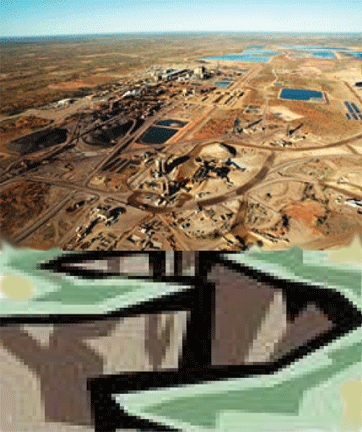
difficult to determine the safety of the reactor, noting the proximity of a seismic faultline.
The government in Japan, one of the world’s most seismically active countries, does not allow nuclear plants to be situated over active faultlines.
July 27 2024, TOKYO, https://japantoday.com/category/national/japan-nuclear-watchdog-panel-decides-against-restarting-tsuruga-reactor1
A panel of Japan’s nuclear watchdog decided on Friday against restarting a reactor at the Tsuruga nuclear power plant citing seismic risks, paving the way for the regulator to keep the Japan Atomic Power plant shut.
The panel said it was difficult to determine the safety of the reactor, noting the proximity of a seismic faultline. Consequently, it said, the reactor was not deemed compliant with criteria for installation licensing.
“We will conduct an additional investigation. We are not considering decommissioning the plant,” Mamoru Muramatsu, president of Japan Atomic Power, said after the panel meeting, according to Kyodo News Agency.
The government in Japan, one of the world’s most seismically active countries, does not allow nuclear plants to be situated over active faultlines.
The panel is set to report its decision to the Nuclear Regulation Authority (NRA) soon.
If approved, this would be the first case of non-compliance under the stricter safety standards imposed after the 2011 Fukushima nuclear disaster.
The move could hinder the government’s efforts to restart more nuclear power plants to ensure a stable energy supply.
Japan, which had 54 operational reactors before the 2011 disaster, has restarted only 12 of the 33 nuclear reactors it has been considering restarting.
Along with most reactors in Japan, operations at the Tsuruga’s No.2 reactor have been halted since 2011 following triple meltdowns at Tokyo Electric Power’s Fukushima Daiichi nuclear power plant.
On March 11, 2011, Japan’s northeast coast was struck by a magnitude 9 earthquake, the strongest quake in Japan on record, and a massive tsunami, triggering the worst nuclear crisis since Chernobyl a quarter of a century earlier.
US Forces Japan to be upgraded to warfighting command

The shift will move operational control of Japan-based forces east from Hawaii and, officials say, deepen cooperation with the Japanese military.
TOKYO—The Pentagon will upgrade and expand its three-star command in Japan to handle operational control of U.S. forces based there, part of an effort to deepen ties between the U.S. and Japanese militaries and to streamline command and control of joint operations, senior defense officials told reporters traveling with Defense Secretary Lloyd Austin on Friday.
“Secretary Austin plans to announce that the United States intends to reconstitute U.S. Forces Japan as a Joint Force Headquarters, reporting to the commander of U.S. INDOPACOM,” said the senior official. The shift will give USFJ, which is “currently, primarily, an administrative command” more warfighting responsibilities. “They do day-to-day management of the alliance, but not operational command of forces. So it’ll be a significant difference for them.”
The announcement comes as part of the Joint Statement of the Security Consultative Committee (“2+2”) committee meeting taking place in Tokyo between Austin, Secretary of State Anthony Blinken, and their Japanese counterparts.
The command will grow as it adds missions and responsibilities to its current alliance-management functions, the official said, “including some of the planning exercises and commanding of operations, and we’ll be doing those, as I mentioned, side-by-side with Japanese forces like never before.”
Many details of the new headquarters aren’t yet known and officials said that the approach will be phased, with many more discussions about how to implement yet to come. Among the decisions to be made is whether the expanded USFJ will have a command structure that integrates Japanese forces, the way U.S. Joint Forces Korea does for South Korean forces.
“A major part of that phased approach will involve bilateral working groups with the U.S. side, led by INDOPACOM, to work through important implementation factors, including potential resourcing needs, infrastructure, personnel, authorities and ranks,” the official said.
The new Joint Force Headquarters will allow INDOPACOM officers and operators to have daily interactions with Japanese counterparts about how to plan exercises, operations, and how to act on shared intelligence and information, the official said. ……………………..more https://www.defenseone.com/policy/2024/07/us-forces-japan-be-upgraded-warfighting-command/398386/
‘Atomic bomb hell must never be repeated’ say Japan’s last survivors

Atomic People will be broadcast on Wednesday 31 July on BBC Two and BBC iPlaye
Lucy Wallis, BBC News https://www.bbc.com/news/articles/crg5lyd25jno 26 July 24
It was early in the day, but already hot. As she wiped sweat from her brow, Chieko Kiriake searched for some shade. As she did so, there was a blinding light – it was like nothing the 15-year-old had ever experienced. It was 08:15 on 6 August 1945.
“It felt like the sun had fallen – and I grew dizzy,” she recalls.
The United States had just dropped an atomic bomb on Chieko’s home city of Hiroshima – the first time a nuclear weapon had ever been used in warfare. While Germany had surrendered in Europe, allied forces fighting in World War Two were still at war with Japan.
Chieko was a student, but like many older pupils, had been sent out to work in the factories during the war. She staggered to her school, carrying an injured friend on her back. Many of the students had been badly burnt. She rubbed old oil, found in the home economics classroom, onto their wounds.
“That was the only treatment we could give them. They died one after the next,” says Chieko.
“Us older students who survived were instructed by our teachers to dig a hole in the playground and I cremated [my classmates] with my own hands. I felt so awful for them.”
Chieko is now 94 years old. It is almost 80 years since the atomic bombs were dropped on Hiroshima and Nagasaki and time is running out for the surviving victims – known as hibakusha in Japan – to tell their stories.
Many have lived with health problems, lost loved ones and been discriminated against because of the atomic attack. Now, they are sharing their experiences for a BBC Two film, documenting the past so it can act as a warning for the future
After the sorrow, new life started to return to her city, says Chieko.
“People said the grass wouldn’t grow for 75 years,” she says, “but by the spring of the next year, the sparrows returned.”
In her lifetime, Chieko says she has been close to death many times but has come to believe she has been kept alive by the power of something great.
The majority of hibakusha alive today were children at the time of the bombings. As the hibakusha – which translates literally as “bomb-affected-people” – have grown older, global conflicts have intensified. To them, the risk of a nuclear escalation feels more real than ever.
“My body trembles and tears overflow,” says 86-year-old Michiko Kodama when she thinks about conflicts around the world today – such as the Russian invasion of Ukraine and the Israel-Gaza war.
“We must not allow the hell of the atomic bombing to be recreated. I feel a sense of crisis.”
Michiko is a vocal campaigner for nuclear disarmament and says she speaks out so the voices of those who have died can be heard – and the testimonies passed on to the next generations.
“I think it is important to hear first-hand accounts of hibakusha who experienced the direct bombing,” she says.
Michiko had been at school – aged seven – when the bomb was dropped on Hiroshima.
“Through the windows of my classroom, there was an intense light speeding towards us. It was yellow, orange, silver.”
She describes how the windows shattered and splintered across the classroom – the debris spraying everywhere “impaling the walls, desk, chairs”.
“The ceiling came crashing down. So I hid my body under the desk.”
After the blast, Michiko looked around the devastated room. In every direction she could see hands and legs trapped.
“I crawled from the classroom to the corridor and my friends were saying, ‘Help me’.”
When her father came to collect her, he carried her home on his back.
Black rain, “like mud”, fell from the sky, says Michiko. It was a mixture of radioactive material and residue from the explosion.
She has never been able to forget the journey home.
“It was a scene from hell,” says Michiko. “The people who were escaping towards us, most of their clothes had completely burned away and their flesh was melting.”
She recalls seeing one girl – all alone – about the same age as her. She was badly burnt.
“But her eyes were wide open,” says Michiko. “That girl’s eyes, they pierce me still. I can’t forget her. Even though 78 years have passed, she is seared into my mind and soul.”
Michiko wouldn’t be alive today if her family had remained in their old home. It was only 350m (0.21 miles) from the spot where the bomb exploded. About 20 days before, her family had moved house, just a few kilometres away – but that saved her life.
Estimates put the number of lost lives in Hiroshima, by the end of 1945, at about 140,000.
In Nagasaki, which was bombed by the US three days later, at least 74,000 were killed.
Sueichi Kido lived just 2km (1.24 miles) from the epicentre of the Nagasaki blast. Aged five at the time, he suffered burns to part of his face. His mother, who received more serious injuries, had protected him from the full impact of the blast.
“We hibakusha have never given up on our mission of preventing the creation of any more hibakusha,” says Sueichi, who is now 83 and recently travelled to New York to give a speech at the United Nations to warn of the dangers of nuclear weapons.
When he woke up after fainting from the impact of the blast, the first thing he remembers seeing was a red oil can. For years he thought it was that oil can that had caused the explosion and surrounding devastation.
His parents didn’t correct him, choosing to shield him from the fact it had been a nuclear attack – but whenever he mentioned it, they would cry.
Not all injuries were instantly visible. In the weeks and months after the blast, many people in both cities began to show symptoms of radiation poisoning – and there were increased levels of leukaemia and cancer.
For years, survivors have faced discrimination in society, particularly when it came to finding a partner.
“‘We do not want hibakusha blood to enter our family line,’ I was told,” says Michiko.
But later, she did marry and had two children.
She lost her mother, father and brothers to cancer. Her daughter died from the disease in 2011.
“I feel lonely, angry and scared, and I wonder if it may be my turn next,” she says.
Another bomb survivor, Kiyomi Iguro, was 19 when the bomb struck Nagasaki. She describes marrying into a distant relative’s family and having a miscarriage – which her mother-in-law attributed to the atomic bomb.
“‘Your future is scary.’ That’s what she told me.”
Kiyomi says she was instructed not to tell her neighbours that she had experienced the atomic bomb.
Since being interviewed for the documentary, Kiyomi has sadly died.
But, until she was 98, she would visit the Peace Park in Nagasaki and ring the bell at 11:02 – the time the bomb hit the city – to wish for peace.
Sueichi went on to teach Japanese history at university. Knowing he was a hibakusha cast a shadow on his identity, he says. But then he realised he was not a normal human being and felt a duty to speak out to save humankind.
“A sense that I was a special person was born in me,” says Sueichi.
It is something the hibakusha all feel that they share – an enduring determination to ensure the past never becomes the present.
Atomic People will be broadcast on Wednesday 31 July on BBC Two and BBC iPlaye
Nuclear energy not the way to go: coalition Taiwan
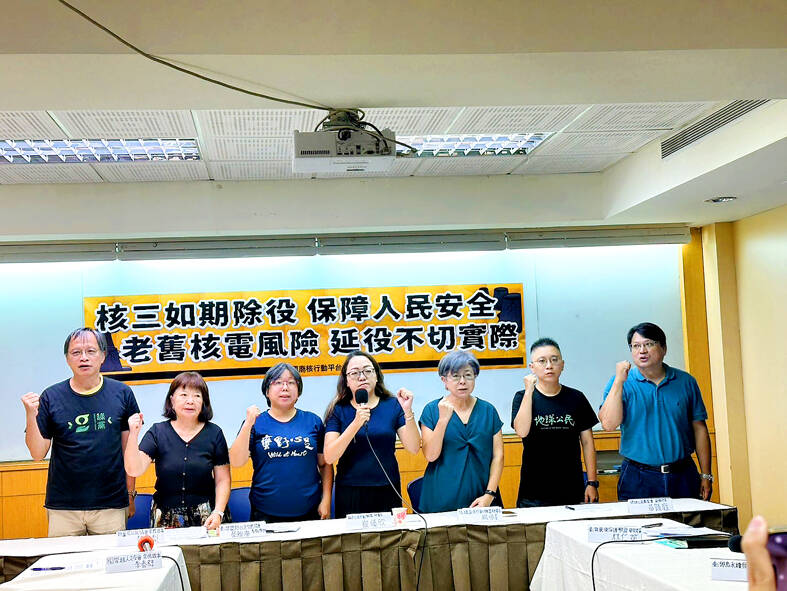
By Yang Yin-ting and Jonathan Chin / Staff reporter, with staff writer, https://www.taipeitimes.com/News/taiwan/archives/2024/07/27/2003821385
Relying on nuclear power is the wrong strategy for Taiwan to achieve net zero emissions, a coalition of environmental groups said yesterday, amid rising calls from some lawmakers and government officials in support of it.
The National Nuclear Abolition Action Platform held a news conference in Taipei yesterday — two weeks before the National Climate Change Response Committee’s inauguration meeting, which is expected to discuss nuclear power.
The Chinese Nationalist Party (KMT) has indicated that it would seek to extend the operations of the nation’s nuclear reactors, including the ones at the Ma-anshan Nuclear Power Plant in Pingtung County, a coalition spokesperson said.
The Ma-ashan plant’s first reactor, which has reached the end of its 40-year service life limit, is to be deactivated today, while its second reactor is scheduled for decommissioning in May next year, it said.
The KMT’s failure to acknowledge the public security risks posed by the nation’s aged reactors or the problem of nuclear waste disposal has exposed the recklessness of the party’s energy policy, it said.
Lawmakers should drop proposed amendments to the Nuclear Reactor Facilities Regulation Act (核子反應器設施管制法) and allow the Ma-anshan plant to be decommissioned as planned, the spokesperson said.
Green Citizens’ Action Alliance secretary-general Tsuei Su-hsin (崔愫欣) said that high operating costs and the lack of suitable sites for waste disposal make the bid to continue generating nuclear power impractical for Taiwan.
Taiwan Environmental Protection Union executive Lin Ren-pin (林仁斌) said that global energy production trends point to a decline in nuclear energy.
China — which has built more new nuclear reactors than any country in the world — reported that renewables experienced faster growth than nuclear energy, he added.
The Ma-anshan plant straddles a geological faultline in the Hengchun Peninsula and has a terrible safety record, Lin said.
The scarcity of land, high population density and propensity to build nuclear power plants on soft rock strata are a recipe for disaster on the scale of the partial meltdown at Japan’s Fukushima Dai-ichi nuclear power plant, he said.
Moms Love Taiwan Association secretary-general Yang Shun-me (楊順美) said that the Jinshan Nuclear Power Plant is practically decommissioned, as the lion’s share of its equipment and transmission towers had already been removed.
The remaining facilities at the power plant has not been maintained for many years, she added.
The Guosheng Nuclear Power Plant has two inoperable reactors, while the Ma-anshan plant cannot resume operations without a full shutdown and replacing critical components, Yan said.
This means none of the nation’s three nuclear power plants stand a chance of contributing to emissions reduction, she said.
Citizen of the Earth Taiwan deputy director Huang Ching-ting (黃靖庭) said opposition lawmakers were making untruthful claims about a purported energy shortage.
Citing Taiwan Power Co’s electricity supply report this month, he said that Taiwan has enough energy to keep the nighttime reserve margin above 10 percent through 2030, which does not indicate a shortage.
Nuclear power plants must obtain safety certifications and replace key components before lengthening their service life, he said, adding that the process is estimated to take five to 10 years.
The Ma-anshan plant is rightly decommissioned since the facility’s reactors generate a marginal amount of electricity compared with the safety risks they represent, he said.
Altogether, there is virtually no chance that Taiwan could get any of its old nuclear power plants back online before 2030, Huang said.
Using nuclear energy to reduce emissions is impractical and impossible to implement in time, he said
Progress is Slow in ASEAN’s Anti-Nuclear Pact: Indonesia
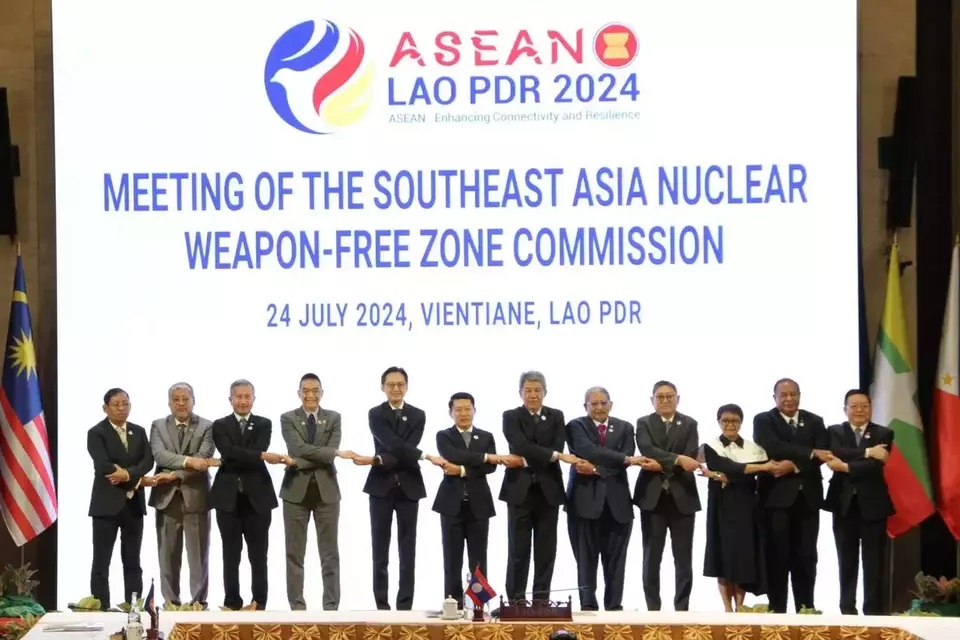
Jayanty Nada Shofa, July 25, 2024, https://jakartaglobe.id/news/progress-is-slow-in-aseans-antinuclear-pact-indonesia
Jakarta. The progress is slow in bringing nuclear-possessing countries to promise that they would keep the Southeast Asian region nuke-free, Indonesia told fellow ASEAN members.
Foreign Affairs Minister Retno Marsudi is currently in Laos to discuss the bloc’s matters with her ASEAN counterparts. The group’s Southeast Asia Nuclear Weapon-Free Zone (SEANWFZ) pact became one of the major themes in the discussions.
The treaty aims to create a peaceful Southeast Asia region that is free from nuclear weapons. The pact has legally binding protocols for the five nuclear-weapon states — China, France, Russia, the UK, and the US — to sign and ratify. By signing, these five countries would promise to not use or threaten to use nukes in the region. Although the SEANWFZ dates back to 1995, no nuclear weapon state has signed the protocol so far.
“There has not been any significant progress from the nuclear-weapon states in regards to the SEANWFZ protocol,” Retno said in a press statement on Wednesday evening.
Amidst the sluggish progress, Indonesia thinks it is about time that ASEAN should involve experts in their efforts.
“Indonesia suggests that we should appoint experts, including legal experts from every ASEAN country, to give their inputs in the next SEANWFZ Commission meeting with a clear and measurable timeline,” Retno said.
Of all five nuclear-weapon states, China appears to be the one who is the closest to signing the pact. Last year, Malaysia’s then-Foreign Affairs Minister Zambry Abdul Kadir said that China had given its word to sign the protocol “unconditionally”.
Kadir made the remarks on the sidelines of an ASEAN foreign ministerial meeting in Jakarta last July. Not long after Kadir’s statement, Secretary-General Kao Kim Hourn also dropped a similar hint that Beijing had shown a “strong desire” to sign the SEANWFZ protocol. But again, China has yet to keep its promise.
Will US defend Japan with nukes or turn it into the line of fire?
By Global Times, Jul 22, 2024
The US, which bombed Japan with nuclear weapons, is reportedly about to protect Japan with nuclear weapons. Reports show that Japan and the US will draft their first joint document on expanded deterrence policy, which will include a clause affirming nuclear weapons will be included in US methods to defend Japan. However, it might be premature if Japan feels moved by this.
Japanese newspaper Yomiuri Shimbun, citing sources, reported that the document will specify measures that the US could take in peacetime and emergencies; as well as conditions under which the US could take retaliatory actions against third countries, and what those measures could be, under the backdrop of so-called threats from China and Russia. The foreign and defense ministers of Japan and the US will discuss the details at a meeting in Tokyo later this month, according to the report. …………………………………………..
Both the US and Japan have their own calculations behind the push for this joint document. Japan wants to boost its deterrent capabilities through military alliance with the US. Washington hopes to make Tokyo a thornier pawn in its “Indo-Pacific Strategy.” Claims of “threats” from China and Russia are merely far-fetched excuse – the US simply wishes Japan to be more proactive toward China and Russia under the nuclear umbrella, so as to alleviate US pressure in countering both countries.
The essence of today’s US nuclear umbrella in the Asia-Pacific region is not about protection. Rather, it serves as a platform for the US to disrupt regional stability among major powers through providing excuses to enhance strategic offensive capabilities of US allies.
Japan, a non-nuclear weapon state, would hardly become a primary target for nuclear strikes, if there will be one. Still, the US is now pulling Japan in its “nuclear protection circle” while mulling to deploy nuclear weapons to Japan. In that scenario, Japan could be viewed as a nuclear-weapon state. The US is pushing Japan to be the next battleground. And by promoting the joint document, Japan demonstrates its readiness to be considered a potential nuclear target due to its alliance with the US…………………………………………………………………… more https://www.globaltimes.cn/page/202407/1316500.shtml
China Stops Arms Control Talks With the US Over Arms Sales to Taiwan
The Chinese Foreign Ministry says the US continues to do things that go against Beijing’s ‘core interests’
Anti War, by Dave DeCamp, JULY 18, 2024
The Chinese Foreign Ministry said Wednesday that Beijing had stopped arms control talks with the US over continued US arms sales to Taiwan and other steps that go against China’s “core interests.”
The US and China held consultations on arms control back in November 2023. A reporter asked Chinese Foreign Ministry spokesman Lin Jian about comments from US officials suggesting China declined to hold another round.
“Over the past weeks and months, despite China’s firm opposition and repeated protest, the US has continued to sell arms to Taiwan and done things that severely undermine China’s core interests and the mutual trust between China and the US. This has seriously compromised the political atmosphere for continuing the arms control consultations,” Lin said.
“Consequently, the Chinese side has decided to hold off discussion with the US on a new round of consultations on arms control and non-proliferation. The responsibility fully lies with the US,” the spokesman added………………………………………………………more https://news.antiwar.com/2024/07/17/china-stops-arms-control-talks-with-the-us-over-arms-sales-to-taiwan/
Fukushima plant ends 7th round of treated water release into sea

Tokyo Electric Power Co. announced that it has completed the third round of
treated radioactive water discharge from the stricken Fukushima No. 1
nuclear power plant in this fiscal year. About 7,800 tons of filtered water
were released from storage tanks into the Pacific Ocean after being diluted
by a large volume of seawater, the company said on July 16. This was the
seventh batch of treated water dumped into the sea since TEPCO began the
discharge program in August last year. The utility plans four more rounds
of discharge before the current fiscal year ends in March.
Asahi Shimbun 17th July 2024
Yongbyon Nuclear Complex: New evidence of increased activity
Night-time lights visible at the Yongbyon radiochemical laboratory suggest that North Korea is covertly importing spent fuel rods for plutonium extraction reprocessing
DAILY NK By Bruce Songhak Chung, 16 July 24
Evidence suggests that North Korea is ramping up production of plutonium and uranium nuclear materials at the radiochemical laboratory and uranium enrichment facility in the Yongbyon nuclear complex, as it has begun full-scale operation of the experimental light water reactor this summer. Recently, major foreign media outlets covering North Korea have debated and verified the reliability of the thermal infrared analysis of the Yongbyon facility presented in a Daily NK column I published in May. This article summarizes thoughts and opinions on this matter, and also examines what is behind the intermittent night lights observed in Yongbyon through night-time luminosity images.
Recent conditions at the Yongbyon reactor and light water reactor area were examined using Maxar’s GeoEye-1 satellite imagery (40 centimeter resolution). In the June 19 satellite photo, heated cooling water from the reactor and light water reactor operation is clearly identified being discharged into the Kuryong River through two pump stations, accompanied by white foam. This marks the 16th cooling water discharge detected this year. As it continues to appear in satellite images since late April, the experimental light water reactor appears to have entered full-scale operation. The South Korean Ministry of National Defense had previously predicted that the Yongbyon light water reactor would enter normal operation in or around the summer months.
Below the second pump station, a yellow substance spread out in a rectangular shape can be seen on the ground. This could be wheat or barley being dried after harvest. In North Korea, mid-June is the peak harvest time for wheat and barley in the fields, followed typically by planting corn as the year’s second crop. Soldiers and workers guarding the Yongbyon nuclear facility appear to be engaging in farming activities in empty spaces within the complex as food rations are insufficient.
Analysis of Yongbyon thermal infrared satellite imagery………………………………………………………………………………………..
Repairs of the boiler room in the Yongbyon thermal power plant ………………………………………………………
Mysterious late night lights at the radiochemical laboratory………………………………………………………….
influential foreign media outlets recently released an assessment about thermal infrared analysis, which is used to determine the operational status of the Yongbyon nuclear facilities. The prominent U.S. North Korea-focused website Beyond Parallel has provided an in-depth analysis of the reliability of thermal infrared data. I read the three articles with great interest. The conclusion of the series of articles evaluated the results of the thermal infrared analysis of North Korea’s Yongbyon nuclear facilities as generally reliable. The outlet explained that after obtaining and comparing Yongbyon facility operation records for over two years held by the U.N., the results largely matched those of the thermal infrared analysis. When high heat was detected in the thermal infrared data, it corresponded with the operation of the Yongbyon facilities. However, the caveat was that facilities operating at low intensity might not be detected due to weak heat emissions. They also recommended drawing comprehensive conclusions by combining thermal infrared analysis with various other data, as there are still imperfections in the analysis. This is valuable advice worth noting.
Please send any comments or questions about this article to dailynkenglish@uni-media.net. https://www.dailynk.com/english/yongbyon-nuclear-complex-new-evidence-of-increased-activity/
–
July 16, 2024
US Ally South Korea Threatens Nuclear-Armed North Korea With Regime Destruction
https://www.newsweek.com/south-north-korea-nuclear-weapons-regime-destruction-1925096, Jul 15, 2024
South Korea said Kim Jong Un‘s regime in the North faces a certain end if it uses nuclear weapons, a strongly worded statement that came after Pyongyang blasted Seoul and Washington for opening the door to further nuclear force deployments to the peninsula.
“If North Korea attempts to use nuclear weapons, the overwhelming response of the South Korea-U.S. alliance will bring about the end of the North Korean regime,” the Defense Ministry in Seoul said on Sunday.
“There is no scenario in which the North Korean regime will survive after using nuclear weapons,” the ministry added.
Kim’s government has stepped up its ballistic missile tests despite existing prohibitions backed by the U.N. Security Council. Amid spiraling tensions on the Korean Peninsula, Pyongyang has threatened to launch a preemptive nuclear strike to defend its territory from what it claims is an impending invasion.
In Washington, D.C., last week, President Joe Biden met South Korean counterpart Yoon Suk Yeol and recommitted “the full range of U.S. capabilities, including nuclear,” to the defense of the longtime U.S. treaty ally.
In a joint statement issued later the same day, the U.S. Defense Department and South Korean Defense Ministry announced the signing of “Guidelines for Nuclear Deterrence and Nuclear Operations on the Korean Peninsula.” This is a move to further integrate U.S. nuclear assets with South Korea’s conventional forces in defense of the alliance.
On Saturday, the North Korean Defense Ministry warned the United States and the South—”hostile states“—that they would “pay an unimaginably harsh price” for increased nuclear cooperation.
The allies were “betraying their sinister intention to step up their preparations for a nuclear war against the DPRK,” read the statement carried by the official Korean Central News Agency. DPRK stands for the Democratic People’s Republic of Korea, North Korea’s official name.
“We come to the conclusion that there is only one option for us to take against such confrontational fanatics,” the ministry said, noting the urgent requirement “to further improve its nuclear deterrent readiness and add important elements to the composition of the deterrent.”
South Korea’s Defense Ministry described the new guidelines as “a legitimate measure,” justified by North Korea’s continued development of nuclear-capable missiles.
The forceful language against Kim was first used by Biden last year during a state visit by Yoon.
“A nuclear attack by North Korea against the United States or its allies or partners is unacceptable and will result in the end of whatever regime, were it to take such an action,” Biden said.
North Korea’s embassy in Beijing did not immediately respond to a written request for comment.
The new guidelines governing when and how American nuclear forces might be deployed and used on the Korean Peninsula were crafted by the U.S.-ROK Nuclear Consultative Group, established after Yoon’s visit to the White House. ROK stands for the Republic of Korea, South Korea’s official name.
South Korea, which has no nuclear weapons, says the contents of the guidelines are confidential.
Analysts say Washington aims to boost the credibility of what it calls “extended deterrence,” the ability of the U.S. military to deter adversaries and reassure allies, particularly with its nuclear arms.
North Korea conducted its first nuclear test in 2006 and is estimated to have around 50 nuclear warheads in its stockpile, according to the Stockholm International Peace Research Institute.
In SIPRI’s annual yearbook released last month, the think tank’s experts described North Korea’s nuclear weapons program as “active but highly opaque.”
“Based on statements by the North Korean leader, Kim Jong Un, and North Korea’s expanding force posture, it seems likely that North Korea intends to increase its nuclear warhead inventory significantly,” the experts said.
North Korean nuclear weapons, 2024
Bulletin By Hans M. Kristensen, Matt Korda, Eliana Johns, Mackenzie Knight | July 15, 2024
North Korea continues to modernize and grow its nuclear weapons arsenal. In this Nuclear Notebook, the authors cautiously estimate that North Korea may have produced enough fissile material to hypothetically build up to 90 nuclear warheads, but has likely assembled fewer than that—potentially around 50. To deliver the warheads, North Korea is enhancing and diversifying its missile force, most recently with new solid-fuel long-range strategic missiles, short-range tactical missiles, and sea-based missiles. The Nuclear Notebook is researched and written by the staff of the Federation of American Scientists’ Nuclear Information Project: director Hans M. Kristensen, associate director Matt Korda, research associate Eliana Johns, and program associate Mackenzie Knight.
This article is freely available in PDF format in the Bulletin of the Atomic Scientists’ digital magazine (published by Taylor & Francis) at this link.
North Korea—also known as the Democratic People’s Republic of Korea, or DPRK—has made significant advances over the past two decades in developing its nuclear weapons arsenal. Since 2006, North Korea has detonated six nuclear devices, updated its nuclear doctrine to reflect the irreversible role of nuclear weapons for its national security, and continued to introduce a variety of new missiles test-flown from new launch platforms.
It is widely assumed that North Korea has operational nuclear warheads for its short- and medium-range missiles as well as possibly for its longer-range missiles, although the latter capability has not yet been publicly demonstrated. There is considerable uncertainty about which of North Korea’s missiles have been fielded with an active operational nuclear capability. However, it seems clearer from North Korea’s public statements and systems-testing that the country intends to field an operational nuclear arsenal capable of holding targets at risk in East Asia, the United States, and Europe.
In 2021, Kim Jong-un announced several key strategic goals for North Korea’s nuclear weapons program, proposed as a five-year plan. According to Kim’s statement, these goals included: 1) producing “super-sized nuclear warheads,” 2) producing smaller and lighter nuclear weapons for tactical uses, 3) improving precision strike and range capabilities, 4) introducing “hypersonic gliding flight warheads,” 5) developing “solid-fuel engine propelled intercontinental, underwater, and ground ballistic rockets,” and 6) introducing a “nuclear-powered submarine and underwater-launch nuclear strategic weapon” (KCNA 2021). North Korea appears to have made significant progress on these goals, and has since introduced more demands including the dramatic increase of missile production and “cutting edge strategic weapon engines” (Kim 2023).
Due to the lack of clarity surrounding North Korea’s nuclear program, agencies and officials of the US intelligence community, as well as military commanders and independent experts, struggle to assess the program’s characteristics and capabilities………………………………………………………………………………………………………………………….
North Korea’s nuclear policy
For decades, North Korea has made numerous statements and signals about its nuclear weapons policy, laying out its nuclear doctrine if deterrence fails. Such statements have more recently been codified in official declaratory policy. In 2013, for example, North Korea’s “Law on Consolidating the Position of Nuclear Weapons State” suggested a no-first-use policy, noting that North Korea’s nuclear arsenal would only be used “to repel invasion or attack from a hostile nuclear weapons state and make retaliatory strikes” (KCNA 2013). Kim Jong-un officially declared a no-first-use policy in 2016 following North Korea’s fourth nuclear test.
Since 2016, however, North Korean statements and force posture changes have indicated a shift away from this no-first-use policy. Just two months after the policy was declared, the North Korean government issued a statement that North Korea would not be the first to use nuclear weapons “as long as the hostile forces for aggression do not encroach upon its sovereignty” (KCNA 2016b). In 2020, Kim Jong-un stated that North Korea’s nuclear deterrent “will never be used preemptively. But if […] any forces infringe upon the security of our state and attempt to have recourse to military force against us, I will enlist all our most powerful offensive strength in advance to punish them” (38 North 2020). Such caveats culminated in September 2022 when North Korea’s parliament codified in law North Korea’s right to launch nuclear weapons preemptively (Kim 2022). One year later, the North Korean government codified under the country’s constitution its right to “deter war and protect regional and global peace by rapidly developing nuclear weapons to a higher level” (Soo-Yeon 2023).
The abandonment of North Korea’s no-first-use policy coincides with the country’s recent efforts to develop tactical nuclear weapons. Following development and demonstration of new long-range strategic nuclear-capable missiles, the pursuit of tactical nuclear weapons appears intended to provide options for nuclear use below the strategic level and strengthen its regional deterrence posture (KCNA 2022; National Committee on North Korea 2021). According to two analysts, Pyongyang now sees its nuclear weapons as useful not only for retaliation against an attack but also for potentially winning a limited conflict………………
………………….. Occasionally, North Korea has explicitly mentioned or signaled which targets it would hit with its nuclear weapons. These include US military bases in South Korea, the Asia-Pacific region, Guam, Hawaii, and the continental United States.
………………………………………………………………….. despite occasional inflammatory statements, it appears highly likely that North Korea—as with other nuclear-armed states—would use its nuclear weapons only under extreme circumstances, particularly if the continued existence of the North Korean state and its political leadership were threatened.
North Korea’s nuclear weapons program
Plutonium production operations
The Yongbyon Nuclear Scientific Research Center, located in North Pyongan province, has been called the “beating heart” of North Korea’s nuclear weapons program. At Yongbyon, North Korea produces plutonium at its five megawatt-electric (MWe) graphite-moderated nuclear reactor, which has been operating intermittently since 1986………………………………………………………………………………………………………
Uranium enrichment operations
Assessing the state of North Korea’s uranium enrichment operations is more difficult because the operational history and locations of several associated uranium enrichment facilities are unknown………………………………………………………………
Fissile material and warhead inventory estimates
Because of the prior access to the facilities at Yongbyon, analysts have a reasonable understanding of North Korea’s plutonium production capabilities. However, given the uncertainties about the operations at Yongbyon’s uranium enrichment facility and the possible existence of a second centrifuge facility, it is unclear how much highly-enriched uranium (HEU) North Korea has produced and how much uranium it might divert to military purposes, including for plutonium production. Still, this amount is known to be growing and it is clear North Korea is investing in the improvement of its fissile material production capabilities………………………………………………………………………………………………………………………………………………………….
The size of North Korea’s nuclear stockpile also depends on the weapon design and the number and types of launchers that can deliver them. Many experts also estimate that North Korea may have built a smaller number of nuclear weapons than what its stockpile of fissile material may suggest………………………………………………………………………………………………………………….
Nuclear testing and weaponization
After six nuclear tests—including two with moderate yields and one with a high yield—there is no longer any doubt that North Korea can build powerful nuclear explosive devices designed for different yields. North Korea’s latest nuclear test, conducted on September 3, 2017, had a yield of well over 100 kilotons and demonstrated that North Korea had managed to design a thermonuclear device or at least one that used a mixed-fuel (composite) design………………………………………………………………………………………………………………………………………
Potential land-based nuclear-capable missiles
Over the past decade, North Korea has developed a highly diverse ballistic missile force, including missiles in all major range categories…………………………………………………………………………………………
Short-range missiles…………………………………………………………………………………
Medium- and intermediate-range missiles North Korea is developing a new generation of medium- and intermediate-range missiles with improved accuracy, readiness, and maneuverability…………………………………………………………………
Intercontinental ballistic missiles
The most dramatic of North Korea’s recent developments has been the display and test launch of large intercontinental ballistic missiles (ICBMs),…………………………………………………
Sea-based nuclear-capable missiles
Over the past decade, North Korea has worked to develop an increasingly sophisticated sea-based nuclear deterrent. ……………………………………………………………………..
Submarine-launched ballistic missiles……………………………………………
Submarine-launched cruise missiles North Korea is developing a new submarine-launched cruise missile, known as Pulhwasal-3-31. The system has been labeled a “strategic cruise missile”—implying a nuclear-capable status……………………………………………………
Other sea-based weapons North Korea appears to be developing an underwater weapon system………………………………………..
Land-attack cruise missiles North Korea appears to be developing a series of land-attack cruise missiles (LACMs)—………………………………………………… more https://thebulletin.org/premium/2024-07/north-korean-nuclear-weapons-2024/
China is installing the wind and solar equivalent of five large nuclear power stations per week

Instead of nuclear, solar is now intended to be the foundation of China’s new electricity generation system.
ABC Science / By technology reporter James Purtill, 16 July 24, https://www.abc.net.au/news/science/2024-07-16/chinas-renewable-energy-boom-breaks-records/104086640
In short:
China is installing record amounts of solar and wind, while scaling back once-ambitious plans for nuclear.
While Australia is falling behind its renewables installation targets, China may meet its end-of-2030 target by the end of this month, according to a report.
What’s next?
Energy experts are looking to China, the world’s largest emitter and once a climate villain, for lessons on how to rapidly decarbonise.
While Australia debates the merits of going nuclear and frustration grows over the slower-than-needed rollout of solar and wind power, China is going all in on renewables.
New figures show the pace of its clean energy transition is roughly the equivalent of installing five large-scale nuclear power plants worth of renewables every week.
A report by Sydney-based think tank Climate Energy Finance (CEF) said China was installing renewables so rapidly it would meet its end-of-2030 target by the end of this month — or 6.5 years early.
It’s installing at least 10 gigawatts of wind and solar generation capacity every fortnight.
By comparison, experts have said the Coalition’s plan to build seven nuclear power plants would add fewer than 10GW of generation capacity to the grid some time after 2035.
Energy experts are looking to China, the world’s largest emitter, once seen as a climate villain, for lessons on how to go green, fast.
“We’ve seen America under President Biden throw a trillion dollars on the table [for clean energy],” CEF director Tim Buckley said.
“China’s response to that has been to double down and go twice as fast.”
Smart Energy Council CEO John Grimes, who recently returned from a Shanghai energy conference, said China has decarbonised its grid almost as quickly as Australia, despite having a much harder task due to the scale of its energy demand.
“They have clear targets and every part of their government is harnessed to deliver the plan,” he said.
China accounts for about a third of the world’s greenhouse gas emissions. A recent drop in emissions (the first since relaxing COVID-19 restrictions), combined with the decarbonisation of the power grid, may mean the country’s emissions have peaked.
“With the power sector going green, emissions are set to plateau and then progressively fall towards 2030 and beyond,” CEF China energy policy analyst Xuyang Dong said.
So how is China building and connecting panels so fast, and what’s the role of nuclear in its transition?
Like building solar farms near Perth to power Sydney
Because its large cities of the eastern seaboard are dominated by apartment buildings, China hasn’t seen an uptake of rooftop solar like in Australia.
To find space for all the solar panels and wind turbines required for the nation’s energy needs, the planners of China’s energy transition have looked west, to areas like the Gobi Desert.
The world’s largest solar and wind farms are being built on the western edge of the country and connected to the east via the world’s longest high-voltage transmission lines.
These lines are so long they could span the length of our continent.
In Australian terms, it’s the equivalent of using solar panels near Perth to power homes in Sydney.
Mr Buckley said China’s approach was similar to the Australian one of developing regional “renewable energy zones” for large-scale electricity generation.
“They’re doing what Australia is doing with renewable energy zones but they’re doing it on steroids,” he said.
What about ‘firming’ the grid?
One of the issues with switching a grid to intermittent renewables is ensuring a steady supply of power.
In technical terms, this is the difference between generation capacity (measured in gigawatts) and actual energy output (measured in gigawatt-hours, or generation over time).
Renewables have a “capacity factor” (the ratio of actual output to maximum potential generation) of about 25 per cent, whereas nuclear’s is as high as 90 per cent.
So although China is installing solar and wind generation equivalent to five large nuclear power plants per week, their output is closer to one nuclear plant per week.
Renewables account for more than half of installed capacity in China, but only amount to about one-fifth of actual energy output over a year, the CEF’s Tim Buckley said.
To “firm” or stabilise the supply of power from its renewable energy zones, China is using a mix of pumped hydro and battery storage, similar to Australia.
“They’re installing 1GW per month of pumped hydro storage,” Mr Buckley said.
“We’re struggling to build the 2GW Snowy 2.0 in 10 years.”
There are some major differences between Australia and China’s approaches, though. Somewhat counterintuitively, China has built dozens of coal-fired power stations alongside its renewable energy zones, to maintain the pace of its clean energy transition.
China was responsible for 95 per cent of the world’s new coal power construction activity last year.
The new plants are partly needed to meet demand for electricity, which has gone up as more energy-hungry sectors of the economy, like transport, are electrified.
The coal-fired plants are also being used, like the batteries and pumped hydro, to provide a stable supply of power down the transmission lines from renewable energy zones, balancing out the intermittent solar and wind.
Despite these new coal plants, coal’s share of total electricity generation in the country is falling.
The China Energy Council estimated renewables generation would overtake coal by the end of this year.
The CEF’s Xuyang Dong said despite the country’s reliance on coal, “having China go green at this speed and scale provides the world with a textbook to do the same”.
“China is installing every week the equivalent of what we’re doing every year.”
Despite this speed, China wasn’t installing renewables fast enough to meet its 2060 carbon neutrality target, she added.
“According to our analysis, [the current rate of installation] is not ambitious enough for China.”
What about nuclear?
China is building new nuclear plants, although nowhere near as fast as it once intended.
In 2011, Chinese authorities announced fission reactors would become the foundation of the country’s electricity generation system in the next “10 to 20 years”.
But Japan’s 2011 Fukushima disaster prompted a moratorium on inland nuclear plants, which have to use river water for cooling and are more vulnerable to frequent flooding.
Meanwhile, over the following decade, solar became the cheapest electricity in the world.
From 2010 to 2020, the installed cost of utility-scale solar PV declined by 81 per cent on a global average basis.
As well as cheap, it was safe, which made solar farms quicker to build than nuclear reactors.
Instead of nuclear, solar is now intended to be the foundation of China’s new electricity generation system.
Authorities have steadily downgraded plans for nuclear to dominate China’s energy generation. At present, the goal is 18 per cent of generation by 2060.
China installed 1GW of nuclear last year, compared to 300GW of solar and wind, Mr Buckley said.
“That says they’re all in on renewables.
“They had grand plans for nuclear to be massive but they’re behind on nuclear by a decade and five years ahead of schedule on solar and wind.”
How is China transitioning so fast?
In June of this year, on the eve of the Coalition’s nuclear policy announcement, former Queensland Premier Annastacia Palaszczuk, who’s now a Smart Energy Council “international ambassador”, led a delegation of Australians to the world’s largest clean energy conference in Shanghai.
The annual Smart Energy Conference hosts more than 600,000 delegates across three days.
Its scale underlines China’s increasing dominance of the global clean energy economy and, for some attendees, prompted unenviable comparisons with Australia’s progress.
Mr Buckley, who was part of the delegation, said he was “blown away”.
“China is winning this race.”
John Grimes, the Smart Energy Council CEO who also attended, said Australia could learn from the Chinese government’s ability to execute a long-term, difficult and costly transition plan, rather than relying on market forces to find a solution.
“Australia’s transition is going too slow, there was a lost decade of action,” he said.
“The world today spends about $7 trillion a year on coal, gas and oil and that money is going to find a new home.
Who is going to be the economic winner in that global economic transition? It’s going to be China.”
He and other energy experts are frustrated with the progress of Australia’s transition, including the discussion of nuclear power and the “weaponisation of dissent” from community groups over new wind farms and transmission lines.
Stephanie Bashir, CEO of the Nexa energy advisory, said Australia’s transition was tangled in red tape.
“The key hold-up for a lot of projects is the slow planning approvals,” Ms Bashir, who also attended the conference, said.
“In China they decide they’re going to do something and then they go and do it.”
The Australian Energy Market Operator’s (AEMO) plan to decarbonise the grid and ensure the lights stay on when the coal-fired power stations close requires thousands of kilometres of new transmission lines and large-scale solar and wind farms.
Australia is installing about half the amount of renewables per year required under the plan.
Due to this shortfall, many experts say its unlikely to meet its 2030 target of 82 per cent renewables in the grid and 43 per cent emissions reduction.
“We need to build 6GW each year from now until each power station closes, and so far we’re only bringing online 3GW,” Ms Bashir said.
“If we identify some projects are nation-building … and we need them for transition, we just have to get on with it.”
Mr Buckley predicted China would accelerate its deployment of renewables.
“My forecast is it will lift 20 per cent per annum on current levels.”
North Korea tests new nuclear-capable underwater drone
Canberra Times, By Soo-Hyang Choi and Ju-Min Park, March 24 2023
North Korea has tested a new nuclear-capable underwater attack drone, as leader Kim Jong-un warned joint military drills by South Korea and the United States should stop.
The drone cruised underwater at a depth of 80 to 150 metres for more than 59 hours and detonated a non-nuclear payload in waters off its east coast on Thursday, North Korean state news agency KCNA said on Friday.
Analysts say North Korea is showing off its increasingly diverse nuclear threats to Washington and Seoul, though they are sceptical whether the underwater vehicle is ready for deployment.
North Korea intends to signal “to the United States and South Korea that in a war, the potential vectors of nuclear weapons delivery that the allies would have to worry about and target would be vast,” said Ankit Panda, senior fellow at the US-based Carnegie Endowment for International Peace.
“There would be silos, railcars, submarines and road mobile missile launchers and now they’re adding this underwater torpedo to the mix,” he said………………………………………………………… more https://www.canberratimes.com.au/story/8134654/north-korea-tests-new-nuclear-capable-underwater-drone/—
Deaths mount as Pakistan swelters in heatwave

As the temperatures rose in southern Pakistan, so did the body count. The
Edhi ambulance service says it usually takes around 30 to 40 people to the
Karachi city morgue daily. But over the last six days, it has collected
some 568 bodies – 141 of them on Tuesday alone. It is too early to say
exactly what the cause of death was in every case. However, the rising
numbers of dead came as temperatures in Karachi soared above 40C (104F),
with the high humidity making it feel as hot as 49C, reports said. People
have been heading to hospitals seeking help.
BBC 27th June 2024
1 This Month
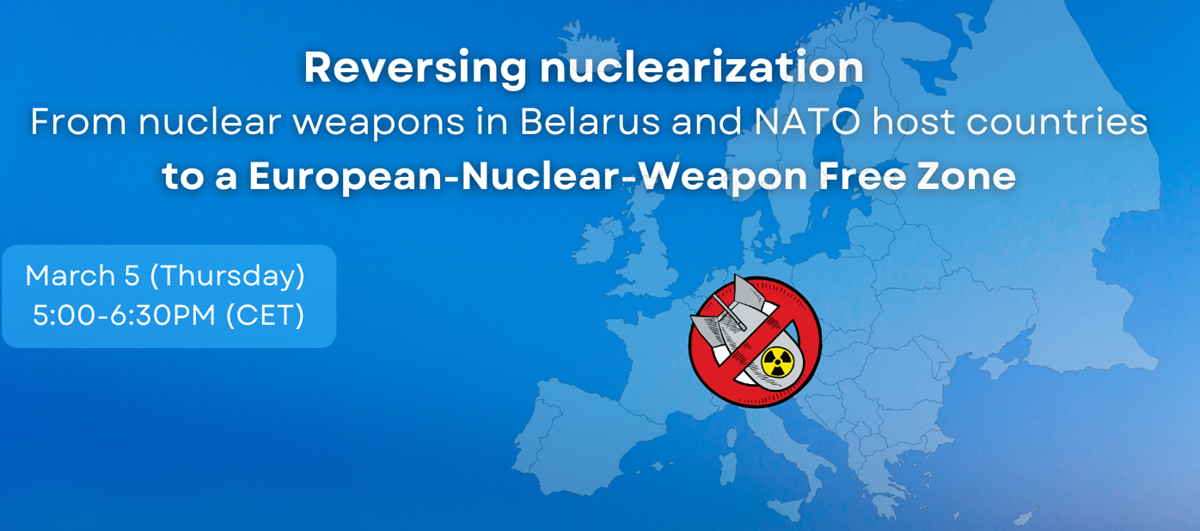
5 March -Online – Reversing nuclearization:
From nuclear weapons in Belarus and NATO host countries to a European-Nuclear-Weapon Free Zone
11am-12:30pm Eastern Time USA / 5pm-6:30pm CET

of the week – Advocating for a
nuclear free beach – https://www.samuellawrencefoundation.org/
The Samuel Lawrence Foundation advocates for a Nuclear Waste Free Beach at San Onofre, join us and take action!

10 March A LIVE WEBINAR THE REAL EFFECTS OF NUCLEAR POWER
What the Industry Isn’t Telling Us
1:00 PM Mountain, 2 pm Central, 3 pm Eastern. Live on the Keepers of the Water Facebook page

18 March Webinar @ 1 PM EST: An Assessment of SMR Projects: The Case of Canada
register for the zoom:
https://us02web.zoom.us/webinar/register/WN_o8BIIOUvQ2ONJR1nta65DQ#/registration

of the week – STOP SMALL MODULAR REACTORS IN CANADA
To see nuclear-related stories in greater depth and intensity – go to https://nuclearinformation.wordpress.com
-
Archives
- March 2026 (51)
- February 2026 (268)
- January 2026 (308)
- December 2025 (358)
- November 2025 (359)
- October 2025 (376)
- September 2025 (258)
- August 2025 (319)
- July 2025 (230)
- June 2025 (348)
- May 2025 (261)
- April 2025 (305)
-
Categories
- 1
- 1 NUCLEAR ISSUES
- business and costs
- climate change
- culture and arts
- ENERGY
- environment
- health
- history
- indigenous issues
- Legal
- marketing of nuclear
- media
- opposition to nuclear
- PERSONAL STORIES
- politics
- politics international
- Religion and ethics
- safety
- secrets,lies and civil liberties
- spinbuster
- technology
- Uranium
- wastes
- weapons and war
- Women
- 2 WORLD
- ACTION
- AFRICA
- Atrocities
- AUSTRALIA
- Christina's notes
- Christina's themes
- culture and arts
- Events
- Fuk 2022
- Fuk 2023
- Fukushima 2017
- Fukushima 2018
- fukushima 2019
- Fukushima 2020
- Fukushima 2021
- general
- global warming
- Humour (God we need it)
- Nuclear
- RARE EARTHS
- Reference
- resources – print
- Resources -audiovicual
- Weekly Newsletter
- World
- World Nuclear
- YouTube
-
RSS
Entries RSS
Comments RSS
 nuclear-news