Korea’s “Season of Summits”https://wordpress.com/read/blogs/39598748/posts/5355-29 May 18The upcoming “will they—won’t they” US-DPRK summit, either by accident or by design, has the potential to re-set the strategic atmosphere on the Korean Peninsula…but only if Washington and Pyongyang can find a convergence of common interest.
There are limitations on American action on the Korean peninsula that constrain its menu of choice vis-à-vis North Korea (DPRK). The absence of a substantive relationship between the US and North Korea limits Washington’s economic and diplomatic leverage. However, as the more powerful party with overwhelming nuclear superiority and clear capacity to deter the DPRK nuclear threat, the US does have capacity to re-set the terms of the relationship by reducing the heat in negotiations. Washington can do this by changing the focus for the negotiations.
The long game
North Korea can be deterred as a nuclear power. A peace treaty to formally end the Korean War represents the best pathway to managing regional security and ensuring the safety of the people who live in the region. Under the umbrella of a formalised peace regime, human security concerns within North Korea are more likely to be constructively addressed. Engagement and interaction is the best vehicle for this, based on an understanding of complex systems and social change processes within the DPRK.
Summits are symbols that act as markers in a much broader process of relationship-building, based on confidence-building measures and clear, achievable implementation steps. Confidence-building measures develop the relationship between negotiating parties and gradually evolve the level of trust necessary to progress to subsequent steps on the negotiation pathway.
Depth of relationships are also a source of leverage; one of the reasons why the United States has struggled to influence the DPRK is that it does not have substantive economic links through which to influence the government in Pyongyang. This lack of leverage is why US officials have argued for China to play a more substantive role in pressuring North Korea, because China has a relationship with the DPRK that it can leverage. Rightly or wrongly, the US has dealt itself out of direct influence over North Korea through its various policies of strategic isolation and maximum pressure.
We should also understand that from a complex systems perspective, relationships—be they economic, governmental, institutional, or people-to-people—create flows of information, wealth and resources in and out of the DPRK. Those flows interact with and turbo-charge social change processes already underway in the DPRK, as we have seen with such flows between the DPRK and China. The result is a change, developing over time, in the relationship between the North Korean state and its people over time through the marketisation and Yuan-isation of the economy, and proliferation of information technologies into the country.
Focusing on the wrong prize
Regardless of whether or not the US-DPRK summit ultimately goes ahead, it is concerning that the Trump administration could blow an opportunity to meaningfully change the strategic goalposts on the Korean Peninsula by focussing on the wrong prize.
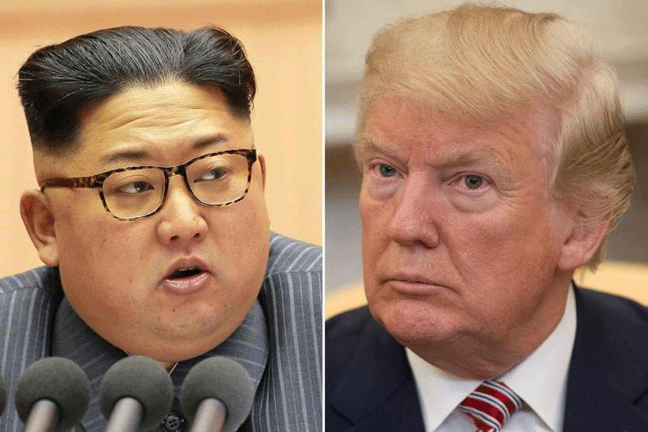
The only real trinket of value that Washington has to offer Kim Jong Un is a formal treaty to conclude the Korean War. It is likely that North Korea very much wants to negotiate an agreement with the United States, but under Pyongyang’s terms. It is no revelation to long-term North Korea watchers that those terms do not include “complete, verifiable, irreversible denuclearisation” (CVID).
The problem with Trump’s insistence on CVID is that there is no mutually agreeable starting point for a discussion with North Korea on those terms. There is no outcome in which the regime willingly relinquishes its nuclear weapons program because the Kim regime is so heavily invested in nuclear weapons as the foundation of its security strategy, economic development pathway, and domestic political legitimacy.
The negotiations surrounding the summit need to find a lowest common denominator that both parties can agree on. We saw this in the inter-Korean summit where Moon and Kim settled on easy-win engagement measures and mutually-beneficial security measures as the starting point for a confidence-building pathway.
CVID is a dead-end
The US and the DPRK clearly do not trust each other, and both parties have good reasons to be guarded ahead of a “will they—won’t they” summit. Most media attention coming out of the inter-Korean summit focused on Article 3.4 of the Panmunjom Declaration, which called for “complete denuclearisation” and “a nuclear-free Korean Peninsula,” building on the call in Article 1.1 for both parties to work together on implementing the 2005 Joint Statement on denuclearisation of the Korean Peninsula and the 13 February Agreement of 2007.
However, this clause does not mean North Korea has committed to denuclearisation as that concept is understood by the Trump administration. In the wake of his second meeting with Kim Jong-un, Moon Jae-in insisted that the North Koreans are committed to denuclearisation, clearly hoping to maintain the diplomatic momentum to ensure the US-DPRK summit takes place. However, the North Korean interpretation of a nuclear-free Korea implies the full nuclear weapons relinquishment of the United States and ultimate fulfilment of the spirit of the Nuclear Non-proliferation Treaty.
North Korea’s recent demolition of tunnels at its Punggye-ri nuclear test site are a gesture of goodwill to Washington, offering up a now-obsolete facility with an eye toward the upcoming US-DPRK summit. We have seen this kind of offering before, when the North Koreans demolished the cooling tower at their Yeongbyeon reactor in 2008.
Moon Jae-in’s tactical ego-stroking comments about Trump deserving the Nobel Peace Prize aside, one can argue that South Korea does not have high confidence in the Trump administration. South Korea’s diplomatic efforts in 2018 have been geared to guiding the US into a more conciliatory position with North Korea and make it politically safer for Trump to negotiate for an agreement with Pyongyang, knowing that there are influential American officials in Trump’s ear counselling for war.
Fears of American bellicosity in Seoul are not unwarranted. American hawks view any kind of engagement with North Korea as a “loss,” as “appeasement”—one of the most juvenile and misapplied terms in the international relations lexicon—and are well aware of the difficulty of getting any negotiated deal ratified in a Republican-majority Congress (recalling the fate of the Agreed Framework). National Security Advisor John Bolton’s recent comments comparing North Korea to Libya reinforce this perception. The irony of the present moment is a deal is more likely to stick in the US if it is owned by a Republican president. Such are the ironies and opportunities of Korean Peninsula diplomacy in 2018.
The Korean nuclear roller coaster: Has time run out for a summit? Brookings, Jonathan D. Pollack Tuesday, May 29, 2018 The turbulence and drama on the Korean Peninsula over the past week defies imagination. On May 24, President Trump withdrew from his planned summit with North Korean leader Kim Jong-un, acting almost as impulsively as when he first agreed to the meeting in early March. Following a conciliatory response from Pyongyang’s senior nuclear negotiator Kim Kye-gwan, the president two days later sharply reversed course and said that the summit might still take place.
Not to be outdone, on May 26 Kim Jong-un abruptly convened a second meeting with South Korean President Moon Jae-in on the North Korean side of the truce village of Panmunjom. The next day, American and North Korean officials began to interact on the language of a possible communiqué. Separate consultations between the United States and North Korea in Singapore were expected to begin today, on May 29, with North Korea represented by Kim Jong-un’s de facto chief of staff, Kim Ch’ang-soon. Additional discussions have taken place between Chinese and North Korean officials in Beijing, perhaps connected to a possible stopover by Kim Jong-un while traveling to Singapore, which would be his third visit to China in less than two months. One of Kim Jong-un’s closest aides and a vice chairman of the Korean Workers Party Central Committee, General Kim Yong-chol, is now en route to New York, and is expected to serve as the lead point-of-contact with U.S. officials in deliberations over the Singapore meeting.
These heightened activities all suggest that the summit will indeed go forward, though there has been no formal announcement to this effect.
However, two facts remain incontestable. There is as yet no U.S.-North Korea agreement on the terms of a summit, and time is running out to reach such an understanding. An unspoken but unmistakable anxiety thus pervades these intensified political and diplomatic maneuvers. Only 10 days before President Trump’s presumed departure for Singapore, it is stunning how little remains agreed to, even in broad conceptual terms. Advocates of diplomacy argue that this is the purpose of face-to-face negotiations. But the contrasts in the language and expectations of the two leaderships remain glaring, even after two visits by Mike Pompeo to Pyongyang, first as CIA director and subsequently as secretary of state.
The fundamental issue is what the summit is supposed to be about. ……….
New Delhi only recognizes UN sanctions, foreign minister said
Throughout previous sanctions, India purchased Iranian oil
President Donald Trump may have ordered the re-imposition of sanctions on Iran, but one of Asia’s biggest oil importers — and a strategic partner of the U.S. — plans on ignoring them.
India, a long-time buyer of oil from both Iran and Venezuela, only complies with United Nations-mandated sanctions and not those imposed by one country on another, said foreign minister Sushma Swaraj at a press conference in New Delhi on Monday.
“India will comply with UN sanctions and not any country-specific sanctions,” Swaraj said at an annual briefing, flanked by her two junior foreign ministers and India’s foreign secretary.
Swaraj later met Iranian foreign minister Javad Zarif, where they discussed Trump’s plan to withdraw from the 2015 Iran nuclear deal. Swaraj said “all parties to the agreement should engage constructively for peaceful resolution of the issues,” according to a foreign ministry statement. ……
India’s post-independence history as a leader of the “non-aligned” movement — developing nations not allied with the U.S. or the then-Soviet Union — means New Delhi maintains economic relationships that raise eyebrows in western capitals, including with Iran, Venezuela and North Korea. India also ignored U.S. requests to close its embassy in North Korea, Swaraj said at her briefing.
In February, Iranian president Hassan Rouhani visited India and met with Indian Prime Minister Narendra Modi to discuss energy cooperation and New Delhi’s investments in Iran’s Chabahar port.
A petition against the Wylfa Newydd nuclear plant signed by almost 6,000 people was handed to Japan’s Ministry of International Trade and Industry.
Pawb’s (People against Wylfa B) trip comes amid reports of UK and Japanese government investment in the project.
Technological giant Hitachi said there had been “no changes to disclose”.
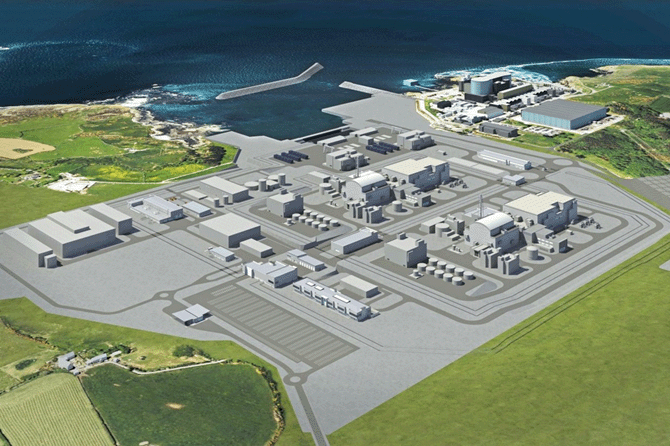
Hitachi’s Horizon Nuclear Power wants to start building on Anglesey in 2020, but recent reports say the British government is to offer £13.3bn to support the project.
Prime Minister Theresa May met Hitachi’s chairman Hiroaki Nakanishi earlier this month to discuss support.
Speaking to BBC Wales from Japan, Meilyr Tomos from Pawb, said: “There’s huge uncertainty. It’s a scheme that requires two governments to prop it up, so there’s no certainty on anything at this stage.
“It’s not a commercial proposition. You need the biggest bang for your buck, that’s not something nuclear can deliver, it’s far too expensive.
N Korea’s Destroyed Nuke Site Lays Basis for Denuclearization Talks – Expert https://sputniknews.com/analysis/201805261064829259-north-korea-site-destruction-talks-prospect/ WASHINGTON 27 May 18, – North Korea’s dismantling of its nuclear weapons test site should be seen as a positive step towards resolving the crisis on the Korean peninsula, Institute for Science and International Security President David Albright said in a statement on Friday.
“North Korea’s action should not be trivialized but viewed as an important step to reduce tensions and lay the basis for denuclearization negotiations,” Albright said. “It is not fair to portray it as part of an effort to hide or disguise its nuclear weapons capabilities.”
North Korea’s action, he added, is even better than a freeze because it represents a permanent disabling of the site. Three minutes of film footage taken by a journalist makes it clear that major buildings and tunnel entrances were destroyed, according to Albright.
But like many disabling steps, North Korea could likely resume nuclear weapons tests within a few months by digging tunnels in nearby mountains, Albright said. Moreover, the action does not affect North Korea’s existing stockpile of nuclear bombs and its ability to make additional weapons, even if the lack of a test facility could inhibit the nation’s ability to field reliable and deliverable warheads, according to the release.
On Friday, Trump signaled that the meeting with Kim may actually go forward after the US president received a “warm” letter from Pyongyang. In comments published by North Korea’s state-run news agency KCNA, Kim said on Friday that he wanted the United States to know Pyongyang wants to sit down at “any time” to solve problems with Washington.
Before founding the institute, Albright worked with the International Atomic Energy Agency (IAEA) from 1992 to 1997 and was the first non-governmental inspector of the Iraqi nuclear program. He was also a Senior Staff Scientist at the Federation of American Scientists.
China’s Nuclear Weapons: Everything You Always Wanted to Know National Interest, Steve Weintz, 25 May 18,
With its first nuclear test on October 16, 1964, China joined the other victorious allies of World War II in the nuclear club, both cementing and unsettling the postwar order. Hard experience of the American nuclear threat during the Korean War and the divorce from the Soviet Union, propelled China towards the bomb in ways familiar to those observing North Korea’s current quest. Mao Zedong himself said in 1956, “…if we don’t want to be bullied, we have to have this thing.”
But China for all its size has made itself a limited nuclear power. It has demonstrated its ability to build very big bombs but chose to test and make few of them. The size of China’s arsenal is a highly guarded state secret, but estimates put it in the several hundreds, not thousands. Beijing can hold armies and cities at risk, but not make the rubble bounce several times over…………
One H-bomb test nearly went horribly wrong. When test pilot Yang Guoxiang lined up his Q-5A fighter-bomber for its drop maneuver and pulled the weapon release, the bomb failed to drop. After three attempts Yang returned to base with a live hydrogen bomb slung beneath his plane. The whole airbase – all 10,000 crew – sheltered in underground tunnels while a lonely Yang carefully climbed out of his cockpit and awaited assistance. All ended well this time and Yang later successfully carried out his mission.
The three independent candidates for Niigata governor are, from left: Chikako Ikeda, Hideyo Hanazumi and Satoshi Annaka.
May 25, 2018
NIIGATA–The election for a new governor of Niigata Prefecture was triggered by a sex scandal, but the key issue facing voters is where the candidates stand on restarting the Kashiwazaki-Kariwa nuclear power plant, one of the world’s biggest nuclear facilities.
Campaigning officially kicked off May 24.
The outcome of the June 10 vote could have a bearing on the Abe administration’s moves to bring more nuclear plants back online.
Although the candidates are running as independents, two are supported by political parties.
In early speeches, they all outlined their position on the nuclear plant operated by Tokyo Electric Power Co., but residents are calling on them to be less cautious and state where they truly stand.
“Many people are still suffering (because of the Fukushima nuclear disaster), and there are still many people living as evacuees,” said a female resident, 66. “Some kids have even been bullied. So I really want the candidates to state clearly that Niigata doesn’t need a nuclear plant anymore.”
On the other hand, a 70-year-old female resident argued that local people “cannot flatly oppose the restart of the nuclear plant because of the impact it will have on economy.”
For this reason, she said, “I cannot easily say I am against it.”
The election is expected to come down to a battle between Hideyo Hanazumi, 60, a former vice commandant of the Japan Coast Guard, and Chikako Ikeda, 57, a former member of the prefectural assembly.
Hanazumi is supported by the ruling coalition of the Liberal Democratic Party and Komeito, while Ikeda is backed by five opposition parties.
The other candidate is Satoshi Annaka, 40, a former member of the Gosen municipal assembly.
The election was triggered by the April resignation of Ryuichi Yoneyama after he admitted to paying women for sexual favors.
Yoneyama, 50, had taken a cautious stance on restarting the Kashiwazaki-Kariwa complex.
Hanazumi declared that he would take over an investigation started by Yoneyama to understand the fundamental cause of the triple meltdown at the Fukushima No. 1 nuclear plant in 2011, and reach his decision on the issue when the investigation ends in several years.
Ikeda stressed the significance of reviewing the Fukushima nuclear disaster, stating that continuing with the investigation is “the most basic of basics.”
She said the matter must be pursued rigorously.
Ikeda added that she would make a final decision on the restart issue after careful discussions with residents and other parties.
“I will seek a zero-nuclear Niigata Prefecture,” she said.
North Korea claims it has demolished its nuclear testing site North Korea has carried out what it said is the demolition of its nuclear test site, setting off a series of explosions over several hours in the presence of foreign journalists. ABC News, 25 May 18
Key points:
Closing of North Korea’s nuclear test site was announced by Kim Jong-un before planned summit with US President Donald Trump
North Korea brought in a small group of foreign journalists to witness the event
Demolition comes after North Korea labelled US Vice President Mike Pence a “political dummy”
The explosions at the nuclear test site deep in the mountains of the North’s sparsely populated north-east were centred on three tunnels at the underground site and a number of buildings in the surrounding area.
North Korea had completely dismantled its Punggye-ri nuclear test ground “to ensure the transparency of discontinuance of nuclear test,” state news agency KCNA said.
The dismantling of the nuclear test ground “completely closed the tunnel entrances,” it said, adding that two tunnels there had been ready for use in “powerful underground nuclear tests”.
There was no leakage of radioactive material or adverse impact on the surrounding environment from the dismantling, the agency added.
Scientists say there was a significant release of radioactive particles during the Fukushima-Daiichi nuclear accident.
The researchers identified the contamination using a new method and say if the particles are inhaled they could pose long-term health risks to humans.
The new method allows scientists to quickly count the number of caesium-rich micro-particles in Fukushima soils and quantify the amount of radioactivity associated with these particles.
The research, which was carried out by scientists from Kyushu University, Japan, and The University of Manchester, UK, was published in Environmental Science and Technology.
In the immediate aftermath of the Fukushima Daiichi nuclear accident, it was thought that only volatile, gaseous radionuclides, such as caesium and iodine, were released from the damaged reactors. However, in recent years it has become apparent that small radioactive particles, termed caesium-rich micro-particles, were also released.
Scientists have shown that these particles are mainly made of glass, and that they contain significant amounts of radioactive caesium, as well as smaller amounts of other radioisotopes, such as uranium and technetium.
The abundance of these micro-particles in Japanese soils and sediments, and their environmental impact is poorly understood. But the particles are very small and do not dissolve easily, meaning they could pose long-term health risks to humans if inhaled.
Therefore, scientists need to understand how many of the micro-particles are present in Fukushima soils and how much of the soil radioactivity can be attributed to the particles. Until recently, these measurements have proven challenging.
The new method makes use of a technique that is readily available in most Radiochemistry Laboratories called Autoradiography. In the method, an imaging plate is placed over contaminated soil samples covered with a plastic wrap, and the radioactive decay from the soil is recorded as an image on the plate. The image from plate is then read onto a computer.
The scientists say radioactive decay from the caesium-rich micro particles can be differentiated from other forms of caesium contamination in the soil.
The scientists tested the new method on rice paddy soil samples retrieved from different locations within the Fukushima prefecture. The samples were taken close to (4 km) and far away (40 km) from the damaged nuclear reactors. The new method found caesium-rich micro-particles in all of the samples and showed that the amount of caesium associated with the micro-particles in the soil was much larger than expected.
Dr Satoshi Utsunomiya, Associate Professor at Kyushu University, Japan, and the lead author of the study says “when we first started to find caesium-rich micro-particles in Fukushima soil samples, we thought they would turn out to be relatively rare. Now, using this method, we find there are lots of caesium-rich microparticles in exclusion zone soils and also in the soils collected from outside of the exclusion zone”.
Dr Gareth Law, Senior Lecturer in Analytical Radiochemistry at the University of Manchester and an author on the paper, adds: “Our research indicates that significant amounts of caesium were released from the Fukushima Daiichi reactors in particle form.
“This particle form of caesium behaves differently to the other, more soluble forms of caesium in the environment. We now need to push forward and better understand if caesium micro-particles are abundant throughout not only the exclusion zone, but also elsewhere in the Fukushima prefecture; then we can start to gauge their impact”.
The new method can be easily used by other research teams investigating the environmental impact of the Fukushima Daiichi accident.
Dr Utsunomiya adds: “we hope that our method will allow scientists to quickly measure the abundance of caesium-rich micro-particles at other locations and estimate the amount of caesium radioactivity associated with the particles. This information can then inform cost effective, safe management and clean-up of soils contaminated by the nuclear accident”.
The Growing Dangers of the New Nuclear-Arms Race, The Trump Administration’s push for more nuclear weapons is part of a perilous global drive to miniaturize and modernize devices that already promise annihilation. New Yorker, By Eric Schlosser, 24 May 18, “…….On the morning of August 6, 1945, Setsuko Thurlow, then thirteen years old, was preparing to decode messages on the second floor of the Army headquarters in Hiroshima. About twenty girls from her school worked beside her, and thousands of other middle schoolers were employed at patriotic tasks throughout the city as part of the Student Mobilization Program. Thurlow noticed a bright bluish-white flash outside the window at 8:15 a.m. She never saw the mushroom cloud; she was in it. She felt herself fly through the air, blacked out, and awoke pinned in the rubble of the collapsed building, unable to move. Lying there in silence and total darkness, she had a feeling of serenity. And then she heard the cries of classmates trapped nearby: “God, help me!,” “Mother, help me!” Someone touched her, removed the debris on top of her, and told her to crawl toward the light.
She somehow made it out safely and realized that what was left of the headquarters was on fire. A half dozen or so other girls survived, but the rest were burned alive.
The smoke and dust in the air made the morning look like twilight. As Thurlow and a few classmates left the city center and walked toward the hills, they witnessed one grotesque scene after another: dead bodies; ghostly figures, naked and burned, wandering the streets; parents desperately searching for lost children. She reached an Army training ground in the foothills, about the size of two football fields. Every inch of ground was covered with wounded people begging for water. There seemed to be no doctors, no nurses, no medical help of any kind. Thurlow tore off strips of her clothing, dipped them in a nearby stream, and spent the day squeezing drops of water from them into the mouths of the sick and dying. At night, she sat on the hillside and watched Hiroshima burn.
Thurlow was reunited with her parents. But her sister and her sister’s four-year-old son died several days later. Her sister’s face had grown so blackened and swollen that she could only be recognized by her voice and her hairpin. Soldiers threw her body and that of her son into a ditch, poured gasoline on them, and set them on fire. Thurlow stood and watched, in a state of shock, without shedding a tear. Her favorite aunt and uncle, who lived in the suburbs outside Hiroshima and appeared completely unharmed, died from radiation poisoning a few weeks after the blast.
More than seven decades later on the afternoon of December 10, 2017, I watched Thurlow accept the Nobel Peace Prize on behalf of the International Campaign to Abolish Nuclear Weapons (ican). It was a remarkable moment, as she slowly walked to the podium with a cane, and the crowd in Oslo’s City Hall gave a standing ovation. After the bombing, Thurlow attended universities in Hiroshima and Lynchburg, Virginia. Later, she earned a master’s degree in social work at the University of Toronto. She married a historian and settled in Canada. She began her anti-nuclear activism in 1954, and became a leading advocate for survivors of the atomic bombings, known as the hibakusha. A few years ago, I spent time with her in Stockholm, meeting with academics and legislators to discuss the nuclear threat. In her early eighties, she was sharp, passionate, tireless, and free of bitterness. “Today, I want you to feel in this hall the presence of all those who perished in Hiroshima and Nagasaki . . . a great cloud of a quarter of a million souls,” Thurlow said in her Nobel speech. “Each person had a name. Each person was loved by someone. Let us insure that their deaths were not in vain.”………..https://www.newyorker.com/news/news-desk/the-growing-dangers-of-the-new-nuclear-arms-race
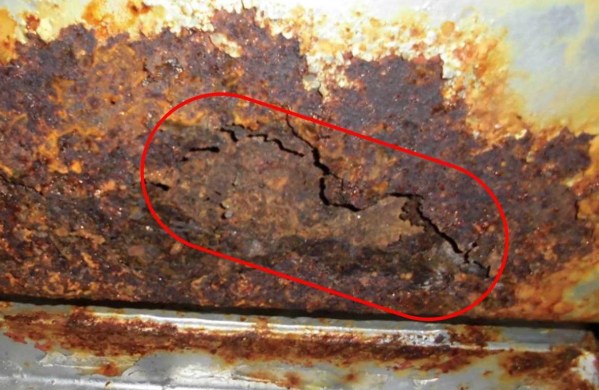
Corrosion is seen in a ventilation duct at the No. 3 unit of the Kashiwazaki-Kariwa nuclear power plant in Niigata Prefecture. | NUCLEAR REGULATION AUTHORITY
Corrosion and holes have been found in ventilation ducts at 12 reactors at seven nuclear plants across the country, the Nuclear Regulation Authority said Wednesday, raising concerns that workers could be exposed to radiation in the event of an accident.
The governmental nuclear watchdog released the results of a nationwide survey it had ordered following a revelation in December 2016 that corrosion had left multiple holes in the air ducts of the No. 2 reactor at Chugoku Electric Power Co.’s Shimane plant in western Japan. That reactor was not included in the survey.
Serious corrosion was found at the No. 3 unit of the Kashiwazaki-Kariwa plant in Niigata Prefecture operated by Tokyo Electric Power Company Holdings Inc. and may have abnormally affected ventilation of the central control room, the watchdog said.
Although the No. 7 unit at the same plant has passed a test to resume operation, the NRA said it will inspect the impact of any corrosion found at the reactor. No abnormality associated with corrosion has been found at the remaining 10 units, it said.
Corrosion or holes were found in steel or galvanized steel ducts at Tohoku Electric Power Co.’s Onagawa nuclear plant, Japan Atomic Power Co.’s Tokai No. 2 nuclear plant, Tepco’s Fukushima No. 1 nuclear plant and Kashiwazaki-Kariwa nuclear plant, Chubu Electric Power Co.’s Hamaoka plant, Hokuriku Electric Power Co.’s Shiga nuclear plant and Chugoku Electric’s Shimane plant.
If an accident occurs, radioactive materials could flow into a plant’s central control room through such holes, putting workers in danger of radiation exposure.
At the No. 3 reactor at the Kashiwazaki-Kariwa plant, a crack as large as 13 centimeters in length and 5 cm in width was found. A total of nine holes and cracks have been discovered at the Nos. 3 and 7 units at the plant.
All the reactors with corrosion were boiling-water reactors, the same type used at the Fukushima No. 1 plant, which spewed a massive amount of radioactive material into the atmosphere following the March 2011 earthquake and tsunami.
No problems have been detected at pressurized-water nuclear reactors, as filtering and other measures take place near air inlets.
The holes at the No. 2 unit at the Shimane plant were discovered when insulation materials covering the ducts were removed for inspection.
The holes, the largest of which measured about 100 centimeters wide and about 30 centimeters long, are believed to have been caused by dew condensation and rainwater that seeped inside the building, as well as salt deposits on the ducts, given that the corrosion extended about 50 meters from the air inlet and spread from the inner surface of the ducts.
Chugoku Electric has decided to increase the number of inspection points at sections near fresh-air inlets and bolster anti-corrosion measures, including the installation of a dehumidifier.
Asahi Shimbun 20th May 2018 [Machine Translation]Hitachi announced plans to delay the goal of starting
nuclear power plans planned in the UK for about two years to 2027. The collection of funds necessary for the project is difficult, and reconsideration of sharing has started between companies that undertake design and construction.
The continuation of the project itself is increasingly uncertain.
In the plan, two nuclear reactors will be built on Anglesey island in the UK. The goal of starting operation has been
announced as “early 20’s”.However, according to officials, the Hitachi side recently proposed a new goal “April 27” to companies and others involved in the plan. It is planned to decide whether to start construction in 2019,
but it seems to be assuming a case where this time is delayed. https://www.asahi.com/articles/ASL5M4HZ3L5MULFA001.html
Gov’t energy plan inflexibility on nuclear, renewables reveals lack of vision (Mainichi Japan) The government has unveiled its revised basic energy plan, though its core elements concerning the ratio of Japan’s electricity needs to be supplied by nuclear power and renewables by fiscal 2030 has not changed from the plan adopted three years ago.
In that three years, conditions surrounding energy production have changed drastically both inside and outside Japan, so it is very difficult to understand why the government has chosen to simply maintain course.
The energy plan calls for 20-22 percent of Japan’s energy mix to be made up of nuclear power in 2030, with renewables accounting for 22-24 percent — just as the 2015 version did. However, while Japan has been marking time, other advanced nations have been moving fast to expand solar and other renewable power generation. The reason is simple: measures to combat global warming simply cannot wait.
…….Renewable energy already makes up about 15 percent of Japan’s electricity production. The big utilities have also been expanding their renewable generation base as electricity market liberalization has spurred competition. Keeping the 2030 renewables target as-is could discourage this trend.
We must also question the continuing role projected for nuclear power. Around 30 reactors would be required to fill 20-22 percent of Japan’s energy needs as laid out in the plan, but only eight are now back in operation following the shutdowns after the triple-meltdown at the Fukushima No. 1 nuclear plant.
Serious questions are being raised over the economic viability of nuclear plants, as is shown by the fact that Kansai Electric Power Co. decided last year to decommission two of its larger reactors. Even experts are shaking their heads in doubt at the energy plan’s targets for nuclear power generation……..https://mainichi.jp/english/articles/20180519/p2a/00m/0na/016000c
“……….Uncertainties for Nuclear Power, Carnegie Endowment, Mark Hibbs, 14 MAY 18
China’s nuclear power wager might not indefinitely pay high dividends. Until now, the state has boosted the nuclear power industry with incentives that, in the future, may come under pressure. The electric power system is subject to reform in the direction of more transparent oversight and pricing that might disadvantage nuclear investments. President Xi Jinping supports state control of strategic economic sectors, but he also advocates market reforms that have helped lead Western nuclear power industries into crises.
The nuclear sector must withstand what Xi calls “new normal” conditions: a gradual slowing down of China’s economy, characterized by diminishing returns on capital goods investments and translating into rising debt and overcapacity. Nuclear investments may be affected by demographics, changes in electricity load profile, and technology innovations including emergence of a countrywide grid system able to wheel bulk power anywhere.
There is also political risk. Public support for nuclear power in China is volatile and may be low. Concerns since the Fukushima Daiichi accident in Japan have prompted Beijing not to proceed with long-established plans to build most of China’s future nuclear plants on inland sites. Should this policy continue into the 2020s, prospects for China’s nuclear construction sector will decline; indefinitely continuing nuclear construction at eastern coastal sites (where nearly all of China’s nuclear power is generated) may encounter resistance on economic, capacity, and political grounds.
Under Xi, China’s globalization continues but the state is assuming ever-greater liability. Political decisionmaking and corporate culture may not support an indefinite increase in the risk presented by more nuclear power investments. Some quasi-official projections before Fukushima that China by 2050 might have 400 or more nuclear power plants have been cut in half. Beijing’s risk calculus may reflect that China’s population would blame the Communist Party and the state for a severe nuclear accident. In a country with a patchy track record for industrial safety, said one Chinese planning expert in 2016, “The more reactors we have, the greater our liability.”
…….. If China merely replicates others’ collective past experience, it will reinforce the view that fast reactors and their fuel cycles are too risky, complex, and expensive to generate large amounts of electricity.
If China merely replicates others’ collective past experience, it will reinforce the view that fast reactors and their fuel cycles are too risky, complex, and expensive to generate large amounts of electricity.
Prepared for battle: China lands nuclear strike bombers on South China Sea islands CHINA raised global fears after sending nuclear bombs and warplanes above the South China Sea as part of a simulated training exercise with air force officials declaring the country is “preparing for battle”. Express UK, By LATIFA YEDROUDJ May 20, 2018 Air force personnel confirmed it had ”organised multiple bombers” to conduct “take-off and landing training” along islands and reefs in the South China Sea, as practise in light of a full-scale war.