The Journey Beyond Nukes Begins with an Apology

Robert C. Koehler 7 April 25 https://abombtribunal.campaignus.me/34/?q=YToxOntzOjEyOiJrZXl3b3JkX3R5cGUiO3M6MzoiYWxsIjt9&bmode=view&idx=158534555&t=board
When the powerful speak, mushroom clouds emerge – oh so easily. Power is about conquest; winning the war, getting what you want no matter the cost.
For instance, Israel should nuke Gaza. “Do whatever you have to do.” Thus declared Sen. Lindsey Graham last year in a Meet the Press interview, comparing the current genocide in Palestine to the U.S. decision to end World War II by A-bombing Hiroshima and Nagasaki. “That was the right decision,” he said, spewing out the historical abstraction that still rules the world.
Nothing is more sacred than self-defense! And nothing is more necessary for that than nuclear weapons, at least for the countries that possess them. To think beyond this abstraction – to cry out against the pain of the victims and declare their use is potential human suicide – violates the political norm of the powerful and is easily categorized by the media, often sarcastically, as naïve.
And thus we’re stuck in a MAD world, apparently: a world under unending threat of mutually assured destruction. If you have a problem with that, you’re probably a weakling singing “Kumbaya.”
Or so the global war machine wants us to believe, reducing humanity’s anti-nuke – antiwar – sanity to a hollow hope.
It is in this context that I heard Sim Jintae and Han Jeong-Soon speak at a small event the other day in suburban Chicago, sponsored by an organization called – brace yourself – The International People’s Tribunal to hold the U.S. accountable for dropping A-bombs. The two speakers (via translator) are Korean victims of the bombs the U.S. dropped on Hiroshima neaarly eight decades ago. Sim Jintae is a first-generation survivor: He was 2-years-old when the bomb was dropped. Han Jeong-Soon is a second-generation survivor – the child of survivors of the inferno, who has suffered throughout her life from the after-effects of the bombing. Their message: Nuclear war lasts forever!
Well, that’s part of their message. Note: The movement they represent is Korean. A little known fact about the bombings of Hiroshima and Nagasaki is that thousands of Koreans were what you might call doubly victimized by the horror, This was during an era when Japan had colonial control over Korea, and some 100,000 Koreans had been forcibly moved to Japan to do wartime labor. Many of them, including Sim Jintae’s parents, had been working in a munitions factory in Hiroshima.
About 40,000 Koreans died in the bombings. Those who survived suffered the after-effects in silence . . . until they reclaimed one another and found a collective voice. This is the voice I heard last week at the event I attended, and it resonated as loud as – perhaps louder than – the pro-nuke media and their supplicants. Their collective voice emerges from reality, not abstraction. My God, I hope it’s louder than that Lindsey Graham, and so many other politicians.
Here is the voice of Han Jeong-Soon. Born in Korea fourteen years after the destruction of Hiroshima – her parents had also been forced laborers there, living a few kilometers from the epicenter of the bomb blast – she suffered all her life from birth defects: heart problems, chest pain, lung issues. She had multiple surgeries. She suffered on her own . . . until she saw a film about the bombing in 2004. Then:
“I realized my pain was not only my pain but other people’s pain,” she told us. She began organizing other second-generation survivors, and began telling the world: “My war has not ended. No war should be allowed or tolerated. No to all war.”
Is this the voice that will drown out the military-industrial complex? The People’s Tribunal is demanding, as the starting point of the human journey beyond war, for the United States to apologize for dropping atomic bombs on Hiroshima and Nagasaki. This was an action that instantly expanded the scope of hell the human race could inflict on itself.
When I heard that word, “apologize,” in the context of first- and second-generation Korean A-bomb victims – victims who were denied necessary health care, by both Japan and the United States – what I heard was a soul scream: a demand that the perpetrator grasp and acknowledge the full extent of the harm it caused, and in so grasping, vow never to use such a monstrous weapon again . . . and, indeed, vow to transcend war itself.
The International People’s Tribunal put it this way:
“The A-Bomb Tribunal aims to establish the illegality of the U.S. atomic bombings in 1945 to secure the basis for condemning all nuclear threats and use as illegal today. The fact that the atomic bombings of Hiroshima and Nagasaki were illegal under the international laws in 1945 means that the use and threat of nuclear weapons today are also illegal.
“The A-Bomb Tribunal aims to overcome the nuclear deterrence theory that justifies the use and threat of nuclear weapons by nuclear-weapon states, and contribute to the realization of denuclearization of the Korean Peninsula and a nuclear-free world.”
Let us listen to those who have suffered the most. Let us hear the cry of their throbbing souls and begin to understand that the time has come for us to create a world beyond dominance and war. Indeed, let us begin listening to one another and, in so doing, learn that we all matter. This is the true nature of power.
TEPCO’s rehabilitation plan delays expose limits to nuke power reliance.
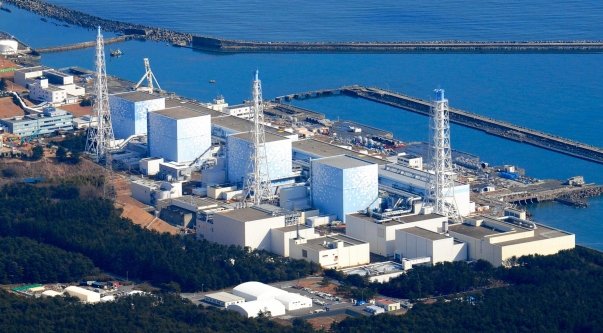
It was unreasonable in the first place for the power company to draw up a rehabilitation scenario relying on atomic power despite having caused a serious nuclear plant accident.
April 9, 2025 (Mainichi Japan), https://mainichi.jp/english/articles/20250409/p2a/00m/0op/029000c
Tokyo Electric Power Company (TEPCO) Holdings Inc. has postponed the revision of its business rehabilitation plan, which it had scheduled to carry out by the end of fiscal 2024. The company attributed the postponement to a lack of prospects for restarting the Kashiwazaki-Kariwa nuclear power plant in Niigata Prefecture, which it had seen a trump card in improving its earnings.
Will the utility be able to fulfill its responsibility in the recovery from the Fukushima disaster and the stable power supply amid such a state of affairs?
TEPCO has borrowed money from the national government to deal with the aftermath of the Fukushima nuclear meltdowns. This includes funds needed for compensation payments to affected residents and the decommissioning of the Fukushima Daiichi Nuclear Power Station. It has also taken out bank loans to fund its electric power business. The rehabilitation plan was supposed to form the premise for this financial aid.
The plan was first formulated in 2012, the year after the onset of the Fukushima disaster, and has since been updated almost every three years. The cost for handling the nuclear catastrophe was initially estimated at 6 trillion yen (approx. $41.27 billion), but that figure swelled to 21.5 trillion yen (148 billion) under the current plan outlined in 2021. The cost further rose to 23.4 trillion yen (approx. $161 billion) when taking into account compensation for fishery operators due to the release of treated water from the stricken Fukushima nuclear plant, among other expenses.
The cap on borrowing from the national government was subsequently raised to 15.4 trillion yen (approx. $106 billion). Based on these developments, calls grew to update TEPCO’s rehabilitation plan.
While TEPCO is scheduled to repay 500 billion yen (approx. $3.45 billion) annually to the national government, the actual repayment amount has hovered around 400 billion yen (around $2.76 billion) on average in recent years due to the firm’s poor performance.
The primary factor behind TEPCO’s sluggish earnings is that the Kashiwazaki-Kariwa nuclear plant has yet to be restarted. TEPCO had initially expected to resume the plant’s operations in fiscal 2019, eyeing a balance improvement of 100 billion yen (approx. $688 million) per reactor brought back online. But following a series of scandals including inadequate antiterror measures at the plant, the prospect of gaining local consent for its restart has waned.
TEPCO’s injection of more than 1 trillion yen (approx. $6.88 billion) into safety measures has also taken a heavy toll on its management, weighing down its cash flow. There are concerns that the utility may not even be able to afford capital investment essential for a stable power supply.
It was unreasonable in the first place for the power company to draw up a rehabilitation scenario relying on atomic power despite having caused a serious nuclear plant accident. In the amendments to be made to the rehabilitation plan by the end of fiscal 2025, the utility should completely overhaul its strategy.
TEPCO must accelerate its business realignment to improve its earning capacity. Its thermal power generation sector was integrated into Chubu Electric Power Co. in 2019, yet TEPCO needs to expand collaboration with other firms in renewable energy and other sectors with high growth potential. It urgently needs to streamline operations to stave off deterioration of its finances.
The company is urged to carry out a rehabilitation plan that is not reliant on nuclear power generation.
Impeachment of Yoon Suk-yeol threatens South Korea’s nuclear energy policy momentum
Impeachment turmoil may disrupt the trajectory of Korea’s nuclear sector
Chosun Biz, 4th April 2025, By Jin Sang-hoon
The Constitutional Court has cited the impeachment of President Yoon Suk-yeol, making it likely that the energy policy centered on nuclear power promoted by the former president will lose momentum.
The Yoon Suk-yeol government, established in May 2022, has abandoned the nuclear phase-out policy pursued during the previous Moon Jae-in administration and has been implementing an energy policy centered around nuclear power again. In July 2022, the decision was made to resume the construction of the Shin Hanul Units 3 and 4 nuclear power plants, which began construction in September last year, and the procedure for the continued operation of 10 nuclear plants, including the Hanul Units 1 and 2, which will reach their designed lifespan by 2030, has also begun.
In early 2018, the proportion of nuclear power in total electricity generation was 23.4%, but under the Yoon Suk-yeol government, it rose to 29.6% in 2022. There was also an ambitious push to win overseas nuclear power contracts, resulting in securing two nuclear power plants in the Czech Republic worth 24 trillion won. In the case of the Czech Dukovany nuclear power project, the detailed coordination between Korea Hydro & Nuclear Power and the Czech authorities has been completed, leaving only the final contract.
However, the decision to impeach the former president has made it uncertain whether the nuclear-centered energy policy will continue. Since intergovernmental nuclear contracts are made at the government level, it is crucial to see how determined the government is in pushing forward.
With the early presidential election following the impeachment of the former president, if the Democratic Party comes to power, the nuclear power policy may be reversed again. The government has established the 11th Basic Plan for Electricity Supply and Demand, which includes forecasts for electricity demand and supply plans up to 2038, believing that three large new nuclear power plants are necessary. However, as the Democratic Party demands a reduction in new nuclear power plants and an expansion of the share of renewable energy, the plan for large new nuclear plant construction has been reduced to two.
An anonymous energy industry official noted, “During the Moon Jae-in administration, a large budget was invested in renewable energy, leading to the emergence of many solar-related businesses and stakeholders in local areas,” adding, “If the Democratic Party comes to power and they demand support again, the budget for nuclear power could be reduced.”…………………… https://biz.chosun.com/en/en-policy/2025/04/04/3U66VMSXWZDU5CHQUD5PS75NHY/
The great trek for justice
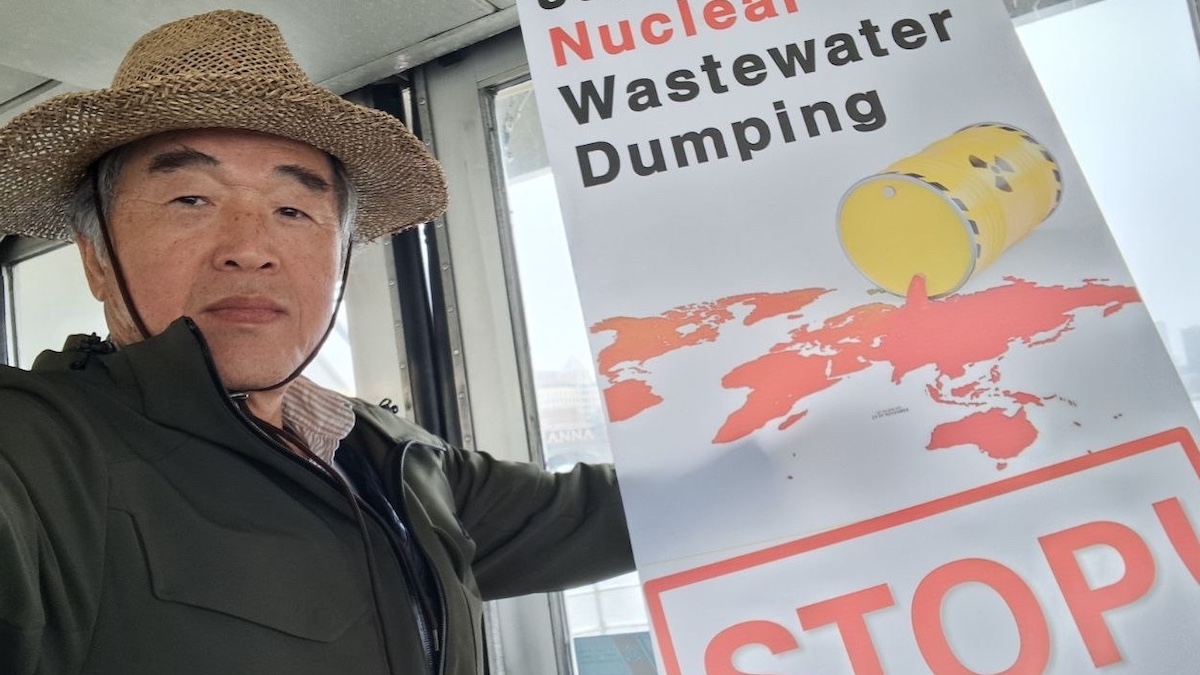
At the heart of the matter for Lee is the devastating and continued destruction of the ecosystems on which all of us — human and animals — depend. The Fukushima radioactive water dump is just one of the most recent examples.
, by beyondnuclearinternational, https://beyondnuclearinternational.org/2025/03/30/the-great-trek-for-justice/
Won-Young Lee has walked from his homeland in South Korea to Tokyo. Now he’s on the march in the US, writes Linda Pentz Gunter
How far would you walk for a cause? In the case of South Korean anti-nuclear activist, Won-Young Lee, that distance has no limit.
Lee, 67, and the director of the Korea Land Future Research Institute and the Public Reporting Center for the Dangers of Nuclear Power Plants (PRCDN), will arrive in Washington, DC on April 8, having walked there from the United Nations in New York City, a journey he began on March 19. The distance is about 260 miles.
His cause this time is to draw attention to the continued dumping of highly radioactive waste water from the stricken Fukushima Daiichi nuclear power plant in Japan into the Pacific Ocean. This is not Mr. Lee’s first walk, but he chose the dates deliberately to span the time between the 2011 Fukushima nuclear disaster that began on March 11 and the April 26, 1986 Chornobyl reactor explosion in Ukraine.
This latest walk falls under the umbrella of what Lee has titled the “New Silk Road for Life and No-Nukes. Walking Planet Earth With Joy.” Together, the walks constitute a marathon that have taken Lee and other walkers through vast areas of the Asian continent, including Vietnam, Laos, Thailand, Malaysia, India and Nepal and on through Uzbekistan, Azerbaijan, and Georgia and through numerous countries in Europe. Lee himself has traversed 6,125 miles on foot.
He has been inspired, he says, by Gandhi’s ‘Salt March’ “that led to India’s independence,” and was also started, Lee says, “by a small number of people,” that grew into ever greater numbers.
That will of the people manifested again in 2023, during a trek of almost 1,000 miles undertaken by South Korean and Japanese citizens from Seoul, South Korea to Tokyo, Japan with stops that included one in Hiroshima.
Currently, as Lee marches resolutely from Manhattan to DC, he has encountered others who are equally inspired, often from Japan. Yoko Akashi, who marched with him in New Jersey, wrote that “even though we’re only two walking highways and shopping streets, people waved, honked cars and wanted to know more because they’re concerned.”
All of this is done with unbounded optimism. The purpose of the current walk is not only to engage with populations along the route but to try, once it reaches its destination in the nation’s capital, to convince members of Congress and even the White House, that the water dumping at Fukushima needs to stop.
“By marching, we can gain the support of citizens, get citizens to join the march, and as the procession gets longer, citizens can pressure politicians,” asserts Lee.
We have published numerous articles on our news site — Beyond Nuclear International — arguing against the dumping of at least 1.3 million tons of radioactive water from Fukushima into the Pacific, a procedure that will go on for years, even decades.
One of the more recent ones, by Tilman Ruff, sums up many of the arguments. Another earlier one from GENSUIKIN, also lays out the specific risks.
Lee’s organization has turned to the cartoon format to produce a booklet telling the story. It’s entitled STOP! Fukushima Nuclear Wastewater Dumping and can be downloaded from the PRCDN website in English here.
I met with Lee and a group of Korean activists on Capitol Hill in February, during a press conference led by Congressman Brad Sherman (CA-32), a senior member of the House Foreign Affairs Committee, to urge for the passage of his bipartisan legislation, the Peace on the Korean Peninsula Act.
The bill calls for swift and substantial diplomatic engagement in order to achieve a formal end to the Korean War – America’s longest war.
During the event, Lee expressed his hopes for a political change of policy over the dumping (I am afraid I did not share his optimism.) In a statement before his New York to Washington march began, Lee expressed the view that stopping the dumping was in the hands of the US president. “He is the only person to whom the Japanese prime minister bows his head,” Lee wrote. “If the US president asks the Japanese prime minister to stop, the dumping can be stopped.”
At the heart of the matter for Lee is the devastating and continued destruction of the ecosystems on which all of us — human and animals — depend. The Fukushima radioactive water dump is just one of the most recent examples.
“Humanity has a responsibility to respect the survival of all living things in the ecosystem as well as its own future generations,” said a declaration put out before the latest walk launched. And yet, “the Japanese government is intentionally dumping potentially fatal nuclear contaminants into the sea.”
Both the International Atomic Energy Agency (IAEA) and the United Nations come in for deservedly harsh criticism as well. In the cartoon booklet, the IAEA is referred to as “Japan’s Brazen Enabler”. The UN, says the declaration, is “ignoring the spirit of the World Charter of Nature (1982), drawn up by themselves and the Earth Charter (2000), made by agreement at the Rio Environmental Conference, and are simply watching the destruction of our ecosystem.” Striking an uncharacteristically pessimistic note, it adds: “All of these things show that our international community is completely broken. At this rate, there is no hope for humanity.”
In conclusion, the march declaration offers the following:
- The Japanese government, which has intentionally put humanity and the Earth’s ecosystem at great risk, must immediately stop dumping nuclear contaminated water and apologize to all living things on Earth.
- The U.S. government and the IAEA, which support Japan’s ocean dumping of nuclear contaminated water, should immediately withdraw their support and seek safe measures for all living things on Earth.
- The UN and the International Community must acknowledge and reflect on dereliction of their duty to stop Japan from dumping nuclear contaminated water into the ocean.
- Global citizens, keep in mind that if we turn a blind eye to these errors, we are committing a crime to our descendants, and let us actively punish any country or power that intentionally commits such crimes.
- Global citizens, let us be aware of our responsibility to protect the dignity of all life in the global village, and set the right guideposts.
Headline photo Won-Young Lee courtesy of the subject.
Linda Pentz Gunter is the international specialist at Beyond Nuclear and writes for and edits Beyond Nuclear International. Her forthcoming book, Hot Stories. Reflections from a Radioactive World, will be published later this year.
Hegseth Orders Pentagon To Focus on Preparing for War With China Over Taiwan
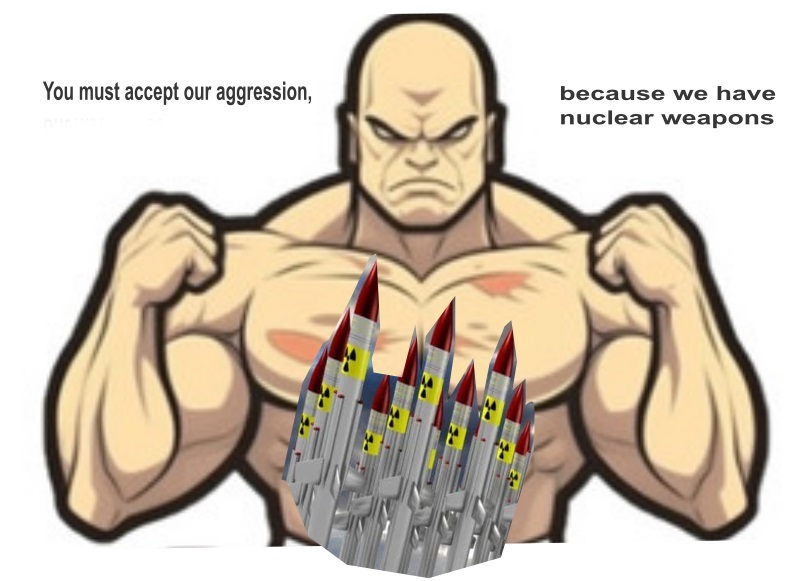
In an internal memo, Hegseth called China the ‘sole pacing threat’
by Dave DeCamp March 30, 2025 , https://news.antiwar.com/2025/03/30/hegseth-orders-pentagon-to-focus-on-preparing-for-war-with-china-over-taiwan/
Secretary of Defense Pete Hegseth distributed a memo in mid-March ordering the Pentagon to put its focus on preparing for a war with China, a nuclear-armed power, by “assuming risk” in Europe and other parts of the world, The Washington Post reported on Saturday.
The Post didn’t publish the full memo, known as the Interim National Defense Strategic Guidance, but said it “outlines, in broad and sometimes partisan detail, the execution of President Donald Trump’s vision to prepare for and win a potential war against Beijing and defend the United States from threats in the ‘near abroad,’ including Greenland and the Panama Canal.”
The Pentagon has considered China the top “threat” facing the US since the first Trump administration, but the Post report said the memo is “extraordinary in its description of the potential invasion of Taiwan as the exclusive animating scenario that must be prioritized over other potential dangers — reorienting the vast US military architecture toward the Indo-Pacific region beyond its homeland defense mission.”
The report said that the guidance from Hegseth says the Pentagon’s force planning construct “will consider conflict only with Beijing when planning contingencies for a major power war” and leave the “threat from Moscow largely attended by European allies.”
Hegseth wrote that China “is the Department’s sole pacing threat, and denial of a Chinese fait accompli seizure of Taiwan — while simultaneously defending the US homeland is the Department’s sole pacing scenario.”
The memo reflects the Trump administration’s policy toward Europe and calls for NATO allies to take a “far greater” burden sharing. The document says that the US is unlikely to provide substantial support to Europe if Russia’s military advances in the region, saying the US will only provide nuclear deterrence.
The memo also calls for the US to pressure Taiwan to increase military spending “significantly.”
For years now, the US military has been openly preparing for war with China despite the risk of nuclear escalation. It has done this by expanding military bases in the Asia Pacific, building alliances, and increasing support for Taiwan. While being done in the name of deterrence, these steps have only increased tensions in the region, making conflict more likely.
The Post report says that Hegseth’s plans to prepare a “denial defense” of Taiwan include “increasing the troop presence through submarines, bombers, unmanned ships, and specialty units from the Army and Marine Corps, as well as a greater focus on bombs that destroy reinforced and subterranean targets.” His memo also calls for increasing the defenses of US troop positions in the region and establishing more weapons stockpiles.
Hegseth Circulated Secret Pentagon Memo On Preparing For War With China
by Tyler Durden, Tuesday, Apr 01, 2025, https://www.zerohedge.com/geopolitical/hegseth-circulated-secret-pentagon-memo-preparing-war-china
Over the weekend The Washington Post revealed that Secretary of Defense Pete Hegseth distributed a memo in mid-March which ordered the Pentagon to prioritize its war-planning focus on potential future conflict with China.
The memo, called the Interim National Defense Strategic Guidance “outlines, in broad and sometimes partisan detail, the execution of President Donald Trump’s vision to prepare for and win a potential war against Beijing and defend the United States from threats in the ‘near abroad,’ including Greenland and the Panama Canal.”
It’s nothing new that the Pentagon considers China a ‘top pacing threat’ – but it does confirm that the Trump administration would likely be willing to go to war in the event of a mainland invasion of the self-ruled island.
The memo interestingly presented a strategy of “assuming risk” in Europe and other parts of the world, to refocus efforts on top nuclear-armed rivals.
The Pentagon’s force planning and new focus “will consider conflict only with Beijing when planning contingencies for a major power war” and leave the “threat from Moscow largely attended by European allies” – according to the report.
Hegseth wrote that China “is the Department’s sole pacing threat, and denial of a Chinese fait accompli seizure of Taiwan — while simultaneously defending the US homeland is the Department’s sole pacing scenario.”
The memo urges NATO allies take on a “far greater” burden-sharing on defense, and puts Europe on notice in the event of greater threats from Russia:
Hegseth’s guidance acknowledges that the U.S. is unlikely to provide substantial, if any, support to Europe in the case of Russian military advances, noting that Washington intends to push NATO allies to take primary defense of the region. The U.S. will support Europe with nuclear deterrence of Russia, and NATO should only count on U.S. forces not required for homeland defense or China deterrence missions, the document says.
A significant increase in Europe sharing its defense burden, the document says, “will also ensure NATO can reliably deter or defeat Russian aggression even if deterrence fails and the United States is already engaged in, or must withhold forces to deter, a primary conflict in another region.”
As for Taiwan specifically, it lays out ways the Pentagon intends to help its ally bolster defenses, short of outright entering any direct conflict.
WaPo and others have said the Heritage Foundation think tank is the driving force behind the strategic ideas presented in the memo.
Hegseth’s plans specify a “denial defense” of Taiwan – according to the memo – which will include “increasing the troop presence through submarines, bombers, unmanned ships, and specialty units from the Army and Marine Corps, as well as a greater focus on bombs that destroy reinforced and subterranean targets.”
China calls for strict, long-term international supervision over Fukushima wastewater discharge: spokesman
2025-03-26, https://www.bastillepost.com/global/article/4690031-china-calls-for-strict-long-term-international-supervision-over-fukushima-wastewater-discharge-spokesman?fbclid=IwY2xjawJSuCVleHRuA2FlbQIxMQABHRXbhJz-aEa94Wd_9BghnsxtDEzzaxDZiiCBsWn9LWkvzinWWdeZIhe3Zg_aem_9apdp3Teicc2HwmyoEjwCw
Guo made the statement at a press conference in Beijing in response to a media query about Japan’s wastewater discharge.
China calls for strict and long-term international supervision over Japan’s discharge of nuclear-contaminated wastewater from the crippled Fukushima Daiichi Nuclear Power Plant into the ocean, Chinese Foreign Ministry spokesman Guo Jiakun said on Wednesday.
“I would like to emphasize that China opposes Japan’s unilateral discharge of nuclear-contaminated wastewater into the ocean, and this position remains unchanged. Since last year, Chinese experts have visited Japan twice to independently collect samples and announced the relevant test results in a timely manner. On the basis that Japan has fulfilled its commitments and the test results haven’t shown any abnormalities, the General Administration of Customs of China held in Beijing on March 12 technical exchanges with Japan over the safety of Japanese aquatic products,” Guo said.
“China will continue to work with the rest of the international community to urge Japan to earnestly fulfill its commitments and ensure that the discharge of Fukushima nuclear-contaminated wastewater into the sea is always under strict international supervision,” said the spokesman.
Hit by a magnitude-9.0 earthquake and an ensuing tsunami on March 11, 2011, the Fukushima Daiichi nuclear power plant suffered core meltdowns in three reactors that released radiation, resulting in a level-7 nuclear accident, the highest on the International Nuclear and Radiological Event Scale.
The plant then generated a massive amount of wastewater tainted with radioactive substances from cooling down the nuclear fuel in the reactor buildings.
Disregarding domestic and foreign questioning and protests, the Japanese government decided in April 2021 to “filter and dilute” the nuclear contaminated wastewater from the plant and started the ocean discharge of the radioactive wastewater on August 24, 2023. This process is expected to last 20 to 30 years, until the nuclear power plant is scrapped.
Dismantling work begins at Hamaoka nuclear plant
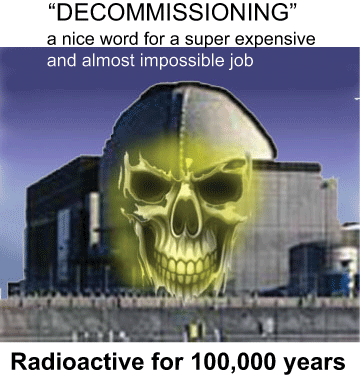
The start of the dismantling work signifies that the so-called “great era of decommissioning” has begun in earnest in Japan.
While Japan has entered an era of decommissioning, decommissioning plans continue to be postponed due to the lack of a finalized waste disposal site.
By FUMI YADA/ Staff Writer, March 17, 2025, https://www.asahi.com/ajw/articles/15671904?fbclid=IwY2xjawJHQ-9leHRuA2FlbQIxMQABHcLLRpjB5amZOZL-8qR613ATPjVA-r1TzUbw_ezeLkSwaBkwhCZVpLnMlw_aem_9niHHKoB8JXLoduuhcoh2Q
Dismantling work has begun at Chubu Electric Power Co.’s Hamaoka nuclear power plant in Omaezaki, Shizuoka Prefecture, the first time a commercial reactor in Japan is being dismantled.
On March 17, a crane was used to lift and remove the top lid of the No. 2 reactor pressure vessel, which contained nuclear fuel during its operation.
The start of the dismantling work signifies that the so-called “great era of decommissioning” has begun in earnest in Japan.
The No. 1 and No. 2 reactors at the Hamaoka plant are both boiling water reactors.
The No. 1 reactor began operation in 1976 with an output of 540,000 kW, and the No. 2 reactor went online in 1978 with an output of 840,000 kW.
After the earthquake resistance guidelines for nuclear power plants were revised in 2006, Chubu Electric Power Co. decided to decommission both reactors in 2008 due to the high cost of seismic reinforcement and other necessary measures.
Work began in 2009.
So far, spent nuclear fuel in the building has been removed to the fuel pools of No. 4 and No. 5 reactors, which are located on the same site, and unused fuel has been taken off site.
Decontamination of equipment has been carried out, and since fiscal 2015, dismantling of the turbines, generators and part of the reactor building has also been under way.
The dismantling of the reactor, which began on March 17, is considered the main part of the decommissioning work.
The reactor pressure vessel and internal reactor structures have high radiation levels that make them inaccessible to humans.
The work will be carried out by remote control using specialized robots, which requires advanced technology.
Chubu Electric Power Co. will dismantle the No. 1 and No. 2 reactors over a period of about 12 years, starting with the No. 2 reactor first.
The decommissioning of the two reactors is expected to be completed in fiscal 2042 after the buildings are finally dismantled.
Chubu Electric estimates that the decommissioning of No. 1 reactor will cost about 37.9 billion yen ($254.4 million) and about 46.2 billion yen for the No. 2 reactor.
However, the company has not yet decided where to dispose of the large amount of metal, concrete and other waste materials generated by the decommissioning work.
In Japan, the Japan Atomic Energy Agency has decommissioned a small experimental reactor, but no commercial reactors have been decommissioned yet.
At present, 18 nuclear power plants, excluding Tokyo Electric Power Co.’s Fukushima No. 1 nuclear power plant, are scheduled to be decommissioned.
Many other reactors in Japan have been in operation for a long time.
While Japan has entered an era of decommissioning, decommissioning plans continue to be postponed due to the lack of a finalized waste disposal site.
Subsidies attract companies, but not workers, to Fukushima zones
By SUSUMU OKAMOTO/ Staff Writer, Asahi Shimbun March 18, 2025
Billions of yen in government subsidies have attracted businesses and fueled a surge in industrial park development across areas affected by the Fukushima nuclear disaster.
But one big problem remains: Most workers are not returning to these municipalities that were depleted through evacuation orders.
………………………………………………………………………………….Industrial parks developed by local governments are almost entirely funded by the central government.
So far, 21 parks have opened in the region since the disaster, with nine more planned.
The total cost has exceeded 100 billion yen.
While the construction boom has given the impression of an economic revival, actual progress has fallen short of government and local expectations.
WORKERS NOT RETURNING
………………………………….Interviews with local governments and companies show that 89 businesses and organizations employ around 2,500 people in newly developed industrial parks.
Around 1,050 work in six towns and villages with high radiation levels and restricted access―Tomioka, Okuma, Futaba, Namie, Katsurao and Iitate.
But only about 15 percent of them live within those municipalities. Most of the workers commute from Iwaki and other nearby cities.
DEBATE OVER CONTINUING SUBSIDIES
In November, municipalities affected by the nuclear disaster strongly opposed a government review that suggested a possible end to the industry ministry’s subsidy program around 10 years after the lifting of all evacuation orders.
Experts on the review panel argued that the economic impact of the subsidies remains unclear.
But Kawauchi Mayor Yuko Endo, whose entire village was evacuated, warned, “The town won’t survive if the subsidies are cut off.”
Over the eight years through fiscal 2023, the ministry’s program has distributed 95.9 billion yen to 135 companies and organizations.
“Without jobs, people won’t return to nuclear disaster-affected areas,” a ministry official said. “Without people, neither commercial nor medical facilities can come back.”
The government has allocated an additional 11 billion yen for the program in fiscal 2025.
LONG ROAD TO SUSTAINABLE GROWTH
“Young people in Fukushima Prefecture were already leaving for cities before the disaster,” said Toshiyuki Kanai, a professor at the University of Tokyo’s of Faculty of Law. “Creating jobs alone won’t bring people back.”
However, he added: “The government has little choice but to continue support, given its responsibility for the displacement caused by the nuclear disaster. The scale of the damage is irreparable.”………………… https://www.asahi.com/ajw/articles/15656086?fbclid=IwY2xjawJG4llleHRuA2FlbQIxMQABHflEUQCKoAUe6O8fzoy952K_909rjqNLcrSehKzuCAKI-j0j72skaYMOlQ_aem_Qo9irxiJmty4KnXYMVu3aA
China, Russia back Iran as Trump presses Tehran for nuclear talks

By Ryan Woo, Xiuhao Chen and Laurie Chen, March 14, 2025,
- Summary
- China, Russia, Iran say talks should be based on mutual respect
- They say ‘unlawful’ unilateral sanctions should be lifted
- China, Russia urge respect for Iran’s right to peaceful uses of nuclear energy
BEIJING, March 14 (Reuters) – China and Russia stood by Iran on Friday after the United States demanded nuclear talks with Tehran, with senior Chinese and Russian diplomats saying dialogue should only resume based on “mutual respect” and all sanctions ought to be lifted.
In a joint statement issued after talks with Iran in Beijing, China and Russia also said they welcomed Iran’s reiteration that its nuclear programme was exclusively for peaceful purposes, and that Tehran’s right to peaceful uses of nuclear energy should be “fully” respected………………………………………………… https://www.reuters.com/world/asia-pacific/china-iran-russia-kick-off-talks-beijing-over-irans-nuclear-issues-2025-03-14/
Alarmed by Trump, South Korea mulls Japan-style nuclear option
Prominent voices seek capacity to reprocess spent nuclear fuel or enrich uranium and be able potentially to make bombs.
ASIA TIMES, by Daniel SneiderMarch 15, 2025
……………………………………………………………………………………………………………………………………………… The most striking evidence of South Korean alarm over the treatment of allies is the widening discussion of the need to have an independent nuclear arms capability. Conservatives have long advocated that option, but the debate has now moved into progressive circles where prominent voices are calling for South Korea to develop nuclear latency – the capacity to reprocess spent nuclear fuel or enrich uranium to be able to potentially possess fissile material for making bombs.
The Japanese model?
For now, South Korea hopes it can follow the path set by Japanese Prime Minister Shigeru Ishiba and offer Trump concessions ranging from trade, supply chain investment, and cooperation on shipbuilding to promoting South Korea’s role as an asset in a confrontation against China.
At the moment, South Korea does not have an effective government, pending the imminent decision of the Constitutional Court on the impeachment of South Korean President Yoon Suk Yeol. But whatever follows, the South Korean president will have to deal with Trump.
Assemblyman Wi believes the best they can hope for is a smooth and non-confrontational meeting modeled on that of Ishiba, which yielded a joint statement that reaffirmed the US-Japan alliance along the lines of previous statements with the Joe Biden administration.
………………………………………………………………………………….. I think President Trump thinks North Korea is unfinished business left over from the first Trump administration. We have to prepare for the worst.”
Nuclear latency
“The worst” includes the withdrawal of United States Forces Korea (USFK) from South Korea and a withholding of the US nuclear umbrella.
Regardless of how important the U.S.-ROK alliance is now, “there may come a time when it is difficult to rely on the US for our security,” former Minister of Foreign Affairs Yoon Young-kwan wrote in an op-ed published this month. “In preparation for that time, we should strengthen our national defense capabilities, including potential nuclear capabilities, and prepare to handle the deterrence of North Korea with our own strength.”
Progressives are more reticent to endorse nuclear weapons outright, but some have thrown their weight behind nuclear latency – a conscious imitation of the model pursued by Japan to have a full fuel cycle capability. South Korea could, theoretically, reprocess the spent fuel from its power reactors to extract bomb-grade plutonium or, alternatively, have the capacity to enrich uranium, potentially up to bomb-grade levels.
South Korea has long sought to revise the so-called 123 agreement for nuclear cooperation with the United States, which has restricted its ability to have a full fuel cycle. The agreement was only recently reaffirmed, in January at the close of the Biden administration.
In an important column published on March 4 in the progressive newspaper Kyunghyang Shinmun, former Minister of Unification Lee Jong-seok, another close advisor to presidential aspirant Lee Jae-myung, argued that nuclear latency can be achieved within the framework of the Nuclear Non-Proliferation Treaty and with the consent of the United States.
“China, Russia and North Korea, our neighboring countries, are nuclear weapon states, and Japan has already demonstrated its potential,” Lee wrote. “In this situation, it is rather unnatural that South Korea, a nuclear power, cannot reprocess or enrich uranium due to the restrictions of the Korea-US Nuclear Energy Agreement.”
Others in Seoul advocate defecting from the 123 agreement if the United States reduces USFK forces on the peninsula, says Kim Joon-hyung, a Rebuilding Korea Party lawmaker and former senior diplomat.
Kim is a critic of the U.S. alliance but is personally opposed to nuclear latency. “I don’t agree with nuclear proliferation,” he said. “Even if we have nuclear weapons, I don’t think we have security. Small conflicts may become more common. The Korean Peninsula is too small – high tech conventional weapons are enough. Japan will go nuclear and relations with China and Russia will worsen.”
Others are concerned about the isolation that South Korea could experience if it goes down this road. Cho Hyun, a former senior diplomat and progressive foreign policy advisor, helped negotiate the 123 agreement during the Bill Clinton administration. “The right wing thinks we should have our own nuclear development,” Cho told me in Seoul. “We don’t think it is realistic. Some progressives want to request the US for full fuel cycle like Japan. I am against this.”
As the nuclear latency argument rapidly gains support among progressive circles, revising the 123 agreement may become a bargaining chip for South Korea in negotiations with the Trump administration.
At least some inside the administration, though likely not Trump-appointed officials, have become aware of this, prompting media reports that the U.S. Department of Energy is considering labeling South Korea a “sensitive country,” a designation for countries who might be considering going nuclear.
For South Korea, this may only be the start of many shocks to come.
Daniel C. Sneider is a non-resident distinguished fellow at the Korea Economic Institute of America and a lecturer in East Asian studies at Stanford University. https://asiatimes.com/2025/03/alarmed-by-trump-south-korea-mulls-japan-style-nuclear-latency/#
Chinese nuclear weapons, 2025
Bulletin, By Hans M. Kristensen, Matt Korda, Eliana Johns, Mackenzie Knight | March 12, 2025
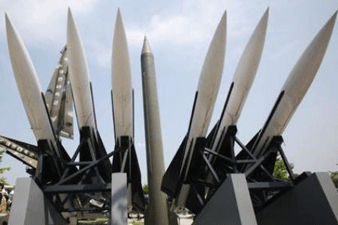
The modernization of China’s nuclear arsenal has both accelerated and expanded in recent years. In this issue of the Nuclear Notebook, we estimate that China now possesses approximately 600 nuclear warheads, with more in production to arm future delivery systems. China is believed to have the fastest-growing nuclear arsenal among the nine nuclear-armed states; it is the only Party to the Treaty on the Non-Proliferation of Nuclear Weapons that is significantly increasing its nuclear arsenal. The Nuclear Notebook is researched and written by the staff of the Federation of American Scientists’ Nuclear Information Project: director Hans M. Kristensen, associate director Matt Korda, and senior research associates Eliana Johns and Mackenzie Knight.
………………………………………………………………………………………………………………………………………………………………………… more https://thebulletin.org/premium/2025-03/chinese-nuclear-weapons-2025/
Movements across the world call for an end to all US military exercises on the Korean peninsula
The call to cancel the military exercises takes on increased urgency given the military accident last week when South Korean jets bombed their own citizens in the region bordering North Korea during the preparation of yet another joint military exercise with the US.
March 12, 2025 by Abdul Rahman, people’s dispatch
Pressure continues to grow against the ongoing Freedom Shield 25, a joint military exercise between the US and South Korea.
The International People’s Assembly (IPA) and International League of Peoples Struggle (ILPS) joined Nodutdol, an anti-imperialist Korean diaspora group, in launching a joint statement calling for the Freedom Shield military exercises to be cancelled, claiming it is drumming up threats of war on the Korean peninsula. The anti-imperialist and anti-war platforms bring together hundreds of people’s movements and organizations across the world.
“Freedom Shield 25 has dire implications for regional and global peace and stability. As part of Washington’s New Cold War against China, the NATO bloc and its Asian and Oceanian partners are escalating in East Asia, using the Korean peninsula as a staging ground. Freedom Shield poses a most immediate threat to the stability of the region, but its effects also extend far beyond,” the statement reads……………………………………………………………………………………………………………………………………. more https://peoplesdispatch.org/2025/03/12/movements-across-the-world-call-for-an-end-to-all-us-military-exercises-on-the-korean-peninsula/
Governor urges contaminated soil be disposed of outside Fukushima by 2045

Soil from radiation decontamination work after the 2011 nuclear reactor
meltdowns in Fukushima Prefecture should be disposed of outside the
prefecture by the deadline set by law, Fukushima Gov. Masao Uchibori said
in a recent interview. A law stipulates that all such soil must be disposed
of outside Fukushima by March 2045.
“The final disposal must be completed
within 20 years, no matter whether the soil is reused (within Fukushima) or
not,” the governor said. However, Shiro Izawa, the mayor of Futaba — one
of the towns hosting Tokyo Electric Power Company Holdings’ crippled
Fukushima No. 1 plant — said lasts month that soil from radiation
decontamination work should be reused in Fukushima. The mayor said this was
his personal opinion. Uchibori pointed out the heavy burden placed on
Futaba and the neighboring town of Okuma for accepting interim storage
facilities for soil from decontamination work.
Japan Times 11th March 2025. https://www.japantimes.co.jp/news/2025/03/11/japan/fukushima-gov-soil-disposal/
‘Nervous and rushed’: Massive Fukushima plant cleanup work involves high radiation and stress
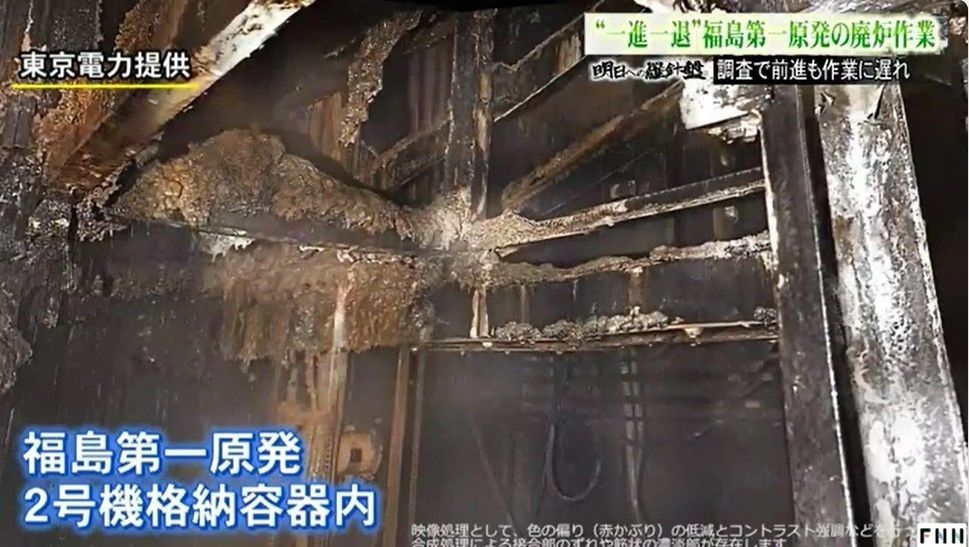
Experts say the hard work and huge challenges of decommissioning the plant are just beginning. There are estimations that the work could take more than a century. The government and TEPCO have an initial completion target of 2051, but the retrieval of melted fuel debris is already three years behind, and many big issues remain undecided.
By ASSOCIATED PRESS, 12 March 2025
OKUMA, Japan (AP) – The Fukushima Daiichi nuclear power plant’s radiation levels have significantly dropped since the cataclysmic meltdown in Japan 14 years ago. Workers walk around in many areas wearing only surgical masks and regular clothes.
It’s a different story for those who enter the reactor buildings, including the three damaged in the 2011 earthquake and tsunami. They must use maximum protection – full facemasks with filters, multi-layered gloves and socks, shoe covers, hooded hazmat coveralls and a waterproof jacket, and a helmet.
As workers remove melted fuel debris from the reactors in a monumental nuclear cleanup effort that could take more than a century, they are facing both huge amounts of psychological stress and dangerous levels of radiation.
The Associated Press, which recently visited the plant for a tour and interviews, takes a closer look.
A remote-controlled extendable robot with a tong had several mishaps including equipment failures before returning in November with a tiny piece of melted fuel from inside the damaged No. 2 reactor.
That first successful test run is a crucial step in what will be a daunting, decades-long decommissioning that must deal with at least 880 tons of melted nuclear fuel that has mixed with broken parts of internal structures and other debris inside the three ruined reactors…………………………………………………
Radiation levels are still dangerously high inside the No. 2 reactor building, where the melted fuel debris is behind a thick concrete containment wall. Earlier decontamination work reduced those radiation levels to a fraction of what they used to be.
In late August, small groups took turns doing their work helping the robot in 15- to 30-minute shifts to minimize radiation exposure. They have a remotely controlled robot, but it has to be manually pushed in and out.
“Working under high levels of radiation (during a short) time limit made us feel nervous and rushed,” said Yasunobu Yokokawa, a team leader for the mission. “It was a difficult assignment.”
Full-face masks reduced visibility and made breathing difficult, an extra waterproof jacket made it sweaty and hard to move, and triple-layered gloves made their fingers clumsy, Yokokawa said.
To eliminate unnecessary exposure, they taped around gloves and socks and carried a personal dosimeter to measure radiation. Workers also rehearsed the tasks they’d perform to minimize exposure…………………………………………………..
a growing number of workers are concerned about safety and radiation at the plant, said Ono, the decommissioning chief, citing an annual survey of about 5,5,00 workers……
Yokokawa and a plant colleague, Hiroshi Ide, helped in the 2011 emergency and are team leaders today. They say they want to make the job safer as workers face high radiation in parts of the plant.
On the top floor of the No. 2 reactor, workers are setting up equipment to remove spent fuel units from the cooling pool. That’s set to begin within two to three years.
At the No. 1 reactor, workers are putting up a giant roof to contain radioactive dust from decontamination work on the top floor ahead of the removal of spent fuel.
To minimize exposure and increase efficiency, workers use a remote-controlled crane to attach pre-assembled parts, according to TEPCO. The No. 1 reactor and its surroundings are among the most contaminated parts of the plant.
Workers are also removing treated radioactive wastewater. They recently started dismantling the emptied water tanks to make room to build facilities needed for the research and storage of melted fuel debris.
After a series of small missions by robots to gather samples, experts will determine a larger-scale method for removing melted fuel, first at the No. 3 reactor.
Experts say the hard work and huge challenges of decommissioning the plant are just beginning. There are estimations that the work could take more than a century. The government and TEPCO have an initial completion target of 2051, but the retrieval of melted fuel debris is already three years behind, and many big issues remain undecided.
Ide, whose home in Namie town, northwest of the plant, is in a no-go zone because of nuclear contamination, still has to put on a hazmat suit, even for brief visits home…….
https://www.dailymail.co.uk/wires/ap/article-14484347/Nervous-rushed-Massive-Fukushima-plant-cleanup-exposes-workers-high-radiation-stress.html
1 This Month



Shut down the radiation-damaged Heysham nuclear reactors now
To see nuclear-related stories in greater depth and intensity – go to https://nuclearinformation.wordpress.com

Say No to NASA’s Reckless Nuclear Reactor on the Moon
Say No to NASA’s Reckless Nuclear Reactor on the Moon
-
Archives
- October 2026 (254)
- September 2026 (339)
- August 2026 (330)
- July 2026 (355)
- June 2026 (287)
- May 2026 (306)
- April 2026 (356)
- March 2026 (251)
- February 2026 (267)
- January 2026 (308)
- December 2025 (358)
- November 2025 (359)
-
Categories
- 1
- 1 NUCLEAR ISSUES
- business and costs
- climate change
- culture and arts
- ENERGY
- environment
- health
- history
- indigenous issues
- Legal
- marketing of nuclear
- media
- opposition to nuclear
- PERSONAL STORIES
- politics
- politics international
- Religion and ethics
- safety
- secrets,lies and civil liberties
- spinbuster
- technology
- Uranium
- wastes
- weapons and war
- Women
- 2 WORLD
- ACTION
- AFRICA
- Atrocities
- AUSTRALIA
- Christina's notes
- Christina's themes
- culture and arts
- Events
- Fuk 2022
- Fuk 2023
- Fukushima 2017
- Fukushima 2018
- fukushima 2019
- Fukushima 2020
- Fukushima 2021
- general
- global warming
- Humour (God we need it)
- Nuclear
- RARE EARTHS
- Reference
- resources – print
- Resources -audiovicual
- Weekly Newsletter
- World
- World Nuclear
- YouTube
-
RSS
Entries RSS
Comments RSS

