North Korea will be the most pressing issue at this week’s Donald Trump-Xi Jinping summit

 Learning to live with a nuclear North Korea?, https://theconversation.com/learning-to-live-with-a-nuclear-north-korea-75620 The Conversation, Executive Director of La Trobe Asia and Professor of International Relations, La Trobe University April 3, 2017 North Korea has been on a long march to acquire a usable nuclear weapon. Since 2011, when Kim Jong-un replaced his father at the head of the Democratic People’s Republic of Korea, the pace of that march has quickened markedly.
Contrary to claims made by Nikki Halley, the new US ambassador to the UN, North Korea’s leader is not crazy – he has decidedly rational motives. Kim wants nuclear weapons to provide security from a world that he believes threatens North Korea’s existence.
So far, North Korea has conducted five nuclear tests – in 2006, 2009, 2013 and two in 2016. The decision to acquire nuclear weapons was initially prompted by the perception that without such a deterrent, North Korea risked Iraq’s fate: invasion and regime change.
Although North Korea has one of the largest militaries in the world – its army alone has more than 1 million soldiers – it is an antiquated fighting force whose principal advantage is its proximity to South Korea. Its ability to win a fight against a technologically sophisticated opponent is widely questioned. Nuclear weapons offset that weakness markedly.
An independent nuclear capacity would also reduce the country’s dependence on China. Beijing has long believed that North Korea is a useful buffer between it and an American-allied South Korea. Pyongyang realises, however, that were Beijing to change its attitude then it would find itself dangerously exposed.
North Korea perceives it is isolated in a world that is hostile to its existence. However loathsome the regime may be and however badly it misallocates resources to bolster the ruling elite, the reason for acquiring nuclear weapons is entirely rational: they are a vital means for North Korea to protect itself.
Kim has made the acquisition of nuclear weapons a core priority. It is central to government propaganda, figures prominently in nationalist iconography, and indeed the country’s nuclear standing is now enshrined in the constitution.
Most analysts believe North Korea has not yet mastered all three parts of the “nuclear trinity” required to make a usable weapon. This entails first developing a controlled nuclear explosion. The second is miniaturising and hardening that technology so it can work reliably while attached to a means of delivery. The final step is an accurate and reliable delivery system, such as a ballistic missile.
North Korea definitely has the first step and is getting close to both the second and third steps. Barring either a change in heart from the regime about its nuclear ambition or some kind of effective international intervention, North Korea is very likely to have a functioning nuclear weapon within a few years – if not sooner.
The acceleration of the nuclear program – three tests since 2013 compared with two tests between 2006 and 2012 – reflects most obviously the higher priority Kim has placed on it.
Development of missile technology – the third step in the nuclear trinity – has also increased in tempo, with more than 20 tests since January 2016. The recent acceleration is an attempt not just to “sprint” to the finish but also to take advantage of the sense of uncertainty in the region.
North Korea’s more adventurous tendencies are most effectively kept in check when the US and China are able to align their interests and policies. That has most assuredly not been the case over the past year or so.
During his “reassurance tour”, US Secretary of State Rex Tillerson declared that the old policies toward North Korea had failed – and “everything was on the table”. Many interpreted this as a new appetite for strategic risk from the incoming administration.
As with other aspects of America’s Asia policy, Tillerson was light on detail about what new approach Washington might pursue. One assumes it was a major point of debate in Seoul and Beijing. But speculation abounds that pre-emptive attacks may be being considered more seriously than in the past.
The problem with managing North Korea’s nuclear ambition is that there are so few options, and none of them are appealing. As an isolated economy that cares little for international public opinion there are precious few carrots and sticks.
Sanctions have had some effect, but they largely punish the population and not the regime. And they are regularly flouted by China on an opportunistic basis.
Due to the compressed geography of the peninsula, military action would come at a heavy price – North Korea would retaliate by unleashing massive force on South Korea. Seoul is within 60 kilometres of the border with North Korea; pre-emption would be extraordinarily risky.
North Korea will be the most pressing issue at this week’s Donald Trump-Xi Jinping summit. What can be done? There are three main options.
The first is to somehow convince North Korea to step back from its nuclear ambitions, possibly using the stalled Six-Party Talks framework. Given how important it has become to the leadership, both as a security goal and as a sense of national purpose and identity, this seems highly unlikely.
Many once assumed North Korea had started down the nuclear path as an elaborate means to receive international aid. That is, it didn’t actually want them as such, but sought them as a means to extort international financial support. This no longer appears to be the case, if it ever was.
The second option is to coerce North Korea into giving them up. This is equally fraught. Not only is the risk of major war significant, but even short of war, more targeted and better-enforced sanctions seem unlikely to halt the run to the finish line.
The third and least-worst of the options is a tried and tested policy but one that is politically unsavoury. That is, to engage with the regime, bilaterally or in the Six-Party mode. The aim here would be to retard but probably not prevent its nuclear weapon development while devising ways of learning to live with a nuclear North Korea.
Well-managed deterrence can produce a more stable strategic environment in northeast Asia than has existed in recent years. Engagement could also lead to reduced tension, greater stability and possibly even economic reform in North Korea.
Of one thing we can be sure: North Korea acts rationally, and the one outcome above all it wants to avoid is its own demise.
Northy Korea has a a nuclear-tipped bargaining chip
Is North Korea putting a nuclear-tipped bargaining chip on the table? Reuters, | SEOUL, 6 Apr 17,
As the leaders of China and the United States sit down for a summit on Thursday, North Korea has made sure it also has something on the negotiating table: A nuclear-tipped bargaining chip.
North Korea launched a projectile on Wednesday, which U.S. officials said appeared to be a liquid-fueled, extended-range Scud missile that only traveled a fraction of its range before spinning out of control and crashing into the sea.
The launch was North Korea’s latest in a long series of missile and nuclear tests that have accelerated in their variation and intensity over the last two years.
And now, experts agree, North Korea is closing in on the ability to hit the United States with a missile, a goal that for decades has been the subject of Pyongyang’s vivid propaganda posters.
“They’ve been able to put a nuke on a missile for a while now,” said Jeffrey Lewis of the California-based Middlebury Institute of International Studies.
“The stated purpose of the last test was to validate the nuclear weapon design that would arm all of North Korea’s missiles,” Lewis said of North Korea’s September 2016 nuclear test – its fifth and largest to date.
Since then, North Korea has further ramped up its tests and rhetoric, emphasizing a consistent message: To create a nuclear device small enough to mount on an intercontinental ballistic missile (ICBM), and fire it at the United States.
“If we push the button, the bombs will be fired and reduce the U.S. to ashes,” an editorial in the ruling Workers’ Party newspaper the Rodong Sinmun said on Wednesday.
North Korea now has the strength to “wipe out” the United States “in a moment” with an H-bomb, the editorial said.
“This is again our warning”.
BARGAINING CHIP From last year, North Korea took the rare step of publicizing images of its missile equipment tests, convincing analysts that Pyongyang’s banned program was further along toward successfully testing an intercontinental ballistic missile (ICBM) than first thought.
“The first few tests might fail, but that’s not good news because they’ll learn,” said Lewis. “How long it takes to make it work is anyone’s guess. Maybe a couple of years, maybe the first time”………
It was not clear if Wednesday’s launch was deliberately timed to coincide with Thursday’s summit between China’s President Xi Jinping and U.S. President Donald Trump in Florida, where North Korea is expected to be a prime topic of discussions.
Some experts think North Korea has tried to make sure the two world leaders are aware Pyongyang has a bargaining chip in any forthcoming moves to clam down on its weapons programs…….http://www.reuters.com/article/us-northkorea-missiles-bargaining-idUSKBN17811R
Need for America and China to work together on North Korean situation


 North Korea: Why America and China need to deal with Kim Jong-un together http://www.abc.net.au/news/2017-03-26/why-america-and-china-need-to-deal-with-kim-jong-un-together/8385362 By North Asia correspondent Matthew Carney, Nearly every week, Kim Jong-un seems to announce a successful test in his nuclear and missile program, edging him ever closer to his aim of striking America with a nuclear warhead.
Taking the North Korean leader out with military action is now being discussed, but that could lead to much bigger problems and plunge the region into years of chaos and instability. Worse still, it could force a confrontation between China and the US.
On the face of it, the North Korean military looks impressive. It has about 1.2 million troops. But the reality is that the weaponry is outdated and obsolete, much of it from the Soviet era. It’s no match for any modern army, so Mr Kim could be removed effectively.
Christopher Hill, probably the most experienced US diplomat in North Korean affairs, says with Mr Kim in power, there is no chance of dialogue. “Frankly, we don’t have a real insight into his thinking — we do know he seems to be totally uninterested in negotiation,” he said.
The real danger, said Mr Hill, is that the Trump administration has little understanding about how to deal with the North Korea threat, and the US State Department is in disarray. “We have a kind of Home Alone situation at the State Department, so we don’t have a lot of people focusing on this issue at this point,” he said.
Military action could prove costly Despite this, while visiting North Asia last week, US Secretary of State Rex Tillerson ruled out negotiation and put military action on the table. It’s action that could prove costly: a humanitarian disaster, with biological and nuclear weapons at play; a contested occupation as China and America battle for control.
Dr Euan Graham from the Lowy Institute says it could prove more destructive and costly than the Iraq war.
“Kicking in the door is the easy part; once you go in and occupy ground, then if that’s contested you can very quickly find even superpowers’ resources can become thinly spread,” he said.
Mr Hill says people like to compare the situation on the Korean Peninsula with the reunification of Germany, but this would actually be much worse. Frankly speaking, the difference between North Korea and East Germany cannot be described,” he said.
“They are just worlds apart in terms of what Germany had to do and what the South Koreans would have to do.”
These immense challenges make policymakers and experts around the world question the value of removing Mr Kim and his nuclear program.
Dr Graham says the US then has a choice: “Is it better to live with this threat and manage it through deterrence and existing sanctions like it did with China and the Soviet Union for decades? Or does it become so unacceptable that it has to accept the high cost of potential economic recession in north-east Asia and military conflict that could take several thousands if not higher numbers of lives?”
China and America are at oddsThe complicating factor is that the powers at play cannot agree on what North Korea should become. They all have competing strategic needs.
China wants a new regime that will serve its interests, and it fears US troops on its border.
Professor Cheng Xiaohe from Beijing Renmin University says China will have to deal with a flood of refugees.
“Millions of North Koreans will seek safe havens in China or across the 38th parallel into the minefields to seek protection in South Korea,” he said.
“Even hundreds of thousands will take to boats to sail boat to other countries to seek refuge.”
It’s doubtful whether America wants to lead another foreign intervention. The Iraq campaign almost bankrupted the country with little to show in return, and it left hundreds of thousands dead.
South Korea too is losing its desire for reunification. It would cost several trillion dollars at least and threaten South Korea’s thriving high tech economy which is 18 times bigger than North Korea’s.
Dr Jiyoung Song from the Carnegie Council for Ethics in International Affairs says the younger generation in the South have very little in common with their brethren in the North.
Most South Koreans are definitely worried about the economic side — the unification costs, but also the unemployment and competition for jobs and universities.
The only way forward…Mr Hill, who led the push for a negotiated solution with the six-party talks that ended in 2009 after North Korea withdrew and resumed its nuclear program, says the only way forward is to engage with China and plan how to deal with the regime and the aftermath.
“We have to have an in-depth dive deep with the Chinese to really figure out how together we can deal with that and I think we need to do it and do it a lot more,” he said.
But Mr Hill says both sides have to get over their mutual distrust.
“Many Chinese see the demise of North Korea as a Chinese defeat and a US victory,” he said.”They worry that the US might take advantage of this and put US troops right up on the Chinese border.”
Dr Cheng agrees that China is afraid of being played by the US.
“All countries need to work together to settle their differences and adopt a joint line to build that country for peace and stability and carry out post-reunification works,” he said.
But while experts may agree in a call for global engagement, the Trump administration seems to be turning inwards towards more isolationist policies.
Satellite images show hectic activity at North Korea nuclear site
 North Korea nuclear test site witnesses hectic activity, satellite images show http://www.ibtimes.co.uk/north-korea-nuclear-test-site-witnesses-hectic-activity-satellite-images-show-1613722
It is unclear whether the reported presence of vehicles indicates preparation for a potential missile launch. IBT, By India Ashok, 26 Mar 17, Satellite imagery of a North Korean nuclear test site reportedly reveals hectic activity, sparking fears of a potential missile launch or nuclear test. Images from a commercial satellite of the Punggye-ri nuclear test site in North Korea purportedly show four or five vehicles or trailers present at the entrance of the site where North Korea’s previous four nuclear tests took place.
The activity may indicate that North Korea is gearing up for its sixth nuclear test. Satellite images also indicate that some construction material, presumably sand and aggregate, remains undisturbed at the site, according to a report by US think tank 38 North.
The report stated: “That material, if it is sand and aggregate, when mixed with concrete, may be intended to ‘stem,’ that is to plug segments of the tunnel to prevent a nuclear explosion from escaping into the atmosphere.”
Satellite images also reportedly show that apart from a few mining carts and two trucks at the West Portal, there’s little to no activity at the nuclear site. According to 38 North, this lack of activity may indicate that either “Pyongyang is inthe final stages of test preparation or that the site is in a standard operating mode.”
On Friday (24 March), South Korean officials warned that Pyongyang appeared to be in the last stages of preparing for yet another nuclear test and could carry out detonations within hours of an order issued by leader Kim Jong-un.
Numerous reports surfaced last week about North Korea preparing for yet another potential missile or nuclear test, amid rising tensions with its neighbours and the West.
It remains unclear whether the reported presence of the vehicles at the Punggye-ri nuclear site is indicative of Pyongyang’s willingness to conduct yet another nuclear test.
North Korea’s Capability Has Entered A ‘New Phase’ – warns U.N. Nuclear Inspector Yukiya Amano
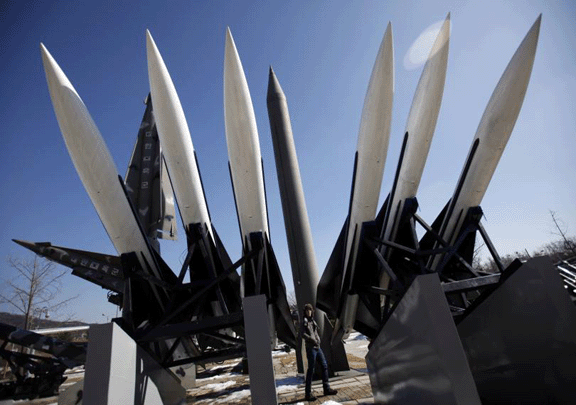 U.N. Nuclear Inspector: North Korea’s Capability Has Entered A ‘New Phase’ And while a diplomatic solution is necessary, one is unlikely to be reached, warns Yukiya Amano. WASHINGTON — North Korea’s nuclear weapons program has entered a “new phase,” with the country having doubled the size of its uranium-enrichment facility in recent years, Yukiya Amano, director general of the International Atomic Energy Agency, told The Wall Street Journal.
North Korea nuclear program is ‘imminent’ threat says Rex Tillerson
 Tillerson says North Korea nuclear program is ‘imminent’ threat, as China urges talks
Tillerson also said that US-China relations appear to be at a historic inflection point that must be carefully managed. Politico, By 3/18/17,
North Korea’s nuclear program poses an “imminent” threat that nonetheless requires the United States, China, and other countries to respond with a “staged approach” that includes sanctions, Secretary of State Rex Tillerson said in a rare encounter with the media.
Tillerson, speaking to the conservative Independent Journal Review in an interview published Saturday, also said that U.S.-China relations appear to be at a historic inflection point that must be carefully managed.
China’s foreign minister, meanwhile, urged the United States to remain “cool-headed” on the issue of North Korea and to consider going ahead with talks with Pyongyang.
The U.S. secretary of state is in the final stages of a trip to Asia, having made stops in Japan and South Korea and, this weekend, in China. A good chunk of his discussions have focused on how to handle the challenge posed by the government in Pyongyang, whose recent ballistic missile tests have alarmed the international community.
Tillerson repeatedly framed the North Korean threat as “imminent,” and during his trip he has ruled out negotiations with the country while leaving open the possibility of a pre-emptive military strike to eliminate its nuclear program.
But in his interview with IJR, Tillerson did not promise any imminent public response by the U.S. and others, aside from the ongoing diplomatic flurries. Instead, he said there had to be a “staged approach” to North Korea, one that involves enforcing, and possibly enhancing, international sanctions, while persuading Pyongyang that giving up its nuclear weapons would help it on other levels………
Tillerson also downplayed, but did not entirely rule out, suggestions that Japan and South Korea should develop their own nuclear weapons in a bid to stave off the North Korean threat…….
China’s sway over North Korea is perhaps the most urgent issue the two countries must tackle, Tillerson said. The secretary of state indicated that the Trump administration believes China must do more to enforce sanctions on North Korea, which relies on Beijing as an economic lifeline.
It’s the same stance taken by the Obama administration, which toward the end of its tenure also was increasingly alarmed by the threat posed by North Korea. President Barack Obama is reported to have told Trump that North Korea is the top national security priority facing his new administration. http://www.politico.eu/article/tillerson-says-north-korea-nuclear-program-is-imminent-threat-as-china-urges-talks/
Disaster looms over North Korea: how could this be stopped?
 How to stop a North Korean nuclear trainwreck, The Hill, BY PHILIP W. YUN, – 03/17/17 The assassination of Kim Jong Nam, the older half-brother of North Korean dictator Kim Jong Un, is yet another bizarre episode in a string of reality TV events that is now commonplace in our public discourse.
It’s easy to get sucked into the intrigue, but it distracts from the big picture: The United States is in the middle of a slow-motion trainwreck with North Korea over its nuclear weapons and missile program. North Korea’s missile tests on Monday are just the latest alarm in what could spiral into a full-blown crisis.
We better start listening.
Unless we do something about it now, a “metal on metal” collision could be in the offing, marked by more North Korean tests and calls within Washington for military strikes to stop them.
Kim Jong Nam’s murder and the subsequent media circus obscure more crucial events: China’s decision last month to ban all coal imports from North Korea; the Feb. 11 test launch of a mobile, land-based, solid-fueled missile; and, critically, the annual U.S.-South Korean military exercises happening this month, that almost certainly sparked last weekend’s tests………
we have no choice but to swallow a bitter pill. Using what little leverage and pressure we have, we must talk with the North Koreans at sufficiently high levels, something we haven’t done for some time.
But we must make these hard choices now — or they will be made for us.
Philip W. Yun is executive director of Ploughshares Fund, a San Francisco-based peace and security foundation. He previously served as senior adviser to the assistant secretary of State for East Asian and Pacific Affairs and as a senior adviser to two U.S. coordinators for North Korea Policy: former Secretary of Defense William J. Perry and former Under Secretary of State Wendy Sherman. Yun was a member of a government working group that managed U.S. policy and negotiations with North Korea under President Clinton and was part of the U.S. delegation that traveled to North Korea with then-Secretary of State Madeleine Albright in 2000. http://thehill.com/blogs/pundits-blog/defense/324461-how-to-stop-a-north-korean-nuclear-trainwreck
How to defuse tensions around the issue of North Korea’s nuclear weapons testing?
Can Tillerson Crack North Korea?, Carnegie Endowment For International Peace, RICHARD SOKOLSKY, JOEL WIT , March 15, 2017, Secretary of State Rex Tillerson’s visit to Northeast Asia this week comes as tensions are running high in the region. North Korea recently conducted a simultaneous test of four ballistic missiles that could be used to attack South Korea and Japan, as well as U.S. forces stationed in those countries with nuclear weapons. The impending American deployment of an anti-ballistic missile system in South Korea to defend against a missile attack has provoked China’s strong opposition. South Korean president Park Geun-hye has just been removed from office for corruption, and a presidential election that could bring the opposition party to power will be held in May. While all this is happening, the Trump administration is doing some serious soul-searching about how to deal with North Korea. In short, Secretary Tillerson will face a diplomatic landscape that is littered with landmines on his first big troubleshooting mission overseas.
The diplomatic hat trick the Trump administration needs to pull off is finding a solution that can stop the growth of the North Korean threat, rebuild cooperation with Beijing and gain support from U.S. allies, particularly a new South Korean government. That’s a very tall order, especially since the overwhelming temptation in Washington will be to double down on sanctions, including measures against Chinese banks and businesses that have ties with North Korea, and to ratchet up rhetoric about military options for eliminating Pyongyang’s WMD threat. If that’s all Secretary Tillerson brings to Asia, his mission will fail. He will only create more running room for Pyongyang to move forward with its nuclear and missile programs by making cooperation between Washington and Beijing even more difficult to achieve.
The smart move would be to defuse tensions while laying the groundwork for a strategy that combines threats with leaving the door open a crack for renewed dialogue with North Korea. The first two stops on his trip—Tokyo and Seoul—will provide him with an opportunity to pledge Washington’s firm commitment to their security. But the real centerpiece of Secretary Tillerson’s trip will be Beijing. China’s public proposal last week that the United States suspend its joint military exercises—a key demand by North Korea—in return for Pyongyang suspending its nuclear and missile tests—a move that would serve Washington’s interests—signals that it is willing to play an active, even positive role in avoiding a “head-on collision,” in the words of Chinese foreign minister Wang Yi. While the Trump administration quickly rejected the proposal, rather than just leaving the matter there, Secretary Tillerson should pick up the diplomatic gauntlet.
Caution, always the watchword when dealing with North Korea, should be reflected in the secretary’s counterproposal. Rather than dive headlong into new negotiations, step one should be “talks about talks”: unconditional preliminary discussions to see if North Korea is willing to put its nuclear weapons program on the table. “Unconditional” is the key word. While the United States has insisted in the past that North Korea agree ahead of time to focus on giving up its nuclear weapons, Pyongyang’s view is that talks should be held without preconditions. There seems to be little if no downside in adopting that approach, since the North Koreans understand that their program will be Washington’s number one topic for discussion. Step two in this process will be a decision by President Trump and Kim Jong-un, based on the results of these preliminary talks, whether formal negotiations should resume. If North Korea proves willing to address Washington’s WMD concerns, formal negotiations can start. If North Korea is not serious, the United States should then move on to putting greater diplomatic pressure on China, enacting new sanctions, and taking further measures to protect Seoul and Tokyo.
Whether the Trump administration adopts this approach or just presses the policy default button—more sanctions and military measures—is the $64,000 question. Consequential secretaries of state solve the thorniest and most important national security problems through patient, skillful diplomacy and negotiations. Fair or not, Secretary Tillerson has been pilloried by the press and pundits as missing in action. This sensitive diplomatic mission offers him an opportunity to show his mettle. The last thing Washington needs, at a time when America’s global leadership and position in Asia is under challenge, is for Secretary Tillerson to leave the region empty-handed, or in worse shape than he found it.
This piece was originally published by the National Interest. http://carnegieendowment.org/2017/03/15/can-tillerson-crack-north-korea-pub-68278
US intelligence : new round of missile, nuclear testing by North Korea expected
US anticipates new round of missile, nuclear testing by North Korea By Barbara Starr, CNN Pentagon Correspondent, March 16, 2017 Story highlights
US efforts to ‘denuclearise North Korea’ have failed- US secretary of state Rex Tillerson
 Tillerson concedes US efforts to ‘denuclearise North Korea’ have failed
US secretary of state starts four-day Asia-Pacific trip by calling for new approach towards Pyongyang’s weapons programme, Guardian, Justin McCurry , 16 Mar 17 The US secretary of state, Rex Tillerson, has conceded that 20 years of US attempts to “denuclearise” North Korea have failed, and called for a new approach towards the regime’s nuclear weapons programme.
Speaking in Tokyo at the start of a four-day visit to Japan, South Korea and China, Tillerson said on Thursday: “I think it’s important to recognise that the political and diplomatic efforts of the past 20 years to bring North Korea to the point of denuclearisation have failed.
“That includes a period where the United States has provided $1.35bn in assistance to North Korea as an encouragement to take a different pathway.
“In the face of this ever-escalating threat, it is clear that a different approach is required. Part of the purpose of my visit to the region is to exchange views on a new approach.”
Tillerson said he and his Japanese counterpart, Fumio Kishida, had discussed a fresh approach to North Korea’s “dangerous and unlawful” nuclear programme, but neither revealed details.
US administration officials have said that all options are on the table, including military strikes, but Tillerson indicated that Washington would continue to demand the full implementation of UN sanctions and press China to make more effective use of its leverage with the North Korean regime.
Calls for an alternative to the multinational sanctions supported by previous Japanese and US administrations have grown amid worrying evidence that the measures have not prevented North Korea from edging closer to its aim of developing nuclear weapons capable of striking the US mainland.
Japan and South Korea, which host tens of thousands of American troops, are within range of North Korean missiles…….
Chinese cooperation has been further complicated by the forthcoming deployment of a controversial US anti-missile system in South Korea.
China has objected to the Terminal High Altitude Area Defence (Thaad) missile defence system, describing its advanced radar as a threat to its own security. Military officials in the US and South Korea insist that Thaad’s sole purpose is to thwart missile attacks from North Korea……..
Tillerson said making Japan the first stop on his visit “does underscore the importance that the United States places on the Japanese-US relationship, but also the importance of the Asia-Pacific region to the United States. The US-Japan alliance remains the cornerstone of peace and stability in the Asia-Pacific region.”
Tillerson was due to hold talks with Japan’s prime minister, Shinzō Abe, on Thursday evening. On Friday, he will meet South Korea’s acting president, Hwang Kyo-ahn, and visit the demilitarised zone – the heavily armed border separating South and North Korea.
In Beijing at the weekend, Tillerson is expected to attempt to calm Chinese fears over Thaad, play down talk of a possible trade war between the world’s two largest economies, and finalise plans for the Chinese leader, Xi Jinping, to visit Trump in April. https://www.theguardian.com/us-news/2017/mar/16/tillerson-concedes-us-efforts-to-denuclearise-north-korea-have-failed
Defector’s ‘Astounding’ Theories About A Potential North Korean Nuclear Apocalypse Discredited
http://dailycaller.com/2017/03/16/defectors-astounding-theories-about-a-potential-north-korean-nuclear-apocalypse-discredited/ RYAN PICKRELL A high-ranking North Korean defector believes the North intends to test a nuclear bomb over a dozen times larger than anything it has previously tested, but that theory is a bit off.
Defector says that Kim Jong Un’s nuclear ambitions could bring about state collapse.
Defector: North Korea’s next nuclear test could lead to collapse http://www.upi.com/Top_News/World-News/2017/03/14/Defector-North-Koreas-next-nuclear-test-could-lead-to-collapse/6641489489192/ By Elizabeth Shim  | March 14, 2017 — The senior North Korea diplomat who defected to the South from Pyongyang’s Embassy in London said Kim Jong Un‘s nuclear ambitions could bring about state collapse.
Thae Yong-ho, who recently compared Kim to the Roman emperor Nero, said North Korea is headed down a dangerous path as it seeks recognition as a nuclear weapons state like “India or Pakistan,” Voice of America reported Tuesday.
“The Kim Jong Un regime will never give up nuclear weapons,” Thae said.
The high-profile defector added North Korea could “fall apart” if the regime decides to conduct a major nuclear test at its Punggye-ri nuclear site, where Pyongyang conducts tests of weapons of mass destruction.
Recent satellite images show tunnel digging continues at the site, which lies below the 800-meter Mount Mantap.
According to 38 North, the activity indicates North Korea may be prepared to conduct additional underground nuclear tests.
Thae said Tuesday the site is located on a road that connects Pyongyang to Hamgyong Province, and that “roads and railways that go up north pass by the nuclear test site.” “If a large explosion takes place and the area becomes contaminated with radiation while Pyongyang loses control of the border region of North Hamgyong Province, mass defections could take place,” Thae said.
A nuclear failure in a “small country like North Korea” could lead to disaster, the defector said, adding China and the international community must be aware of the danger.
Thae also said Kim Jong Un is trying to achieve parity with South Korea’s relatively more powerful military with his nuclear weapons program.
In an annual ranking of militaries around the world, South Korea troops ranked the 11th most powerful in 2016, while North Korea’s military strength ranked 25th in the survey by website Global Firepower.
North Korea tried to sell nuclear-weapon material
http://www.foxnews.com/world/2017/03/09/north-korea-tried-to-sell-nuclear-weapon-material.html North Korea attempted to sell a form of lithium metal, a key material for developing miniaturized nuclear weapons, to unidentified international buyers last year, according to United Nations investigators tracking dictator Kim Jong Un‘s weapons-of-mass-destruction programs.
“The U.N. Panel of Expert’s report on North Korea provides further evidence that North Korea will stop at nothing to advance its illicit nuclear and missile programs,” said Sen. Cory Gardner (R., Colo.) who wrote a new sanctions bill against North Korea last year.
North Korea’s production of the enriched lithium, known as lithium-6, is also seen by nuclear experts as evidence of the country’s accelerated efforts to miniaturize a nuclear warhead, potentially for use on ballistic missiles.
Lithium-6 can be used to produce tritium, which is used to flood neutrons into a nuclear device and magnify the explosive power of nuclear detonations, allowing countries to build bombs with smaller amounts of plutonium or uranium, nuclear experts said.
These smaller devices can be affixed to intercontinental ballistic missiles.
“Lithium-6 is ideal, not only for making tritium for boosting fission devices, but also for directly fueling advanced weapons—including thermonuclear bombs,” said Henry Sokolski, a former Pentagon official who heads the Nonproliferation Policy Education Center, a Washington think tank.
Lithium also has nonmilitary applications, particularly in producing batteries, lubricants and medicines, nuclear experts said. North Korea is believed to have significant natural deposits of the metal in its soil.
US moves Thaad missile defence system into South Korea : Trump says it’s a”new phase”
Donald Trump says nuclear threat from North Korea has entered ‘new phase’
US president told Japanese PM he is ‘100%’ with Tokyo as US moves Thaad missile defence system into South Korea following Pyongyang missile launches, Guardian, Justin McCurry The threat posed by North Korea to the US and its allies has entered a “new phase”, Donald Trump said on Tuesday, a day after the regime test-launched four ballistic missiles towards Japan.
In phone talks on Tuesday, Trump told Japan’s prime minister, Shinzo Abe, that the US stood “100%” with Tokyo after three of the intermediate-range missiles landed in the sea off Japan’s north-west coast.
“President Trump told me that the United States was with Japan 100%, and that he wanted his comments to be communicated to the Japanese people,” Abe told reporters at his residence. “He said he wanted us to trust him as well as the United States 100%.
“Japan and the United States confirmed that the latest missile firing by North Korea … is a clear challenge to the region and the international community, and that its threat has entered a new phase.”
The comments came as the US said the “first elements” of its controversial missile defence system had arrived in South Korea on Tuesday. The Terminal High Altitude Area Defense (Thaad) anti-missile system is meant to intercept and destroy short- and medium-range ballistic missiles during the last part of their flights, the US Pacific Command said in a statement.

“Continued provocative actions by North Korea, to include yesterday’s launch of multiple missiles, only confirm the prudence of our alliance decision last year to deploy Thaad to South Korea,” US Pacific Commander Admiral Harry Harris said.
China has denounced Thaad’s deployment, saying its powerful radar would compromise its security.
South Korea’s Yonhap news agency, citing military sources, said the system could be operational as early as April, well ahead of schedule.
Trump and Abe spoke as the North Korean leader, Kim Jong-un, declared the launches a success and warned that they were part of a training exercise for an attack on US military bases in Japan, home to almost 50,000 American troops.
“The four ballistic rockets launched simultaneously are so accurate that they look like acrobatic flying corps in formation,” the state-run Korean Central News Agency quoted Kim as saying. The regime also released images of the missile launches, with a smiling Kim in attendance.
The launches were seen as a protest against the start of joint military exercises involving South Korea and the US that Pyongyang regards as a rehearsal for an invasion of North Korea.
A day after operation Foal Eagle began last Wednesday, North Korea’s army, deploying the same vitriolic language it reserves for the annual drills, warned that it was ready to “immediately launch its merciless military counteractions” if South Korean or US forces fired “even a single shell” into waters near the divided Korean peninsula…….
Trump has yet to state how he intends to address the growing North Korean threat from ballistic missiles, amid evidence that the regime is edging closer to acquiring the ability to marry a miniaturised nuclear warhead with a long-range missile capable of striking the US mainland.
The UN has imposed six rounds of sanctions since the North conducted its first nuclear test in 2006, but they have failed to dent the regime’s quest to build what it claims is a “defensive” nuclear arsenal.
Trump has not publicly commented on Monday’s missile launch, but his ambassador to the UN, Nikki Haley, said on Twitter that the world “won’t allow” North Korea to continue on its “destructive path”.
Choi Kang, an analyst at the Seoul-based Asan Institute for Policy Studies, said the launch was a warning to Tokyo. “North Korea is demonstrating that its target is not just limited to the Korean peninsula any more but can extend to Japan at any time and even the US,” he said. https://www.theguardian.com/world/2017/mar/07/donald-trump-threat-north-korea-new-phase
Nuclear warning from North Korea
North Korea warns joint US-South Korea military exercises are pushing region to ‘nuclear disaster’ http://www.abc.net.au/news/2017-03-07/nkorea-us-skorea-exercises-leading-to-nuclear-disaster/8330554 North Korea has warned that US-South Korean military exercises — which it called “the most undisguised nuclear war manoeuvrers” — are driving the Korean Peninsula and north-east Asia towards “nuclear disaster”.
Key points:
- North Korea’s UN ambassador warns that “it may go over to an actual war”
- The White House announces more defence capabilities to be deployed to the region
- The raised tensions follow another series of North Korean ballistic missile tests
- On Monday some 50,000 North Koreans rally in support of mobilisation efforts
North Korea’s UN ambassador, Ja Song-nam, said in a letter to the UN Security Council on Monday the US was using nuclear-propelled aircraft carries, nuclear submarines, nuclear strategic bombers and stealth fighters in the joint exercises that began on March 1.
“It may go over to an actual war,” he warned of the military drills.
“Consequently, the situation on the Korean Peninsula is again inching to the brink of a nuclear war.”
Mr Ja again urged the Security Council to discuss the US-South Korea exercises and warned if it ignored North Korea’s request as it had in the past it would demonstrate the UN’s most powerful body was only a “political tool” of the United States.
The ambassador said the United States sought to convince public opinion that the joint exercise was a response to North Korea’s nuclear weapons, but said the US and South Korea carried out military drills numerous times before Pyongyang possessed its “nuclear deterrent”.
North Korea sent the letter on the manoeuvrers hours after North Korea fired four banned ballistic missiles earlier on Monday, in apparent reaction to the US-South Korean exercises.
Three of them landed in waters Japan claims as its exclusive economic zone, South Korean and Japanese officials said.
US President Donald Trump discussed plans to respond to the recent missile launches with South Korea’s acting president, Hwang Kyo-ahn, an official at Mr Hwang’s office said.
Mr Trump also had a phone call with Japanese Prime Minister Shinzo Abe, reaffirming its alliance with Tokyo and condemning North Korea’s tests as a threat to regional security.
THAAD deployment begins
The US started to deploy the first elements of its advanced Terminal High Altitude Area Defence (THAAD) anti-missile system to South Korea in response to the missile tests, US Pacific Command said.
“Continued provocative actions by North Korea, to include yesterday’s launch of multiple missiles, only confirm the prudence of our alliance decision last year to deploy THAAD to South Korea,” US Pacific Commander Admiral Harry Harris said in a statement.
South Korea’s media cited the nation’s military as saying the THAAD deployment would be complete in one to two months and would be operational as early as April.
The move by the US military is likely to deepen the brewing conflict between South Korea and China, which has angrily opposed the THAAD deployment as destroying regional security balance.
Meanwhile, North Korean authorities gathered more than 50,000 people together on Monday to make a show of support for the country’s latest mobilisation campaign.
Mr Ja said the main reason the Democratic People’s Republic of Korea (DPRK) — the country’s official name — was equipping itself “with nuclear attack capabilities” and strengthening its nuclear deterrent forces was in self-defence against what he called the US “extreme anti-DPRK hostile police and nuclear threats and blackmails as well as manoeuvrers to enforce its nuclear weapons”.
North Korea’s UN Mission also issued a press statement denouncing and rejecting a report by the Security Council’s panel of experts that monitors UN sanctions against the DPRK.
The experts said North Korea was flouting sanctions by trading in prohibited weapons and other goods and using evasion techniques “that are increasing in scale, scope and sophistication”.
The DPRK Mission again insisted the sanctions “have no legal basis at all” and violate the country’s “lawful rights”.
1 This Month

of the week – Shut Down Drone Warfare!


Tell the Ukrainian Government to Drop Prosecution of Peace Activist Yurii Sheliazhenko

Petition to revoke the licensing of the Near Surface Nuclear Disposal Facility (NSDF) at Chalk River. https://www.ourcommons.ca/petitions/en/Petition/Details?Petition=e-7247
To see nuclear-related stories in greater depth and intensity – go to https://nuclearinformation.wordpress.com
-
Archives
- April 2026 (68)
- March 2026 (251)
- February 2026 (268)
- January 2026 (308)
- December 2025 (358)
- November 2025 (359)
- October 2025 (376)
- September 2025 (257)
- August 2025 (319)
- July 2025 (230)
- June 2025 (348)
- May 2025 (261)
-
Categories
- 1
- 1 NUCLEAR ISSUES
- business and costs
- climate change
- culture and arts
- ENERGY
- environment
- health
- history
- indigenous issues
- Legal
- marketing of nuclear
- media
- opposition to nuclear
- PERSONAL STORIES
- politics
- politics international
- Religion and ethics
- safety
- secrets,lies and civil liberties
- spinbuster
- technology
- Uranium
- wastes
- weapons and war
- Women
- 2 WORLD
- ACTION
- AFRICA
- Atrocities
- AUSTRALIA
- Christina's notes
- Christina's themes
- culture and arts
- Events
- Fuk 2022
- Fuk 2023
- Fukushima 2017
- Fukushima 2018
- fukushima 2019
- Fukushima 2020
- Fukushima 2021
- general
- global warming
- Humour (God we need it)
- Nuclear
- RARE EARTHS
- Reference
- resources – print
- Resources -audiovicual
- Weekly Newsletter
- World
- World Nuclear
- YouTube
-
RSS
Entries RSS
Comments RSS
 nuclear-news