A group of seven European Union countries – the Czech Republic, Sweden, Poland, Romania and Bulgaria, as well as Britain and Germany – held at least two formal meetings with North Korean officials in Pyongyang in September, three EU diplomats said.
But they felt frustrated because the higher-level access that they had obtained in Pyongyang last year had fallen away, with only medium-ranking foreign ministry officials now attending the meetings, the diplomats said.
“There was a sense that we weren’t really getting anywhere because they sent these department heads,” said a Brussels-based diplomat who had been briefed on the meetings, which were described as “very serious” in atmosphere and tone.
“They want to talk to the United States.”
The White House has ruled out such talks, with President Donald Trump telling Secretary of State Rex Tillerson he would be “wasting his time” negotiating with the North Koreans.
The United States has no embassy in Pyongyang and relies on Sweden, the so-called U.S. protecting power there, to do consular work, especially when Westerners get into trouble.
In contrast to recent meetings, when North Korean officials met EU envoys in the Czech Republic’s embassy in 2016 to discuss issues including cultural programs and regional security, a deputy foreign minister would attend, one EU diplomat said.
For the small club of European Union governments with embassies in North Korea, that reflects Pyongyang’s anger at the EU’s gradually expanding sanctions that go beyond those agreed by the United Nations Security Council.
It could have repercussions for broader EU efforts to help mediate in the nuclear crisis, according to the EU diplomats briefed by their colleagues in Pyongyang, as the bloc prepares more measures against North Korea.
EU foreign policy chief Federica Mogherini, who chaired talks on the historic 2015 nuclear deal with Iran, says the bloc is ready to mediate in any talks aimed at freezing North Korea’s missile and nuclear weapons programs.
But at the same time, the European Union wants an oil embargo on Pyongyang that it hopes other countries will follow.
ENGULFED IN FLAMES’ Kim Jong-un warns of ‘nuclear clouds over suicidal Japan’ as he brands the country’s Prime Minister a ‘headless chicken’ North Korea’s state media said ‘the Japanese archipelago will be engulfed in flames in a moment’ The Sun UK, By Jon Lockett, 3rd October 2017,
NORTH Korea has threatened “suicidal” Japan with “nuclear clouds” as it blasted Prime Minister Shinzo Abe’s call for the world to pile more pressure onto the rogue state.
Kim Jong-un’s state media ripped into Abe accusing him of “running around the UN stage like a headless chicken” and pushing the region into a nuclear war.
Japan’s such rackets inciting the tension of the Korean Peninsula is a suicidal deed that will bring nuclear clouds to the Japanese archipelago,” said KCNA.
“No one knows when the touch-and-go situation will lead to a nuclear war, but if so, the Japanese archipelago will be engulfed in flames in a moment.”…….
North Korea has conducted a flurry of missile tests recently amid growing international unease.
NORTH KOREA BENEFITS FROM NUCLEAR WEAPONS. GET USED TO IT. War on the Rocks, Markl S Bell, 2 Oct 17It isoftensaidthatnuclear weapons offer little beyond the ability to deter. But if nuclear weapons deter, they also necessarily offer benefits to states that go well beyond simply deterring attack. North Korea today is in the process of reaping those benefits, and this will constrain American foreign policy in the region. As much as American policymakers might want to wish this away, it is better to adjust the sails than to hope the wind disappears. War with North Korea should now be off the table and the denuclearization of North Korea is similarly unrealistic. If the United States wants to tamp down the current crisis, it needs to get used to North Korean nuclear weapons and the constraints they impose on U.S. foreign policy.
It is true that nuclear weapons deter. But because they deter attack, they also act as a shield that reduces the risks and costs of pursuing a host of other foreign policy behaviors. My researchshows that nuclear weapons can facilitate a range of objectives that states of all stripes may find attractive. Possessing nuclear weapons can allow states to act more independently of allies, engage in aggression, expand their position and influence, reinforce and strengthen alliances, or stand more firmly in defense of the status quo. States with nuclear weapons are aware of these benefits, and use nuclear weapons to pursue them. This applies as much to democratic states committed to the status quo as it does to authoritarian or revisionist states.
Consider the case of Britain. A declining, status quo state when it acquired nuclear weapons in the 1950s, Britain was increasingly dependent on the United States for its security, facing growing challenges to its role as the preeminent power in the Middle East, while its commitments to allies were becoming increasingly uncredible. What did it do when it acquired nuclear weapons? As I show in a 2015 International Securityarticle, Britain used nuclear commitments instead of conventional military commitments (which it could no longer afford) to reassure allies that were increasingly skeptical of Britain’s ability to come to their aid. Similarly, Britain’s nuclear weapons reduced the risks of acting more independently of the United States and of using military force to resist challenges to its position in the Middle East……..
Today, North Korea is taking advantage of its nuclear weapons, just as past nuclear states have done. What’s good for the goose is good for the gander. So, if North Korean nuclear weapons are useful even if they never get used, what might Kim Jong Un’s regime want to use them for?
North Korea faces serious military threats from South Korea and the United States. South Korea is vastly more economically powerful and has the support of the most powerful state the world has ever known. Since the end of the Cold War, the United States —unconstrained by the absence of a peer competitor — has shown a repeated inclination to pursue regime change around the world, labelled North Korea as part of the “Axis of Evil”, imposed punishing sanctions on North Korea, and kept tens of thousands of forces stationed in the region……
North Korea would like to be able to stop the United States from flying military aircraft close to its territory (particularly the B-1B Lancer flights from Guam) and weaken the U.S.-South Korean alliance. It would like to show that Washington’s threats of regime change or military intervention on the Korean peninsula are empty talk, and demonstrate that the United States is unable to shoot down its missiles. And North Korea may want to be able to more credibly threaten military action against South Korea. All of these make good strategic sense for North Korea as it seeks to reduce the threats it faces and strengthen its position on the Korean peninsula in the face of massive U.S. conventional military superiority.
How do North Korean nuclear weapons help it achieve these goals? By raising the dangers of escalation, North Korea seeks to drive wedges between the United States and South Korea and raise fears of “decoupling” as well as to make it riskier for the United States to fly planes close to its airspace or engage militarily on the Korean peninsula. North Korea launches missiles, daring the United States to try (and quite likely fail) to shoot them down; it refuses to back down when challenged; and it raises the possibility of more provocative nuclear tests.
These actions are predictable, because they advance North Korean national interests. But they are also dangerous, raising the risk of escalation. This is a feature, not a bug, of North Korean strategy. Raising escalation risks is exactly how North Korea hopes to convince the United States to back off and, therefore, to improve its position on the Korean peninsula. And in the process of such escalation, North Korea might be entirely rational to use nuclear weapons first if things got bad enough.
What should the United States do?
North Korea would like to be able to stop the United States from flying military aircraft close to its territory (particularly the B-1B Lancer flights from Guam) and weaken the U.S.-South Korean alliance. It would like to show that Washington’s threats of regime change or military intervention on the Korean peninsula are empty talk, and demonstrate that the United States is unable to shoot down its missiles. And North Korea may want to be able to more credibly threaten military action against South Korea. All of these make good strategic sense for North Korea as it seeks to reduce the threats it faces and strengthen its position on the Korean peninsula in the face of massive U.S. conventional military superiority.
How do North Korean nuclear weapons help it achieve these goals? By raising the dangers of escalation, North Korea seeks to drive wedges between the United States and South Korea and raise fears of “decoupling” as well as to make it riskier for the United States to fly planes close to its airspace or engage militarily on the Korean peninsula. North Korea launches missiles, daring the United States to try (and quite likely fail) to shoot them down; it refuses to back down when challenged; and it raises the possibility of more provocative nuclear tests.
These actions are predictable, because they advance North Korean national interests. But they are also dangerous, raising the risk of escalation. This is a feature, not a bug, of North Korean strategy. Raising escalation risks is exactly how North Korea hopes to convince the United States to back off and, therefore, to improve its position on the Korean peninsula. And in the process of such escalation, North Korea might be entirely rational to use nuclear weapons first if things got bad enough.
What should the United States do?
Any serious policy demands a dose of reality. Denuclearization and regime change are no longer achievable without risking tens (and potentially hundreds) of thousands of American lives. North Korea has nuclear weapons, benefits from having them, and has no interest in giving them up. Denying this reality is not only delusional, but encourages North Korea to take more belligerent actions, accelerate its nuclear program further, and exacerbate the spiral of escalation.
A better approach would be to seek limited concessions from North Korea in exchange for limited concessions by the United States. For example, as James Acton has proposed, North Korea might agree to eschew missile tests over the territory of South Korea and Japan, if the United States limited flights of B1-B bombers close to North Korean territory. Such a deal would acknowledge that North Korea’s capabilities impose constraints on U.S. foreign policy and grant North Korea benefits. At the same time, it reduces the risks of miscalculations or accidental escalation, diminishing North Korean fears of a surprise attack by the United States, and lending some stability to U.S.-North Korean relations. And if North Korea violated the deal, the U.S. could easily resume those flights……..
Ultimately, there are no free lunches in international politics. If the United States wants North Korea to constrain its nuclear program, it will need to offer North Korea something in exchange. And if the United States tries to pursue regime change or denuclearize North Korea by force, it must accept that North Korean nuclear capabilities allow it to force the United States to pay a high price for doing so. Mark S. Bell is an assistant professor in the Political Science Department at the University of Minnesota. https://warontherocks.com/2017/10/north-korea-benefits-from-nuclear-weapons-get-used-to-it/
Trump says North Korea talks are ‘waste of time’ President contradicts Tillerson’s statement that lines of communication are open Ft.com by Demetri Sevastopulo in Washington, 2 Oct 17 Donald Trump dismissed the prospect of talks with Pyongyang as pointless barely a day after his secretary of state said the US was using new channels of communication to weigh the possibility of negotiations with North Korea about its nuclear programme. “I told Rex Tillerson, our wonderful Secretary of State, that he is wasting his time trying to negotiate with Little Rocket Man,” Mr Trump tweeted on Sunday morning. “Save your energy Rex, we’ll do what has to be done!”.
In a second tweet later in the day, he added: “Being nice to Rocket Man hasn’t worked in 25 years, why would it work now? Clinton failed, Bush failed, and Obama failed. I won’t fail.”
The US president’s interventions came after Mr Tillerson told reporters during a visit to China that Washington had three direct channels of communication with North Korea……..
Richard Haass, president of the US Council on Foreign Relations, slammed Mr Trump for undercutting his secretary of state. “Potus truly misguided here-& SecState should resign,” he tweeted on Sunday. Ian Bremmer, head of Eurasia Group, a risk consultancy, said the president’s comments were the “stupidest tweet on national security I’ve ever seen from a sitting head of state”………
After Mr Trump used a speech at the UN to describe Mr Kim as “Rocket Man . . . on a suicide mission” and threatened to “totally destroy” North Korea, Mr Kim responded by calling the US president a “mentally deranged dotard” while his foreign minister said Pyongyang would consider detonating a hydrogen bomb over the Pacific Ocean…….
To send a strong signal to Mr Kim, the US has been conducting increasingly frequent high-profile exercises around the Korean peninsula, sometimes with Japan and South Korea. Last weekend, US warplanes flew farther north from the demilitarised zone — that separates South and North Korea — than at any point in the 21st century. In combination with the military warnings, Washington is leading a global campaign to ratchet up economic pressure on North Korea in an effort to squeeze the regime, cut off funding for weapons programmes, and force Pyongyang to the negotiating table. The UN has recently imposed two sets of harsh sanctions that — combined with previous measures — embargo 90 per cent of North Korean exports. The US has also imposed unilateral sanctions and has punished Chinese and Russian companies that have been accused of facilitating weapons development in North Korea.https://www.ft.com/content/cd2087a0-a5f1-11e7-ab55-27219df83c97 Follow Demetri Sevastopulo on Twitter: @dimi
North Korean leader Kim Jong Un provides guidance on a nuclear weapons program in this undated photo released by North Korea’s Korean Central News Agency (KCNA) in Pyongyang September 3, 2017. KCNA via REUTERS
North Korea vows to become a ‘state nuclear force’, Aljazeera, 1 Oct 17
Pyongyang calls sanctions and pressure ‘futile’ in halting its development of nuclear weapons. North Korea’s state news agency has called the US-led effort to impose sanctions over its weapons programme futile, vowing the country inevitably will become a “state nuclear force”.
The comments on Sunday came from the Korean Central News Agency’s website Uriminzokkiri after US Secretary of State Rex Tillerson met for talks with China’s top diplomats and President Xi Jinping in Beijing on the Korean nuclear crisis.
Tillerson has been a proponent of a campaign of “peaceful pressure”, using US and UNsanctions and working with China to turn the screw on the regime.
Will North Korea sell its nuclear technology? The Conversation, Daniel Salisbury
Earlier this month CIA Director Mike Pompeo suggested “the North Koreans have a long history of being proliferators and sharing their knowledge, their technology, their capacities around the world.”
My research has shown that North Korea is more than willing to breach sanctions to earn cash.
A checkered history
Over the years North Korea has earned millions of dollars from the export of arms and missiles, and its involvement in other illicit activitiessuch as smuggling drugs, endangered wildlife products and counterfeit goods.
But it’s not the fear of a deliberate nuclear attack that has scholars and experts in East Asia most worried, but something totally accidental.
Recent sanctions against North Korea have been designed not only to cripple the country’s economy, but to stop them gaining the equipment needed to make more nuclear weapons.
But those same sanctions could prevent North Korea getting the supplies they need to maintain their existing nuclear facilities.
“There could be a nuclear accident, and that could be a nuclear weapon exploding and releasing radiation, or it could be the nuclear facilities breaking down and causing a Fukushima-style radiation leak,” Stephen Nagy of Tokyo’s International Christian University told nine.com.au.
“If you think about where North Korea is, that radiation would spread into northeast China, probably go to South Korea, and it would affect parts of Japan as well.”
Most experts agree that North Korea simply wants a nuclear bomb as a deterrent to prevent other nations bombing or invading them. And the purpose of their various weapons tests is a demonstration not of what they will do, but of what they can do.
Dr Nagy said most people in Tokyo are “not so concerned about an actual attack”. “They worry about a launch over Japan, and what happens if it falls into Japan accidentally?” he said. “What happens if that weapon does carry a nuclear weapon and there’s an accident?”
It’s not an unreasonable concern, though North Korea is unlikely to do something so provocative as firing a nuclear weapon over another country.
But Pyongyang has fired two intercontinental ballistic missiles over Japan’s northern island of Hokkaido, a literal shot across the bow as a sabre-rattling method.”If a launch falls down on Japan, does that mean that the United States goes to war?” Dr Nagy said. “Does that mean the nuclear fallout falls on Japan?”
Nuclear fallout can be far-reaching and devastating. The Chernobyl meltdown of 1986 spread a cloud of radiation stretching from Iran to Ireland.
North Korea is not as geographically isolated as many people think. The sprawling metropolis of Seoul has a population of 25 million and is walking distance from the border. And a serious nuclear accident in North Korea could spread radiation across the most heavily populated part of the world, with Beijing, Shanghai, Tokyo and Vladivostok certainly within range.
As with all nuclear meltdowns, the extent of the radioactive damage is based on the strength and direction of the wind.
There are already radiation fears stemming from North Korea’s detonation site, the mountain of Punggye-ri. Chinese scientist Wang Naiyan flagged the possibility the mountain could collapse, leaking radioactive material into the atmosphere.
Perhaps even more concerning is the prospect of an accidental detonation of a nuclear bomb on North Korean soil.
A 250-kiloton detonation would be so broad and destructive that it would be difficult to determine the cause.
So it is entirely possible an accidental explosion would be indistinguishable from a nuclear attack from the United States, triggering a nuclear war.
No choice for US but to accept a nuclear North Korea, ex-CIA analyst sayshttp://www.scmp.com/news/china/diplomacy-defence/article/2113296/no-choice-us-accept-nuclear-north-korea-and-more 28 Sept 17,US acceptance of a nuclear North Korea might include a nuclear-armed South Korea, said Su Mi Terry, who served under former US president George W. Bush. The US has no choice but to accept the nuclearisation of North Korea and China may need to live with a South Korea that is nuclear-armed or at least more heavily weaponised than the US’s ally is now, said a northeast Asia analyst formerly with the CIA.
US acceptance of a nuclear North Korea would need to come with military measures that include at minimum a robust missile defence system in South Korea regardless of how China might react to such a scenario, Su Mi Terry, who served as a senior North Korea analyst in the CIA under former President George W. Bush, told the South China Morning Post.
“We can be creative about containment and deterrence,” Terry, now a senior adviser at Bower Group Asia, a consultancy specialising in Asia-Pacific issues, said in an interview.
A containment and deterrence policy “doesn’t have to mean that we just sit around and say ‘that’s OK’. It may mean missile defence. It may mean ultimately after North Korea acquires its capability to attack the United States with a nuclear-tipped ICBM, it may mean that South Korea will have to go nuclear”.
Terry’s remarks reflect what some analysts are saying about realistic outcomes for the stand-off on the Korean Peninsula, but run counter to the official line in Washington and Beijing.
While the US and China have cooperated on passing unanimously a series of sanctions against Pyongyang and condemnations of the country’s nuclear weapons programme, the deployment of a US missile defence system in South Korea has stirred China’s anger.
In addition to her role at Bower Group, Terry is also a senior research scholar at the Columbia University’s Weatherhead East Asian Institute
China has consistently opposed the deployment of the US’s Terminal High Altitude Defense (THAAD) system in South Korea, saying it would do little to deter the missile threat from North Korea while allowing the US military to use its radar to look deep into China’s territory and at its missile systems.
The US and South Korea have resisted such calls, arguing that THAAD is a defensive system only. Yet, an effective missile defence for South Korea would likely require even more than the existing THAAD deployment.
The likelihood that the US and China will clash over containment and deterrence options has risen following a volley of militaristic threats between US President Donald Trump and Kim.
North Korea “will have to continue with the provocations, they will have to continue and complete their [nuclear] programme because Kim Jong-un has made it personal and Trump has made it personal”, Terry said.
“You see Kim Jong-un’s statement which came out after Trump made his UN speech. I’ve never seen anything like that, where he says he takes it personally, writing in the first person on the front page of Rodong Shimbun (an official North Korean government newspaper) and putting his name to it. There’s no way Kim Jong-un is going to back down from that. If he was going to back down he would not have made it so personal.”
Terry was referring to Kim’s response to a threat Trump made in his speech to the United Nations General Assembly last week to “totally destroy” North Korea. Kim said in his response carried by state media: “I will surely and definitely tame the mentally deranged US dotard with fire.”
China and the US remain engaged in finding a solution to their concerns around North Korea, with both sides aiming for denuclearisation.
US Secretary of State Rex Tillerson left Washington for Beijing on Thursday and will be there until October 1 for talks that will include Pyongyang’s nuclear and missile programmes.
Tillerson and his Chinese counterparts “will discuss a range of issues, including [President Donald Trump’s] planned travel to the region, the denuclearisation of the Korean Peninsula and trade and investment”, the US State Department said in an announcement earlier this week.
Former NATO military chief: there’s a 10% chance of nuclear war with North Korea
And a 20-30% chance of a conventional one. Vox by Yochi DreazenRetired Navy Adm. James Stavridis spent 37 years in the military, including four years as the supreme allied commander of NATO. Hillary Clinton vetted him as a possible running mate. President-elect Donald Trump considered naming him secretary of state. He is a serious man, and about as far from an armchair pundit as it’s possible to be.
And that’s precisely what makes his assessment of the escalating standoff with North Korea so jarring. Stavridis believes there’s at least a 10 percent chance of a nuclear war between the US and North Korea, and a 20 to 30 percent chance of a conventional, but still bloody, conflict.
“I think we are closer to a significant exchange of ordnance than we have been since the end of the Cold War on the Korean peninsula,” he said during a panel I moderated Tuesday at the University of Pennsylvania’s Perry World House.
His estimate of the potential death toll from even a nonnuclear war with North Korea is just as striking. North Korea has at least 11,000 artillery pieces trained on Seoul, South Korea’s capital of 25 million people, and would be certain to use them during any conflict. The US would be just as certain to mount a sustained bombing campaign to destroy those artillery pieces as quickly as possible.
The result? “It’s hard for me to see less than 500,000 to 1 million people, and I think that’s a conservative estimate,” he said.
Remember: That’s assuming North Korea doesn’t use its arsenal of nuclear weapons, which can already hit Seoul and much of Japan.
Speaking at the same event, Michèle Flournoy, formerly the No. 3 official at the Pentagon in the Obama administration, said Trump’s harsh rhetoric toward Pyongyang — which has included deriding North Korean leader Kim Jong Un as “Little Rocket Man” — created the real risk of an accidental war between the two countries.
“My worry is that all of this heated rhetoric has really charged the environment so that it’s much more likely now that one side or the other will misread what was intended as a show of commitment or a show of force,” she said. “It could be the basis of a miscalculation that actually starts a war that wasn’t intended at that moment.”…….
Here’s why the odds of war with North Korea are rising
Both Stavridis and Flournoy see Kim as a fundamentally rational leader whose overriding goals are to ensure the survival of his regime and his personal control over North Korea. Nuclear weapons, in Flournoy’s words, are “the ace that he could play if there was a conflict to say, ‘Stop, you’re not going to take me out without risking nuclear war.’”
查看繁體中文版 By RICK GLADSTONE and DAVID E. SANGER,North Korea threatened on Monday to shoot down American warplanes even if they were not in the country’s airspace, stating that President Trump’s comments suggesting he would eradicate North Korea and its leaders were “a declaration of war.”
The nuclear threat can be contained by diplomacy, These issues are manageable if they are given the right degree of priority, John Sawers Ft.com 25 Sep 17 “……… North Korea is the issue of the day. The objective of a denuclearised Korean peninsula, pursued by the previous US administrations, is no longer an achievable goal.
The best that can be hoped for is the suspension of nuclear and missile testing in return for security assurances and practical aid. Sanctions are designed to draw Kim Jong Un into a negotiation with that aim, and to pressure China to take a more active part. But it is very hard to see President Kim pulling back now. And China is more concerned about a new US-led war in Korea or the north collapsing and sending millions of refugees into China, than it is about living with a nuclear armed Pyongyang.
The US only really has two strategic options: contain and deter the threat; or destroy it, which would require regime change. There are always military options. But all who have studied the secret Pentagon plans are sobered by the scale of loss of life in South Korea these would entail. There is also a risk of China reluctantly coming to the aid of the north as it did in the 1950s.
Realistically, it seems the only practical option is containment. That requires missile defence systems to create uncertainty that nuclear-tipped missiles would ever get through to their target, and to deter any use of such weapons by being clear that North Korea would be destroyed if it ever tried to use them.
Mr Kim may be hard for us to comprehend, but he is a rational actor and he is certainly not suicidal. US concern about this isn’t exaggerated by the Trump administration: it has a serious problem on its hands.
However much we may view containment as the only sensible answer, there are still dangers of miscalculation. Mr Kim may be tempted to use his nuclear arsenal to hold others to ransom. There is also a proliferation threat. We have seen how Pyongyang has used its nuclear technology as an export earner. In 2007, the Israelis destroyed a secret nuclear reactor in the Syrian desert that had been designed and built by the North Koreans. Is it conceivable that a future terrorist organisation might be able to obtain such a device? Unlikely. But if they had the means, then Pyongyang would be the first place to go to get it. Pakistan’s ambivalent relationship with terrorist organisations adds to the dangers.
One country where our nuclear weapons concerns had eased is Iran. The nuclear agreement has its weaknesses, especially that it only applies for 10 years. But it is worth having, and Tehran is complying by its technical requirements. If Donald Trump walks from the nuclear deal — as he threatened at the UN last week — then before long he could find he has another North Korea to deal with, this one in the Gulf.
The outlook on nuclear weapons might look grim. But as we showed in the cold war, these issues are manageable with skilful diplomacy and the right investments in defence. We just have to give it the right degree of priority. When I was at MI6, and before that our negotiator with Iran on its nuclear programme, I was always mindful of the nuclear threat. The only issue that can seriously threaten our way of life must be among our top international security priorities. The writer is chairman of Macro Advisory Partners and a former chief of MI6, the British Secret Intelligence Service https://www.ft.com/content/02c58f70-9c80-11e7-8b50-0b9f565a23e1
The US President warned Pyongyang’s foreign minister that if he if ‘he echoes thoughts’ of the country’s leader Kim Jong Un they both ‘won’t be around much longer’.
He was responding after Ri Yong Ho told the United Nations General Assembly on Saturday that targeting the US mainland with its rockets was inevitable after ‘Mr Evil President’ made an ‘irreversible mistake’ by calling Mr Kim ‘rocket man’.
Describing Mr Trump as a ‘mentally deranged person full of megalomania,’ Mr Ri went on to tell the annual gathering of world leaders that the country was now ‘only a few steps away from the final gate of completion of the state’s nuclear force’.
Hitting back on Twitter, Mr Trump wrote: ‘Just heard Foreign Minister of North Korea speak at UN If he echoes thoughts of Little Rocket Man, they won’t be around much longer!’
Shortly before Mr Ri was scheduled to speak at the assembly, the Pentagon announced a fleet of US bombers and fighter jets had flown off North Korea’s coast, in what it called a ‘clear message’ to Pyongyang.
Pentagon spokeswoman Dana White said it underlined the range of military options available to the US.
U.S. knows ‘for sure’ it has A-Bomb, foreign minister says
Korea, Japan, China, Russia may suffer if things get violent
North Korea’s possession of nuclear weapons is preventing the U.S. from launching a first strike against the rogue nation, Russian Foreign Minister Sergei Lavrov said in an interview.
“The Americans won’t strike because they know for sure — rather than suspect — that it has atomic bombs,” Lavrov said Sunday on Russia’s NTV television. “I’m not defending North Korea right now, I’m just saying that almost everyone agrees with this analysis.”
Lavrov said the U.S. attacked Iraq “solely because they had 100 percent information that there were no weapons of mass destruction left there,” refuting arguments the American government made at the time.
Tensions between the nations ratcheted up this weekend as President Donald Trump and North Korea Foreign Minister Ri Yong Ho traded threats. On Saturday, U.S. Air Force B-1B bombers flew over international waters east of North Korea.
Lavrov said thousands of innocent people will suffer, in North Korea and in bordering South Korea, Japan and even maybe China and Russia, in the absence of a diplomatic solution.
Turning to another source of tension, Lavrov also added that he can’t rule out that the U.S. plans for Syria go beyond fighting terrorism. The Americans “swear that they have no goal in Syria other than eliminating terrorists,” he said. “When it happens, we’ll see if this was true or the U.S. nonetheless pursues some political goals, which we yet don’t know of.”
Recent earthquakes near North Korea’s nuclear test site have raised questions as to how far radioactive material would travel if an underground atomic explosion triggers a leak.
A magnitude 3.2 earthquake was detected near the test site on Saturday, according to the Associated Press. The U.S. Geological Service (USGS) registered the quake at a magnitude 3.5.
“The quake is small enough to suspect that it could have been caused by a tunnel collapse, and satellite data shows there have been many landslides in the area since the nuclear test,” Hong Tae-kyung, a professor at the department of Earth System Sciences at Yonsei University, told the AP.
However, Korea’s Meteorological Administration believed the earthquake to be natural.
This string of earthquakes raises questions on how far the wind would carry dangerous radiation if a leak occurs.
Non-tropical systems would be the driving force for where radiation would travel. These systems generally travel in a west to east manner with some fluctuations to the north and south.
“As a weak front passes through North Korea early this week, winds around 4,000 feet (1,219 meters) will begin to pick up from the west to northwest at 20-30 mph,” AccuWeather Senior Meteorologist Alan Reppert said.
Any radiation that would be released into the atmosphere during the second half of the week would push towards northern Japan, possibly towards Hokkaido and far northern Honshu, to the north of Tokyo.
Reppert added “The only major city this would affect is Sapporo, as this would be north of Sendai.”
Any radiation would likely stay fairly close to the ground for the first day or two following a possible leak, before gradually rising higher into the atmosphere.
Beyond the passage through Japan, any possible radiation could travel close to southeastern Russia, the Aleutian Islands or head into the North Pacific Ocean away from any land masses.
This general steering flow will likely persist through the week with slight day-to-day variation.
If a leak occurs, health hazards would not only be limited to those who are outside without the proper protection.
“The big concern is the underground water will be contaminated, polluting the plants and animals, and finally the people who consume animal meat will be seriously impacted,” Wei Shijie, a former worker on nuclear weapons in China, told The Telegraph.
The area where the earthquake struck is not known to experience natural earthquakes. As earth-shaking booms are a natural feature of underground nuclear weapons testing, the quake led to suspicions North Korea had detonated yet another model of nuke — as it did earlier this month, sparking fears it had successfully developed a hydrogen bomb.
“This event occurred in the area of the previous North Korean Nuclear tests,” the United States Geological Survey wrote on its website. “We cannot conclusively confirm at this time the nature (natural or human-made) of the event. The depth is poorly constrained and has been held to 5km by the seismologist.”
According to the Washington Post, China’s state earthquake-monitoring agency initially believed the test to have been an explosion, although South Korean officials told the Associated Press “the analysis of seismic waves and the lack of sound waves clearly showed that the quake wasn’t caused by an artificial explosion.”
Per the AP, the 3.4-magnitude quake would be much smaller than previous nuclear tests, the weakest of which generated a magnitude 4.3 quake and the strongest of which, the test this month, resulted in a magnitude 6.3 quake. One possible explanation is the region is undergoing aftershocks in the wake of the previous nuclear tests.
“It could be a natural earthquake that really was man-made as the nuclear test would have transferred a lot of stress,” Yonsei University in Seoul earth system sciences professor Hong Tae-kyung told CBC. “The quake is small enough to suspect that it could have been caused by a tunnel collapse, and satellite data shows there have been many landslides in the area since the nuclear test.”
Other than the disquieting pace of North Korean nuclear weapons development, one immediate concern from the ongoing tests is seismological data suggesting the test site might be about to cave in.
Researchers at the University of Science and Technology of China in Hefei, Anhui province concluded earlier this month another test at Punggye-ri could cause the overhead mountain to cave in, potentially releasing large amounts of radioactive material which could drift far beyond the region into neighbouring countries including China.
According to South Korean paper Chosun Ilbo, sources said after the September 3rd test, residents in the area were prohibited from travelling to the capital, Pyongyang, due to possible radioactive contamination.





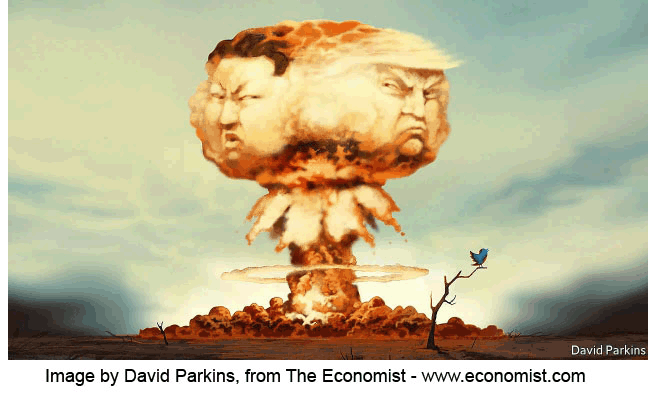






 nuclear-news