North Korean leader Kim Jong Un provides guidance on a nuclear weapons program in this undated photo released by North Korea’s Korean Central News Agency (KCNA) in Pyongyang September 3, 2017. KCNA via REUTERS
When North Korea suddenly threw a historic summit with the United States into question on Wednesday, it cited – five times – the fate of another country and another leader, half a world away, as an example of why no one should trust American efforts to disarm another nation.
The country was Libya, and the leader was Muammar Gaddafi, who made a bad bet that he could swap his nascent nuclear program for economic integration with the USA.
That deal, executed by the Bush administration nearly 15 years ago, is a footnote to American histories of that era. But it has always loomed large for the North Koreans.
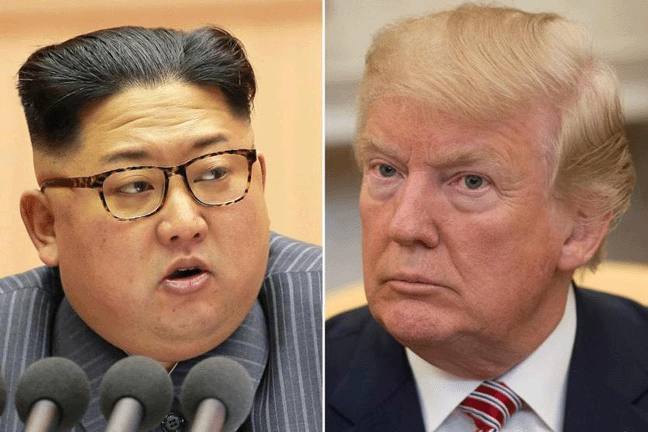
The planned June 12 meeting between US President Donald Trump and North Korean leader Kim Jong-un has been regarded by disarmament advocates as an opportunity to end decades of animosity between North Korea and the US.
But in the mind of Trump’s new national security adviser, John Bolton, who was an architect of the Libya deal, that is the model of how things should play out as the two leaders meet: Complete nuclear disarmament in return for the promise of economic integration. Bolton said as much last weekend.
In issuing its threat to back out of the summit meeting, the North referred to Bolton’s comments, calling them a “Libya mode of nuclear abandonment”.
So why is the Libya model suddenly becoming a sticking point in the meeting between Trump and Kim?
What happened in Libya
In 2003, Gaddafi saw the US invasion of Iraq and the toppling of Saddam Hussein, and may well have concluded he was next. In a lengthy, secret set of negotiations with Britain and the US, he agreed to voluntarily hand over the equipment he had purchased from Abdul Qadeer Khan, a leader of the Pakistani nuclear program. North Korea and Iran had also been customers of Khan, who was later placed under house arrest after his activities were exposed.
The Libya material was flown out of the country, much of it placed at a US weapons laboratory in Oak Ridge, Tennessee. When president George W. Bush announced the deal, he made a clear reference to North Korea and Iran when he said “I hope other leaders will find an example” in Libya’s action.
What happened less than a decade later might be at the heart of what Kim appears to fear.
The US and its European allies began a military action against Libya in 2011 to prevent Gaddafi’s threatened massacre of civilians. US president Barack Obama acceded to arguments from secretary of state Hillary Clinton to join the European-led action.
But no one in the Situation Room debated what message the decision to turn on Gaddafi might send to other countries the US was trying to persuade to relinquish their weapons, according to interviews conducted later with more than half a dozen people engaged in the discussion.
North Korea’s fear of meeting the same fate as Libya – or maybe more specifically its leader meeting the same fate as Gaddafi – has appeared to factor into North Korea’s thinking about its own weapons program for years.
In 2011, after the US and allies launched airstrikes in Libya, North Korea’s foreign minister said the denuclearisation of the North African nation had been an “an invasion tactic to disarm the country”.
After Gaddafi was killed, the narrative in North Korea became clear: Had he not surrendered his nuclear program, North Korean officials said, he might still be alive.
In 2016, shortly after North Korea conducted a nuclear test, its state-run news outlet, the Korean Central News Agency, made direct reference to Libya and Iraq. “History proves that powerful nuclear deterrence serves as the strongest treasured sword for frustrating outsiders’ aggression,” the agency said.
“The Saddam Hussein regime in Iraq and the Gaddafi regime in Libya could not escape the fate of destruction after being deprived of their foundations for nuclear development and giving up nuclear programs of their own accord,” it said.
But North Korea was also clear to draw a line between itself and the two nations. Its statement on Wednesday said it was off base to suggest that the “dignified state” of North Korea could share the same destiny as Libya or Iraq, which “collapsed due to yielding the whole of their countries to big powers”.
“The world knows too well that our country is neither Libya nor Iraq, which have met miserable fates,” the statement said. The North made explicit reference to a homegrown achievement that Gaddafi never neared: It had already become a nuclear-armed country.
Unlike North Korea, Libya was not actually a nuclear weapons state. During inspections in 2003, the Americans discovered Libya had centrifuges that could be used to produce highly enriched uranium – fuel for a bomb.
“It is absolutely absurd to dare compare the DPRK, a nuclear weapon state, to Libya, which had been at the initial state of nuclear development,” the North Korean statement said, using the initials for the country’s official name, the Democratic People’s Republic of Korea.
North Korea has tested six nuclear weapons, and US intelligence agencies believe it has 20 to 60 more, as well as intercontinental ballistic missiles capable of striking the United States.
What is the White House saying about the Libya model?
North Korea’s statement Wednesday also made direct reference to Bolton.
In his first televised interviews after becoming national security adviser last month, Bolton told Face the Nation on CBS and Fox News Sunday that Libya’s denuclearisation was what he envisioned when moving ahead with North Korea talks.
“We have very much in mind the Libya model from 2003, 2004,” he said on Fox. “There are obviously differences. The Libyan program was much smaller, but that was basically the agreement that we made.”
When a reporter asked Sarah Huckabee Sanders, the White House press secretary, specifically about the Libya model and if the administration’s approach to North Korea would be the same, she backed away from Bolton’s comparison.
“I haven’t seen that as part of any discussions, so I am not aware that that’s a model that we are using,” Sanders said Wednesday. “There is not a cookie cutter on how this works.” New York Times
North Korea Threatens to Call Off Summit Meeting With Trump, NYT, By Choe Sang-Hun and Mark Landler, 查看简体中文版查看繁體中文版SEOUL, South Korea — North Korea threw President Trump’s planned summit meeting with its leader, Kim Jong-un, into doubt on Wednesday, threatening to call off the landmark encounter if the United States insisted on “unilateral nuclear abandonment.”
The warning, made by the North’s disarmament negotiator, caught Trump administration officials off guard and set off an internal debate over whether Mr. Kim was merely posturing in advance of the meeting in Singapore next month or was erecting a serious new hurdle.
The abrupt change in tone began early Wednesday, when North Korea indefinitely postponed high-level talks with South Korea over the North’s sudden objection to joint military drills by the South and the United States that began last week. The North also raised the possibility of scrapping the meeting with Mr. Trump.
Then hours later, the North broadened the source of its anger and sharpened the threat to the summit with Mr. Trump.
Kim Kye-kwan, a vice foreign minister, rejected the administration’s demand that it quickly dismantle its nuclear program as Libya had done 15 years ago, singling out John R. Bolton, Mr. Trump’s new national security adviser, for condemnation.
“If the United States is trying to drive us into a corner to force our unilateral nuclear abandonment, we will no longer be interested in such dialogue and cannot but reconsider our proceeding to the D.P.R.K.-U.S. summit,” the statement said, using the abbreviation for the North’s formal name, the Democratic People’s Republic of Korea.
Satellite photo offers clue as N Korea promises ‘total ban’ on nuclear tests , SMH, 16 May 18,Geneva: North Korea will join international efforts to ban nuclear tests, its ambassador to the United Nations in Geneva, Han Tae Song, told the Conference on Disarmament on Tuesday.
North Korea, which is believed to have tested six nuclear weapons, has said it will dismantle its only known nuclear test site this month ahead of a meeting on June 12 between US President Donald Trump and North Korean Leader Kim Jong-un.
It comes as a satellite photo appeared to back up North Korea’s claim, showing that buildings have already been dismantled at the country’s only test site…….
An analysis on Monday by the 38 North website said commercial imagery taken last week showed several operational support buildings had been razed, and rails for mining carts apparently removed.
North Korea said it will dismantle its Punggye-ri test site between May 23 and 25 in the presence of local and international media. The site was used for each of its six underground nuclear test explosions………
The analysis said no tunnel entrances at the test site appeared to have been permanently closed yet.
SBS, 16 May 18North Korea on Wednesday called into question a much-anticipated and unprecedented summit between its leader Kim Jong-un and US President Donald Trump, the South’s Yonhap news agency reported.
Pyongyang also cancelled high-level talks due Wednesday with Seoul over the Max Thunder joint military exercises between the US and the South, Seoul said.
The US will “have to undertake careful deliberations about the fate of the planned North Korea-US summit in light of this provocative military ruckus”, Yonhap quoted the North’s official news agency KCNA as saying.
The drills between the two allies’ air forces were a rehearsal for invasion and a provocation at a time when inter-Korean relations were warming, it cited KCNA as adding.
The language used is a sudden and dramatic return to the rhetoric of the past from Pyongyang, which has long argued that it needs nuclear weapons to defend itself against the US. …….
South Korea’s Yonhap news agency reported that Pyongyang had called the June 12 summit into question over joint military exercises between the US and the South.
Telegraph 14th May 2018,The United States has told North Korea that is must start shipping nuclear
weapons, fissile material and some of its long-range missiles out of the
country within a couple of months of the June summit between Kim Jong-un,
the North Korean leader, and President Donald Trump, according to South
Korean media. https://www.telegraph.co.uk/news/2018/05/14/us-pressures-north-korea-ship-nuclear-weapons-overseas-sanctions/
Telegraph 11th May 2018 , Closing down North Korea’s nuclear test site at Punggye-ri is going to be
more complicated and fraught with risk than has previously been suggested, with analysts suggesting that acting in haste for short-term political gain might lead to an environmental crisis.
One suggestion is to use explosives to seal the entrances to the three tunnels that have been drilled into the
mountain, although the concern is that further detonations at the already weakened site could lead to a collapse of internal spaces and the release of massive amounts of radioactivity into the atmosphere.
Given the danger, the alternative is to bury the entire site in a mixture of lime and sand.
Trump’s decision to reimpose sanctions on Iran clearly violates the multilateral Iran nuclear deal, known officially as the Joint Comprehensive Plan of Action (JCPOA). While the move is unsurprising—given Trump’s failure to recognize the nonproliferation value of the deal and frequent threats to walk away—it is dangerous and irresponsible, and it risks manufacturing a nuclear crisis that the international community cannot afford.
There was no legitimate reason for Trump to reimpose sanctions. For the past two years, the nuclear deal has verifiably restricted Iran’s nuclear program and subjected it to intrusive monitoring and verification. Even critics of the deal, such as Secretary of State Mike Pompeo, have admitted that there is no evidence that Iran is in violation of the agreement.
Trump’s main criticism—that the deal paves the way to an Iranian nuclear weapon in 10 years—is based on a flawed analysis that discounts the value that the permanent monitoring mechanisms and prohibitions put in place by the deal possess. They are a bulwark against nuclear weapons development.
By violating the deal, Trump has only isolated the United States and undermined Washington’s credibility. His “plan B” —to negotiate a “better deal” with Iran— is completely unrealistic. After this clear demonstration that the United States cannot be counted on to implement an agreement in good faith, Trump will hard pressed to gain any support for sanctions, let alone new talks. As a result, Trump is inciting a proliferation crisis, rather than working with allies to develop a long-term diplomatic strategy that would build on the agreement in the years ahead and address Iran’s malign activities outside of the accord.
Despite Trump’s reckless decision to reimpose sanctions, it would be premature to declare the nuclear deal dead. The JCPOA is a multilateral agreement endorsed by the UN Security Council and Washington’s P5+1 partners—China, France, Germany, Russia, and the United Kingdom—which have pledged to implement the deal, irrespective of US actions. And these states and the European Union have powerful tools at their disposal to block the secondary effects of US sanctions.
It will be critical that these states move quickly to insulate legitimate business from US sanctions, demonstrating to Iran that there is still an incentive—trade with Europe and other developed economies—to continue abiding by the nuclear commitments made under the accord. Failure to ensure that Iran has international trading opportunities will make it more likely that Tehran will respond to Trump’s violation by breaching the nuclear limits. While Iran is unlikely to dash for a bomb, Iranian officials have left the door open to restart uranium enrichment to 20 percent uranium 235, a level of fissionable material currently prohibited by the deal. If Iran choses this path it would destabilize the region and increase the risks of conflict.
Trump’s decision has nonproliferation consequences beyond Iran. Trump is about to sit down at an important summit with North Korean leader Kim Jong-un to discuss denuclearization of the Korean peninsula. Violating the Iran deal undermines US credibility in those negotiations and sends a message to Kim Jong-un that even if an agreement is reached and North Korea abides by its terms, there’s no guarantee that Washington will fulfill its commitments. This is a dangerous precedent to set and risks this historic opportunity to de-escalate tensions with North Korea.
Singapore will host U.S.-North Korea summit, nuclear issue to dominateSteve Holland, Matt Spetalnick WASHINGTON (Reuters), 11 May 18 Leaders of the United States and North Korea will meet for the first time when President Donald Trump and Kim Jong Un hold a summit on June 12 in Singapore where the U.S. side will try to persuade Pyongyang to give up its nuclear weapons.
…….. “The highly anticipated meeting between Kim Jong Un and myself will take place in Singapore on June 12th. We will both try to make it a very special moment for World Peace!” Trump wrote on Twitter…….
Trump is embarking on this high-stakes meeting with Kim after sending shockwaves through the world on Tuesday when he announced that the United States was pulling out of a 2015 accord imposing international oversight of Iran’s nuclear program.
The move raised questions over whether North Korea might now be less inclined to negotiate its own nuclear deal with Washington.
Trump and Japanese Prime Minister Shinzo Abe spoke by telephone on Wednesday and the White House said the two leaders “affirmed the shared goal of North Korea abandoning its illicit weapons of mass destruction and ballistic missile programs” and remained committed to cooperating with South Korea.
Japan worries that it could be the target of any first-use of nuclear weapons by Pyongyang.
……… Kim recently promised to suspend missile tests and shut a nuclear bomb test site.
North Korea is still technically at war with the United States and its ally South Korea because the 1950-53 Korean War ended in a truce, not a treaty.
The choice of Singapore will put the summit on friendly turf for Trump, as the island nation is a strong U.S. ally and the U.S. Navy frequently visits its port.
The wealthy financial and shipping hub is seen as a gateway between Asia and the West and has been called the “Switzerland of Asia,” in contrast to North Korea’s isolated economy that its leaders now want to modernize.
Or, he’s making the rest of the world think he is by arranging a performance for the satellites that pass overhead.
Satellite images taken since last month’s inter-Korean summit show a steady reduction in the number of buildings around North Korea’s known nuclear test site, built under Mount Mantap in the Punggye-ri area in the north of the country.
“At the very least, this a welcome PR move,” said Jeffrey Lewis, head of the East Asia program at the James Martin Centre for Nonproliferation Studies in Monterey, California.
“Over the past two weeks, five or six buildings have inexplicably come down,” Lewis said, citing commercial satellite images from the San Francisco-based firm Planet Labs that have a resolution comparable to Google maps. “Something is clearly happening there.”
As part of the extraordinary rapprochement now going on, North Korea has vowed to dismantle the test site, where all six of its nuclear detonations have taken place, this month. But as with so many things about North Korea, it’s difficult to tell how much of this is wheat and how much is chaff.
Kim made the pledge during a historic summit with South Korean President Moon Jae-in, which laid the groundwork for a meeting between Kim and President Donald Trump that will likely take place in the next month or so.
Kim said he would invite security experts and journalists to the North to observe the closure of the site, the South’s presidential Blue House said.
All six of North Korea’s nuclear tests have taken place deep under the mountain at Punggye-ri, with five of them occurring in the tunnel complex accessed through an entrance known as the north portal. There are two other entrances to the site, the west and south portals.
The last test, in September last year, was so huge that some experts wondered if Mount Mantap was suffering from “tired mountain syndrome” and had become unusable. But numerous nuclear experts have cast doubt on that theory, noting that even if the tunnels leading to the north portal were unusable, the other two entrances could still be operational.
Tunnelling and activity at the west portal had been visible as recently as April 20, a week before the inter-Korean summit, according to an analysis for 38 North, a website devoted to North Korea.
There are clusters of buildings at the portals, including administration buildings and a command center, as well as smaller buildings.
The big, main buildings are still there but the smaller, more peripheral ones at the north and south portals, the entrances to the main tunnels, have come down, Lewis said.
This could be part of the preparations for inviting journalists and experts to watch the closure of the site, which, Lewis said, could be as simple – and as reversible – as blocking the portals.
“Shutting down the test site is something they can easily do. It’s just tunnels so they can seal the entrances – but they can also unseal them,” he said.
“And the tunnels are always going to be there,” he added, unless North Korea blows up the whole site.
Still, analysts wanting to be optimistic about the diplomatic process say that declaring the site finished and taking some steps towards closing it would support their theory that Kim is making an effort, just like this week’s release of three Americans who had been held in North Korea.
But sceptics say that closing a test site that might well be spent is just cosmetic.
A group of Chinese scientists last month said they believe the test site had collapsed after September’s huge test, which caused an earthquake so big that satellites caught images of the mountain above the site actually moving.
North Korea claimed to have detonated a hydrogen bomb, which would be exponentially more powerful than the atomic devices previously tested, and experts said the size of the earthquake suggested that it had indeed been a hydrogen, or thermonuclear, explosion.
Adding to theory that the site has outlived its utility is new research from scientists from the Earth Observatory of Singapore at Nanyang Technical University, who claim to have found evidence that the damage at Mount Mantap was more substantial than other research shows.
In their study, which will be published in the journal Science on Thursday, they argued that by using satellite radar imagery to supplement ground-based seismological readings they were able to gain a more accurate picture of the September 3 test.
Sylvain Barbot, a researcher with the Earth Observatory of Singapore, wrote in an e-mail that the nuclear test last year was so large that “we could ‘feel’ it from space.”
The amount of shaking that accompanied the explosion was so severe that traditional radar measurements were inaccurate, Barbot said, and his team had to use unusual techniques to compensate for significant changes in the landscape.
By using these techniques, the researchers were able to estimate a depth for the nuclear detonation: Around 450 metres, beneath the summit of Mount Mantap. Researchers then combined this information with seismological readings to come up with an estimated yield for the weapon of between 120 kilotons to 304 kilotons.
Much of this range would be far higher than officials from the United States and South Korea estimate.
The researchers also found evidence that a significant part of Mount Mantap had collapsed after the explosion, supporting the Chinese study. A “very large” part of the facility had collapsed, Barbot said, “not merely a tunnel or two.”
An underground North Korean nuclear test in September last year exploded with 10 times the energy of the atomic bomb that exploded over Nagasaki in 1945.
It also caused the overlying mountain peak to sink by half a metre and shift about 3.5 metres south.
Key points:
North Korea detonated a nuclear bomb under Mt Mantap on September 3, 2017
Using satellite measurements and seismic data, geophysicists calculated the strength of the test and its location — the first time satellite radar has been used this way
The blast was big enough to cause an earthquake and deform the mountain above
These are conclusions drawn by geophysicists, who used satellite radar and instruments that pick up waves travelling through the earth, to calculate the explosion’s depth and strength.
In the journal Science today, they also report signs that a subterranean tunnel system at the test site collapsed 8.5 minutes after the bomb detonated.
In the past, satellite technology — called synthetic radar aperture imagery — has mapped how the ground stretches and warps after earthquakes.
But this is the first time it has been used to examine a nuclear bomb test site, according to Teng Wang, study co-author and a geophysicist at Singapore’s Nanyang Technological University.
Since the United Nations General Assembly adopted the Comprehensive Nuclear-Test-Ban Treaty in 1996, nine nuclear tests have taken place.
Six of these were by North Korea, five of which were at its Mt Mantap facility in the country’s north.
The bombs were detonated in chambers tunnelled into the mountain itself — a granite peak that extends upwards just over 2,200 metres.
But this means the details of the tests, such as the energy produced by the bombs, have been largely unknown outside North Korea — until now.
Eye in the sky, ear to the ground
Dr Wang and his colleagues suspected they could deduce the strength and precise location of the bomb test on September 3 last year, which triggered a magnitude-6.3 earthquake.
Clandestine nuclear activities are tracked by a global monitoring system of sensors that pick up the faint shivers and shudders generated by distant underground blasts and earthquakes.
But while these instruments are capable of picking up the wave signature of a bomb blast thousands of kilometres away, more information is needed to pinpoint exactly where an explosion has taken place.
So in the weeks after the September North Korean bomb test, Dr Wang and his colleagues received images of the Mt Mantap terrain before and after the test, snapped by the German TerraSAR-X satellite.
To map the bumps and dips on the Earth’s entire surface, TerraSAR-X pings radar towards the ground and measures how long it before the signal is bounced back up again.
“As long as the ground is deformed, we can measure it from space using synthetic radar aperture,” Dr Wang said.
Combined with a bit of nifty mathematical modelling — the first time anyone’s modelled an underground nuclear test with radar data — he and his colleagues got a fix on the exact location of the detonation site.
This is a highlight of the work, said Hrvoje Tkalcic, a geophysicist at the Australian National University, who was not involved in the study.
“What’s always difficult is pinpointing an exact location [of a bomb test],” Professor Tkalcic said.
Dr Wang and his team calculated that the top of the mountain subsided about half a metre after the September test, and parts of it shuffled south.
To manage this deformation, the bomb released the energy equivalent to between 109,000 and 276,000 tonnes of TNT in a chamber 450 metres below Mt Mantap’s peak.
The “Fat Man” bomb that exploded over Nagasaki yielded an energy level equivalent to 20,000 tonnes.
Among the data, they found the seismic shivers of a second, smaller event — an aftershock that appeared 700 metres south of, and 8.5 minutes after, the explosion.
The waves produced by the aftershock weren’t consistent with an explosion; rather, it looked like the ground had imploded.
This, the geophysicists suggest, “likely indicates the collapse of the tunnel system of the test site”.
While Dr Wang and his team used data from seismic monitoring systems in China and the surrounding area, Australia has one of the best in the world, Professor Tkalcic said: the Warramunga monitoring station in the Northern Territory, near Tennant Creek.
It’s almost smack bang in the centre of the continent, in an incredibly quiet part of the world, seismically speaking; far from tectonic plate edges, cities and the shoreline, where waves crashing on the coast create seismic noise.
It uses an array of buried instruments to pick up waves that travel through the ground, acting as a giant antenna to amplify weak signals.
“They’re used in the same way as astronomers use arrays of antennas to look at deep space. It’s just that our antennas are pointed to the centre of the earth,” Professor Tkalcic said.
There is also an infrasound detection system at Warramunga station, which detects waves that travel through the atmosphere produced by bomb blasts.
The data is transmitted by satellite to the Comprehensive Nuclear-Test-Ban Treaty Organisation in Vienna, where it is monitored round the clock.
So how do geophysicists know if seismic waves are caused by bomb blasts and not, say, an earthquake or landslide?
In a subterranean explosion, the ground is pushed outwards and compressed, sending a particular type of wave through the ground, Professor Tkalcic said.
An earthquake’s seismic signature is different. If two plates collide, rub against each other or slip, they send out another type of wave.
“We can tell if the first motion was predominantly a compression or if it was a shear type of motion,” Professor Tkalcic said.
Nuclear Inspectors Would Face Monumental Task in N.Korea http://english.chosun.com/site/data/html_dir/2018/05/08/2018050801221.html By Cho Yi-jun May 08, 2018
The U.S.’ call for a “permanent, verifiable, irreversible dismantlement” of North Korea’s nuclear and ballistic missile programs would pose a monumental task for international inspectors.
U.S. officials project “the most extensive inspection campaign in the history of nuclear disarmament, one that would have to delve into a program that stretches back more than half a century and now covers square miles of industrial sites and hidden tunnels across the mountainous North,” according to the New York Times on Sunday.
The success of any verification hinges on accurately assessing North Korea’s nuclear weapons and missile stockpiles, most of which are hidden away. Already U.S. intelligence agents are going all out to gather data about the North’s nuclear and ballistic missile facilities.
The U.S. National Geospatial-Intelligence Agency recently launched a project that tracks the movements of all vehicles in and out of North Korean military installations, CNN reported. Washington has also monitored North Korean responses to American fighter planes flying overhead to arrive at an overall assessment of the North’s hidden military bases.
One diplomatic source in Washington said the U.S. “may have assessed North Korea’s secret military installations much more accurately than the North thinks.”
The New York Times cited the RAND Corporation as arriving at no better assessment than that North Korea has 20 to 60 nuclear warheads and around 40 to 100 nuclear facilities, while one nuclear facility has more than 400 buildings.
“While there is no question Iran hid much of its weapons-designing past, North Korea has concealed programs on a far larger scale,” the daily said.
The RAND Corporation predicts that it would take 273,000 U.S. troops just to locate and secure North Korea’s weapons of mass destruction, which is more than the number of American soldiers deployed in Iraq at the peak of the U.S. invasion.
It warned that the International Atomic Energy Agency has only 300 inspectors, and 80 of them are already assigned to monitoring activities in Iran. If the North agrees in principle to denuclearize, the IAEA will have a huge task simply finding the personnel.
North Korea could easily conceal highly enriched uranium which could be used to produce a nuclear bomb, and it would be virtually impossible to find if the North fails to cooperate.
Justice Party lawmaker Kim Jong-dae, who recently visited Washington, told reporters that North Korea has “tens of thousands of facilities related to nuclear and missile development, while there are around 10,000 underground tunnels and storage facilities in the Mt. Baekdu area.”
“Realistically, the U.S.-North Korea summit should discuss nuclear arms reduction rather than complete dismantlement,” he added.
Mac Thornberry, head of the U.S. House Armed Services Committee, told Fox New that he is “very skeptical” that North Korea will completely dismantle its weapons of mass destruction and advised the U.S. to “prepare for the worst.”
But others warned that North Korea could face a grim future if it attempts to fool the U.S.
Hardline U.S. lawmaker Lindsey Graham said in a radio interview that North Korea played “every president before -– Clinton, Bush, all of them” but warned that Pyongyang would regret it if it tries to dupe the Trump administration since this would mean the “end of the North Korean regime.”
TOKYO — North Korean leader Kim Jong Un wants to talk to President Trump about “phased and synchronous measures” to deal with the standoff over the North’s nuclear program, Chinese state media reported Tuesday after Kim made his second visit to China in as many months.
This wording, coupled with Kim’s desire to “eventually achieve denuclearization and lasting peace on the peninsula,” will ring alarm bells in Washington as it reinforces suspicions that the North Korean leader will ask Trump to take simultaneous steps to reduce tensions.
The U.S. president said Tuesday in Washington that Secretary of State Mike Pompeo was en route to North Korea to finalize a date and location for a meeting between Trump and Kim. It would be the first such parley between a sitting American president and a North Korean leader.
“This wording about a ‘phased approach’ shows that this is going to be a process,” said Patrick McEachern, a fellow at the Woodrow Wilson Center who previously worked on North Korea at the State Department.
“There are no home runs here. Success in diplomacy with North Korea is going to be a series of singles, with some strikeouts and errors along the way,” he said.
There is considerable skepticism among analysts that Kim, having tried so hard to get a credible nuclear weapons program, is about to give it all up — certainly not without extracting major concessions from the United States. That could include reducing the U.S. military footprint in South Korea.
Kim made the remarks during a two-day visit to the Chinese port city of Dalian, not far from the North Korean border, where he met with President Xi Jinping, Xinhua reported Tuesday night. His younger sister and close aide, Kim Yo Jong, also was seen at the meetings………
South Korea has repeatedly said that the North is willing to discuss its nuclear program in talks with the United States, although “denuclearization” has not been defined. The language in the April 27 agreement has many American analysts worried that Kim will insist on U.S. military drawdowns from South Korea as part of any deal.
Although there is considerable skepticism in the United States and Japan about whether North Korea is genuine in its detente efforts, analysts point out that Kim appears to want to move on from nuclear to economic development.
“I do think North Korea would have a very strong interest to pivot to economic development,” Zhao said. “In this regard, it would have a strong motivation to build much stronger economic ties with China, South Korea and Russia.”
The South Korean government is exploring ways to increase economic cooperation with North Korea without breaching international sanctions or earning the ire of Trump. Reports from the Chinese-North Korean border suggest that Chinese authorities have already lost much of their enthusiasm for enforcing existing sanctions.
Seoul: North Korea’s nuclear test site is fully operational, a specialised website reports, corroborating a similar announcement by the North Korean leader earlier.
Pyongyang offered to permanently close down the Punggye-ri nuclear test site in May in the presence of international observers and journalists after the two Koreas agreed on a complete denuclearisation of the Peninsula during a historical summit between South Korean President Moon Jae-in and North Korean leader Kim Jong-un on Friday.
“The two mountainous areas accessible by the South and West Portals remain viable, and could support future underground nuclear testing,” the website 38North said after analysing new radar data about the site.
The report also confirmed that the two central tunnels of the site were in good condition, contrary to earlier reports by Chinese experts who said they could have been irreversibly damaged after the sixth and most powerful underground nuclear test carried out by Pyongyang in September.
The report also confirmed Kim’s earlier assertion that Pyongyang was shutting down not defunct but rather operational nuclear facilities, including the Punggye-ri nuclear test site, the centre where it carried out all of its six nuclear tests.
During the historical summit, Kim had proposed that the site should be shut down publicly to highlight Pyongyang’s commitment to denuclearisation.
38North said that although the north portal – used by Pyongyang for five of the six tests – seems to have been abandoned, they had detected construction of new tunnels in another section of the site.
38North – a website linked to the John Hopkins University in the United States – said that the new tunnels could allow the use of underground installations, dismissing analysis by other experts who said North Korea had announced the closure because the facility had become completely unusable.
Kim Jong-un promises to close North Korea’s nuclear test site in May in front of the world, ABC News , 29 Apr 18
North Korean leader Kim Jong-un has vowed to shut down the country’s nuclear test site in May and open the process to experts and journalists from South Korea and the United States, Seoul’s presidential office has said.
Key points:
Singapore is being considered as a location for the Trump-Kim summit
Mr Trump said he would continue to sanctions pressure on Pyongyang
He is also providing the Japanese Prime Minister with updates on the negotiations
Mr Kim made the comments during his summit with South Korean President Moon Jae-in on Friday (local time), where he also expressed optimism about his anticipated meeting with Donald Trump.
The North Korean leader said the US President would learn he is “not a person” to fire missiles toward the United States, Mr Moon’s spokesman Yoon Young-chan said.
During the summit, the two Korean leaders promised to work toward the “complete denuclearisation” of the Korean Peninsula, but made no references to verification or timetables…………
North Korea suspends nuclear tests, will change time zone
Mr Kim reacted to scepticism that the North would only be closing down the northernmost test tunnel at the site in Punggye-ri, which some analysts say became too unstable to conduct further underground detonations following the country’s sixth and most powerful nuclear test in September.
In his conversation with the South Korean President, Mr Kim denied that he would be merely clearing out damaged goods, saying that the site also has two new tunnels that are larger than previous testing facilities, Mr Yoon said.
I have been following the story of radiological dangers posed by the increasing stressed geology of the North Korean nuclear test site for some months. Over the last week the story was again raised by the Australian newspaper. This motivated me to find the closest Chinese authority. The story was, as far as I can gather, published this week in The South China Morning Post on Wednesday 25 April 2018. The article, written by Stephen Chen, is entitled “North Korea’s nuclear test site has collapsed … and that may be why Kim Jong-un suspended tests“. The first paragraph explains further: “The mountain’s collapse after a fifth blast last fall has led to the creation of a massive ‘chimney’ that could leak radioactive fallout into the air, researchers have found….” before I go any further, there are two questions to ask: 1. How credible is Stephen Chen’s reporting and 2. Who are the researchers involved? eg are they retired diplomats only or are they qualified to comment in a scientific manner? If so have their findings been peered reviewed?
(what journalists say is irrelevant to me except when the articles lead me to find the peer reviewed papers published by scientists. Newspapers seem not to put relevant links to source documents up which is a crying shame.)
1. Stephen Chen: his bio on the SCMP site states: “Stephen covers breakthoughs in science and their impact on society, environment, military, geopolitics, business – pretty much all aspects of life. His stories often travel across the globe. Stephen is an alumnus of Shantou University, the Hong Kong University of Science and Technology, and the Semester at Sea programme which he attended with a full scholarship from the Seawise Foundation. In his spare time, Stephen reads and writes novels. He lives in Beijing with a beautiful wife and two lovely kids.”
fair enough, signs look hopeful that the article is not reporting a scientific “furphy”, as Broinowski described the generic story on the Australian ABC TV this morning. But let’s dig a nanometer deeper. Who are the researchers Chen is referencing? Does he name them and are they famous? (fame = mass readership and lots of grant money):
“A research team led by Wen Lianxing, a geologist with the University of Science and Technology of China in Hefei, concluded that the collapse occurred following the detonation last autumn of North Korea’s most powerful thermal nuclear warhead in a tunnel about 700 metres (2,296 feet) below the mountain’s peak.
The test turned the mountain into fragile fragments, the researchers found….” end quote from the SCMP/Chen.
Further, Chen reports: “A research team led by Wen Lianxing, a geologist with the University of Science and Technology of China in Hefei, concluded that the collapse occurred following the detonation last autumn of North Korea’s most powerful thermal nuclear warhead in a tunnel about 700 metres (2,296 feet) below the mountain’s peak.
The test turned the mountain into fragile fragments, the researchers found. ” source: ibid.
Describing these findings and the dangers posed by the scientific observations as reported by Chen does not smack of “Furphy” or fantasy Richard B. (No I don’t mind who your sister is, you should know better).
Wen Lianxing et al have been tracking North Korean nuclear tests, as far as I can find (hamstrung as I am, because I cannot speak or read Chinese), from at least 2006, and certainly since 2009, when the team became the first in the world to precisely locate the location of a North Korean nuclear test. : “High-precision Location of North Korea’s 2009 Nuclear Test”
Article in Seismological Research Letters 81(1):26-29 · January 2010 authors: Lianxing Wen, University of Science and Technology of China (Hefei, China); Hui Long, Stony Brook University (Stony Brook, United States).
Have a read of it Mr Broinowski. You might find it sensible and not a furphy.
Ok, on with the real matters at hand. Underground nuke tests invariably leak radionuclides into the biosphere. The US underground nuclear test regime has created a legacy of cost and risk, to put it mildly, which continues to this day. Name a US underground shot, and go to DOE Opennet and enter the shot’s code name. Up pops reams of documents detailing the test, the immediate result, and the long term consequences in terms of risk and costs.
There is no reason to suspect that the risks and costs of North Korea’s underground will be any more “furphy” ridden that the US underground tests were. And continue to be.
So without any further ado, even if I have to drag Richard B kicking and screaming into 1954, is some more non furphy from Chen and the SCMP:
“It is necessary to continue monitoring possible leaks of radioactive materials caused by the collapse incident,” Wen’s team said in the statement.
The findings will be published on the website of the peer-reviewed journal, Geophysical Research Letters, likely next month.
North Korea saw the mountain as an ideal location for underground nuclear experiments because of its elevation – it stood more than 2,100 metres (6,888 feet) above sea level – and its terrain of thick, gentle slopes that seemed capable of resisting structural damage…..
“The mountain’s surface had shown no visible damage after four underground nuclear tests before 2017.
But the 100-kilotonne bomb that went off on September 3 vaporised surrounding rocks with unprecedented heat and opened a space that was up to 200 metres (656 feet) in diameter, according to a statement posted on the Wen team’s website on Monday. ….
“As shock waves tore through and loosened more rocks, a large section of the mountain’s ridge, less than half a kilometre (0.3 mile) from the peak, slipped down into the empty pocket created by the blast, leaving a scar visible in satellite images.
Wen concluded that the mountain had collapsed after analysing data collected from nearly 2,000 seismic stations. ….
“Three small earthquakes that hit nearby regions in the wake of the collapse added credence to his conclusion, suggesting the test site had lost its geological stability.
Another research team led by Liu Junqing at the Jilin Earthquake Agency with the China Earthquake Administration in Changchun reached similar conclusions to the Wen team. ….
“The “rock collapse … was for the first time documented in North Korea’s test site,” Liu’s team wrote in a paper published last month in Geophysical Research Letters.
The breakdown not only took off part of the mountain’s summit but also created a “chimney” that could allow fallout to rise from the blast centre into the air, they said. …
“Zhao Lianfeng, a researcher with the Institute of Earth Science at the Chinese Academy of Sciences in Beijing, said the two studies supported a consensus among scientists that “the site was wrecked” beyond repair.
“Their findings are in agreement to our observations,” he said.
“Different teams using different data have come up with similar conclusions,” Zhao said. “The only difference was in some technical details. This is the best guess that can be made by the world outside.” ….
“Speculation grew that North Korea’s site was in trouble when Lee Doh-sik, the top North Korean geologist, visited Zhao’s institute about two weeks after the test and met privately with senior Chinese government geologists.
“Although the purpose of Lee’s visit was not disclosed, two days later Pyongyang announced it would no longer conduct land-based nuclear tests.”
” Hu Xingdou, a Beijing-based scholar who follows North Korea’s nuclear programme, said it was highly likely that Pyongyang had received a stark warning from Beijing.
““The test was not only destabilising the site but increasing the risk of eruption of the Changbai Mountain,” a large, active volcano at China-Korean border, said Hu, who asked that his university affiliation not be disclosed for this article because of the topic’s sensitivity.
“The mountain’s collapse has likely dealt a huge blow to North Korea’s nuclear programme, Hu said.
Hit by crippling international economic sanctions over its nuclear ambitions, the country might lack sufficient resources to soon resume testing at a new site, he said.
“But there are other sites suitable for testing,” Hu said. “They must be closely monitored.”
Guo Qiuju, a Peking University professor who has belonged to a panel that has advised the Chinese government on emergency responses to radioactive hazards, said that if fallout escaped through cracks, it could be carried by wind over the Chinese border.
“So far we have not detected an abnormal increase of radioactivity levels,” Guo said. “But we will continue to monitor the surrounding region with a large [amount] of highly sensitive equipment and analyse the data in state-of-the-art laboratories.”
“Zhao Guodong, a government nuclear waste confinement specialist at the University of South China, said that the North Korean government should allow scientists from China and other countries to enter the test site and evaluate the damage.
“We can put a thick layer of soil on top of the collapsed site, fill the cracks with special cement, or remove the pollutants with chemical solution,” he said.
“There are many methods to deal with the problem. All they need [to do] is ask.” end quote . source: ibid.
For the sake of ignorant ex diplomats everywhere, let me list all the qualified scientists Chen gives as sources for his article:
1. Wen Lianxing
2. Liu Junqing
3. Zhao Lianfeng
4. Hu Xingdou
5. Guo Qiuju
6. Zhao Guodong
The above qualified people consider that North Korean nuclear tests have, and do, pose a continuing radiological risk to North Korea and to China. This is due to the geologic damage the test series have caused. As any rational person with knowledge of the US underground test era knows, such risks are extremely well documented in the case of the US tests and appalling documented in the case of North Korea.
Dissenters from my point view and the content of Chen’s reported based upon his 6 expert sources are: 1. Richard Broinowski, retired diplomat. Not a scientist.
blows rasberry at RD. so sue me.
P.S. and another thing Richard B. You won’t close the South Korean nuclear plants down by going on TV and denying the North Korean radiological mess, which is probably an undisclosed actual disaster for the people there. Underground nuke test sites have many ways of leaking radionuclides. Over the years a test site’s hydrology is main vector, but anything can happen at the time, and, in the US experience has happened. The chances of uncontained radionuclides let loose into the biosphere is very high in North Korea and no ideology can successfully hide that fact. Your comments on the ABC TV this morning were damaging to the movement and frankly, in my opinion, bloody ignorant. Would you accept the facts of the matter if the scientists Chen cites were all born in London and were named “Watt”?
This post has been posted on Mr Stephen Chen’s facebook page. with thanks to him and his sources.





 I have been following the story of radiological dangers posed by the increasing stressed geology of the North Korean nuclear test site for some months. Over the last week the story was again raised by the Australian newspaper. This motivated me to find the closest Chinese authority. The story was, as far as I can gather, published this week in The South China Morning Post on Wednesday 25 April 2018. The article, written by Stephen Chen, is entitled “North Korea’s nuclear test site has collapsed … and that may be why Kim Jong-un suspended tests“. The first paragraph explains further: “The mountain’s collapse after a fifth blast last fall has led to the creation of a massive ‘chimney’ that could leak radioactive fallout into the air, researchers have found….” before I go any further, there are two questions to ask: 1. How credible is Stephen Chen’s reporting and 2. Who are the researchers involved? eg are they retired diplomats only or are they qualified to comment in a scientific manner? If so have their findings been peered reviewed?



 nuclear-news