A third ‘nuclear summit’ between Trump and Kim?
- Officials from North Korea and the United States are holding “informal” talks about a third nuclear summit in the future, South Korea’s president Moon Jae-in said Wednesday, the Wall Street Journal reported.
-
- The Trump administration has held two summits with North Korea in the past year, the first in Singapore in June 2018 and another in Hanoi this past February, neither of which were able to produce a concrete de-nuclearization deal.
- Trump is scheduled to travel to Seoul, South Korea on Saturday after he attends the G-20 summit in Japan, which could present an opportunity for American and North Korean officials to set plans for a third summit.
- Under the Trump administration, the US has pursued far friendlier relations with North Korea than other nations, with Trump even going as far as to frequently praise North Korea’s dictator Kim Jong-un……. . https://www.insider.com/us-north-korea-are-in-talks-for-third-nuclear-summit-2019-6
Trump sent Kim Jong Un an ‘excellent’ letter
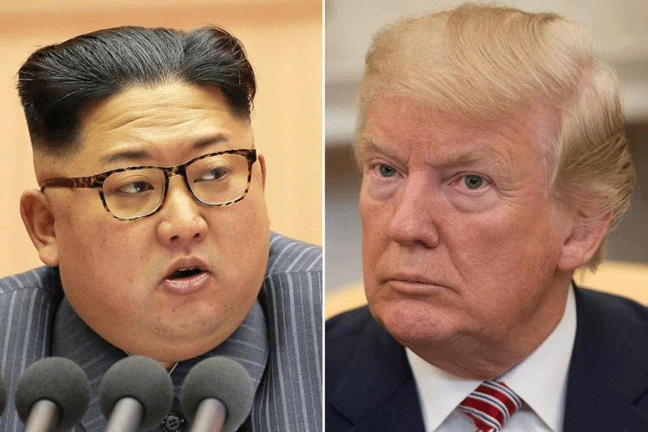 North Korea says Trump sent Kim Jong Un an ‘excellent’ letter amid stalled nuclear diplomacy, abc news, June 23, 2019,
The White House confirmed that Trump had sent a letter to Kim.
“Correspondence between the two leaders has been ongoing,” Press Secretary Sarah Sanders said in a statement.
It comes after nuclear talks between the U.S. and North Korea broke down after the failed summit between Kim and Trump in February in Vietnam.
The U.S. is demanding that North Korea abandon its nuclear weapons entirely before international sanctions are lifted. North Korea is seeking a step-by-step approach in which moves toward denuclearization are matched by concessions from the U.S., notably a relaxation of the sanctions.
Kim “said with satisfaction that the letter is of excellent content,” Pyongyang’s Korean Central News Agency reported.
“Appreciating the political judging faculty and extraordinary courage of President Trump, Kim Jong Un said that he would seriously contemplate the interesting content,” the agency said, without elaborating.
South Korea’s presidential office said it sees the exchange of letters between Kim and Trump as a positive development for keeping the momentum for dialogue alive……….
Nuclear negotiations have been at a standstill, but Trump recently told reporters he received a “beautiful” letter from Kim, without revealing what was written. In an interview with TIME magazine last week, Trump said he also received a “birthday letter” from Kim that was delivered by hand a day before. ……..
Chinese President Xi to North Korea prior to G20 conference
Living with a nuclear North Korea: how to move beyond the impasse
Demanding complete denuclearization has long been a diplomatic dead-end. Markus Bell and Geoffrey Fattig ,June 13th, 2019
Three months after the breakdown of the Hanoi Summit, North Korean leader Kim Jong Un has tested the waters of acquiescence by conducting two rounds of missile tests. In the past, a new round of United Nations sanctions would have followed such launches, escalating rhetoric and mutual condemnation.This had been the pattern, at least until President Trump veered off script by contradicting his National Security Advisor, John Bolton on the issue of whether the missile launches violated existing UN sanctions. During a recent visit to Japan, a presidential tweet dismissed the launches as small weapons that “disturbed some of my people…but not me.”Apart from the rather surreal aspect of witnessing an American President side with the leader of North Korea over his own advisors, it could be argued that Trump is actually the realist in the room, while the hawkish Bolton and Secretary of State, Mike Pompeo are the ones living in a fantasyland.
By clinging to the notion that North Korea can be made to denuclearize through either increased pressure or sanctions relief, they are ensuring the continuation of a long-running policy failure that has allowed the North Korean regime to further the country’s nuclear program while precluding openings for addressing the egregious human rights situation inside the country.
The prevailing belief among Korea watchers, that Kim cannot be induced or coerced into denuclearizing, means that a nuclear North Korea is essentially a fait accompli— a reality to which all the sanctions, summits and handshakes in the world will not change.
TRADING A NUCLEAR NORTH KOREA FOR HUMAN SECURITY IN EAST ASIA
And it is this point that we recently argued: that the international community’s focus needs to shift from traditional security concerns (the nuclear program) to non-traditional (humanitarian concerns) as an avenue to engage in dialogue on improving living conditions for North Koreans.
Since we published our thoughts others have followed suit in agreeing that it is time to shift strategy toward managing North Korea’s ascent into the nuclear club rather than fruitlessly trying to prevent it.
Insisting on complete denuclearization is a recipe for a continued stalemate in future negotiations. And given Kim’s implied threat to restart nuclear tests next year if a deal with the U.S. cannot be struck, tensions could again rise.
A return to the saber rattling of 2017 would wipe away the trust built through the inter-Korean reconciliation efforts of South Korea’s Moon Jae-in administration that began during the PyeongChang 2018 Olympic Winter Games.
This would be especially unfortunate, considering that the current security situation on the Korean peninsula represents the best of a bad set of options.
he past 18 months of relative silence from Pyongyang serves as a blueprint for how to manage socializing North Korea into the international community. In refraining from nuclear tests, North Korea has satisfied one of the conditions of the “Three Nos” proposal outlined by Siegfried Hecker, which remains the most realistic path forward for breaking the impasse.
In the interim, this route leads to an agreement – tacit or otherwise – allowing North Korea to maintain its current arsenal in return for a commitment to freeze its nuclear program and not proliferate weapons technology.
While such an outcome is hardly ideal, it is in keeping with the cold reality of the situation. A nuclear North Korea, socialized to international norms, also raises the possibility that the country will begin to act like a ‘normal state,’ bound to its various international obligations.
Such thinking is in line with Alexander Wendt’s “norm adoption,” whereby states accept established international standards of behavior as they experience the benefits of being integrated into the global community.
THE BENEFITS OF A ‘NORMAL’ NORTH KOREA
What kind of benefits might we see from a ‘normal’ North Korean state? Improvements in human rights are top of the wish list, including, for example, adherence to the International Commission on Intervention and State Sovereignty’s Responsibility to Protect (R2P), which compels member states to prevent crimes against humanity in their territory.
In essence, a resolution of the nuclear issue would provide a fresh opening to engage the regime on human rights, and the subsequent opportunity to improve the lives of average North Koreans. ……..
FACING REALITY
A nuclear North Korea is now a reality, and negotiations that demand the country dismantle its nuclear program are unlikely to succeed.
Although the addition of one more state into the nuclear club is problematic, many of the arguments for denying North Korean ascendance into this group are insufficient, and a rigid adherence to this position by the international community could conceivably result in a second Korean War.
Acknowledging this reality and engaging with the country’s leadership offers an alternate path forward, and one that has the potential for bettering the lives of the people of North Korea. https://www.nknews.org/2019/06/living-with-a-nuclear-north-korea-how-to-move-beyond-the-impasse/
North Korea’s nuclear envoys apparently not executed or sent to labour re-education camp, as previously reported
North Korea’s former top nuclear envoy, Kim Yong-chol, accompanied leader Kim Jong Un to an art performance, state news agency KCNA said on Monday, signalling that the former spymaster is alive and remains a force in the power structure.
Sunday’s appearance followed conflicting reports of shake-ups in the team that led engagement with the United States last year, only for nuclear talks to collapse after Kim Jong-un and President Donald Trump failed to strike a pact at a February summit…….
On Friday, South Korean newspaper Chosun Ilbo had said Kim Yong-chol, the leader’s right-hand man and a counterpart of US Secretary of State Mike Pompeo before the failed summit, had been sent to a labour and re-education camp, citing an unidentified North Korean source.
Asked about reports of a “shake-up” of Kim’s negotiating team in a May 5 interview with ABC News, Pompeo said it did appear that his future counterpart would be somebody else, adding: “But we don’t know that for sure.”……..
As Kim Jong-un’s point man for the nuclear talks, Kim Yong-chol was stripped of a key party post in apparent censure for the summit’s collapse, a South Korean lawmaker said in April.
That move may have cleared the way for long-time diplomats sidelined during last year’s process to take centre stage if talks with the United States resumed, analysts said…….
The Chosun Ilbo report, which Reuters was unable to confirm independently, also said North Korea executed its working-level nuclear envoy to the United States, Kim Hyok-chol. …..
Some officials who worked with Kim Yong-chol have been out of the public eye since the summit. But other seasoned diplomats who appeared to have been sidelined, including Vice Foreign Minister Choe Son Hui, were seen returning to the spotlight. https://www.canberratimes.com.au/story/6195440/nkorea-shows-former-top-nuclear-envoy/
South Korean Report Says That North Korea Executed and Purged Top Nuclear Negotiators
|
North Korea Executed and Purged Top Nuclear Negotiators, South Korean Report Says, NYT, By Choe Sang-Hun, May 30, 2019, SEOUL, South Korea — North Korea has executed its special envoy to the United States on spying charges, as its leader, Kim Jong-un, has engineered a sweeping purge of the country’s top nuclear negotiators after the breakdown of his second summit meeting with President Trump, a major South Korean daily reported on Friday.Kim Hyok-chol, the envoy, was executed by firing squad in March at the Mirim airfield in a suburb of Pyongyang, the North Korean capital, Chosun Ilbo, South Korea’s largest daily, reported on Friday, citing an anonymous source. Mr. Kim faced the charge that he was “won over by the American imperialists to betray the supreme leader,” the newspaper said.
Four officials of the North Korean Foreign Ministry were also executed, the South Korean daily reported, without providing any hint of who its source might be or how it obtained the information. South Korean officials could not confirm the Chosun Ilbo report. North Korea has not reported any execution or purge of top officials in recent months. The country remains the world’s most isolated, and outside intelligence agencies have sometimes failed to figure out or have misinterpreted what was going on in the closely guarded inner circles of the country’s leader, Kim Jong-un. …… No American officials have spoken publicly of any intelligence they might have seen that would confirm or refute the rumors. Diplomats in Washington from other countries have also acknowledged hearing the rumors, but have said they have no confirmation. But some signs in recent weeks have led analysts in South Korea to speculate that Mr. Kim may be engineering a reshuffle or a purge of his negotiating team in the wake of the summit meeting, held in February in Hanoi, Vietnam. The meeting was widely seen as a huge embarrassment for Mr. Kim, who is supposedly seen as infallible in his totalitarian state. On Thursday, Rodong Sinmun, the official newspaper of the North’s ruling Workers’ Party, carried a commentary warning against “anti-party, anti-revolutionary acts” of officials who “pretend to work for the supreme leader in his presence but secretly harbor other dreams behind his back.” …… Chosun Ilbo, the South Korean newspaper, reported Friday that Kim Yong-chol, a senior Workers’ Party vice chairman who visited the White House as the main point man for diplomacy with the United States, had also been purged, sentenced to forced labor in a remote northern province. Also sent to a prison camp was Kim Song-hye, a senior female nuclear negotiator who teamed up with Kim Hyok-chol in working-level negotiations ahead of the Kim-Trump summit, the South Korean newspaper said. North Korea even sent a summit translator to a prison camp for committing a translation mistake, it said. During the Hanoi summit meeting, Mr. Kim demanded that Mr. Trump lift the most painful international sanctions against his country in return for partially dismantling his country’s nuclear weapons facilities. The meeting collapsed when Mr. Trump rejected the proposal, insisting on a quick and comprehensive rollback of the North’s entire weapons of mass destruction program before lifting sanctions. ……… Jung Chang-hyun, head of the Korean Peace and Economy Institute, a research group affiliated with South Korea’s Moneytoday news media group, said he had heard that four North Korean Foreign Ministry officials were executed by firing squad around March, not because of the breakdown of the Hanoi summit meeting, but rather for a separate corruption scandal. …….https://www.nytimes.com/2019/05/30/world/asia/north-korea-envoy-execution.html |
|
North Korea warns that nuclear talks “will never be resumed” if USA continues ‘hostile acts’
 North Korea vows ‘fiercer’ response, end to nuclear talks if U.S. continues ‘hostile acts’, Japan Times, BY JESSE JOHNSON, STAFF WRITER, MAY 24, 2019 North Korea vows ‘fiercer’ response, end to nuclear talks if U.S. continues ‘hostile acts’, Japan Times, BY JESSE JOHNSON, STAFF WRITER, MAY 24, 2019
North Korea said Friday that nuclear talks with the United States “will never be resumed” unless Washington halts what Pyongyang said were “hostile acts” and demands of “unilateral disarmament,” warning of a “fiercer” response if this continues. In a statement carried by the North’s official Korean Central News Agency, an unidentified Foreign Ministry spokesman delivered Pyongyang’s latest warning to the U.S. in the wake of President Donald Trump’s failed summit with leader Kim Jong Un in Hanoi in February. “We hereby make it clear once again that the United States would not be able to move us even an inch with the device it is now weighing in its mind, and the further its mistrust and hostile acts towards the DPRK grow, the fiercer our reaction will be,” the spokesman said, using the acronym for the North’s formal name, the Democratic People’s Republic of Korea. “Unless the United States puts aside the current method of calculation and comes forward with a new method of calculation, the DPRK-U.S. dialogue will never be resumed and by extension, the prospect for resolving the nuclear issue will be much gloomy,” the spokesman said. The Hanoi talks, the second summit between Trump and Kim, collapsed without a deal due to large differences over the scope of North Korea’s denuclearization and potential sanctions relief by the U.S. Reuters reported in March that Trump had passed Kim a note bluntly calling for North Korea to surrender all its nuclear weapons and fuel, a demand he could not abide by…….. https://www.japantimes.co.jp/news/2019/05/24/asia-pacific/politics-diplomacy-asia-pacific/north-korea-vows-fiercer-response-end-nuclear-talks-u-s-continues-hostile-acts/#.XOhfUxYzbGg |
|
The US demanded the closure of five atomic facilities during the Hanoi summit, but Kim offered only two
|
Trump clarifies nuclear gulf between US, North Korea The US demanded the closure of five atomic facilities during the Hanoi summit, but Kim offered only two, Asia Times, By ANDREW SALMON 22 May 19, President Donald Trump, speaking to US broadcaster Fox News on Sunday evening, said Washington had sought, during a February summit with North Korean leader Kim Jong Un, to shutter five nuclear sites, but Pyongyang was only willing to close two. |
Trump and Kim “in love”, but have few options now that discussions have collapsed
|
Trump and Kim’s Cozy Relationship Makes Nuclear Talks Tougher The leaders, who “fell in love” during their first summit, have few options now that discussions have collapsed. Bloomberg, By Youkyung Lee, 20 May19,Donald Trump and Kim Jong Un often explain their surprisingly warm relationship in the language of romance. They “ fell in love” during the first-ever summit between a U.S. president and a North Korean leader in Singapore last year, Trump said. A top North Korean diplomat similarly describes the chemistry between the two leaders as “mysteriously wonderful.”
Since the breakup of the most recent round of talks in Hanoi in February, however, Kim has registered his displeasure not as a lover scorned, but as a dictator at the helm of an increasingly advanced nuclear arsenal. Over one week in May, he personally oversaw the trials of at least two short-range ballistic missiles capable of striking all of South Korea, where some 28,500 U.S. troops are based. The back-to-back launches broke an almost 17-month pause in major weapons testing and likely violated United Nations resolutions banning North Korea from firing ballistic missiles—but crucially, it didn’t violate Kim’s pledge to Trump to halt testing of long-range missiles that could strike the continental U.S. The act was both aggressive and subtle, showing the U.S. that North Korea was willing to play ball but refused to be played. In securing the unprecedented meeting with Trump and entering direct negotiations with the U.S. president, Kim left himself few options if the conversations were to go poorly. The U.S. has been in a similar position since Trump tweeted just after the Singapore meeting that North Korea was “no longer a nuclear threat.” Both leaders must now walk a delicate line to save face and avoid what neither of them wants: nuclear war. Kim’s primary goal going into the Hanoi summit was considerably more mundane. He was seeking to make North Korea a normal country in the eyes of the world and to remove sanctions that are crushing the economy and stoking popular unrest. According to the UN, its 2018 harvest was the worst in a decade, leaving 40 percent of the population in need of food assistance. …….. Current South Korean President Moon Jae-in is caught between the two leaders. Seoul is within the range of both missiles fired in early May, and Moon doesn’t want to disrupt his own fragile relationship with Kim by appearing to side with Trump. In his speech, Kim urged Moon to stop being an “officious mediator,” using a Korean slang term—ojirap—that’s rarely used by public figures in official settings and almost never by a younger person referring to an elder. The South Korean government “must defend the interest of the nation,” Kim said. Moon helped broker the first summit between Trump and Kim, in a pair of dramatic meetings with the North Korean leader on the Koreas’ militarized border, and is now pushing for a third by appealing to common human decency. …… The second missile test, on May 9, occurred while Trump’s top nuclear envoy, Stephen Biegun, was in Seoul to meet with South Korean officials. There’s been no indication that the U.S. is willing to accept what many North Korea watchers agree is Kim’s true goal: admission into the exclusive club of accepted nuclear-armed states. ………. The more time passes, the more sophisticated Kim’s arsenal becomes, shrinking Trump’s margin of error in responding to threats and increasing the danger of miscalculation. There’s also the risk that Trump and Kim learn they’re not as close as they thought they were. …. https://www.bloomberg.com/news/articles/2019-05-20/trump-and-kim-got-too-serious-too-fast-in-nuclear-discussions |
|
Donald Trump says he would not allow Iran to develop nuclear weapons
 Trump warns Iran it will never be allowed to build nuclear arsenal, US president insists he wants to avoid Tehran conflict after weeks of escalating tensions, Ft.com 20 May 19 Trump warns Iran it will never be allowed to build nuclear arsenal, US president insists he wants to avoid Tehran conflict after weeks of escalating tensions, Ft.com 20 May 19
Donald Trump said he would not allow Iran to develop nuclear weapons, while insisting he wanted to avoid war with the Islamic republic after weeks of escalating tensions. The US president has kept Tehran on edge by mixing threats with statements playing down the odds of a conflict, as foreign policy analysts speculate that Mr Trump is less keen on military conflict than some of his hawkish advisers. “I don’t want to fight. But you do have situations like Iran, you can’t let them have nuclear weapons — you just can’t let that happen,” Mr Trump said in an interview with Fox News. He had earlier warned Tehran to stop threatening America, and suggested that the US would destroy Iran if there was a military conflict. “If Iran wants to fight, that will be the official end of Iran. Never threaten the United States again!” he tweeted.
Tensions have risen sharply in recent few weeks, with Iran saying it will no longer comply with elements of the 2015 nuclear accord it signed with world powers, including the US, and Washington deploying an aircraft carrier strike group to the region. …….
Mr Trump’s key foreign policy advisers, national security adviser John Bolton and secretary of state Mike Pompeo, have referred to unspecified “escalatory action” from Tehran, fuelling speculation that the hawkish pair are trying to convince the president to go to war with Iran.
This has led some lawmakers to grow concerned that the administration is seeking to enter into a conflict without congressional approval. Several senators were last week given details of the administration’s intelligence on Iran, with more lawmaker briefings expected this week. …… https://www.ft.com/content/0192edae-7b0a-11e9-81d2-f785092ab560
|
|
|
“Denuclearization” has different meanings for North Korea and USA
|
North Korean missiles: Size does not matter, Bulletin of the Atomic Scientists, By Duyeon Kim, Melissa Hanham, May 15, 2019 When it comes to dealing with North Korea’s nuclear program, one fundamental challenge (among many) has been a gap in the definitions of very basic terms in the security lexicon. This inability to agree on the basics has complicated negotiations and communications for more than 25 years. While the vague use of the term “denuclearization” has allowed a kind of rapprochement between the United States and North Korea, denuclearization will never actually happen until the parties agree on what it means and how to achieve it.
“Denuclearization” is not the only term in contention, and diplomacy is not the only field in which semantics count. North Korea is playing another hand in this age-old word game: Missiles are being tested, but Pyongyang prefers to call them “rockets.” In North Korea, a rocket can be anything from artillery rounds to a space launch vehicle. Pyongyang fired a short-range ballistic missile, artillery, and multiple-launch rocket systems on May 4 and another barrage on May 9, revealing what the new “tactical guided weapon” they also tested on April 18 and likely November 2018 really is. The regime claims that the firing of these “rockets” is routine and defensive in nature. The activities near Wonson are indeed likely to resemble how North Korea would attempt to repel an invasion from the East. Unfortunately, this exercise included what may be a short-range missile capable of carrying a nuclear warhead. Washington does not appear to be overreacting to these latest tests, which it should not, and has chosen to focus on the short-range nature of the missile involved. But the Trump administration must not turn a blind eye either. Responses and punishments—proportionate to the significance and gravity of Pyongyang’s actions—can be taken without botching the diplomatic process. The lack of an international response only emboldens the regime to sharpen its gray-zone tactics to push the envelope and gain influence without having to explode nuclear devices or fire long-range missiles. These smaller, solid-fuel missiles matter because—tipped with nuclear warheads or chemical or biological weapons—they threaten South Korea as well as US troops and American citizens in the South. Indeed these may be the first weapons used in a large scale conflict that could pull allies in. They cannot be regarded simply as part of a sovereign country’s right to develop arms. The larger intercontinental ballistic missiles (ICBMs) are not the only enemy. Smaller missiles are just as significant. Size does not matter—it’s what you can do with a missile that counts. What’s in a name? For the first time, Washington, Pyongyang, and Seoul are reading from the same script and agree on one thing: these missiles ought not to be called “missiles.” Instead, they are being named “projectiles” and “rockets.” The common thread is to prevent the already fragile diplomatic process from unraveling…… https://thebulletin.org/2019/05/north-korean-missiles-size-does-not-matter/?utm_source=Bulletin%20Newsletter&utm_medium=iContact%20email&utm_campaign=NKmissiles_05152019 |
|
North Korea is unlikely to ever give up all its nuclear weapons
Former Defense Secretary Robert Gates said North Korea is unlikely to ever give up all its nuclear weapons, and that President Donald Trump was right to walk away from deal with leader Kim Jong-un in February.In an interview with CBS that taped on May 10, Gates said North Koreans have come to see some modest nuclear capabilities as “essential to their national survival.”
“I believe that North Koreans will never completely denuclearize,” Gates said, adding that the Trump administration is “unrealistic in believing that they can get complete denuclearization.” ……. https://www.politico.com/story/2019/05/12/robert-gates-north-korea-1317623
Increased tension as U.S. has seized a North Korean ship for sanctions violations
 In Middle of Nuclear Standoff, U.S. Seizes North Korean Cargo Ship Illicitly
  Exporting Coal, Slate, By HANNON, 9 May 19
Donald Trump’s gamble with nuclear negotiations with North Korea – the risk of war if it falls apart
Trump’s Bet on Kim Might Not Pay Off, All that’s preventing the collapse of talks is that North Korea’s missiles haven’t flown far enough yet. The Atlantic URI FRIEDMAN, 10 May 19
U.S. Secretary of State Mike Pompeo ays that a nuclear deal with North Korea is still possible
|
Pompeo insists North Korea nuclear deal still possible despite weapons test, Secretary of state echoes the president, saying ‘there’s opportunity to get a negotiated outcome’ on a denuclearization deal, Guardian, Victoria Bekiempis in New York 6 May 2019 Secretary of State Mike Pompeo insisted Sunday that a nuclear disarmament deal between the US and North Korea was still possible, despite the country’s launch of several short-range projectiles into the sea one day earlier.“There’s an opportunity to get a negotiated outcome, where we get fully verified denuclearization” and said the US hopes to “get back to the table and find the path forward,” he told ABC’s This Week politics program on Sunday. He also claimed that North Korean leader Kim Jong-un is on board with coming to an accord. “Chairman Kim has repeated that,” Pompeo said. “He’s repeated that quite recently, in fact.” Pompeo said the latest missile launch did not cross any international boundaries. “That is, they landed in the water east of North Korea and didn’t present a threat to the United States or to South Korea or Japan,” he said. “And we know that they were relatively short-range.” Pompeo’s statements about brokering a deal echo those of Donald Trump, who said he still thought the US and North Korea would reach a nuclear dealdespite the fact that talks have stalled since the leaders’ recent unsuccessfulsummit meeting in Vietnam. ……. https://www.theguardian.com/world/2019/may/05/mike-pompeo-north-korea-disarmament-deal-possible-despite-weapons-test |
|
1 This Month


Shut down the radiation-damaged Heysham nuclear reactors now
To see nuclear-related stories in greater depth and intensity – go to https://nuclearinformation.wordpress.com

Say No to NASA’s Reckless Nuclear Reactor on the Moon
Say No to NASA’s Reckless Nuclear Reactor on the Moon
-
Archives
- October 2026 (247)
- September 2026 (339)
- August 2026 (330)
- July 2026 (355)
- June 2026 (287)
- May 2026 (306)
- April 2026 (356)
- March 2026 (251)
- February 2026 (267)
- January 2026 (308)
- December 2025 (358)
- November 2025 (359)
-
Categories
- 1
- 1 NUCLEAR ISSUES
- business and costs
- climate change
- culture and arts
- ENERGY
- environment
- health
- history
- indigenous issues
- Legal
- marketing of nuclear
- media
- opposition to nuclear
- PERSONAL STORIES
- politics
- politics international
- Religion and ethics
- safety
- secrets,lies and civil liberties
- spinbuster
- technology
- Uranium
- wastes
- weapons and war
- Women
- 2 WORLD
- ACTION
- AFRICA
- Atrocities
- AUSTRALIA
- Christina's notes
- Christina's themes
- culture and arts
- Events
- Fuk 2022
- Fuk 2023
- Fukushima 2017
- Fukushima 2018
- fukushima 2019
- Fukushima 2020
- Fukushima 2021
- general
- global warming
- Humour (God we need it)
- Nuclear
- RARE EARTHS
- Reference
- resources – print
- Resources -audiovicual
- Weekly Newsletter
- World
- World Nuclear
- YouTube
-
RSS
Entries RSS
Comments RSS

