nuclear-news

The News That Matters about the Nuclear Industry Fukushima Chernobyl Mayak Three Mile Island Atomic Testing Radiation Isotope

Safety and language problems, as Tepco plans to bring in foreign workers for Fukushima clean-up

April 25, 2019 Posted by | Fukushima continuing | Leave a comment

Hazardous removal of spent fuel rods is just one step in the Fukushima nuclear clean-up

April 20, 2019 Posted by | Fukushima continuing | Leave a comment

Japan has a new kind of visa to lure foreign blue collar workers for Fukushima clean-up

Japan Aims to Hire Foreigners for Nuclear Cleanup

The country’s largest utility is working to decommission the Fukushima plant amid radiation risks at the site of the 2011 disaster, WSJ , By Mayumi Negishi and Chieko Tsuneoka, April 18, 2019 TOKYO—Japan’s largest utility is looking to foreign blue-collar workers to help decommission its Fukushima Daiichi nuclear-power plant amid a labor shortage exacerbated by radiation risks at the site of the 2011 nuclear disaster.

Tokyo Electric Power Co., or Tepco, said Thursday it has informed dozens of contractors that foreigners could qualify for a new type of visa that allows manual workers to stay in the country for five years. Workers who enter areas with elevated radiation would need sufficient Japanese-language skills...(subscribers only) https://www.wsj.com/articles/japan-aims-to-hire-foreigners-for-nuclear-clean-up-11555595613

April 20, 2019 Posted by | Fukushima continuing | Leave a comment

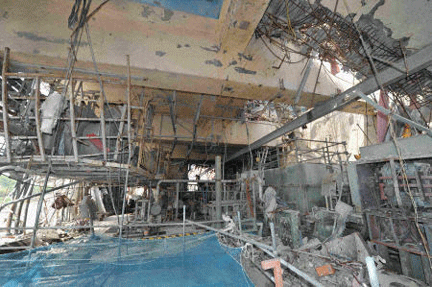
Japan’s massive task to clean up nuclear fuel pools of Fukushima stricken reactors

April 18, 2019 Posted by | Fukushima continuing | Leave a comment

Okuma residents reluctant to return : much of the area still highly radioactive

Fukushima Japan nuclear fallout: Okuma residents encouraged home  https://www.dw.com/en/fukushima-japan-nuclear-fallout-okuma-residents-encouraged-home/a-48272491 12 Apr19

Eight years after a triple meltdown at the Fukushima nuclear power plant, part of nearby Okuma has been declared safe for residents to return. But there has been no rush to go home as radiation levels remain high. The evacuation order for parts of Okuma was lifted by the Japanese government on Wednesday.

But just 367 of the town’s pre-2011 population of 10,341 have registered to go home, according to local media reports in Japan.

Okuma sits alongside the Fukushima Daiichi Nuclear Power Station and 40% of the town has been declared safe for a permanent return. But a survey last year found only 12.5% of former residents wanted to do so.

Prime Minister Shinzo Abe is to attend a ceremony in Okuma on Sunday to mark the occasion. But the government has been accused of promoting the return of residents to showcase safety ahead of the Tokyo Olympics next summer.

“This is a major milestone for the town,” Mayor Toshitsuna Watanabe said in a written statement. “But this is not the goal, but a start toward the lifting of the evacuation order for the entire town.”

Lingering radiation

There are plans to open a new town hall in May to encourage more people to go back to their town which was devastated by the earthquake, tsunami and triple meltdown at the plant in March 2011. But the town center near the main train station remains closed due to high radiation levels which exceed the annual exposure limit. There will be no functioning hospital for another two years.

Much of Okuma still records high radiation levels and is off-limits. All of nearby Futaba remains closed, with the former 40,000 residents unable to return home. In a report from an investigation published last month, environmental campaign group Greenpeace said “radiation levels remain too high for the safe return of thousands of Japanese citizen evacuees.”

Reluctance to return

The government lifted the evacuation order for much of neighboring Tomioka two years ago. But only 10% of Tomioka’s population has so far returned. Some 339 square kilometers (131 square miles) of the area around the plant are designated unsafe.

Fears of exposure to radiation remain high among former residents, especially those with children. In its report, Greenpeace accused the government of failure: “In the case of workers and children, who are in the frontline of hazards resulting from the Fukushima Daiichi nuclear disaster, the Japanese government continues to ignore international radioprotection recommendations.”

Part of the Okuma is being used to store millions of cubic meters of toxic soil collected during the decontanimation operation. Authorities say it will be removed by 2045 but no alternative storage site has yet been found.

In all, 160,000 people were evacuated out of the area when three of Fukushima’s six reactors went into meltdown, leading to radiation leaks.

April 13, 2019 Posted by | Fukushima continuing | Leave a comment

Impossible at present to remove all fuel debris from stricken Fukushima nuclear reactors

Unclear debris map casts shadow over decommissioning of Fukushima plant   https://mainichi.jp/english/articles/20190409/p2a/00m/0na/021000c   April 9, 2019 (Mainichi Japan) TOKYO — The government and Tokyo Electric Power Co. (TEPCO) are set to launch full-scale probes of the inside of the No. 1 through No. 3 reactors at the disaster-stricken Fukushima Daiichi Nuclear Power Station this fiscal year, in an attempt to determine which reactor to work on first to remove fuel debris — a critical step for decommissioning the facility.

April 11, 2019 Posted by | Fukushima continuing | Leave a comment

Japanese government partially lifts evacuation order in one Fukushima nuclear plant hometown

April 11, 2019 Posted by | Fukushima continuing | Leave a comment

Nuclear challenge: How Japan has boosted food exports from disaster hit Fukushima – exclusive government interview

08-Apr-2019 By Tingmin Koe, Japanese authorities have been engaging both tourists and foreign governments in a double-pronged strategy to promote food products produced in areas that were hardest hit by the nuclear disaster in 2011, according to a senior government official.

HTTPS://WWW.FOODNAVIGATOR-ASIA.COM/ARTICLE/2019/04/08/NUCLEAR-CHALLENGE-HOW-JAPAN-HAS-BOOSTED-FOOD-EXPORTS-FROM-DISASTER-HIT-FUKUSHIMA-EXCLUSIVE-GOVERNMENT-INTERVIEW 

April 9, 2019 Posted by | Fukushima continuing | Leave a comment

Few evacuees are likely to return next week to parts of Okuma, host of Fukushima nuclear plant

Evacuees can return next week to parts of Okuma, host of Fukushima nuclear plant, but few likely to. Japan Times, 5 Apr 19, KYODO The government formalized on Friday its decision to partially lift from next Wednesday a mandatory evacuation order for residents of a town that jointly hosts the crippled Fukushima No. 1 nuclear power plant.

The town of Okuma — which saw all of its roughly 10,000 residents evacuate after one of the world’s worst nuclear disasters, triggered by a deadly earthquake and tsunami — will allow former residents to return for the first time in eight years, the government decided. The decision was said to be based on the lower radiation levels achieved through decontamination work.

Futaba, the other town that hosts the plant, remains a no-go zone.

Despite the decision, a very small number of residents are expected to return to Okuma. As of late March, only 367 people from 138 households, or around 3.5 percent of the original population of 10,341, were registered as residents of areas where the order will be lifted. …..

There will be no restrictions in place over approximately 38 percent of the town’s total area, but the rest will remain off-limits due to higher radiation levels……https://www.japantimes.co.jp/news/2019/04/05/national/evacuees-can-return-next-week-parts-okuma-host-fukushima-nuclear-plant-likely/#.XKfUetIzbGg

April 6, 2019 Posted by | Fukushima continuing | Leave a comment

Cost of the Fukushima nuclear disaster estimated at up to 81 trillion yen

An aerial view shows workers wearing protective suits and masks working atop contaminated water storage tanks at Tokyo Electric Power Co. (TEPCO)’s tsunami-crippled Fukushima Daiichi nuclear power plant in Fukushima, in this photo taken by Kyodo August 20, 2013. Japan’s nuclear watchdog said on Wednesday it is concerned that more storage tanks at the wrecked Fukushima nuclear plant will spring leaks, following the discovery that highly contaminated water is leaking from one of the hastily built containers. Picture taken August 20, 2013. Mandatory Credit. REUTERS/Kyodo (JAPAN – Tags: DISASTER ENVIRONMENT POLITICS ENERGY)
ATTENTION EDITORS – THIS IMAGE WAS PROVIDED BY A THIRD PARTY. FOR EDITORIAL USE ONLY. NOT FOR SALE FOR MARKETING OR ADVERTISING CAMPAIGNS. THIS PICTURE IS DISTRIBUTED EXACTLY AS RECEIVED BY REUTERS, AS A SERVICE TO CLIENTS. MANDATORY CREDIT. JAPAN OUT. NO COMMERCIAL OR EDITORIAL SALES IN JAPAN. YES

Think tank puts cost to address nuke disaster up to 81 trillion yen  http://www.asahi.com/ajw/articles/AJ201903100044.html By ATSUSHI KOMORI/ Staff Writer, March 10, 2019  In a startling disparity, a private think tank puts the cost of addressing the 2011 Fukushima nuclear disaster between 35 trillion yen and 81 trillion yen ($315 billion and $728 billion), compared with the government estimate of 22 trillion yen.

The calculation, by the Tokyo-based Japan Center for Economic Research, showed that the total could soar to at least 60 percent more and up to 3.7 times more than the 2016 estimate by the Ministry of Economy, Trade and Industry.

In releasing the latest estimates on March 7, the center said it is time for serious debate over the role nuclear energy should play in the nation’s mid- and long-term energy policy.

Of the highest price tag of 81 trillion yen, 51 trillion yen would go toward decommissioning the crippled Fukushima No. 1 nuclear power plant and treating and disposing of radioactive water. The ministry put the cost for these tasks at 8 trillion yen.

The center calculated the compensation to victims at 10 trillion yen, while the comparable estimate by the ministry was 8 trillion yen.

Although the center’s estimate for the decontamination operation was 20 trillion yen, the ministry’s projection was 6 trillion yen.

The biggest disparity in the estimates between the think tank and the ministry is that the former put the treatment and disposal of contaminated water at 40 trillion yen and included the cost for disposing of polluted soil produced during cleanup operations in the overall costs.

If contaminated water is released in the sea after it is diluted with water, the overall costs could be 41 trillion yen, including 11 trillion yen estimated for decommissioning and disposal for tainted water.

The least expensive way of coping with the accident–35 trillion yen–would be to encase the plant in a concrete sarcophagus, rather than undertaking the formidable challenge of retrieving melted nuclear fuel from the reactors, and releasing contaminated water into the sea. In this case, it would cost 4.3 trillion yen to close down the plant and dispose of the radioactive water.

But this scenario drew fire from residents in the affected municipalities as they view covering nuclear fuel debris with a massive structure would be tantamount to asking them to give up hope of eventually returning to their hometowns.

The center’s latest projections followed its estimates two years ago, in which the number varied from 50 trillion yen to 70 trillion yen.

It updated its projections based on the findings about treatment and disposal of radioactive water and progress in cleanup operations over the past years.

March 23, 2019 Posted by | Fukushima continuing | 1 Comment

Fukushima radioactive water – a million tons, and still coming

Fukushima water headache: 1 million tons and counting http://www.asahi.com/ajw/articles/AJ201903190042.html THE ASAHI SHIMBUN,March 19, 2019The crippled Fukushima No. 1 nuclear plant reached an undesired milestone on March 18: Storage tanks at the site now contain more than 1 million tons of radiation-contaminated water.The announcement by the plant’s operator, Tokyo Electric Power Co., came as the utility and the central government continue to weigh water-disposal methods while hearing the concerns of fishermen who fear for their livelihoods.

Toyoshi Fuketa, chairman of the Nuclear Regulation Authority, has repeatedly said a decision must be made soon on how to deal with the contaminated water.

“We are entering a period in which further delays in deciding what measure to implement will no longer be tolerable,” Fuketa recently said.

Groundwater becomes contaminated when it flows into the buildings of the three reactors that suffered meltdowns in 2011 following the Great East Japan Earthquake and tsunami. Water that is used to cool the nuclear fuel debris is processed to remove radioactive substances, but the system cannot get rid of tritium.

These problems have forced TEPCO to store the contaminated water in hundreds of tanks installed at the Fukushima plant.

If more storage tanks are constructed, the overall capacity of 1.37 million tons at the site will likely be reached by the end of 2020.

Fukushima fishermen are already on alert for the one option they have already criticized–diluting the water and dumping it into the Pacific Ocean.

The economy ministry in 2016 said that measure could be implemented in the shortest time frame and at a low cost.

Fuketa has also said this is the most realistic option, but he noted that it would require years of preparation.

ome experts said the go-ahead for the dilution measure should have been given at the end of 2018 to start the process before the storage tanks reach capacity.

Economy ministry officials tried to explain various measures being considered at a public hearing in Fukushima in August 2018, including releasing the diluted water into the ocean.

“It will have a devastating effect on fishing in Fukushima,” said Tetsu Nozaki, who heads the Fukushima prefectural federation of fisheries cooperative associations.

Fukushima fishermen have slowly resumed operations since all forms of fishing were prohibited after high levels of radiation were found in fish caught off the Fukushima coast.

Fish auctions restarted at Fukushima ports in spring 2017, but the volume of fish brought in is still only about 20 percent of levels before the 2011 nuclear accident.

The last thing Fukushima fishermen want is an increase of negative publicity about their catches if the diluted water is dumped into the Pacific.

The government has spent about 34.5 billion yen ($309 million) to build a frozen underground earth wall around the three reactor buildings to divert the groundwater to the ocean. The “ice wall” has cut down the flow of groundwater, which at one time reached about 500 tons a day.

But still, groundwater continues to flow into the three reactor buildings at a rate of about 100 tons daily.

(This article was compiled from reports by Chikako Kawahara, Hiroshi Ishizuka, Toshio Kawada and Kazumasa Sugimura.)

March 21, 2019 Posted by | Fukushima continuing | Leave a comment

Fukushima Prefecture to lose 15 high schools, due to population decline

As population declines, Fukushima Prefecture to lose 15 of its 96 high schools, Japan Times , FUKUSHIMA MINPO, MAR 15, 2019

The Fukushima Prefectural Board of Education will reduce its number of prefecture-run high schools by 15 by the end of fiscal 2023 as the region continues to struggle with a dwindling number of students due to a declining birthrate.

The mergers will be implemented over the span of three years from fiscal 2021 and will reduce the number of high schools in the prefecture from 96 to 81.

Twenty-five schools will be merged and reorganized into 13 under the plan, which will integrate schools located in close proximity of one another. Each school will retain four to six classes per grade.

With the merger, the prefecture’s 88 day schools and seven night schools will be reduced to 74 and six, respectively, by the end of March 2024, according to the education board’s reform plan revealed Feb. 8. Fukushima’s only correspondence school will remain open……… https://www.japantimes.co.jp/news/2019/03/15/national/population-declines-fukushima-prefecture-lose-15-96-high-schools/#.XIwdDSIzbGg

March 16, 2019 Posted by | Fukushima continuing, social effects | Leave a comment

Nobody wants to host Fukushima’s millions of cubic metres of radioactive soil

Fukushima grapples with toxic soil that no one wants   https://www.theguardian.com/world/2019/mar/11/fukushima-toxic-soil-disaster-radioactive Eight years after the disaster, not a single location will take the millions of cubic metres of radioactive soil that remain, Justin McCurry in Okuma 12 Mar 2019 
Workers at a soil separation facility for decontamination work in Okuma. Photograph: Issei Kato/Reuters

Not even the icy wind blowing in from the coast seems to bother the men in protective masks, helmets and gloves, playing their part in the world’s biggest nuclear cleanup.

Away from the public gaze, they remove the latest of the more than 1,000 black sacks filled with radioactive soil and unload their contents into giant sieves. A covered conveyor belt carries the soil to the lip of a huge pit where it is flattened in preparation for the next load. And there it will remain, untouched, for almost three decades.

It is repetitive, painstaking work but there is no quick way of addressing arguably the most controversial physical legacy of the triple meltdown that occurred eight years ago at the nearby Fukushima Daiichi nuclear power plant.

In the years after the disaster, about 70,000 workers removed topsoil, tree branches, grass and other contaminated material from areas near homes, schools and public buildings in a unprecedented ¥2.9tn (£21bn) drive to reduce radiation to levels that would enable tens of thousands of evacuees to return home.

The decontamination operation cleaned generated millions of cubic metres of radioactive soil, packed into bags that carpet large swaths of Fukushima prefecture.

Japan’s government has pledged that the soil will moved to the interim storage facility and then, by 2045, to a permanent site outside of Fukushima prefecture as part of a deal with local residents who do not want their communities turned into a nuclear dumping ground.

But the government’s blueprint for the soil is unravelling: so far, not a single location has agreed to accommodate the toxic waste.

While workers inside the ruined nuclear plant struggle to contain the build-up of more than 1m tonnes of radioactive water, outside, work continues to remove, process and store soil that will amount to 14m cubic metres by 2021.

The task is expected to take another two years, according to Jiro Hiratsuka, an environment ministry official who is guiding a small group of foreign journalists, including the Guardian, around the interim storage facility.

“We are required by law to find a final storage place outside Fukushima, so it can’t be kept here indefinitely,” Hiratsuka said. “It’s true that we have yet to find an appropriate location, but a lot will depend on how much space we need and the level of radioactivity in the soil.”

There is opposition, too, to the idea of using soil with lower radiation levels – or less 8,000 becquerels per kilogram – as the foundation for roads, embankments and other infrastructure in Fukushima.

The storage facility straddles the towns of Okuma and Futaba, located west of the power plant, where radiation levels are still too high for residents to return. So far, 2.3m cubic metres of soil – about 15% of the total – have been brought to the site.

The operation involves thousands of workers, including drivers who make 1,600 return trips every day. So far, 355,000 trucks have been used – and officials say they need more.

“I am aware that some people are saying it would be better to keep it here, but the people of Okuma and Futaba have had a really tough time, and they agreed the soil could be kept here on the condition that it would eventually be moved out of Fukushima,” Hiratsuka said.

Despite the decontamination efforts, only a small number of residents who were ordered to leave after the triple meltdown have returned to neighbourhoods where evacuation orders have been lifted, according to local government data.

A poll by the Asahi newspaper and a local broadcaster found that almost two-thirds of evacuated residents felt anxious about radiation despite official claims that decontamination work had been a success.

As Japan marked the eighth anniversary on Monday of the magnitude-9 earthquake and deadly tsunami that triggered the Fukushima meltdown, environmental groups warned that some “safe” neighbourhoods still contained radiation hotspots.

Greenpeace investigation revealed high levels of radiation in areas that had been declared safe, and accused the government of misleading the international community about the risks faced by returning evacuees and decontamination workers.

“Some areas still have significantly high levels of radiation,” said Shaun Burnie, a senior nuclear specialist at Greenpeace Germany who is based in Japan. “They are much higher than background radiation before the accident.”

Minoru Ikeda, who took part in the decontamination effort, said workers cut corners to meet strict deadlines. “There were times when we were told to leave the contaminated topsoil and just remove the leaves so we could get everything done on schedule,” he said. “Sometimes we would look at each other as if to say: ‘What on earth are we doing here?’”

He was sceptical of official claims that a permanent home would be found the for soil. “I don’t believe for a minute that they will be able to move all that soil out of Fukushima,” he said. “The government has to come up with a plan B.”

March 12, 2019 Posted by | Fukushima continuing | Leave a comment

Radioactive boars thrive in Fukshima towns

Times 11th March 2019 The towns around the Fukushima Dai-ichi nuclear power plant are among the
most perilously radioactive in the world, yet in their own strange way they have never been busier. The people who lived here fled in a rush after the meltdown of the nuclear reactors, but a new citizenry has established itself and is thriving in the unusual conditions. They squat in family groups in the wooden interiors of the traditional Japanese houses. They
thrive on the fruit on the trees and the water that flows around the old rice fields. They are hairy, tusked and weigh 200lb.

They are the radioactive wild boars of Fukushima. It is eight years today since the massive earthquake and tsunami that smashed into Fukushima Dai-ichi, and a good deal has changed since the terrible weeks that followed. The spewing
reactors have been largely contained, although it will be a lifetime before they are fully dismantled. The radiation in the towns has been reduced and in those marginal areas where the levels are lowest people have been permitted to return.

Even when gas and electricity are reconnected, their once thriving towns have few shops, schools or social services. But there is another obstacle to their return: the takeover of the evacuation zone by wild animals. In the absence of Man, nature has marched off the forested mountains and taken over his former home. Raccoons and rats, monkeys and
palm civets have all taken advantage of the empty houses to find food, shelter and a convenient place to breed. But none has better adapted, or done more damage, than the wild boar.

https://www.thetimes.co.uk/article/26b333e2-435f-11e9-924d-9729bcd51a7f

March 12, 2019 Posted by | Fukushima continuing, Reference | 1 Comment

Eight Years on, Fukushima Nuclear Disaster Still Poses Health Risks

https://havanatimes.org/?p=149927  March 9, 2019 By Akio Matsumura HAVANA TIMES – On March 11, we commemorate the 8th anniversary of the Fukushima nuclear disaster. To an outside observer, this anniversary passes as a technical progress report, a look at new robot, or a short story on how lives there are slowly returning to normal.

Yet in Japan, the government has not figured out how to touch or test the irradiated cores in the three crippled reactors, which continue to contaminate water around the site of the melt down. The government does not know where it will put that radioactive material once it can find a way to move it.

Meanwhile, the government and site operator are running out of room to store the contaminated water, which is filling up more and more tanks. The cleanup is estimated to take forty years and the cost is estimated at $195 billion.

The latest publicly released findings of radiation levels are from 2017, when Tokyo Electric Power Company had to use a remote-controlled robot to detect the levels in Reactor 2, since no human can approach the crippled reactor.

The rates read 530 sieverts per hour, the highest since the March 2011 meltdown. We have no reason to believe that they have fallen since then. Remote-control robots are being used in the other reactors as well, indicating that radiation levels are similarly high there.

Even using the robot, work can only be carried out for very short times, since the robots can only stand 1000 sieverts of exposure – less than two hours in this case.

This is an extremely high amount of radiation. After TEPCO published the rate, the Asahi Shimbun reported that “an official of the National Institute of Radiological Sciences said medical professionals have never considered dealing with this level of radiation in their work.”

The Japan Times quoted Dr. Fumiya Tanabe, an expert on nuclear safety, who said that the “findings show that both the preparation for and the actual decommissioning process at the plant will likely prove much more difficult than expected.”


Fukushima’s Children Need International Attention

There have been many victims of this disaster. Thousands of people have been displaced from their homes. Local fishermen are worried that the government will proceed with its plan to dump the storage tanks of contaminated water into the ocean.

Others worry that the flow of the radioactive wind and contaminated water are reaching North America and will continue to do so for the next forty years.

Above all of these important issues, it is the children of Fukushima who most need our attention. They are at risk of higher rates of cancer because of their exposure to the contamination from the initial explosion. In Chernobyl, the only comparable case we have, more than 6,000 cases of thyroid cancer were found in children according to the UN through 2005.

There is evidence that thyroid cancer rates are higher among Fukushima’s children than the national population, but it is a latent disease: it is still too early to tell what the full impact will be. But it is clear the case needs action.

Scientists will always offer different opinions, swayed first by uncertainty, but also, sadly, by politics, money, and ambition.

Some will claim that the evidence has been exaggerated, underestimated, or that perhaps we’re at too early a stage to be certain. Or that we need more time to clarify the results. I have seen many instances of these arguments at the United Nations and international science conferences. Why do we wait and make another mistake?

Helen Caldicott, a medical doctor and founding president of Physicians for Social Responsibility, part of a larger umbrella group that was awarded the Nobel Peace Prize in 1985, wrote: “The truth is that most politicians, businessmen, engineers and nuclear physicists have no innate understanding of radiobiology and the way radiation induces cancer, congenital malformations and genetic diseases which are passed generation to generation. Nor do they recognize that children are 20 times more radiosensitive than adults, girls twice as vulnerable as little boys and fetuses much more so.”

UNICEF Can Lead

We face many complex challenges of climate change, poverty alleviation, and national security. The health and welfare of children must always be our top priority. They are our future; our deepest purpose is to care and provide for them. By deciding not to fully investigate the effects of Fukushima, we fail them.

We all agree with that personally, but which institution is best positioned to carry out the mission? To me, UNICEF, the United Nations Children’s Fund, is the only answer. Indeed, putting children above national security is at UNICEF’s core.

Maurice Pate, an American humanitarian and businessman who joined UNICEF at its inception in 1947, agreed to serve as the Executive Director upon the condition that UNICEF serves the children of “ex-enemy countries, regardless of race or politics.” In 1965, at the end of Pate’s term, the organization won the Nobel Peace Prize.

To this day, its mission includes a commitment to “ensuring special protection for the most disadvantaged children – victims of war, disasters, extreme poverty, all forms of violence and exploitation and those with disabilities.” The children of Fukushima deserve the protection of UNICEF.
——
*Akio Matsumura is also the Secretary General of the Global Forum Moscow Conference hosted by President Gorbachev at the Kremlin in 1990 as well as of the Parliamentary Earth Summit Conference hosted by Brazil National Assembly in Rio de Janeiro in 1992

March 10, 2019 Posted by | children, Fukushima continuing | Leave a comment