nuclear-news

The News That Matters about the Nuclear Industry Fukushima Chernobyl Mayak Three Mile Island Atomic Testing Radiation Isotope

Every hour, Fukushima reactor 2 emits more than 10,000 times the yearly allowable dose for radiation workers

March 13, 2021 Posted by | Fukushima continuing, radiation, Reference | Leave a comment

Radiation from Fukushima meltdown collects in timber in affected region

Telegraph 11th March 2021 Even inside his log-cabin home, in an idyllic valley in Japan’s Fukushima Prefecture, the geigercounter clipped to Nobuyoshi Ito’s jacket gives off a near-constant crackle. But every time he goes to put another log on the wood burner in a corner of his living room, it intensifies into a single, drawn-out cacophony.
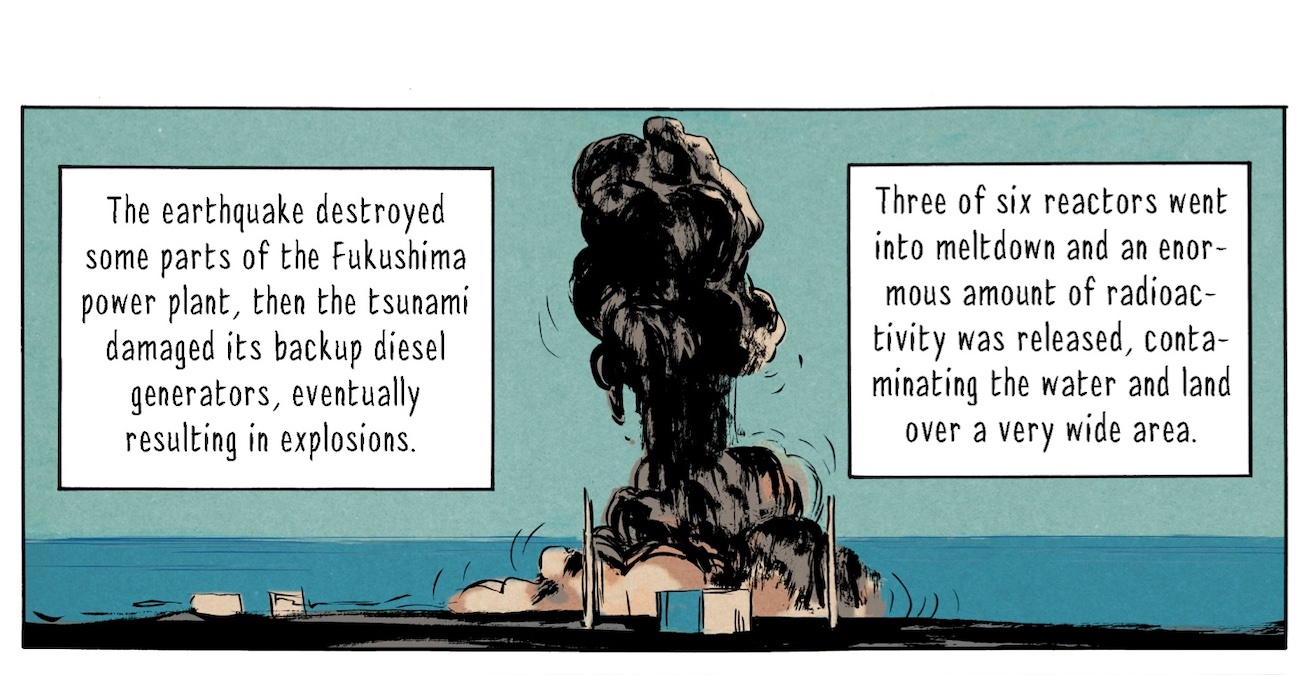
The locally felled timber was exposed to the radiation that escaped from the Fukushima Dai-ichi nuclear plant, less than 40 miles to the south-east, when three of the plant’s reactors suffered melt-downs after the March 2011 earthquake and the tsunami that it unleashed on coastal regions of north-east Japan.
The plume of radiation passed directly over Mr Ito’s home, on the outskirts of the town of Iitate, leaving an invisible but very dangerous dusting on everything that it came in contact with. A decade on from the second-worst nuclear accident in history, he says the radioactivity collects in the ashes from his wood-fired stove, as well as in the metal of the burner and the silvered flue that rises through the roof. He shrugs.

https://www.telegraph.co.uk/news/2021/03/11/young-families-brave-radiation-repopulate-towns-devastated-fukushima/

March 13, 2021 Posted by | environment, Fukushima continuing, radiation | Leave a comment

Japanese government hopes that not-yet-designed robots might clean up Fukushima nuclear mess

CNet 10th March 2021, The Japanese government estimates it will cost $75.7 billion and take 40 years to fully decommission and tear down the facility. The Japan Atomic Energy Agency even built a research center nearby to mock up conditions inside the power plant, allowing experts from around the country to try out new robot designs for clearing away the wreckage.
The hope is that the research facility — along with a drone-testing field an hour away — can
clean up Daiichi and revitalize Fukushima Prefecture, once known for everything from seafood to sake. The effort will take so long that Tepco and government organizations are grooming the next generation of robotics experts to finish the job.

https://www.cnet.com/features/for-fukushimas-nuclear-disaster-robots-offer-a-sliver-of-hope/

March 13, 2021 Posted by | Fukushima continuing | Leave a comment

Fukushima nuclear accident costs so far $188billion, projected final costs of $740 bn.

David Lowry’s Blog 10th March 2021, Pediatrician Dr Alex Rosen, a leading figure in the German branch of the International Physicians for the Prevention of Nuclear War (IPPNW) said it was “luck and divine intervention” that wind from the west blew most of the radiological releases out over the Pacific Ocean, meaning the Fukushima accident released more radioactivity to the oceans than the Chernobyl accident and all the nuclear weapons tests together.
Another webinar I attended, on 9 March, was co-hosted by Northwestern University’s Roberta
Buffett Institute for Global Affairs located in Evanston, Illinois, and the Bulletin for the Atomic Scientists, based in Chicago, to launch a new international interdisciplinary collaborative study on “Nuclear Disaster Compensation: Lessons from Fukushima: Interviews with Experts and
Intellectuals, edited by anthropology professor Hirokazu Miyazaki.
Former US Nuclear Regulatory Commission chairperson, Allison McFarlane, now a professor and director of the School of Public Policy and Global Affairs at the University of British Columbia in Vancouver, pointed out in the webinar that the Fukushima accident has so far cost US$188billion, with projected final costs of US$740 bn.

http://drdavidlowry.blogspot.com/2021/03/nuclear-fuk-ed.html

March 13, 2021 Posted by | business and costs, Fukushima continuing, Reference | Leave a comment

Impossible timetable set for returning Fukushima nuclear site to ‘greenfield”

Greenpeace 11th March 2021, Nine months after the triple reactor meltdown at the Fukushima Daiichinuclear plant in March 2011, Tokyo Electric Power Company (TEPCO) announced that decommissioning of the site will be completed within 30-40 years.

Practically, the people of Japan were told that some time between 2041 and 2051, the site would be returned to ‘greenfield.’ In the past decade, the complexity and scale of the challenge at the Fukushima Daiichi site has become slowly clearer. The decommissioning task at the Fukushima Daiichi site is unique in its challenge to society and technology. But still, the
official time frame for TEPCO’s Road Map for decommissioning remains that set in 2011.

https://www.greenpeace.org/static/planet4-japan-stateless/2021/03/8323f3ca-gpsummary_decommissioning_eng.pdf

March 13, 2021 Posted by | Fukushima continuing | Leave a comment

1.2 million tonnes of contaminated water and nowhere to put it – Fukushima’s continued legacy

Japan grappling with 1.2 million tonnes of contaminated water and nowhere to put it   Japan has a crisis on its hands at the site of the country’s worst natural disaster. One challenge it faces has been deemed near-impossible. NZ Herald,  Rohan Smith– 11 March 21, 

On the site of Japan’s nuclear disaster, 10 years on from the meltdown that changed the world forever, authorities are grappling with impossible choices.

Today marks a decade since the 2011 Fukushima nuclear disaster. Towns surrounding the Tokyo Electric Power Company’s Fukushima Daiichi plant have long since been abandoned but the fallout from the March 11, 2011 event is far from over.

Every single day, 100 tonnes of groundwater seeps into one of the broken reactor basements at the site of the world’s worst nuclear disaster since Chernobyl.

That’s a problem because the water is mixing with radioactive debris and needs to be treated and stored. But TEPCO has more than 1.2 million tonnes of contaminated water sitting in storage tanks that are very quickly running out of capacity.

Estimates suggest the tanks will reach overflow point next year. And one of the choices on the table for Japanese authorities is hugely unpopular and potentially devastating: Release more than 1 million tonnes of the treated radioactive water into the sea.

On the site of Japan’s nuclear disaster, 10 years on from the meltdown that changed the world forever, authorities are grappling with impossible choices.

It is not the only problem that needs solving. There is a far more dangerous situation unfolding in several of the plant’s damaged reactors.

According to local reports, there is still 900 tonnes of melted reactor debris inside three reactors that experienced meltowns. The plan to extract it was described by the Times as “near-impossible” because “the radioactivity remains extremely high near the reactor containment vessels — enough to instantly kill a human and to disable a robot.”

The plan is to decommission the plant by 2051.

Pictures from abandoned properties in the original exclusion zone show weeds growing around homes that were vacated in a hurry.   ….  more https://www.nzherald.co.nz/world/japan-grappling-with-12-million-tonnes-of-radioactive-water-and-nowhere-to-put-it/33TKZUD6JM4GHFJSMIBZ3WZKVY/

March 11, 2021 Posted by | Fukushima continuing | Leave a comment

Part of Tomioka, 6 miles from Fukushima, is still a no-go zone

Daily Mail 10th March 2021, Part of the town of Tomioka, about 10 kilometers (6 miles) from the Fukushima Daiichi nuclear power plant, is still a no-go zone 10 years after
a meltdown sent radioactive fallout over the area. The no-go zone is about
12% of the town, but was home to about one-third of Tomioka´s population
of 16,000. It remains closed after the rest of the town in northeastern
Japan was reopened in 2017. Only those with official permission from the
town office can enter the area for a daytime visit.

https://www.dailymail.co.uk/wires/ap/article-9345355/AP-PHOTOS-No-zone-near-nuclear-plant-hosted-picnics.html

March 11, 2021 Posted by | Fukushima continuing | Leave a comment

The thought of the Olympics – the only hold-up to emptying contaminated water to the ocean.

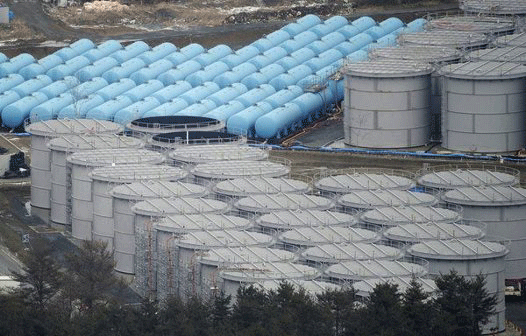
Washington Post 6th March 2021, Beside the ruins of the Fukushima Daiichi nuclear plant, more than 1,000 huge metal tanks loom in silent testament to one of the worst nuclear disasters in history, the meltdown of three nuclear reactors 10 years ago this month. The tanks contain nearly 1.25 million tons of cooling water from the 2011 disaster and groundwater seepage over the years — equivalent to around 500 Olympic-size swimming pools — most of it still dangerously radioactive.

Running out of space to build more tanks, the government  wants to gradually release the water into the sea — after it has been decontaminated and diluted — over the next three decades or
more. Even though a formal decision has yet to be announced, the government and Tokyo Electric Power Co. (TEPCO) have insisted that an ocean release is their preferred solution and that it is perfectly safe.

The only thing holding them back appears to be the Olympics and the bad publicity it could
generate before the Games begin in July, experts say. The idea of releasing the water has infuriated Fukushima’s fishing community, only now getting back on its feet after taking a battering in the wake of the 2011 disaster and the subsequent ocean contamination. Also angry is South Korea, even though it is more than 600 miles away across the sea.

https://www.washingtonpost.com/world/asia_pacific/fukushima-japan-radioactive-water-anniversary/2021/03/05/b0515cd0-76b8-11eb-9489-8f7dacd51e75_story.html

March 9, 2021 Posted by | Fukushima continuing | Leave a comment

Isolated and alone — Beyond Nuclear International

Suguru’s story reveals bullying, ostracization and government whitewash

Isolated and alone — Beyond Nuclear International
A teenager’s account of the Fukushima ordeal  https://wordpress.com/read/feeds/72759838/posts/3219596582 By Linda Pentz Gunter, 7 Mar 21, 

Ten years after the March 2011 Fukushima nuclear disaster, how has the Japanese government responded and what is it like for the people affected, still struggling to return their lives to some semblance of normality? Here is how things look:

  • Manuals are being distributed in schools explaining that radioactivity exists in nature and is therefore not something to be afraid of.
  • The government is considering getting rid of radiation monitoring posts as these send the wrong message at a time of “reconstruction”.
  • The Oversight Committee for Fukushima Prefecture Health Management Survey is discussing the possibility of stopping thyroid inspections at schools because they stress children out and overburden teachers and staff.

    • Depression and suicide rates among young people from Fukushima are likely to be triggered by being called “germs” and by being seen as “contaminated”.
    • Those who speak out about radiation are more stigmatized today than they were 10 years ago.
    • Those who “voluntarily” evacuated, recognizing that the so-called protection standards were not adequate for their region, are often ostracized from their new communities. They are seen as selfish for abandoning their homeland, friends and families “just to save themselves” and are bullied as parasites living on compensation funds, even though the “auto-evacuees” as they are known, received none.
      • Those forced to evacuate are also bullied if they do not now return, accused of not trusting the government and its assertions that it is safe to do so.
      • The taboo against speaking out for proper radiation protection and for compensation has grown worse as the rescheduled Olympics loom for this summer and Japan is determined to prove to the world it has fixed the radiation problem and beaten Covid-19.
      • On March 1, 2021, it took three judges all of 30 seconds to dismiss a case brought by 160 parents and children who lived in Fukushima prefecture at the time of the nuclear accident, and known as the Children’s Trial Against Radiation Exposure. The class action suit sought 100,000 yen per person in damages from the government and the prefecture, due to the psychological stress brought on by the lack of measures to avoid radiation exposure after the accident.
      • These are some of the realities uncovered by France-based Japanese activist, Kurumi Sugita, as she interviewed those affected and began to compile a graphic short story about her findings, entitled Fukushima 3.11 and illustrated by French artist, Damien Vidal. The booklet is produced by the French NGO, Nos Voisins Lontains 3.11 (Our Distant Neighbors 3.11).

        Fukushima 3.11, a long-form cartoon strip, is told in the first person by the youngest of Sugita’s interview subjects, Fukushima evacuee, Suguru Yokota, who was 13 at the time of the nuclear disaster.

        Suguru was also one of the plaintiffs in the Children’s Trial, and noted after the devastating dismissal, just days before the Fukushima disaster’s 10th anniversary, that “we cannot give up” and that “the court hasn’t issued a legitimate verdict.”

      • In 2012, Sugita had traveled to Japan with a research project she helped create, financed by the French National Centre for Scientific Research where she worked, to set up an investigation into Japan’s nuclear victims. A list of 70 interview candidates was put together.

        “I met Suguru in 2013 in Sapporo where he was living alone after he moved there from Fukushima,” said Sugita. “I also interviewed his mother and they were interviewed once a year over six years.”

        A schoolboy at the time of the accident, the book follows Suguru’s account of his experiences. He encounters the refusal by his uncle to believe the dangers in the early days of the accident, “a typical denial case,” says Sugita, and he is ostracized at school where he is the only pupil to wear a mask.

        Suguru’s only respite comes when his mother, who is equally alert to the radiation risks, sends him on a “radiation vacation” to Hokkaido, the first time he encounters peers who share his concerns.

      • Back at school and feeling isolated and alone, Suguru studies at home instead, eventually leaving the region for a different high school and then college.

      • The book weaves in essential information about radiation risks, and the clampdowns by the Japanese government, which withdrew support for auto-evacuees claiming, as Suguru relates it, that “these families are not victims. They are responsible for their fate.”

        The book was first published in the magazine, TOPO, whose audience is predominantly teenagers and which reports on topics of current interest. 

        “It appealed to us to address an audience interested in world events, but not exclusively the nuclear issue,” said illustrator Vidal.  “We thought our comic strip could be read by all those — and not necessarily just teenagers — who want to understand what the consequences of the nuclear accident were, and how it affected the inhabitants of Fukushima Prefecture.”

      • The book vividly brings home the psychological and emotional pain suffered by those who chose to recognize the true dangers posed by the Fukushima disaster, as well as the financial hardships and fracturing of families. And it exposes the depths of deliberate denial by authorities, more interested in heightened normalization of radiation exposure in the name of commerce and reputation.

      • Even as early as October 2011, an announcement is made that “rice produced in Fukushima Prefecture will supply school canteens again.” We see Suguru and his mother watching this news on their television, then the name-calling Suguru faces in school for bringing his own lunch. He is shown in the strip being called a “hikokumin”, which, explains Suguru, “is a really insulting word, used during the Second World War. It refers to people who are not worthy of being Japanese citizens.”

        But that stigma has only become worse with time, Sugita says. 

        These days people are name-called “hoshano”. “Hoshano”(放射能) means radioactivity, but with a different Chinese character(放射脳) it  means “radioactive brain – or brain contaminated by the fear of radioactivity”, she explains. And that is the slur in common circulation now.

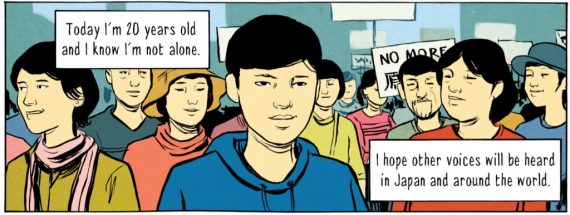
        Nevertheless, the book ends on a hopeful note. “Today,” concludes Suguru on the closing page, “I know I’m not alone. I hope other voices will be heard in Japan and around the world.”

        It’s easy to say “never again.” But in order to ensure it, we must all continue to raise our voices, joining Suguru’s and others yearning to be heard.

        Read the English language version of Fukushima 3.11 on line for free. A version is also available in French. Hard copies (in French only), may be ordered from Nos Voisins Lontains 3.11 for 8€ plus shipping costs.


March 8, 2021 Posted by | children, Fukushima continuing, media, psychology - mental health, social effects | Leave a comment

Fukushima Daiichi 2011-2021 — Beyond Nuclear International

Greenpeace report reveals deception and abuse

Fukushima Daiichi 2011-2021 — Beyond Nuclear International

March 8, 2021 Posted by | Fukushima continuing | Leave a comment

Most 2011 quake, Fukushima crisis survivors back ending nuclear power

Most 2011 quake, Fukushima crisis survivors back ending nuclear power

March 6, 2021 (Mainichi Japan)    TOKYO (Kyodo) — About four in five survivors of the 2011 earthquake, tsunami and Fukushima nuclear crisis in northeastern Japan support abolishing nuclear power generation immediately or gradually, a Kyodo News survey showed Saturday nearly 10 years after the disaster.

Some 30 percent of respondents said all nuclear power plants should be abolished immediately, with 52 percent supporting phasing out nuclear power and eventually eliminating it.

The poll conducted in November in the three hardest-hit prefectures of Iwate, Miyagi and Fukushima had 300 respondents and found that only 15 percent were in favor of restarting nuclear reactors and relying on them in the future.

Following a magnitude-9.0 earthquake and subsequent tsunami that hit on March 11, 2011, the Nos. 1 to 3 reactors at the Fukushima Daiichi nuclear plant owned by Tokyo Electric Power Company Holdings Inc. suffered meltdowns.

Decommissioning work continues to prove difficult and evacuation orders are still in place in some areas around the complex a decade after the world’s worst nuclear accident since the 1986 Chernobyl disaster.

All reactors in Japan were halted after the nuclear crisis but some have resumed operations in recent years under stricter safety regulations. The government aims for renewable energy to account for 50-60 percent of overall electricity by 2050 while relying on 30-40 percent from thermal power and nuclear energy.

By prefecture, 40 percent of respondents in Fukushima supported an immediate exit from nuclear energy, higher than 27 percent in Iwate and 24 percent in Miyagi.

Hiromi Suzuki, a 59-year-old evacuee from Namie, close to the crippled nuclear plant, said consumers remain concerned that fish from Fukushima may be contaminated with radiation…..https://mainichi.jp/english/articles/20210306/p2g/00m/0na/065000c

March 8, 2021 Posted by | Fukushima continuing | Leave a comment

Fukushima nuclear decommissioning not really under control- persistent highly radioactive debris remains

March 6, 2021 Posted by | Fukushima continuing | Leave a comment

Reuters gives a timeline of events: Fukushima 2011 – 2021

March 6, 2021 Posted by | Fukushima continuing, Reference | Leave a comment

Fukushima wrecked nuclear plant: area remains a health and environmental disaster

Decade After Fukushima Disaster, Greenpeace Sees Cleanup Failure, Bloomberg Green,  By

  •  Land identified for cleanup remains contaminated: Study
  •  Long-term threat to human and environmental health remains

Ten years after the worst nuclear accident since Chernobyl, land Japan identified for cleanup from the triple reactor meltdown of the Fukushima Dai-Ichi atomic power plant remains contaminated, according to a report from Greenpeace.

In addition, Greenpeace said its own radiation surveys conducted over the last decade have consistently found readings above government target levels, including in areas that have been reopened to the public. The lifting of evacuation orders in places where radiation remains above safe levels potentially exposes people to an increased risk of cancer, the report said.

On average, just 15% of land in the “Special Decontamination Area,” which is home to several municipalities, has been cleaned up, according to the environmental advocacy group’s analysis of government data. That’s despite the government’s claims that the area has largely been decontaminated, the group said.

……..While the government has been steadily lifting evacuation orders on towns since 2014, roughly 36,000 people are still displaced.

Greenpeace recommended that Japan suspend the current return policy, which “ignore science-based analysis, including potential lifetime exposure risks to the population” and abandon plans to lift evacuation orders in six municipalities. https://www.bloomberg.com/news/articles/2021-03-04/decade-after-fukushima-disaster-greenpeace-sees-cleanup-failure?s=09

March 6, 2021 Posted by | decommission reactor, Fukushima continuing | Leave a comment

Japan’s daunting task – to decommission Fukushima nuclear plant, over many decades

March 6, 2021 Posted by | decommission reactor, Fukushima continuing | Leave a comment