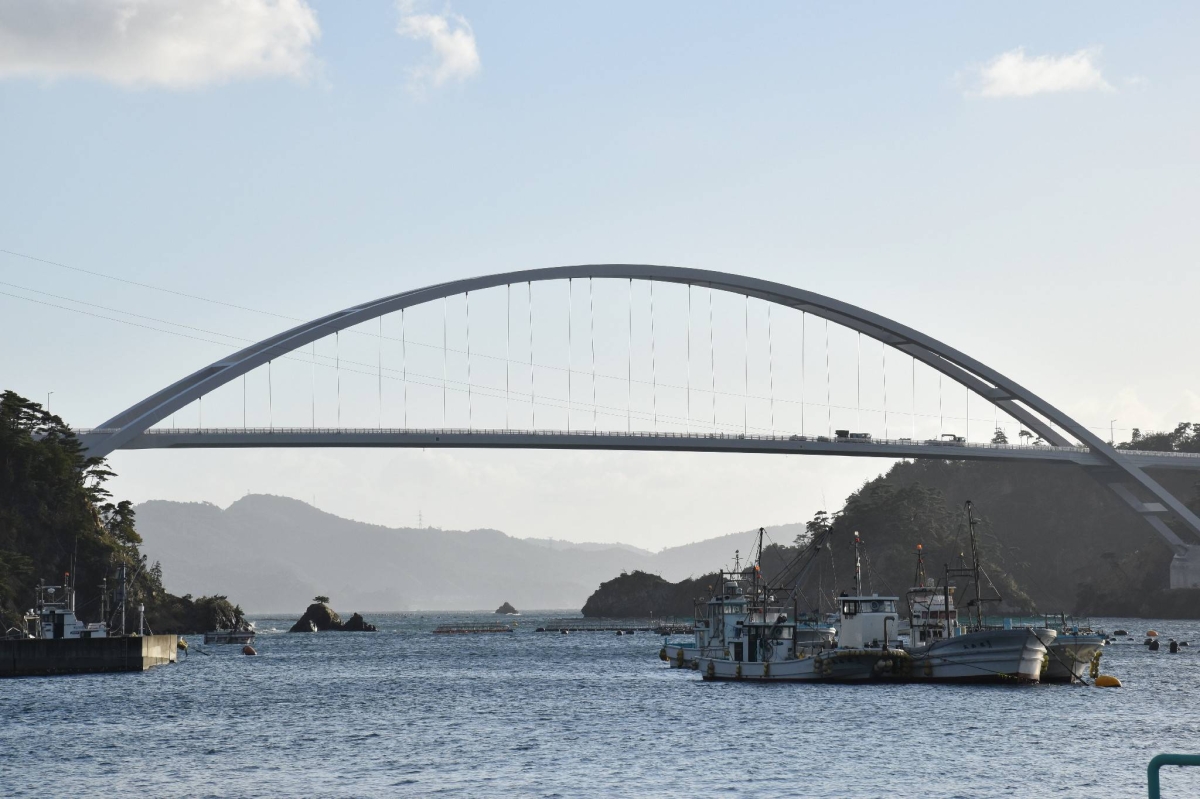
Japan, US to communicate on possible use of nuclear weapons
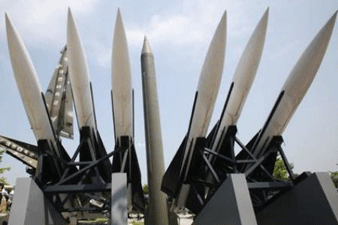
Establishing such an operational framework is aimed at strengthening the U.S. nuclear umbrella that protects Japan and enhancing its deterrence capabilities against North Korea and China.
Asia News Network, December 30, 2024
TOKYO – Japan and the United States will communicate regarding Washington’s possible use of nuclear weapons in the event of a contingency, the two governments have stipulated in their first-ever guidelines for so-called extended deterrence, The Yomiuri Shimbun has learned.
According to Japanese government sources, Japan will convey its requests to the United States via the Alliance Coordination Mechanism (ACM), through which the Self-Defense Forces and U.S. forces maintain contact with each other.
Establishing such an operational framework is aimed at strengthening the U.S. nuclear umbrella that protects Japan and enhancing its deterrence capabilities against North Korea and China.
Against North Korea, China
The Foreign Ministry announced the formulation of the guidelines Friday but had not disclosed the details, as they contain classified military intelligence.
The U.S. president, who is also the commander in chief of U.S. forces, has the sole authority to authorize a nuclear attack. Before the completion of the guidelines, no written statement existed that said Japan was allowed to pass on its views to the United States regarding Washington’s possible use of nuclear weapons.
Extended deterrence is a security policy aimed at preventing a third country from attacking an ally by demonstrating a commitment to retaliate not only in the event of an armed attack on one’s own country, but also in the event of an attack on an ally.
Responding to North Korea’s nuclear development program and China’s military buildup, the Japanese and U.S. governments in 2010 began holding working-level consultations in which their foreign and defense officials meet regularly to discuss nuclear deterrence and other issues. Japan has expressed its stance on the use of nuclear weapons in the meetings.
The two countries will exchange views on Washington’s use of nuclear weapons also in the framework of the ACM, which was set up in normal times under the revised Guidelines for Japan-U.S. Defense Cooperation in 2015.
Under the ACM, discussions are designed to take place both by the Alliance Coordination Group, comprising director general-level officials of the diplomatic and defense authorities, and by the Bilateral Operations Coordination Center, involving senior officials of the SDF and U.S. forces. If necessary, high-level discussions involving Cabinet members are also expected to be held.
This system will enable Japan to convey its views to the United States on Washington’s potential use of nuclear weapons at all stages, from normal times to contingencies………………. https://asianews.network/japan-us-to-communicate-on-possible-use-of-nuclear-weapons/
Toshiyuki Mimaki: Let’s save humanity from nuclear weapons
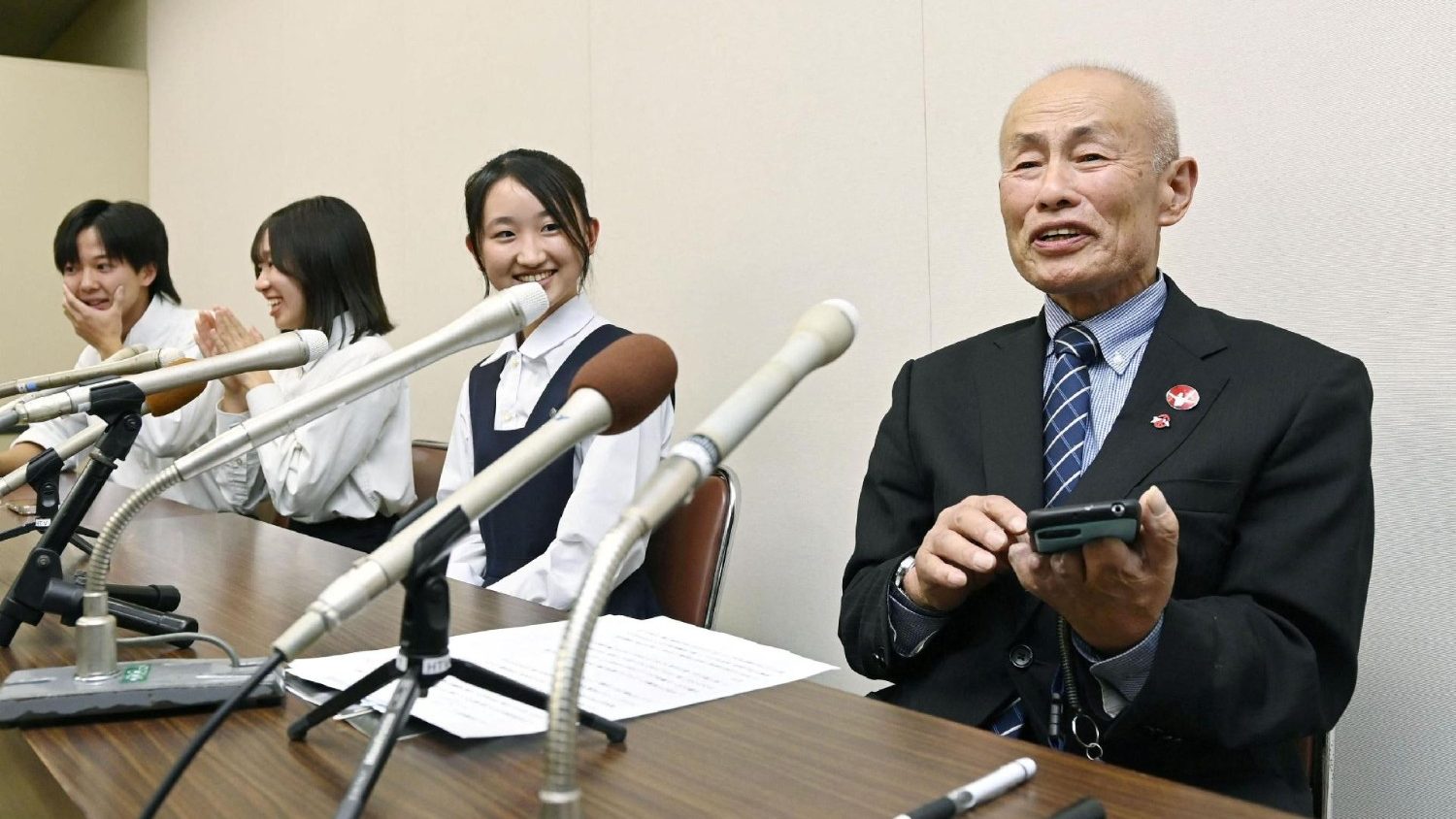
An interview with Hiroshima atomic bomb survivor and co-president of the Japanese foundation Nihon Hidankyo, Toshiyuki Mimaki, recipient of the 2024 Nobel Peace Prize. Mimaki reflects on his meeting with Pope Francis in Japan in 2019 and calls on world leaders to commit to eliminating nuclear weapons.
By Alessandro Gisotti, https://www.vaticannews.va/en/world/news/2024-12/mimaki-nihon-hidankyo-nobel-peace-prize-elimination-nuclear-arms.html
Shattered buildings. A landscape wiped clean. So much destruction that the sea became visible where once a vibrant city stood. This is the indelible memory carried by a three-year-old boy who witnessed an unthinkable and catastrophic event—one that, tragically, did occur. Toshiyuki Mimaki shares this harrowing memory with L’Osservatore Romano.
Now 82 years old, Mimaki has never stopped reflecting on August 6, 1945, the day the atomic bomb devastated Hiroshima, his hometown. That moment not only changed the course of human history but also took the lives of tens of thousands of people.
On December 10, Mimaki accepted the Nobel Peace Prize in Oslo as co-president of Nihon Hidankyo, a foundation established in 1956 dedicated to nuclear disarmament. Nihon Hidankyo unites the hibakusha—survivors of the atomic bombings of Hiroshima and Nagasaki at the end of World War II.
The foundation’s mission is rooted in the power of testimony, relying on the gentle but impactful strength of storytelling. The Norwegian Nobel Committee acknowledged this effort, stating, “We all have a duty to continue the mission of the hibakusha. Their moral compass is our legacy. Now it is up to us. The fight for disarmament requires persistent and vocal advocacy.”
As the International Day of Peace approaches, Toshiyuki Mimaki reflects on his role as a custodian of the legacy of those who came before him—the hibakusha who founded Nihon Hidankyo. Survivors like him aim to ensure the world never forgets the tragedy of that fateful August morning.
“When I was three years old,” Mimaki recounts, “my mother, younger brother, and I were exposed to the bomb’s radiation while searching for my father, who worked for the Hiroshima railway. Countless lives were lost, and buildings were consumed by flames to the extent that you could see all the way to the sea. My younger brother is now undergoing treatment for brain cancer.”
Despite the pain of revisiting such memories, sharing these experiences is central to the hibakusha mission: ensuring that the horror of nuclear weapons is never repeated. This mission becomes ever more urgent as the remaining survivors of the bombings near the end of their lives.
“Hiroshima has taken steps to preserve these testimonies,” Mimaki explains. “The city has established programs to educate young people, training them to become messengers who can carry forward our stories for future generations.”
Mimaki expresses deep gratitude for Pope Francis’s dedication to nuclear disarmament. He had the opportunity to meet the Pope during his visit to Hiroshima and Nagasaki in November 2019. “I met the Pope when he came to visit us,” Mimaki recalls. “He gave me a medal in a red case, and I asked him to work toward abolishing nuclear weapons. I still treasure a photograph from that day.”
Despite the global appeal for disarmament, discussions about the potential use of nuclear weapons and the possibility of atomic conflict have intensified in recent years. For Mimaki, who still carries the scars of that catastrophic day, the thought of nuclear weapons being used again is unimaginable.
“If nuclear weapons were ever used again,” he warns, “it would mean the end of humanity. This is why I implore leaders of nations with nuclear arsenals to commit to their complete elimination.”
Mimaki is particularly alarmed by the ongoing conflicts in Gaza and Ukraine. “Russian President Putin,” he observes with concern, “has lowered the threshold for the use of nuclear weapons, making them deployable at any moment. It’s a terrifying situation. I urge everyone to visit Hiroshima and Nagasaki and see the Atomic Bomb Museum. Witness firsthand the devastating impact nuclear weapons have on human life.”
Philosophy Against Nuclear Power

It is now clear that the residents of Fukushima are far from some voluntarist subjects but rather a people who live under constant subjection. The installation of nuclear power plants was not democratically decided, neither did it bring any halt to the historical subjection. Rather, nuclear power plants worsened the subjection by reproducing subjection. It should be clear that the one who bears the responsibility is the “village” (TEPCO, the government, etc.) rather than the victims.
How many times we should suffer from this “blindness to nuclear apocalypse” in order to realize that nuclear power is just a technology against humanity?
New Bloom, Shen Yun-Yen, 12/29/2024
Yoshiyuki SATO and Takumi TAGUCHI, Datsugenpatsu no tetsugaku (Philosophy for Abandoning Nuclear Power), Jimbun Shoin, 2016.
THE NUCLEAR BOMB certainly posed a serious problem for contemporary philosophy. From Heidegger to Arendt to Marcuse, philosophy in the mid-20th century struggled to deal with this all-annihilating artificial production. Unfortunately, most of these philosophers did not analyze the complex relationships between nuclear technology, capital, state, etc.
………………………………………………………….. ……………….Fortunately, two philosophers, Yoshiyuki Sato and Takumi Taguchi, accept the difficult challenge of philosophizing nuclear power. In their joint work Datsugenpatsu no tetsugaku, they argue at the outset that neither “pure philosophy” nor “philosophy as usual” will ever constitute an effective critique of nuclear power (13-4). What we need, according to Sato and Taguchi, is a Datsugenpatsu no tetsugaku, which can be translated as either a philosophy of abandoning nuclear power, or simply philosophy for abandoning nuclear power…………………………………………………..
The book is divided into four parts, each with three chapters, and a conclusion. The first part deals with the identity of kaku (nuclear weapons) and genpatsu (nuclear power plants); the second an ideology critique; the third a historico-politico-economic critique of the development of nuclear power; the fourth part attempts to consider nuclear power a public hazard; lastly, the conclusion provides a vision for a society without nuclear power.
1.
Even after the Fukushima catastrophe, many philosophers continued to philosophize the phenomenon as usual, or, to borrow a phrase from Adorno, touting the “jargon of authenticity.” It’s just weak. Ontology alone will never constitute a critique of nuclear power. Rather than providing a sound critique, these sorts of philosophy books seemed to reaffirm the ontological inability of philosophy when faced with nuclear catastrophe.
Fortunately, two philosophers, Yoshiyuki Sato and Takumi Taguchi, accept the difficult challenge of philosophizing nuclear power. In their joint work Datsugenpatsu no tetsugaku, they argue at the outset that neither “pure philosophy” nor “philosophy as usual” will ever constitute an effective critique of nuclear power (13-4). What we need, according to Sato and Taguchi, is a Datsugenpatsu no tetsugaku, which can be translated as either a philosophy of abandoning nuclear power, or simply philosophy for abandoning nuclear power. Each translation carries different connotations. “A philosophy of abandoning nuclear power” seems to make philosophy a means for abandoning nuclear power, while the other seems to be a sublation of “philosophy as usual.” The logic is actually clear: nuclear power serves as a medium for philosophy to sublate itself.
Like Marx, who philosophically criticized philosophy by incorporating political economy and history into philosophy, Sato and Taguchi incorporate different fields of thought in order to critique nuclear technology and renew philosophy. They not only bring Günther Ander, Foucault, Judith Butler, Montesquieu, etc. together and interpret their th
2.
THE BOOK OPENS with a warning: our stubborn “blindness” to the repetition of nuclear catastrophes. In 1945, nuclear bombs were dropped in Hiroshima and Nagasaki, which made philosopher Günther Anders argue that “Hiroshima is everywhere,” that is, regardless of location, we were already living in an age where indiscriminate annihilation became possible, and irreversible. In 1954, the US conducted nuclear testing (H-Bomb) at Bikini Atoll, and the “ashes of death” fell all over the place, which led to the death of several Japanese fishermen fishing nearby. In the same year, Günther Anders lamented that, after Hiroshima and Nagasaki, we still suffered from the “apocalypse-blindness” to nuclear weapons. In 1979, the year of the Three Mile Island accident, Anders reasserted his arguments, and noted that nuclear plants served but a masquerade of nuclear weapons. And then there was Chernobyl (1986), which made Anders change his argument from “Hiroshima is everywhere” to “Chernobyl is everywhere.”
As Japanese philosophers, that is, philosophers from a country where nuclear tragedies happen most frequently (Hiroshima, Nagasaki, Bikini, Tokaimura, Fukushima), Sato and Taguchi clearly understand that Fukushima is not something “accidental” (sōteigai), as many commentators and government officials claim to be, but a repetition of the above-listed catastrophes (29). They also critique the fake distinction of the “civil use” and “military use” of nuclear power by drawing on the works of critical scientists such as Takagi Jinzaburo.
For Sato and Taguchi, the identity between nuclear weapons and nuclear power plants is established historically, that is, nuclear power plants share every feature of the Manhattan Project, from the principle of secrecy, the concentration of capital, the state-centrism, to its technical principles and, perhaps most importantly, the subordination of scientific development to the ends of the state.
Indeed, scientific knowledge is never innocent, which is why Sato and Taguchi employ a Foucauldian analysis of power-knowledge in order to critique the interrelationship between the two. The state decides who is allowed to participate the project, what to research, how much money an experiment needs, etc., without public scrutiny. This is why nuclear technology is a product of the “state-industrial-knowledge complex” (56).
3
IF IN THE context of the U.S., the symbol of the “state-industrial-knowledge complex” is the Manhattan Project, in Japan it’s the “nuclear village” (genshiryoku-mura). The “village” is not a physical location but a principle of exclusion (murahachibu), that is, whoever holds opinions different from them will be excluded. As an entity of highly concentrated power, its impact should not be underrated.
…………………………………………..This top-down, exploitative, discriminatory system exists throughout the history of modern Japan, that is, from Meiji to the present. It is true that in the post-war occupied period, the main condition of getting back Japan’s sovereignty is to democratize the state. However, it is also true that, under the shadow of the Cold War, both the US and the Japanese government did not care much about democratization. The result is that former Class A war criminal suspect Nobusuke Kishi not only became the Prime Minister of Japan (1957-60) and President of the LDP (1957-60), but also played an important role in supporting the “village.” It is no wonder that Sato and Taguchi repetitively argue that nuclear development in Japan serves both economic and military ends, and that as long as this system exists, claims about the “democracy” or democratization of Japan will never make sense.
4
THE VILLAGE DECIDES everything, including what’s to be done after the Fukushima catastrophe. First of all, given the identity of the “military use” and “civil use” of nuclear power, the authors argue quite convincingly that the impact of a nuclear catastrophe can only be compared to that of a war (34-7). That is, nuclear power plants’ disasters often produce effects analogous to those of war. From Chernobyl to Fukushima, whenever a nuclear disaster happens, there are always numerous refugees, lands that are no longer inhabitable, and almost unbearable economic costs.
After the catastrophe of Fukushima, there are many issues that remain unresolved even to today. However, the village’s attitude remains the same. The basic tone is denial and ideological. ………… In the case of the Fukushima catastrophe, the village (including scientists and doctors) decides to abandon certain populations in order to reduce economic costs (102). That is, because “electricity provision is necessary,” the village decides to make hundreds of thousands of residents (or refugees) continue to live under constant radioactive exposure (142).
The village has always been trying to promote an unscientific view of an “acceptable amount of radioactive exposure,” intentionally ignoring many scientists’ strong objections against this hypothesis. Hence, when there are lands still heavily polluted, the government policy asks many refugees to go back to their hometowns out of a deliberate calculation of cost-effectiveness. Without the intertwining of “scientific knowledge” and state power, this operation would not have been possible.
Sato and Taguchi go further to claim that, this sort of calculation is one of the reasons of the catastrophe. As a country where earthquakes happen extremely frequent, Japan’s earthquake studies have always been famous in the field. Long before the Fukushima tragedy took place, many specialists had already warned of a possible earthquake, tsunami, and nuclear disaster due to earthquake and tsunami. However, the village did not take action to prevent such a scenario from happening because the economic costs are just too high (138). It’s just not worth it.
After the Fukushima catastrophe, the village did not repent of its inaction. As for them, these warnings are not voiced from “specialists,” and this is the main reason why they will never take them seriously (134). As the authors point out, the so-called specialist is nothing but those who support the principle of the village (136).
5
……………………………………………………………………………..For the authors, the process of subjection begins with the above-mentioned policy, or the “long-distance electricity provision system.” The state chose certain regions to develop nuclear power plants because the regions were economically poor (as a result of systematic discrimination). The nuclear power plants, however, are more like drug addiction rather than hope. After conducting a rigorous economic analysis, Sato and Taguchi show that the more the regions attach to the nuclear economy, the more they become poorer, since this is nothing but a core-peripheral exploitative system (201-2)………………………………
It is now clear that the residents of Fukushima are far from some voluntarist subjects but rather a people who live under constant subjection. The installation of nuclear power plants was not democratically decided, neither did it bring any halt to the historical subjection. Rather, nuclear power plants worsened the subjection by reproducing subjection. It should be clear that the one who bears the responsibility is the “village” (TEPCO, the government, etc.) rather than the victims.
The Fukushima catastrophe makes the subjection clear, while also provides an opportunity to halt the subjection, according to the authors. That is, as an “event,” it changes the mindset of many of the residents and citizens. Many people chose to live without nuclear power (216), and one court decision even made clear that the lives of residents are above economic prosperity (87).
Seizing the opportunity to formulate a possible future against nuclear power, Sato and Taguchi argue that, firstly, nuclear power is entirely irresponsible for future generations, an idea they take from Hans Jonas (406). The reason is actually quite scientific: nuclear power cannot function without producing radioactive waste, which is inconceivable to be really “disposed.” The profit-seeking mindset of this generation will definitely do harm to next generations, if the world still exists.
Secondly, they argue that the government should formulate a system of referendum, as a way of practicing democracy (442-3). Given that the nuclear village almost always monopolizes any decisions regarding nuclear power, a referendum constitutes a way of abolishing the undemocratic structures of the state-industrial-knowledge complex.
Thirdly, the government, and every citizen, should take renewable energy seriously, and implement concrete policies to facilitate the transition from nuclear energy and highly polluting energies to renewable clean energy. They also go further to propose that energy provision should be taken as a common, rather than some private property monopolized by the “village” (448-50).
It is clear that, as for Sato and Taguchi, nuclear power is not just a feature of the Japanese state. Nuclear power, through its interconnections with capital, knowledge, science, etc., defines the state. A state defined by nuclear power, governed by the nuclear village, is necessarily unscientific, undemocratic, and irresponsible. Abandoning nuclear power, therefore, amounts to restructuring the state. If the Japanese government has always been touting its formal democracy, what the authors call for is a movement of democratizing democracy.
6
……………………………………………………………What I feel most bizarre is the fact that the Japanese government still tries to reopen the nuclear power plants, with little objection from the majority of the Japanese citizens. How many times we should suffer from this “blindness to nuclear apocalypse” in order to realize that nuclear power is just a technology against humanity?
Fukushima triggered a new round of anti-nuclear movements in Taiwan, with the final result of a zero-nuclear policy that will soon be implemented in 2025. When I discuss the recent development of the nuclear village with my Taiwanese friends who have all witnessed, through television, the Fukushima nuclear catastrophe, their reaction is always the same: What the fuck? Did the Japanese suffer from collective amnesia?
I would say yes.
But Sato and Taguchi demonstrate how this collective amnesia is produced rather than natural. Without the official ideology (the so-called “safety myth”) and the support from pseudo-scientific communities, this amnesia would not have been possible. Speaking of “collective amnesia,” one couldn’t help but think of issues regarding war responsibility and post-war responsibility. But, again, only a radical democratization can help the country to really face its past wrongs. https://newbloommag.net/2024/12/29/philosophy-nuclear-power/
Japan’s fishing town of Suttsu faces nuclear waste dilemma amid population decline

Residents of Suttsu worry that, despite potential economic benefits, a nuclear waste facility will harm the community and leave a legacy of radioactive waste
Jonathan Vit 29 Dec 24, https://www.scmp.com/week-asia/politics/article/3292482/japans-fishing-town-suttsu-faces-nuclear-waste-dilemma-amid-population-decline
It was a place Kyoko Tsuchiya could finally call home. As a child, her father was frequently transferred across Japan for his job at the national phone company. Later, as an adult, Kyoko fell in love with a man who worked for the post office. After they married, she continued to move around, rarely staying long enough in one place to truly feel at home.
Suttsu, with its unique charm, was different. This small town, nestled among scenic landscapes, is where Kyoko’s husband, Kazuyuki, grew up. Now in retirement, the couple decided to return to provide care and support for his elderly father.
Located on Hokkaido, Japan’s ruggedly beautiful northern island, the seaside fishing town hugs the windswept western coast. There, they opened a small inn called “Pension Mellow” which sits perched on a quiet hilltop overlooking the sea.
Kazuyuki could watch the fishing boats through binoculars from the kitchen window. When he spotted a friend’s boat, he would buy fresh seafood for his guests. One evening, he proudly served octopus sashimi made from a large octopus pulled from the frigid sea earlier that day.
“I was finally able to put down roots here,” Kyoko said. “I wanted a place where I could settle down and live a relaxed life. That’s how it was until 2020. Now, I don’t know …”
On Thursday, August 13, 2020, residents of this small town found themselves at the centre of a national controversy that attracted news helicopters and television crews to their usually sleepy streets.
Japan’s Nuclear Waste Management Organisation (Numo) was searching for a town willing to host a large underground facility to store the country’s nuclear waste.
However, there were stipulations: it could not be near a seismically active fault line or a volcano, could not contain valuable natural resources like coal or aquifers, and had to be within 20km (12.5 miles) of the coast for safe waste transport.
Any town meeting these requirements could volunteer to undergo studies to evaluate its suitability for the nuclear waste facility.
“In Japan, we have been using nuclear power for over half a century,” said Kenji Yamashita, a press officer with Numo. “As long as we have nuclear power plants, waste will always be produced. So, in every country, it is necessary to find a place to dispose of it.”
Japan currently sends its nuclear waste to a facility in Aomori, the prefecture just south of Hokkaido. The construction of that reprocessing and temporary storage centre has faced delays due to protests from local residents and anti-nuclear activists.
Finding a long-term storage site has been equally challenging. Some towns withdrew their interest due to local opposition before studies could start.
The study is non-binding, meaning a town can start the process without completing it. Additionally, the study is accompanied by substantial subsidies – up to 9 billion yen (US$57.6 million) paid out over the course of the investigation.
This offer was too attractive for Suttsu’s mayor, Haruo Kataoka, to ignore. Like many other towns across Japan, Suttsu has seen a dramatic population decline over the past half-century, having lost more than half of its residents since the 1970s. Nearly half of Suttsu’s population is 65 or older. The local junior school is so small that entire grades fit into a single classroom. A mere seven students make up the school’s first-grade class.
“There’s no doubt this is an ageing town,” Kazuyuki said.
Mayor Kataoka declined to speak with This Week in Asia for this story, but local residents said the six-term mayor has repeatedly tried to find new ways to revitalise the town’s shrinking economy.
Suttsu is home to a large wind energy farm – white windmills dot the landscape and are now featured on signs greeting visitors as they drive into town. It also built a modern town centre, a museum showcasing local history and an elderly care home on a bluff overlooking the town. Few projects delivered the promised financial returns for Suttsu, explained Takashi Saito, a former town council member and relative of the mayor.
“There are a lot of public buildings around town,” Saito said. “It costs a lot of money to maintain and manage them. When you pull back the lid on it, the town has a lot of debt.”
Saito explained that, although he opposes the construction of a nuclear waste facility in town, he understood the mayor’s reasons for pursuing the studies. Suttsu had changed greatly since his childhood, with empty streets and many businesses in the shopping district permanently closed.
“There’s no one walking around the town today,” Saito said. “The town feels lonely now.”
Second Fukushima nuclear sample removal eyed for March

CNA 26th Dec 2024
Three of Fukushima’s six reactors went into meltdown in 2011 after a huge tsunami swamped the facility.
TOKYO: The operator of Japan’s stricken Fukushima nuclear plant said on Thursday (Dec 26) it will start the second round of a tricky operation to collect samples of radioactive debris from the site this spring.
Around 880 tonnes of hazardous material remain at the Fukushima site, 13 years after a catastrophic tsunami caused by a 9.0-magnitude earthquake triggered one of history’s worst nuclear accidents.
Removing the debris is seen as the most daunting challenge in a decommissioning project due to last decades, because of the dangerously high radiation levels.
Last month, operator Tokyo Electric Power Company (TEPCO) said a trial debris removal operation using a specially developed extendible device had been completed.
The sample weighing just below 0.7g – equivalent to about one raisin – was delivered to a research lab near Tokyo for analysis.
A TEPCO official told a press conference they are now gearing up for a second sample removal due in “March to April”……….
https://www.channelnewsasia.com/east-asia/fukushima-nuclear-plant-sample-removal-march-2025-4826701
Tepco eyes second test removal of Fukushima nuclear fuel debris
Japan Times 29th Nov 2024, https://www.japantimes.co.jp/news/2024/11/29/japan/tepco-debris-removal-plan/
Tokyo Electric Power Company Holdings is considering conducting a second test to remove nuclear fuel debris from one of the three meltdown-hit reactors at its Fukushima No. 1 nuclear power plant, company officials said Thursday.
As in the previous test, Tepco plans to use a fishing rod-shaped device to remove the debris from the plant’s No. 2 reactor.
Tepco collected 0.7 gram of debris in the first test, which started in September and ended on Nov. 7. The debris is currently under analysis at the Japan Atomic Energy Agency.
Nuclear Regulation Authority Chairperson Shinsuke Yamanaka has asked the company to collect more debris to gather more data.
Some 880 tons of nuclear debris, a mixture of melted fuel and reactor parts, is estimated to remain in the No. 1, No. 2 and No. 3 reactors at the plant, which was crippled by the March 2011 Great East Japan Earthquake and tsunami.
Japan / Blow For Nuclear Programme As Regulator Blocks Tsuruga-2 Restart

Nucnet By David Dalton, 14 November 2024
NRA cites presence of possible active fault lines underneath facility
Japan’s nuclear watchdog has formally prevented the Tsuruga-2 nuclear power plant in the country’s north-central region from restarting, the first rejection under safety standards that were revised after the 2011 Fukushima disaster.
The Nuclear Regulation Authority said the unit, in Fukui Prefecture, is “unfit” for operation because owner and operator Japan Atomic Power Company (JAPC) failed to address safety risks stemming from the presence of possible active fault lines, which can potentially cause earthquakes, underneath it.
Tsuruga-2, a 1,108-MW pressurised water reactor unit that initially began commercial operation in 1987, is the first reactor to be prevented from restart under safety standards adopted in 2013 based on lessons from the 2011 Fukushima-Daiichi meltdowns following a massive earthquake and tsunami.
Those standards prohibit reactor buildings and other important facilities being located above any active fault…………………………………
Recent press reports in Japan said the NRA had decided Tsuruga-2 could not be restarted because it could not rule out the possibility that a fault line running under the reactor building is connected to adjacent active fault lines.
“We reached our conclusion based on a very strict examination,” NRA chairperson Shinsuke Yamanaka told reporters.
‘Data Coverups And Mistakes’ By Operator
The verdict comes after more than eight years of safety reviews that were repeatedly disrupted by data coverups and mistakes by the operator, Yamanaka said. He called the case “abnormal” and urged the utility to take the result seriously.
An older unit at Tsuruga, the 340-MW Tsuruga-1 boiling water reactor, began commercial operation in 1970 and was permanently shut down in 2015……………………………. https://www.nucnet.org/news/blow-for-nuclear-programme-as-regulator-blocks-tsuruga-2-restart-11-4-2024
Nuclear reactor in 2011 disaster-hit area restarted
A nuclear reactor in northeastern Japan, hit by the devastating 2011 earthquake and tsunami, was restarted Wednesday after a temporary suspension due to an instrument problem, the plant operator said.
In late October, the Onagawa plant’s No. 2 unit became the first reactor to operate in eastern Japan since the natural disaster, but it was halted earlier this month after a checking device became stuck inside the containment vessel.
Tohoku Electric Power Co, the operator of the Onagawa nuclear plant in Miyagi Prefecture, said it detected that a nut on a joint of a guide tube — designed to send devices into the reactor — was not tightened adequately when it was replaced in May.
The operator said it plans to begin power generation possibly this week after the reactor reaches stable criticality and hopes to start commercial operations around December.
The Onagawa unit cleared safety screening in February 2020 under stricter safety standards set after the 2011 nuclear accident at the Fukushima Daiichi power plant. The reactor is the same type as those at the Fukushima plant.
Nuclear debris retrieved from Fukushima reactor weighs 0.7 gram, (Just 880 tons to go)
Japan Times 9th Nov 2024
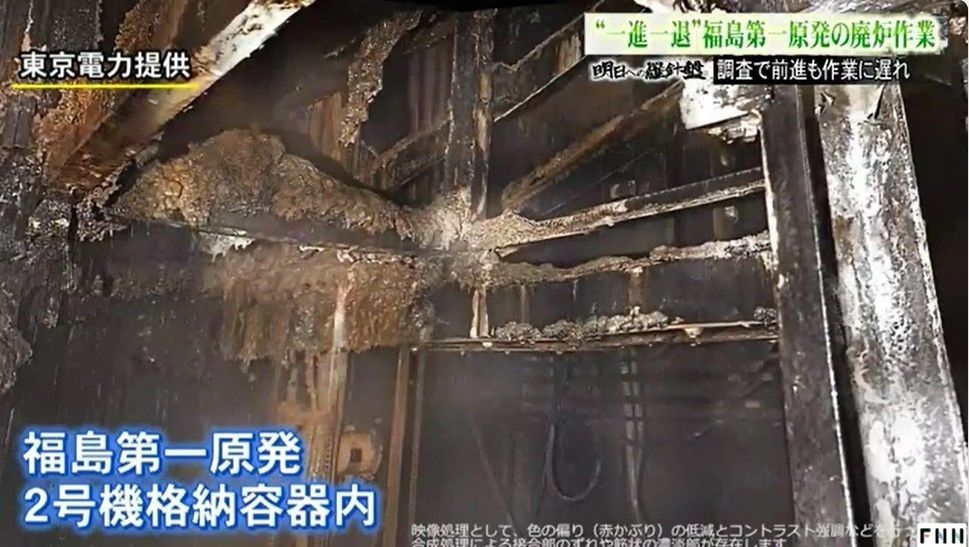
The nuclear fuel debris collected on a trial basis from a crippled reactor at the Fukushima No. 1 nuclear power station weighs 0.7 gram, Tokyo Electric Power Company Holdings said Friday.
The collected substance will be analyzed at four facilities, including the Japan Atomic Energy Agency, for research toward full-scale extraction of nuclear fuel debris from reactors at the Tepco plant in Fukushima Prefecture…………………..
The company plans to spend the next few days preparing for the transportation of the fuel debris to the four facilities.
The four facilities will share the nuclear fuel debris and analyze its components and hardness over several months to a year.
TEPCO collected the debris from the No. 2 reactor Thursday, about two months after the trial work was launched Sept. 10. It was the first time that fuel debris has been removed from a damaged reactor at the Fukushima No. 1 plant.
A total of about 880 tons of nuclear debris, a mixture of melted fuel and reactor parts, is believed to remain in the No. 1 to No. 3 reactors………
https://www.japantimes.co.jp/news/2024/11/09/japan/fukushima-tepco-nuclear-debris/
Tepco removes [a tiny sceric]of nuclear fuel debris from Fukushima disaster site
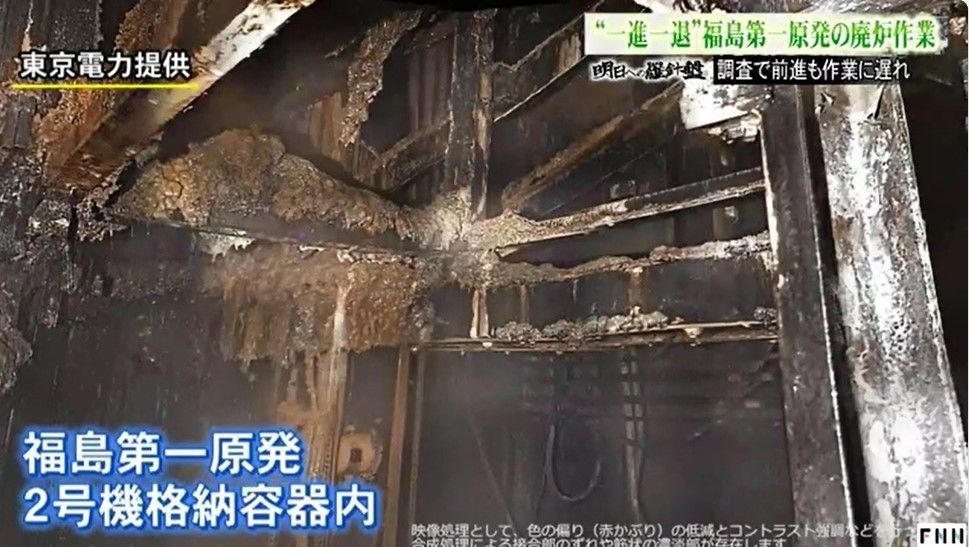
The whole process is expected to cost around ¥23 trillion ($149 billion) and take decades to complete. About 880 tons of radioactive material, like melted fuel and metal cladding, are said to be stuck at the bottom of the three reactors at the plant.
By Shoko Oda, Bloomberg, Japan Times 7th Nov 2024
https://www.japantimes.co.jp/news/2024/11/07/japan/tepco-debris-removal-demonstration/
Tokyo Electric Power Company Holdings says it has removed nuclear fuel debris left inside a reactor in a demonstration at its Fukushima No. 1 power plant, 13 years after a meltdown there.
Radioactive debris was removed from the Unit 2 reactor at the plant and was placed inside a sealed container for transportation, the power producer said in an emailed statement on Thursday.
The demonstration is part of Tepco’s cleanup plan for the site, after the March 2011 Great East Japan Earthquake and tsunami overwhelmed the facility and led to the worst nuclear disaster since Chernobyl. The whole process is expected to cost around ¥23 trillion ($149 billion) and take decades to complete. About 880 tons of radioactive material, like melted fuel and metal cladding, are said to be stuck at the bottom of the three reactors at the plant.
Tepco, which is decommissioning the plant alongside the government, is using a robotic arm that looks like a fishing rod with a claw grip to remove a small sample of the nuclear debris. The company had planned to remove just 3 grams as part of the demonstration.
The removed debris is set to be transported to Japan Atomic Energy Agency’s research facility for analysis, according to Tepco’s website.
The retrieval process began in September but faced challenges. A camera attached to the robotic arm stopped working, forcing Tepco to suspend the demonstration to replace the camera.
Robot Removes First Bit Of Fukushima’s Nuclear Fuel Debris – Just 880 Tons More To Go
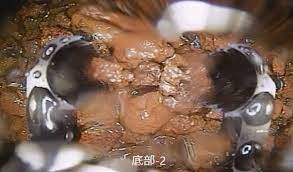
The radioactive ruins are still far too dangerous for humans.
Tom Hale, IFL Science 6th Nov 2024, https://www.iflscience.com/robot-removes-first-bit-of-fukushimas-nuclear-fuel-debris-just-880-tons-more-to-go-76669
robot has delved into the radioactive ruins of Fukushima to retrieve a tiny chunk of spent nuclear fuel. It’s the first time solid fuel debris has been removed from the plant – but they’ve still got a hell of a long way to go: 880 tons of the stuff to be precise.
The remotely operated robotic arm, equipped with a telescopic camera, was able to grasp and retrieve a “small amount of fuel debris” from the floor of Unit 2’s reactor on October 30, according to the plant’s operator Tokyo Electric Power Company Holdings (TEPCO).
“From the results of primary containment vessel internal investigations, we have deduced that the accumulated debris on the surface of the floor inside the pedestal is solidified molten material that consists of fuel elements and also may contain a lot of metal,” TEPCO said in a statement.
The fuel debris will now be taken away from the Fukushima site where scientists will analyze it to gain further insight into how to remove the rest of the debris.
“By analyzing the attributes of the sampled fuel debris we will directly ascertain information such as the composition of debris at the sampling location and radioactivity density,” added TEPCO……………………………………………………………..
It’s estimated that the three impacted reactors contain an estimated total of 880 tons of melted fuel debris, all of which TEPCO hopes to remove during their decommissioning effort by the year 2031. The latest retrieval of a small chunk of radioactive debris is just the beginning of the mammoth feat ahead.
Along with solid debris, the decommissioning project has also had to deal with the colossal quantities of radioactive water that accumulated after being used to cool the damaged reactor cores. In August 2023, Japan began releasing some of the treated wastewater into the Pacific Ocean, much to the annoyance of their neighbors.
TEPCO has expressed hope the entire clean-up operation will be completed in 30 to 40 years, although some speculate the target is overly optimistic.
Senior Journalist
1
Can quake-prone Japan ever embrace nuclear energy again?
Japan Times, By River Akira Davis and Hisako Ueno. The New York Times 4 Nov 24
A decade after one of the most devastating atomic energy disasters in history, Japan was finally getting closer to reviving nuclear power.
Around 2022, a majority of the public began to express support for restarting the nation’s nuclear plants, most of which have remained offline since an earthquake and tsunami caused a nuclear meltdown in Fukushima Prefecture in 2011. The governing Liberal Democratic Party pushed forward with plans to not only restart idled plants, but also build new ones.
The LDP made an urgent call to advance nuclear energy, which it said would help the heavily fossil-fuel-dependent country meet growing energy demands and fulfill its pledge to cut carbon emissions.
Then, this year, a series of disasters reminded many in Japan of their deep fears about nuclear energy, and the LDP lost their majority in the influential lower chamber of parliament. The fate of nuclear power in the country is again uncertain.
In January, the country’s deadliest earthquake in over a decade struck the Noto Peninsula. More than 400 people died, and many buildings were damaged, including an idled nuclear power plant.
In August, a tremor in southern Japan prompted experts to warn that the long-anticipated Nankai Trough megaquake, predicted to kill hundreds of thousands, could be imminent.
“With earthquakes erupting across the country, it is so clear that nuclear power is a harm to our safety,” said Hajime Matsukubo, secretary-general of the Citizens’ Nuclear Information Center in Tokyo. “This was made evident in 2011 and again during the Noto earthquake.”
A poll conducted by the Mainichi Shimbun newspaper a few months after the Noto earthquake revealed that 45% of respondents opposed restarting Japan’s nuclear plants, surpassing the 36% who supported it.
After the LDP’s losses in parliamentary elections Sunday, the party has less than a month to form a minority government or recruit other allies to regain a majority. The Constitutional Democratic Party of Japan, which won the second-most seats behind the LDP in the recent election, strongly opposes plans for Japan to build new nuclear reactors.
Within the next five months, Japan will release a revised energy plan that will define the nation’s target energy mix heading toward 2040. That means that the nascent government — in whatever shape it ultimately assumes — will be forced to confront two long-standing questions that have proved largely impossible to reconcile.
Is nuclear energy, widely considered [?] clean and [?] affordable, the best option for Japan — a nation heavily dependent on fossil fuels yet prone to frequent earthquakes and tsunamis? And if so, how can government leaders sell this to a populace still haunted by the memories of nuclear disaster?……………………………………………………………………………. https://www.japantimes.co.jp/news/2024/11/02/japan/society/nuclear-fears-quake-prone-japan/
Japanese nuclear reactor that restarted 13 years after Fukushima disaster is shut down again
A Japanese nuclear reactor that restarted last week for the first time in more than 13 years after it survived a massive earthquake and tsunami that badly damaged the nearby Fukushima nuclear plant has been shut down again due to an equipment problem
Mari Yamaguchi, 4 Nov 24, https://www.independent.co.uk/news/ap-japanese-tokyo-fukushima-b2640761.html
A Japanese nuclear reactor that restarted last week for the first time in more than 13 years after it had survived a massive 2011 earthquake and tsunami that badly damaged the nearby Fukushima nuclear plant was shut down again Monday due to an equipment problem, its operator said.
The No. 2 reactor at the Onagawa nuclear power plant on Japan’s northern coast was put back online on Oct. 29 and had been expected to start generating power in early November.
But it had to be shut down again five days after its restart due to a glitch that occurred Sunday in a device related to neutron data inside the reactor, plant operator Tohoku Electric Power Co. said.
The reactor was operating normally and there was no release of radiation into the environment, Tohoku Electric said. The utility said it decided to shut it down to re-examine equipment to address residents’ safety concerns. No new date for a restart was given.
The reactor is one of three at the Onagawa plant, which is 100 kilometers (62 miles) north of the Fukushima Daiichi plant where three reactors melted following a magnitude 9.0 earthquake and tsunami in March 2011, releasing large amounts of radiation.
The global nuclear industry has no idea how to decommission Fukushima nuclear plant, but hopes that a tiny robot might help
Robot retrieves radioactive fuel sample from Fukushima nuclear reactor site
Plant’s owners hope analysis of tiny sample will help to establish how to safely decommission facility
Kevin Rawlinson and agency, Sun 3 Nov 2024
A piece of the radioactive fuel left from the meltdown of Japan’s tsunami-hit Fukushima Daiichi nuclear power plant has been retrieved from the site using a remote-controlled robot.
Investigators used the robot’s fishing-rod-like arm to clip and collect a tiny piece of radioactive material from one of the plant’s three damaged reactors – the first time such a feat has been achieved. Should it prove suitable for testing, scientists hope the sample will yield information that will help determine how to decommission the plant.
The plant’s manager, Tokyo Electric Power Company Holdings (Tepco), has said the sample was collected from the surface of a mound of molten debris that sits at the bottom of the Unit 2 reactor’s primary containment vessel.
The “telesco” robot, with its frontal tongs still holding the sample, returned to its enclosed container for safe storage after workers in full hazmat gear pulled it out of the containment vessel on Saturday. But the mission is not over until it is certain the sample’s radioactivity is below a set standard and it is safely contained.
If the radioactivity exceeds the safety limit then the robot must return to find another piece, but Tepco officials have said they expect the sample will prove to be small enough.
The mission started in September and was supposed to last two weeks, but had to be suspended twice.
A procedural mistake held up work for nearly three weeks. Then the robot’s two cameras, designed to transmit views of the target areas for its operators in the remote control room, failed. That required the robot to be pulled out entirely for replacement before the mission resumed on Monday.
Fukushima Daiichi lost its cooling systems during the 2011 earthquake and tsunami, causing meltdowns in three of its reactors. An estimated 880 tons of fuel remains in them, and Tepco has carried out several robotic operations.
Tepco said that on Wednesday the robot successfully clipped a piece estimated to weigh about 3 grams from the area underneath the Unit 2 reactor core, from which large amounts of melted fuel fell during the meltdown 13 years ago.
The plant’s chief, Akira Ono, said only the tiny sample can provide crucial data to help plan a decommissioning strategy, develop necessary technology and robots and retroactively establish exactly how the accident had developed.
The Japanese government and Tepco have set a target of between 30 and 40 years for the cleanup, which experts say is optimistic. No specific plan for the full removal of the fuel debris or its final disposal has been decided.
Onagawa nuclear plant’s restart sparks concerns over evacuation routes
Located on the intricate ria coast of the Oshika Peninsula, Tohoku Electric Power’s Onagawa nuclear power plant — which was restarted on Tuesday — sits amid a maze of narrow, winding mountain roads and remote islands with few transportation options.
When the Great East Japan Earthquake struck in 2011, several sections of evacuation routes along prefectural roads were closed. Residents now fear about their ability to escape if another disaster hits.
According to Miyagi Prefecture’s road management division, two main coastal prefectural roads along the peninsula were partially closed after the earthquake due to road surface collapses, while another inland road saw nine landslides that cut off isolated communities for around 10 days………………….(Subscribers only) https://www.japantimes.co.jp/news/2024/10/30/japan/society/onagawa-evacuation-challenges/
1 This Month

of the week – Shut Down Drone Warfare!


Tell the Ukrainian Government to Drop Prosecution of Peace Activist Yurii Sheliazhenko

Petition to revoke the licensing of the Near Surface Nuclear Disposal Facility (NSDF) at Chalk River. https://www.ourcommons.ca/petitions/en/Petition/Details?Petition=e-7247
To see nuclear-related stories in greater depth and intensity – go to https://nuclearinformation.wordpress.com
-
Archives
- April 2026 (44)
- March 2026 (251)
- February 2026 (268)
- January 2026 (308)
- December 2025 (358)
- November 2025 (359)
- October 2025 (376)
- September 2025 (257)
- August 2025 (319)
- July 2025 (230)
- June 2025 (348)
- May 2025 (261)
-
Categories
- 1
- 1 NUCLEAR ISSUES
- business and costs
- climate change
- culture and arts
- ENERGY
- environment
- health
- history
- indigenous issues
- Legal
- marketing of nuclear
- media
- opposition to nuclear
- PERSONAL STORIES
- politics
- politics international
- Religion and ethics
- safety
- secrets,lies and civil liberties
- spinbuster
- technology
- Uranium
- wastes
- weapons and war
- Women
- 2 WORLD
- ACTION
- AFRICA
- Atrocities
- AUSTRALIA
- Christina's notes
- Christina's themes
- culture and arts
- Events
- Fuk 2022
- Fuk 2023
- Fukushima 2017
- Fukushima 2018
- fukushima 2019
- Fukushima 2020
- Fukushima 2021
- general
- global warming
- Humour (God we need it)
- Nuclear
- RARE EARTHS
- Reference
- resources – print
- Resources -audiovicual
- Weekly Newsletter
- World
- World Nuclear
- YouTube
-
RSS
Entries RSS
Comments RSS
 nuclear-news