UK govt and Japan’s TEPCO to work together on robots to clean up Sellafield an Fukushima’s nuclear pollution
Professional Engineering, Dangerous radioactive material from Fukushima and Sellafield will be retrieved by robots thanks to a new collaboration between the UK and Japan.
The £12m LongOps project is also aimed at automating aspects of nuclear fusion energy production, alongside decommissioning goals.
The four-year research collaboration will use long-reach robotic arms to make decommissioning faster and safer at Tepco’s Fukushima Daiichi reactors in Japan and at Sellafield in the UK.
The Fukushima Daiichi nuclear disaster saw a triple meltdown, three hydrogen explosions and the release of radioactive material after the loss of reactor core cooling following the 2011 earthquake and tsunami.
The Sellafield site in Cumbria is used for nuclear fuel reprocessing and storage, as well as ongoing decommissioning of previous reactors and facilities. There were 21 serious incidents of off-site radiological releases at Sellafield between 1950 and 2000, according to a paper in the Journal of Radiological Protection.
The new project will be led by the UK Atomic Energy Authority’s Remote Applications in Challenging Environments (Race) facility. It will be funded equally by UK Research and Innovation (UKRI), the UK Nuclear Decommissioning Authority (NDA) and Japan’s Tokyo Electric Power Company (Tepco). ….
The decommissioning of legacy nuclear facilities and fusion facilities are complex large-scale projects that are time-intensive to accomplish safely. Using robotics allows teams to keep human workers out of danger. …… https://www.imeche.org/news/news-article/uk-and-japan-tackle-legacy-of-fukushima-and-sellafield-with-robotic-collaboration
India must oppose dumping of radioactive waste into the Pacific, but IAEA and Indian govt downplay the dangers
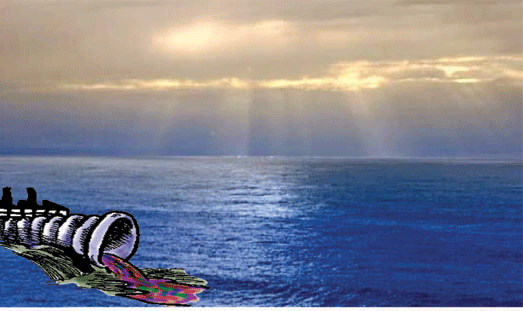 Silence on Fukushima Disaster Exposes our Approach to Nuclear Safety and Why India must Oppose Dumping of Radioactive Water Into the Pacific, BYSONALI HURIA, JANUARY 17, 2021 Next year, the operator of the tsunami-hit Fukushima nuclear plant would start releasing radioactive water into the Pacific Ocean. A number of nations are up in arms against it, but Indian authorities are not rising to the occasion to protect its most vulnerable against the impending disaster.
SONALI HURIA explains what is at stake for people and the environment.
THE new year has begun on a grim note with a toxic gas leak at the Rourkela Steel Plant in Odisha on 6 January, which claimed the lives of four contractual workers. This is the latest in a disconcerting string of industrial accidents in India over the last few years, which have remained peripheral to the mainstream media narrative.
It appears that India has learned precious little from the Bhopal gas disaster, which has ebbed from public memory even as the accident site remains contaminated and survivors continue to await an elusive justice.
Against this backdrop, as we approach the tenth anniversary of the Fukushima nuclear disaster, it may be pertinent to think of what a nuclear accident might mean for the country’s already shoddy industrial safety record and systemic inadequacies, especially as the Fukushima disaster now poses a formidable new challenge to which India’s response, so far, has been active denial and muted silence.
“Fukushima” has become synonymous with the devastating and ongoing nuclear accident that occurred off the eastern Pacific coast of Japan in 2011.
Japan’s nuclear regulator, the Nuclear Regulation Authority (NRA) reportedly stated as recently as in December 2020 that the reactor buildings of the Fukushima Daiichi nuclear power plant continue to record “lethal” levels of radiation, thus posing a “serious challenge” to decommissioning efforts.
DISPOSING CONTAMINATED WATER
Among the many vexing problems precipitated by the accident is the disposal of the contaminated water from the beleaguered nuclear plant.
The acerbic debate within Japan on the disposal of this radioactive water came to a head recently when the Japanese government made it clear that beginning 2022, the operator of the Fukushima plant, the Tokyo Electric Power Company (TEPCO), would start releasing radioactive water from the wrecked plant into the Pacific Ocean—a task envisaged to be accomplished over the next several years as part of larger decommissioning efforts.
Since the devastating earthquake and tsunami off the Pacific coast of Tōhoku triggered a meltdown at the three units of the nuclear plant in March 2011, cleanup efforts have required, among other things, the pumping of tens of thousands of tons of water to cool the smouldering reactor fuel cores.
However, this has led to a steady on-site accumulation of heavily contaminated water—as of 2020, TEPCO has nearly 1.23 million metric tons (and counting) of highly radioactive wastewater on its hands that has been stored in nearly 1,044 tanks…………
LOOMING DANGERS
Greenpeace International has warned that carbon-14, which TEPCO affirmed is present in the contaminated tank-water for the first time in August 2020, has the “potential to damage human DNA”.
Tokyo’s decision has understandably ruffled feathers globally.
The Republic of Korea, China, and Chile, state parties to the London Convention on the Prevention of Marine Pollution by Dumping of Wastes and Other Matter, have repeatedly called for international deliberation and resolution of the problem, even as South Korea, which has banned all seafood imports from the region since the accident, has formally called upon the International Atomic Energy Agency (IAEA) to dissuade Japan. While the North Korean state media described the proposed discharge as a “criminal act”, a coalition of environmental and citizens’ groups from Taiwan petitioned the Japanese government in November 2020, expressing their objections.
The IAEA has confined itself to assisting the Japanese government rather than question or evaluates the proposed water disposal plan. It has demonstrated yet again that it is not the international nuclear watchdog many believe it to be.
UN Special Rapporteurs on hazardous wastes, right to food, rights to assembly and association, and the rights of indigenous people have also urged Japan not to use the present pandemic as a “sleight of hand” to release the radioactive water without any credible consultation within and outside Japan regarding a decision that will have a long-lasting impact on the environment and human health.
DANGERS FOR INDIA
The stakes for India cannot be overstated either.
In an unanticipated moment of candidness, nuclear health scientists from within the Indian establishment—the Defence Research Development Organisation (DRDO) and the All India Institute of Medical Sciences (AIIMS)—have warned that the release of the Fukushima wastewater containing “radioactive isotopes such as cesium, tritium, cobalt and carbon-12” will prove disastrous for human and aquatic health across the world’s coastal belts by crippling fishing economies and causing a “spectrum of diseases, including cancer”……..
the Indian government, in particular, its nuclear establishment, has consistently downplayed the risks associated with nuclear energy to public and environmental health, even labelling public concerns surrounding radiation “myths”, and whose first reactions to the Fukushima nuclear accident were of impudent denial.
… EAS Sarma, former Union Power Secretary to the Government of India, has exhorted the Department of Atomic Energy (DAE) to apprise the Prime Minister’s Office of the “far-reaching implications” of the proposed release of the radioactive Fukushima water, and for India to take a firm stand at the IAEA against this unilateral decision of the Japanese government.
TEPCO has reportedly already been draining hundreds of tonnes of contaminated water into the Pacific Ocean. Noting with dismay the abject silence of the DAE and India’s Environment Ministry in this regard, Sarma identifies the lack of a robust nuclear regulatory body or mechanism in India as responsible for this lack lustre approach to an issue of great import for the health of the people of the country and the larger marine ecology of the region.
Domestically, it is time to pause and think whether India is equipped to handle an accident of the scale of Fukushima—a nuclear Bhopal?
Sarma’s letter to the Cabinet Secretary also underscores the need for the government to recognise the magnitude of the devastation wrought by nuclear accidents, the inability of TEPCO to handle the disaster even a decade since its occurrence, and thus to pause its own plans “to import reactors on a large scale and enlarge nuclear power generation capacity”.
…..…DOWNPLAYING THE DANGERS
In effect, therefore, the IAEA has demonstrated yet again that it is not the international nuclear watchdog many believe it to be. In her fascinating new account of the Chernobyl nuclear accident, Manual for Survival, the environmental historian, Kate Brown, explores the IAEA’s complicity in downplaying the accident and denying radiation impacts in exposed Chernobyl children and even asserting that “radiation anxiety” stems from “irrational fears”, as nuclear technocrats across the globe are prone to doing.
In the tenth year of the ongoing Fukushima accident, therefore, it is imperative that a dialogue be initiated on the need for an effective international nuclear monitoring regime that isn’t also tasked with the responsibility of promoting nuclear energy.
Domestically, it is time to pause and think whether India is equipped to handle an accident of the scale of Fukushima—a nuclear Bhopal?
At the very least, it is time India’s government demonstrates that it is willing and able to deploy its purportedly surging international stature and influence under Prime Minister Narendra Modi to protect the country’s environment and the health of its vulnerable communities against the Fukushima water release, which appears a near certainty now. https://www.theleaflet.in/silence-on-fukushima-disaster-exposes-our-approach-to-nuclear-safety-and-why-india-must-oppose-dumping-of-radioactive-water-into-the-pacific/#
Thyroid cancer at ages 0 and 2 at the time of the nuclear accident-Health survey in Fukushima Prefecture January 2021
Thyroid cancer at ages 0 and 2 at the time of the nuclear accident-Health survey in Fukushima  Prefecture Posted by: ourplanet Posted on: Thu, 01/14/2021 –00:46 http://ourplanet-tv.org/?q=node/2537 (Japanese only)
(Translated from Google) The “Prefectural Health Survey” Review Committee was held in Fukushima City on the 15th to discuss the health survey of Fukushima citizens following the accident at the Fukushima Daiichi Nuclear Power Plant. For the first time, it was discovered that two infants, a 0-year-old girl and a 2-year-old girl at the time of the accident, were diagnosed with thyroid cancer.
Material https://www.pref.fukushima.lg.jp/site/portal/kenkocyosa-kentoiinkai-40.html

This time, the result of the fourth round of thyroid examination until June last year was newly announced. The number of children diagnosed with suspected thyroid cancer by fine needle cytology increased by 6 from the previous time to 27, and the number of children who underwent thyroidectomy increased by 3 from the previous time to 16 children. Up to now, 252 patients have been diagnosed with thyroid cancer or suspected thyroid cancer from prior examination, of which 203 have undergone thyroid surgery. 202 people, excluding one, were confirmed to have thyroid cancer.
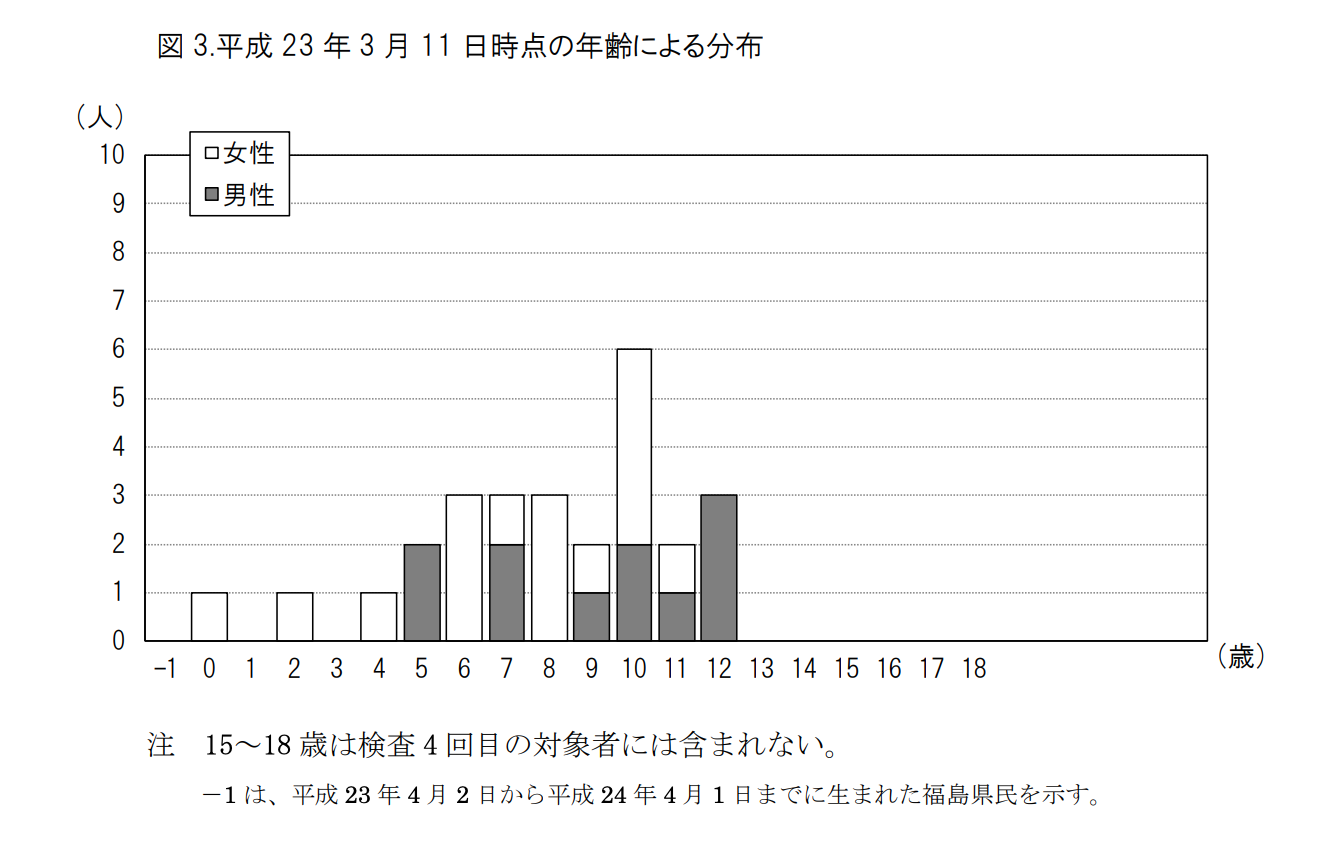
In the fourth round of examination, it was found for the first time that a girl who was 0 years old and a girl who was 2 years old at the time of the accident were diagnosed with thyroid cancer. Since the age of the examination is not the actual age but the grade, the ages at the time of the examination are 9 years old (3rd grade of elementary school) and 11 years old (5th grade of elementary school), respectively. According to the previous test results of 27 patients, 5 patients had “A1 judgement” without nodules or tumors, and 16 people had “A2 judgement” with nodules of 5 mm or less or cysts of 2 cm or less, 5 mm or more. 5 people had a “B-judgement” with nodules or cysts of 2 cm or more, and 1 had not been examined. He had the smallest tumor size of 6.1 mm and the largest tumor was 29.4 mm.
What stands out in the results of the fourth round of examination is the high dose of radiation for people diagnosed with thyroid cancer. Of the 27 patients diagnosed as suspected of being malignant by fine needle cytology, 11 patients (40.7%) who submitted the basic survey questionnaire had an exposure dose of less than 1 mSv in 2 patients (18.1%) 4 months after the accident. The number of children exposed to 2mSv or more was the highest, with 4 (36.3%) from 1mSv to 2mSv and 5 (45.5%) from 2mSv to 5mSv. In particular, the two boys who were five years old at the time of the accident were both over 2mSv.
According to the results of the basic survey of all Fukushima residents, 62.2% are less than 1mSv, 31.6% are from 1mSv to 2mSv, and 5.5% are from 2mSv to 3mSv. Very different.

To review the mass examination at school At this review committee, a major shift was made to reviewing simultaneous examinations at schools. The test, which has found more than 200 people with thyroid cancer, raises the theory of “overdiagnosis” among experts who deny the effects of radiation exposure, saying that they are finding thyroid cancer that they do not have to find. There is a growing opinion that the mass examination at school should be reviewed.
Based on these opinions, the review committee decided to conduct an interview survey at schools in the prefecture on August 31st last time. This time, there was a report on the results of a survey conducted by the prefecture at 26 elementary and junior high schools and high schools in the prefecture.
At many schools, thyroid examinations were performed during class hours, criticized by Shoichiro Tsugane, a member of the National Cancer Center, saying, “You can’t take this without a strong will.” “The benefits of the test are not except that you can be reassured when you get negative. The discovery of thyroid cancer has little benefit in avoiding death or poor quality of life, especially when you are diagnosed with thyroid cancer. “I think it will be a huge disadvantage for those who do,” he said. “Thyroid examination in a group of asymptomatic healthy people is not desirable. I asked him to stop the mass examination at school. ..
In addition, Professor Toshiya Inaba of Hiroshima University also cut out at the school examination that “they are left behind” and said, “Parents are not worried. The school rents the venue. The prefectural medical college has an inspection. I understand each position well, but in the end, it is the people who are left unattended. ” He emphasized that the prefectures and medical colleges that are the subjects of the survey should explain more to children and students the significance of the test and the fact that it can be rejected.

In response, Professor Satoshi Tomita of Fukushima University argued head-on. He criticized that “many Fukushima residents have anxiety about their health” and that members of the Prefectural Health Investigation Committee, especially members outside Fukushima Prefecture, are calling for the cancellation or reduction of examinations. He said that thyroid examination is a way to relieve the anxiety of Fukushima residents, “the anxiety of Fukushima residents, especially those with children, is left behind.” “It is dangerous to go in the direction of reduction easily.” “Thinking” was pointed out.
Ikuko Abe, chairman of the Fukushima Clinical Psychologists Association, who also lives in Fukushima Prefecture and has a close relationship with schools, agrees with this, saying, “I agree with Professor Tomita’s opinion.” “Given the anxiety about radiation that Fukushima residents have, thyroid examinations are very reassuring,” she said. “Reducing or eliminating the examinations still takes the opposite position. I want you to do it. “
What caught my eye in the discussion was the presence of Katsushi Tahara, director of the Ministry of the Environment’s Health and Welfare Department. The members of the review committee from the Ministry of the Environment have not said much, but have played a role in important aspects of policy change. This time too, Mr. Tahara considers the fact that the school is cooperating with the implementation of the examination, such as encouraging households whose delivery to Fukushima Medical University is delayed to submit again when the deadline has passed. About 30% of the children undergoing medical examinations at school were asked intensively about this point, such as confirming that the school side took over the collection of consent forms.
To conduct hearings with the person to be inspected Following a survey of the school, the prefecture proposed to have a place to hear directly from the children and students who had been inspected. Questions were raised about the representativeness of the interviewees, and there was an opinion requesting a quantitative survey such as a questionnaire, but the prefecture’s proposal was approved because the survey took too long.
Regarding this “interview survey,” there was a harsh debate over the neutrality of the content, such as the opinion that a pilot study was unavoidable and that the voices of patients diagnosed with thyroid cancer should also be heard. With the strong push back of the constellation chairman, it was decided that the selection of the target audience and the holding method would be left to the chairperson and the prefecture. The results will be reported at the next meeting.
In response to the further shift to reviewing mass screening at school in this “interview,” Chiba parent and child of the “thyroid cancer support group Hydrangea Association” that supports families with thyroid cancer said, “Accident Among the 0-year-old and 2-year-old children at that time, a child with thyroid cancer appeared and my chest hurts. Thyroid cancer also has recurrence and metastasis, and early detection and early treatment are beneficial for the child. Given that the cancer was found in a school test, there can be no argument to eliminate the school test. ” The group has made offers to the prefecture three times in the past and opposes the reduction of inspections.
13.7 million sign petition urging all nations to ban nuclear weapons

 13 million sign petition urging all nations to ban nuclear weapons, http://www.asahi.com/ajw/articles/14106594, By RYO SASAKI/ Staff Writer, January 14, 2021 A petition by an organization of survivors of the 1945 atomic bombings of Hiroshima and Nagasaki urging all nations to sign the U.N. treaty banning nuclear weapons has garnered a whopping 13.7 million signatures.
The Appeal of the Hibakusha association made the announcement during an online news conference on Jan. 13 after submitting the petition to the United Nations on Jan. 8.
The treaty goes into effect on Jan. 22.
The association collected the signatures on the streets, internet and elsewhere before finishing the effort at the end of December.
A total of 1,497 incumbent and former prefectural governors and mayors in Japan added their names to the petition. The petition also drew support from numerous people in countries other than Japan.
The campaign association, comprised of members of Nihon Hidankyo (Japan Confederation of A- and H-Bomb Sufferers Organizations) and other organizations, began their activities to achieve a nuclear-free world “while we still live” in April 2016.
The Treaty on the Prohibition of Nuclear Weapons was adopted in July 2017. Since then, the campaign has been asking all nations to join the treaty and advocating for it to take effect as early as possible.
The campaign to collect signatures was initially to end by September 2020, but was extended after it appeared that the treaty was likely to go into effect in the near future.
The association collected more than 1 million signatures over the additional three months, mainly online.
Why Japanese people should say ‘Sayonara’ to nuclear energy- a nun’s voice for nuclear victims

Sister Reiley, who has served as a missioner in Japan since 1968, was referring to the accident at Fukushima-Daichi Nuclear plant, which occurred on March 11, 2011. The accident was triggered by a devastating tsunami that followed a powerful 9.0 earthquake that hit a large part of Japan’s northern coast.
The quake and tsunami left more than 18,000 people dead or missing and hundreds of thousands of houses and businesses destroyed, according to Japan’s National Police Agency. More than 160,000 people fled the region near the nuclear plant because of the meltdown and more than 40,000 are still unable to return home due to radiation contamination.
Last June, Sister Reiley took the 3.5-hour train ride from Tokyo, where she lives, to Fukushima to give this Maryknoll reporter a tour around Haramachi, a town near where the Fukushima-Daichi nuclear accident happened.
The area had the feeling of a sci-fi apocalyptic movie: A ghost town with abandoned farmlands that could not be used; streets blocked with fences and no-trespassing signs; decaying houses damaged by the earthquake that cannot be repaired because they are contaminated; Geiger counter boxes under the street signs to measure the level of radioactivity; thousands of huge black vinyl bags filled with radioactive dirt; security guards wearing masks and radioactive protective gear at checkpoints, only allowing entrance to radioactive waste cleaning crews—many of them immigrants who are temporarily hired to do a job that could harm their health. …….
Sister Reiley has striven to show God’s love for the people by speaking out against nuclear energy in a country whose 52 nuclear plants, she believes, pose an enormous threat to human life.
After the triple disaster in 2011, Sister Reiley responded to the Japanese Catholic Church’s call for volunteers. “Initially I went several times a year to several different Japan Caritas bases wherever the need was at the time,” says Sister Reiley. “But gradually towns far away from the reactor returned to normal, (except) Haramachi where the need is still great for the elderly, differently abled and those people in a low economic bracket. They don’t have the means to move away from the reactor area.”
…….. Her concern about nuclear energy began in 1979 in her native Schuylkill County, Pa. She was visiting home from her mission in Japan when there was a reactor meltdown at the Three Mile Island nuclear plant in nearby Dauphin County. It is considered the most serious nuclear accident in U.S. history, according to the U.S. Nuclear Regulatory Commission.
“We’re poisoning our earth,” Sister Reiley remembers her father saying shortly after the nuclear accident.
“In 1999, there was a nuclear accident at the Tokaimura [nuclear facility] in Ibaraki Prefecture,” Sister Reiley says. “About two years after that accident happened, I asked the families [at the cancer hospital], ‘Where are you from?’ ‘Ibaraki.’ ‘Where are you from?’ ‘Ibaraki.’”
Out of the 24 beds for children with cancer at the hospital, at the time, seven children were from Ibaraki, explains the missioner. “But nobody can document that and say absolutely, ‘that’s why [the nuclear accident] they got cancer’.”
Still, the missioner works tirelessly to raise awareness about the dangers in nuclear energy Nearly 25 years after the 1986 nuclear accident in Chernobyl, in the former Soviet Union, Sister Reiley read an article, in a Japanese newspaper, about the high incidences of cancer linked to the nuclear accident. The report cited a study conducted by an international team of researchers led by the National Cancer Institute. That gave the Maryknoll sister an opportunity to question what happened at the nuclear facility in Japan. She visited the newspaper headquarters to speak to the editors.
“Won’t you please do some research about Tokaimura? About the accident that happened in Ibaraki?” she asked. The paper did not respond to her request. She was undaunted.
That sombre day in June in Haramachi, as we drove back to the train station, we saw a farm with cattle and stopped for a lesson from Sister Reiley. She explained that the government had asked the owner to kill the cattle. The cows’ milk could not be sold nor could the cows be slaughtered to sell their meat because they were contaminated. The cows, she continued, were innocent victims of problems caused by human beings.
“But this wonderful man asked the government to let the cows live a natural life and die a natural death,” says Sister Reiley.
Then she translated a sign at the cattle ranch. “We lived here with no fear of nuclear energy and now we realise that we lost something that can never be returned to us and we want people to understand that we have to say sayonara, goodbye, to nuclear energy.” https://catholicoutlook.org/jana-voice-for-nuclear-victims/
High court drops TEPCO’s appeal against order for compensation to affected Fukushima worker
| High court drops TEPCO’s appeal against order for compensation to affected Fukushima worker |
http://www.japan-press.co.jp/modules/news/index.php?id=13357, December 17, 2020
In the court battle, the man, who worked for the TEPCO subsidiary Kandenko at the time of the Fukushima nuclear disaster, stated that he experienced anxiety over health problems due to radiation exposure during emergency work he was assigned to do at the crippled nuclear power plant. According to the worker, he was assigned to emergency work that included connecting cables to a power panel in the basement of the No. 3 reactor’s turbine building. He suffered external exposure to radiation of up to 10.81 mSv and internal exposure of 5.8 mSv. The worker demanded a total of 1.1 million yen in damage from his company and TEPCO on the grounds that they failed to fulfill their responsibility to ensure workers’ safety.
At the appeal hearing, TEPCO demanded that the district court decision be reviewed because the amount of radiation which the worker received was less than that needed to be compensated.
The high court ruling pointed out that it is generally accepted that exposure to some levels of radiation may increase the risk of health problems such as getting cancer. Stating that the plaintiff’s health anxiety is understandable, the court turned down the utility’s demand.
At a press conference after the ruling, lawyer Hirota Tsuguo on behalf of the plaintiff’s legal team said, “It is significant that the court ordered TEPCO, which has dominant power in the nuclear power-related industry, to compensate the worker. The company should abide by the court judgement.”
Past related article:
> Radiation-exposed worker sues TEPCO [May 8, 2014]
In March 2011 Japan’s government considered evacuating the then Emperor Akihito further away from Fukushima
|
Emperor’s evacuation to Kyoto weighed after Fukushima nuclear disaster , Japan Times, 3 Jan 2021 The government led by the now-defunct Democratic Party of Japan unofficially proposed that then-Emperor Akihito evacuate to Kyoto or somewhere further west immediately after the eruption of the March 2011 Fukushima nuclear crisis, a former administration official has said.However, the Imperial Household Agency flatly dismissed the idea, saying there was “no way” the emperor would do so at a time when people were not evacuating Tokyo, leading to the government of Prime Minister Naoto Kan to give up the proposal.
Several former senior officials at the Prime Minister’s Office separately said the administration at the time also briefly considered evacuating Prince Hisahito, the son of Crown Prince Akishino and Crown Princess Kiko, from Tokyo to Kyoto…….. https://www.japantimes.co.jp/news/2021/01/02/national/emperor-fukushima-nuclear/ |
|
Fukushima nuclear clean-up hugely affected by discovery of lethal radiation levels

|
Lethal Levels of Radiation Found in Damaged Fukushima Reactor Will Have ‘Huge Impact’ on Shutdown, Regulators Warn https://www.commondreams.org/news/2020/12/30/lethal-levels-radiation-found-damaged-fukushima-reactor-will-have-huge-impact The radiation levels reported around shield plugs at two reactors are high enough to kill a worker exposed for even an hour. Brett Wilkins, staff writer
In what Japanese regulators on Wednesday called an “extremely serious” development, lethal levels of radiation have been recorded inside the damaged reactor building at the Fukushima No. 1 nuclear power plant, threatening the shutdown and decommissioning of the site of the second-worst peacetime nuclear disaster in history.”This will have a huge impact on the whole process of decommissioning work.” —Toyoshi Fuketa, Nuclear Regulation Authority According to The Asahi Shimbun, Japan’s Nuclear Regulation Authority (NRA) reported that massive amounts of radioactive materials have been found around shield plugs of the containment vessels in the No. 2 and No. 3 reactors. NRA officials estimated radiation levels at 10 sieverts per hour—enough to kill a worker who spends just one hour there. Decommission of the reactor requires workers to remove the shield plugs, which block radiation from the reactor core during normal plant operation. This discovery has forced officials to reconsider their shutdown plans. NRA chair Toyoshi Fuketa said that removing the highly irradiated shield plugs made safe retrieval of nuclear fuel debris—an already dangerously daunting task—all the more difficult.. “It appears that nuclear debris lies at an elevated place,” Fuketa said at a news conference earlier this month. “This will have a huge impact on the whole process of decommissioning work.” The latest alarming find is the result of an investigation that resumed in September after a five-year pause in which the NRA took new measurements of radiation levels around the shield plugs at the No. 2 and No. 3 reactors. Tokyo Electric Power Co., the operator of the plant, announced December 24 that nuclear fuel debris removal would be postponed until 2022 or later due to the coronavirus pandemic. As Common Dreams reported in October, Greenpeace and other environmental and anti-nuclear advocates expressed shock and outrage after the Japanese government announced a plan to release stored water from the ill-fated plant into the Pacific Ocean. Greenpeace subsequently released a report claiming that radioactive carbon-14 released into the ocean “has the potential to damage human DNA.” The Fukushima Daiichi disaster—the result of a 2011 earthquake and tsunami that killed more than 15,000 people in northeastern Japan—was the worst nuclear incident since the 1986 Chernobyl meltdown in the former Soviet Union, and the worst in Japan since the United States waged a nuclear war against the country in 1945 that killed hundreds of thousands of people. |
Never give up! 95 year old Hibakusha welcomes the UN nuclear ban treaty
 Hibakusha: A-bomb survivor, 95, never giving up the battle to eliminate nuclear weapons https://mainichi.jp/english/articles/20201229/p2a/00m/0na/032000c
December 30, 2020 (Mainichi Japan) Following news that the Treaty on the Prohibition of Nuclear Weapons would enter into force early in 2021, some 200 people including atomic-bomb survivors, or hibakusha, gathered in front of the Atomic Bomb Dome in the western Japan city of Hiroshima on Oct. 25, 2020 and shared their joy.
But one “face” of the city bombed during World War II, who four years earlier had smiled as he shook hands with Barack Obama, the first U.S. President to visit Hiroshima while in office, was not able to take part. The following hibakusha report, coming 75 years after the atomic bombing of Hiroshima, focuses on the life of this figure, 95-year-old Sunao Tsuboi, who has stood at the forefront of hibakusha activities with an indomitable spirit.
Tsuboi has served as chairman of the Hiroshima Prefectural Confederation of A-bomb Sufferers Organizations (Hiroshima Hidankyo) for the past 16 years. He now spends his days at his home in Hiroshima’s Nishi Ward, where a decorative card bears his creed in calligraphic ink: “Futo Fukutsu — Never give up!”
From around the time the imperial year changed from Heisei to Reiwa in May 2019, Tsuboi’s legs became extremely weak, and he was unable to do without his wheelchair. He has been receiving intravenous drips once a fortnight for cancer, heart disease and anemia. This year he received at least 30 blood transfusions, and it has not been easy for him to get out of bed.
On the day of the atomic bombing on Aug. 6, 1945, Tsuboi suffered burns over his entire body, and he remained unconscious for over 40 days. His sight became impaired in his left eye, and he became critically ill three times. To repay his feeling of indebtedness for being able to live, he became a teacher, and continued to share his experiences with students for over four decades, becoming known as “Pikadon Sensei” — a reference to the flash (pika) and boom (don) of the atomic bomb.
After he retired, he continued to share his experiences both in Japan and overseas, visiting 21 countries including Britain, France, China, India, Pakistan and North Korea, which possess nuclear weapons.
“The color of our skin doesn’t have to be the same. We don’t need borders. Humankind won’t be happy unless we help each other,” Tsuboi says. With his fist raised high, he has continued to call for a world without nuclear weapons.
Tsuboi released comments expressing his joy after he learned that the Treaty on the Prohibition of Nuclear Weapons would enter in force.
“I am filled with excitement, thinking, ‘At long last. This is great.’ It is a major step toward my long-held, earnest desire for nuclear weapons to be banned and eliminated,” he said. At the same time, he noted that states with nuclear weapons, as well as Japan, had not ratified the treaty and said, “The road hereafter may be rough.”
Still, each time I have met Tsuboi, he has repeatedly stated, “I won’t give up until there are zero nuclear weapons. Never give up!”
(Japanese original by Naohiro Yamada, Osaka Photo Group)
Delay in removal of melted nuclear fuel from Fukushima No 1 Power plant, because of the pandemic
|
Pandemic delays melted nuclear fuel removal at Fukushima http://www.asahi.com/ajw/articles/14059716, By YU KOTSUBO/ Staff Writer, December 25, 2020 The government and operator of the Fukushima No. 1 nuclear power plant announced they had abandoned plans to start removing melted nuclear fuel and other contaminated debris from the stricken facility within 2021, citing delayed development in Britain of a robotic arm crucial for the purpose.They explained that the novel coronavirus pandemic was chiefly to blame for the delay.
The government and Tokyo Electric Power Co. had planned to start the hazardous task in 2021 but said Dec. 24 that is no longer feasible. In December 2011, nine months after the triple meltdown triggered by the March earthquake and tsunami disaster, the two parties set a goal of starting to retrieve the melted fuel “within 10 years” so reactor decommissioning could start. Since then, they have had to downsize the scale of debris that can be realistically be retrieved, mainly because the technology does not exist to accomplish such dangerous work. The No. 2 reactor, along with the No. 1 and No. 3 reactors, went into meltdown after tsunami generated by the 2011 Great East Japan Earthquake knocked out cooling systems at the plant. Debris retrieval constitutes the biggest obstacles to deciding how reactor decommissioning will progress in the years ahead. The debris is emitting extremely high levels of radiation, making it difficult to access the site even with robots. Little is known about the state of the debris or its composition. The government and TEPCO revised the timetable last December with the aim of retrieving a few grams of debris on an experimental basis in 2021 from the No. 2 reactor. The No. 2 reactor was chosen because the state of the containment housing is better understood than for the other reactors. Japan approached Britain to develop a special robotic arm because it has more experience in this field. But the work has experienced significant delays because of the COVID-19 pandemic. Trial tests for the robotic arm are planned to be held in Japan next spring or later with retrieval work postponed to 2022 or later. However, many questions remain about the reactor decommissioning of the Fukushima No. 1 nuclear power plant as a whole due to a number of factors such as wrecked equipment at the site. For example, initial projections to complete the removal of used nuclear fuel from a fuel pool were delayed for 10 years. However, the government and TEPCO are sticking to their schedule to complete reactor decommissioning between 2041 and 2051. With regard to debris retrieval, this is to be done on a “step-by-step” basis. The two parties on Dec. 24 also announced they will postpone the start of probing the interior of the No.1 reactor’s containment vessel from the second half of fiscal 2020 to fiscal 2021. They have been working to secure a route that will allow robotic equipment to explore the interior but experienced huge hurdles because their current method caused radioactive substances to spread. The accumulated debris in the three reactors is estimated to total about 880 tons. Tentative plans call for increasing the amount of debris to be retrieved gradually after a few grams are collected with a metallic brush attached to the top of the robotic arm and analyzed. |
|
Fukushima nuclear debris removal to be delayed due to pandemic
|
Fukushima nuclear debris removal to be delayed due to pandemic, https://www.japantimes.co.jp/news/2020/12/23/national/fukushima-nuclear-debris-delay/ The operator of the Fukushima No. 1 nuclear power plant, which suffered core meltdowns in 2011, has decided to delay the removal of nuclear debris by about one year from 2021 due to the coronavirus pandemic, sources said Wednesday.The process of removing the melted fuel, the most difficult part of cleaning up the facility, was to begin at the No. 2 reactor in 2021, but the virus spread has stalled tests in the U.K. of a robot arm that is to be used for the removal, the sources said.
Of the Nos. 1 to 3 reactors that experienced meltdowns following a massive earthquake and tsunami, the removal procedure was to start at the No. 2 unit because the operator, Tokyo Electric Power Company Holdings Inc., had the best grasp of its internal condition, they said. Tepco had planned to insert a robot arm into the unit’s containment vessel, from which it would initially extract around 1 gram of the debris at a time, then gradually expand the amount as it works toward removing several kilograms a day. The company was originally scheduled to verify in August the viability of the robot arm in the U.K. and transfer the equipment to Japan in February 2021 so that workers could start training with it. However, the spread of COVID-19 in the U.K. has caused delays, as precautionary measures were taken to limit the number of workers at factories, according to the sources. Tepco is considering doing part of the testing in Japan. The removal process is expected to take several years for the No. 2 unit, which according to one estimate contains 237 tons of debris. Together, the three units are estimated to house around 880 tons of debris. The government and Tepco have said they expect the plant’s decommissioning to be completed between 2041 and 2051. |
|
75% of the Japanese public want Japan to join the Treaty on the Prohibition of Nuclear Weapons
|
Japanese Public Opinion, Political Persuasion, and the Treaty on the Prohibition of Nuclear Weapons, Taylor Francis Online, Jonathon Baronb,Rebecca Davis Gibbons &Stephen Herzog– 21 Dec 20, ABSTRACT
The Treaty on the Prohibition of Nuclear Weapons (TPNW) poses a challenge to decades of Japanese nuclear policy. While Japan has relied on the US nuclear umbrella since the aftermath of World War II, numerous pro-disarmament groups – including the Hibakusha – are calling for Tokyo to join the Treaty. We contribute to these discussions with commentary on a new national survey we conducted in Japan (N = 1,333). Our results indicate that baseline support for the Prime Minister signing and the Diet ratifying the TPNW stands at approximately 75% of the Japanese public. Only 17.7% of the population is opposed, and 7.3% is undecided. Moreover, this support is cross-cutting, with a wide majority of every demographic group in the country favoring nuclear disarmament. Most strikingly, an embedded survey experiment demonstrates that the Japanese government cannot shift public opinion to oppose the Ban through the use of policy arguments or social pressure. Such broad support for the TPNW indicates that the Japanese government will not be able to hide from the Treaty and must take action to restore its credibility as a leader on nuclear disarmament………… https://www.tandfonline.com/doi/full/10.1080/25751654.2020.1834961?src=& |
|
Major Japan life insurers shun investing in nuclear weapons-linked firms
 Major Japan life insurers shun investing in nuclear weapons-linked firms, https://www.japantimes.co.jp/news/2020/12/14/national/major-japan-life-insurers-investing-nuclear-weapons-linked-firms/ 14 Dec 20, Four major Japanese life insurers do not invest in or extend loans to producers of nuclear weapons or companies related to them, Kyodo News learned Saturday, as part of their efforts toward socially responsible investing.The revelation comes as various lenders in Japan, Europe and the United States have refrained from investing in companies involved in the nuclear weapons industry.It also precedes the entry into force in January of a United Nations treaty that will ban such weapons. Major Japan life insurers shun investing in nuclear weapons-linked firms, https://www.japantimes.co.jp/news/2020/12/14/national/major-japan-life-insurers-investing-nuclear-weapons-linked-firms/ 14 Dec 20, Four major Japanese life insurers do not invest in or extend loans to producers of nuclear weapons or companies related to them, Kyodo News learned Saturday, as part of their efforts toward socially responsible investing.The revelation comes as various lenders in Japan, Europe and the United States have refrained from investing in companies involved in the nuclear weapons industry.It also precedes the entry into force in January of a United Nations treaty that will ban such weapons.
The four life insurers which managed a combined ¥151 trillion in assets in fiscal 2019 — Nippon Life Insurance Co., Dai-ichi Life Insurance Co., Meiji Yasuda Life Insurance Co. and Fukoku Mutual Life Insurance Co. — did not disclose lists of targeted companies. The restraint shown by the life insurers reflects a growing trend toward valuing environmental, social and governance (ESG) factors in making investment decisions. It is believed that such investing strategies will give a boost to the advancement of green technologies while cutting funding for developing nuclear weapons. Three of the insurers, with Nippon Life being an exception, say they do not invest in companies involved in the maintenance of nuclear warheads or manufacturing of ballistic missiles, in addition to those making nuclear weapons. According to PAX, an international nongovernmental organization for peace, U.S. Lockheed Martin Corp., which develops the long-range Minuteman intercontinental ballistic missile, is among such companies. More than 300 lenders including major Japanese banks invested a total of $748 billion in companies involved in the nuclear weapons industry between January 2017 and January 2019, according to the NGO. In April, Dai-ichi Life published a basic policy that excludes weapons producers from its portfolio. The company told Kyodo News that companies linked to nuclear weapons raise concerns from the viewpoint of ESG. Meiji Yasuda said it does not invest in or extend loans to companies that are found to have links to nuclear and other inhumane weapons based on undisclosed internal rules. Categorizing companies related to nuclear weapons as “socially problematic,” Fukoku has excluded them from its investible universe in line with its own guidelines adopted in February 2019. Nippon Life, meanwhile, said it does not invest in shares or bonds of nuclear weapons producers. The Treaty on the Prohibition of Nuclear Weapons will become the first international pact outlawing the development, testing, possession and use of nuclear weapons, though the world’s major nuclear powers have not joined it. Japan, the only country to have suffered a nuclear attack, has not taken part, to the disappointment of many atomic bomb survivors in Hiroshima and Nagasaki, as it is protected under the U.S. nuclear umbrella. Sumitomo Life Insurance Co., which does not have guidelines on investing in nuclear weapons companies, said it will consider exercising restraint as investing in such companies would hurt its reputation once the nuclear ban treaty takes effect. |
|
2 million yen ($19,300) incentive for families to move to near crippled Fukushima No. 1 nuclear power plant
|
Under the program that will start in fiscal 2021, the Reconstruction Agency will provide an additional amount of up to 4 million yen to those who start new businesses in 12 cities, towns and villages where residents had been ordered to evacuate from after the triple meltdown at the plant. Eleven of those municipalities had come under the central government’s evacuation order, while in the remaining municipality, Hironomachi, residents were ordered to leave by the town government. Katsuei Hirasawa, the reconstruction minister, said on Dec. 17 that his agency is focused on repopulating those areas because only around 20 percent of residents have returned there even after the evacuation orders were lifted. One requirement is that the families must live in the locations for at least five years. The agency will provide 1.2 million yen to families that relocate to the 12 areas from other parts of Fukushima Prefecture and 2 million yen to those from other prefectures. The amount is 800,000 yen for single-person households that relocate from other areas of the prefecture and 1.2 million yen for those from outside the prefecture. …….. http://www.asahi.com/ajw/articles/14031389 |
|

Nuclear waste plan spells doom for a Hokkaido fishing community
Hokkaido fishing villages face tough decision over nuclear disposal sites, Japan Times, HOKKAIDO SHIMBUN, Dec 18, 2020
A frosty wind was blowing in from the Sea of Japan at the Suttsu fishing port in Hokkaido in late November. There, catching anglerfish with a grim look on his face was 77-year-old fisherman Kyozo Kimura.
“The haul of fish has been decreasing to the point where we can’t even make ends meet. It has been tough,” said Kimura.
In 1977, Kimura, a native of the town of Matsumae, married into a family whose fishing business had been around for five generations since the Meiji Era (1868-1912). Longline fishing of trout prospered at the time, and he reminisced about the time when he got a new 29-ton ship, funded by his father-in-law, and was filled with hope that he could go out fishing anywhere with it.
But that dream did not last long.
An international regulation took effect later that year restricting fishermen to operating within 200 nautical miles of a nation’s shores.
Despite various efforts including changing to smaller ships aiming to catch Alaskan pink shrimp in coastal waters, hauls continued to drop. To make ends meet, Kimura ventured into scallop farming, learning the ropes from acquaintances.
Though the stable revenue from scallop farming has supported the family for years, the increase in sea temperatures in the past few years and other factors have led to the recurrent deaths of scallops, cutting hauls to a third of their heyday. The impact of coronavirus this year has also kept the price low amid declining demand.
Then, in August, local residents saw shocking headlines that Suttsu was considering applying for preliminary research into being a final disposal site for high-level radioactive waste produced from nuclear power plants.
Hearing the news, Kimura was upset, worrying that harmful rumors about radiation could potentially bring down the price of scallops. Local fishermen were split, and Kimura has heard about families arguing over the topic. Soon, people started avoiding it altogether.
In the 60 years or so since he graduated from high school, Kimura has worked as a fisherman, taking pride in his profession. But he is also aware of the importance of the town’s subsidies. For him to run a steady scallop farming business, any help, including municipal subsidies for fishing materials, makes a difference.
“I can’t go on by myself. If the lives of people won’t improve, we won’t have any more younger generations in the town,” said Kimura.
While showing some understanding of the need for a preliminary survey — for which Suttsu will receive government subsidies — he does not see the need for building a nuclear waste disposal site in the town.
On Nov. 17, the government launched preliminary surveys for the towns and villages of Suttsu and Kamoenai in Hokkaido, where herring fishing used to flourish.
According to the histories of the municipalities, wajin, or Japanese migrants to Hokkaido, made a hamlet and started fishing there in the Meiji Era. The industry became so lucrative at the time that there even remains a “herring palace” in Suttsu, which symbolizes the successful fishing business back then.
Although once a thriving industry, herring fishing began its steep decline around the late Meiji Era, and it was a shadow of its former self by the onset of the Showa Era (1926-1989).
After the end of World War II, fishermen began to seek ways to increase their catch, such as switching to pelagic fishing, but they were soon hit by the 200-nautical-mile fishing regulation. Though they have shifted to catching atka mackerel inshore and scallop farming as alternatives for survival, the hauls have been on the decline.
According to a fishery cooperative in Suttsu, there was about ¥2 billion worth of transactions in fiscal 1978, the oldest figures available on record. But transactions are now about ¥1 billion to ¥1.5 billion annually.
The Furuu fishery co-op also reports that there were 270 members in total in fiscal 2009 when three co-ops, Furuu, Kamoenai and Tomari, were merged together, but the number had shrunk to 126 in fiscal 2019.
Nobushige Miura, a 57 year-old fisherman in Kamoenai village, saw the industry dwindling first hand.
“In the offshore area, there aren’t many fish in the sea and prospects for fish farming are bleak. In the past decade, fishermen have been quitting one after the other saying they cannot hand down the business to their kids,” said Miura.
Miura is neither for nor against the village accepting the government’s preliminary survey. But he knows that the village’s future is bleak.
“If we don’t do anything, the village will disappear in the future,” he said.
Miura has been farming scallops for the past 30 years but recently he has seen the number of dead scallops on the rise, a trend also seen in Suttsu.
Miura’s family business started in the Edo Period (1603 to 1868), and is now in its fifth generation. Despite its long history, though, he realizes that the business will come to a halt in his generation due to the absence of successors. That is why Miura hopes all the more for the village to thrive, even for a short time.
Nihonkai Shokudo, a restaurant that sits along the national highway in Suttsu, serves local seafood throughout spring and summer. Owner Sumio Kawachi, 58, is a fourth-generation fisherman.
After graduating from Suttsu high school, he ran a construction business in Sapporo before becoming a fisherman when he was 37 years old due to an injury at his former workplace.
Amid the difficulties in the fishing business, he has been offering fishing classes to tourists in a bid to survive.
“Combining fishing with tourism is creating new business opportunities,” said Kawachi.
Kawachi’s mother was born into a family of fishermen in Rokkasho, Aomori Prefecture, where a nuclear reprocessing plant is located. His mother used to tell him about the divide among fishermen over the construction of the facility.
Having visited Rokkasho multiple times since his childhood, he has seen the fishing industry decline despite the help of government subsidies.
Reflecting on his experience, his hope is for everyone to think twice about the potential consequences of constructing a nuclear disposal site.
“I am fishing in a sea that I have succeeded from my ancestors. Will we be able to hand down the sea to future generations given the preliminary research for the nuclear disposal site?”
1 This Month
Chernobyl: The Lost Tapes – A good documentary on Chernobyl on SBS available On Demand for the next 3 weeks– https://www.sbs.com.au/ondemand/tv-program/chernobyl-the-lost-tapes/2352741955560

of the week–London Campaign for Nuclear Disarmament

Tell the Ukrainian Government to Drop Prosecution of Peace Activist Yurii Sheliazhenko
To see nuclear-related stories in greater depth and intensity – go to https://nuclearinformation.wordpress.com
-
Archives
- April 2026 (114)
- March 2026 (251)
- February 2026 (268)
- January 2026 (308)
- December 2025 (358)
- November 2025 (359)
- October 2025 (376)
- September 2025 (257)
- August 2025 (319)
- July 2025 (230)
- June 2025 (348)
- May 2025 (261)
-
Categories
- 1
- 1 NUCLEAR ISSUES
- business and costs
- climate change
- culture and arts
- ENERGY
- environment
- health
- history
- indigenous issues
- Legal
- marketing of nuclear
- media
- opposition to nuclear
- PERSONAL STORIES
- politics
- politics international
- Religion and ethics
- safety
- secrets,lies and civil liberties
- spinbuster
- technology
- Uranium
- wastes
- weapons and war
- Women
- 2 WORLD
- ACTION
- AFRICA
- Atrocities
- AUSTRALIA
- Christina's notes
- Christina's themes
- culture and arts
- Events
- Fuk 2022
- Fuk 2023
- Fukushima 2017
- Fukushima 2018
- fukushima 2019
- Fukushima 2020
- Fukushima 2021
- general
- global warming
- Humour (God we need it)
- Nuclear
- RARE EARTHS
- Reference
- resources – print
- Resources -audiovicual
- Weekly Newsletter
- World
- World Nuclear
- YouTube
-
RSS
Entries RSS
Comments RSS
 nuclear-news