Fukushima Nuclear Disaster Nearly ‘Ended The Japanese State’
 This article from Russian publication ‘Sputnik News.It makes insightful poits about the collusion between the nuclear industry and government – in Japan, and the USA. But it’s a pity that the Russian media doesn’t shed light on the situation in Russia, which is probably just as bad – perhaps worse.
Fukushima Nuclear Disaster Nearly ‘Ended The Japanese State’, Radioactive Waste Specialist Explains, Sputnik News, by Mohamed Elmaazi 12 Mar 21, 10 years ago, on 11 March 2011, an earthquake measuring 9.0 on the Richter scale triggered a tsunami that crashed into Japan’s Fukushima Daiichi nuclear power plant. The effect of the resultant meltdown will continue to be felt for generations to come, although it could easily have been far worse, Kevin Kamps of Beyond Nuclear tells Sputnik.
United Nations Scientific Committee on Atomic Radiation (UNSCEAR) report on Fukushima health effects -rushed, inadequate, inconsistent

Dr Ian Fairlie, 12 Mar 21, more https://www.ianfairlie.org/news/latest-unscear-report-on-the-fukushima-nuclear-disaster-in-2011/ On March 9, the United Nations Scientific Committee on Atomic Radiation (UNSCEAR) published an advance copy of its latest (third) report on the health effects from the Fukushima Daichi nuclear accident which commenced on March 11, 2011. UNSCEAR 2020 Report – Annex B – Advance Copy
The report shows signs of having been rushed out as it is an advance copy and is unfinished. It states 23 electronic attachments with supplementary information on detailed analyses of doses to the public and their outcomes are currently in production and will be available soon on the UNSCEAR website.
I shall look at the Report in more detail when the additional information is published. However at the 10th anniversary of the nuclear catastrophe at Fukushima in 2011, it’s necessary to have an initial look at the Report’s comments on contentious issues arising from the accident – (a) the number of expected fatal cancers and (b) the continuing controversy over the cause(s) of the large observed increases in thyroid cancers (TCs) in Japan since 2011.
On (a), the 2020 Report concludes that there are no observed ill health effects from the accident but this conclusion is inconsistent with UNSCEAR’s own estimates of high collective doses from the accident. Table 13 (page 72) of UNSCEAR’s 2020 report shows that, in the first 10 years after the accident, the whole body collective dose from the accident was 32,000 man Gy. When we apply the widely-accepted fatal cancer risk estimate of 10% per Gy to this figure, we see that about 3,000 fatal cancers will have occurred due to the accident, correct to one significant figure. The report’s strange, unscientific conclusion to the contrary is inconsistent with these estimates. The only assumption used here is that radiation’s dose-response relationship follows the linear-no-threshold model, as recognised and used by all the world’s radiation protection authorities.
On (b), the 2020 Report (page 107, para q) concludes that the sharp increase in observed thyroid cancers post-Fukushima was not due to thyroid intakes of iodine isotopes from the accident but due to increased surveillance.
However large collective doses to the thyroid are also published in UNSCEAR’s new 2020 report. In the first 10 years after the accident, the 2020 report states the collective thyroid dose to the Japanese population from the accident was 44,000 man Gy. Again, this is a high number, but the absence of an authoritative risk factor for thyroid cancer – especially among young children aged 0 to 4 who were exposed to both internal intakes of radioactive iodine plus external exposures to ground-deposited Cs-134 and C-137 means that reliable estimates of the actual numbers of thyroid cancer cases due to the accident are unfortunately not possible. The supplementary information yet to be released may enable such calculations to be made. However the large collective dose to the thyroid from Fukushima casts doubt on UNSCEAR’s conclusion that the observed increases are not due to the accident.
I would not be surprised to learn that the negative conclusions in the UNSCEAR 2020 Report might be a reason why an advance copy was rushed out in unfinished form before the anniversary of the Fukushima accident.
I add the caveat that the above analysis is a (second) draft and has not yet been fully peer-reviewed. However many requests have been made for views on the UNSCEAR’s 2020 report, so I’m publishing this quickly. Any errors which are pointed out will be corrected in a later post.
UN report claiming no connection between thyroid cancer and Fukushima disaster is not credible

|
Beyond Nuclear 11th March 2021, A new UN report which dismisses the March. 11, 2011 Fukushima disaster as the cause of elevated rates of thyroid cancer in that region’s childrennleaves serious questions unanswered and appears to be a rush to press to maximize publicity around the nuclear accident’s 10th anniversary, concluded Beyond Nuclear today. An advance publication of a section of the 2020 United Nations Scientific Committee on Atomic Radiation (UNSCEAR) report —Sources, effects and risks of ionizing radiation, Scientific Annex B, Advance Copy — claims that “a rise in thyroid cancer among children in the last decade was not related to increased radiation,” and nstead attributes the increases to more thorough and sophisticated testing.
But according to Dr. Ian Fairlie, a leading radiation scientist, the doses delivered by the Fukushima disaster — and as established by UNSCEAR’s own estimates— would be high enough to cause thyroid cancer among exposed children. Dr.Fairlie asserts the report’s conclusion, that “the increase…is not the result of radiation exposure”, is
“scientifically unsound..[and] inconsistent with UNSCEAR!s own estimates of high collective doses to the thyroid published in its 2012 and 2013 reports.”–http://www.beyondnuclear.org/home/2021/3/11/un-report-claiming-no-connection-between-thyroid-cancer-and.html |
|
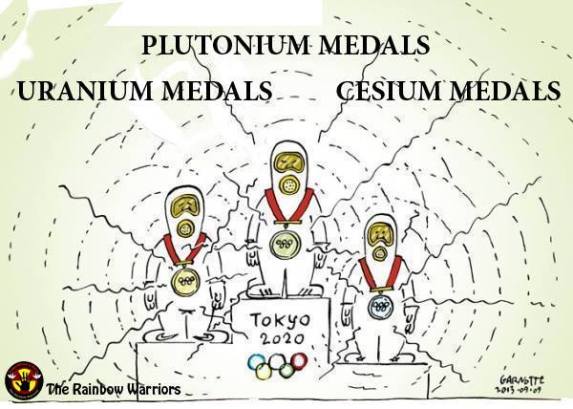
Tokyo Olypics: is it safe to promote Japan’s so-called “recovery” by sending athletes into a nuclear exclusion zone?
|
‘Fukushima today: “I’m glad that I realized my mistake before I died.” Bulletin of the Atomic Scientists, By Thomas A. Bass | March 10, 2021”……….After a lighting ceremony at J-Village, the Olympic torch will be run for three days through Fukushima’s nuclear exclusion zone. The zone is now a checkerboard of remediated areas and other places that are closed off behind accordion fences. Japan hopes to focus our attention on the refurbished schools and town halls, re-opened train stations, and two new museums that have been built in Fukushima, while trying to keep the TV cameras away from the ruined houses and radioactive cars lying nearby. The torch will then be run to Fukushima City, 40 miles to the northwest, where the first six Olympic games in softball and baseball are scheduled to be played after the games officially open July 23. But is it safe to promote Japan’s so-called “recovery” by sending athletes into a nuclear exclusion zone? The area has been tidied up and dotted with LED monitors showing the latest cesium releases from F1, comparable to the devices that measure airborne radiation levels found in other parts of the world. But these airborne releases are only part of the story—and not the most worrisome part. In 2013, scientists discovered that Fukushima’s exploding reactors had showered Japan with microparticles, or little glassy beads, of radioactive cesium and uranium. Hot spots from these microparticles can be found in vacuum cleaner bags and automobile air filters as far away as Tokyo. Fukushima prefecture is full of radioactive hot spots, and these hot spots keep moving as microparticles are washed down from the forested mountains that make up 70 percent of the prefecture, researchers said in Nature Scientific Reports. In 2019, a survey conducted for Greenpeace found hot spots in the J-Village parking lot, where children participating in a youth soccer match were eating their lunch. Greenpeace measured radiation levels at over 71 microSieverts per hour (one microSievert is one-millionth of a Sievert, or one-thousandth of a milliSievert)—1,775 times higher than the normal reading in this area before the Fukushima disaster of about 0.04 microSieverts per hour. The elevated reading, which translates to roughly about 0.62 Sieverts over the course of a year, meant that anyone breathing dust from the J-Village playing fields could be ingesting radioactive particles—little death stars lighting the way to cancer and genetic mutation. Since then, researchers have found radioactive hot spots at the Azuma baseball stadium in Fukushima City and all along the route to be run by the Olympic torch bearers….. https://thebulletin.org/2021/03/fukushima-today-im-glad-that-i-realized-my-mistake-before-i-died/?utm_source=Newsletter&utm_medium=Email&utm_campaign=ThursdayNewsletter032021&utm_content=NuclearRisk_Bass_03102021 |
|
Every hour, Fukushima reactor 2 emits more than 10,000 times the yearly allowable dose for radiation workers

|
Fukushima today: “I’m glad that I realized my mistake before I died.” Bulletin of the Atomic Scientists, By Thomas A. Bass | March 10, 2021 ”………..What we know about nuclear disasters at Chernobyl, Fukushima, and elsewhere comes primarily from modelling what is known as the “source term”—the types and amounts of radioactive material that were in a reactor’s core and then released to the environment by an accident. These models are revised as we learn more about the prevailing winds and other factors but are still only models; ideally, one wants to examine the reactors’ cores themselves. Unfortunately, even 10 years later, no one can get close to Fukushima’s reactor cores, and we do not even know precisely where they are located. As recently as December 2020, Japan’s Nuclear Regulatory Authority (NRA) announced “extremely serious” developments at Fukushima that were far worse than previously thought, the Asahi Shimbun newspaper reported. TEPCO had discovered that the massive shield plugs covering the reactors were emitting 10 Sieverts of radiation per hour—a lethal dose for humans (though it should be noted that reactor cores are normally examined by robots, unless these, too, are destroyed by radiation). Because Fukushima now has more contaminated material at higher doses than previously estimated, “this will have a huge impact on the whole process of decommissioning work,” said NRA chairman Toyoshi Fuketa. The effective dose of radiation required to sicken or kill you is measured in Sieverts, a unit named after Rolf Sievert, the Swedish physicist who first calibrated the lethal effects of radioactive energy. A dose of 0.75 Sieverts will produce nausea and a weakened immune system. (Sieverts are used to measure the relative biological damage done to the human body, while becquerels and curies are units that describe the amount of radiation emitted by radioactive material.) A dose of 10 Sieverts will kill you, if absorbed all at once. A dose somewhere in-between 0.75 and 10 Sieverts gives you a fifty-fifty chance of dying within 30 days. Guidelines for workers in the nuclear industry limit the maximum yearly dose to 0.05 Sieverts, or 50 milliSieverts—the equivalent of five CT scans, says Harvard Health Publishing. (This is a high figure compared to the 1 milliSievert per year that is considered acceptable for the general public; a physicist familiar with the industry explained that the thinking is that workers in the nuclear energy industry are implicitly being paid to take on the risk.) So how many Sieverts are currently being produced by Fukushima’s melted reactors? The latest reading from reactor No. 2 is 530 Sieverts per hour. This means that every hour the heart of the reactor is emitting more than 10,000 times the yearly allowable dose for radiation workers…… https://thebulletin.org/2021/03/fukushima-today-im-glad-that-i-realized-my-mistake-before-i-died/?utm_source=Newsletter&utm_medium=Email&utm_campaign=ThursdayNewsletter032021&utm_content=NuclearRisk_Bass_03102021 |
|
Radiation from Fukushima meltdown collects in timber in affected region
Japanese government hopes that not-yet-designed robots might clean up Fukushima nuclear mess
clean up Daiichi and revitalize Fukushima Prefecture, once known for everything from seafood to sake. The effort will take so long that Tepco and government organizations are grooming the next generation of robotics experts to finish the job.
https://www.cnet.com/features/for-fukushimas-nuclear-disaster-robots-offer-a-sliver-of-hope/
Fukushima nuclear accident costs so far $188billion, projected final costs of $740 bn.
 David Lowry’s Blog 10th March 2021, Pediatrician Dr Alex Rosen, a leading figure in the German branch of the International Physicians for the Prevention of Nuclear War (IPPNW) said it was “luck and divine intervention” that wind from the west blew most of the radiological releases out over the Pacific Ocean, meaning the Fukushima accident released more radioactivity to the oceans than the Chernobyl accident and all the nuclear weapons tests together.
Buffett Institute for Global Affairs located in Evanston, Illinois, and the Bulletin for the Atomic Scientists, based in Chicago, to launch a new international interdisciplinary collaborative study on “Nuclear Disaster Compensation: Lessons from Fukushima: Interviews with Experts and
Intellectuals, edited by anthropology professor Hirokazu Miyazaki.
http://drdavidlowry.blogspot.com/2021/03/nuclear-fuk-ed.html
Japan’s main opposition party -”Japanese society is viable without operating nuclear power plants”
|
Mainichi 12th March 2021, Yukio Edano, leader of the main opposition Constitutional Democratic Party of Japan (CDP), expressed his intention to aim for the elimination of
nuclear power in Japan on March 11 — the 10th anniversary of the 2011 Great East Japan Earthquake and tsunami — after earlier stating it was no easy task. Edano’s declaration appeared to be a response to criticism over
his recent comment that “ending nuclear power is not easy.” Edano told reporters at the Diet, “It has been demonstrated during these 10 years that Japanese society is viable without operating nuclear power plants. I intend to make a society that does not depend on nuclear power permanent.” https://mainichi.jp/english/articles/20210312/p2a/00m/0na/002000c |
|
Fukushima: “How Japan was blinded to the predicted certainty of disaster”.
Impossible timetable set for returning Fukushima nuclear site to ‘greenfield”
Greenpeace 11th March 2021, Nine months after the triple reactor meltdown at the Fukushima Daiichinuclear plant in March 2011, Tokyo Electric Power Company (TEPCO) announced that decommissioning of the site will be completed within 30-40 years.
Practically, the people of Japan were told that some time between 2041 and 2051, the site would be returned to ‘greenfield.’ In the past decade, the complexity and scale of the challenge at the Fukushima Daiichi site has become slowly clearer. The decommissioning task at the Fukushima Daiichi site is unique in its challenge to society and technology. But still, the
official time frame for TEPCO’s Road Map for decommissioning remains that set in 2011.
1.2 million tonnes of contaminated water and nowhere to put it – Fukushima’s continued legacy

Japan grappling with 1.2 million tonnes of contaminated water and nowhere to put it Japan has a crisis on its hands at the site of the country’s worst natural disaster. One challenge it faces has been deemed near-impossible. NZ Herald, Rohan Smith– 11 March 21,
On the site of Japan’s nuclear disaster, 10 years on from the meltdown that changed the world forever, authorities are grappling with impossible choices.
Today marks a decade since the 2011 Fukushima nuclear disaster. Towns surrounding the Tokyo Electric Power Company’s Fukushima Daiichi plant have long since been abandoned but the fallout from the March 11, 2011 event is far from over.
Every single day, 100 tonnes of groundwater seeps into one of the broken reactor basements at the site of the world’s worst nuclear disaster since Chernobyl.
That’s a problem because the water is mixing with radioactive debris and needs to be treated and stored. But TEPCO has more than 1.2 million tonnes of contaminated water sitting in storage tanks that are very quickly running out of capacity.
Estimates suggest the tanks will reach overflow point next year. And one of the choices on the table for Japanese authorities is hugely unpopular and potentially devastating: Release more than 1 million tonnes of the treated radioactive water into the sea.
On the site of Japan’s nuclear disaster, 10 years on from the meltdown that changed the world forever, authorities are grappling with impossible choices.
It is not the only problem that needs solving. There is a far more dangerous situation unfolding in several of the plant’s damaged reactors.
The plan is to decommission the plant by 2051.
Pictures from abandoned properties in the original exclusion zone show weeds growing around homes that were vacated in a hurry. …. more https://www.nzherald.co.nz/world/japan-grappling-with-12-million-tonnes-of-radioactive-water-and-nowhere-to-put-it/33TKZUD6JM4GHFJSMIBZ3WZKVY/
Part of Tomioka, 6 miles from Fukushima, is still a no-go zone
Daily Mail 10th March 2021, Part of the town of Tomioka, about 10 kilometers (6 miles) from the Fukushima Daiichi nuclear power plant, is still a no-go zone 10 years after
a meltdown sent radioactive fallout over the area. The no-go zone is about
12% of the town, but was home to about one-third of Tomioka´s population
of 16,000. It remains closed after the rest of the town in northeastern
Japan was reopened in 2017. Only those with official permission from the
town office can enter the area for a daytime visit.
The thought of the Olympics – the only hold-up to emptying contaminated water to the ocean.
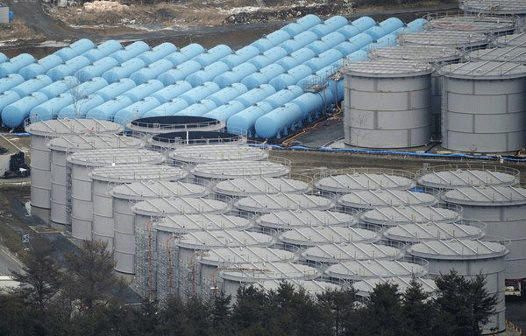
Washington Post 6th March 2021, Beside the ruins of the Fukushima Daiichi nuclear plant, more than 1,000 huge metal tanks loom in silent testament to one of the worst nuclear disasters in history, the meltdown of three nuclear reactors 10 years ago this month. The tanks contain nearly 1.25 million tons of cooling water from the 2011 disaster and groundwater seepage over the years — equivalent to around 500 Olympic-size swimming pools — most of it still dangerously radioactive.
Running out of space to build more tanks, the government wants to gradually release the water into the sea — after it has been decontaminated and diluted — over the next three decades or
more. Even though a formal decision has yet to be announced, the government and Tokyo Electric Power Co. (TEPCO) have insisted that an ocean release is their preferred solution and that it is perfectly safe.
 The only thing holding them back appears to be the Olympics and the bad publicity it could
generate before the Games begin in July, experts say. The idea of releasing the water has infuriated Fukushima’s fishing community, only now getting back on its feet after taking a battering in the wake of the 2011 disaster and the subsequent ocean contamination. Also angry is South Korea, even though it is more than 600 miles away across the sea.
Cash-strapped Japanese nuclear company funds road plans near idle nuclear plant
Cash-strapped JAPC funds road plans near idle nuclear plant, THE ASAHI SHIMBUN
March 8, 2021, TSURUGA, Fukui Prefecture—Multibillion-yen road projects continue on a peninsula here, funded in part by a nuclear power company that has gained no income from electricity for a decade.
The roads were planned decades ago for the expected expansion of the Tsuruga Nuclear Power Plant here. Although all nuclear operations and construction at the nuclear plant have long been halted, the work on the roads has not stopped.
“We are building a new road,” said a signboard near an area where heavy vehicles were removing dirt from the site of a planned tunnel in the city of Tsuruga, Fukui Prefecture, in mid-February.
The sign included an apology for causing an inconvenience to motorists.
The city roads being built are Nishiura Route No. 1 and No. 2 on the sparsely populated eastern side of a peninsula that juts out into the Sea of Japan separating Wakasa and Tsuruga bays.Japan Atomic Power Co. (JAPC) and Kansai Electric Power Co. (KEPCO) plan to provide 1.5 billion yen ($14 million) to Tsuruga for road construction from fiscal 2018 to fiscal 2021, according to sources.
JAPC owns three nuclear reactors, including two at the Tsuruga Nuclear Power Plant. But all three reactors have been shut down since the 2011 Fukushima disaster, meaning that JAPC has had zero income from electric power generation for a decade.
The neighboring town of Mihama hosts the KEPCO-run Mihama Nuclear Power Plant, which has also been shut down since 2011.
So where does JAPC’s money for the roads come from?
JAPC had derived income from selling its electricity to five major utilities—Tokyo Electric Power Co., KEPCO, Tohoku Electric Power Co., Hokuriku Electric Power Co. and Chubu Electric Power Co. After the Fukushima nuclear disaster, JAPC’s management has relied on the basic electricity rates paid by the five major electric companies.
The basic rates come mainly from electricity bills that consumers pay.
Some experts are concerned that JAPC’s continued generous aid for road construction could affect the electricity rates charged by the five utilities.
The plans to build the two city roads were hatched around 1993, when the Fukui prefectural assembly passed a resolution to build the No. 3 and No. 4 reactors at the Tsuruga plant.
The work was expected to increase traffic of large vehicles into the peninsula………..By fiscal 2021, JAPC and KEPCO will have provided 4.06 billion yen to the city for the road construction.
After fiscal 2022, the city government said it will tell the companies how much they should pay “from fiscal year to fiscal year.”
JAPC shoulders 58 percent of the costs, while KEPCO pays 42 percent. The ratio “was decided by the business operators,” and the city government “does not know how it was decided,” an official said.
After its reactors were shut down and its business conditions deteriorated, JAPC was criticized for providing such generous donations to Tsuruga.
JAPC in 2013 demanded that the city not list its donations in the financial document, and the payments were not recorded in fiscal 2012 and fiscal 2013, the sources said.
……… KEPCO’s public relations office said the company “will be actively involved in” the city’s road construction projects, but declined to reveal the amount it has provided.
As of the end of January this year, there were 520 people living in the peninsula registered as residents of Tsuruga. The peninsula has hosted seven nuclear reactors, of which five have been under decommissioning work.
The planned city-owned Nishiura Route No. 2 will be 800 meters long. The construction site is located north of the center of the Tsuruga city.
The estimated cost to build this road is 1.46 billion yen.
A former Fukui prefectural official who was familiar with the deal-making process said.
JAPC offered the money “as a quid pro quo for the city’s acceptance of the nuclear plant’s expansion plan.”
The innkeeper who wanted the roads in the area also noted that times have changed since the start of construction.
“The traffic of vehicles related to nuclear power plants has drastically decreased compared to the times before the Fukushima accident,” the innkeeper said. “I don’t know if the roads are really needed.”
(This article was written by Hideki Muroya and Tsunetaka Sato.) http://www.asahi.com/ajw/articles/14250714
1 This Month
To see nuclear-related stories in greater depth and intensity – go to https://nuclearinformation.wordpress.com/
29 Jan. Thursday 7-8 p.m. Webinar – World’s Largest Nuclear Station in Port Hope, ON?

31st January – Challenging the War Machine – a DECLASSIFIED UK SUMMIT

Website of the Week
Now until to February 10, 2026 Radioactive waste storage in France: the debate is finally open! How to participate?
-
Archives
- January 2026 (271)
- December 2025 (358)
- November 2025 (359)
- October 2025 (376)
- September 2025 (258)
- August 2025 (319)
- July 2025 (230)
- June 2025 (348)
- May 2025 (261)
- April 2025 (305)
- March 2025 (319)
- February 2025 (234)
-
Categories
- 1
- 1 NUCLEAR ISSUES
- business and costs
- climate change
- culture and arts
- ENERGY
- environment
- health
- history
- indigenous issues
- Legal
- marketing of nuclear
- media
- opposition to nuclear
- PERSONAL STORIES
- politics
- politics international
- Religion and ethics
- safety
- secrets,lies and civil liberties
- spinbuster
- technology
- Uranium
- wastes
- weapons and war
- Women
- 2 WORLD
- ACTION
- AFRICA
- Atrocities
- AUSTRALIA
- Christina's notes
- Christina's themes
- culture and arts
- Events
- Fuk 2022
- Fuk 2023
- Fukushima 2017
- Fukushima 2018
- fukushima 2019
- Fukushima 2020
- Fukushima 2021
- general
- global warming
- Humour (God we need it)
- Nuclear
- RARE EARTHS
- Reference
- resources – print
- Resources -audiovicual
- Weekly Newsletter
- World
- World Nuclear
- YouTube
-
RSS
Entries RSS
Comments RSS
 nuclear-news