Nuclear fusion is a never-ending dream

. “The development of the toroidal [magnetic confinement] nuclear fusion reactor is totally blocked by three challenges:
One, abysmally high cost (trillions of yen more in the future?) and a mind-boggling long time (more than 50 years); two, gigantic and complicated systems (a mega-sized system cannot be handled unless simple); and three, the heat-resistant material and radiation-proof material for the reactor walls are not available on earth.”
BY CITIZENS’ NUCLEAR INFORMATION CENTER · APRIL 5, 2023, By Nishio Baku (CNIC Co-Director)
Green Transformation (GX) Basic Policy proposed by the Japanese government mentions nuclear fusion as one of the next-generation innovative nuclear technologies in its reference information. I doubted my ears when I learned that the Nuclear Energy Subcommittee of the ministerial Advisory Committee for Natural Resources and Energy, which drafted the policy, brought up nuclear fusion as one of the “innovative technologies” to be pursued.
It was a big surprise. That is the very nuclear fusion that, at the Second International Conference for the Peaceful Uses of Atomic Energy of September 1 through 13, 1958 in Geneva, Dr. H. J. Bhabha from India, who chaired the conference, flamboyantly predicted would take shape in 20 years. It has been 64 years since then. The government refers to this vintage technology as “innovative”.
During the decade of the 1980s, various Japanese universities received more budget than previously from the government for nuclear fusion research. The website of professor Takabe Hideaki, Institute of Laser Fusion, Osaka University, notes on September 10, 2014 that, during the days of the Second Oil Crisis, when Gekko XII [the experimental laser fusion apparatus at Osaka University] was completed, the government’s top-down initiative provided the university with a budget of 30 billion yen (in the value of the yen at the time), to build the laser system and a robust building for it.
I find this maybe a special case (another document I have with me says, of the fiscal 1984 national budget, 35 billion yen was given to the then Power Reactor and Nuclear Fuel Development Corporation and a total of 7 billion yen to universities). Uramoto Joshin, a former associate professor at the National Institute for Fusion Science, wrote in his retirement memoir “My Final Words as a NIFS Staff” (NIFS News, May 1998), that he was in a festive mood around the time when he joined the former Plasma Research Institute of Nagoya University, which was one of the founding bodies of the NIFS.
The boom faded, and in 1989, the Plasma Research Institute was reorganized as the National Institute for Fusion Science, an inter-university research institute, into which a part of the Heliotron Plasma Physics Laboratory at Kyoto University and a part of the Institute for Fusion Theory at Hiroshima University were incorporated. The technology that the government refers to is the same nuclear fusion.
In what respect can the nuclear fusion reactor be a “next-generation innovative reactor”? While there is no full-size nuclear fusion reactor, what would a “compact nuclear fusion reactor” look like?
Today, “private-sector nuclear fusion” by venture companies seems to be enjoying a global boom………………………………………………. the project did not seem very practical.
……………………………………………………………. Whatever the case, the ignition lasts only one instant.
How far will the muddy road continue?
This nuclear fusion was mentioned by Prime Minister Kishida in his administrative policy speech on January 17, 2022 with the cryptic reasoning that it would help achieve the 2050 goal of carbon neutrality. Using this as the basis, the government set up the Nuclear Fusion Strategy Expert Panel under the Integrated Innovation Strategy Promotion Council of the Cabinet Office.
The panel had its first meeting on September 30, where Takaichi Sanae, Minister of State for Science and Technology Policy, said: “I have a strong will to accelerate the efforts to commercialize nuclear fusion technology as far as possible.” However, the Innovative Reactor Working Group placed under the Nuclear Energy Subcommittee, states in its “Roadmap for Introduction” (August 9, 2022) that whether the construction of a prototype nuclear fusion reactor should start or not will be determined in the mid-2030s. What would “commercializing nuclear fusion” mean at this point?
I wonder how much longer this fusion boom will continue. “As I am leaving this institute, I breathe a sigh,” Associate Professor Uramoto said in his NIFS retirement memoir. “The development of the toroidal [magnetic confinement] nuclear fusion reactor is totally blocked by three challenges: One, abysmally high cost (trillions of yen more in the future?) and a mind-boggling long time (more than 50 years); two, gigantic and complicated systems (a mega-sized system cannot be handled unless simple); and three, the heat-resistant material and radiation-proof material for the reactor walls are not available on earth.”
For the cost, the Special Committee on the ITER Project of the Japan Atomic Energy Commission bragged about ITER in its report, “International Thermonuclear Experimental Reactor (ITER) Project Forecast” (May 18, 2001): “It is difficult to correctly estimate the cost required to realize a nuclear fusion reactor, …………………………………………………
Of the challenges Uramoto pointed out, the second one, “gigantic and complicated systems (a mega-sized system cannot be handled unless simple)” and the third one, “the heat-resistant material and radiation-proof material for the reactor walls are not available on earth” remain unsolved, despite the passage of so many years.
The pot is calling the kettle black
It is meaningless to compare nuclear fusion with nuclear power generation, but some say: “Nuclear fusion is clean.” In terms of the radioactivity released when a large accident occurs, nuclear fusion technology would emit less radioactivity than a conventional nuclear plant.
However, the daily releases of radioactive materials from nuclear fusion would be greater than those from a conventional nuclear power plant. Nuclear fusion is also more likely to leak tritium and radioactive gas. It will produce four times as much energy as nuclear fission while producing seven times as many neutrons. Workers in the fusion plant would be exposed to radiation, and people in the neighborhood would also be exposed due to sky shine. Plant equipment would be strongly radiated and easily embrittled, requiring frequent replacement, producing a huge amount of highly contaminated wastes……………………………………………. more https://cnic.jp/english/?p=6549
Foundation in Fukushima nuclear plant reactor likely badly damaged
The internal wall of a cylindrical foundation supporting the reactor
pressure vessel of the No. 1 unit of the crippled Fukushima Daiichi nuclear
power plant may be badly damaged across its entire circumference, its
operator said Tuesday. Some of the damage was revealed in videos taken
during a survey of the No. 1 unit’s containment vessel by operator Tokyo
Electric Power Company Holdings Inc., which said it would further analyze
the footage and assess the seismic resistance of the pedestal. The survey,
conducted from March 28 through March 31 using an underwater robot, found
the concrete wall missing in over half of the pedestal measuring 5 meters
in internal diameter, leaving the reinforcing bar exposed.
Mainichi 4th April 2023
https://mainichi.jp/english/articles/20230404/p2g/00m/0bu/040000c
Citizens’ Nuclear Information Center news roundup April/May 2023
Nuke Info Tokyo April/May Newsletter includes: Fukushima Now – Part 1:
Railroading the Contaminated Water Release is Unacceptable! by Ban
Hideyuki; Fukushima Now – Part 2: Current State of Post-Accident
Operations at Fukushima Daiichi Nuclear Power Station (Jun. to Dec. 2022)
By Matsukubo Hajime; Childhood thyroid cancer cases confirmed in the
Fukushima Health Management Survey and others; Nuclear fusion is a
never-ending dream By Nishio Baku; News Watch Revisions to Basic Policy on
High-level Radioactive Waste Disposal / Surveillance Camera Monitoring
Interrupted at Rokkasho Recycling Plant / Takahama Unit 4 Automatically
Shut Down / Unjust Verdict in Lawsuit for National Compensation for
Second-Generation Hibakusha.
CNIC 5th April 2023
Japan’s nuclear regulators find errors in Japan Atomic Power’s safety documents for the Tsuruga plant.
Nuclear regulators said Wednesday they will again halt a safety assessment
of an offline central Japan reactor after its operator repeatedly submitted
documents containing errors, further prolonging a process toward resumption
that has already taken years. Japan Atomic Power has been seeking approval
to reboot the No. 2 unit at the Tsuruga plant in Fukui Prefecture under
stricter regulations imposed following the 2011 Fukushima nuclear power
plant disaster, but its application has been fraught with mistakes and data
tampering.
Japan Times 5th April 2023
https://www.japantimes.co.jp/news/2023/04/05/national/tsuruga-reactor-safety-assessment-halt/
Mainichi 5th April 2023
https://mainichi.jp/english/articles/20230405/p2g/00m/0na/027000c
New images from inside Fukushima reactor spark safety worry
Images captured by a robotic probe inside one of the three melted reactors
at Japan’s wrecked Fukushima nuclear power plant showed exposed steel bars
in the main supporting structure and parts of its thick external concrete
wall missing, triggering concerns about its earthquake resistance in case
of another major disaster.
The plant’s operator, Tokyo Electric Power
Company Holdings, has been sending robotic probes inside the Unit 1 primary
containment chamber since last year. The new findings released Tuesday were
from the latest probe conducted at the end of March. An underwater remotely
operated vehicle named ROV-A2 was sent inside the Unit 1 pedestal, a
supporting structure right under the core.
It came back with images seen
for the first time since an earthquake and tsunami crippled the plant 12
years ago. The area inside the pedestal is where traces of the melted fuel
can most likely be found. An approximately five-minute video – part of
39-hour-long images captured by the robot – showed that the 120-centimeter
(3.9-foot) -thick concrete exterior of the pedestal was significantly
damaged near its bottom, exposing the steel reinforcement inside. TEPCO
spokesperson Keisuke Matsuo told reporters Tuesday that the steel
reinforcement is largely intact but the company plans to further analyze
data and images over the next couple of months to find out if and how the
reactor’s earthquake resistance can be improved.
The images of the exposed
steel reinforcement have triggered concerns about the reactor’s safety.
Daily Mail 4th April 2023
Mental illness plagues Japan’s nuclear disaster survivors
Some 37 percent of the survivors of Japan’s Fukushima Daiichi nuclear
power plant disaster of 2011 still suffer from mental illness due to
financial crisis, isolation, and drastic changes in living conditions, says
a survey.
The survey results indicated that the victims suffer from
post-traumatic stress disorder or PTSD due to “anxieties about
compensation and indemnification,” “unemployment” and “nuisances
just by being an evacuee.” The survey was conducted by the Waseda
Institute of Medical Anthropology on Disaster Reconstruction and the
Disaster Relief Assistance Network Saitama, a citizens group, between
January to April 2022 among 5,350 households, the Asahi Shimbun reported on
April 3.
Union of Catholic Asian News 4th April 2023
https://www.ucanews.com/news/mental-illness-plagues-japans-nuclear-disaster-survivors/100894
TEPCO visually confirms melted nuclear fuel at Fukushima plant
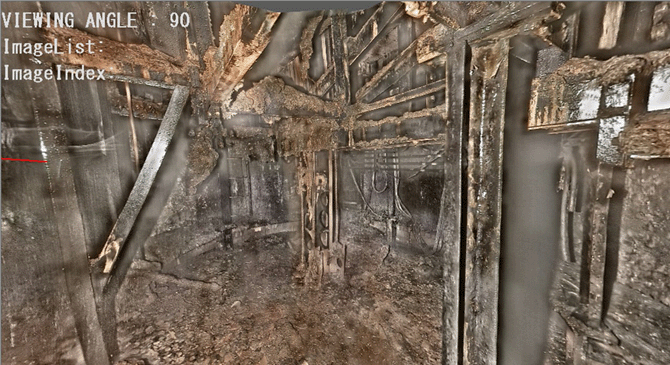
THE ASAHI SHIMBUN, March 31, 2023 , This article was written by Keitaro Fukuchi, Ryo Sasaki and Takuro Yamano.
A robotic study provided the first visual confirmation that melted nuclear fuel broke through a pressure vessel at the Fukushima No. 1 nuclear power plant, the government and Tokyo Electric Power Co. said March 30.
Images taken by the robot under the No. 1 reactor at the plant also confirmed heavy damage to a concrete “pedestal” under the pressure vessel.
The inspection by the robot started on March 29. It was the first such study at the No. 1 reactor, one of the three reactors that melted down at the plant following the Great East Japan Earthquake and tsunami in 2011.
More than 90 percent of the nuclear fuel at the No. 1 reactor is believed to have fallen from the pressure vessel.
The robot found a large amount of melted fuel debris under the pressure vessel.
……………. TEPCO still faces the difficult challenge of how to remove the fuel debris and how to protect the damaged pedestal from future earthquakes.
The meltdown at the No. 1 reactor is believed to be worse than those at the No. 2 and No. 3 reactors at the plant.
The International Research Institute for Nuclear Decommissioning estimates the No. 1 reactor building contains 279 tons of melted fuel debris.
Naoyuki Takaki, a professor of nuclear safety engineering at Tokyo City University, said the fuel debris “cannot be taken out unless it is broken down into small pieces.”
Takaki said the method for cutting up such chunks will depend on the ratio and hardness of metal mixed in with the melted fuel.
But the information on objects within the fuel debris is limited so far.
“To put it briefly, it is unknown,” Takaki said.
The No. 1, No. 2 and No. 3 reactors at the Fukushima plant contain an estimated total of 880 tons of melted fuel debris.
TEPCO officials aim to start removal work of the fuel debris at the No. 2 reactor in the latter half of fiscal 2023. The initial plan is to take out a few grams, analyze their elements and hardness, and then increase the amount to be removed.
No timetable is set for such work at the No. 1 and No. 3 reactors.
The damaged pedestal has raised concerns that an earthquake could knock down the structure…………………………….more https://www.asahi.com/ajw/articles/14874722
12 years later, evacuation orders lifted in parts of two towns near the crippled Fukushima nuclear power station
The government said Wednesday it will lift evacuation orders for parts of
two towns near the crippled Fukushima nuclear power plant next week, 12
years after their residents were forced to leave due to a nuclear disaster
following the massive earthquake and tsunami in March 2011. Evacuation
orders will be lifted in parts of Namie at 10 a.m. on March 31 and
neighboring Tomioka at 9 a.m. on April 1, the government said, while aiming
for a similar order to be lifted in the remaining village, Iitate, this
spring.
Japan Times 22nd March 2023
https://www.japantimes.co.jp/news/2023/03/22/national/fukushima-evacuation-orders-lifted/
Rebooting memories of life before the nuclear devastation of Hiroshima
20 March 2023Peace and Security https://news.un.org/en/story/2023/03/1134662
A Japanese initiative to colourize photos of Hiroshima survivors, taken before the war, has been hailed by the UN as a way to breathe new life into conversations about peace, and a world without nuclear weapons.
Only a few survivors of the World War Two Hiroshima and Nagasaki nuclear bombings are still alive to share their memories. Acutely aware that she is part of the last generation to be able to talk directly to the hibakusha – those who survived the Hiroshima nuclear bomb – Anju Niwata, a young Japanese peace activist born and raised in Hiroshima, launched a project called “Rebooting Memories”, which involves colourizing photos taken in the city before the war, featuring survivors, and the families and places lost in the bombing.
Ms. Niwata uses a combination of software and interviews with survivors to accurately bring colour to the black and white photos she borrows from the survivors. “The black and white photos may appear lifeless, static, and frozen to us”, she says.
“By colourizing the photos, however, the frozen time and memories of the peaceful lives before the bombing gradually advance and start breathing. It takes a long time, but I am always encouraged by the hibakusha’s joy at seeing the colour photos.
Her efforts have been warmly welcomed by the hibakusha, who played a big part in helping people around the world to understand the devastating impact of nuclear weapons, in the years following the Second World War.
Tokuso Hamai was evacuated from Hiroshima when he was two-years-old, before the bombing. All of his family members were killed. As part of Ms. Niwata’s project, he went with her to the site of the barber shop that his father used to run, in Hiroshima’s Nakajima district.
Today, any remains of the shop, and the buildings around it, have disappeared, buried under the Peace Park built to commemorate the tragic event, and remember the victims.
Standing at the site, and looking at the colour photographs, sparked Mr. Hamai’s memories of pre-War Hiroshima. “I recalled what I had forgotten”, he says. “If the photos were black and white, this would not have happened. What I recalled first was a green avenue of cedars. I remember picking cedar buds as bullets for a toy gun.”
Ms. Niwata’s aim of reviving awareness of the consequences of nuclear war is wholeheartedly supported by Izumi Nakamitsu, the UN Under-Secretary-General of Disarmament Affairs, who is herself Japanese.
“Disarmament is part of the DNA of the United Nations. The first General Assembly session took place in London, just a few months after Hiroshima and Nagasaki. The shock of the nuclear bombings made a huge impact on everyone in the world at the time.
“Since then, it’s been part of a priority agenda of the United Nations and it is even more important today because we are again in a dangerous world where conflicts and tensions are on the rise. There are some 13,000 nuclear weapons in the world’s arsenals, relations between nuclear weapons states are tense. This poses existential threats, and I think it’s important that people start to imagine the impact if they are ever used.
I think Ms. Niwata’s project will have an enormous impact. if you can visualize how things were, it enters your imagination more vividly, and will do something to your mind and then your heart.”
When she took part in the SDG Global Festival of Action, a UN event filled with dozens of inspiring speakers from around the world, Ms. Niwata was encouraged to see that she was far from the only young activist working towards peace, each using different methods to achieve the same goal. “It is my mission to continue spreading the thoughts and memories of the atomic bomb survivors into the future and realize a world free from nuclear weapons”.
- In 2019, a General Assembly resolution, “Youth, Disarmament, and Non-proliferation”, reaffirmed the important and positive contribution that young people can make in sustaining peace and security.
- That same year, the UN Office for Disarmament Affairs (UNODA) launched the #Youth4Disarmament outreach initiative, recognizing that young people like Ms. Niwata play a critical role in raising awareness and developing new ways to reduce threats from weapons of mass destruction and conventional arms.
- The initiative connects geographically diverse young people with experts to learn about current international security challenges, the work of the United Nations, and how to actively participate.
What’s dumped is not just Fukushima nuclear water
In January, the Japanese government announced that it would begin to release into the Pacific Ocean more than 1.37 million tons of water from the wrecked Fukushima Daiichi nuclear plant sometime this spring or summer. A shadow of nuclear contamination is looming larger.
Although the Tokyo Electric Power Company (TEPCO) insists that the contaminated water has been filtered and diluted and meets the criterion for a safe discharge, a report has shown that 73 percent of the treated water still exceeds the discharge standard.
Unlike normal wastewater from nuclear power plants, Fukushima nuclear-contaminated water contains over 60 kinds of radioactive substances. Besides tritium, which is difficult to remove, the treated water also contains strontium-90 and carbon-14, whose half-lives are 29 years and 5,730 years, respectively.
For those who can’t grasp its meaning, tritium can replace stable hydrogen atoms in the human body and cause chronic radiation syndrome and cancer. Strontium-90 is highly toxic and may induce bone tumors.
Experts have pointed out that once released into the ocean, the contaminated water would rapidly spread to most parts of the Pacific. Radiation would be absorbed by marine life and enters the human body.
In 2022, it was detected that radiation in black rockfish caught off Fukushima prefecture was 14 times higher than the safe level for humans, even after 11 years have passed since the Fukushima nuclear disaster. The South China Morning Post reported that caesium, one of the most dangerous radionuclides that “can build up in muscle, fat and bone and cause malignant tumors,” was detected in “fish caught at a depth of 24 meters about 9 km off Fukushima prefecture’s town of Shinchi.”
After more than 10 years, the local fishery industry has not fully recovered. In 2012, Japan banned the sale of 36 species of fish caught off Fukushima, and Tokyo’s decision crushed their hopes. Voices of opposition have been ongoing. In Japan, fishery organizations have expressed their concerns. Citizens in Tokyo, Osaka and Shizuoka protested on the streets to demand the government rescind its decision.
On the world stage, Japan’s neighbors including China, Russia and South Korea have asked Tokyo to provide useful information, engage in full consultation, and take responsible measures. The Pacific Island countries urged Japan not to release the contaminated water before there is enough scientific evidence proving that it’s safe. And independent UN human rights experts issued a joint statement calling Japan’s decision “very concerning” and “deeply disappointing.”
To make a clear evaluation of the safety of Japan’s plan, an International Atomic Energy Agency task force was set up to conduct a safety review. Days ago, it completed its second regulatory review and “will release a report on its findings in about three months, as well as a comprehensive report before the discharge.” Nonetheless, even before the task force set out, Tokyo unilaterally announced the planned discharge. The Japanese government has set its mind on the discharge regardless of the review outcome.
When Tokyo decides to discharge the contaminated water without ensuring safety, does it even consider people’s right to life and health? As a party to the UN Convention on the Law of the Sea, the Convention on Early Notification of a Nuclear Accident, and the Convention on Nuclear Safety, does the Japanese government recognize its international obligations? When it puts the whole Pacific and Pacific Rim countries at the risk of environmental disaster, how does it uphold the principle of “environment first”?
When it comes to nuclear contamination, it’s better to err on the side of caution. There could be better alternatives than dumping the contaminated water into the sea. Evaporating, storing underground the tritium-laced water from the plant, or storing and processing the water over the long term, these are all technically reasonable options that are safer than a direct discharge. Unfortunately, Tokyo has chosen to go for the cheapest “quick fix.”
When the earthquake and tsunami struck Fukushima, neighboring countries reached out their helping hands to Japan. Today, the nation is repaying them with tons of nuclear contaminated water.
The Pacific Ocean is home to billions of people, but Japan takes it as its own sewer. Along with contaminated water, Japan’s reputation, conscience and international obligations will be dumped as well.
Sociologist urges Japan to stop perpetuating nuclear colonialism
Japan should stop perpetuating nuclear colonialism, and instead respect the
sovereignty and self-determination of Pacific nations regarding the planned
discharge of radioactive wastewater from the Fukushima Daiichi Nuclear
Power Plant, a New Zealand sociologist has said.
The social aspects and major country relations around Japan’s decision to release the radioactive
wastewater from the defunct plant must be questioned, Karly Burch from the University of Auckland told Xinhua in a recent interview.
CGTN 11th March 2023
Grief – Japan marks 12 years since Fukushima nuclear disaster as concerns grow over treated radioactive water release

9 News By Associated Press, Mar 12, 2023
Japan on Saturday marked the 12th anniversary of the massive earthquake, tsunami and nuclear disaster with a minute of silence, as concerns grew ahead of the planned release of the treated radioactive water from the wrecked Fukushima nuclear plant and the government’s return to nuclear energy.
The 9.0 magnitude earthquake and tsunami that ravaged large parts of Japan’s northeastern coast on March 11, 2011, left more than 22,000 people dead, including about 3,700 whose subsequent deaths were linked to the disaster.
A moment of silence was observed nationwide at 2.46pm, the moment the earthquake struck.
Some residents in the tsunami-hit northern prefectures of Iwate and Miyagi walked down to the coast to pray for their loved ones and the 2,519 whose remains were never found.
In Tomioka, one of the Fukushima towns where initial searches had to be abandoned due to radiation, firefighters and police use sticks and a hoe to rake through the coastline looking for the possible remains of the victims or their belongings.
At an elementary school in Sendai, in Miyagi prefecture north of Fukushima, participants released hundreds of colorful balloons in memory of the lives lost.
In Tokyo, dozens of people gathered at an anniversary event in a downtown park, and anti-nuclear activists staged a rally.
The earthquake and tsunami that slammed into the coastal Fukushima Daiichi nuclear plant destroyed its power and cooling functions, triggering meltdowns in three of its six reactors.
They spewed massive amounts of radiation that caused tens of thousands of residents to evacuate.
Over 160,000 people had left at one point, and about 30,000 are still unable to return due to long-term radiation effects or health concerns.
Many of the evacuees have already resettled elsewhere, and most affected towns have seen significant population declines over the past decade.
At a ceremony, Fukushima Gov. Masao Uchibori said decontamination and reconstruction had made progress, but “we still face many difficult problems.”
He said many people were still leaving and the prefecture was burdened with the plant cleanup and rumors about the effects of the upcoming release of the treated water.
The plant’s operator, Tokyo Electric Power Company Holdings, and the government are making final preparations to release into the sea more than 1.3 million tons of treated radioactive water, beginning in coming months.
The government says the controlled release of the water after treatment to safe levels over several decades is safe, but many residents as well as neighbours China and South Korea and Pacific island nations are opposed to it.
Fishing communities are particularly concerned about the reputation of local fish and their still recovering business.
In his speech last week, Uchibori urged the government to do utmost to prevent negative rumors about the water release from further damaging Fukushima’s image.
……….. Kishida’s government has reversed a nuclear phase-out policy that was adopted following the 2011 disaster, and instead is pushing a plan to maximise the use of nuclear energy to address energy supply concerns triggered by Russia’s war on Ukraine while meeting decarbonisation requirements.
He said last week that while the energy policy is the central government’s mandate, he wants it to remember that Fukushima continues to suffer from the nuclear disaster. https://www.9news.com.au/world/japan-fukushima-nuclear-disaster-anniversary-concerns-treated-radioactive-water-release/ccd3dc02-52ae-449f-98a8-0475fbdb85ed
12 yrs after Fukushima nuclear disaster, gov’t not facing evacuees’ hardship

March 11, 2023 (Mainichi Japan) Editorial:
https://mainichi.jp/english/articles/20230311/p2a/00m/0op/006000c
Today marks 12 years since the Great East Japan Earthquake of March 11, 2011. Over 22,000 lives were lost due to the cataclysm, including a massive tsunami that struck coastal regions and the disaster at the Fukushima Daiichi Nuclear Power Station.
Today, some 31,000 people are still living as evacuees. Around 90% of them are residents of Fukushima Prefecture. In municipalities mostly within so-called “difficult-to-return zones” where radiation levels are high, many residents have been barred from coming back, and reconstruction has been delayed.
The government is proceeding with decontamination of the areas it has designated as bases for reconstruction within these zones. However, they account for less than 10% of the zones’ total area. It also plans to prepare places outside these reconstruction bases so that people who want to return to those areas can do so, but it is expected that decontamination will be limited to the homes to which people want to return and the surrounding roads. This has left residents who want the whole area decontaminated at a loss.
Local ties lost
The town of Namie in Fukushima Prefecture is a prime example of the difficult circumstances. The current population stands below 2,000 — less than a tenth of what it was before the 2011 disaster. The fact that it has the largest area of difficult-to-return zones, accounting for 80% of the entire town, has put it at a significant disadvantage.
“Even if just one part is decontaminated and a person comes back alone, they can’t live in a mountain village. The government first needs to prepare an environment in which the local community can maintain itself,” stressed Shigeru Sasaki, 68, who has evacuated within Fukushima Prefecture.
Before the disaster, Sasaki lived in the eastern part of the Tsushima district, located in a gorge in Namie. When the Obon season arrived, residents in the settlement would go out together and cut the grass along roads and work together to protect the community.
Since the nuclear disaster, however, the entire Tsushima district has been off-limits as a place to dwell. Sasaki is the deputy leader of a group of 650 plaintiffs in a class action against the government and Fukushima Daiichi operator Tokyo Electric Power Company (TEPCO) Holdings Inc. They are calling for the town to be restored to its original state, bringing radiation levels down to what they were before the disaster, but their claims were rejected by a district court. They are now appealing.
Last year, there was a change in government policy that struck a nerve with those whose lives were turned upside down by the nuclear disaster. The administration of Prime Minister Fumio Kishida effectively extended the operating life of existing nuclear reactors, which had been set at a maximum of 60 years, and also set out to promote replacing them with next-generation nuclear power plants. It is thus lowering the banner of “freedom from reliance on nuclear power” that had been held up from the time of the meltdown.
Sasaki was unable to hide his anger. “We see Tsushima in such a state, yet the government is acting as if the problems in Fukushima are over,” he said.
Meanwhile, some residents have voiced concerns that moves to go back to nuclear power will cause memories of the disaster to fade.
Since 2012, the year after the Fukushima disaster, the Namie Machi Monogatari Tsutae-tai, a town storytellers’ group, has performed picture story shows inside and outside Fukushima Prefecture, conveying the confusion immediately after the disaster and the hardship of life as evacuees. Group founder Yoshihiro Ozawa, 77, lamented, “What was the point of all our activities to date to make sure that people don’t forget the accident?”
Ozawa’s health has deteriorated and so he has given up on returning to Namie, where medical infrastructure remains inadequate. He and his wife still live in the place where they evacuated, and they have little contact with neighbors. He worries about what will happen when one of them ends up alone there.
“My friends and relatives are all scattered. I want people to know that Fukushima still has many issues,” Ozawa said.
Anger at the government for forgetting the lessons of 3.11
While the Japanese government wants to quickly close the book on the nuclear disaster, the locals cannot escape from the disaster’s prolonged effects. There is a wide gap between the perceptions of the two sides.
It is said that it will take several decades to decommission the Fukushima Daiichi reactors. In a survey asking residents why they were hesitant to return, quite a few people cited concerns about nuclear power plant safety, in addition to a lack of hospitals and commercial facilities.
Treated wastewater that continues to accumulate at the Fukushima Daiichi is set to be released into the ocean sometime from this spring onward. However, those in the fishery and others harbor strong concerns about reputational damage. At the end of last year, TEPCO announced compensation standards in the event of such damage, but there are no signs it will be able to gain people’s understanding.
Contaminated soil and other items collected during clean-up efforts across the prefecture remain in interim storage facilities in the local towns of Okuma and Futaba. They are supposed to be moved outside the prefecture for final disposal by 2045, but a destination for the material remains undecided.
Such problems, which are difficult to solve, weigh heavily on the future of the region.
Residents have not only lost their hometowns and a place to live; they have lost the happiness and security of living in close contact with those familiar to them. Twelve years after the outbreak of the nuclear disaster, this sense of profound loss has yet to heal.
The nuclear disaster is not over.
Rather than hurrying to retreat to nuclear power, the government should look squarely at the hardship of each and every resident. It has a responsibility to put effort into supporting them so that wherever they find shelter, they can make connections with people and find a purpose in life.
The voices of the victims

The right to avoid exposure is “a fundamental right to protect human life”
The voices of the victims — Beyond Nuclear International
Firsthand accounts from Fukushima survivors and others afflicted by the nuclear sector
From Nos Voisins Lontains 3.11 (Our Faraway Neighbors 3.11)
Where are the voices of nuclear victims? It is becoming increasingly difficult to hear them. In denial of the harmful consequences of atomic plants, there is an attempt, for example, to downplay and minimize the damage caused by nuclear accidents and more generally the nuclear risk, limiting it merely to the number of deaths.
But there is a far wider web of suffering, especially because nuclear power accidents often do not cause instant, headline-grabbing deaths, but later ones, after a long latency period. This makes them harder to quantify and more easily dismissed.
In the context of the revival of nuclear power in France and Japan, it seems important to return to the field and listen to the voices of the victims. To that end, Nos Voisins Lontains 3.11 has created a new YouTube Channel — Voix des victimes du nucléaire (Voices of the nuclear victims).
In this series, the NGO Nos Voisins Lointains 3.11 (Our Faraway Neighbours 3.11) proposes to broadcast their voices with English subtitles. We are not presenting only the voices of the Fukushima nuclear accident victims, but also more widely the words of the victims of all nuclear uses, military or civil.
We hope that the courage and perseverance of these people will allow the warning voices of so many Cassandras to be heard far and wide, piercing the curse of the powerful nuclear industry and the political powers that support it.
The first video message is from Akiko Morimatsu. You can watch her testimony below. The transcript of her remarks follows.
My name is Akiko MORIMATSU.
The Great East Japan Earthquake of March 11, 2011 was followed by the TEPCO Fukushima Daiichi nuclear accident. What happened to us, the residents of Fukushima? What damage did the people living near the plant suffer? I would like to tell you about it in a concrete way.
On March 11, 2011, I was living in Koriyama, a town in Fukushima Prefecture, located about 60 km from the Fukushima Daiichi plant. There were four of us. Me, my husband and two children. A 5-month-old girl and a 3-year-old boy.
First of all, I would like to tell you that when a nuclear accident occurs, regardless of our age or sex, whether we are for or against nuclear power, we are all confronted with the problem of exposure to radioactivity. Radiation is invisible and colourless. There is no pain or tingling on the skin. And there is the issue of low-dose radiation exposure. At a great distance, you are exposed to low doses of radiation. Besides the fact that radiation cannot be perceived by the senses, people do not die instantly.
In this context, we, living 60km from the plant, lost our home in the Great Earthquake, and then after this natural disaster, we suffered a man-made disaster: the nuclear accident.
Of course, we did not hear the explosions at the nuclear power plant, nor did we see the damaged plant buildings directly. We only learned about the accident through the news on TV. Apart from that, there was no way to know that an accident with explosions took place. There was no way of knowing the exact situation of the Fukushima Daiichi plant, nor how much radiation we would be exposed to.
First of all, I would like to tell you that when a nuclear accident occurs, regardless of our age or sex, whether we are for or against nuclear power, we are all confronted with the problem of exposure to radioactivity. Radiation is invisible and colourless. There is no pain or tingling on the skin. And there is the issue of low-dose radiation exposure. At a great distance, you are exposed to low doses of radiation. Besides the fact that radiation cannot be perceived by the senses, people do not die instantly.
In this context, we, living 60km from the plant, lost our home in the Great Earthquake, and then after this natural disaster, we suffered a man-made disaster: the nuclear accident.
Of course, we did not hear the explosions at the nuclear power plant, nor did we see the damaged plant buildings directly. We only learned about the accident through the news on TV. Apart from that, there was no way to know that an accident with explosions took place. There was no way of knowing the exact situation of the Fukushima Daiichi plant, nor how much radiation we would be exposed to. . We didn’t know how much radiation we had to endure, because neither the state authorities nor the operator TEPCO provided accurate information. We, the people living near the plant, had to make many decisions in this ignorance.
I’m going to tell you about the most difficult thing I have had to do in the last 12 years since the accident. After the explosions at the nuclear power plant, we were well aware of the explosions… But we, who were 60 km away from the plant, were not evacuated by force. Apart from the evacuation order, there was also a confinement order. Gradually, within a radius of 2 km, then 3 km around the nuclear power plant, the population was forcibly evacuated. The circular mandatory evacuation zone gradually expanded. And from 20 to 30 km from the power plant, there was the order to stay indoors. That was the order given by the government. But we, 60 km away, did not receive the confinement order. We were not evacuated either. We were left on our own without any protection.
In this situation, I learned from the TV that the tap water, the drinking water, was contaminated. The first information I got was about the tap water in Kanamachi in Tokyo. They had found radioactive substances in the water. It was on a television program.
The Kanamachi water treatment plant was 200 km from the Fukushima Daiichi plant. We were only 60 km from the plant. Within the 200 km radius, the radioactivity increased, and with the rain radioactive substances contaminated the drinking water. Since the tap water at 200 km from the plant was contaminated, the water at 60 km had to be contaminated without any doubt. So, we learned about the radioactive contamination of our drinking water from the TV news.
Up to that point, it was known that radioactive material had been dispersed, but at 60km, there were no orders to evacuate or to stay indoors. There were repeated statements from the Prime Minister’s Office that there would be no immediate impact on health. The issue of exposure was indeed on our minds. But when I found out that the water in Tokyo was contaminated, and that the water in Fukushima was also contaminated, I realised that I was unknowingly drinking radioactive water. But even after learning this fact, I had to continue drinking the water. And so did my two children, aged 5 months and 3 years. My 5-month-old daughter was clinging to life through breast milk from a mother who was drinking contaminated water.
We also heard on the news that there had been a huge radioactive fallout in and around Fukushima, that shipments of leafy vegetables had been suspended, that farmers were going to lose their livelihoods, and that there had been suicides of desperate farmers. They had lost all hope in the future of their profession. All this we heard on TV.
So, we learned that there really was radioactive contamination. I learned that the farmers had milked the cows, but since shipping was no longer possible, they had to dump the milk in the fields.
As a nursing mother in Fukushima, I thought that we were also mammals like the cows. We humans were also exposed to high doses of radioactivity in the air, and we had to drink tap water, knowing that it was polluted.
I heard about the biological concentration. Milk was even more radioactive than water. That’s why the milk had to be thrown away. Yet I was drinking radioactive water, I was breastfeeding my 5-month-old daughter, and my milk concentrated the radioactivity.
didn’t want to be exposed to radiation myself, and of course I didn’t want my five-month-old child to be exposed to radiation. But we were totally denied the right to choose to refuse exposure. Above all, a baby can’t say she doesn’t want to drink breast milk because it is contaminated. My three-year-old son brought me a glass when he was thirsty, saying “mummy, give me a glass of water”. Knowing that the tap water was contaminated, I was obliged to give him this water.
This is my experience.
The will to avoid exposure, the right to avoid exposure, are fundamental rights to protect life. Their violation is the most serious of all the damages caused by the nuclear accident. I think this issue should be at the heart of the nuclear debate.
I am not the only one who gave poisoned water to our children. Many people living in the area affected by the nuclear disaster had the same experience.
In order to avoid repeating these experiences and to improve the radioprotection policy, I would like you all to think together about the real damage caused by a nuclear accident, starting with whether you can drink radio-contaminated water. I think that this would naturally lead to a certain conclusion.
The most serious damage I suffered from the nuclear accident was that I was subjected to radiation exposure that was not chosen and was avoidable.
This is the most serious damage to which I would strongly like to draw your attention.
Headline photo of Akiko Morimatsu and her son in Geneva at the UN courtesy of Nos Voisins Lontains 3.11.
1 This Month

of the week – Shut Down Drone Warfare!


Tell the Ukrainian Government to Drop Prosecution of Peace Activist Yurii Sheliazhenko

Petition to revoke the licensing of the Near Surface Nuclear Disposal Facility (NSDF) at Chalk River. https://www.ourcommons.ca/petitions/en/Petition/Details?Petition=e-7247
To see nuclear-related stories in greater depth and intensity – go to https://nuclearinformation.wordpress.com
-
Archives
- April 2026 (79)
- March 2026 (251)
- February 2026 (268)
- January 2026 (308)
- December 2025 (358)
- November 2025 (359)
- October 2025 (376)
- September 2025 (257)
- August 2025 (319)
- July 2025 (230)
- June 2025 (348)
- May 2025 (261)
-
Categories
- 1
- 1 NUCLEAR ISSUES
- business and costs
- climate change
- culture and arts
- ENERGY
- environment
- health
- history
- indigenous issues
- Legal
- marketing of nuclear
- media
- opposition to nuclear
- PERSONAL STORIES
- politics
- politics international
- Religion and ethics
- safety
- secrets,lies and civil liberties
- spinbuster
- technology
- Uranium
- wastes
- weapons and war
- Women
- 2 WORLD
- ACTION
- AFRICA
- Atrocities
- AUSTRALIA
- Christina's notes
- Christina's themes
- culture and arts
- Events
- Fuk 2022
- Fuk 2023
- Fukushima 2017
- Fukushima 2018
- fukushima 2019
- Fukushima 2020
- Fukushima 2021
- general
- global warming
- Humour (God we need it)
- Nuclear
- RARE EARTHS
- Reference
- resources – print
- Resources -audiovicual
- Weekly Newsletter
- World
- World Nuclear
- YouTube
-
RSS
Entries RSS
Comments RSS
 nuclear-news