TEPCO begins process to scrap Fukushima No. 2 nuclear plant,
TEPCO begins process to scrap Fukushima No. 2 nuclear plant, http://www.asahi.com/ajw/articles/14379413
THE ASAHI SHIMBUN, June 23, 2021 Tokyo Electric Power Co. Holdings Inc. began decommissioning the Fukushima No. 2 nuclear power plant in Fukushima Prefecture on June 23, aiming to complete the work in fiscal 2064.
In 2018, TEPCO decided to scrap all four reactors at the plant, located south of the No. 1 nuclear plant that was devastated by the 2011 Great East Japan Earthquake and tsunami. Operations at the No. 2 plant have been suspended since it was inundated by the tsunami.
The company estimates the total cost of scrapping the No. 2 plant, including reprocessing spent nuclear fuel, at 410 billion yen ($3.70 billion).
TEPCO divided the process of decommissioning the plant in four stages, each taking about a decade. In the first stage, the company will focus mainly on decontamination work.
TEPCO has already begun work to scrap all six reactors at the crippled No. 1 plant. The company needs considerable manpower to simultaneously carry out the decommissioning work at both plants.
It is also facing many challenges, such as where some 10,000 spent nuclear fuel assemblies should be transferred to.
The Nuclear Regulation Authority, the government’s nuclear watchdog, approved TEPCO’s decommissioning plan for the No. 2 plant on April 28. The company also obtained prior consent to the plan from Fukushima Prefecture as well as Tomioka and Naraha towns, which co-host the plant, on June 16.
Fukushima Governor Masao Uchibori is urging TEPCO to move the spent fuel out of the prefecture and to cultivate a corporate culture that prioritizes safety and to work with local companies when carrying out the decommissioning work.
TEPCO started the work by inspecting the interior of the reactor buildings and checking the procedure for decommissioning. It will bring in necessary equipment and materials to the plant from July 1 and begin decontamination work on a full scale from mid-July.
(This article was written by Tetsuya Kasai and Satoshi Shinden.)
Fukushima waste water dumped in Pacific Ocean – a critical environmental issue threatening marine pollution

Is Japan’s Nuclear Wastewater Dumping Reckless? THE ASEAN POST, Anna Malindog-Uy6 June 2021
it is important to speak about one of the most critical environmental issues that might cause marine pollution in the Pacific Ocean and beyond soon.
It can be recalled that a few months back, Japan alarmingly announced that it will release around 1.25 million tons of contaminated water or wastewater from the destroyed Fukushima nuclear power plant into the sea. These 1.25 million tons of wastewater can fill up around 500 Olympic-sized swimming pools.
What’s pretty disquieting is the fact that, thus far, there has never been any precedent in the world or actual practice of discharging such a huge volume of wastewater into the sea. Even the International Atomic Energy Agency (IAEA), though not opposed to Japan’s decision, has no relevant experience in this regard.
Accordingly, it will be hard to assess the long-term effects of such dumping of radioactive waste into the sea. Likewise, according to some reports, no independent testing of the water will be allowed as previously promised. ………
Perplexing
But one perplexing thing about all this is the fact that the United States (US) seems to be in agreement with this decision. In a tweet, US Secretary of State, Antony Blinken said “We thank Japan for its transparent efforts in its decision to dispose of the treated water.” This is a bit idiosyncratic and out of the ordinary given that the US continues to ban the import of farm and seafood products from the Fukushima region just like some other countries, precisely because of fears that these marine and agricultural products are contaminated with radioactive materials.,……….
Protests
Nevertheless, countries in East Asia like South Korea, China, and even Taiwan are protesting against Japan’s unilateral decision to dump radioactive waste into the Pacific Ocean. This is because it will be hazardous to marine ecosystems and resources, and will affect the fishing industries of these countries. ……….
Roque, an expert on international law said that “I can only repeat the principles of International Environmental Law that I hope all countries will comply with. The first principle is we are one ecosystem. The second principle is that we are interconnected and the third principle is that the polluter must pay.”……….
it’s not only neighbouring countries that have expressed their opposition and resistance to the plan of dumping wastewater into the sea. Even the Japanese people themselves are opposed to it.
For instance, the local fisherfolks of Fukushima have publicly announced their opposition to the plan saying, “…the said plan will undo the years of work rebuilding their industry’s reputation since the plant was destroyed and ruined by the huge tsunami in March 2011.”
In a Yahoo Japan survey, 41.5 percent of the 31,035 respondents disagreed with the government’s plan.
Conclusion
The unilateral plan of the Japanese government to dump wastewater in the Pacific Ocean needs to be reconsidered and studied further. Japan should at least show the necessary courtesy to consult and discuss its decision with its immediate neighbours like South Korea, China, Taiwan, and even beyond East Asia given the seriousness of the matter.
It should be noted that the bodies of water in Asia are very much connected and pollutants originating from the Fukushima water will no doubt reach other nearby areas, affecting local marine and the coastal environments and people’s health. Thus, as a responsible member of the community of nations, Japan should think twice before proceeding with its plan and prudently consult with countries that will directly be affected by such a decision.
However, Japan being a privileged country may not heed the call of its neighbours probably because it has the backing of the US. But if something goes wrong with the said plan, developing countries like the Philippines will surely be adversely affected and left on their own to suffer the negative consequences. ……
It is also quite shocking that the international media and even the mainstream media in the Philippines is downplaying this issue which is of great importance.
Another baffling issue is why has the IAEA sanctioned Japan’s decision when not much study has been done yet on the effects of dumping such a huge volume of radioactive wastewater into the sea. ……..https://theaseanpost.com/article/japans-nuclear-wastewater-dumping-reckless
Japanese government and TEPCO planning release of radioactive water, via a pipeline to the Pacific Ocean
Japan Times 12th May 2021, Japan and Tepco studying release of Fukushima water 1 kilometer from coast.
Tokyo Electric Power Company Holdings Inc. and the government are
considering a plan to release treated radioactive water from the crippled
Fukushima No. 1 nuclear power plant into the sea about 1 kilometer from the
coast, informed sources said Tuesday.
The plan calls for a pipeline to be set up at the bottom of the ocean, according to the sources. Tepco, the
government and the Nuclear Regulation Authority are expected to kick off
full-fledged talks next month to decide whether to release the water
directly from the coast near the power plant or offshore through a
pipeline, the sources said. As tritium cannot be removed with existing
technology, the levels of the radioactive substance will be diluted to
about 1/40 of the state-set standard before the release of the treated
water into the ocean.
https://www.japantimes.co.jp/news/2021/05/12/national/release-fukushima-water-study/
Even with water release to the Pacific, Fukushima nuclear plant needs more storage tanks
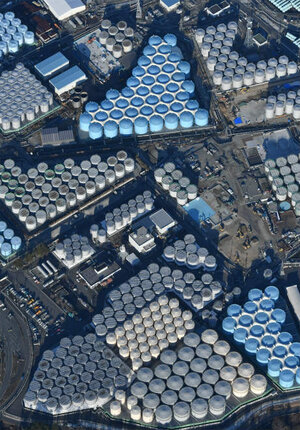
Even with water release, nuclear plant needs more storage tanks, Asahi Shimbun, By KEITARO FUKUCHI/ Staff Writer, May 1, 2021 The plan to release treated radioactive water from the crippled Fukushima No. 1 nuclear plant into the sea will likely not resolve the chronic problem of contaminated water accumulating there, Asahi Shimbun calculations show.
The maximum rate of water discharge allowed under the government’s basic plan would be less than the inflow of rainwater and groundwater at the nuclear power plant, meaning that additional water storage tanks would inevitably be needed at the site.
The government on April 13 approved the basic plan to release more than 1 million tons of treated water into the sea. The government and plant operator Tokyo Electric Power Co. hope to start discharging the water two years from now. Existing storage tanks at the site are expected to reach full capacity around the same time.
The Asahi Shimbun studied this plan based on documents and materials published by the government and TEPCO……… http://www.asahi.com/ajw/articles/14332645
Fukushima waste water plan won’t win public confidence, no matter how hard Japan tries
Fukushima waste water plan won’t win public confidence, no matter how hard Japan tries, Peter Wynn Kirby https://www.scmp.com/comment/opinion/article/3130239/fukushima-waste-water-plan-wont-win-public-confidence-no-matter-how
- The nuclear industry’s history of secrecy and cover-ups is only one reason
- Tepco’s incompetent and at times dishonest handling so far of the 2011 disaster and its aftermath has shattered what’s left of people’s trust.
To exasperated observers, this recalled the nuclear industry’s notorious 1990s mobilisation of Pluto-kun, a puckish cartoon character who drinks plutonium – arguably the world’s most dangerous substance – to demonstrate its harmlessness.

While other nations in the region have registered vociferous opposition to the water release plan, the domestic resistance is telling. A majority of Japanese oppose the plan. For a decade, the fishing industry has laboured, successfully, to show that the seafood it brings to market is safe, giving a wide berth to the plume of radioactive effluent haemorrhaging out of the Fukushima nuclear plant. All these efforts may soon appear to have been made in vain.
As indicated above, the choice of last Tuesday for the announcement seems to have been dictated by politics alone. Did Japan see the Olympics as a feel-good spectacle that could provide cover for the decision? Did US President Joe Biden’s recent pressure on Japan and South Korea to work together on regional security make the timing more palatable?
Whatever the calculus involved, one thing is for sure: the more Japan tries to make Fukushima Daiichi seem perfectly safe, the more people distrust the message – and the messenger.
As the Japanese proverb goes, “Let the past drift away like water.” Yet with radiation, letting go is not so simple. Even as the Japanese government tries to rid itself of the catastrophic after-effects of the Fukushima nuclear crisis, radioactive traces stubbornly remain.
Japan announced last week its intention to release about 1.25 million tonnes of waste water collected from the bowels of the crippled Fukushima Daiichi nuclear power station. The water to be released into the Pacific Ocean contains tritium, a radioactive hydrogen isotope with a half-life of over 12 years. The unwelcome news has provoked uproar both within Japan and among neighbouring countries.
For over a decade, authorities have been engaged in a messy, difficult, frustrating, even Sisyphean task, flushing the ruined footprint of the power station with water to keep the slumped nuclear fuel there from triggering a chain reaction.The meltdowns left parlous uranium fuel in desultory clumps amid the wreckage below. The only way to cool the escaped uranium is to flood the most dangerous areas of the Fukushima Daiichi complex with circulating seawater. Radioactive groundwater and waste water have been stored on-site to avoid contact with humans and the environment.
Ever since, huge water tanks filled with contaminated water have been springing up around the Fukushima Daiichi site like poisonous mushrooms. Now, there are over 1,000 of them. Most rival the size of small Japanese apartment buildings.
You didn’t have to be a genius to realise that the situation at Fukushima Daiichi was unsustainable. Any child who could do basic maths, or maybe a bit of Minecraft, would have been able to see that, day by day, month by month, the water would increase and the 350-hectare site would have less and less available space.Whatever else you might say about Japanese bureaucrats with regard to nuclear policy, they have very good maths skills. As a result, we can surmise that Prime Minister Yoshihide Suga’s announcement last week was, at root, a question of politics and calculated timing
Not that Japan didn’t attempt to resolve the situation otherwise. Authorities tried a range of strategies, including plugging leaks and creating a gigantic US$300 million ice wall around the site, underground, to stem water flow.
In the end, filtering the waste water was the only workable solution. But Japan had mixed results with this strategy. In June 2011, the first filtration system set up by reviled Tepco – Tokyo Electric Power Co, the company that owned the nuclear power station – broke down after only a few hours. The amount of radioactive Caesium in the water overwhelmed the filters.
More recently, before a parliamentary commission, Tepco was forced to admit that it had falsely claimed to have treated most of the waste water from the plant. In actual fact, Tepco had properly dealt with only about one-fifth of the waste water.
Astonishingly, this disappointing result stemmed from it not having bothered to change the filters often enough. Even such basic elements of quality control seem to be beyond the capabilities of the Tepco team, which already lives in infamy after having presided over the world’s second most damaging civil nuclear disaster, after Chernobyl.
Predictably, scientists, officials and industry stakeholders argue that this degree of tritium discharge happens all the time in the nuclear industry – this is more or less true, however perturbing – and suggest that the announced controlled release should therefore present no problem whatsoever.
But the history of the nuclear industry globally is one of military synergies, secrecy, cover-ups, Machiavellian information management, and propaganda-style communication with the public. Indeed, it was striking that on the very same day as Suga’s announcement, Japan’s reconstruction agency released a video depicting tritium in the form of Tritium-kun, a harmless-seeming fishlike creature with blushing cheeks who says tritium release is safe.
US backs Japan’s Fukushima plans despite S Korea’s concerns
US backs Japan’s Fukushima plans despite S Korea’s concerns
Seoul fails to gain US support against Japan’s decision to release contaminated water from Fukushima nuclear plant. Aljazeera, 18 Apr 2021
US climate envoy John Kerry has reaffirmed Washington’s confidence in Japan’s decision to release contaminated water from its crippled Fukushima nuclear plant into the sea despite concerns raised by South Korea.
Kerry arrived in Seoul on Saturday to discuss international efforts to tackle global warming, on a trip that included a stop in China ahead of President Joe Biden’s virtual summit with world leaders on climate change this month.
South Korean Foreign Minister Chung Eui-yong sought to rally support behind the country’s protest against the Fukushima plan at a dinner meeting with Kerry.
Under the plan, more than one million tonnes of water will be discharged from the plant wrecked by an earthquake and tsunami in 2011 into the nearby sea off Japan’s east coast.
Seoul strongly rebuked the decision, with the foreign ministry summoning the Japanese ambassador and President Moon Jae-in ordering officials to explore petitioning an international court.
“Minister Chung conveyed our government and people’s serious concerns about Japan’s decision, and asked the US side to take interest and cooperate so that Japan will provide information in a more transparent and speedy manner,” the ministry said in a statement.
But Kerry, at a media roundtable on Sunday, said Tokyo had made the decision in a transparent manner and will continue following due procedures.
“The US is confident that the government of Japan is in very full consultations with the IAEA,” he said, referring to the International Atomic Energy Agency…….. The former US secretary of state added that Washington would closely monitor Japan’s implementation “like every country, to make certain there is no public health threat”…….. https://www.aljazeera.com/news/2021/4/18/s-korea-us-show-differences-over-japans-fukushima-plans
Fukushima nuclear wastewater ‘fundamentally different’ from normal plants: Chinese ministry,
Fukushima nuclear wastewater ‘fundamentally different’ from normal plants: Chinese ministry, https://www.globaltimes.cn/page/202104/1221363.shtml
By Global Times , 18 Apr 21, Amid international pushback against Japan’s decision to dump nuclear-contaminated wastewater from the Fukushima nuclear power plant into the sea, China’s Ministry of Ecology and Environment has urged Japan to consider all safe ways of disposal to deal with the issue, as the nuclear-contaminated water is fundamentally different from discharges from other normal nuclear plants.
Regardless of domestic opposition and doubts from the international community, Japan made a unilateral decision to dump the contaminated water into the sea before exhausting all safe ways of disposal or fully consulting with neighboring countries and the international community, the ministry said.
China, as Japan’s close neighbor and one of the stakeholders in this issue, has expressed grave concerns.
The Chinese environment ministry urged Japan, which has a responsibility to the international community, to conduct further research on all safe ways of disposal and release related information in a timely and transparent way.
A cautious decision should be made after a careful consideration of all other safe ways of disposal and full consultation with all stakeholders, it said.
The ministry stressed that the nuclear-contaminated water has fundamental differences from the discharge of a normally operated nuclear plant, either in terms of the original source, category of radionuclides, or disposal treatment imparity.
The Fukushima contaminated wastewater came from the cooling water injected into the melted reactor core after the nuclear accident, as well as groundwater and rainwater that permeated the reactor. It contains a variety of radionuclides in the melted reactor core, which are difficult to treat, it said.
Discharges from a normally operated plant are mainly from the technology and land drainage, which contain few fission nuclides. After being treated and strictly monitored under international standards, such discharges are much less harmful than the international standards require, the ministry noted.
The ministry also said that China will evaluate the possible impact of nuclear-contaminated wastewater on the marine environment and strengthen monitoring of the radiation in that environment.
Fukushima” is not over: Japanese NGOs raise concern over the ongoing nuclear disaster
Fukushima” is not over: Japanese NGOs raise concern over the ongoing nuclear disaster, Friends of the Earth Japan, Pacific Asia Resource Center (PARC), 14 Apr 21,
On the 10th anniversary of one of the worst nuclear accidents at Fukushima Daiichi Nuclear Power Station, and amid the controversial decision of the Japanese government to dump “treated” radioactive water into the ocean, Japanese NGOs Friends of the Earth Japan and Pacific Asia Resource Center (PARC) co-produced a documentary film Fukushima 10 Years Later: Voices from the continuing nuclear disaster. The film sheds light on the ongoing suffering of victims of the accident and poses critical questions about the Japanese government’s poor responses to the accident.
While then-Prime Minister Abe vainly declared to the world that “the situation in Fukushima is completely under control”, nuclear decays are continuing inside the molten fuel rods, and the exploded plants are still emitting radioactive particles to this day. In the meanwhile, evacuees are torn apart in limbo, with grim hopes of returning to their homeland, continued fear of radioactive fallout, and a dire socio-economic situation. Fisherfolk, who overcame the initial fear of ocean contamination, are forced to relive the experience each time TEPCO and the Japanese government repeatedly choose to release contaminated water into the ocean.
This happens all under the propaganda that Fukushima is pressing ahead with “Fukkou (Recovery)”.
This video aims to highlight the current situation of the victims of the man-made disaster, and challenge the government propaganda of Fukushima’s Recovery.
Fukushima 10 Years Later: Voices from the continuing nuclear disaster
Produced by Friends of the Earth Japan and Pacific Asia Resource Center
Supervised by HOSOKAWA Komei (Citizens’ Commission on Nuclear Energy)
Directed by MATSUMOTO Hikaru (Friends of the Earth Japan)
Running time: 43 min.
The English subtitled version of the film is now available on Vimeo on Demand and will cost USD 5.75 to rent and USD 47.50 to purchase.
https://vimeo.com/ondemand/fukushima10years
For further information on the film, please contact OKUMURA Yuto, Pacific Asia Resource Center.
E-mail: video@parc-jp.org
Yuto Okumura,Pacific Asia Resource Center (PARC)
Fukushima: Japan announces it will dump contaminated water into sea
Fukushima: Japan announces it will dump contaminated water into sea https://www.theguardian.com/environment/2021/apr/13/fukushima-japan-to-start-dumping-contaminated-water-pacific-ocean
More than 1m tonnes of contaminated water will be released from the destroyed nuclear station in two years’ time, Japan plans to release into the sea more than 1m tonnes of contaminated water from the destroyed Fukushima nuclear station, the government said on Tuesday, a decision that is likely to anger neighbours such as South Korea.
The move, more than a decade after the nuclear disaster, will deal another blow to the fishing industry in Fukushima, which has opposed such a step for years.
The work to release the water will begin in about two years, the government said, and the whole process is expected to take decades.
“On the premise of strict compliance with regulatory standards that have been established, we select oceanic release,” the government said in a statement after relevant ministers formalised the decision.
Around 1.25 million tonnes of water has accumulated at the site of the nuclear plant, which was crippled after going into meltdown following a tsunami in 2011.
It includes water used to cool the plant, as well as rain and groundwater that seeps in daily.
The water needs to be filtered again to remove harmful isotopes and will be diluted to meet international standards before any release.
The decision comes about three months ahead of the postponed Olympic Games to be hosted by Tokyo, with some events planned as close as 60km (35 miles) from the wrecked plant.
The disposal of contaminated water from the Fukushima Daiichi plant, run by Tokyo Electric Power, has proved a thorny problem for Japan as it pursues a decades-long decommissioning proj
Japan’s Prime Minister getting ready to release Fukushima waste water into the Pacific ocean?
Reuters 6th April 2021, Japanese Prime Minister Yoshihide Suga will hold a ministerial meeting as early as next week to start discussions on the release of contaminated Fukushima Dai-ichi Nuclear Power Plant water into the ocean, broadcaster FNN said on Tuesday.
Suga is also expected to meet with the head of the national federation of fisheries cooperatives as early as Wednesday to discuss the potential release of the water. The water, which is treated but contains traces of tritium, was used to cool the reactors in the aftermath of the Fukushima Dai-ichi Power Plant’s nuclear disaster in 2011 and is now stored within the grounds of the power plant.
4,000 Fukushima waste bags contain unidentified radioactive materials

Mainichi 6th April 2021, Of the 85,000 containers holding radioactive waste placed in the radiation-controlled area of the Fukushima Daiichi nuclear power plant, the contents of about 4,000 have not been identified, operator Tokyo ElectricPower Company Holdings Inc. (TEPCO) announced on April 5. According to TEPCO, it began listing the contents of the containers after the meltdown in 2011, but about 4,000 of them remain unidentified. The company says it will formulate a survey plan and proceed to determine what they hold.
https://mainichi.jp/english/articles/20210406/p2a/00m/0na/002000c
Infamous Fukushima town sign praising nuclear energy to become permanent museum display

全町避難が続く福島県双葉町で、原発推進看板の撤去工事を見守る標語考案者の大沼勇治さん=21日
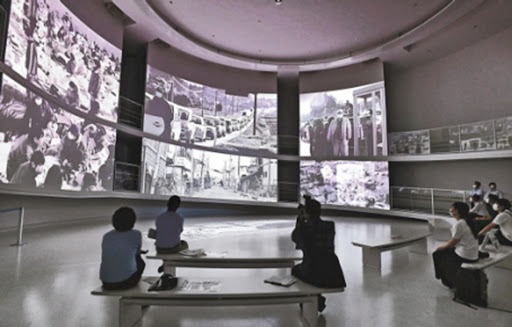 Infamous Fukushima town sign praising nuclear energy to become permanent museum display https://mainichi.jp/english/articles/20210320/p2a/00m/0na/006000c, March 20, 2021 (Mainichi Japan) FUKUSHIMA — A sign hailing nuclear energy and formerly located on the main street of Fukushima Prefecture town Futaba, which was rendered inaccessible following the nuclear meltdowns triggered by the March 2011 Great East Japan Earthquake, will go on display at the Great East Japan Earthquake and Nuclear Disaster Memorial Museum in the town from March 24. Infamous Fukushima town sign praising nuclear energy to become permanent museum display https://mainichi.jp/english/articles/20210320/p2a/00m/0na/006000c, March 20, 2021 (Mainichi Japan) FUKUSHIMA — A sign hailing nuclear energy and formerly located on the main street of Fukushima Prefecture town Futaba, which was rendered inaccessible following the nuclear meltdowns triggered by the March 2011 Great East Japan Earthquake, will go on display at the Great East Japan Earthquake and Nuclear Disaster Memorial Museum in the town from March 24.
The sign measures 2 meters by 16 meters, and reads “Nuclear Power: Energy for a Bright Future.” After the 2011 nuclear disaster at the Tokyo Electric Power Co. Fukushima Daiichi Nuclear Power Station, the sign became iconic nationally as a symbol of the northeastern Japan town that pushed for nuclear power and still remains entirely subject to evacuation orders. The sign was removed in March 2016 because its deterioration posed dangers, and photos of the sign were displayed at the museum. It is too large to be placed indoors, so authorities delayed its display when opening the museum in September 2020; in the meantime, discussions on how to exhibit it were held with the Fukushima Prefectural Government. Then, on March 19, the prefectural government announced the sign will go on permanent display at the museum’s outdoor terrace from March 24. Yuji Onuma, 45, who came up with the sign’s slogan when he was in elementary school, said, “I believe exhibiting the sign will symbolize a resolve to never have another nuclear accident, and to aim for a bright future this time around. It took a long time after its removal for display plans to be finalized, but I hope coming face to face with the real thing will give visitors a chance to think about the nuclear disaster.” (Japanese original by Ryusuke Takahashi, Fukushima Bureau) |
|
Fukushima disaster 10 years on: How long will it take to clean up the nuclear waste?
Decontamination and living with ‘black bags’
Piles of black bags were generated by the vast, painstaking clean-up and then transported from other storage places. Those black bags have occupied more than 90 blocks ranging from 180 sq m to 6,500 sq m in the northern part of Tomioka since 2015.
According to a 2018 report from Japan’s Ministry of the Environment, the estimated total quantity of decontaminated soil will be somewhere between 16 and 22 million cubic metres after volume reduction. This is 13 to 18 times larger than the volume of the Tokyo Dome.
The Ministry says the total will likely be at the lower end of the provided range, in a latest reply to The Straits Times’ query.
Limits of decontamination
The “decontamination” only involves soil removal in flatland areas – the government has said that it is impossible to clear the soil in mountainous areas, but more than 70 per cent of the hardest-hit areas are mountainous.
Mr Nobuyoshi Ito is one of those who live in the mountainous areas where vast decontamination is hard to carry out.
Mr Ito first moved to Iitate village in Fukushima prefecture in 2010 after he retired as an IT engineer, to work as an “apprentice farmer”.
He had no ties with the village before that, but the self-professed “guinea pig” ended up staying on there, in open defiance of government orders to evacuate, and against his children’s wishes for him to live with them in Niigata prefecture on the west coast.
“When the government asked us to evacuate… I asked if there would be criminal charges if I continued to live here,” he told The Straits Times in 2016. “They said no.”
He carries a dosimeter around with him all the time, measuring anything he can lay his hands on from soil, plants to animal carcasses. He also owns a laboratory-grade radiation measuring machine at his cabin, deep in the mountains in the village.
He thinks the government’s decision to not decontaminate forested mountainous areas will backfire due to factors such as rain that may spread radioactive material, and in a study last year found that 43 out of 69 locations along the Olympic torch relay route had radiation levels above the government limits.
He told The Straits Times that he fears that Tokyo is overly eager to portray that everything was “under control”, given that this could give the impression that it is “case closed”.
Non-profit Greenpeace notes that such standards in towns neighbouring the nuclear plant would not pass in other parts of the world.
The indefinite future: Where to permanently store 16 million bags of nuclear waste
The law requires that the final disposal site of high-level nuclear waste should be outside of Fukushima by March 2045.
Two fishing villages in Hokkaido are vying to host the final storage facility of Japanese nuclear waste for half a century, splitting communities between those seeking investment to stop the towns from dying, and those haunted by the 2011 Fukushima disaster who are determined to stop the project.
I cannot give a deadline at this moment. We will consider the entire schedule based on the progress at the two new potential sites, along with nationwide public relations activities.
MS MASARU KASHIMA
New type of large and highly radioactive particles found in Japan
|
Recent studies have revealed that the fall-out from reactor unit 1 also included larger caesium-bearing particles, each greater than 300 micron in diameter, which have higher levels of activity in the order of 105 Bq per particle. These particles were found to have been deposited in a narrow zone stretching around 8 km north-northwest from the reactor site.
Surface soil samplesIn their study, chemist and environmental scientist Satoshi Utsunomiya of Japan’s Kyushu University and colleagues have analyzed 31 of these particles, which were collected from surface soil taken from roadsides in radiation hotspots. “[We] discovered a new type of radioactive particle 3.9 km north northwest of the Fukushima Daiichi Nuclear Power Plant, which has the highest caesium-134 and caesium-137 activity yet documented in Fukushima, 105–106 Bq per particle,” Utsunomiya says. Alongside the record-breaking radioactivity seen in two of the particles (6.1×10⁵ and 2.5×10⁶ Bq, after correction to the date of the accident) the team also found that they had characteristic compositions and textures that differed from those previously seen in the reactor unit 1 fall-out. Reactor building materialsA combination of techniques including synchrotron-based nano-focus X-ray analysis and transmission electron microscopy indicated that one of the particles was found to be an aggregate of smaller silicate nanoparticles each with a glass-like structure. This is thought to be the remnants of reactor building materials that were first damaged in the explosion and then picked up caesium that had been volatized from the reactor fuel. The other particle had a glassy carbon core and a surface peppered with other microparticles of various compositions, which are thought to reflect a forensic snapshot of the particles that were airborne within the reactor unit 1 building at the moment of the hydrogen explosion and the physio-chemical phenomena they were subjected to. “Owing to their large size, the health effects of the new particles are likely limited to external radiation hazards during static contact with skin,” explained Utsunomiya — with the two record-breaking particles thought too large to be inhaled into the respiratory tract. Impact on wildlifeHowever, the researchers note that further work is needed to determine the impact on the wildlife living around the Fukushima Daiichi facility — such as, for example, filter feeding marine molluscs which have previously been found susceptible to DNA damage and necrosis on exposure to radioactive particles. “The half-life of caesium-137 is around 30 years,” Utsunomiya continued, adding: “So, the activity in the newly found highly radioactive particles has not yet decayed significantly. As such, they will remain [radioactive] in the environment for many decades to come, and this type of particle could occasionally still be found in radiation hot spots.” Nuclear material corrosion expert Claire Corkhill of the University of Sheffield – who was not involved in the study – says that the team have offered new insights into the events that unfurled during the accident. “Although the two particles selected [for analysis] were small, a mighty amount of chemical information was yielded,” she said, noting that some of the boron isotopes the researchers identified could only have come from the nuclear control rods damaged in the accident……… The study is described in Science of the Total Environment. https://physicsworld.com/a/new-type-of-fallout-from-fukushima-daiichi-found-a-decade-after-nuclear-disaster/ |
|

Japan’s Nuclear Clean-Up Has No End in Sight
Climbing Without a Map: Japan’s Nuclear Clean-Up Has No End in Sight, U.S. News, By Reuters, Wire Service Content March 12, 2021, BY SAKURA MURAKAMI AND Aaron Sheldrick TOKYO (Reuters) – For one minute this week, workers at the Fukushima nuclear station fell silent to mark the 10-year anniversary of a natural disaster that triggered the worst nuclear accident since Chernobyl.
Then they went back to work tearing down the reactors melted down in the days after a tsunami on March 11, 2011.
The job ranks as the most expensive and dangerous nuclear clean-up ever attempted. A decade in, an army of engineers, scientists and 5,000 workers are still mapping out a project many expect will not be completed in their lifetime.
Naoaki Okuzumi, the head of research at Japan’s lead research institute on decommissioning, compares the work ahead to climbing a mountain range – without a map.
“The feeling we have is, you think the summit’s right there, but then you reach it and can see another summit, further beyond,” Okuzumi told Reuters.
Okuzumi and others need to find a way to remove and safely store 880 tonnes of highly radioactive uranium fuel along with a larger mass of concrete and metal into which fuel melted a decade ago during the accident.
The robotic tools to do the job don’t yet exist. There is no plan for where to put the radioactive material when it is removed.
Japan’s government says the job could run 40 years. Outside experts say it could take twice as long, pushing completion near the close of the century……..
It wasn’t until 2017 that engineers understood how complicated the clean-up would become. By that point, five specially designed robots had been dispatched through the dark, contaminated waters pumped in to cool the uranium. But radiation zapped their electronics.
One robot developed by Toshiba Corp, nicknamed the “little sunfish”, a device about the size of a loaf of bread, provided an early glimpse of the chaotic damage around the cores.
Kenji Matsuzaki, a robot technician at Toshiba who led development of the “sunfish”, had assumed that they would find melted fuel at the bottom of the reactors.
But the sunfish’s first video images showed a tumult of destruction, with overturned structures inside the reactor, clumps of unrecognizable brown debris and dangerously radioactive metal.
“I expected it to be broken, but I didn’t expect it would be this bad,” Matsuzaki said.
The delivery of a robotic arm to start removing fuel, developed in a $16 million programme with the UK’s Nuclear Decommissioning Authority, has been delayed until 2022. Tepco plans to use it to grab some debris from inside reactor 2 for testing and to help plan the main operation………….
But the cleanup has been delayed by the buildup of contaminated water in tanks that crowd the site. The melted cores are kept cool by pumping water into damaged reactor vessels.
But the cleanup has been delayed by the buildup of contaminated water in tanks that crowd the site. The melted cores are kept cool by pumping water into damaged reactor vessels. https://www.usnews.com/news/world/articles/2021-03-12/climbing-without-a-map-japans-nuclear-clean-up-has-no-end-in-sight
1 This Month



Shut down the radiation-damaged Heysham nuclear reactors now
To see nuclear-related stories in greater depth and intensity – go to https://nuclearinformation.wordpress.com

Say No to NASA’s Reckless Nuclear Reactor on the Moon
Say No to NASA’s Reckless Nuclear Reactor on the Moon
-
Archives
- October 2026 (255)
- September 2026 (339)
- August 2026 (330)
- July 2026 (355)
- June 2026 (287)
- May 2026 (306)
- April 2026 (356)
- March 2026 (251)
- February 2026 (267)
- January 2026 (308)
- December 2025 (358)
- November 2025 (359)
-
Categories
- 1
- 1 NUCLEAR ISSUES
- business and costs
- climate change
- culture and arts
- ENERGY
- environment
- health
- history
- indigenous issues
- Legal
- marketing of nuclear
- media
- opposition to nuclear
- PERSONAL STORIES
- politics
- politics international
- Religion and ethics
- safety
- secrets,lies and civil liberties
- spinbuster
- technology
- Uranium
- wastes
- weapons and war
- Women
- 2 WORLD
- ACTION
- AFRICA
- Atrocities
- AUSTRALIA
- Christina's notes
- Christina's themes
- culture and arts
- Events
- Fuk 2022
- Fuk 2023
- Fukushima 2017
- Fukushima 2018
- fukushima 2019
- Fukushima 2020
- Fukushima 2021
- general
- global warming
- Humour (God we need it)
- Nuclear
- RARE EARTHS
- Reference
- resources – print
- Resources -audiovicual
- Weekly Newsletter
- World
- World Nuclear
- YouTube
-
RSS
Entries RSS
Comments RSS

