8 Significant facts about Fukushima Daiichi Nuclear Station
6. In Japan, the only radiation from Fukushima Daiichi Nuclear Reactors that is being measured is the radioactive cesium. However large amounts of strontium 90 and tritium are spreading all over Japan. Strontium and tritium’s radiation consists of beta rays, and are very difficult to measure. However both are extremely dangerous: strontium can cause leukemia, and tritium can cause chromosome disorder.
8. ……Tokyo Governor Naoki Inose said .“It is not under control now.”
Some Facts You Must Know About Fukushima Takashi Hirose | CounterPunch, 26 Mar 15 “………Here are eight things you need to know. Continue reading
Fukushima clean-up failures – RADIOACTIVE RAINWATER, BAD IDEAS, TECHNICAL ERRORS etc
Fukushima disaster followed by four-year litany of failures costing hundreds of millions http://www.news.com.au/world/asia/fukushima-disaster-followed-by-four-year-litany-of-failures-costing-hundreds-of-millions/story-fnh81fz8-1227280207492 VERY GOOD PHOTOS MARCH 26, 2015 THE tragedy of Fukushima is far from over, a whole four years after 18,000 people died when the Daiichi nuclear power plant was destroyed by a tsunami and earthquake.
Japanese government auditors have revealed that more than a third of the $2 billion of taxpayer money dedicated to the clean-up has been wasted.
Tourists are returning to the region as radiation fears fade, and there are plans to host events in the area for the 2020 Tokyo Olympics, yet the region is in chaos, seemingly cursed by a litany of failures and screw-ups.
- RADIOACTIVE RAINWATER Continue reading
Daunting problem of Fukushima’as continuing flood of radioactive water
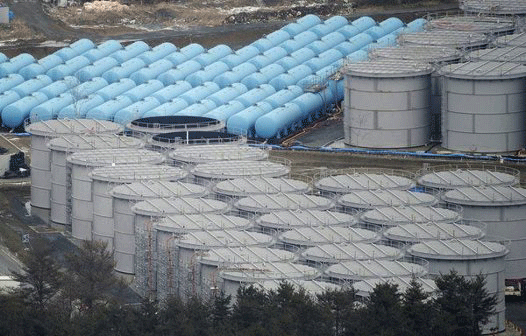
Tepco’s nuclear clean-up wasted $1.6 billion of tax-payers’ money
Japanese audit finds $1.6 billion wasted in Fukushima nuclear plant cleanup Fox News, 24 mar 15 TOKYO – Japanese government auditors say the operator of the Fukushima Dai-ichi nuclear plant has wasted more than a third of the 190 billion yen ($1.6 billion) in taxpayer money allocated for cleaning up the plant after it was destroyed by a March 2011 earthquake and tsunami.
A Board of Audit report describes various expensive machines and untested measures that ended in failure. It also says the cleanup work has been dominated by one group of Japanese utility, construction and electronics giants despite repeated calls for more transparency and greater access for international bidders……
 Some of the failures cited in the report:
FRENCH IMPORT: Among the costliest failures was a 32 billion yen ($270 million) machine made by French nuclear giant Areva SA to remove radioactive cesium from water leaking from the three wrecked reactors. The trouble-plagued machine lasted just three months and treated only 77,000 tons of water, a tiny fraction of the volume leaking every day. It has since been replaced with Japanese and American machines.
SHODDY TANKS: TEPCO hurriedly built dozens of storage tanks for the contaminated water at a cost of 16 billion yen ($134 million). The shoddy tanks, using rubber seals and assembled by unskilled workers, began leaking and some water seeped into the ground and then into the ocean. The tanks are now being replaced with more durable welded ones.
GIANT UNDERGROUND POOLS: A total of 2.1 billion yen ($18 million) was spent on seven huge underground pools built by Maeda Corp. to store the contaminated water. They leaked within weeks, and the water had to be transferred to steel tanks.
 UNFROZEN TRENCH: A 100 million yen ($840,000) project to contain highly contaminated water in a maintenance tunnel by freezing it failed because the water never completely froze. TEPCO subsidiary Tokyo Power Technology even threw in chunks of ice, but eventually had to pour in cement to seal the trench. http://www.foxnews.com/world/2015/03/24/japanese-audit-finds-millions-dollars-wasted-in-fukushima-nuclear-plant-cleanup/
Fukushima accident – pieces of fuel rods and reactor vessels blasted to least 130km
 NHK admitted pieces of fuel rods and reactor vessels blasted to at least Ibaraki to contain Uranium & Zirconium http://fukushima-diary.com/2014/08/nhk-admitted-pieces-fuel-rods-reactor-vessels-blasted-least-ibaraki-contain-uranium-zirconium/ Iori Mochizuki In the early morning news flash of 8/9/2014, NHK announced that pieces of nuclear fuel, fuel rods, reactor pressure vessels and the internal structure were blasted to at least 130km away from Fukushima nuclear plant.
It was 2μm diameter particle. The ball-looking shape proves it was molten in high temperature and quickly cooled down. The particles contain Uranium, Zirconium etc, which are the same material as nuclear fuel and the structure inside the vessels. These were collected from 3/14 ~ 3/15/2011 in Tsukuba city Ibaraki prefecture by the study group of Science Univ. of Tokyo.
The reason why NHK suddenly started reporting about this fact is not clear. It has been already 3 years and 5 months, which is probably too late to escape. There is a possibility that NHK announces the actual contamination situation in the area closer to Tokyo when people pay much less attention to Fukushima accident.
International Research Institute for Nuclear Decommissioning found no nuclear fuel nor water in Fukushima reactor 1
IRID SAW no fuel or water remaining in reactor core of Reactor 1 http://fukushima-diary.com/2015/03/irid-saw-no-fuel-or-water-remaining-in-reactor-core-of-reactor-1/ Iori Mochizuki Following up this article. Tepco to start “scanning” inside of Reactor 1 in early February by using muon [URL] IRID (International Research Institute for Nuclear Decommissioning) and High Energy Accelerator Research Organization announced they could not find a potential part of nuclear fuel in Reactor core of Reactor 1.
On 3/19/2015, they released the prompt report of their “scanning” test implemented until 3/10/2015.
The report tells they could not find anything longer than 1m in reactor core, where originally fuel assemblies were set.
The muon equipment was installed in North of Reactor 1 and also in North-West of Reactor 1. However, neither of them detected a potential fuel assembly.
Also, no water is retained in the reactor core of RPV (Reactor Pressure Vessel). These facts found strongly supports the possibility that the molten fuel has already dropped onto the bottom of Primary Containment Vessel. They did not mention the further possibility that the molten fuel has already gone through the outer wall of the vessel.
About the state of Spent Fuel Pool 1, they did not conclude more than “assuming the fuel remains inside the pool, but the size is not identified”.
Fish and wild foods still showing radioactivity in Fukushima area
The decline in contamination has been very slow among bottom fish, including karei flat fish and ainame greenling caught off Fukushima. The same is true of freshwater fish, including iwana, caught from rivers, lakes and ponds in Fukushima, Miyagi, Tochigi, Gunma and Chiba prefectures.
As for mushrooms and wild vegetables, samples from 11 prefectures, including Fukushima, Yamanashi, Nagano and Shizuoka, exceeded the threshold between April 1 last year and March 1, according to the data.
Produce worries easing but some fish, wild foods still a problem in wake of Fukushima meltdowns, Japan Times BY MIZUHO AOKI STAFF WRITER MAR 12, 2015 The public panic over the threat of radioactive food has subsided in the four years since the Fukushima No. 1 nuclear power plant experienced three reactor core meltdowns and spewed massive amounts of fallout, but worries persist.
Seikatsu Club, a mail-order food delivery co-op, maintains an online database that includes more than 700,000 results of radiation tests on food items. Page views have fallen to about one-tenth of their peak in 2012, said Hiroshi Tsuchida, a quality management division chief with the co-op, but there are people who still visit the site almost daily.
“For such members, we are continuing testing and disclosing all the data on our website,” Tsuchida told The Japan Times. “In Ukraine, there are screening devices at markets where people check food even today, nearly 30 years since the (start of the Chernobyl) nuclear disaster. I believe we should do the same.”
Despite the lingering fears, however, overall contamination levels of farm produce and seafood from Fukushima and neighboring prefectures have declined significantly……..
But concern remains over fish, wild vegetables and wild game. Between April 1 last year and March 1, around 292,000 such samples were tested for radioactive cesium and 502, or 0.17 percent, exceeded the safe threshold, the health ministry said. In fiscal 2012, that ratio stood at 0.85 percent. Continue reading
Another major leak of radioactive water at Fukushima nuclear facility
 Japan TV: “Radiation levels surge” at Fukushima — “Another major leak” — “Massive leak of … highly contaminated water” — “Hundreds of tons… breached barriers” (VIDEO) http://enenews.com/groundwater-radiation-levels-surge-fukushima-after-another-major-leak-750-tons-water-relatively-high-levels-radioactivity-video?utm_source=feedburner&utm_medium=email&utm_campaign=Feed%3A+ENENews+%28Energy+News%29
TEPCO, Mar 11, 2015 (emphasis added): Fukushima Daiichi NPS Prompt Report — Tepco Reports Rainwater Containing Strontium90 Found Seeping Into Ground At Fukushima Daiichi Tank Area; No Leakage Into Ocean… approximately 750 tons of rainwater containing Strontium90 may have seeped into the ground… [TEPCO] explained that the water is unlikely to leak out to the ocean through any of its drainage channels but it is monitoring the situation… the total amount of nuclides emitting beta rays such as Strontium90 ranged from 150 to 8,300 Bequerels per liter… it is investigating the cause of the rainwater contamination…
Asahi, Mar 11, 2015: [TEPCO] reported a massive leak of radioactive rainwater… on March 10. It said hundreds of tons of contaminated rainwater breached barriers surrounding storage tanks for highly radioactive water and seeped into the ground… Highly contaminated wateralso leaked from the same area and seeped into the ground in summer 2013… In the latest leakage, workers discovered bubbles at the junctions of side ditches in the area. Officials said this indicated that contaminated rainwater had seeped through the junctions and into the ground.
NHK, Mar 11, 2015: Radioactive rainwater leak at Fukushima plant — The operator of the Fukushima Daiichi nuclear plant says an estimated 750 tons of rainwater with relatively high levels of radioactivity has been leaked… TEPCO officials said the rainwater was 15 centimeters deep at 10:30 PM on Monday, but the figure had fallen to 8 centimeters shortly after 8 AM on Tuesday… They say the water inside the dam contained up to 8,300 becquerels per liter of beta-particle-emitting substances. TEPCO officials say all the water has now been collected. They say the drainage channel to the ocean is buried underground and it is unlikely that the water flowed into the ocean.
Jiji Press, Mar 11, 2015: TEPCO initially put the amount of leaked rainwater at 400 tons. The number was revised to 747 tons.
Arirang, Mar 12, 2015: Another major leakat… Fukushima nuclear power plant earlier this week may have raised radiation levels in nearby waters. [TEPCO] told Seoul-based Yonhap News that the radiation levels in water collected on Wednesday were 30 times higher than the sample collected on Monday. TEPCO said earlier this week that nearly [750] tons of contaminated rainwater had escaped the plant.
NHK, Mar 11, 2015: Groundwater radiation levels surge after leak – [TEPCO] says levels of radioactive material in groundwater have surged 30-fold, apparently after contaminated rainwater leaked outside a barrier… [It] estimates the leak at about 750 tons of rainwater, and it says levels of beta ray-emitting substances [were] 8,300 becquerels per liter. On Wednesday, TEPCO measured 11,000 becquerels per liter in groundwater… up from 370 becquerels…
Prolonged exposure to radiation is taking health toll on Fukushima’s kids
 TV: Officials lying, many more kids getting cancer after Fukushima — Report: 1,200+ deaths from “illness caused by prolonged exposure” — Mom: “I’m really worried… children not the same… sick… nosebleeds, rashes.. white blood cells decreased” — Radiation by school 100 times normal (VIDEO) http://enenews.com/tv-fukushima-residents-govt-lying-im-really-worried-many-children-same-sick-nosebleeds-rashes-incredible-fatigue-white-blood-cells-decreased-radiation-levels-school-100-times-normal-video?utm_source=feedburner&utm_medium=email&utm_campaign=Feed%3A+ENENews+%28Energy+News%29
ABC (Australia), Mar 11, 2014 (emphasis added): Radiation levels posing cancer risks… Before the disaster, there was just one to two cases of thyroid cancers in a million Japanese children but now Fukushima has more than 100 confirmed or suspected cases, having tested about 300,000 children… It is expected that thyroid cancers could turn up about four to five years after a nuclear disaster… [Megumi] Muto said her daughter and son, like many other children, had not been the same since experiencing the Fukushima fallout. “They had rashes on their bodies then nose bleeds. My son’s white cells have decreased and they both haveincredible fatigue… both have multiple nodulesaround their thyroids. I’m really worried.”… Mutowanted to move her family out of Fukushima city but she said she could not afford to.
News 24 (SAPA), Mar 10, 2015: A total of 1232 deaths in Japan’s Fukushima prefecture over the past year were linked to the nuclear accidentfour years ago, up 18% from a year earlier, a news report said on Tuesday. A death is considered nuclear-related if is not directly resulting from a nuclear accident but is due from an illness caused by prolonged exposure. Namie town, close to the Fukushima Daiichi Nuclear Power Station, had the largest number of deaths at 359, followed by 291 in Tomioka town, which is also near the complex, the Tokyo Shimbun reported.
ABC (Australia) video transcript, Mar 11, 2014:
- Headline: Fukushima residents have taken cancer and radiation testing into their own hands, saying authorities are lying to them about the safety of their community.
- Matthew Carney, ABC correspondent: It’s a heartbreaking time for Megumi Muto. Her daughter is being tested to see if the lumps in her thyroid gland have grown… Megumi isconvinced exposure to high radiation levels after the Fukushima nuclear meltdowns is the cause.
- Megumi Muto, Fukushima mother (translated): I feel angry. I think the authorities hide the real dangers, and now many more children are being diagnosed.
- Carney: Many residents in Fukushima don’t trust the government or TEPCO.
- Muto: Since the disaster my kids have been sick with nosebleeds, rashes and lethargy. Fukushima used to be a safe… area, but not now.
ABC (Australia) audio transcript, Mar 11, 2014:
- Michael Brissenden, ABC: the issue of long term health implications like cancer are causing the greatest concern and controversy in Japan…
- Matthew Carney, ABC correspondent: [Fukushima residents say the local and central] governments failed to protect the children. And they do not trust what the government or TEPCO… are telling them about radiation levels and safety. They’re conducting their own radiation tests and near this school in Fukushima City, the monitor reads 3 mircosieverts an hour. That’s about 100 times the rate of Tokyo.
- Sumio Kunno, nuclear plant engineer: I have to investigate and inform the public of the facts… They’re still not decontaminating areas where children live or play.
Pro nuclear signs to be removed from deserted town of Futaba
Deserted Fukushima town to remove pro-nuclear signs 7 News, Tokyo (AFP) 10 Mar 15 – A Japanese town that was evacuated after the 2011 Fukushima nuclear disaster has decided to remove street signs trumpeting the benefits of atomic power, an official said Tuesday.Deserted Futaba town, which plays host to the crippled Fukushima Dai-ichi nuclear power plant, is set to earmark cash to remove huge signboards erected in 1988 and 1991, a town official told AFP.
“Nuclear power: the energy for a bright future,” says one sign written in the style of a haiku poem at the entrance to the town. “Nuclear power: for development of our homeland, a prosperous future,” reads the other.
Futaba’s 6,300 residents were ordered to flee their homes in the days after reactors began melting down at Fukushima when an enormous tsunami swamped their cooling systems.
They are still unable to return because of fears over elevated levels of radiation that leaked from the plant, and many remain in poorly-constructed temporary homes…….
0,000 people remain displaced because of the no-go zone around the plant.
Scientists warn that it may be many years until it is safe to return and say that some areas may have to be abandoned forever.
Campaign groups say unemployment is high and levels of depression and other illness are far above normal in displaced communities. https://au.news.yahoo.com/world/a/26585240/deserted-fukushima-town-to-remove-pro-nuclear-signs/
Video: Fukushima had “meltdown, melt-through, & melt-out within days of quake”
 Video: Fukushima had “meltdown, melt-through, & melt-out within days of quake” — US Gov’t: Analysis says containment vessel fails after fuel melts through barrier — Experts: Corium may have melted out to reactor building, prepare for radiation doses over 200,000,000 microsieverts/hour http://enenews.com/video-fukushima-meltdown-melt-melt-days-quake-govt-analysis-shows-containment-vessel-failed-after-fuel-melted-barrier-experts-corium-melted-container-reactor-building-prepare-radiation-levels-20?utm_source=feedburner&utm_medium=email&utm_campaign=Feed%3A+ENENews+%28Energy+News%29
Jiji Press, Mar 5, 2015 (emphasis added): Where is the melted fuel in the stricken reactors at Fukushima No. 1? This remains a question… cosmic rays [are being used] to “see through” the reactors… [Prof. Fumihiko Takasaki of the High Energy Accelerator Research Organization calls the] nuclear disaster a “national crisis”… muon detectors were… placed last July at reactor No. 1… As detector units can’t be placed underground at reactor 1, any melted fuel in the underground part of the reactor will go undetected.
Science (AAAS), Mar 5, 2015: Fukushima Daiichi… won’t be truly safe until engineers can remove nuclear fuel… But first, they have to find that fuel… [TEPCO] thinks… fuel in the Unit 1… dropped to the bottom of the containment… engineers need much more detail about its location and condition… By the end of this month, Takasaki says, the detectors may have absorbed enough muons to confirm there is no fuel left in the reactor core… [Detectors]won’t be able to map fuel that may have flowed to the bottom of the containment vessel.
Wall St Journal: Fuel rods… melted fully out of their pressure vessel [says Tepco]… but it likely stopped as Tepco began [injecting] seawater [See: Tepco: We should have told public this sooner… water injections failed to cool melted fuel]… Edwin Lyman, a senior scientist with the Union of Concerned Scientists, says it remains unclear why the fuel rods didn’t also breach the containment wall. “Why this didn’t happen is still unknown”…
U.S. NRC — State-of-the-Art Reactor Consequence Analyses (SOARCA) Report (pdf), Oct 2012: Fukushima Daiichi… presented… many insights with potential parallels to SOARCA’s analysis of… Peach Bottom, a similarly designed plant… in the SOARCA scenarios, significant hydrogen release [begins with] failure of the containment pressure boundary, which… results from molten debris failing the drywell liner… (i.e., drywell liner melt-through)… TEPCO has announced… the fuel did not move laterally across the drywell floor [and melt through the liner]… In the analyses presented in this report, hydrogen [was] released via the failure of the drywell liner by melt-attack.
Argonne National Lab (USA), MCM (Switzerland), Sep 2014: location of 1F corium — Critical questions relate to the extent of core melt and the extent to which it has melted through RPV and penetrated into the primary containment… “hot particles”… may be throughout the reactor building [and] water collection system and even released to surroundings… Identification of hot particles… is going to be critical for safe decommissioning… [the equipment] must withstand extremely high radiation – perhaps up to greater than 200 Sv/hr.
More from MCM: Most molten core appears to be contained within the primary containment, although a very small extent of melt-through to… cannot be precluded.
Symposium sponsored by Consortium for Japan Relief — Chim Pom, published Feb 2015: “Media never reported that the whole process — meltdown, melt-through, and so-called melt-out — happened, was done within a few days after the earthquake.”
1,232 deaths in 2014 in Fukushima Prefecture linked to nuclear disaster
Deaths tied to Fukushima nuclear disaster up 18% Press TV 11 Mar 15 A fresh report in Japan shows the number of deaths by radiation from the country’s Fukushima nuclear power plant disaster in 2011 increased by 18 percent last year.
The report published on Tuesday by the Japanese newspaper Tokyo Shimbunsaid figures from authorities in Fukushima Prefecture showed a total of 1,232 deaths in 2014 were linked to the nuclear disaster.
The highest number of fatalities occurred in the town of Namie near the Fukushima Daiichi Nuclear Power Station, with 359 deaths, followed by 291 cases in Tomioka town also near the plant.
Nuclear radiation exposure can cause serious health problems. The first signs of nuclear radiation exposure are nausea and vomiting.
Exposure increases the probability of developing some other diseases, mainly cancer, tumors, and genetic disorders……..http://www.presstv.ir/Detail/2015/03/10/401156/Deaths-tied-to-Fukushima-disaster-up-18
New Report: State of Affairs and Ongoing Challenges of the Fukushima Nuclear Disaster
Greetings! This is Komei Hosokawa, secretary general of the Citizens’ Commission on Nuclear Energy (CCNE), Japan.
I am pleased to inform you that a special English edition of the CCNE’s report will be launched on the occasion of the 4th anniversary of the beginning of the Fukushima nuclear disaster and also on the occasion of the United Nation’s 3rd World Conference on Disaster Risk Reduction (WCDRR), to be held in Sendai, Japan, not very far from Fukushima.
The report, entitled The State of Affairs and Ongoing Challenges of the Fukushima Nuclear Disaster: a Civil Society Response Towards Recovery, intends to answer questions such as:
- – What have been the impacts of the Fukushima nuclear disaster?
- – What is the current condition of the victims of the nuclear disaster?
- – What is going on at the nuclear plant site and what risks still exist?
- – What mistakes did authorities make in response to the nuclear disaster?
- – What countermeasures are now necessary to cope with the situation?
A PDF is already available for download from the CCNE website (www.ccnejapan.com/eng/policy_outline_0-2.pdf ).
This special edition is a provisional and partial translation of the comprehensive Japanese report, Our Path to a Nuclear-Free Japan: Policy Outline for a Nuclear Phaseout, published in April 2014 by the Citizens’ Commission on Nuclear Energy (CCNE), Tokyo. The full report comprises seven chapters, of which the first three chapters have been translated into English to meet the special interests of the WCDRR delegates as well as experts on disaster control and prevention tasks worldwide.
The translated chapters are as follows:
Prologue: Why Should We Aim for a Nuclear-Free Society?
Chapter 1: An Overview of the Damage Caused by the Fukushima Nuclear
Power Plant Accident and the “Restoration of Humanity”
Chapter 2: The Actual State of the Fukushima Daiichi Nuclear Power Plant
Reactors and Issues Surrounding the Accident Settlement
Update information has been added to help readers understand more recent developments in the issues.
The remaining chapters deal with radioactive waste issues (Chapter 3), regulation standards, seismological issues and contingency planning (Chapter 4), financial considerations and sustainability issues (Chapter 5), and the democratic process towards the energy shift (Chapter 6). The full English edition will appear by July 2015. An executive summary in English covering all the chapters is already available at the CCNE website ( www.ccnejapan.com/?p=2048 ).
The Japanese Government and the organisers of WCDRR 2015 are inclined to exclude topics related to the nuclear disaster from the conference agenda. This avoidance is quite inappropriate, unprofessional and unethical, given that the convention this time is being held in the region severely affected by the Great East Japan Earthquake of 2011, which resulted in an unprecedented complex disaster of quake, flood and radioactive fallout. Even after four years now, more than 120 thousand people are still in exile from the nuclear disaster exclusion zones. It should also be reminded that the state of nuclear emergency declared by the Japanese Government in March 2011 has not yet been lifted. The disaster is far from over; the victims need care and support; and the Fukushima Daiichi plant is still in the middle of the hard struggle to bring the accident to an end (the question being when and how).
I hope the CCNE report will give you a clear idea about the actual state of affairs of the Fukushima nuclear disaster. Please circulate widely; for more information, contact me or the CCNE secretariat in Tokyo ( email@ccnejapan.com ).
- Hosokawa, MA, PhD
Professor, Dept of Environmental & Social Research,
Kyoto Seika University, 606-8588 Japan
Co-chair, Greenpeace Japan, Inc.
http://www.greenpeace.org/japan
Co-chair, Pacific-Asia Resource Center (PARC)
http://en.parc-jp.org:8080/en
Chief Secretary, Citizens’ Commission on Nuclear Energy (CCNE)
http://www.ccnejapan.com/?p=2048
Editor, MagpieNews, Nukes Headliner from Japan
Massive buildup of radioactive debris at Fukushima No 1 nuclear plant
FOUR YEARS AFTER: Radioactive debris continues to stack up at Fukushima No. 1 nuclear plant http://ajw.asahi.com/article/0311disaster/fukushima/AJ201503080013 March 08, 2015 By HIROMI KUMAI/ Staff Writer
FUTABA, Fukushima Prefecture–With nowhere to put it, refuse and debris contaminated with radioactive materials continue to pile up at the crippled Fukushima No. 1 nuclear power plant here.
A total of 258,300 cubic meters of radioactive debris was produced from the March 2011 accident to the end of this January in the plant, where decommissioning work is under way.
The amount is equivalent to the capacity of about 650 25-meter-long swimming pools.
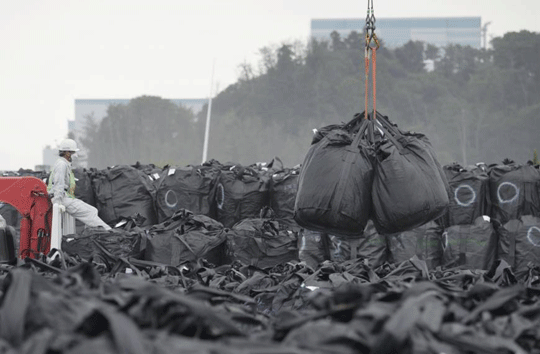
Of the 258,300 cubic meters, 178,600 cubic meters were mainly debris that had been scattered around reactor buildings, wood refuse produced in the work in the plant and protective suits used by workers, according to the plant’s operator, Tokyo Electric Power Co.
The remaining 79,700 cubic meters were trees that were felled to create space for tanks storing radioactive water. There were also 1,846 objects that absorbed radioactive materials from contaminated water.
According to the road map worked out by the government and TEPCO, the basic plan for disposing of the radioactive waste will be released in fiscal 2017.
Worldwide effect of Fukushima radioactive plume
 UCLA Researchers: Fukushima “not only affecting that local area, but also worldwide” — Gov’t Expert: “Immediately the Iodine-131 plume moved eastward reaching US West Coast [then] covering entire northern hemisphere… Significant concern on the safety of the population and environment worldwide” (VIDEO) http://enenews.com/ucla-researchers-fukushima-only-affecting-local-area-worldwide-govt-expert-immediately-iodine-131-plume-moved-eastward-reaching-west-coast-covering-entire-northern-hemisphere-early-april-posing-sig?utm_source=feedburner&utm_medium=email&utm_campaign=Feed%3A+ENENews+%28Energy+News%29 8 March 15
In the Fukushima Disaster Zone with UCLA researchers, Mar 3, 2015: Four years after Fukushima disaster, some areas remain untouched, clocks recording the exact time that the tsunami swept through. Access is highly restricted but two UCLA researchers were recently given permission to document the disaster zone. — at 3:45 in — “With this study I think that’s what we’re trying to explore — is that once a nuclear catastrophe strikes, it’s not only affecting that local area, but also worldwide.”
Atmospheric dispersion of Iodine-131 released after the Fukushima event, by Giuseppe A. Marzo, ENEA (Italian National agency for new technologies, Energy and sustainable economic development), 2014: From March 12, 2011, a significant amount of radioactive material… discharged into the atmosphere… Total emission of 131I has been estimated in [128** petabecquerels (PBq)], while 133Xe, and 137Cs total emissions have been estimated in [15,300 PBq and 36.6 PBq], respectively. In this work the global atmospheric dispersion of 131I released by the Fukushima accident is carried out, focusing on this specific radionuclide due to its radiological relevance in terms of consequences on the human health… Figure 1 summarizes the simulation results. It illustrates the radioactivity concentration due to 131I released into the atmosphere at specific times and integrated over the total atmospheric column. Immediately after the initial release on March 12, the plume moved eastward reaching the United States west coast on [March 15 at 10:00p PST]… In early April the plume extended over the entire northern hemisphere… A significant accidental event occurred at the Fukushima NPPs… volatile radionuclides such as 131I were transported away from the source posing significant concern on the safety of the population and the environment worldwide… the atmospheric dispersion of 131I [was] covering the entire northern hemisphere by early April…
**According to a document released by TEPCO, “Our result shows a higher I-131 amount (500PBq) compared to the result obtained from a thirdparty organization (120-200PBq).”
1 This Month

of the week – Shut Down Drone Warfare!


Tell the Ukrainian Government to Drop Prosecution of Peace Activist Yurii Sheliazhenko

Petition to revoke the licensing of the Near Surface Nuclear Disposal Facility (NSDF) at Chalk River. https://www.ourcommons.ca/petitions/en/Petition/Details?Petition=e-7247
To see nuclear-related stories in greater depth and intensity – go to https://nuclearinformation.wordpress.com
-
Archives
- April 2026 (68)
- March 2026 (251)
- February 2026 (268)
- January 2026 (308)
- December 2025 (358)
- November 2025 (359)
- October 2025 (376)
- September 2025 (257)
- August 2025 (319)
- July 2025 (230)
- June 2025 (348)
- May 2025 (261)
-
Categories
- 1
- 1 NUCLEAR ISSUES
- business and costs
- climate change
- culture and arts
- ENERGY
- environment
- health
- history
- indigenous issues
- Legal
- marketing of nuclear
- media
- opposition to nuclear
- PERSONAL STORIES
- politics
- politics international
- Religion and ethics
- safety
- secrets,lies and civil liberties
- spinbuster
- technology
- Uranium
- wastes
- weapons and war
- Women
- 2 WORLD
- ACTION
- AFRICA
- Atrocities
- AUSTRALIA
- Christina's notes
- Christina's themes
- culture and arts
- Events
- Fuk 2022
- Fuk 2023
- Fukushima 2017
- Fukushima 2018
- fukushima 2019
- Fukushima 2020
- Fukushima 2021
- general
- global warming
- Humour (God we need it)
- Nuclear
- RARE EARTHS
- Reference
- resources – print
- Resources -audiovicual
- Weekly Newsletter
- World
- World Nuclear
- YouTube
-
RSS
Entries RSS
Comments RSS
 nuclear-news