Strange and extreme tissue damage in dead dolphins near Fukushima
Japan Scientist: “I’ve never seen this before” — White lungs found in dolphins that died during mass stranding near Fukushima — Interruption of blood supply leading to death of tissue — Disease has been  linked to radiation exposurehttp://enenews.com/dead-dolphins-washed-fukushima-entirely-white-lungs-head-scientist-ive-never-before-interruption-blood-supply-leading-tissue-death-disease-linked-radiation-exposure-large-spike-after-chernoby?utm_source=feedburner&utm_medium=email&utm_campaign=Feed%3A+ENENews+%28Energy+News%29
Asahi Shimbun, Apr 11, 2015 (emphasis added):
- Google Translate: Ibaraki Prefecture… for a large amount of dolphin which was launched on the shore… the National Science Museum… investigated… researchers rushed from national museums and university laboratory, about 30 people were the anatomy of the 17 animals in the field. [According to Yuko Tajima] who led the investigation… “the lungs of most of the 17… was pure white ischemic state, visceral signs of overall clean and disease and infections were observed”… Lungs white state, that has never seen before.
- Systran: The National Science Museum… investigated circumstance and cause etc concerning the mass dolphin which is launched to the seashore of Ibaraki prefecture… the researchers ran from the museum and the university laboratory… approximately 30 people dissected 17… [Yuko Tajima] of the National Science Museum which directed investigation research worker [said] “the most lung 17 was state with true white, but as for the internal organs being clean”… The lung true white as for state, says… have not seen.
Fukushima Diary, Apr 12, 2015: According to National Science Museum, most of the inspected 17 dolphins had their lungs in ischaemia state… The chief of the researching team stated “Most of the lungs looked entirely white”… internal organs were generally clean without any symptoms of disease or infection, but most of the lungs were in ischaemia state. She said “I have never seen such a state”.
Wikipedia: Ischemia is a vascular disease involving an interruption in the arterial blood supply to a tissue, organ, or extremity that, if untreated, can lead to tissue death.
Many reports have been published on the links between ischemia and radiation exposure:
- “It has been shown that the ionizing radiation in small doses under certain conditions can be considered as one of starting mechanisms of… IHD [ischemic heart disease].” –Source
- “Radiation risks on non-cancer effects has been revealed in the [Chernobyl] liquidators… Recently, the statistically significant dose risk of ischemic heart disease… was published.” –Source
- “Incidence of and mortality from ischemic heart disease (IHD) have been studied in a cohort of 12210 workers [at] Mayak nuclear facility… there was statistically significant increasing trend in IHD incidence with total external gamma dose.” –Source
- “Numerous studies have been published concerning non cancer diseases in liquidators… Risk of ischemic heart disease… seems increased.” –Source
- “In 1990 the International Chernobyl Project has been carried out under the aegis of the IAEA… It is known that the international experts who had taken part in the International Chernobyl Project were aware of the report by the Minster of the Ministry of Health Care of Belarus delivered at an informal meeting arranged by the IAEA… The Belorussian Minister reported about… the worsening of the general health state of the affected population… “Among adults in 1988 there was a two- to fourfold increase, in comparison with preceding years, in the number of persons suffering from… ischemic heart diseases” –Source
- “In a study on a Russian cohort of 61,000 Chernobyl emergency workers… a statistically significant risk of ischemic heart disease was observed.” –Source
How investments are damaged by the continuing nuclear radiation crisis at Fukushima
5 Ways Fukushima The radiation Emits Tend to be Poisoning Ventures. International Health Insurance and Medical Health 16 Apr 15 (? weird translation)
“…….1. Investors with Uranium are usually Hurt:
The purchse price for every lot associated with uranium has tanked since the 03, 2011 nuclear meltdown with Fukushima, which in turn brought about cutbacks for anybody invested in uranium exploration gives. ……..
 |
Click here to Reply or Forward
|
Photos, videos of dead robot abandoned in Fukushima reactor No 1

On 4/13/2015, Tepco announced the dead robot had reported it measured approx. 10 Sv/h in Reactor 1 before it went out of order.
The robot was investigating the ground floor of PCV (Primary Containment Vessel) in Reactor 1.
The report shows the atmospheric dose was 7 〜 10 Sv/h. Temperature was around 20℃.
The video of 2:39 length shows steam coming up from the basement floor of PCV, where Tepco assumes molten fuel is retained, and grating was covered with something like yellow glue. The screen is full of white spots due to the extremely high level of radiation.
Tepco announced they gave up collecting the robot. They will cut off the cable and will not send the second robot until they figure out the reason why the robot went out of order.
Radiation within Fukushima reactor enough to kill a human within an hour
 Radiation measured at deadly 9.7 sieverts in Fukushima reactor, Japan Times, JIJI APR 13, 2015 Tokyo Electric Power Co. said Monday that radiation in the primary containment vessel of the No. 1 reactor of the Fukushima No. 1 power station gets as high as 9.7 sieverts per hour — enough to kill a human within an hour.
The radiation levels at six locations in the western section of the first floor of the PCV ranged from 7.0 to 9.7 sieverts per hour, the beleaguered utility said in disclosing data collected by a remote-controlled robot on Friday.
By contrast, the temperatures at the six locations monitored were cool, ranging from 17.8 to 20.2 degrees.
Tepco sent the robot into the primary containment vessel on Friday, expecting it to stay alive for 10 hours. But the robot failed within three hours after completing about two-thirds of its planned route. Tepco has given up on recovering the robot.
The survey involved eight Tepco employees and 36 other workers who were hired by contractors. The maximum radiation dose logged was 1.73 millisieverts…….http://www.japantimes.co.jp/news/2015/04/13/national/radiation-measured-at-deadly-9-7-sieverts-in-fukushima-reactor/#.VS3jUNyUcnk
TEPCO to abandon the failed robot stuck inside Fukushima nuclear reactor
Fukushima Containment Robot To Be Abandoned Inside, Simply Info http://www.fukuleaks.org/web/?p=14680 April 12th, 2015
TEPCO announced that the robot stuck in containment will not be recovered. They will send a team into the reactor building today to cut the cable for the robot and leave it in containment. Entry of the second robot was postponed. TEPCO has not made the data collected by the first robot public yet……..
Robot fails, in effort to inspect inside of Fukushima reactor no 1
Fukushima Unit 1 Robot Dies In Containment During Inspection Simply Info April 10th, 2015
Kyodo News is reporting the robot died inside unit 1′s containment during the inspection. It stopped functioning part way through the inspection…….http://www.fukuleaks.org/web/?p=14672TEPCO has provided no other information about this yet.
Fukushima nuclear decommissioners have no idea how to deal with molten nuclear cores
Times: “The worst possible result” revealed at Fukushima — Plant Chief: Centuries may pass before humans find a way to deal with molten cores — Top Official: “We have no idea” what to do, “the technology simply doesn’t exist… I can’t say it’s possible” (VIDEOS) http://enenews.com/times-worst-possible-result-revealed-fukushima-plant-chief-centuries-pass-before-humans-invent-deal-molten-fuel-videos
NHK ‘Nuclear Watch’ transcript, Mar 31, 2015 (emphasis added):
- NHK: The people trying to decommission the Fukushima Daiichi nuclear plant have been hit by setback after setback… and faced accusations of misconduct. It’s lost them a lot of public trust… [Naohiro Masuda, president of Tepco’s decommissioning company] revealed he’s not sure if he can comply with the government set plan [for] removing the fuel…
- Naohiro Masuda, president of Tepco’s Fukushima Daiichi Decommissioning Company: We have no idea about the debris. We don’t know its shape or strength. We have to remove it remotely from 30 meters above, but we don’t have that kind of technology, it simply doesn’t exist... We still don’t know whether it’s possible to fill the reactor containers with water. We’ve found some cracks and holes in the three damaged container vessels, but we don’t know if we found them all. If it turns out there are other holes, we might have to look for some other way to remove the debris.
- NHK: Asked [about the gov’t target to begin by 2020], his answer was surprisingly candid.
- Masuda: It’s a very big challenge. Honestly speaking, I cannot say it’s possible.
Dale Klein, Tepco Nuclear Reform Monitoring Committee chair, Mar 31, 2015 (at 24:00 in):
- Richard Lloyd Parry, The Times: I was at the plant last week on the tour and we talked Mr. Ono, the boss. He made no bones about the fact that the technology… to remove the molten or semi-molten fuel doesn’t exist yet… I asked him how can you be sure that it will be, and he said, “Well, 200 years ago people would never have dreamed of bullet trains or mobile phones, but they exist.” That seems to be the scale of the leap… that’s going to be required. So there must be immense uncertainties around that… There must surely be a chance that it won’t work out, and that the eventual solution will be something like the Chernobyl solution… a sarcophagus of some kind sealing in the 3 plants…
- Klein: This is something that has never been done… Units 1, 2, and 3… molten fuel penetrated the bottom of the vessel… We don’t know… how much and where it moved.
The Times (complete article), Mar 28, 2015: The chief of the Fukushima nuclear power station has admitted that the technology needed to decommission three melted-down reactors does not exist, and he has no idea how it will be developed [and] conceded that the stated goal of decommissioning the plant by 2051 may be impossible without a giant technological leap… [Tepco] continues to be embarrassed by leaks of radiation into the sea… Recent scans of one revealed the worst possible result: all the nuclear fuel that was in the reactor’s furnace has melted and dripped down into the concrete outer containment vessel… The alternative would be to seal the entire complex in a giant sarcophagus like the one covering Chernobyl — butit would have to extend underground to stop contaminated groundwater reaching the sea. [See the initial report based on an excerpt from this article here]
Akira Ono, chief of Fukushima Daiichi, Mar 28, 2015: “There are so many uncertainties… For removal of the debris, we don’t have accurate information… or any viable methodology… I believe human beings have the capability to develop technologies… It may take 200 years.”
Increasing percentage of radioactive cesium in water in basement of Fukushima nuclear reactor 1
 Cs-134/137 density of Reactor 1 basement water continues to increase since last July, Fukushima Diary Iori Mochizuk1, 3 Apr 15 790,000,000Bq/m3 According to Tepco, Cs-134/137 density of contaminated water that is retained in the basement of Reactor 1 has been increasing since last July.
On 3/4/2015, Tepco published the latest data of Cesium-134/137 density of retained water in Reactor 1 turbine building.
This water is assumed to be the mixture of leaked coolant water and groundwater that keeps coming in from the outside of the crippled building.
The report reads Cs-134/137 density was 1,790,000,000 Bq/m3 from the sample taken on 1/28/2015.
It was 1,670,000,000 Bq/m3 in November, 1,470,000,000 Bq/m3 in September, 1,460,000,000 Bq/m3 in July, which shows it has been constantly increasing though they release data only every two months.
It is not identified what keeps making the contamination level higher for 7 months in water retained in Reactor 1 basement.
http://www.tepco.co.jp/nu/fukushima-np/f1/smp/2014/images/tb_water_140730-j.pdf
http://www.tepco.co.jp/nu/fukushima-np/f1/smp/2014/images/tb_water_140926-j.pdf
http://www.tepco.co.jp/nu/fukushima-np/f1/smp/2014/images/tb_water_141128-j.pdf
http://www.tepco.co.jp/nu/fukushima-np/f1/smp/2015/images/tb_water_150304-j.pdf
i
Below Fukushima nuclear plant – pools of molten nuclear fuel
AP: Melted fuel may have “dropped even beyond” the bottom of Fukushima plant — ‘China Syndrome’ predicted by US gov’t analysis — IAEA Expert: Pools of corium beneath reactors are up to 2 stories high (VIDEO)http://enenews.com/ap-melted-fuel-could-dropped-beyond-bottom-fukushima-plant-iaea-expert-pools-corium-could-be-taller-2-story-house-video?utm_source=feedburner&utm_medium=email&utm_campaign=Feed%3A+ENENews+%28Energy+News%29
AP, Mar 27, 2015 (emphasis added): [It] was billed as a way to decipher where, exactly, the morass of nuclear fuel might sit at the bottom of reactors… But what went wrong, even in a simple demonstration for reporters… was a sobering reminder of the enormous challenges that lie ahead… a programming glitch could not be fixed in time for Friday’s demonstration… No one knows where the molten fuel debris lies, and in what shape or state. [TEPCO] has said itlikely sank to the bottom of the plant. But the fuel could have dropped even beyond. Tadashi Yotsuyanagi, an official in charge of the muon project at Toshiba… acknowledged the technology will not be able to get the complete image toward the bottom of the reactor… David Ireland, a professor who heads the Nuclear Physics Group at the University of Glasgow, said muons may be the only way to probe inside atomic reactors. “There are not really any other noninvasive options that will allow inspection,” he said in an email.
The Japan Times published the AP report above, however one sentence was altered. “Tepco has said it likely sank to the bottom of the plant. But the fuel could have dropped even beyond” vs. “But the fuel could possibly have escaped even beyond the containment facility to the outside environment.”
IAEA technical meeting Managing the Unexpected, Harri Tuomisto, Sr. Nuclear Safety Officer at Finland’s Fortum Power, 2012:
- Part 4: “If the cooling is not successful, it means the corium melts through the vessel… When this massive amount of corium enters into the containment zone, there are very, very many different energetic consequences… Interaction of molten core and concrete starts… concrete is eroding, and this eroding of concrete, for a long time it was known as China Syndrome.”
- Part 5: “The corium will be in 3 parts, there is a solid crust formation in the bottom of the pool, then there’s a pool of oxidic materials… The metals and oxides are not soluble with each other and the metals will be separated… which is bad news in the sense that theheat transfer to the vessel is much higher, and it’s much more difficult to guarantee the integrity of the [containment] vessel in that case.”
- Part 6: “Molten corium on the containment floor, it’s eroding the concrete and going partially downward. Actually it will never go to China, because it also erodes sideways… The final size of the pooling maximum case is 10 to 15 meters in diameter, and 6-7 meters [20-23 ft or 2 stories] deep — or even deeper.”
- Part 9: “There are quite many challenges… There are different energetic phenomenon… which can lead to different combustions… accelerating flames, or even detonations — which can cause a very high pressure in the containment and even break the containment… Then there’s this China Syndrome — attack of containment liner by corium — which can also bypass containment.” (See US gov’t analysis: Fukushima containment breached due to “failure of the drywell liner by melt-attack“)
- Slides 3-4: If corium melts through the vessel, there are various energetic consequences caused by ejected high-temperature molten corium… Molten corium on the containment basemat initiates core-concrete interaction that releases aerosols and non-condensible gases to containment atmosphere and erodes the concrete (‘China syndrome‘)
Plutonium-241 from Fukushima nearly 70,000 times more than atomic bomb fallout in Japan.
 Fukushima: Uranium and Plutonium Contamination of Large Areas of Oceans, Ground-water, Soils.By Edmondo Burr Global Research, March 29, 2015 Your News Wire Scientists have raised concern over the rate of radioactive contamination of the Pacific, due to the Fukushima nuclear accident.
- Expert : Plutonium-241 from Fukushima nearly 70,000 times more than atomic bomb fallout in Japan.
- Officials : Molten fuel now ‘particle-like’, contains ‘special’ nuclear materials.
- Gov’t Labs : Large areas of oceans contaminated by plutonium from events such as Fukushima; Build-up in biosphere expected; Considerable hazard to humans.
Energy News statement :
Detection of long-lived plutonium isotopes in environmental samples by Accelerator Mass Spectrometry (AMS) — Plutonium isotopes 239Pu, 240Pu and 242Pu are anthropogenic radionuclides emitted into the environment by nuclear activities. Pu is accumulated in the human body and hence, poses a considerable hazard to human health. Due to the long half-lives, these isotopes are present in the biosphere on large time scales and a build-up can be expected. Therefore it is important to study the contamination pathway of Pu into the drinking water… a method to detect long-lived Pu isotopes by Accelerator Mass Spectrometry (AMS) is being developed. AMS requires only few milligrams of sample material… Consequently, more samples from different locations can be taken which is essential when searching for locally increased Pu concentrations as in the Pacific Ocean after the Fukushima accident… Samples from different locations in the Pacific Ocean and from the snow-hydrosphere are planned…
Statement by: Taeko Shinonaga, head of Radioanalytical Laboratory at Helmholtz Zentrum Munchen (research institution founded jointly by Germany’s Federal Ministry of Education & Research and Bavaria’s Finance Ministry), scientists from Technische Universitat Munchen (Germany), Verhandlungen der Deutschen Physikalischen Gesellschaft 2013 meeting (emphasis added)
Presentation by: Taeko Shinonaga, head of Helmholtz radioanalytical lab (pdf), Nov 2014: Comparison of activity between [nuclear bomb testing] fallout Pu particle and Fukushima origin Pu particle:…..http://www.globalresearch.ca/fukushima-uranium-and-plutonium-contamination-of-large-areas-of-oceans-ground-water-soils/5439271
35-ton piece of machinery debris impedes gate at Fukushima No 1 nuclear reactor
Setback at Fukushima No. 1 plant threatens reactor 3 rod removal Tokyo Electric Power Co. has disclosed that a 35-ton piece of machinery debris might be resting on the inner gate of the spent fuel pool for reactor 3 of the Fukushima No. 1 power plant and that the gate is slightly out of position.
Tepco said Thursday that a fuel-handling machine dislodged during the March 2011 quake, tsunami and meltdown-triggered hydrogen explosions is touching one of two gates that stand between the pool and the reactor containment vessel……http://www.japantimes.co.jp/news/2015/03/27/national/debris-poses-risk-spent-fuel-pool-gate-fukushima-1s-reactor-3-tepco/#.VRiPYPyUcnk
It didn’t work: Toshiba’s state of the art technology to find Fukushima nuclear cores
Cutting-edge tech to scan Fukushima for nuclear fuel flops in front of reporters, Rt.com March 27, 2015 A presentation of state-of-the-art technology aimed to show the location of nuclear fuel molten debris at the crippled Fukushima plant in Japan ended in a flop, raising concerns about the $5 million project.
Fukushima operator Tokyo Electric Power Co (TEPCO) tasked Japanese tech giant Toshiba to come up with a solution after the nuclear plant was hit by an earthquake and tsunami in 2011.
After four years of research, Toshiba has developed a technology, which relies on muons in finding the nuclear fuel’s location.
Those tiny cosmic-ray subatomic particles are capable of going through almost anything except for the heavy elements like uranium and plutonium used for nuclear fuel.
The company plans to erect two tall walls right next to each reactor to shoot out muons through them to create an image of what’s inside – similar to medical X-rays.
Previously, the muons have been successfully used to scan volcanoes, ship’s cargoes and even the Egyptian pyramids.
But the technology’s presentation Friday turned into an epic fail as a programming glitch, which wasn’t fixed in time, prevented it from displaying any images of muons at all…….http://rt.com/news/244717-fukushima-muons-scan-toshiba/
Cry for help from an official in Fukushima
Official in Fukushima: “Please Please HELP US!” — Hot particles of melted fuel are inhaled by children everyday — We are forced to have it in our bodies — “Please let all people in the world know the life we are living”http://linkis.com/2dWaC
Excerpts from Oyama Koichi of the Minamisoma City Council, May 13, 2014 — Translation byDissensus Japan, May 25, 2014:
- I want to shout for all the people in this world: “Please Please HELP US!”
- The cause substance have been found. This is an aggregate of radionuclides which starts with Uranium [in] a nuclear reactor at more than 5000°C.
- This mixed metal contains four different substances, α・β・γ and also have the possibility to radiate neutron ray.
- No creature on earth never knew this substance.
- We are forced to have those strong substances inside our body without knowing where it exactly stays.
- To say that “Cesium has got the same system as potassium and it will be discharged from the body” is just a lie! […]
- We are all manipulated by the words “radiation” and “radiation doze” without knowing the real identity of radiation source. We are not told the real facts of being irradiated […]
- They only compare radiation doze and natural potassium contained in bananas and manipulated people as if it was a scientific study. I really want the scholars patronized by the government to be punished by the rancorous of all children on this earth. […]
- The informations say that hot particles were diffused and flied in all directions in Japan. The particles from hell is flying in the air and people don’t protect themselves anymore three years after the nuclear accident and children are aspirating those horrible particles everyday!!!
- PLEASE PLEASE PLEASE HELP US! Please let all people in the world to know the life we are living since the accident, everyday and today.
Mako Oshidori on the status of Fukushima Daiichi nuclear power plant
 Mako Oshidori in Düsseldorf “The Hidden Truth about Fukushima”, Fukushima Voice version 2E 28 May 2014 “……….I would like to talk about the current status of Fukushima Daiichi nuclear power plant. This is a chimney called a “stack” behind Units 1 and 2. There are various issues all over Fukushima Daiichi NPP, but this is one of the places that I consider the most dangerous. It is 120 m tall.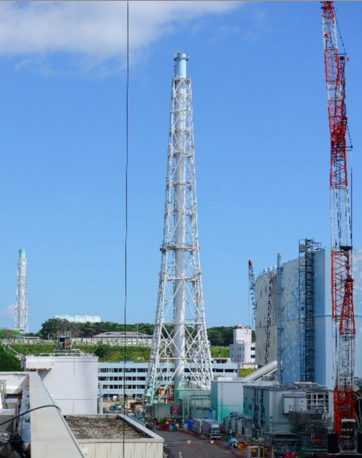

 Ordinarily, this should be immediately repaired, but the bottom of the stack is 25 Sv/h, and there is one spot that is 15 Sv/h. So, they can’t do anything about it. What TEPCO is doing about this is they have appointed workers to constantly watch it. This is very close to Units 1 and 2. We still get occasional earthquakes in Fukushima and eastern Japan. Workers on site are very worried about whether it would fall onto the reactor buildings. If it ever fell on Unit 1 or 2, all the workers would have to evacuate. There is no guarantee they would have enough time to evacuate, and it could lead to a severe accident necessitating evacuation of nearby residents once again.
One of the things not well known is the fact that in reality radioactive materials continue to be released into air and groundwater from the reactors at Fukushima Daiichi nuclear power plant.
Groundwater is of course contaminated. This [diagram] is the area where PM Abe declared the contaminated water being completely blocked when trying to bring the Olympics to Tokyo.
Mako Oshidori on the plight of TEPCO’s nuclear plant workers
Mako Oshidori in Düsseldorf “The Hidden Truth about Fukushima”, Fukushima Voice version 2E 28 May 2014 “…..Next, I would like to talk about the nuclear power plant workers. This man [photo in original] used to work for TEPCO as a nurse at a medical clinic inside FDNPP. I interviewed him when he quit his job at TEPCO in 2013. [photo]There was an NPP worker who died in January 2012. I did a fairly thorough investigation after I was able to obtain police report on him. We got an address for the guarantor for the deceased worker, so we went to that address. There was an apartment building at this address without a unit numbered 204 which was supposed to be where the guarantor lived. In Japan, number four could mean bad luck (Note: In Japanese, number 4 phonetically sounds just likea Japanese word for “death”). After room 203, there was room 205, skipping room 204. I asked the other occupants of the apartment building, but there was no resident there by the name of this guarantor, so it didn’t seem like I wrote down the number wrong. Even though the building could be located on a map, you have to go there to verify the room is actually there. This might have been an guarantor with an imaginary address. This is the dark side of the construction and nuclear industries, not just post-nuclear accident, that those without families, especially elderlies, are given harsh work.
Workers who were exposed to 100 mSv in 2011 are entitled to annual cancer screening and thorough medical care. However, most workers get exposure doses below 100 mSv, such as 90, 95, or 83 mSv, and they don’t qualify for thorough medical care. Workers who had been working at NPP since before the accident know what could happen to them a after reaching a certain exposure dose in one year, or what it means to get exposed to 35 mSv in 2 hours during a particular work. They talk about how they probably won’t live too long. They are determined not to have any children, and they often talk about how uncertain they are about their lives in 5 years.
In current Japan, even children are not being protected, but there are some who are determined to protect children’t health. However, there is hardly any group or individuals advocating for protecting the workers in the most dangerous environment at FDNPS. I believe that is our responsibility. My article about the deceased worker from the January 2012 investigation was actually published in a weekly magazine Shukan Bunshun. However, a singer Ayumi Hamazaki suddenly got divorced right then, and I was asked to cut 75% of the article. I think a big reason why information such as this is not publicized is because readers are not craving for such information. We are in essence not fulfilling our duty to be informed……….http://fukushimavoice-eng2.blogspot.com.au/2014/05/mako-oshidori-in-dusseldorf-hidden.html
1 This Month

of the week – Shut Down Drone Warfare!


Tell the Ukrainian Government to Drop Prosecution of Peace Activist Yurii Sheliazhenko

Petition to revoke the licensing of the Near Surface Nuclear Disposal Facility (NSDF) at Chalk River. https://www.ourcommons.ca/petitions/en/Petition/Details?Petition=e-7247
To see nuclear-related stories in greater depth and intensity – go to https://nuclearinformation.wordpress.com
-
Archives
- April 2026 (68)
- March 2026 (251)
- February 2026 (268)
- January 2026 (308)
- December 2025 (358)
- November 2025 (359)
- October 2025 (376)
- September 2025 (257)
- August 2025 (319)
- July 2025 (230)
- June 2025 (348)
- May 2025 (261)
-
Categories
- 1
- 1 NUCLEAR ISSUES
- business and costs
- climate change
- culture and arts
- ENERGY
- environment
- health
- history
- indigenous issues
- Legal
- marketing of nuclear
- media
- opposition to nuclear
- PERSONAL STORIES
- politics
- politics international
- Religion and ethics
- safety
- secrets,lies and civil liberties
- spinbuster
- technology
- Uranium
- wastes
- weapons and war
- Women
- 2 WORLD
- ACTION
- AFRICA
- Atrocities
- AUSTRALIA
- Christina's notes
- Christina's themes
- culture and arts
- Events
- Fuk 2022
- Fuk 2023
- Fukushima 2017
- Fukushima 2018
- fukushima 2019
- Fukushima 2020
- Fukushima 2021
- general
- global warming
- Humour (God we need it)
- Nuclear
- RARE EARTHS
- Reference
- resources – print
- Resources -audiovicual
- Weekly Newsletter
- World
- World Nuclear
- YouTube
-
RSS
Entries RSS
Comments RSS
 nuclear-news