Huge rise in thyroid cancer in Fukushima’s children

 Officials: 6,000% cancer rate increase in Fukushima children’s thyroids — Expert: Urgent countermeasures against the suspected outbreak are necessary — Professor: Gov’t stopped me from checking thyroid exposure levels after 3/11 (VIDEO) http://enenews.com/officials-6000-increase-thyroid-cancer-rate-among-fukushima-children-asahi-16-new-cases-detected-first-3-months-2015-professor-urgent-countermeasures-against-suspected-outbreak-necessary-govt?utm_source=feedburner&utm_medium=email&utm_campaign=Feed%3A+ENENews+%28Energy+News%29
Asahi Shimbun, May 19, 2015 (emphasis added): Fukushima finds 16 new cases of thyroid cancer in young people… authorities said May 18, although they added it is “unlikely” a direct result of the nuclear accident…The 16 new cases were detected between January and March, and bring the total number of young people diagnosed with the disease in the testing program to 103… 127 [have been diagnosed or suspected of having thyroid cancer]… many cases of thyroid cancer in infants were reported after the 1986 Chernobyl disaster. However, this has not proven to be the case so far with regard to the Fukushima nuclear crisis.
Fukushima Voice, May 19, 2015: The Thyroid Examination Evaluation Subcommittee… came to a conclusion [that this] clearly represents an excess incidence… by an order of magnitude(At the November 11, 2014 subcommittee meeting, it was described as “61 times“)… this increase can be a result of either excess occurrence due to radiation exposure or over-diagnosis… “it is not possible to conclude if thyroid cancer cases detected during the screening are radiation-induced… it is unlikely these cases are the effect of radiation exposure… the exposure dose is far less than the Chernobyl accident and that there have been no cancer cases in children younger than 5… early internal exposure dose from radioactive iodine is extremely critical in assessing the effect of the accident.”
The subcommittee and Asahi article discount the link between these cancers and the Fukushima disaster due to a lack of cases among infants. Asahi claims this is unlike Chernobyl, where “many cases of thyroid cancer in infants” had developed. Is this accurate? According toShinichi Suzuki, who was in charge of the Fukushima Thyroid Examination, March 2015: “There is a striking similarity between the [age] profiles of patients diagnosed during the period of latency after Chernobylin Ukraine and currently in Fukushima.”
Also, the subcommittee noted “the early internal exposure dose from radioactive iodine is extremely critical in assessing the effect of the accident” — what does that dose data show?
Japan Focus, Dec 8, 2014: Sakiyama Hisako, former senior researcher at the National Institute of Radiological Sciences… observed that power was deployed to stop measurements of thyroid exposure being taken… Professor Tokonami Shinji of Hirosaki University… tried to measure exposure levels immediately after the explosions [but] was halted by Fukushima Prefecture, which accused him of stirring up trouble… Tokonami went on to test 65 Fukushima residents one month after the explosions [and] found radioactive iodine in the thyroids of 50 out of the 65 (77%)… He estimated the equivalent dose to the thyroid [was up to] 87 mSv [and] infants who remained in areas with high iodine levels may have been exposed to over 100 mSv.
FUKUDEN (pdf), Dec 31, 2014: Prof. Toshihide Tsuda, an epidemiology specialist [said] “When we analyzed the results of the thyroid cancer survey conducted in the Fukushima Prefecture according to location, it is obvious that there are more numbers of thyroid cancer cases in the Nakadori area (middle area), and we urgently need to take necessary measures.”
Prof. Tsuda, Eiji Yamamoto & Etsuji Suzuki of Okayama Univ.: [The thyroid cancer] incidence rate ratio was 26.98… in the nearest area, and in Fukushima city, it was 19.41… compared with the Japanese mean… [E]xcess incidence rate ratios were observed… Dose-response relationship by distance from the plant was indicated… countermeasures against the suspected outbreak are necessary in Fukushima and the neighboring areas.
Japan’s Abe government relinquishing responsibility for health of Fukushima residents and workers
Fukushima; The Beginning Of The End, A series of announcements over the last two weeks have shown the Abe administration’s true plan for Fukushima & Japan. As the political class pushes for reactor restarts, their commitment towards Fukushima has turned to outright betrayal.
Starting in 2016 local governments will be forced to pay for part of the reconstruction costs.
Last week the central government announced they plan to reopen any area below 50 mSv/year for people to return by 2017. Areas at 20 mSv/year or below would be reopened in 2016. 20 mSv/year is the international maximum annual radiation exposure for nuclear workers. Now adults and children would be expected to expose themselves to radiation levels at and even above what is permissible for nuclear workers. ICRP cites that the public should not be exposed to more than 1 mSv/year.
The central government plans to end housing assistance for voluntary evacuees by 2017. …….http://www.fukuleaks.org/web/?p=14764
Neurological and heart disease – huge rise in Fukushima evacuees
Huge spike in neurological diseases after Fukushima — 600% rise in disorders among evacuees — Similar abnormalities reported post-Chernobyl — Cases of heart disease, brain infarction also up — Physicians: “Great concern there will be additional health hazards” http://enenews.com/study-reveals-large-spike-neurological-diseases-fukushima-600-increase-disorders-causing-hearing-loss-dizziness-people-evacuation-area-cases-heart-disease-brain-infarction-physicians-great-co?utm_source=feedburner&utm_medium=email&utm_campaign=Feed%3A+ENENews+%28Energy+News%29
Journal article by authors from Soma General Hospital and Tohoku University, Apr 7, 2015 (emphasis added): Change in and Long-Term Investigation of Neuro-Otologic Disorders in Disaster-Stricken Fukushima Prefecture
[Neuro-otology: Branch of clinical medicine which treats neurological disorders of the ear]
- Soma City [is] 44 km north of Fukushima Daiichi… almost all patients who require hospitalization for ear, nose, and throat (ENT) care were referred to our department… We thus investigated the influence of the disaster on internal ear diseases.
- Regarding the evacuation area, the total number of patients [in the ENT department]increased 4.64 times [364% in 1st year], 4.24 times [324% in 2nd year], and 4.54 times[354% in 3rd year] compared with the number before the disaster.
- New patients [with vertigo, Meniere’s disease, and acute low-tone sensorineural hearing loss] in Shinchi Town… increased by 64.3%, 114.3%, and 46.4% [in years 1, 2, and 3] respectively… In the case of Minami-Soma City, except the evacuation area… increased by 84.2%, 152.6%, and 142.1%, respectively… Regarding the evacuation area… the numbers of patients with vertigo, MD, or ALHL became 7 times [600% increase in 1st year], 5 times [400% increase in 2nd year], and 7 times [600% increase in 3rd year].
- Although the causes for MD and ALHL are still unknown [the rise] might be due to increased tension and stress… As for the cases [of vertigo] we were unable to establish the neuro-otologic pathogeneses in… 72% [and] there may have been cases of psychogenic dizziness… administration of an anti-vertigenous drug or advice to keep calm and to have a sound mind did not help… There were some difficult cases where ENT treatment alone did not work, presumably because these cases were complicated with some mental diseases… In some serious cases, we… referred the patients to psychiatric care or prescribed psychosomatic medicine. Some patients refused our advice… or to admit that they had a mental problem.
- The number of reported cases of heart disease and brain infarction have increased in the devastated area… Diabetes, osteoporosis, and psychiatric illnesses were feared to have worsened… There is a great concern that there will be additional health hazards, and we strongly feel the need for administrative support.
Journal of the American Academy of Audiology (pdf), 1995: Ototoxicity and Irradiation — Additional Etiologies of Hearing Loss in Adults… The article [discusses] the effects of irradiation on hearing [in patients] exposed to excessive radiation as a result of theChernobyl nuclear disaster… Shidlovckaya of the Kiev Research Institute of Otolaryngology has been studying [cleanup workers from] Chernobyl… her patients have evidenced a number of disorders, including hearing loss… When Shidlovckaya divided her population into three groups – [those] who worked directly at the disaster site; residents… nearby; and residents… some distance from the disaster site – an interesting pattern in the auditory resultsemerged… analysis indicated that, in 100 percent of [workers] examined, there aredisturbances or abnormalities… Furthermore, the… lesser radiation exposure… the less likely it was that these deviations would be present… Obviously, this is an important area of further research and could have a significant impact on our reaction to patients who have been exposed to radiation…
Annals of the New York Academy of Sciences, 2009: Diseases of Sense Organs — Throughout the more contaminated territories [around Chernobyl,] hearing abnormalities occur with greater frequency… Between 46 and 69% of surveyed liquidators had some hearing disorder.
Watch: St. Louis Children’s Hospital on radiation-induced hearing loss
Risks in Decision n to Dismantle Cover Over Damaged Fukushima Reactor
Decision to Dismantle Cover Over Damaged Fukushima Reactor ‘Questionable’ Sputnik News 16 May 15 A decision of the Tokyo Electric Power Company (TEPCO) to begin Friday preparatory work to dismantle the protective cover over the Reactor 1 building at the damaged Fukushima nuclear power plant raises questions, an expert in the nuclear energy told Sputnik.
“It [the cover] was … meant to protect the environment from the dispersion of radioactive particles. Of course, these risks continue beyond the taking off of the cover: rainwater washing out radioactivity that enters the ocean, heavy storms impacting water and nitrogen injection systems,” Mycle Schneider, an independent analyst on Energy and Nuclear Policy, said.
He cited the International Atomic Energy Agency, that has stated in its latest report that this decision may lead to “higher radiological and conventional safety risks to the work force.”……..http://sputniknews.com/analysis/20150516/1022209934.html
10,000 lawsuits against TEPCO, operator of Fukushima nuclear power plant
 Fukushima n-plant operator faces 10,000 lawsuits http://www.newkerala.com/news/2015/fullnews-54069.html Tokyo, May 6 Nearly 10,000 people have filed lawsuits against the operator of the Fukushima nuclear plant, following the 2011 accident at the plant, according to data released by a group of Japanese lawyers. Currently 9,992 people, among them home-owners unable to return to houses near the plant because of high radiation levels, have filed 25 joint lawsuits against Tokyo Electric Power (TEPCO) in 20 different courts, Efe news agency cited the group as telling Asahi newspaper on Wednesday.
Since then thousands of people, including 900 more so far in 2015, have filed new lawsuits or joined existing ones.
The plaintiffs are dissatisfied with the government’s financial compensation scheme, launched after an earthquake and tsunami on March 11, 2011, triggered the nuclear accident.
Under the compensation scheme, TEPCO has been paying compensation to people who had to abandon their homes and to business owners in the affected region for the losses suffered because of the accident.
However, the plaintiffs claim the payments are insufficient and are asking for TEPCO to pay an additional indemnity until radiation levels around the plant return to the levels of prior to the accident.
They are also claiming financial compensation for the destruction of their communities. Most are also seeking compensation under Japan’s rehabilitation law. Fukushima is the world’s worst nuclear accident since Chernobyl, Ukraine, in 1986, forced the evacuation of thousands of people from the area and seriously affected agriculture, fisheries and local livestock.
Fukushima’s birds already showing mutations from nuclear radiation
 Most organisms that we have examined showed significantly increased rates of genetic damage in direct proportion to the level of exposure… Many organisms showed increased rates of deformities, developmental abnormalities, eye cataracts, and even tumors and cancers.
Former Japan TV News Anchor: The mutations have begun in Fukushima; Birds found blind, unable to fly — Magazine: “Birds in tailspin 4 years after Fukushima… the proverbial canary in a coalmine” — Professor: Birds with mutations popping up all over in contaminated areas (VIDEO) http://enenews.com/former-japan-tv-news-anchor-mutations-begun-fukushima-birds-found-fly-magazine-birds-tailspin-4-years-after-fukushima-proverbial-canary-coalmine-professor-partial-albinos-popping-all-place-conta?utm_source=feedburner&utm_medium=email&utm_campaign=Feed%3A+ENENews+%28Energy+News%29
Japan Times, Mar 8, 2015 (emphasis added): Katsuhide Okada… didn’t worry much about the power plant: It was so safe, Tepco told the Futaba community… [T]he roses that Mr. Okada cultivated over a lifetime — more than 750 varieties, nearly 8,000 bushes — have perished. Still,Okada has returned to Futaba 10 times… he was interviewed on NHK appearing grim and heartbroken… Maya Moore, a former news anchor and journalist at NHK, happened to catch Okada’s interview… she collaborated with Okada and the group in putting together the book “The Rose Garden of Fukushima.” Continue reading
Abnormally rapid rise in temperature in Fukushima nuclear reactor 1
Thermometer of Reactor 2 indicates rapid increase in temperature again / 79℃ on http://fukushima-diary.com/2015/05/thermometer-of-reactor-2-indicates-rapid-increase-in-temperature-again-79%E2%84%83-on-5102015/ 5/10/2015 Fukushima  Diary Iori Mochizuki Following up this article.. A thermometer of Reactor 2 indicates a rapid increase of temperature / From 20℃ to 70℃ within 6 hours [URL]
Tepco’s plant parameter is showing that one of the thermometers is indicating a rapid increase in Reactor 2 temperature again.
The parameter is updated every 6 hours. This thermometer is installed in PCV (Primary Containment Vessel) of Reactor 2, and it is not considered to be out of order.
The temperature started rising in the end of April. It was below 55℃, however it got in the constant increasing trend. At the moment of 23:00 on 5/10/2015 (JST), the temperature is already 79℃.
Tepco has made no announcement on this abnormality in reactor temperature.
High radiation dpses in 991 Fukushima Daiichi workers
more intensive medical examinations needed – for Fukushima’s children
74% chance of lymph node metastasis Not only is the number of thyroid cancers large, but also the symptoms are serious. Last year Fukushima Medical University published 55 cases of thyroid cancer in Fukushima: 2 of them were anaplastic carcinoma, and 74% of them lymph node metastasis. Normally, the prognosis of thyroid cancer among adults is good: little metastasis and slow progression. But this is not true of thyroid cancer found in Fukushima.
The Government Must Expand Medical Examinations for Victims of the Fukushima Nuclear Disaster http://www.foejapan.org/en/energy/doc/150310.html 10 March 2015
117 children in Fukushima have been suspected of having thyroid cancer: the second round of medical examination found 8 children. On February 12, 2015, the Oversight Committee for Fukushima Prefecture Health Management Survey held a meeting. According to the committee, the total number of children suspected of thyroid cancer reached 117. Of them, 86 already went through surgery and were confirmed to have suffered thyroid cancer. Since April 2014, the second round of medical examination has been conducted on 75,311 children. 8 of them had shown “no abnormality” at the first round, but they were newly suspected of thyroid cancer after the second round. One of them went through surgery and indeed had thyroid cancer.Every time a child in Fukushima was diagnosed with thyroid cancer, Fukushima Medical University and the Japanese government insisted on “screening effects” – namely, an early ultrasound scan simply detected thyroid cancer that would have been otherwise found much later. The university and the government also argue that thyroid cancer develops slowly: Since the number of paediatric thyroid cancers began to increase only five years after the Chernobyl Nuclear Disaster, the cases of paediatric thyroid cancers in Fukushima so far are unlikely to have be caused by the Fukushima Daiichi Nuclear Disaster. But if their argument had been correct, they would not have found any thyroid cancer after the second round of medical examination. Nonetheless, Hokuto Hoshi, chairman of the oversight committee, stated, “Of course, we cannot completely preclude the possibility of causal relationship between the nuclear disaster and thyroid cancer. But, given the results of medical examinations, we don’t think it’s necessary to change our position, that is, the causal relationship is unlikely.”
74% chance of lymph node metastasis Not only is the number of thyroid cancers large, but also the symptoms are serious. Last year Fukushima Medical University published 55 cases of thyroid cancer in Fukushima: 2 of them were anaplastic carcinoma, and 74% of them lymph node metastasis. Normally, the prognosis of thyroid cancer among adults is good: little metastasis and slow progression. But this is not true of thyroid cancer found in Fukushima. Moreover, the nuclear fallout contaminated not only Fukushima but also adjacent prefectures, as suggested by UNSCEAR’s report. In light of the real extent of nuclear pollution, the government must expand the coverage of medical examinations for areas outside of Fukushima Prefecture.
Treatment for other diseases than thyroid cancer
While we tend to focus on thyroid cancer, we also should keep in mind the necessity of systematic medical examinations for thyroid malfunction and other illnesses. According to longitudinal surveys on A-bomb survivors, radiation dose exceeding 1 mSv (with regard to a particular organ) is statistically correlated with the increased likelihood of uterine fibroid, thyroid diseases, cataract, kidney and ureteral stones (among men), hypertension, and heart attack. The national report, published by the Ukraine government 25 years after the Chernobyl disaster, also describes thyroid malfunction and many other illnesses related to immune, respiratory, and digestive systems.
Problems with MOE’s “Expert Committee” and “Current Policy”
Victims of the nuclear disaster and NGOs demanded the government to (1) improve medical examinations and (2) extend them to municipalities outside of Fukushima Prefecture. The Ministry of Environment (MOE), responsible for the health of disaster victims, established the “Expert Committee” in November 2013. The committee is chaired by Shigenobu Nagataki, emeritus professor at Nagasaki University, one of the longstanding defenders of the “radioactivity-is-safe” ideology who helped to underestimate health effects of the Chernobyl disaster. The committee also includes members who received monetary contributions from the Federation of Electric Power Companies of Japan, sit on radioactivity, nuclear safety, and emergency response commissions, and are responsible for the failures to distribute potassium iodine tablets and use SPEEDI in the aftermath of the nuclear disaster. Put another way, those who helped to create disaster victims deliberated on policy for victims’ health management.
The selection of committee members, as well as the way the committee’s deliberation was framed, was therefore meant to defend the foregone conclusion, not to expand the current medical examinations for disaster victims. Indeed, the mid-term report published by the expert committee in December 2014 not only failed to offer epidemiological analysis of thyroid cancer and other illnesses in Fukushima Prefecture, not to mention case studies, but also concluded that the level of radiation exposure outside the prefecture is too low to warrant any medical examination. Given this report, MOE announced its “current policy” on February 28, 2015, to promote “nationwide cancer registration” as well as “risk-communication projects” to educate citizens with “accurate” information about health effects of radioactivity, instead of expanding medical examinations for disaster victims inside and outside of Fukushima.
Conclusion
Article 13.2 in the Act on the Protection and Support for the Children and other Victims of the TEPCO Disaster guarantees lifelong medical examinations for victims residing in areas where radiation doses are estimated to exceed a certain level, whereas Article 13.3 promises to subsidize medical expenses for illnesses related to the nuclear disaster. However, these measures are yet to be implemented. At this rate, we are concerned that adequate investigation and prevention of thyroid cancer and other illnesses, both inside and outside of Fukushima, will not take place. We therefore demand that the government effectively implement the Act, given that our knowledge of health effects of radioactivity is very much incomplete at present.
| Details of the 8 children suspected of thyroid cancer after the second roundSex: 4 boys and 4 girls Age: 6 to 17 at the time of the disaster Size of tumour: 6-17.3 mm Residence: Namie, Date, Tamura, Ōkuma, Fukushima Estimated dose: less than 1 mSv (2), 2.1 mSv maximum, unknown (2) First-round results: A1 (5), A2 (3) |
Contact:
Friends of the Earth Japan
1-21-9 Komone Itabashi-ku Tokyo 173-0037
TEL: (+81)3-6909-5983
FAX: (+81)3-6909-5986
E-mail: info@foejapan.org
VIDEO: Fukushima nuclear plant shaken by Mag 5 earthquake
Breaking* Strong Mag 5 Quake Strikes Fukushima Nuclear Plant- 5/3/15 http://investmentwatchblog.com/breaking-strong-mag-5-quake-strikes-fukushima-nuclear-plant-5315/
M5.0 – 45km E of Namie, Japan
IV
DYFI?
Location
Data Source US1
Map showing extent (w,s,e,n) = (136.5151, 32.4929, 146.5151, 42.4929)
37.493°N 141.515°E depth=42.4 km (26.4 mi)
http://earthquake.usgs.gov/earthquake…
Occurred at (JST) Latitude
(degree) Longitude
(degree) Depth Magnitude Region Name
13:03 JST 03 May 2015 37.5N 141.6E 40 km 4.8 Fukushima-ken Oki
http://www.jma.go.jp/en/quake/2015050…
It would appear Youtube is further censoring me by not allowing thumbnails for my videos.
Large amount of radioactive cesium in Fukushima water purification center
Nearly 6,000 Bq/kg of Cs-134/137 detected from melted slag of water purification center in Fukushima Fukushima Diary, On 4/30/2015, Fukushima prefectural government announced 5,645 Bq/Kg of Cesium-134/137 was detected from melted slag of a water purification center.The sampling date was 3/12/2015. Because it contains 1,383 Bq/Kg of Cs-134, it is certainly from Fukushima nuclear plant.
The second highest reading of this March was 3,786 Bq/Kg. This water purification center is located in Koriyama city.
Cs-134/137 have been measured from melted slag of this purification center everyday since the beginning of this year…….http://fukushima-diary.com/2015/05/nearly-6000-bqkg-of-cs-134137-detected-from-melted-slag-of-water-purification-center-in-fukushima/
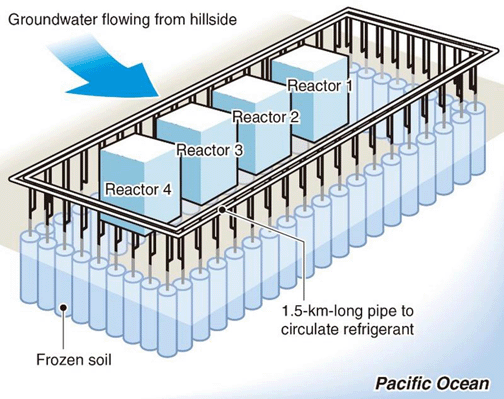
TEPCO begins freezing wall of ice around Fukushima Daiichi nuclear reactors
Fukushima Daiichi Frozen Wall Begins Freezing Operations http://www.fukuleaks.org/web/?p=14725 April 23rd, 2015 TEPCO’s contractors have begun the process of freezing the completed sections of the frozen wall. Blocks 1-8 are currently in the freezing process. Other sections are either still under construction or in the process of having the plumbing installed. The sections currently being frozen include the land side and north sides of the reactor building areas.
As workers’ radiation exposure count rises, shortage of labour predicted at Fukushima nuclear plant
 Fears grow over labour shortage at Fukushima nuclear plant, Power Engineering, 20/04/2015 By Tildy Bayar A labour shortage could be in the works for the decommissioning crew at Japan’s Fukushima No 1 nuclear power plant, analysts have warned, potentially putting the project at risk.
According to a weekend report in the Asahi Shimbun newspaper, an official at Japan’s Agency for Natural Resources and Energy said it is “unclear to some extent whether it will be possible to secure enough labour until the decommissioningprocess is completed”. At issue is the number of workers being forced to leave after reaching the legal limit for radiation exposure – 100 millisieverts in five years, or a maximum exposure rate of 50 millisieverts per year – set by the national Industrial Safety and Health Act. (The International Commission on Radiological Protection recommends that workers receive no more than 20 millisieverts per year over five years.)
Of the plant’s 14,000 registered workers, 174 have reportedly left the plant after reaching the legal limit, and 2081 have received between 50 and 100 millisieverts of exposure. Of the latter group, the Asahi Shimbun said “a majority” have been transferred to lower-exposure positions by their companies before reaching the limit, a common practice once an employee’s exposure reaches 20 millisieverts.
This leaves the coming work – including tasks which need to be carried out within the most radioactive parts of the plant – in doubt……….. Analysts say a long-term plan is needed to keep the project going for the 30-40 years that complete decommissioning is projected to take. Shigeaki Tsunoyama, who heads the Fukushima Prefectural Government’s safety advisory group, told the Asahi Shimbun that “decommissioning will stall” if too many experienced workers hit the exposure limit and leave or are transferred. “The government and Tepco have to take some steps as early as possible,” he warned.
One area being explored by Tepco is the replacement of human workers with robots in radioactive areas of the plant. So far, the utility says it has used robots equipped with cameras to explore the damage inside the reactors. “We are expecting to apply remote techniques further to the operations,” it stated, “such as the decontamination of the high-dose radiation area inside the reactor buildings and the removal of fuel debris from the reactor contaminant vessel or the reactor pressure vessel.”
Next on the agenda for Tepco is removing fuel rods from reactor 3’s spent fuel pool, which is planned to largely involve remote operations in order to limit workers’ exposure. However, some workers will be required to set up the necessary equipment. http://www.powerengineeringint.com/articles/2015/04/fears-grow-over-labour-shortage-at-fukushima-nuclear-plant.html
The demise of 2 robots inside the Fukushima nuclear disaster
These Robots Are Stranded Inside a Nuclear Disaster http://www.defenseone.com/technology/2015/04/these-robots-are-stranded-inside-nuclear-disaster/110683/ BY ADAM PASICKQUARTZ
This month, a Tokyo utility company sent two specially-designed robots on an ill-fated mission into the Fukushima nuclear disaster site to assess the damage.
Four years after an earthquake and tsunami destroyed Japan’s Fukushima nuclear plant, Tokyo Electric Power Co. is still at work trying to clean up the scene. This month TEPCOsent two specially-designed shape-shifting robots into the Fukushima No. 1 nuclear reactor to assess the damage.
Even if the robots hadn’t been damaged, a Pixar-style “WALL-E” ending was never in the cards: As IEEE Spectrum notes, the robots became so radioactive that they would have been permanently stored in a shielded box if they had returned from their missions.
The anonymous snakebots may be done for, but there is still a vast robot menagerie working on the Fukushima cleanup—including Quince, Packbot, Raccoon, and Rosemary
Fukushima nuclear catastrophe goes on – worst may not be over
CBS: Worst may not be over from Fukushima — “Effects of radiation have become much more severe” — “Enormous decline” seen in animal species — “Striking drop-off… really dramatic impacts” due to nuclear disaster (VIDEO)http://enenews.com/cbs-worst-be-fukushima-effects-radiation-become-severe-enormous-decline-animal-species-really-striking-drop-dramatic-impacts-video?utm_source=feedburner&utm_medium=email&utm_campaign=Feed%3A+ENENews+%28Energy+News%29
University of South Carolina, Apr 15, 2015 (emphasis added): Dwindling bird populations in Fukushima… as several recent papers from University of South Carolina biologist Tim Mousseau and colleagues show, the avian situation there is just getting worse… They recently published a paper in the Journal of Ornithology showing results from the first three years…Many populations were found to have diminished in number as a result of the accident, with several species suffering dramatic declines… What might be most disheartening to the researchers involved, and bird-lovers in general, is how the situation is progressing in Fukushima. Despite the decline in background radiation in the area over these past four years,the deleterious effects of the accident on birds are actually increasing.
Dr. Tim Mousseau, USC biologist: “The declines have been really dramatic… now we see thisreally striking drop-off in numbers of birds as well as numbers of species of birds. So both thebiodiversity and the abundance are showing dramatic impacts in these areas with higher radiation levels, even as the levels are declining.”
CBS News, Apr 16, 2015: Near site of Fukushima disaster, birds still in peril… birds are becoming a rarity around the damaged nuclear site… “There are dramatic reductions in the number of birds”… Mousseau told CBS News. “In terms of barn swallows in Fukushima, there had beenhundreds if not thousands in many of these towns where we were working. Now we are seeing a few dozen of them left. It’s just anenormous decline.”… Around Fukushima, Mousseau predicts the worst may not be over… “So now we see this really striking drop-offin numbers of birds as well as numbers of species of birds. So both the biodiversity and the abundance are showing dramatic impacts in these areas with higher radiation levels, even as the levels are declining.” Mousseau said the reason comes down to the long-term impact of the radiation. “It takes multiple generations for the effects of mutations to be expressed…”
Journal of Ornithology, A. Møller, I. Nishiumi and T. Mousseau, March 2015: Cumulative effects of radioactivity from Fukushima on the abundance and biodiversity of birds… overall abundance and diversity of species on average decreased with increasing levels of background radiation… the relationship became more strongly negative across years… Although there has been great public interest concerning the ecological, genetic and potential health consequences of the Fukushima radiological disaster, basic research to date has been surprisingly limited… Recent seminal studies of butterflies exposed to radioactive contaminants associated with the Fukushima disaster found strong evidence for increased mutation rates, developmental abnormalities and population effects as a direct consequence of exposure to radionuclides… Murase et al. (2015) made an equally compelling case for radiation having a negative impact on reproductive performance in the decline of Japanese goshawks.
Environmental Indicators (Journal), A. Møller and T. Mousseau, 2015: Many species occur both at Chernobyl and Fukushima, allowing a test of similarity in the effect of radiation on abundance….among the 14 species occurring at both sites [the] slope of the relationship between abundance and radiation for the 14 common species was… much stronger at Fukushima… [Since 2011] the effects of radiation on abundance became much more severe.
Watch the researchers bird counting in Fukushima at a “very hot and quiet site”
1 This Month

of the week – Shut Down Drone Warfare!


Tell the Ukrainian Government to Drop Prosecution of Peace Activist Yurii Sheliazhenko

Petition to revoke the licensing of the Near Surface Nuclear Disposal Facility (NSDF) at Chalk River. https://www.ourcommons.ca/petitions/en/Petition/Details?Petition=e-7247
To see nuclear-related stories in greater depth and intensity – go to https://nuclearinformation.wordpress.com
-
Archives
- April 2026 (68)
- March 2026 (251)
- February 2026 (268)
- January 2026 (308)
- December 2025 (358)
- November 2025 (359)
- October 2025 (376)
- September 2025 (257)
- August 2025 (319)
- July 2025 (230)
- June 2025 (348)
- May 2025 (261)
-
Categories
- 1
- 1 NUCLEAR ISSUES
- business and costs
- climate change
- culture and arts
- ENERGY
- environment
- health
- history
- indigenous issues
- Legal
- marketing of nuclear
- media
- opposition to nuclear
- PERSONAL STORIES
- politics
- politics international
- Religion and ethics
- safety
- secrets,lies and civil liberties
- spinbuster
- technology
- Uranium
- wastes
- weapons and war
- Women
- 2 WORLD
- ACTION
- AFRICA
- Atrocities
- AUSTRALIA
- Christina's notes
- Christina's themes
- culture and arts
- Events
- Fuk 2022
- Fuk 2023
- Fukushima 2017
- Fukushima 2018
- fukushima 2019
- Fukushima 2020
- Fukushima 2021
- general
- global warming
- Humour (God we need it)
- Nuclear
- RARE EARTHS
- Reference
- resources – print
- Resources -audiovicual
- Weekly Newsletter
- World
- World Nuclear
- YouTube
-
RSS
Entries RSS
Comments RSS
 nuclear-news