‘Scorpion’ robot to help develop new robots that could go deeper into Fukushima nuclear reactor unit 2
Officials hope the robot can see the fuel in the pressure vessel in the middle of the reactor. The fuel hasn’t been located exactly and studied because of the high radiation levels.
The difficult work of decommissioning the Fukushima plant damaged by the 2011 earthquake and tsunami will take decades. The scorpion robot is the second to enter a primary containment vessel, after “snake” robots were sent in April inside the worst-hit Unit 1. One of the two robots used in that reactor became stuck and had to be left behind, and neither was able to spot the melted fuel debris.
This time, the scorpion crawler, which is 54 centimeters (21 inches) long when it is extended, will enter through a duct designed as a passageway for fuel rods. Toshiba has no back up machine……….
Toshiba officials said they hope the robot can capture images of deeper areas of the vessel, though the primary focus is the platform area, so they can design suitable robots that can go deeper into the vessel……
The robot’s entry is just the beginning of the reactor investigation required before the most challenging task of removing the melted fuel.: http://phys.org/news/2015-06-small-robot-interior-fukushima-daiichi.html#jCp
Radiation effects on Fukushima’s birds are getting worse
Mousseau said the reason comes down to the long-term impact of the radiation. “It takes multiple generations for the effects of mutations to be expressed in natural populations,” he said
 Near site of Fukushima disaster, birds still in peril, By MICHAEL CASEY CBS NEWS April 16, 2015, Four years after the Fukushima disaster, birds are becoming a rarity around the damaged nuclear site.
A study in the Journal of Ornithology found that half the populations of 57 bird species had suffered declines. Studying birds over three years at 400 sites, University of South Carolina biologist Tim Mousseau and his colleagues found that the numbers continue to decline over time – even as the radiation threat drops.
“There are dramatic reductions in the number of birds that should be there based on the overall patterns,” Mousseau told CBS News. “In terms of barn swallows in Fukushima, there had been hundreds if not thousands in many of these towns where we were working. Now we are seeing a few dozen of them left. It’s just an enormous decline.”
In addition to barn swallows, the great reed warbler, Japanese bush warbler and the meadow bunting have been the hardest hit………
Mousseau also has been among researchers leading a project that compares the environmental impact of Fukushima to that of Chernobyl, the scene in 1986 of the worst accident at a nuclear plant. As the director of the Chernobyl + Fukushima Research Initiative, he looked at the impact of birds in both places.
In a second paper in the Journal of Ornithology this month, Mousseau and his longtime collaborator Anders Moller of the French National Centre for Scientific Research found that migratory birds appear to fare worse around Chernobyl than year-round residents. The opposite is true in Fukushima…….
Around Fukushima, Mousseau predicts the worst may not be over.
“The relationship between radiation and numbers started off negative the first summer, but the strength of the relationship has actually increased each year,” Mousseau says. “So now we see this really striking drop-off in numbers of birds as well as numbers of species of birds. So both the biodiversity and the abundance are showing dramatic impacts in these areas with higher radiation levels, even as the levels are declining.”
Mousseau said the reason comes down to the long-term impact of the radiation.
“It takes multiple generations for the effects of mutations to be expressed in natural populations,” he said, referring to effects such as shorter life spans and reduced fertility. “At some point, there will be a balance of the negative effects of mutations and immigration of fresh, new birds. We just don’t know enough to say when a balance will be reached.” http://www.cbsnews.com/news/fukushima-disaster-taking-a-toll-on-birds/
A new set of problems for Fukushima’s stricken nuclear facility
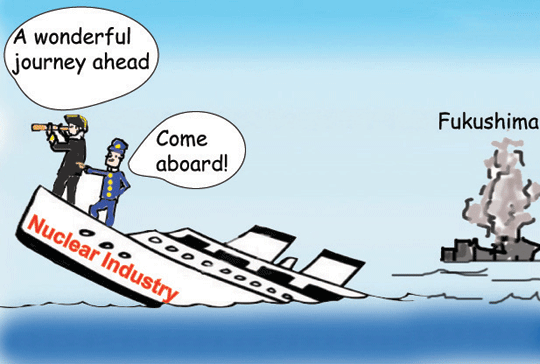 New Problems & Challenges Plague Fukushima, Simply Info June 23rd, 2015 As June wanes we find more delays, more problems and new admissions about the extent of the disaster.
TEPCO introduced a new roadmap plan. In this they declared they would now focus on safety over speed. At the same time they announced that spent fuel removal work for units 1-3 would be delayed again. Currently they are attempting to remove the cover on unit 1 but this process has not actually begun based on visual evidence at the plant. TEPCO has not been forthcoming what is delaying this work again. Work at unit 3 had been underway in early spring to remove parts of the crane that fell into the fuel pool. An oil leak was found as they attempted to remove a portion of the crane. This stopped the removal work as they cleaned the oil out of the pool water and investigated a cause. Around the same time they discovered damage to the metal gate that connects the spent fuel pool to the reactor well. After this discovery, removal work at unit 3 appeared to cease.
Newer reports also showed that the earlier concept of flooding the reactor containments to remove damaged fuel debris is being phased out. ……..http://www.fukuleaks.org/web/?p=14818
The challenges posed in the cleanup of Japan’s Fukushima nuclear plan
What’s ahead for Japan’s Fukushima nuclear plant http://www.nwitimes.com/business/local/what-s-ahead-for-japan-s-fukushima-nuclear-plant/article_6032428a-090a-5d83-99ff-b0dce1f61627.html Mari Yamaguchi Associated Press TOKYO | Four years after an earthquake and tsunami destroyed Japan’s Fukushima nuclear power plant, the road ahead remains riddled with unknowns.
The government approved a revised 30- to 40-year roadmap Friday that delays by three years the start of a key initial step — the removal of still-radioactive fuel rods in the three reactors that had meltdowns following the March 2011 disaster in northeast Japan.
Experts have yet to pinpoint the exact location of the melted fuel inside the three reactors and study it, and still need to develop robots capable of working safely in such highly radioactive conditions. And then there’s the question of what to do with the waste.
Some of the uncertainties and questions: Continue reading
New book: Fukushima: The Story of a Nuclear Disaster
 Book: Fukushima: The Story of a Nuclear Disaster,Truth Dig, Jun 12, 2015 By Louise Rubacky “Fukushima: The Story of a Nuclear Disaster” A book by David Lochbaum, Edwin Lyman, Susan Q. Stranahan and the Union of Concerned Scientists
In “Fukushima: The Story of a Nuclear Disaster,” a team of scientists and a Pulitzer Prize-winning journalist recount what happens when a catastrophe strikes that no one imagines. No one with the clout to prevent it, that is. It’s a tale of entwined worlds that must cooperate intelligently in order to protect the public. The tensions and cross-purposes among them, however, lead to indecision, inaction and increased calamity. In crisis, these worlds—the nuclear energy industry, two powerful governments, and international regulatory commissions—are about as effective as a machine lubed with super glue.
Early and often comes the warning: HUBRIS AHEAD. Words and phrases like prevailing wisdom, low risk, practically unthinkable, unlikely, government assurances, assumptions, confidence, remote possibility and a situation we had never imaginedappear throughout; they indicate attitudes about potential dangers, and point to why the earthquake and tsunami had such dire effects on Fukushima Daiichi Nuclear Power Plant and Japan.
This chronicle, another in the continuing tragedy of the human gamble against nature, is mostly peopled by players who could be said to represent knowledge, fear, power and money. In standing, the first of these comes last. Corporate captains, regulators and leaders charged with public safety cover up or sidestep facts that, if acknowledged and addressed, could imperil their coffers or careers. As in the U.S., there’s a symbiotic and dangerous relationship between government and industry in Japan. The route from the public to the private sector is known here as the revolving door; there, the delicate name for that greasy highway is “amakudari,” translated as “descent from heaven.”…………..
“Fukushima” makes a fine reference volume for understanding nuclear power production and its still-critical dangers. It’s also a mosaic of determined reconstruction, and serves as a play-by-play guide to What Not to Believe during an industrial accident. As the prescient journalist I.F. Stone warned for decades about governments: They all lie. And so it goes for most large corporations, whose PR shields give “spinning”—formerly known as lying—a shiny sophistication. Eight days into the crisis, Chuck Casto, the NRC rep in Japan working on no sleep and with little cooperation, said, “I’m just trying to figure out who the power player is over here.” This too is a crux of the story, and others about high-stakes arenas. ….http://www.truthdig.com/arts_culture/item/fukushima_the_story_of_a_nuclear_disaster_20150612
Gov’t Officials: Fukushima should be declared uninhabitable
 Gov’t Officials: Fukushima should be declared uninhabitable — “Conditions are getting worse, we have to move people away… we can’t wait” — “Someone has to do something” — “Just like evacuation of children in WWII” — Newspaper: “Fukushima youths ready to desert irradiated hometowns” (VIDEO) http://enenews.com/govt-officials-fukushima-be-declared-uninhabitable-wait-around-conditions-getting-worse-move-people-away-like-evacuation-children-during-world-war-ii-japan-newspaper-fukushima-youths-ready?utm_source=feedburner&utm_medium=email&utm_campaign=Feed%3A+ENENews+%28Energy+News%29
Jiji Press, Jun 5, 2015 (emphasis added): Fukushima youths ready to desert irradiated hometowns, survey finds… a majority of the young people living in 12 radiation-contaminated municipalities in Fukushima do not plan to be living in the same place… The survey, conducted in February and March, covered members of some 13,000 households randomly selected from the 77,600 still remaining in the 12 municipalities… “The results are very shocking,” said Satoshi Endo, mayor of the town of Hirono… Fukushima Prefectural Government will present a clear vision so young people can have hope about their hometowns, a senior official said..
The Asia-Pacific Journal, May 25, 2015:
- Murakami Tatsuya, former mayor of Tōkaimura (“Birthplace of nuclear power in Japan”): There are 14 reactors on [Japan’s Pacific coast] and I wouldn’t have been surprised if all these reactors had ended up failing in some way or another… It tells you how catastrophic it could be for a country like Japan to house nuclear power plants… It is crazy. Right now about 130,000 people in Fukushima have been evacuated from the exclusion areas, although it would be 80,000 or 90,000 people if we do not count voluntary evacuees… Speaking from the examples of Chernobyl, Fukushima should have been declared uninhabitable, especially to raise children.
- Prof. Katsuya Hirano, UCLA: I agree… families with small children should have been given new land somewhere safe to start their lives again. The government should have provided them with a new village and community to live…
- Murakami: I thought about the possibility of relocating the entire Tōkaimura myself. The news about the Fukushima crisis chilled me to the bone. As I mentioned, we were so close to having a similar situation, so I started thinking about relocating the entire village and in fact found a place in Hokkaido… and have them start dairy farming and cultivating new land in Hokkaido… I even visited the area. If it doesn’t work, I thought, other alternatives would be Australia or our sister state, Idaho.
Press Conference for Dr. Akira Sugenoya, Mayor of Matsumoto, Japan (AP: Sugenoya is a surgeon and thyroid specialist who left a prestigious Japanese hospital to perform lifesaving cancer surgeries in Chernobyl for several years): “It is clear that a significant amount of radioactive iodine was released from Fukushima Daiichi. It was a huge mistake not to take any measures immediately… There are children in Fukushima diagnosed with thyroid cancer, and the number of cases is increasing… I have said “children and pregnant women will suffer negative health effects in the future, as a result of external — and especially internal — exposure… In order to protect their lives, the government must, as a matter of national policy, move the children out of contaminated regions… The people are being exposed to radiation on a daily basis. Someone has to do something… A good part of Japan has been contaminated with nuclear fallout. This is just like the evacuation of children that took place en masse during the World War II.”
Taro Yamamoto, member of Japan’s Upper House of Parliament: “We have to grasp the real situation of which our children are in… we cannot wait around, because the conditions are getting worse. We have to move people away from the affected areas.”
Dr. Sugenoya’s press conference here | Interview with Yamamoto here
Burnout and stress in Fukushima’s 7,000 nuclear cleanup workers
Stress on The Front Lines of Fukushima Cleanup, NHK, 12 March 2015 Four years ago, crews at Fukushima Daiichi in Japan were racing to keep the nuclear plant from spiraling out of control following the earthquake and tsunami. Today, that sense of urgency has dissipated. But the situation remains serious as workers juggle a host of problems as they decommission the facility. Given the risks involved, health concerns and other worries weigh heavily on their minds……Every day about 7,000 workers help decommission the reactors. In heavy protective clothing, they carry out such tasks as collecting and storing contaminated water. However, the decommissioning work is expected to take up to 40 years to complete. Keeping stress levels down and morale up is proving difficult.
Maeda says a change of mood has definitely come over his staff. He also says it’s getting harder to find new skilled workers. His company now has only one-third the number of experienced workers it had before the accident. “If it carries on like this, we’ll go out of business,” he says.
Four years after the disaster, the decontamination of land around the plant continues. But it is hard to predict when places like Maeda’s hometown of Namie will be habitable again. He says many residents are losing hope of returning home……… http://www3.nhk.or.jp/nhkworld/english/news/nuclearwatch/20150312.html
Nuclear Regulation Authority (NRA) official warns on hydrogen explosion risk at Fukushima

 Gas buildup under Fukushima threatens hydrogen explosion, warn nuclear officials, June 01, 2015 by: Jonathan Benson, staff writer (NaturalNews) It is estimated that at least 130 storage containers holding radioactive waste at the stricken Fukushima Daiichi nuclear facility in Japan are now leaking, according to new reports. The result is a continuous hydrogen gas buildup that nuclear experts say could one day trigger a cascade of devastating explosions potentially unlike anything the world has ever seen.
The Tokyo Electric Power Company (TEPCO) discovered the leaks during a recent inspection, observing that hydrogen and other gases are accumulating in the sediment at the bottoms of many of the storage tanks onsite. The buildup from this is causing contaminated water inside the tanks to expand, blowing off their lids and spilling their contents.
An official from the Nuclear Regulation Authority (NRA), which was given the bad news during a recent study group meeting with TEPCO, reportedly told the media that this constantly accumulating gas buildup is an imminent danger and that something needs to be done to contain it.
“If the concentration level is high, a spark caused by static electricity could cause a container to explode,” stated one unnamed government official about the situation, as quoted by the news source The Asahi Shimbun.
Many of Fukushima’s storage containers are faulty; some are missing gas venting holes
In early April, many of the containers identified as leaking radioactive waste were found to be leaking the fluid through their gas venting holes, which are supposed to prevent this very thing from occurring. It was also later discovered that some of the storage tanks weren’t even properly outfitted with gas venting holes, exacerbating the problem…….http://www.naturalnews.com/049910_Fukushima_nuclear_waste_hydrogen_explosion.html
Fukushima Daiichi ‘s Port has Record Levels of Radiation
 Record levels of radioactivity in plant’s port http://www3.nhk.or.jp/nhkworld/english/news/nuclear.html May 30, 2015 The operator of the damaged Fukushima Daiichi nuclear plant says it has found record-high levels of radioactive water in the facility’s port. It says the high levels are due to a leak of wastewater. Tokyo Electric Power Company officials said on Friday that contaminated water leaked from a crack in a hose connecting a wastewater tank to a building at the plant.
They later detected about 22,000 becquerels of beta ray-emitting substances per liter of water in a nearby drainage ditch. The ditch is in the upper part of a drainage channel. The utility also found the density of radioactive materials in the channel was around 6,600 becquerels per liter. That’s more than 200 times higher than the figure recorded on Wednesday.
TEPCO officials took samples of seawater from 4 locations in the port, where the leaked water reached via the drainage channel. They detected between 190 and 320 becquerels of radioactive substances per liter. The figure is the highest ever recorded in the port.
Utility officials say the leak stopped after they halted the flow of water, and that it has not affected waters in the Pacific Ocean outside the port. TEPCO workers are trying to collect water from the drainage channel to prevent it from reaching the ocean.
Voluntary evacuees from Fukushima may lose free housing in 2017
Fukushima may end free housing for voluntary nuclear evacuees in 2017, Japan Times, 27 May 15 JIJI FUKUSHIMA – The Fukushima Prefectural Government may stop providing free accommodations at the end of March 2017 for people who voluntarily left areas in the prefecture not subject to nuclear evacuation advisories, sources said.
Officials hope to encourage people who evacuated on their own to return home, but the proposed end to the assistance will certainty draw objections from them……..
Many voluntary evacuees are people with children as well as former residents of such areas as the town of Hirono, the village of Kawauchi and the city of Minamisoma, all geographically close to the government-designated evacuation zones.
They sought refuge outside their hometowns mainly due to concerns over exposure to radiation from the reactor meltdowns at Tokyo Electric Power Co.’s Fukushima No. 1 plant.
Under the Disaster Relief Act, the prefectural government provides prefabricated temporary housing for nuclear evacuees for free and fully finances their rent for private apartments.
The aid program was originally supposed to run two years, but it was extended by a year twice, with the current version set to expire at the end of next March. For voluntary evacuees, the prefecture hopes to terminate the assistance after another one-year extension, the sources said.
It is looking at continuing the free accommodations for people who fled the designated evacuation areas, the sources said. http://www.japantimes.co.jp/news/2015/05/18/national/fukushima-may-end-free-accommodations-voluntary-nuclear-evacuees-2017/#.VWt9hdKqpHy
Fukushima food coming to a grocery near you?
 How Fukushima Produce Is Making Its Way Into International Stores, Before It’s News,Wednesday, May 27, 2015 It is being reported that tainted food from Fukushima, Ibaraki, Gumma, and Chiba is making its way into local supermarkets in Taiwan due to the irresponsibility of mislabeling. What’s more, these food products were banned in Taiwan since March of 2011.
The first question is: Why are food products from the concerned Japanese prefectures surrounding Fukushima mislabelled?
The second question is: Why is Japan attempting to foist its unsafe and inferior radioactive foods on Taiwan?
Instead of humbly acquiescing to Taiwan’s wishes, Japan takes an aggressive approach even threatening WTO arbitration.
Taiwan’s Food and Drug Administration said the latest enforcement was in line with radiation safety management practices that other countries have put in place on Japanese food imports following the 2011 Fukushima nuclear disaster.
It said it “is necessary to protect the safety of food consumption” for Taiwanese.
But Japan is protesting the move, with the government warning that it may escalate the matter to the World Trade Organization, potentially deepening the conflict between Taipei and Tokyo……..
they are now still dealing with the Fukushima meltdown(s) — a set of intractable nuclear challenges which may have no practical solutions. That means that those prefectures surrounding Fukushima may always have an environment suffering from a proliferation of radionuclides. What exactly are radionuclides?
A radionuclide or radioactive nuclide is a nuclide that is radioactive. Also referred to as a radioisotopeor radioactive isotope, it is an isotope with an unstable nucleus, characterized by excess energy available to be imparted either to a newly created radiation particle within the nucleus or via internal conversion. During this process, the radionuclide is said to undergo radioactive decay, resulting in the emission of gamma ray(s) and/or subatomic particles such as alpha or beta particles.[1] These emissions constitute ionizing radiation. (Source: Wikipedia — Radionuclide)
Radionuclides, and especially the ionizing radiation which they emit, are certainly not something that anyone would want in their back yard, much less in their food. Nevertheless, Japan feels it can maintain the same policies that got them into this calamitous predicament. Hopefully, Taiwan will not relent to demands so unreasonable they strain credulity. After all, Japan needs to learn some critical lessons for their own benefit as well as for their trading partners.http://beforeitsnews.com/health/2015/05/how-fukushima-produce-is-making-its-way-into-international-stores-2575244.html
Inadequate cleaning of Fukushima radioactive water
 Fukushima Daiichi Cleans Most Contaminated Water, Not Really, Simply Info May 28th, 2015 TEPCO announced that they have cleaned most of the contaminated water at Fukushima Daiichi. But thedetails show they are no where near close to being done.
Only cesium 137 & 134 along with strontium 90 have been removed from certain tanks of water. 620,000 tons of water have had these two isotopes removed. 10,000 tons of water currently can not be filtered for an undisclosed reason.
440,000 tons of water have now been run through ALPS with 180,000 tons still needing to be processed. Previous admissions showed that ALPS did not remove cobalt 60, iodine 129 and tritium among possible other isotopes……. http://www.fukuleaks.org/web/?p=14776
As many as 333 Fukushima radioactive water tanks may be leaking
Leaking Fukushima containers could lead to hydrogen explosions, Rt.com May 25, 2015 Containers holding contaminated water at the crippled Fukushima nuclear power plant are at risk of hydrogen explosions, with 10 percent of them found to be leaking. As many as 333 containers may be defective, according to TEPCO.
The first leak was discovered by the plant’s operator, Tokyo Electric Power Company (TEPCO), on April 2. The discovery prompted an inspection of other containers at the site.
Twenty-six of the 278 containers examined by May 20 had some sort of leak or were bleeding from their lids. There are a total of 1,307 containers at the plant.
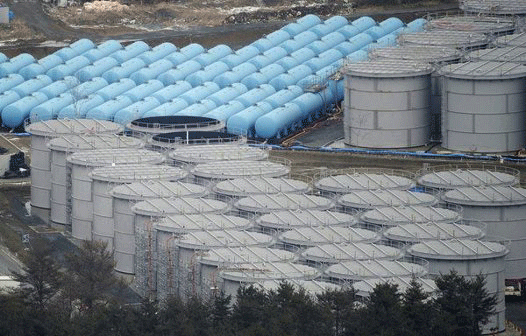
According to TEPCO, the leaks and bleeding were likely caused by hydrogen and other types of gases that resulted from the water’s exposure to high levels of radiation. Those gases appear to have accumulated in sediment at the bottom of the containers, expanding the volume of the liquid……http://rt.com/news/261793-fukushima-containers-hydrogen-explosions/
Inspector resigns as 127 Fukushima children diagnosed malignant or possible malignant thyroid tumor
 127 Fukushima children diagnosed malignant or possible malignant thyroid tumor / Inspector Suzuki resigned http://fukushima-diary.com/2015/05/127-fukushima-children-diagnosed-malignant-or-possible-malignant-thyroid-tumor-inspector-suzuki-resigned/ 5/18/2015, Fukushima prefectural government announced they found malignant or possible malignant thyroid tumor from 127 children so far.
Among 127 children, they confirmed 103 children cases are thyroid cancer.
Before 311, pediatric thyroid cancer was found only in one of 1 million children. The population of Fukushima prefecture is approx. 200 million in 2012.
They have tested only 0.4 million children so far.
Also, Fukushima health investigative committee announced in the press conference that the thyroid tumor inspector, Suzuki, professor from Fukushima medical university resigned “in order to focus on the medical treatment of thyroid cancer”. The successor, Otsuru, who is also a professor of Fukushima medical university stated he is a physician so he cannot treat the cancer.
Japan SAYS it will start removing fuel debris from stricken reactors in 2021
Japan still aims to start removing nuclear fuel debris at the three damaged reactors at Tokyo Electric Power Co.’s Fukushima No. 1 power plant in 2021, it was learned Thursday.
The schedule remained intact in a draft update to the government’s roadmap to the decommissioning of reactors 1, 2 and 3, all of which experienced fuel meltdowns during the nuclear disaster from March 2011. The draft was submitted to a meeting of a government task force on the matter.
But it looks inevitable that the government will review the schedule. The exaction location of the molten nuclear fuel in the reactors is still unknown and radiation levels in and around the reactors are very high.
In autumn last year, the government and Tepco discussed a delay of about five years in the start of work to remove the fuel debris from reactor 1.
Meanwhile, the government is reviewing the schedule for removing spent fuel at storage pools at the three reactors.
Removal work has been slated to begin for reactor 3 by the end of this September. But the work will likely be delayed because radiation levels remain high and operations to remove rubble from the damaged building have not progressed as planned……http://fukushimaemergencywhatcanwedo.blogspot.com.au/
1 This Month

of the week – Shut Down Drone Warfare!


Tell the Ukrainian Government to Drop Prosecution of Peace Activist Yurii Sheliazhenko

Petition to revoke the licensing of the Near Surface Nuclear Disposal Facility (NSDF) at Chalk River. https://www.ourcommons.ca/petitions/en/Petition/Details?Petition=e-7247
To see nuclear-related stories in greater depth and intensity – go to https://nuclearinformation.wordpress.com
-
Archives
- April 2026 (68)
- March 2026 (251)
- February 2026 (268)
- January 2026 (308)
- December 2025 (358)
- November 2025 (359)
- October 2025 (376)
- September 2025 (257)
- August 2025 (319)
- July 2025 (230)
- June 2025 (348)
- May 2025 (261)
-
Categories
- 1
- 1 NUCLEAR ISSUES
- business and costs
- climate change
- culture and arts
- ENERGY
- environment
- health
- history
- indigenous issues
- Legal
- marketing of nuclear
- media
- opposition to nuclear
- PERSONAL STORIES
- politics
- politics international
- Religion and ethics
- safety
- secrets,lies and civil liberties
- spinbuster
- technology
- Uranium
- wastes
- weapons and war
- Women
- 2 WORLD
- ACTION
- AFRICA
- Atrocities
- AUSTRALIA
- Christina's notes
- Christina's themes
- culture and arts
- Events
- Fuk 2022
- Fuk 2023
- Fukushima 2017
- Fukushima 2018
- fukushima 2019
- Fukushima 2020
- Fukushima 2021
- general
- global warming
- Humour (God we need it)
- Nuclear
- RARE EARTHS
- Reference
- resources – print
- Resources -audiovicual
- Weekly Newsletter
- World
- World Nuclear
- YouTube
-
RSS
Entries RSS
Comments RSS
 nuclear-news