TEPCO exploits homeless, mentally disabled men, in Fukushima nuclear clean-up
 TV: Mentally disabled are working at Fukushima Daiichi, says journalist — Many men forced to go to plant — Homeless treated like ‘disposable people’(VIDEO) http://enenews.com/tv-journalist-says-theres-mentally-disabled-workers-at-fukushima-many-men-forced-to-work-at-plant-homeless-treated-like-disposable-people-video
RT News, Nov. 20, 2013: Homeless men employed cleaning up the stricken Fukushima nuclear plant, including those brought in by Japan’s yakuza gangsters, were not aware of the health risks they were taking and say their bosses treated them like “disposable people.” […] While some workers voluntarily agreed to take jobs on the nuclear clean-up project, many others simply didn’t have a choice […] many of the workers were brought into the nuclear plant by Japan’s organized crime syndicates, the yakuza. […] Although a special task force to keep organized crime out of the nuclear clean-up project has been set up, investigators say they need first-hand reports from those forced to work by the yakuza […]
Anonymous former Fukushima worker: We were given no insurance for health risks, no radiation meters even. We were treated like nothing, like disposable people — promised things, and then kicked us out when we received a large radiation dose.
Tomohiko Suzuki, journalist who worked at Fukushima plant: The government called Tepco to take urgent action, Tepco relayed it to subcontractors — and they, eventually, as they had a shortage of available workers, called the Yakuza for help. […] They were given very general information about radiation and most were not even given radiation meters. They could have exposed themselves to large doses without even knowing it. Even the so-called Fukushima 50 […] at least three of them were enrolled by the yakuza.
Aleksey Yaroshevsky, RT: There are 25% more openings for jobs at Fukushima plant than applicants, according to government data. Gaps filled, says Suzuki, by the homeless, the desperately unemployed and even those with mental disabilities.
TEPCO removes 20-ton piece of debris from fuel pool at Fukushima No. 1 nuclear plant
20 – Ton Object Removed From Fukushima Fuel Pool http://www.japanbullet.com/news/20-ton-object-removed-from-fukushima-fuel-pool August 2, 2015 Tokyo Electric Power Co. on Aug. 2 removed a 20-ton piece of debris from a nuclear fuel storage pool, a small but critical step in decommissioning the crippled Fukushima No. 1 nuclear power plant. It was the largest piece of debris left in the No. 3 reactor building’s storage pool, which is holding 566 nuclear fuel assemblies.
The reactor building was heavily damaged by a hydrogen explosion shortly after the Great East Japan Earthquake and tsunami on March 11, 2011, triggered the nuclear crisis at the plant.
The object removed was part of fuel replacement equipment used to load and unload nuclear fuel at the No. 3 reactor. It has prevented TEPCO from removing the nuclear fuel assemblies in the pool to a safer location.
The piece of equipment originally weighed 35 tons, but TEPCO used an underwater cutting device to pare it down to 20 tons.
The utility began lifting the debris shortly before noon. Workers remotely controlled two large cranes, equipped with three specially designed hooks, to pull out the debris while closely monitoring the process with cameras.
The delicate operation required the utmost attention to detail to prevent the debris from touching the pool’s walls. If it had dropped back into the pool, it could have damaged the nuclear fuel assemblies.
The debris was safely placed on the ground after 90 minutes, during which time TEPCO suspended all outdoor decommissioning work at the plant compound in case of an accident.
After removing the smaller debris from the pool, the utility plans to install special equipment on the upper structure of the reactor building to lift out the nuclear fuel assemblies.
TEPCO plans to start the fuel-removal operation in January 2018 at the earliest.
Fukushima Daiichi Unit 3 – leak may have consequences for the global nuclear industry
Leak of contaminated water at Fukushima Daiichi Unit 3 may have international safety impact http://enformable.com/2014/01/leaks-contaminated-water-fukushima-daiichi-unit-3-may-international-safety-impact/ On Saturday, workers at the Fukushima Daiichi nuclear power plant in Japan were operating a remote-controlled robot to remove debris on the first floor of the Unit 3 reactor building when they discovered a stream of water nearly a foot wide flowing through the first floor the reactor building before escaping into a drain on the floor.
After an investigation found that the water contained levels of radioactive materials equal to highly contaminated water which is accumulating in the basement of the reactor building, Tokyo Electric announced that water leaking inside of the Unit 3 reactor building is likely coming from the containment vessel where it was used to cool the melted nuclear fuel, rather than rain water.
The operators used the robot to sample water flowing into the basement of the reactor building. The investigation revealed some 24 million becquerels per liter of beta ray-emitting radioactive materials, which includes strontium, 700,000 becquerels per liter of Cesium 134, and 1.7 million becquerels per liter of Cesium 137.
Tokyo Electric also found that the temperature of the water, 20 degrees Celsius, is consistent with the same as water found at the bottom of the reactor. he water is coming from a room which houses a main steam isolation valve, which is causing concern among experts around the world. The latest details have raised questions as to whether the main steam isolation valve or any of its ancillary systems may have failed during the disaster.
There are two main steam isolation valves in each of the four pipes which carry steam from the reactor vessel to the turbine. In case of accident or power loss, the MSIV’s are supposed to fail in a closed configuration.
After the reactor shut down on March 11th, 2011, the main steam isolation valves should have closed with the turbine tripped. Even if workers had manually re-opened the MSIV’s when emergency diesel generators restored power to plant equipment before the tsunami hit the plant, the pressure inside of the condenser should have automatically re-closed the MSIVs shortly thereafter.
The fact that water is leaking from a room which houses the main steam isolation valve may indicate that the valve did not close, or was damaged during the course of the disaster.
In 2011, Dave Lochbaum of the Union of Concerned Scientists drew attention to the fact that water levels in the Unit 3 reactor dropped below zero by 16:00, without any information available that would explain why.
If the MSIV did not close or broke, operators could have been facing a Loss of Coolant Accident without even knowing how the coolant water in the reactor could have leaked out.
If the MSIV was damaged or failed open, this would represent an unanalyzed condition which could affect every other operating Boiling Water Reactor in operation currently, who count on the MSIV’s to work as planned.
Source: Union of Concerned Scientists
Source: Asahi Shimbun
Every single hour Fukushima’s stricken reactors discharge 960,000Bq Cs-134/137 to the air
 Still 960,000Bq Cs-134/137 and 2,336,000,000Bq noble gas discharged from reactors to the air every single hour http://fukushima-diary.com/2015/06/still-960000bq-of-cs-134137-and-2336000000bq-of-noble-gas-discharged-from-reactors-to-the-air-every-single-hour/ On 5/25/2015, Tepco reported still 960,000 Bq / hour of Cesium-134 and 137 is assumed to be discharged from Reactor 1 -4 to the air this April.
This is 2.7 times much as their provisional figure published in the end of April.
Tepco states the difference is caused by the change of calculation method. It strongly suggests the entire historical discharged volume of Cs-134/137 has been underestimated since 311 however they did not disclose the recalculated discharged volume before April of 2014.
Comparing to May of 2014, the discharged volume of Cs-134/137 increased to 180% this April. Tepco however states this is lower than 10% of the set point of “discharge control”, and they haven’t made any explanation on this increase.
Especially in Reactor 3, the discharged volume increased 78 times much as May. 2014. Also, 95,000 Bq / hour of Cs-134/137 is discharged from Reactor 4 building though it does not contain nuclear fuel.
Regarding noble gas (such as Kr-85), PCV (Primary Containment Vessel) gas control system detected 2,336,000,000 Bq of gas discharged from Reactor 1-3 every hour this April. Tepco states noble gas passes by as radioactive cloud to cause only external exposure so the exposure dose caused by the discharged noble gas should be significantly small.
http://www.tepco.co.jp/nu/fukushima-np/f1/smp/2015/images/additional_amount_150525-j.pdf
http://www.tepco.co.jp/life/custom/faq/images/d150430_08-j.pdf
This Fukushima catastrophe is not over… We should continue to be very worried.
Nuclear Expert: We should be very worried about ongoing catastrophe at Fukushima… “Complete failure” of ice wall built to contain extremely radioactive water… Plutonium is flowing into Pacific, will for many years to come — Strontium in ocean hits record level, huge increase reported since April (VIDEO)http://enenews.com/nuclear-expert-be-very-worried-about-ongoing-catastrophe-fukushima-plutonium-flowing-pacific-will-many-years-wall-built-contain-extremely-radioactive-water-complete-failure-strontium-90-ocean-hits?utm_source=feedburner&utm_medium=email&utm_campaign=Feed%3A+ENENews+%28Energy+News%29Excerpts from presentation by Arnie Gundersen, Fairewinds Chief Engineer, Jul 16, 2015 (emphasis added):
- Are the meltdowns at Fukushima Daiichi over?… This catastrophe is not over… We should continue to be very worried.
- 3 of the nuclear cores at Fukushima Daiichi are in direct contact with groundwater. Nuclear power designers and engineers never anticipated that possibility.
- Fukushima Daiichi Units No. 1, No. 2, and No. 3 were destroyed… allowing holes and cracks to form… We know for sure that the Fukushima Daiichi containments are full of holes that allow groundwater to come in direct contact with each nuclear core.
- Groundwater is still leaking in and leaking out, at a rate of at least 300 tons per day… more than 1,500 days have passed… 23,000-tanker truckloads of radioactive waterhave already leaked into the Pacific Ocean. Worse yet, there is no end in sight.
- As Fairewinds anticipated, the ‘ice wall’ is a complete failure.
- Cesium, strontium and plutonium from Fukushima Daiichi will continue to bleed into the Pacific Ocean for decades because the groundwater flow is unmitigated.
- Japan’s press looks on silently due to the real threat and constraints of the government’s secrecy act… The true human, financial, and environmental costs of this nuclear power catastrophe are not publicized and discussed.
TEPCO reported on July 17 that Strontium-90 concentrations in the ocean outside Fukushima Units 3 and 4 are at record highs. Levels have spiked around 1,000% in 3 months.
Sr-90 measured between Unit 3 & 4intake channel
- July 17 report: 1,500 Bq/L*
- April 23 report: 150 Bq/L
Sr-90 measured at Unit 4 screen
- July 17 report: 1,500 Bq/L*
- April 23 report: 120 Bq/L
* According to TEPCO’s July 17 report, the total level of all beta ray emitters (which includes Sr-90) was 1,200 Bq/L — yet the levels reported for Sr-90 were 1,500 Bq/L. When a similar occurrence happened last year, Asahi reported: “Strontium levels exceeded the all-beta readings in some instances, leading the utility to decide they were ‘wrong’.” TEPCO’s corrected data revealed much higher levels.
Worrying future for Fukushima’s nuclear refugees, induced to return home
 The woodlands of Iitate are “acting as a long lasting reservoir for radiocesium and as a large source for future recontamination in the environment beyond the forest,”
“You cannot work on a farm, you cannot grow rice, and you cannot pick wild plants either,”
Japan nuclear refugees face dilemma over returning home, Channel News Asia
Many residents have been unable to return to their home towns following the Fukushima nuclear disaster. Even what that changes, there will still be lingering concerns about safety. 21 Jul 2015 NARAHA, Japan: More than four years since Satoru Yamauchi abandoned his noodle restaurant to escape radiation spreading from the tsunami-wrecked Fukushima nuclear plant, the Japanese government is almost ready to declare it safe to go home.
But, like many of the displaced, he’s not sure if he wants to.
“I want my old life back, but I don’t think it’s possible here,” he told AFP on a recent visit to the dusty “soba” buckwheat noodle restaurant in Nahara that he ran for more than two decades………
UNFIT FOR HABITATION
Activists say despite government assurances, many areas still show highly-elevated levels of contamination, and many are unfit for habitation.
They say that for people who abandoned now-almost-worthless — but still mortgaged — homes, allowing TEPCO to stop payments amounts to forcing them to return.
Environmental campaign group Greenpeace has carried out a study of radiation contamination in Iitate, a heavily-forested 200-square-kilometre (75 square miles) district that sits around 40 kilometres northwest of the crippled plant also being eyed for resettlement. Continue reading
Fukushima delegation to Switzerland, to learn about transition plan from nuclear to renewable energy
Fukushima team studies Swiss nuclear experience By swissinfo.ch, with reporting by Fumi Kashimada , 16 July 15
A Japanese delegation from Fukushima, site of a nuclear disaster in March 2011, has visited Switzerland to discuss energy policies, technologies and the development of renewable forms of energy.
“Almost five years after the explosions in the Fukushima Daiichi nuclear power plant, 110,000 people still can’t return to live in their homes,” Masao Uchibori, mayor of the prefecture of Fukushima since November, toldswissinfo.ch in Solothurn.
“The inhabitants of zones with raised levels of radioactivity can’t lead a normal life.”
While most foreign reports on Fukushima focus on the reconstruction of the destroyed power plant, Uchibori points out that “time hasn’t stood still in Fukushima – we’ve made progress on rebuilding the infrastructure”.
Uchibori said the prefecture of Fukushima had set itself the ambitious target of getting 100% of its energy from renewable sources by 2040. To that end, the delegation is interested in Switzerland’s experiences in withdrawing from nuclear power. ……..
“The most important thing is that no nuclear power station accident happens ever again – it doesn’t matter whether it’s in Japan or another country. Countries should cooperate so that the world isn’t dependent on nuclear power.” http://www.swissinfo.ch/eng/nuclear-safety_fukushima-delegation-studies-swiss-nuclear-experience/41552346
Fukushima plant abnormalities – due to ionising radiation fallout?
Yahoo News: Mutated plants near Fukushima gain internet fame — Pics show centers fused together, petals growing out of sides, ring-shaped flower with 4 stems — US Gov’t Expert: Plant abnormalities can be induced after only 24 hours of exposure to radioactive fallout (PHOTOS) http://enenews.com/yahoo-news-mutated-plants-fukushima-gain-internet-fame-pics-show-centers-fused-together-petals-growing-sides-flowers-govt-expert-abnormalities-be-induced-after-only-24-hours-exposure-radioactive?utm_source=feedburner&utm_medium=email&utm_campaign=Feed%3A+ENENews+%28Energy+News%29
Yahoo News, Jul 13, 2015: Deformed daisies from Fukushima disaster site gain Internet fame… one Japanese amateur photographer has captured something a bit more unique than a beautiful bloom. Twitter user @san_kaido posted a photo of mutated yellow daisies last month, found in Nasushiobara City, around 70 miles from Fukushima… The photos show daisies with fused yellow centres and with the petals growing out the side of the flower…
Tweet from @san_kaido, translated by Fukushima Diary: “The right one grew up, split into 2 stems to have 2 flowers connected each other, having 4 stems of flower tied beltlike. The left one has 4 stems grew up to be tied to each other and it had the ring-shaped flower. The atmospheric dose is 0.5 μSv/h at 1 m”…
Taka Katsumi, former aide to Member of Japan’s Parliament, Jun 21, 2015: Deformed Margaret flowers found 130 km from Fukushima Daiichi plant at Nasu Shiobara on May 26, 2015.
Video from Nasushiobara City: Sep 2012, I measured radiation in front of SEKIYA elementary school of Nasushiobara… The monitor indicates… 6.94 on mud in the road side garter, 8.10 micro Sievert per hour on dusts of the school road.
More on Plant Fasciations (emphasis added)
> Univ. of Chicago w/ grant from Rockefeller Foundation (pdf), 1933: All vegetative parts are subject to injury by x-rays. Root tips may become bulbous and swollen, with tumor-like enlargements in which giant cells may occur. Stems become fasciated… flowers of plants rayed in seed or seedling stages may show fasciation…
> Japan’s National Institute of Agrobiological Sciences, 2009: The proportion of plants showing stem fasciation increased with gamma-irradiation… Each single mutant also showed stemfasciation at a low frequency without gamma-irradiation, while gamma-irradiation induced stem fasciation. Importantly, in wild-type plants, the frequency of stem fasciation was very low (<0.1%) [but] were induced by gamma-irradiation.
> Affidavit of James Gunckel, Brookhaven National Lab (pdf), 1984: I have carefully examined… plants, collected shortly after the [1979] accident at TMI and compared them with specimens collected more recently. The current abnormalities [5 years post-accident] are probably carried forward by induced chromosomal aberrations. There were a number of anomalies entirely comparable to those induced by ionizing radiation — stem fasciations [etc.]… Most of the stem abnormalities… are induced by relatively high doses of X or gamma rays extending over a period of usually 2-3 months. Notable exceptions, however, are similar responses to beta ray exposure from radioisotopes… for only 24 hours. In other words, it would have been possible for the types of plant abnormalities observed to have been induced by radioactive fallout on March 29, 1979… I am the world authority on modifications of plant growth and development induced by ionizing radiations…
Nuclear fuel core melted through bottom of Fukushima reactor – documents show
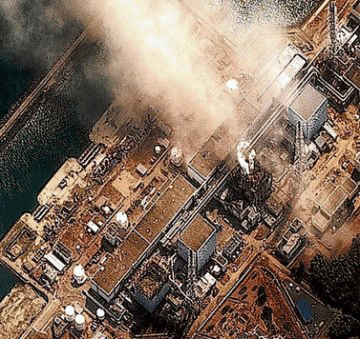 Document shows nuclear fuel burned through bottom of containment vessel under Fukushima reactor — Official: Leakage we observed indicates melt-through by ‘shell attack’ — “This is a very big problem… fuel debris in the PCV is doing something bad” (VIDEO) http://enenews.com/official-document-shows-molten-nuclear-fuel-burned-bottom-containment-vessel-fukushima-tepco-leaks-coming-reactor-indicate-melt-shell-attack-very-big-problem-fuel-debris-pcv-doing-bad-video?utm_source=feedburner&utm_medium=email&utm_campaign=Feed%3A+ENENews+%28Energy+News%29
[Good diagrams]
Shunichi Suzuki, Tokyo Electric Power Co., 2014 IRID Symposium (emphasis added):
• Part 30 – “This is the current situation… This is Unit No. 1, this shows the the lower part of the PCV [primary containment vessel]… Based on the results of research so far… the ‘sand cushion drain’… water is leaking here, which means that this section above there is damaged — so that is highly possible. Therefore, this is a very big problem, because if this is damaged, then one possibility is that shell attackhas happened [see drawing by General Electric at bottom right]. So the debris in the PCV is doing something bad to this, so we have to take that into consideration for investigation.”
• Part 31 – “Unit 2… the water level [in the suppression chamber] and the water level in the torus room is about the same . What that means is that at the bottom [of the S/C], there could be a hole. Not only there, but also there is a pump room and there are other pipings here, so that needs needs to be considered as well when they conduct the investigation.”
• Part 42 – “Unit 1… there is little fuel remaining in the core… Fuel debris exists even outside the pedestal. Therefore we give priority to outside pedestal investigation. I talked about suppressionchamber earlier, shell attack has happened perhaps— I said that — shell attack in Unit 1 is something like this. Debris may exist around here so… there is some fuel that has penetrated outside the pedestal… If debris is outside the pedestal we can’t reach it, therefore we have to consider opening a side area – it’s very unique… Regarding Unit 2 and 3… in Unit 3 we presume that more fuel than we expected has fallen down to the PCV… we cannot deny the possibility that fuel has gone outside the pedestal.”
• Part 55 – “This is a MAAP example [computer code used for estimating fuel debris position]. Improvement points… the height is increasing, we had a single transfer path [for the molten fuel], but it is going to be multiple paths. And also debris, a uniform debris deposit was the assumption, now however asymmetrical distribution has to be considered. And alsodebris below the PCV bottom [see TEPCO drawing at middle right], the behavior has to be considered.”
• Part 95 – “The level of damage is high so it may not be able to stop water… and it may not be possible to fully cover the fuel debris. In such a case innovative approaches could be considered.”
And: Image published by embassy in Japan shows Fukushima melted fuel deep underground
Residents unhappy with inadequate radiation decontamination in city of Date, Fukushima
伊達市- みんなの声 Voices of the Residents in Date, Fukushima, Evacuate Fukushima, Jul 13, 2015Nelson Surjo 子どもの未来を守る会inだて kodomonomiraiwomamorukai by Kurumi Sugita Nos Voisins Lointains 311
The City of Date has divided its territory into three zones to program decontamination work: Zone A where the measurement of ambient radioactivity exceeds 20 mSv/yr, the area adjacent to the B zone A and zone C where radioactivity does not exceed 5 mSv/yr.
In zone C, instead of decontaminating entire areas, the municipality only cleans hot spots that exceed 3μSv/h measured at 1cm off the ground. For example, if a measurement exceeds this limit on a rooftop, it won’t be decontaminated.
During the election campaign of January 2014, the incumbent Mayor Shôji NISHIDA promised to work on decontaminating the entire specified C areas. However, since his re-election, he did not fulfill his promise.
Frustrated by the lack of response from the mayor on their repeated requests for him to fulfill his promise, some residents of Date city gathered to found the “Association to Protect the Future of Children in the Date city” (Kodomo no Mirai wo kai mamoru in Date). They began installing flags and signs across town, calling for effective decontamination work. The association brings together their voices and publish on their website and Facebook page.
The following is a sample of these voices trying to pierce the ongoing deafening silence.
みんなの声 Voices of the Residents………. http://www.evacuate-fukushima.com/2015/07/voices-residents-date-fukushima/
No solution to the Fukushima nuclear pollution: is that why global authorities are ignoring it?
There has been a massive die-off of marine life along the west coast of the US, which has scientists “baffled.” Do you mean to tell me that scientists studying this death of the Pacific haven’t taken into account the possibility that it could be caused by the hundreds of tons of nuclear waste that has been pouring into the Pacific each day for the last four years?
Fukushima: The Extinction-Level Event That No One Is Talking About, Collectively Conscious, July 15 by Satyapriya Source: dougmichaeltruth.wordpress.com A massive earthquake of 9.0 magnitude struck off the coast of Japan, triggering a devastating tsunami, which left parts of the country in utter shambles. Official reports claim that 15,891 people lost their lives, 6,152 were injured and 2,584 were reported missing.
This was the most powerful earthquake ever recorded to have struck Japan, and the fourth most powerful in the world, since modern record keeping began in 1900.[1]This earthquake was so intense in magnitude, that it shifted Honshu, the main island of Japan by an estimated eight feet and actually shifted the Earth’s axis by between four and ten inches![2]
Japan is a nation containing many nuclear reactors which produce roughly 30% of the nation’s electricity.[3] The majority of operable nuclear reactors are right along the coast, in one of the most seismically active areas on the entire planet!

The powerful tsunami caused complete devastation of three of the six nuclear reactors at the Fukushima Daiichi facility, the cores of which melted within the first three days. In November 2011, the Japanese Science Ministry reported that radioactive cesium had contaminated 11,580 square miles of the land surface of Japan,[4] with an additional 4,500 square miles contaminated.[5]
The destroyed reactor sites have been dumping hundreds of tons of radioactive waste into the Pacific Ocean, every single day for the past four years and the devastating results are now becoming plainly obvious. Radioactive cesium (an alkali metal) rapidly contaminates an ecosystem and poisons the entire food chain, and this waste offshoot has been detected in Japanese foodstuffs over a 200 mile radius of the Daiichi facility.[6]
Cesium and other radioactive waste products are bioaccumulative, meaning that they accumulate in an organism at a rate faster than the organism can eliminate it. Of course the Japanese government and TEPCO (Tokyo Electric Power Company) have blatantly lied about the amount of radioactive waste that has been leaking into the Pacific, however, the devastating results have been impossible to ignore.
I’ve wondered since the beginning of this disaster-which has already shown to be far worse that the Chernobyl nuclear disaster in the Ukraine, in 1986-why the world’s top, leading scientists have not come together to figure out how to stop the leaking radiation. The reason is because no one knows how to deal with this catastrophe.
In March of 2015, it was reported in the Times of London, that Akira Ono, the chief of the Fukushima power station admitted that the technology needed to decommission the three melted-down reactors does not exist, and he has no idea how it will be developed.[7]
More recently, Naohiro Masuda, the decommissioning chief of the Fukushima Daiichi Decommissioning Company, also stated that the technology does not exist to remove the highly radioactive debris from the damaged reactors:
Ono also claimed that decommissioning the plant by 2051 may be impossible without huge leaps in technological advancement.[8] It’s also been estimated that plutonium fallout has been 70,000 times greater than atomic bomb fallout in Japan![9]
Japan has also seen a skyrocketing of childhood Cancer rates, particularly, thyroid Cancer.[10] As of August, 2013, TEPCO admitted that between “20 trillion to 40 trillion becquerels[11] of radioactive tritium may have leaked into the sea since the disaster.”[12] Since it’s been shown over and again, that TEPCO repeatedly lied and covered up the true extent of the disaster, that number is most likely far greater.
While official sources keep claiming that there is no danger from the leaking radiation, sea life all along the west coast of the US has been dying in alarming numbers, and many fish and sea creatures tested off the west coast have shown extremely high amounts of radioactivity, that far exceeds safe limits. In actuality though, there really are no “safe” limits of radiation.
The Japan Times reported on Feb 25th, 2015, that cesium and other radioactive waste was pouring from the reactor one site, directly into the ocean.[13] TEPCO did nothing to prevent the leak and simply ignored the problem for close to a year![14]
There has been a massive die-off of marine life along the west coast of the US, which has scientists “baffled.” Do you mean to tell me that scientists studying this death of the Pacific haven’t taken into account the possibility that it could be caused by the hundreds of tons of nuclear waste that has been pouring into the Pacific each day for the last four years? So few dare to admit the extent of damage caused by this disaster or the fact that it is forcing us to face the possibility of our own extinction. What happens when the planet’s largest body of water is rendered lifeless on a planet made up mostly of water? What happens when the radiation accumulates in the atmosphere and is spread throughout the world by the jet stream?
In 2013, the Huffington Post reported that massive amounts of krill washed up along the west coast in a 250 mile stretch from Oregon to California.[15] Krill is an essential part of the ocean’s food chain. When marine life on the low end of the food chain dies off, the larger animals that feed on that marine life starve to death. Carcasses of dead sea lions and seals that were examined revealed high doses of radiation,[16] and yet, mainstream scientists remain “baffled.”…………http://collectivelyconscious.net/articles/fukushima-the-extinction-level-event-that-no-one-is-talking-about/
TEPCO’s plan for decommissioning Fukushima nuclear Unit 3
 Fukushima Unit 3 Decommissioning Plan Released, Simply Info, July 8th, 2015 [Excellent graphs and photos] TEPCO released significant new information about the plan and progress for dealing with unit 3′s spent fuel pool. The report was buried among other documents related to periodic reporting and didn’t receive any press in Japan.
Radiation levels are a constant problem for this work effort. A significant portion of the planning has gone into ways to lower the radiation doses on the refueling floor even though work such as crane operations will be done remotely from another building. Damage to the building structure is another major challenge. The defueling building and any shielding must be designed to not further damage unstable portions of the building.
The defueling building will span over the existing remains of unit 3. Footings will run down to the ground on one side and to an accessory building on the other. Radiation levels are going to be a problem not just for any workers that might have to do some sort of hands on work but to equipment installed over time. High levels of radiation can damage electronics.
The actual defueling building has already been built. A dry run assembly was done in 2014 at the storage facility at Onahama Port near Fukushima Daiichi. The building now sits disassembled at the port waiting for installation on site………..http://www.fukuleaks.org/web/?p=14857
Fukushima is already a global disaster – USA National Lab
 US Gov’t Contractor: Fukushima so fragile it can turn globally catastrophic at any moment — Concern about impact to West Coast from another meltdown — Danger of something “far worse” than initial event — “Substantial risk to stability of Asia-Pacific” — National Lab: Fukushima already a global disaster (VIDEO) http://enenews.com/govt-contractor-fukushima-fragile-turn-globally-catastrophic-moment-concern-about-another-meltdown-affecting-west-coast-poses-substantial-risk-stability-asia-pacific-national-lab-fukushima-al
Banyan Analytics, an institute that assists the U.S. Government in developing strong emergency preparedness and response systems in the Asia-Pacific; Founded by ANSER, a security and defense analysis group that works with the U.S. government and miltary, Nov. 14, 2013 (emphasis added):
Few issues on the Asia-Pacific security horizon are more worrying and potentially more destabilizing to the region than the decommissioning and cleanup of the Fukushima Daiichi nuclear power plant… the situation is dangerous enough that a single mistakecould potentially lead to a radiological disaster far worsethan the initial disaster… That there has not yet been a major disruption in Fukushima that could cause another meltdown and potentiallyaffect the lives of millions in the Asia-Pacific and on the western coast of the United States is an incredible relief to all. But, as some scientists have asserted, the situation in Fukushima is so fragile that a number of things could go wrong at any moment to make the currently risky situation turnglobally catastrophic. An earthquake or severe storm… could cause damage… leading to the massive radiological contamination of the Pacific region, which would endanger the lives of millions of people andforce mass evacuations… In the context of regional security, it is important to acknowledge that the situation in Fukushima poses a substantial risk to the stability of the Asia-Pacific. If an incident occurred during the decommissioning of… the nuclear facility, it would impact systems such as the social and political stability of Japan as well as countries in the region; food security; public health; trade and commerce; the global environment; and regional politics. Governments in the Asia-Pacific would do well to anticipate a variety of emergency scenarios that could unfold during the upcoming and most fragile phases of decommissioning.
Sandia National Laboratories, Nov. 21, 2013: Cleaning Contaminated Water at Fukushima — “As the tragedy unfolded, a unique partnership came together to help solve the problems related to this global disaster.”
Michael Snyder’s 11 horrible inconvenient facts about Fukushima
11 Facts About The Ongoing Fukushima Nuclear Holocaust That Are Almost Too Horrifying To Believe http://collectivelyconscious.net/articles/11-facts-about-the-ongoing-fukushima-nuclear-holocaust-that-are-almost-too-horrifying-to-believe/ by Michael Snyder of www.thetruthwins.com Is Fukushima the greatest environmental disaster of all time? Every single day, 300 tons of radioactive water from Fukushima enters the Pacific Ocean. The radioactive material that is being released will outlive all of us by a very wide margin, and it is constantly building up in the food chain.
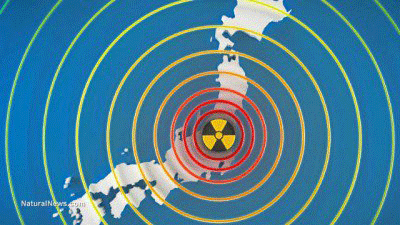
Nobody knows for sure how many people will eventually develop cancer and other health problems as a result of the Fukushima nuclear disaster, but some experts are not afraid to use the word “billions”. It has been well over two years since the original disaster, and now they are telling us that it could take up to 40 more years to clean it up.
It is a nightmare of unimaginable proportions, and there is nowhere in the northern hemisphere that you will be able to hide from it. The following are 11 facts about the ongoing Fukushima nuclear holocaust that are almost too horrifying to believe. Continue reading
Fukushima nuclear facility under control – no way!
Fukushima Not Even Close To Being Under Control Oil Price, By ZeroHedge , 28 June 2015 “……….In late 2014, Helen Caldicott, M.D. gave a speech about Fukushima at Seattle Town Hall. Pirate Television recorded her speech
Dr. Helen Caldicott is co-founder of Physicians for Social Responsibility, and she is author/editor of Crisis Without End: The Medical and Ecological Consequences of the Fukushima Nuclear Catastrophe, The New Press, September 2014. For over four decades Dr. Caldicott has been the embodiment of the anti-nuclear banner, and as such, many people around the world classify her as a “national treasure”. She’s truthful and honest and knowledgeable.
Fukushima is literally a time bomb in quiescence. Another powerful quake and all hell could break loose. Also, it is not even close to being under control. Rather, it is totally out of control. According to Dr. Caldicott, “It’s still possible that Tokyo may have to be evacuated, depending upon how things go.” Imagine that!
Fukushima- The Real Story
According to Japan Times as of March 11, 2015: “There have been quite a few accidents and problems at the Fukushima plant in the past year, and we need to face the reality that they are causing anxiety and anger among people in Fukushima, as explained by Shunichi Tanaka at the Nuclear Regulation Authority. Furthermore, Mr. Tanaka said, there are numerous risks that could cause various accidents and problems.”
Even more ominously, Seiichi Mizuno, a former member of Japan’s House of Councillors (Upper House of Parliament, 1995-2001) in March 2015 said: “The biggest problem is the melt-through of reactor cores… We have groundwater contamination… The idea that the contaminated water is somehow blocked in the harbor is especially absurd. It is leaking directly into the ocean. There’s evidence of more than 40 known hotspot areas where extremely contaminated water is flowing directly into the ocean… We face huge problems with no prospect of solution.”
At Fukushima, each reactor required one million gallons of water per minute for cooling, but when the tsunami hit, the backup diesel generators were drowned. Units 1, 2, and 3 had meltdowns within days. There were four hydrogen explosions. Thereafter, the melting cores burrowed into the container vessels, maybe into the earth……http://oilprice.com/Latest-Energy-News/World-News/Fukushima-Not-Even-Close-To-Being-Under-Control.htm
1 This Month
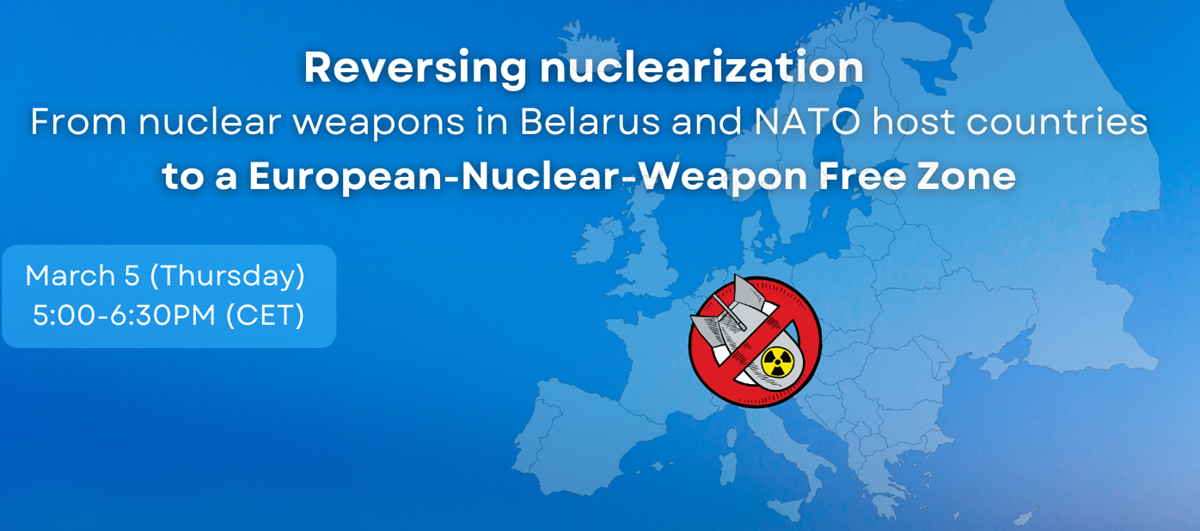
5 March -Online – Reversing nuclearization:
From nuclear weapons in Belarus and NATO host countries to a European-Nuclear-Weapon Free Zone
11am-12:30pm Eastern Time USA / 5pm-6:30pm CET

of the week – Advocating for a
nuclear free beach – https://www.samuellawrencefoundation.org/
The Samuel Lawrence Foundation advocates for a Nuclear Waste Free Beach at San Onofre, join us and take action!

10 March A LIVE WEBINAR THE REAL EFFECTS OF NUCLEAR POWER
What the Industry Isn’t Telling Us
1:00 PM Mountain, 2 pm Central, 3 pm Eastern. Live on the Keepers of the Water Facebook page

18 March Webinar @ 1 PM EST: An Assessment of SMR Projects: The Case of Canada
register for the zoom:
https://us02web.zoom.us/webinar/register/WN_o8BIIOUvQ2ONJR1nta65DQ#/registration

of the week – STOP SMALL MODULAR REACTORS IN CANADA
To see nuclear-related stories in greater depth and intensity – go to https://nuclearinformation.wordpress.com
-
Archives
- March 2026 (38)
- February 2026 (268)
- January 2026 (308)
- December 2025 (358)
- November 2025 (359)
- October 2025 (376)
- September 2025 (258)
- August 2025 (319)
- July 2025 (230)
- June 2025 (348)
- May 2025 (261)
- April 2025 (305)
-
Categories
- 1
- 1 NUCLEAR ISSUES
- business and costs
- climate change
- culture and arts
- ENERGY
- environment
- health
- history
- indigenous issues
- Legal
- marketing of nuclear
- media
- opposition to nuclear
- PERSONAL STORIES
- politics
- politics international
- Religion and ethics
- safety
- secrets,lies and civil liberties
- spinbuster
- technology
- Uranium
- wastes
- weapons and war
- Women
- 2 WORLD
- ACTION
- AFRICA
- Atrocities
- AUSTRALIA
- Christina's notes
- Christina's themes
- culture and arts
- Events
- Fuk 2022
- Fuk 2023
- Fukushima 2017
- Fukushima 2018
- fukushima 2019
- Fukushima 2020
- Fukushima 2021
- general
- global warming
- Humour (God we need it)
- Nuclear
- RARE EARTHS
- Reference
- resources – print
- Resources -audiovicual
- Weekly Newsletter
- World
- World Nuclear
- YouTube
-
RSS
Entries RSS
Comments RSS
 nuclear-news