Fukushima’s radioactive overflowing toilet
As the government of Japan continues to declare that the ocean impact from contaminated storm runoff from the Daiichi site is minimal, attention has been completely diverted from the more serious questions concerning the redistribution of toxic radiation and contaminated groundwater through massive rainfall and flooding into previously pristine locations inhabited by innocent people.
Inland impacts are considerable. Typhoon Etau likely washed more radiation from the mountains surrounding the Daiichi disaster than from the nuclear site itself, yet TEPCO and the Japanese government ignore the health impact of these huge, unmonitored releases. Without the government of Japan accepting responsibility for all the contamination caused by the nuclear disaster, the health of the public on both sides of the Pacific Ocean will continue to be jeopardized.
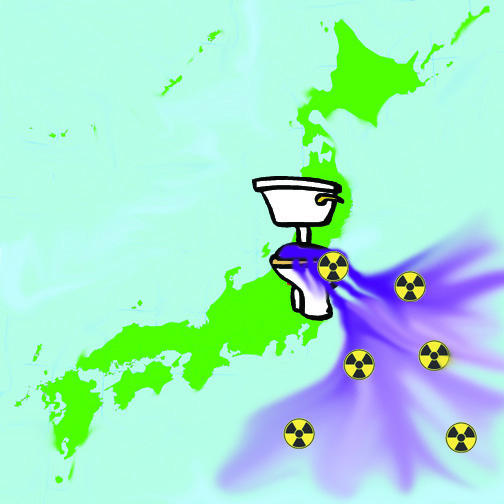
Demystifying Nuclear Power: The Fukushima Toilet Overflows http://www.fairewinds.org/nuclear-energy-education/demystifying-nuclear-power-the-fukushima-toilet-overflows by Sue Prent
Japan just can’t seem to catch a break as extreme forces in nature repeatedly buffet the island.
Efforts are currently underway to coax former Nahara residents, evacuated during the wake of the Fukushima Daiichi triple meltdown, to return to their abandoned homes in the desolated city. Despite assurance that radiation levels in Nahara are now within a ‘safe’ margin, the relatively few who chose immediate return when it officially reopened on September 11, are being issued dosimeters; a reminder that life in this city can never hope to be the same. Continue reading
Timothy Mousseau dismisses radiation as cause of giant wolffish
 NO, THIS WOLFFISH IS NOT A FUKUSHIMA RADIATION MUTANT,
As for the idea of giant, mutant Fukushima fish … there is no scientific evidence to support claims that fallout from the Fukushima disaster has, or will, cause this to happen. Even right after the disaster, a swim in nearby waters would have dosed you with just 0.03% of the daily radiation an average Japanese resident receives. And much of that fallout has disappeared because of natural decomposition and decay.
Besides, even in the extremely unlikely event that radiation was the culprit here, we would actually expect to see smaller, not larger, fish. “Very, very few mutations lead to extra-large size,” explains University of South Carolina radiation specialist Dr Timothy Mousseau. “[Instead], they grow less efficiently, they’re less capable of catching food and they tend to not live as long.
All that said, this catch is still an impressive one. Wolffish (family Anarhichadidae) average about three feet in length (110 cm), but can get bigger. What Hirasaka has landed is a very old and very healthy specimen. “If you look hard and long enough there’s always a few that manage to survive long enough to achieve these large sizes,” says Mousseau. http://www.earthtouchnews.com/wtf/mutants-and-freaks/no-this-wolffish-is-not-a-fukushima-radiation-mutant
Record rain overwhelming Fukushima’s nuclear station’s drainage pumps
Japan’s torrential downpour overwhelmed Fukushima’s drainage pumps sending hundreds of tonnes of contaminated water flowing into the Pacific! Japanese flooding update, The Big Wobble , 10 Sept 15
Rainfall reached 600 millimetres in the area around Joso, with weather officials expecting at least 200mm more in parts of eastern Japan, including Fukushima, the site of the nuclear reactor crippled in 2011, before the downpour stops on Friday.
Report Says Floods May Pose Threat To Radiation Under Fukushima
The torrential downpour has exacerbated a contaminated water problem at the Fukushima nuclear plant as it overwhelmed the site’s drainage pumps, sending hundreds of tonnes of contaminated water flowing into the ocean, a spokesman for operator Tokyo Electric Power (TEPCO) said.
The continuous torrent of rain water is complicating the already difficult situation in Fukushima where, according to an operator of the Tokyo Electric Power (Tepco), the drainage pumps are not able to evacuate all the water that is pouring into the plant, becoming contaminated and damaging the ‘surrounding environment.
Since 2011, the Tempco has been in charge of storing tons of radioactive water used to cool the reactors at the plant, destroyed by the tsunami……..TEPCO is storing huge volumes of water used to cool reactors that were sent into meltdown when a tsunami hit Japan in 2011……..
“This is a scale of downpour that we have not experienced before.
Grave danger could be imminent,” forecaster Takuya Deshimaru told an emergency press conference. Etau, which smashed into Japan on Wednesday, moved out into the Sea of Japan (East Sea) by the end of the day, but a wall of rain continued to lash the country……http://www.thebigwobble.org/2015/09/japans-torrential-downpour-overwhelmed.html
Fukushima nuclear plant under threat from epic flooding
 ABC: “Epic flooding in Japan threatening Fukushima… Serious concerns about nuclear power plant in flood zone” — Hundreds of tons of contaminated water have already flowed into ocean — Torrential downpours overwhelm site — Worst rains to hit area in past 50 years (VIDEO)http://enenews.com/abc-epic-flooding-japan-threatening-fukushima-serious-concerns-about-nuclear-power-plant-flood-zone-hundreds-tons-contaminated-water-flowed-ocean-torrential-downpours-overwhelm-site-video
Mainichi: Typhoon causes injuries, cancelled trains and flights, radioactive water leak… [TEPCO] announced on Sept. 9 that rainwater contaminated with radioactive materials had leaked from the plant’s drainage system into the ocean. The heavy rains brought on by Typhoon Etau exceeded the capacity of a transfer pump… This is the seventh time of possible or confirmed leaks of radiation-contaminated water since the utility began transferring the water from canal to canal in April… TEPCO says it does not know how much contaminated water leaked into the ocean, and is currently analyzing the concentration of the radioactive matter in the leaked water.
ABC News transcript: Epic flooding in Japan threatening the Fukushima plant… Serious concern this morning about a nuclear power plant in the flood zone… Torrential downpours [are] raising concerns about the Fukushima power plant… Reports that these heavy rains may overwhelm the site’s drainage pumps.
Reuters: A spokesman for operator Tokyo Electric Power (TEPCO) told the Guardian hundreds of tonnes of contaminated water have flowed into the ocean from the Fukushima nuclear plant… Rainfall reached 500 mm around Joso, NHK said, with weather officials expecting at least 200 mm more in parts of eastern Japan, including Fukushima, the site of the nuclear reactor crippled in 2011, before the downpour stops on Friday.
AFP: Japan flags grave danger from floods and water tainted by Fukushima nuke plant radiation— Tens of thousands of people were ordered to evacuate across Japan today as heavy rain pounded the country, sending radiation-tainted waters into the ocean at the crippled Fukushima nuclear plant… The torrential downpour has also exacerbated a contaminated water problem at the Fukushima nuclear plant as it overwhelmed the site’s drainage pumps, a spokesman for operator Tokyo Electric Power said.
Weather Channel: JMA issued landslide warnings parts of Miyagi and Fukushima prefectures, including areas near the Fukushima Daiichi nuclear power plant that suffered a catastrophic meltdown after the 2011 Tohoku earthquake and tsunami. According to the Mainichi Shimbun, a national newspaper, the heavy rain caused contaminated water from the site to run off into the Pacific Ocean for several hours early Wednesday.
UPI: More radioactive water has leaked out from the Fukushima Daiichi nuclear power plant… The heavy rain has caused additional leaks at the damaged Fukushima Daiichi nuclear power plant, where the site’s drainage pumps were overwhelmed — causing radioactive water to leak into the Pacific Ocean.
Telegraph: The huge rains also exacerbated a contaminated water problem at the crippled Fukushima nuclear plant as it overwhelmed the site’s drainage pumps, sending radiation-tainted water into the ocean.
Guardian: The heavy rain, which is expected to spread north on Friday, has also caused additional leaks of radioactive water at the stricken Fukushima Daiichi nuclear power plant… The meteorological agency warned that heavy rain would continue in the northeast, including Fukushima prefecture, until early Friday morning.
Bloomberg: The storm caused contaminated water from the wrecked Fukushima nuclear plant to leak into the ocean… Contaminated water at Tokyo Electric Power Co.’s Fukushima Dai-Ichi facility leaked into the Pacific Ocean at about 12:30 a.m. on Wednesday, company spokesman Tatsuhiro Yamagishi said by phone, adding that company is still investigating the leak.
ABC Australia: Fukushima tainted water flows into ocean… weather officials [are] expecting at least 200mm more in parts of eastern Japan, including Fukushima, the site of the nuclear reactor crippled in 2011, before the downpour stops on Friday. The torrential downpour has exacerbated a contaminated water problem at the Fukushima nuclear plant as it overwhelmed the site’s drainage pumps, sending hundreds of tonnes of contaminated water flowing into the ocean, a spokesman for operator Tokyo Electric Power (TEPCO) said.
ABC News: In addition to the clear danger facing residents, Japanese authorities are particularly concerned about the flooding, given its proximity to one of the country’s biggest nuclear power plants, Fukushima — damaged by the 2011 earthquake and subsequent tsunami… “The torrential downpour is threatening safety at the Fukushima nuclear plant, closed since the 2011 disaster, as it has overwhelmed drainage pumps at the site’s contaminated water treatment facility,” a Japanese government official told ABC News.
NPR: Floodwaters also “overwhelmed the drainage pumps at the Fukushima nuclear plant,” Japan Times reports, citing a Tokyo Electric Power Co. spokesman who said the flooding sent “hundreds of tons of contaminated water” into the ocean.
Prensa Latina, Sep 10, 2015: Typhoon Etau Causes Leak of Radioactive Water in Fukushima — Typhoon Etau originated leaks of radioactive water from the Fukushima plant in Japan… Leaks occurred in dams located around the tanks storing liquid used to cool the reactors. With this leak, there have been seven detected since last April when a pumping system was implemented to prevent radioactive waste emanating from the reactor to flow in a place away from the plant.
EFE: Contaminated water from Fukushima leaks into sea due to typhoon Etau — The Fukushima plant… has been found to be leaking contaminated water into the sea following heavy rainfall in the region caused by typhoon Etau, a spokesperson of Fukushima’s operator confirmed to EFE Thursday… The leaks have been caused in the embankments around the tanks where highly radioactive water is stored after they are used to cool the reactors…
USA Today: Tens of thousands of people are ordered to flee homes across Japan as heavy rain pounded the country, sending radiation-tainted waters into the ocean at the crippled Fukushima nuclear plant.
Kyodo: Heavy rains whose severity was described as occurring once in 50 years were observed in… Fukushima Prefecture.
CNN: Fukushima prefecture, which was devastated by the 2011 tsunami, saw more than 30 centimeters (1 foot) of rain in 48 hours — the heaviest downpour there in 50 years, NHK said.
IAEA claims ‘no harm from Fukushima’ – they’re wrong
 Why The IAEA Claim Of No Harm In Fukushima Is Wrong http://www.fukuleaks.org/web/?p=15006 September 2nd, 2015
Portions of the new IAEA report on Fukushima have been criticized by the media and roundly slammed by Greenpeace. Much of the dispute is around a contradictory statement about the potential thyroid cancers in evacuees. IAEA admits that the exposure data being used is limited and unclear but went on to give a solid prediction there would be no thyroid cancers from Fukushima related exposures.
UNSCEAR and IAEA have been relying on outdated estimates done by the Fukushima Health Survey. The Fukushima Health Survey adopted a dose estimate scheme created by NIRS. There are a number of problems with this dose estimate scheme.
- The NIRS dose estimate is for external exposure only. The critical portion of any exposure related to thyroid cancer is the internal exposure. Usually by the inhalation or ingestion of iodine 131.
- There are no actual radiation readings used for estimates made for exposures during the first three days of the accident. These first three days are also when some of the largest exposures would have happened
- NIRS uses the source term radiation estimate provided by the Japanese government. This estimate has been proven to be extremely low by later studies including one that used CTBTO radiation monitors to back track estimate the levels of radiation released from the plant.
- NIRS assumed most residents evacuated before radiation levels rose, for many this was not the case as not all residents evacuated early in the disaster
- NIRS admits there is considerable uncertainty in their estimates and that recalculations may be in order if new data shows the source term or radiation levels were higher. This has never been done…………..
Fukushima Health Impact Summary
nuClear news No.77, September 2015 New emerging evidence from Fukushima shows that nuclear disasters and their aftermaths can kill thousands of people due to necessary evacuations. Between 2011 and 2014, about 2,000 Japanese people, including many old people, died from ill-health and suicides connected with the evacuations. Some nuclear advocates, including government officials, have said these deaths are the fault of the evacuations, as if they were unconnected with the nuclear disaster.
This is incorrect: the evacuations were necessary to avoid large radiation exposures from the radioactive fallout due to the plumes from the Fukushima explosions and meltdowns. In future, such deaths should be included in assessments of the fatalities from nuclear disasters. In sum, the human toll from Fukushima is horrendous: 2,000 Japanese people have died from the evacuations and another 5,000 are expected to die from future cancers 1. Ian Fairlie’s Blog 16th Aug 2015 http://www.ianfairlie.org/news/summing-the-health-effects-of-thefukushima-nuclear-disaster/ http://www.no2nuclearpower.org.uk/nuclearnews/NuClearNewsNo77.pdf
Radiation exposure to Fukushima workers and the community
Fukushima today: A first-person account from the field and the conference table, Bulletin of the Atomic Scientists, 26 Aug 15 Subrata Ghoshroy “……….the building containing the failed reactors has radiation levels as high as 4,000 to 5,000 milliSieverts per hour (400,000 to 500,000 millirems per hour), making even the operation of robots difficult. In fact, two power company robots had to be abandoned while inside the depths of the plant. And some spots, such as inside the primary containment vessel, went as high as 9.7 Sieverts per hour (970,000 millirems per hour). In addition, it has not been possible to precisely locate the melted core. (Another conference speaker, Jun Tateno, who was a former research scientist with the Japanese Atomic Energy Research Institute, accused the government of suppressing voices from the scientific community that were critical of the safety of power plants. He said that we have reached a situation in which we do not even know how much plutonium is in the core.) In the meantime, huge amounts of water must be pumped in to keep the reactors cool; this liquid then mixes with ground water, contaminating it as a result.
The picture is not much better when it comes to the land. In an effort to decontaminate residential areas, radioactive soil is being dug up from approximately 1,000 sites. The government wants to consolidate this contaminated material in semi-permanent storage sites in the “difficult-to-return zones” in Futaba and Okuma towns. Local residents, meanwhile, fear that these could turn into permanent repositories of radioactive material……….
We were told that most workers did not wear dosimeters to record their cumulative radiation dose. There was good money to be made in decontamination work. They did not want to know.
But if one does the math, what the workers and their supervisors were ignoring—or were being told to ignore—could be significant. If a person spent one week working at this part of a supposedly safe parking area for 8 hours per day, then he or she would have been exposed to 40 microSieverts per day. And if that person was there for a 5-day workweek, then over the course of a single week that person would have been exposed to 200 microSieverts. In a year, that person could receive 10 milliSieverts, a significant dose. Of course, scientists are rightly cautious of such “anecdotal” evidence; our Geiger counter readings could have been off, or the machine calibrated incorrectly, or some other source of error introduced—though I doubt it because it had earlier read the background correctly. But the result of such quick and dirty, back-of-the-envelope calculations for what is supposedly a low-risk parking area, well away from the restricted hot zones, do give one pause—especially as the ongoing lack of dosimeters means that no one really knows a given individual’s cumulative dose. The amount of exposure to a thing that you cannot see, hear, smell, taste, or feel sneaks up on you. Even when you think you are safe, you are not.
If nothing else, the fact that a simple, random spot-check registered so highly is an eye-opener, and counter to what has been officially portrayed. ……..An important item seemed to lie further down in the article, which noted: “However, the health ministry said the number of workers surveyed is different from the total number of cleanup personnel reported by the Environment Ministry, which could mean the association failed to record radiation doses of all individuals working around the Fukushima plant.”
No wonder there has been public distrust and charges of a lack of clarity about the radiation clean-up operation, as can be seen in the title of a 2013 Guardian newspaper article: “Life as a Fukushima clean-up worker—radiation, exhaustion, public criticism.”Even when the approximately 7,000 workers involved in the clean-up do wear dosimeters, that is no guarantee of accuracy; there have been reports of a Tokyo Electric Power Company executive who tried to force clean-up workers to manipulate dosimeter readings to artificially low levels by covering their devices with lead shields………http://thebulletin.org/fukushima-today-first-person-account-field-and-conference-table8683#.Vd6Rj7YbwEs.twitter
Experts now doubt that excess thyroid cancer in Fukushima children is due to “screening effect”
 Oshidori Mako Interviews Experts Regarding Excess Occurrence of Pediatric Thyroid Cancer in Fukushima, Fukushima Voice, English Version 6 Aug 15, “………Issue to be considered #2:
 Fukushima: Excess Occurrence of children’s thyroid cancer not due to overdiagnosis
physicians actually involved with diagnosis during the thyroid examination unanimously agree that “it is not overdiagnosis.” These physicians include Dr. Akira Miyauchi from Kuma Hospital, one of nation’s top thyroid clinicians, as well as Dr. Shinichi Suzuki from Fukushima Medical University, director of thyroid examination in Fukushima Prefecture.
 Oshidori Mako Interviews Experts Regarding Excess Occurrence of Pediatric Thyroid Cancer in Fukushima, Fukushima Voice, English Version 6 Aug 15,
This is a translation of an article written by Oshidori Mako and published in the July issue of DAYS JAPAN, posted here with permission of Oshidori Mako. Pediatric Thyroid Cancer in Fukushima
The Thyroid Examination Assessment Subcommittee of
the Prefectural Oversight Committee Meeting for the Fukushima Health Management Survey
Admits Excess Occurrence of Pediatric Thyroid Cancer
In Full-Scale Screening or second round screening, 15 children were newly diagnosed similarly.
EXtra high radiation level in atmosphere above Melted slag storage facility of Fukushima sewage plant
 Melted slag storage facility of Fukushima sewage plant has 10 times higher atmospheric dose than rest of area The atmospheric dose near the melted slag storage facility is approx. 10 times higher than the rest of the area in Fukushima sewage plant.
This is from the data published by Fukushima prefectural government on 8/11/2015………http://fukushima-diary.com/2015/08/melted-slag-storage-facility-of-fukushima-sewage-plant-has-10-times-higher-atmospheric-dose-than-the-rest-of-the-area/
Earthquake M5.0 offshore of Fukushima prefecture
M5.0 hit Fukushima offshore / No announcement on plant status from Tepco http://fukushima-diary.com/2015/08/m5-0-hit-fukushima-offshore-no-announcement-on-plant-status-from-tepco/ by Mochizuki , August 14, 2015 According to JMA (Japan Meteorological Agency), M5.0 occurred offshore of Fukushima prefecture at 5:13 of 8/14/2015 (JST).
The depth of epicenter was 40km. They observed 4 of seismic intensity in Iwaki city.
The earthquake affected the large area from Shizuoka to Aomori prefecture.
The latest status of Fukushima plant has not been announced by Tepco http://www.jma.go.jp/en/quake/20150814051743395-140513.htm

“Trillions of becquerels of radioactive material still flowing into sea” at Fukushima
 Officials: “Trillions of becquerels of radioactive material still flowing into sea” at Fukushima — Map shows nuclear waste coming up from bottom of ocean far offshore — Japan TV Journalist: “Contaminated seawater will circulate around globe… disaster like a huge cloth expanding everyday” (VIDEO) http://enenews.com/officials-trillions-becquerels-radioactive-material-flowing-sea-fukushima-map-shows-nuclear-waste-flowing-bottom-ocean-offshore-japan-tv-journalist-contaminated-seawater-will-circulate-around-gl?utm_source=feedburner&utm_medium=email&utm_campaign=Feed%3A+ENENews+%28Energy+News%29
Interview with NHK journalist Morley Robertson, by the Center for Remembering 3.11, published Jun 30, 2012 (emphasis added): I begin with the radiation leakage. Radiation leakage exerts a long term effect on the environment. It contaminates our food chain, the groundwaterand the ocean. And the contaminated seawater will circulate around the globe. We never know how much this will impact on the environment… We’ll never able to study such issues with empirical certainty… [Due to nuclear testing] we have already accumulated “hidden losses” of radiation damage… how much is the [Fukushima] cesium in relation to that?… I believe we should enjoy delicious food rather than worrying about the food. I enjoyed the town’s delicacy… I didn’t mind about how the beef was produced or where it came from. As long as it is tasty, it is no problem for me. With regard to radiation, I have become more optimistic. My hypothesis is that it’s no use worrying about radiation. For people in Fukushima, they have a lot to worry about their future, like damaged reputation… One reason why we have relied on nuclear plants is because we didn’t know about the facts… We need to face the facts… Rad-waste from the nuclear cycle is said to be unsolvable even after 2.5 million years.
Part II of Robertson’s Interview, published Jun 30, 2012: In 1974, then PM Tanaka declared, “Let ‘s go nuclear!”… we were issued credit cards to buy electric goods to consume the extra electricity… It is OK to say that everything was just a lie… and 3/11 happened. So we must study everything. It isno longer about what to do with Onagawa nuclear power plant, Miyagi or Tohoku. This is about what to do with Japan. This has been revealed by our vulnerability to the accident… So when we talk about “disaster“, it’s like a huge wrapping cloth expanding everyday.
- NHK: Morley is a journalist… working in the fields of television, radio, and lecture meetings… he studied at the University of Tokyo and Harvard University.
- Robertson’s Wikipedia entry (translated from Japanese by Microsoft): In 1968, because of father’s job moved to… Hiroshima [to work] on Atomic Bomb Casualty Commission [and] undertook study of atomic bomb patients.
TEPCO, updated Mar 10, 2015: Fukushima Daiichi Contaminated Water Issue FAQ — Q1Please explain the impact of the leaked radioactive materials on the sea. [Answer:] TEPCO announced that underground water including radioactive materials had leaked into the port… It has been implied that trillions of becquerels of radioactive materials are still flowing into the sea; however, the concentration of radioactive materials in the sea is at a level that meets the Guidelines for Drinking-water Quality, except for some areas…
TEPCO, Apr 28, 2015: Comprehensive risk review was implemented, considering all the possible risks that might have an impact outside the Fukushima Daiichi NPS site… Thepaths through which water could leak outside the site: …
- Sources of risk — Trenches… Pits… Tanks… Accumulated water inside reactor buildings… Contamination inside the port
- Leakage routes — Ground surface… Drainage channels… Underground (groundwater)
- Destination of the contaminated material… The Sea: Unit 1-4 water intake channel… Inside the port… Outside the port
With 2020 Olympics in mind. Japan’s govt trying to coerce Fukushima evacuees back

Even with the massive cleanup, only about one-fifth of the 6,200 displaced residents of Iitate are willing to return, according to a recent head count by village officials.
4 Years After Fukushima Nuclear Calamity, Japanese Divided on Whether to Return By MARTIN FACKLER, NYT< AUG. 8, 2015 ITATE, Japan — For four years, an eerie quiet has pervaded the clusters of farmhouses and terraced rice paddies of this mountainous village, emptied of people after the disaster at the Fukushima Daiichi nuclear power plant, 25 miles away, spewed radiation over a wide swath of northeastern Japan……….
They accuse Tokyo of repeating a pattern from the early days of the disaster of putting residents at risk by trying to understate the danger from the accident. They say the central government is trying to achieve its own narrow political interests, such as restarting the nation’s powerful nuclear industry, or assuring the world that Tokyo is safe enough to host the Summer Olympics in 2020.
“If the national officials think it is so safe, then they should come and live here,” said Kenichi Hasegawa, a former dairy farmer in Iitate who has organized more than 3,000 fellow evacuees — almost half the village’s pre-disaster population — to oppose the return plan. “The government just wants to proclaim that the nuclear accident is over, and shift attention to the Olympics.” Continue reading
Damaged fuel rod containers, suspicious death at Fukushima nuclear plant
 Vice: ‘Suspicious’ death at Fukushima plant — Officials: Damaged nuclear fuel containers found in Unit 3 pool after removal of massive piece of debris — “High radioactivity prevented workers from carrying out the removal smoothly” — Concern about “new fuel failure” (PHOTOS & VIDEO) http://enenews.com/vice-suspicious-death-fukushima-plant-officials-damaged-nuclear-fuel-rod-containers-found-unit-3-pool-after-debris-removed-concern-about-new-fuel-failure-high-radioactivity-prevented-workers?utm_source=feedburner&utm_medium=email&utm_campaign=Feed%3A+ENENews+%28Energy+News%29
NHK, Aug 4, 2015 (emphasis added): Fuel rod casings found damaged by debris… workers have found damaged fuel rod containers after removing a device that had fallen on them during the 2011 disaster. They’re now checking whether the damage will affect their plan to remove fuel from the pool. A 20-ton device for moving fuel rods in and out of the pool on the building’s top floor was removed on Sunday… High radioactivity prevented workers from carrying out the removal smoothly… Workers found that the metal casings of 4 assemblies had been distorted and have twisted handles. This is evident in images released by the operator… The utility is checking for other damage and studying how to remove the distorted casings from the pool.
TEPCO (pdf), Aug 4, 2015: Unit 3 Spent Fuel Pool… we found bent handles of 4 nuclear fuel assemblies located under the Fuel Handling Machine which was removed on August 2nd… there is no indication ofnew fuel failure by the removal… In the future, when discussing fuel removal, we will consider how to deal with the bent handles of nuclear fuel assemblies.
Vice News, Aug 4, 2015: A 30 year-old man died this weekend as he worked on decommissioning Japan’s Fukushima nuclear plant… It is not yet known whether the man’s death was due to radiation exposure, and an autopsy is pending… In a statement released Monday, [Tepco] said that the man had been taken to the emergency room after complaining that he wasn’t feeling well. “His death was confirmed early in the afternoon,” Tepco said. Isabelle Dublineau, the head of the experimental radiotoxicology laboratory for France’s Institute for Radiological Protection and Nuclear Safety (IRSN), said… it was “too early” to comment on the death… While the latest death has already been branded suspicious in the media, Tepco has so far denied that any of the deaths are related to radiation exposure… The worker who died over the weekend was working… on the construction of the “ice wall”…
Fukushima: ALL EVIDENCE POINTS TO MELT DOWNS IN BOTH NUCLEAR REACTORS 5 AND 6
Fukushima; Reactors And/Or SFP’s In #5 And #6 Melted Down – Total of 7 Melt Down’s, Melt Outs, Nuclear Explosions A Green Road Blogspot, 12 July 15,
- massive amounts of hydrogen/tritium gas released out of holes cut in the buildings
- high levels of cesium in the drains coming from 5 and 6
- radioactive water in the basements, hauled away by US military barge
- white smoke from both buildings
- melted fuel in pipe picture
- broken pipes in all buildings
- report of melted down fuel
- report of radioactive xenon gas releases months after disaster
Gov’t model shows Fukushima radioactive gas near Tokyo skyrocketed to 10,000,000,000 times normal levels soon after 3/11 – “Very high concentrations” recorded at all monitoring posts in northern hemisphere (VIDEO)
http://enenews.com/noaa-model-shows-fukushima-radioactive-gas-tokyo-skyrocketed-10-billion-times-normal-levels-after-311-very-high-concentrations-recorded-all-monitoring-posts-northern-hemisphere-video
Radioactivity in the drains, in the gas/air and in the water in the basements comes from melting down fuel rods, not normal operations from a shut down and cooled off reactor and spent fuel pools, wouldn’t you agree?
And where did all of that highly radioactive water from the basements of the #5 and #6 buildings go, by the way, in that US supplied barge? Where did the high level radiation in the water come from? Where did that melted fuel in the pipe go?
In all of the other buildings, the high level radiation in the basements comes from broken reactors with melted down fuel in them. Certainly radioactive water does not come from the tsunami, because the tsunami wave was clean, pure ocean water. And pray tell TEPCO, what was the radiation level in that water, from buildings 5 and 6, hmmmmmm?
MELTDOWN OF THE TRUTH AROUND BUILDINGS 5 AND 6
1 This Month
5 March -Online – Reversing nuclearization:
From nuclear weapons in Belarus and NATO host countries to a European-Nuclear-Weapon Free Zone
11am-12:30pm Eastern Time USA / 5pm-6:30pm CET

of the week – Advocating for a
nuclear free beach – https://www.samuellawrencefoundation.org/
The Samuel Lawrence Foundation advocates for a Nuclear Waste Free Beach at San Onofre, join us and take action!

10 March A LIVE WEBINAR THE REAL EFFECTS OF NUCLEAR POWER
What the Industry Isn’t Telling Us
1:00 PM Mountain, 2 pm Central, 3 pm Eastern. Live on the Keepers of the Water Facebook page

18 March Webinar @ 1 PM EST: An Assessment of SMR Projects: The Case of Canada
register for the zoom:
https://us02web.zoom.us/webinar/register/WN_o8BIIOUvQ2ONJR1nta65DQ#/registration

of the week – STOP SMALL MODULAR REACTORS IN CANADA
To see nuclear-related stories in greater depth and intensity – go to https://nuclearinformation.wordpress.com
-
Archives
- March 2026 (38)
- February 2026 (268)
- January 2026 (308)
- December 2025 (358)
- November 2025 (359)
- October 2025 (376)
- September 2025 (258)
- August 2025 (319)
- July 2025 (230)
- June 2025 (348)
- May 2025 (261)
- April 2025 (305)
-
Categories
- 1
- 1 NUCLEAR ISSUES
- business and costs
- climate change
- culture and arts
- ENERGY
- environment
- health
- history
- indigenous issues
- Legal
- marketing of nuclear
- media
- opposition to nuclear
- PERSONAL STORIES
- politics
- politics international
- Religion and ethics
- safety
- secrets,lies and civil liberties
- spinbuster
- technology
- Uranium
- wastes
- weapons and war
- Women
- 2 WORLD
- ACTION
- AFRICA
- Atrocities
- AUSTRALIA
- Christina's notes
- Christina's themes
- culture and arts
- Events
- Fuk 2022
- Fuk 2023
- Fukushima 2017
- Fukushima 2018
- fukushima 2019
- Fukushima 2020
- Fukushima 2021
- general
- global warming
- Humour (God we need it)
- Nuclear
- RARE EARTHS
- Reference
- resources – print
- Resources -audiovicual
- Weekly Newsletter
- World
- World Nuclear
- YouTube
-
RSS
Entries RSS
Comments RSS
 nuclear-news