2,837 Iitate villagers petition Nuclear Damage Compensation Dispute Resolution Center (NDCDRC)
 Residents of Fukushima’s Iitate Village file petition for nuclear damage compensation to restore home village http://www.cnic.jp/english/newsletter/nit164/nit164articles/03_iitate.html Kaori Yoshioka, CNIC Nearly half of the entire population of Iitate Village, Fukushima Prefecture, filed a petition with the Nuclear Damage Compensation Dispute Resolution Center (NDCDRC) on November 14, 2014, demanding measures to restore the lives of the nuclear disaster victims. The petitioners are 2,837 villagers from 737 households and the petition is addressed to Tokyo Electric Power Company (TEPCO) President and CEO, Naomi Hirose.
Main points of the petition seeking NDCDRC arbitration for an out-of-court settlement
The petitioners call on TEPCO to
- admit legal responsibility for causing serious radioactive contamination in the village and inflicting massive damage on the villagers, and to sincerely apologize to the villagers for this,
- pay 3 million yen to each villager to compensate for mental anguish regarding their health and other psychological stress caused by radiation exposure that could have been prevented,
- raise the amount of compensation for the period of evacuation from 100,000 yen per person per month to 350,000 yen,
- pay 20 million yen to each of the petitioners as compensation for destroying their livelihoods and causing psychological distress,
- pay the maximum amount of compensation (that for the “difficult-to-return zone”) to the residents who need to secure their houses, but without categorizing the locations into “difficult-to-return zone,” “restricted habitation zone,” and “evacuation directive lift preparation zone,” and without forcing them to take complicated procedures for filing applications, and
- pay lawyers’ fees for this class action suit.
Purpose of the class action suit
This class action suit was launched by the Iitate residents for the purpose of extracting an apology from TEPCO for forcing all the villagers to evacuate after the utility’s accident at the Fukushima Daiichi Nuclear Power Station in 2011, to seek just compensation for the damage they have suffered in order to regain their pride as Iitate villagers and to restore their home village.
Exploring molten cores of Fukushima nuclear reactors by means of cosmic ray particles
Cosmic Ray Particles Will Reveal the Molten Hearts of Fukushima Daiichi’s Reactors http://spectrum.ieee.org/tech-talk/energy/nuclear/cosmic-ray-particles-will-reveal-the-molten-hearts-of-fukushima-daiichis-reactors By Eliza Strickland 13 Feb 2015 In the radioactive ruins of the Fukushima Daiichi nuclear power plant, engineers are testing a new sensor technology. The goal is to see through layers of steel and concrete to determine the location of nuclear fuel at the hearts of three melted-down reactors.
The sensor technology makes use of muons, subatomic particles generated when cosmic rays collide with molecules in Earth’s upper atmosphere. About 10,000 muons reach every square meter of our planet each minute, and they whiz through most substances largely unimpeded. However, their progress can be blocked by heavy elements like uranium and plutonium.
Based on this discrepancy, several research teams around the world are developing systems that use muons the same way your dentist uses x-rays. By placing muon detectors near a Fukushima reactor building and determining where the particles’ progress is being blocked, researchers can produce a map of the globs of melted uranium fuel inside the reactor.
There’s a critical need for such maps. The 40-year decommissioning of the Fukushima Daiichi power plant is well underway: Robots are busily surveying and decontaminating the shattered reactor buildings, and workers are removing spent fuel rods from pools. But the hardest step is yet to come. Someday, TEPCO workers will have to remove the melted nuclear fuel that glooped at the bottom of the three reactors’ pressure vessels, leaked through fissures and weak spots, and pooled in unknown nooks and crannies.
Before TEPCO can remove this highly radioactive fuel, the company must first figure out its exact location inside the melted-down reactors. That’s a big challenge, as it will be many years before robots or heavily protected humans are able to remove the tops of the reactor vessels to drop down radiation-shielded cameras. What’s more, those cameras still won’t be able to locate the fuel that seeped out through the bottoms of the presure vessels.
That’s where the muons come in. TEPCO is first testing a system developed by Japan’s High Energy Accelerator Research Organization, putting the device near the heavily damaged Reactor 1. This system uses a “muon permeation” method; essentially just determining where muons are blocked in their progress by uranium. According to an email from TEPCO, this first test is just to serve as a proof of principle, and won’t produce detailed maps of the melted fuel’s location.
Another system is under development by the U.S. company Decision Sciences, using a “muon scattering” method invented at Los Alamos National Lab in the early 2000s. This method places muon detectors on two sides of an object of interest, and tracks the trajectory of muons as they enter and leave the object. Because some muons interact with uranium nuclei and ping away in new directions, mapping this scattering can create a more precise map of a uranium blob’s location and contours. Toshiba, a contractor for TEPCO, has enlisted Decision Sciences to develop its system for Fukushima Daiichi. That device will be tested later this year at Reactor 2.
Mission Impossible at Fukushima as nuclear fuel is melting down daily
 Japan Official: Fuel from Fukushima reactors is “melting down daily” — AP: No way of confirming melted fuel is at bottom of containment vessels — Tepco Adviser: “Schedule for decommissioning the plant is pure supposition” — The Economist: This is ‘Mission Impossible’ (VIDEO) http://enenews.com/japan-official-fuel-fukushima-reactors-melting-down-daily-ap-confirming-melted-fuel-bottom-containment-vessels-tepco-adviser-schedule-decommissioning-plant-pure-supposition?utm_source=feedburner&utm_medium=email&utm_campaign=Feed%3A+ENENews+%28Energy+News%29
Associated Press, Feb 6, 2015 (emphasis added): A snake-like robot designed to examine the inside of one of three melted reactors at the Fukushima Dai-ichi nuclear plant is ready to begin its expedition… Using information gathered by the robot [TEPCO] plans to repair the damaged chambers enough so they can be filled with water… It is expected to enter the Unit 1 reactor as early as April… Expectations for the robot probe are high after earlier efforts at assessment produced limited success… After its trip, technicians plan to store the robot in a shielded box because of its extremely high radioactivity, and it will not be reused… Computer simulations indicate that all of the fuel rods in the Unit 1 reactor probably melted and fell to the bottom of the containment chamber, but until now there has been no way of confirming that… Because of the reactor damage, large volumes of cooling water continue to leak from them, causing contamination and hampering the plant’s cleanup process.
Wall St. Journal, Feb 6, 2015: For the first time since the Fukushima Daiichi nuclear disaster in March 2011, engineers working for [TEPCO] could soon get their first view of nuclear fuel and debris around the melted-down reactors. It is widely believed that during the meltdowns of reactors No. 1-3… the overheated nuclear fuel also flowed out into the reactor vessels… Extracting the nuclear fuel and debris is the mostimportant task involved in decommissioning… But nobody knows what state these deadly materials are in–even the radiation around the buildings storing the reactors is far too high for people to withstand… Now it is ready to examine the fuel and debris, perhaps as soon as April, with the help of a new robot…
The Economist, Feb 7, 2015: Mission impossible; An industrial clean-up without precedent – The stricken Fukushima Dai-ichi nuclear plant is the world’s most complex and costly industrial clean-up… TEPCO’s early guess was that decommissioning would take 30-40 years. That is certainly optimistic. Engineers are grappling with problems with little precedent… Last October the utility pushed back the start of this removal work by five years, to 2025. Dale Klein, [Tepco adviser and former NRC chairman] says that the schedule for decommissioning the plant is pure supposition until engineers figure out how to remove all the fuel.
Taro Yamamoto, member of the Diet of Japan — House of Councillors representing Tokyo, published Feb 5, 2015: “In Fukushima, each reactor has about 90 tons [90,000 kg or ~200,000 lbs] of uranium. These are melting down daily.”
Japan unable to stop highly radioactive waste from flowing out of Fukushima reactors
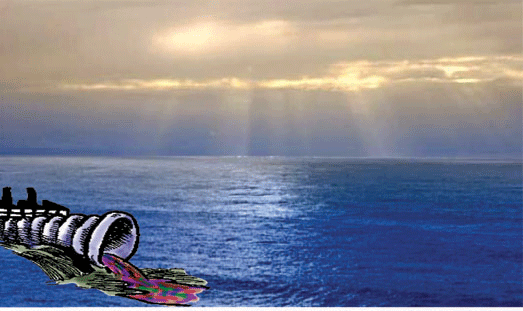 Japan TV: Failure at Fukushima — Cement not stopping highly contaminated nuclear waste from flowing out of reactor buildings — IAEA: Radioactive releases from plant into ocean “a challenging issue” — Officials: Don’t know what to do next, or how this will affect whole ‘decommissioning’ project (VIDEO) http://enenews.com/japan-tv-failure-fukushima-cement-stopping-highly-contaminated-nuclear-waste-flowing-reactor-buildings-iaea-radioactive-releases-plant-ocean-challenging-issue-officials-dont-next-will-affect?utm_source=feedburner&utm_medium=email&utm_campaign=Feed%3A+ENENews+%28Energy+News%29
NHK World transcript excerpts, Feb. 9, 2015: Managers of Japan’s damaged nuclear plant are facing another delay in dealing with a major source of contamination. They’re working on blocking the flow of radioactive water from reactor buildings to underground tunnels. TEPCO officials met with members of the Nuclear Regulation Authority [which] approved a plan to delay the project… Workers were supposed to remove the highly radioactive water… and after that they would have filled in the tunnels with cement. However, efforts to block the flow of water failed. Engineers need to fill in some gaps that may be left in the area where the tunnels and reactor buildings meet. The setback will likely affect a second project to build an ice wall around the 4 damaged reactor buildings. Tepco officials say they’re already 2 weeks to a month behind schedule on that work.
NHK, Feb. 9, 2015: The workers poured cement into the tunnels while draining contaminated water. But blocking the water was not successful as it continued to flow through the buildings… They say they do not yet know how the latest delay will affect the whole decommissioning project. They are still studying the next steps they need to take.
Kyodo News, Feb 2, 2015: … the project to build a huge underground ice wall — a key measure to prevent radioactive water from further building up at the site — and other operations will likely be delayed by up to a month, it added…TEPCO initially planned to finish constructing the 1.5-kilometer frozen wall around the buildings housing the Nos. 1 to 4 reactors…by the end of next month.
Al Jazeera, Feb 9, 2015: The UN’s nuclear watchdog* says contaminated water leaking from Japan’s Fukushima nuclear plant is still “a challenging issue”. The IAEA is reviewing work to decommission the plant… Tepco is criticized with its handling of radioactive water leaks into the Pacific Ocean.
* IAEA the “UN’s nuclear watchdog”? CNN, ABC, Harvard researchers, and even the UN itself, say yes. Perhaps they should consult with the head of the IAEA on the matter: “I have tried to address some widespread misconceptions in the media about the IAEA’s role in nuclear safety… we are not a ‘nuclear safety watchdog’.” A Bloomberg report on the IAEA notes, “The agency’s safety division garnered little respect in US diplomatic cables that describedthe department as a marketing channel for countries seeking to sell atomic technology…The IAEA’s own mission [is] to promote atomic power.”
Watch: NHK | Al Jazeera | Tepco PR video
Fukushima nuclear danger exceeds that of Chernobyl
 Gundersen: New data shows Fukushima exceeds Chernobyl… Plumes seen emanating from both the Unit 3 fuel pool & reactor — Nuke Engineer: Broken fuel rods are above all 3 melted down reactors — Gov’t Experts: Unit 3 explosion may have damaged spent fuel & released even more radioactive material (VIDEO) http://enenews.com/gundersen-new-studies-show-fukushima-releases-exceed-chernobyl-nuclear-engineer-broken-spent-fuel-rods-above-all-3-reactors-melted-down-govt-experts-explosion-unit-3-damaged-stored-spent-fuel-re?utm_source=feedburner&utm_medium=email&utm_campaign=Feed%3A+ENENews+%28Energy+News%29
Arnie Gundersen, nuclear expert and chief engineer at Fairewinds, Jan 29, 2015 (emphasis added): Recent scientific studies from Japan show that 75% of the radiation created by the meltdowns was released more than 5 days after the catastrophe… This data… shows that the total gaseous and liquid radioactive releases from the Fukushima Daiichi meltdown exceedthe radiation released during and after the Chernobyl meltdown — while Fukushima Daiichi radioactivity continues to bleed into the Pacific Ocean… I first spoke to the NRC’s Advisory Committee on Reactor Safeguards in 2010 to share my evidence-based calculations showing that containments would likely leak significant amounts of radioactivity during a nuclear power failure… [They] informed me that, the nuclear industry and NRC simply assume that containments will never leak during nuclear emergencies… Unfortunately, those 3 explosions at Fukushima Daiichi prove that containment systems really do fail… How do we know?… First, you can see the violent explosions and the detonation shock wave on TV and video. The secondpicture though shows there are 2 distinct plumes exiting Unit 3 — one plume emanates from the spent fuel pool, but the other is directly over the reactor vessel… Third, TEPCO itself has admitted that hot gases raging at 250*F were released from the containment… No, it is not steam, because steam only exists at 212*F under normal atmospheric pressure.
Idaho National Laboratory Site’s Environmental Surveillance, Education and Research Program — Annual Site Environmental Report for 2011 (pdf): … [3 of Fukushima Daiichi’s] reactor cores overheated and melted, releasing hydrogen gas and fission products into their reactor containment structures… multiple hydrogen deflagrations occurred that damaged the containment structures and allowed more radioactive material to be released. It is possible that the large hydrogen explosion in Unit 3 may have damaged stored spent fuel and caused the release of additional radioactive material. The Fukushima reactor accident in Japan resulted in the release and global dispersal of radioactive contaminants. These contaminants were transported in air across the Pacific Ocean to the United States…
Radio VR, Aug 23, 2014: Thomas Drolet, who is Chairman, CEO and President at GreenWell Renewable Power Corporation [said] “As a technician and nuclear reactor engineer I can say that they will eventually succeed [at Fukushima Daiichi]“… The reactor itself is by far “the most difficult issue,” Mr, Drolet states. Each of the three damaged reactors has two main areas ofbroken fuel: in the spent fuel base, which is up high, and the reactor core. “Slowly and identically they have to remove that fuel, some of it damaged, some of it whole”…
Fukushima radiation is causing nosebleeds -Manga artist
Manga artist claims again Fukushima radiation is causing nosebleeds, Japan Times, Tetsu Kariya, author of the gourmet manga “Oishinbo,” says in the series’ latest edition that radiation is so high in Fukushima Prefecture it is causing nosebleeds among local residents.

The theme echoes one in a previous story that critics panned when Kariya had the main character suffer a nosebleed after visiting the Fukushima No. 1 nuclear power plant.
The controversial episodes ran in Shogakukan Inc.’s Big Comic Spirits magazine last May. But when the manga was compiled into book form, critical passages, including one linking nosebleeds and radiation exposure, were watered down.
In his latest book, published by Yugensha, Kariya questions the Environment Ministry’s assertion that radiation is unlikely to be causing nosebleeds locally. He cites surveys that found that “many people” have been suffering nosebleeds in the prefecture…..http://www.japantimes.co.jp/news/2015/02/02/national/manga-artist-claims-again-fukushima-radiation-is-causing-nosebleeds/#.VNF_0tKUcnk
Engineers in the dark about the state of Fukushima nuclear molten cores
 TV: Only ‘some’ of Fukushima melted fuel is now solid — Nuclear Expert: Molten core ‘re-melts’, even with enough cooling water — Japan Engineer: “The Fukushima accident was the first of its kind” (VIDEO) http://enenews.com/tv-only-fukushimas-melted-fuel-solid-nuclear-expert-molten-core-will-melt-enough-cooling-water-japan-engineer-fukushima-accident-first-kind-video?utm_source=feedburner&utm_medium=email&utm_campaign=Feed%3A+ENENews+%28Energy+News%29
NHK, Jan 27, 2015 (emphasis added): Groundwater entering the facility becomes tainted when it mixes with melted fuel inside the reactor containers. Tepco engineers believe some of the fuel has cooled down and turned into solid debris. But they don’t know the exact situation, so they’re hoping to take a look inside… Scientists have figured out a way of using muons to help them see substances hidden from views — like magma… When particles hit a high-density object like magma, they lose energy or are absorbed… it’s like an x-ray. Researchers are hoping to use the technique to get a better idea of what’s inside the reactors… Engineers will… try and determine the state of the melted fuel… Engineers say knowing what’s inside will help them figure out a way to decommission the plant.
Asahi Shimbun, Jan 24, 2015: [TEPCO] will use cosmic rays… to identify sites with melted fuel… They will first study the No. 1 reactor… by the end of this fiscal year, estimating how much fuel remains in the reactor[and] intend to extract the melted fuel after surrounding it with water… the plant operator will need to repair damaged sections of the containers to prevent water leaks… However… nuclear fuel at the base of the container cannot be seen using the muon technique…
Dr. Ing. Mazzini, Ph.D. Nuclear & Industrial Safety (pdf): Severe Accident Phenomenology…Milestones of Nuclear Safety: 2011 Fukushima Accident (1st for an External Event)
- Ex-Vessel Accident Phenomena:
-> The molten debris falls into the reactor cavity. This produces boiling off of whatever water is there. If sufficient water is present, the core would be cooled and solidify, and would subsequently re-melt.
-> Steam explosions may also occur at this time as the molten fuel falls onto water in the reactor cavity. This can disperse fuel, create radioactive aerosols, and increase the rate of heat transfer to the containment atmosphere.
-> Molten corium attacks the concrete basement, which proceeds to penetrate, and creates a cauldron that releases aerosols and gases [and] containment pressure rises.
DPA, Jan 28 2015: More delays expected in Fukushima nuclear plant clean-up… More delays in treating contaminated water from Japan’s crippled Fukushima nuclear power plant are likely, a senior official of a company involved in the clean-up said Wednesday. “Some schedule(s) would be delayed because the contaminated facility did not operate as planned,” [said] Yoshiki Ogata, director of the global nuclear project department of Mitsubishi… “The situation in the building is not clear,” he told dpa on the sidelines of a nuclear energy conference. Mitsubishi, along with Toshiba and Hitachi, are the three companies helping… Ogata said that the Fukushima accident was the first of its kind so there were a lot of challenges… “So, first stop the underground water from entering and also leakage to the sea…”
Fukiashima radioactive water clean-up is 2 months behind schedule
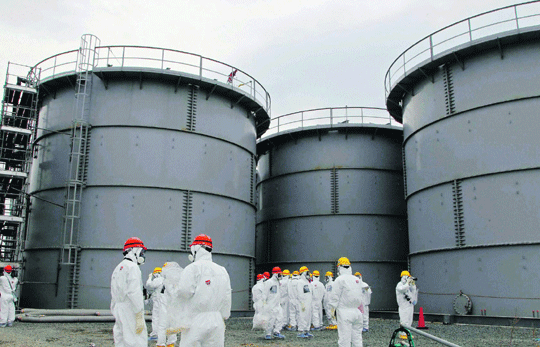 Fukushima Watch: Tepco Two Months Behind on Cleaning Tainted Water http://blogs.wsj.com/japanrealtime/2015/01/26/fukushima-watch-tepco-two-months-behind-on-cleaning-tainted-water/ By MARI IWATA Tokyo Electric Power Co. says it will need an additional two months to process all the highly contaminated water in storage at the Fukushima Daiichi nuclear plant.
The power company previously said it would clean all the water by the end of March. A Tepco spokesman said Friday that the process had been slowed down by the need for workers to frequently clean the filters of the water processing system. He also said the system needed more initial adjustments than first expected when it came into use.
Tepco plans to give a more detailed outline of the water processing schedule in March, the spokesman said.
A large amount of groundwater keeps flowing underneath the reactors, creating about 300 to 400 tons a day of highly contaminated water. The water has been stored in about 1,000 tanks set up at the site.Tepco has been processing the water to remove most of the radioactive materials to reduce the contamination to a low level. The system is unable to remove tritium, a less harmful material.
The company now says it won’t finish processing the stored water until May. After that it will have sufficient capacity to deal with the daily inflows of groundwater.
Robot technology for Fukushima nuclear clean-up operations
British robot maps radiation at Fukushima, Ft.com Tanya Powley, Manufacturing Correspondent , 18 Jan 15 A robot developed by a UK start-up is helping to locate hazardous radiation sources at the scene of the Fukushima disaster, the world’s worst nuclear accident since Chernobyl.
Createc, a small imaging company based in Cumbria, has developed camera technology called N-Visage for robots that can detect and draw a 3D map of high radiation locations that are too contaminated for human workers……..
Nuclear companies are turning to robotics as they look to deliver safer, faster and more cost-effective solutions for the £250bn worth of global nuclear decommissioning that is forecast to take place by 2030.
Hitachi-GE Nuclear Energy, which is leading the clean-up at Fukushima, deployed Createc’s N-Visage camera technology in stair-climbing robots to reach inaccessible areas deep inside the nuclear site. Fukushima was badly damaged by a tsunami in March 2011.
 N-Visage is the only technology that has the right weight, speediness and capability for high radiation, said a spokesman for International Nuclear Services Japan. “N-Visage is very likely to be deployed not necessarily only at Fukushima but also at other nuclear facilities in Japan,” he said.
The N-Visage technology was first used at Britain’s Sellafield, western Europe’s largest nuclear waste site.
Operators at Fukushima are now using the N-Visage technology to understand where radioactive material is coming from inside damaged reactors and help plan clean-up strategies…….
Sylvain Du Tremblay, chief technical and engineering officer at Sellafield, believes the adoption of N-Visage at Fukushima shows the UK can lead in robotics technology for the nuclear industry. “We are using Sellafield facilities that are waiting to be dismantled to test and validate new technologies,” he said. http://www.ft.com/intl/cms/s/0/d2ca4690-85d9-11e4-a105-00144feabdc0.html#slide0
Record high radiation in Fukushima waste water -Cesium up 7,500% this week
 Huge radiation spike detected at Fukushima plant — Multiple records set near workers trying to stop nuclear waste flowing into ocean — Cesium up 7,500% this week http://enenews.com/huge-radiation-spike-detected-fukushima-plant-record-levels-workers-attempting-stop-radioactive-material-flowing-ocean-cesium-7500-week?utm_source=feedburner&utm_medium=email&utm_campaign=Feed%3A+ENENews+%28Energy+News%29
Tokyo Electric Power Company Press Release, January 12, 2015 (Google Translation):
For pumping water groundwater observation hole No.1-12 taken on January 12, cesium 134, cesium 137, cobalt 60 and total beta value is higher as compared with the previous value, the maximum value previously is detected.
 Cesium-134: 140 Bq/L [~7,500% above Jan. 5 level; new record high]
- Cesium-137: 470 Bq/L [~7,500% above Jan. 5 level; new record high]
- Cobalt-60: 1.9 Bq/L [Quadruple previous record high set in 2013]
- β (all beta): 15,000 Bq/L [~6,000% above Jan. 8 level; ~1,300% above previous record high]
Note that observation hole No. 1-12 is near the Unit 2 trench which is filled with thousands of tons of highly radioactive water. Tepco is attempting to seal the trench, but has failed to do so. According to page 2 of Tepco’s presentation to Japan’s Nuclear Regulatory Authority on Dec. 26, 2014 the only part of the trench that has been blocked is right next to No. 1-12 (see map on right).
Neutron radiation from Fukushima has been grossly underestimated
Fukushima Released 13,000,000,000 Times More Neutrons than Initially Estimated http://www.globalresearch.ca/fukushima-released-13000000000-times-more-neutrons-than-initially-estimated/5424619
 “Neutron radiation is the most severe and dangerous radiation” known to mankind January 14, 2015
We estimated a lower limit of 5.2 × 10²¹ slow neutrons m–2 sec–1 [m–2 sec–1 = per sq. meter per second] were emitted from the nuclear fuel rods to the sea water injected in the reactors
- Priyadarshi et al. (2011) have estimated a release amount of 4 × 10¹¹ slow neutrons m–2. The large difference with our estimation [13,000,000,000 times higher] comes from the intrinsic limit of the box model study by Priyadarshi et al.
- Our model directly estimates the amount of material released from the reactor core
- The estimated… number of neutron represent a lower limit of the amount of radiation emitted from the nuclear reactors… These values can be used as a proxy to the total amount of radiation emitted since the melt down
- [The authors] express their gratitude to… the Japanese Ministry of Environment…Ministry of Education, Culture, Sports, and Technology (MEXT)… [and] the Cabinet Office
Priyadarshi et al.: Evidence of neutron leakage at the Fukushima nuclear plant… Despite the obvious implication for human health… there are no quantitative estimates of the neutron flux leakage… [T]ons of seawater were used as a coolant… A consequence is that salts and minerals present in seawater become radioactive by reaction with thermal neutrons… We calculated the total number of neutrons that leaked from the reactor core [and] estimate that a total of 4 × 10¹¹ neutrons per m2 were released before March 20.
Office of Homeland Security & Emergency Coordination: Neutron radiation is a kind of ionizing radiation which consists of free neutrons… Neutrons readily pass through most material, but interact enough to cause biological damage. Neutron radiation is considered to be the most severe and dangerous radiation available. Neutrons can travel great distances…
Failure to control radioactive waste water continues, at crippled Fukushima nuclear site
Engineer: Outright failures continue to plague Fukushima plant — “Public may think worst is over… Nothing could be further from the truth” — Japan TV: New method failing to stop flow of highly contaminated water — Experts: ‘Diluting’ radiation in ocean adds to danger; Spreading it out only makes health damages worse (VIDEO)http://enenews.com/outright-failures-continue-plague-fukushima-japan-tv-new-method-failing-stop-flow-highly-contaminated-water-public-thinks-worst-could-be-further-truth-video?utm_source=feedburner&utm_medium=email&utm_campaign=Feed%3A+ENENews+%28Energy+News%29
Dr. Steve Elwart, professional engineer and expert for Dept. of Homeland Security, Dec 14, 2014 (emphasis added): With most of the media silent about the cleanup, the public may think the worst is over [at Fukushima Daiichi]… Nothing could be further from the truth… [Radioactive water is] leaking out into the ocean, allowing it to spread… around the world through ocean currents [and this has] prompted grave concerns over the impact on sea life in the area and around the world. [Officials] decided to build an “ice wall” around the reactor site… TEPCO conceded defeat and announced the efforts to construct the plug failed… As if things couldn’t get worse, less than two months ago, TEPCO once again came out with an announcement that it was having problems with the ice wall [and] was going to cease operations on the ice wall and pour cement… TEPCO President Naomi Hirose stated officials “will never give up” on the wall…debate continues over how to stop water from leaking into the ocean… outright failures continue to plague the Fukushima cleanup efforts.
NHK Transcript, Dec 26, 2014: TEPCO is still struggling to deal with contaminated water at the Fukushima Daiichi nuclear power plant.
NHK, Dec 26, 2014: New method for contaminated water may be failing — [TEPCO] has indicated that a new method aimed at tackling a large volume of highly radioactive wastewater at the Fukushima Daiichi nuclear power plant has not been entirely successful. TEPCO gave a progress report on its work to a panel of experts at the Nuclear Regulation Authority on Friday. The utility last month began pouring cement into underground tunnels filled with the contaminated water from the reactor buildings to stop the water inflow. The water is believed to be leaking into the sea… officials said that when they pumped water up from one of the pits, the water level at another pit changed. That suggests that gaps exist in the concrete-filled tunnels.
Documentary featuring radiation experts (at 6:30 in):
- Dr. Alice Stewart, physician and epidemiologist: All recommendations say one big hit is more dangerous than just a little one… It’s the basis of the control of nuclear waste — if you dilute it enough, it will be safe. Well, we say dilute it and it will add to the dangers.
- Jan van de Putte, radiation safety specialist: There’s a philosophy called the dilution philosophy, which means if you dilute something, then it doesn’t give any harm. But with all the knowledge we have today, we must say radiation is inducing health damage regardless of how little the doses of are. If you dilute radiation… all the health effects will only be more widely distributed. This is the only effect of this dilution philosophy.
- Dr. Richard Piccioni, biophysicist: Whether you have put it all in one place or have spread it out, the total irradiation of human beings… is the same. In fact if what some researchers like Dr. Stewart are saying is true, it will be even worse.
- Watch the documentary here
Environmental problems remain after the Fukushinma nuclear disaster
 Environmental Issues Remain in Spotlight Following Fukushima Nuclear Disaster Institute for International JournalismBy: William Hoffman Produced & Edited By: Zainab Kandeh Tuesday, December 9, 2014
When three of the six nuclear reactors at the Fukushima power plant went into meltdown after the 2011 tsunami hit, radioactive material started spilling into the water and land and became the largest nuclear disaster since Chernobyl.
Families and businesses are still suffering from the effects of this disaster and it has caused an upheaval of environmental issues and a focus on a new green movement in Japan that has consequences in many different facets of East Asian environmental issues: radiation, agriculture, social responsibility and sustainability in business.
One of the areas that has been most affected by the disaster is agriculture and fishery markets. Mari Takenouchi, an independent journalist in Japan, has followed the effects of the disaster, and found the government is doing a lot to hide some of the radiation’s effects.
She speculates strontium 90 and yttrium 90 radiant raise the incidence of leukemia, diabetes, suppressed immune systems, damage of nervous systems and developmental damage to unborn babies. However, the government was slow to include these radiant in its initial reports.
“Since the Japanese government acknowledged the severe danger of strontium 90, they are doing their best to avoid this topic,” Takenouchi said. “Since there is no scientists who do the research on this in Japan, nobody can say the negative impacts for sure, but I think it is already happening.”
Radiation Effects More Than General Area
These effects can travel far when the fish are affected by this radiation, Takenouchi said, yet canned pacific fish are still being exported to countries such as Cambodia, Ghana, Senegal, the Congo and Sri Lanka. While no connection to the radiation can definitively be made, Takenouchi said the reports of adverse health effects come from school children out of that country are cause to stop exportation of pacific fish to these developing countries……..http://scrippsiij.blogspot.ie/
1 This Month

of the week – Shut Down Drone Warfare!


Tell the Ukrainian Government to Drop Prosecution of Peace Activist Yurii Sheliazhenko

Petition to revoke the licensing of the Near Surface Nuclear Disposal Facility (NSDF) at Chalk River. https://www.ourcommons.ca/petitions/en/Petition/Details?Petition=e-7247
To see nuclear-related stories in greater depth and intensity – go to https://nuclearinformation.wordpress.com
-
Archives
- April 2026 (68)
- March 2026 (251)
- February 2026 (268)
- January 2026 (308)
- December 2025 (358)
- November 2025 (359)
- October 2025 (376)
- September 2025 (257)
- August 2025 (319)
- July 2025 (230)
- June 2025 (348)
- May 2025 (261)
-
Categories
- 1
- 1 NUCLEAR ISSUES
- business and costs
- climate change
- culture and arts
- ENERGY
- environment
- health
- history
- indigenous issues
- Legal
- marketing of nuclear
- media
- opposition to nuclear
- PERSONAL STORIES
- politics
- politics international
- Religion and ethics
- safety
- secrets,lies and civil liberties
- spinbuster
- technology
- Uranium
- wastes
- weapons and war
- Women
- 2 WORLD
- ACTION
- AFRICA
- Atrocities
- AUSTRALIA
- Christina's notes
- Christina's themes
- culture and arts
- Events
- Fuk 2022
- Fuk 2023
- Fukushima 2017
- Fukushima 2018
- fukushima 2019
- Fukushima 2020
- Fukushima 2021
- general
- global warming
- Humour (God we need it)
- Nuclear
- RARE EARTHS
- Reference
- resources – print
- Resources -audiovicual
- Weekly Newsletter
- World
- World Nuclear
- YouTube
-
RSS
Entries RSS
Comments RSS
 nuclear-news