Fukushima’s molten nuclear fuel cores – no technology exists to fix them
Top U.S. Official: “The reality is, no technology exists anywhere to solve problem” of Fukushima’s  melted fuel — TV: Molten mass “will scorch into the earth” if not cooled, a ‘China Syndrome’; Geysers of radioactive steam shooting up for miles around (VIDEOS) http://enenews.com/top-official-reality-technology-exists-anywhere-solve-problem-fukushimas-melted-fuel-tv-molten-mass-will-scorch-earth-cooled-china-syndrome-geysers-radioactive-steam-shooting-miles-around-videos?utm_source=feedburner&utm_medium=email&utm_campaign=Feed%3A+ENENews+%28Energy+News%29
 NHK Nuclear Watch: US View on Fukushima Daiichi, July 2, 2014 (at 2:00 in):
- NHK: Experts say that one of the most difficult challenges of decommissioning the plant is removing fuel debris… And Magwood says that there is no magic wand to wipeout this problem.
- William Magwood, US Nuclear Regulatory Commission: I think people have to be realistic how difficult this is, how long it’s going to take. During my visit to Japan this week, people have asked me from time to time, “Are there technologies in the US that can help solve this problem?” The reality is there is no technology that exists anywhere to solve this problem.
- Watch the NHK broadcast here
‘Modern Marvels‘, History Channel (at 11:30 in):
- Narrator: With the [water] pumps off, the core is being uncovered and its temperature is over 2,000 degrees and rising. When the core reaches 5,000 degrees it will melt, becoming a molten mass — metallic lava that will burn through the 8 inch steel containment vessel. Once out of the plant it will scorch into the earth itself. What happens next could become an unrivaled technological disaster.
- Wilborn Hampton, New York Times reporter: They reach the water table, it will immediately turn to steam, boiling steam. There will be geysers of radioactivity steam shooting up in parking lots and driveways and streets and houses for miles around.
- Narrator: The nightmare scenario is known as the ‘China Syndrome’. Land surrounding the plant will become uninhabitable. A study some years earlier has suggested upwards of 40,000 people could die if the ‘China Syndrome’ becomes reality.
- Watch the History Channel broadcast here
Plutonium flows to the Pacific from Fukushima’s ruptured nuclear reactor containments
 Gov’t Expert: Plutonium is certainly being discharged into Pacific Ocean from Fukushima plant; Flowing out of ruptured containments — TV: Reactor water turns into ‘yellowish, fizzing liquid’ from damaged fuel rods… “It actually vibrates” (PHOTO & VIDEO) http://enenews.com/study-plutonium-being-discharged-fukushima-pacific-ocean-flowing-ruptured-containment-vessels-tv-reactor-water-becomes-yellowish-fizzing-liquid-damaged-fuel-rods-actually-vibrates-video?utm_source=feedburner&utm_medium=email&utm_campaign=Feed%3A+ENENews+%28Energy+News%29
P. Bossew, German Federal Office for Radiation Protection, PLUTONIUM EMISSION FROM THE FUKUSHIMA ACCIDENT (pdf), 2013 (emphasis added): While much has since been published on environmental contamination and exposure to radio-iodine and radio-caesium, little is known about releases of plutonium […] The inability to cool the fuel led to melting of parts of the reactor cores (which parts exactly, is not yet well known) […] [Causes of the containment] ruptures and leaks […] are not entirely clarified […] explosion seems to have produced further structural damage in the containments, at the one hand, and on the other hand released large amounts of radionuclides into the environment. […] the fraction of Pu released into the environment can be expected to be higher [than] atmospheric releases only. Certainly some Pu has been released with liquid effluents and discharged into the ocean. […] The liquid discharges certainly also contained Pu. […]
‘Modern Marvels‘ History Channel (at 19:45 in): It is now 28 hours since the accident at Three Mile Island began. The men in the control room have no way of looking into the reactor…. it now seems clear some of the 36,000 slendertubes holding the uranium fuel have cracked, this is allowing radioactivity to escape into the reactor coolant water. It is imperative operators know how much radioactivity is now in the coolant. Too much, and the nuclear chain reaction could restart… Foreman Ed Hauser agrees to risk his life to take the readings. This is allowing radioactivity to enter the coolant water. He is in for an even greater scare when he draws the coolant water sample. The water from the reactor should be clear; instead he stares at a yellowish, fizzing liquid… It actually vibrates in his hand.
120 Quadrillion becquerels of radioactive cesium into North Pacific Ocean from Fukushima
 Japan Gov’t-funded Study: Fukushima has released up to 120 Quadrillion becquerels of radioactive cesium into North Pacific Ocean — Does not include amounts that fell on land — Exceeds Chernobyl total, which accounts for releases deposited on land AND ocean (MAP) http://enenews.com/japan-govt-funded-study-fukushima-released-120-quadrillion-becquerels-radioactive-cesium-north-pacific-ocean-include-amount-deposited-land-higher-total-amount-released-chernobyl?utm_source=feedburner&utm_medium=email&utm_campaign=Feed%3A+ENENews+%28Energy+News%29 1 July 14,
Scientific Reports (Nature.com), Mar. 4 2014: The total amount of decay-corrected 134Cs in the [subtropical] mode water was an estimated about 6 PBq [petabecquerels, i.e. 6 quadrillion becquerels] corresponding to 10–60% of the total inventory of Fukushima-derived 134Cs in the North Pacific Ocean. […] The decay corrected ratio of 134Cs/137Cs in soils has been calculated to be 1.0, which suggests that the total amounts of 134Cs and 137Cs released from FNPP1 were equivalent. […] the total amount of Fukushima-derived radiocesium in the North Pacific remains uncertain, because it has been difficult to obtain sufficient samples of water, especially from subsurface and deep waters, in the vast North Pacific Ocean […] Estimates of the total 134Cs released to the North Pacific Ocean ranged from 10 PBq (direct discharge of 4 PBq + atmospheric deposition 6 PBq) to 46 PBq (16 + 30 PBq). Thus, the 6 PBq inventory accounts for 10–60% of the total release. However, the total inventory in the subtropical region derived from the activity in STMW [Subtropical Mode Water] may be underestimated, because CMW probably carried the radiocesium into the subtropical region, too […] The estimated inventory in the subtropical region (6 PBq or 10– 60% of the total inventory) is probably a lower limit of estimation because contribution of CMW [Central Mode Water] was not counted. […]
Funding: “This work was partially supported by a Grant-in-Aid… from the Ministry of Education, Culture, Sports, Science and Technology of Japan”
Note: The study states that up to 46 PBq of 134Cs is estimated to have been released into the North Pacific Ocean from Fukushima Daiichi. Yet, it also states that the 6 PBq in the study area represents between 10-60% of the total 134Cs released into the North Pacific Ocean. If the 10% figure is used, the total release into the N. Pacific would equal 60 PBq of 134Cs. The study also states the releases of 134Cs and 137Cs were equivalent, resulting in a total of 120 PBq into the N. Pacific. This total does not include releases deposited on land or in other bodies of water.
Chernobyl Comparison: A report by the Nuclear Enrgy Agency states that when more detailed deposition data eventually became available, the United Nations estimated the total Chernobyl release of 137Cs at 70 PBq. 134Cs is estimated to have been 53.7% of the 137Cs — approximately 38 PBq of 134Cs — resulting in a total of 108 PBq. Unlike the Fukushima total reported above, this does include all 134Cs and 137Cs releases from Chernobyl — not just what was deposited in the ocean.
Plutonium in the playground – Fukushima
 Study: Fukushima plutonium in playground 60 km from nuclear plant — “Proves that indeed Plutonium has been emitted by the accident” — Some “in the form of fuel fragments”? — Up to 14 Billion Bq of Pu-239 and-240 released (MAP) http://enenews.com/study-fukushima-plutonium-in-playground-60-km-from-nuclear-plant-proves-that-indeed-plutonium-has-been-emitted-by-the-accident-some-may-be-in-
P. Bossew, German Federal Office for Radiation Protection, PLUTONIUM EMISSION FROM THE FUKUSHIMA ACCIDENT (pdf), 2013 (emphasis added): […] Apparently no explosive fuel fragmentation occurred, so that little, if any of the release happened in the form of fuel fragments. […] Only scattered data are available from the farther surroundings. It can be assumed that continuous and frequent monitoring of environmental media for Pu from locations more distant than a few km was deemed unnecessary […] Given two different sources (global and Fukushima fallout) with different, but known 238Pu : 239+240Pu ratios, the contributions of the both in a sample which is a mixture of both can be calculated […] we estimated a median 2.28 (95% conf. interval 1.98 –2.58), [15] and 2.19 ± 0.48 (1 ), [14], for Fukushima emissions. […] The background Pu ratio in global fallout has been reported 0.035 ± 0.008 […] a map of the 238Pu : 239+240Pu ratio in the region around the NPP […] The “trace” towards NW from the NPP, in which the Pu ratio deviates strongly from the background […] This proves that indeed Pu has been emitted by the accident […] For 238Pu, the Fukushima contribution is much higher than the global one in many places (as detectable at all) because the Pu ratio is much higher in Fukushima (~2.19) than in global fallout (~0.035). […] Keeping with [the total 137Cs release of] 15 PBq given by NISA […] we find an atmospheric emission of 239+240Pu equal 4.2 GBq. Using the upper estimate of released 137Cs, 50 PBq, a release of 14 GBq is found. [NISA 239+240Pu estimate = 6.4 GBq; Zheng et al. 239+240Pu estimate = 1.0 to 2.4 GBq] […] It should be stressed that the evidence of Pu from Fukushima does not pose any radiological concern […]
P. Bossew, German Federal Office for Radiation Protection, Hirosaki University, Anthropogenic Radionuclides in Environmental Samples from Fukushima Prefecture (pdf), 2013: Three samples [all taken approx. 60 km from FDNPP, 1 from a parking area in Koriyama city and 2 from a playground in Fukushima city] were measured twice […] Sample 4 was too small for a meaningful analysis. […] The result found in this study is consistent with a Pu/ Cs ratio reported by Imanaka et al. (2012) for a highly contaminated place in the Fukushima zone as below 1 E-6 […] Zheng et al. 2011 found 239+240 Pu/137Cs in soil, close to the NPP, as (3.6 ± 1.1) E-7 (only samples with 241Pu>0 considered, and Fukushima contribution 87% to the sample J-village, surface soil , as suggested by the authors), which is in good agreement with the results of this study.
Fukushima: Record high radiation levels at 18 locations between reactors and Pacific
 TV: New concerns at Fukushima; Radioactive material “spilling into ocean” from layer 80 feet deep, officials suspect — Jiji: Record high radiation levels at 18 locations between reactors and Pacific; Crisis far from under control (VIDEO) http://enenews.com/tv-new-concerns-at-fukushima-radioactive-material-spilling-into-ocean-from-layer-80-feet-deep-officials-suspect-jiji-new-record-high-radiation-levels-at-18-locations-near-pacific-problems?utm_source=feedburner&utm_m
Jiji Press, June 18, 2014: Radioactive contamination of groundwater at [Fukushima Daiichi] is far from being under control […] the source of contamination remains unclear and new record levels of radioactive substances have been detected in groundwater taken at a number of measuring points on the ocean side of the plant’s No. 1 to No. 4 reactors. Radioactivity levels in groundwater have hit new record highs at 18 of 32 measuring points on the ocean side since April, according to TEPCO. At the most polluted well, located east of the No. 2 reactor [there’s] 860,000 becquerels of beta ray-emitting radioactive substances such as strontium-90.
NHK WORLD, June 25, 2014: [TEPCO] has found that radioactive water can now easily spread in a deep layer of groundwater. It says it will speed up construction work on a barrier aimed at preventing contaminated water from leaking into the ocean. The deep layer of water is about 25 meters [82 feet] below the surface. […] water pressure in the [deep] layer was lower […] this makes it easier for contaminated water to spread [..] They suspect the radioactive water could be spilling into the ocean. TEPCO officials say the ongoing construction of the barrier may be to blame for the lower pressure. The work involves drilling into the deep layer. […] TEPCO officials say they will take more action to keep radioactive water from spreading in the deep layer. This will involve fortifying holes in an underground frozen-soil wall. Those holes go through the layer and are filled with pipes. […]
See also: Japan Nuclear Expert: Fukushima’s fuel could be about 100 ft. underground in 2 years (AUDIO)
Doubts about Fukushima’s ice wall against radioactive water leaks
 Fukushima ‘ice wall’ looking more like a dirt Slurpee http://america.aljazeera.com/blogs/scrutineer/2014/6/18/fukushima-ice-walllookingmorelikeadirtslurpee.html by Gregg Levine Skeptics of the plan to build a massive ice wall around Japan’s crippled Fukushima Daiichi nuclear facility didn’t have to wait particularly long for their first “I told you so.”
TEPCO, the nominal operator of the battered plant, announced Tuesday that while construction on the network of pipes, pumps, and compressors has begun on what is intended to be a huge ice barrier to prevent mountain runoff from mixing with radioactive water inside the facility, attempts to form a smaller ice wall around already-contaminated water are failing.
“We have yet to form the ice stopper because we can’t make the temperature low enough to freeze water,” a TEPCO spokesman said.
The project is already behind schedule and over budget, and engineers are adding more cooling pipes in hopes they can complete this first small step next month.
While the ground freezing procedure has been used to construct tunnels near waterways, it has never been used for nuclear cleanup and has never been done on such a massive scale. Estimates of the project’s success can best be termed “hopeful.” But freezing the ground around the plant is not strictly a “Why the hell not?” proposition. As previously noted, the plan comes with a list of concerns:
What if freezing causes the ground to sink? What if the ice and the ensuing expansion and contraction interrupts or further damages drainage in the reactor buildings? What if a heat wave or heat from the plant causes parts of the wall to melt? And, what if there is a prolonged loss of power to this cooling system?
The ice wall is only intended to help with the problem of irradiated runoff — the question of what to do with the thousands upon thousands of gallons of water contaminated in the daily fight to cool the melted cores of the damaged reactors and the stored rods in the spent fuel pools remains largely unanswered.
Last month TEPCO began diverting what they say is only moderately radioactive water into the ocean after assuring local fishermen that the levels were safe. Last summer, it was revealed that 300 tons of contaminated water was seeping from the nuclear site into the Pacific every day.
While freezing parts of the ground surrounding the disaster site may or may not be an effective part of the final cleanup and decommissioning, problems continue to outpace response at Fukushima. TEPCO’s experiment around the margins does nothing to address the hot mess at the core (as it were) of the crisis, and is cold comfort to those people still displaced or a country and hemisphere facing generations of radiologic contamination.
Illness and deaths among Fukushima’s nuclear clean-up volunteers
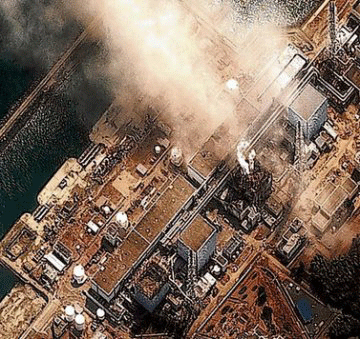 Fukushima Guide: “Lots of people suddenly started having nose bleeds, cats and dogs too, it lasted for some time” after 3/11 — Article: Many who volunteered in Fukushima have died, including 2 students from group of 15 helping to decontaminate http://enenews.com/fukushima-guide-lots-of-people-suddenly-started-having-nose-bleeds-cats-and-dogs-too-it-lasted-for-some-time-after-311-article-many-who-volunteered-in-fukushima-have-died-including-2-stud?utm_source=feedburner&utm_medium=email&utm_campaign=Feed%3A+ENENews+%28Energy+News%29
Zukunashi no Hiyamizu, June 9, 2014 (h/t Dissensus Japan]: Why many of decontamination volunteers died — “Genpatsu Mondai” wrote a blog article in the May 21, 2014 titled “Joining the volunteer with Fukushima citizens result in sudden death!!! Two of fifteen students in the neighborhood already died from an unknown cause”. In this article, you can read many dead cases of volunteers who went to Fukushima and worked there. They went to contaminated area and worked for decontamination as volunteers. […] Basically the purpose of volunteers is to go to the contaminated area where the air dose rate is high and to work there.
Sulejman Brkic, June 12, 2014: We left for Fukushima by bus very early on May 31, from Yokohama […] At the rest area where we stopped to pick up our guide, Masumi K. […] According to Masumi san, the population is divided between those who trust the government and the ones who don’t […] Don’t forget Fukushima are the words spoken to us by Masumi K. […] Masumi is from Okuma which she fled with her family after the nuclear explosions in 2011 […] She has been also battling cancer for some time now […] her husband got seriously sick and needed a new kidney, Masumi gave him one of hers. […] [A] young anonymous worker [at Fukushima Daiichi] told us […] about so many small and big acts of exploitation […] that…well…one stops listening, not on purpose, but it’s just too much, too overwhelming, it starts sounding normal after a while, I am sorry I can’t remember all of it. At every step in that area one can see or hear or feel the Japanese government’s lies and crimes. […] After the young anonymous worker, Masumi K talked again. She told us, again among many other stories of suffering, about the increase in suicides, consumption of alcohol, domestic violence, depression…she also told us how after the ongoing nuclear disaster there was a time when quite lots of people suddenly started having nose bleeds, cats and dogs too, it lasted for some time and then it suddenly stopped.
40 times above normal – thyroid cancer rates in Fukushima’s children
 Fukushima’s Children are Dying (includes audio)http://ecowatch.com/2014/06/14/fukushima-children-dying/2/ Harvey Wasserman | June 14, 2014 Some 39 months after the multiple explosions at Fukushima, thyroid cancer rates among nearby children have skyrocketed to more than forty times (40x) normal.
More than 48 percent of some 375,000 young people—nearly 200,000 kids—tested by the Fukushima Medical University near the smoldering reactors now suffer from pre-cancerous thyroid abnormalities, primarily nodules and cysts. The rate is accelerating.
More than 120 childhood cancers have been indicated where just three would be expected, says Joseph Mangano, executive director of the Radiation and Public Health Project.
The nuclear industry and its apologists continue to deny this public health tragedy. Some have actually asserted that “not one person” has been affected by Fukushima’s massive radiation releases, which for some isotopes exceed Hiroshima by a factor of nearly 30.
But the deadly epidemic at Fukushima is consistent with impacts suffered among children near the 1979 accident at Three Mile Island and the 1986 explosion at Chernobyl, as well as findings at other commercial reactors. Continue reading
Fukushima reactors too “hot” to allow workers to look for molten nuclear cores
 Hemisphere facing generations of radiologic contamination” from Fukushima — TV: It’s a major humanitarian crisis — NYT: “Nobody really knows” if 100s of tons of plutonium & uranium fuel resolidified — Experts: It’s certain reactor cores ‘moved around’; “Flowed to different part of buildings”? (VIDEO)
Al Jazeera, June 17, 2014: Fukushima ‘ice wall’ looking more like a dirt Slurpee […] Skeptics of the plan to build a massive ice wall […] didn’t have to wait particularly long for their first “I told you so.” […] “We have yet to form the ice stopper because we can’t make the temperature low enough to freeze water,” a TEPCO spokesman said. […] What if freezing causes the ground to sink? What if the ice and the ensuing expansion and contraction interrupts or further damages drainage in the reactor buildings? […] TEPCO’s experiment around the margins does nothing to address the hot mess at the core (as it were) of the crisis, and is cold comfort to those people still displaced or a country and hemisphere facing generations of radiologic contamination.
Christopher Morris, Muon Radiography Program Leader, June 16, 2014: “It’s certain that the reactor cores melted and the material moved around. By using muons going through the cores, we can make a radiograph of the uranium material and find out how much is left inside the pressure vessel, how much has leaked out of the pressure vessel.”
Duncan McBranch, Los Alamos Lab’s Chief Technology Officer, June 18, 2014: “The material itself may have melted and flowed to a different part of the building. Invasive techniques such as video endoscopy or introduction of robots run the risk of releasing radiation.”
New York Times, June 17, 2014: […] there are three wrecked reactor cores, twisted masses of hundreds of tons of highly radioactive uranium, plutonium, cesium and strontium. […] most of the material in the plant’s reactors resolidified, in difficult shapes and in confined spaces, wrapped around and through the structural parts of the reactors and the buildings. […] that is what the engineers think. Nobody really knows, because nobody has yet examined […] “nobody knows what happened inside,” [McBranch] said. “Nobody wants to go in to find out.” […] concrete, steel and water will all be distinguishable from uranium, plutonium and other very heavy materials. […] Testing will begin later this year, officials say, and final images will be produced next year.
KRQE, June 18, 2014: LANL technology to examine Fukushima damage […] “This is a major humanitarian crisis,” said Matt Durham, a post-doctoral researcher at Los Alamos […] “They are much too radioactive to go in and look at things,” said Christopher Morris, the lead researcher on the project. […] LANL hopes the detectors will be used in about a year. >> Full broadcast here
Fukushima ice wall project not working out too well
Fukushima operator struggles to build ice wall to contain radioactive water Tepco says it is behind schedule with scheme
because temperature of pipes sunk into ground is not low enough Agence France-Presse in Tokyo theguardian.com, Tuesday 17 June 2014 The operator of Japan‘s battered Fukushima nuclear power plant has said it is having trouble with the early stages of an ice wall being built under broken reactors to contain radioactive water.
Tokyo Electric Power (Tepco) has begun digging the trenches for a huge network of pipes under the plant through which it intends to pass refrigerant. This will freeze the soil and form a physical barrier that is intended to prevent clean groundwater flowing down mountainsides from mixing with contaminated water underneath the leaking reactors.
Tepco said on Tuesday that a smaller, inner ice wall whose pipes it sank earlier to contain the already-contaminated water was proving difficult. “We have yet to form the ice stopper because we can’t make the temperature low enough to freeze water,” a Tepco spokesman said.
“We are behind schedule but have already taken additional measures, including putting in more pipes, so that we can remove contaminated water from the trench starting next month.” The coolant being used in the operation is an aqueous solution of calcium chloride, which is cooled to -30C (-22F).
The idea of freezing a section of the ground, which was proposed for Fukushima last year, has previously been used in the construction of tunnels near watercourses.
However, scientists point out that it has not been done on this scale before, nor for the proposed length of time……http://www.theguardian.com/environment/2014/jun/17/fukushima-ice-wall-radioactive-water
Strange deaths of horses irradiated by Fukushima nuclear catastrophe
Japan Paper: “Horses became weak and died, one by one, from an unknown cause” at farm in Fukushima — Farmer: “There is something seriously wrong going on… This country is going mad, I‘m sure something grave is going to happen” — 14 out of 15 newborn horses died last year (PHOTOS) http://enenews.com/japan-paper-horses-became-weak-and-died-one-by-one-from-an-unknown-cause-at-farm-in-fukushima-farmer-there-is-something-seriously-wrong-going-on-this-country-is-going-mad-i?utm_source=feedburner&utm_medium=email&utm_campaign=Feed%3A+ENENews+%28Energy+News%29
Kyodo News, June 14, 2014: Tadao Mitome feels a duty to continue capturing images of the area to document the effects of the nuclear disaster […] Mitome, 75, published a photo book titled “3/11 Fukushima: Hibaku no Bokujo” (“Stock Farm Exposed to Radiation”), documenting a farm in the village of Iitate and its dying horses. “People should do whatever they are capable of doing,” Mitome said […] Iitate, about 40 km away from the wrecked power plant, [farmer Tokue Hosokawa] defied the central government’s order to evacuate. […] After nearly two years, horses became weak and died, one by one, from an unknown cause. Some horses in Fukushima were also put to death and sent away for autopsies. Mitome said he felt as though the eyes of the killed animals were trying to tell him that they would never let human beings forget about the nuclear disaster. […] “There are things that I must let people in the world know,” he said.
World Network For Saving Children From Radiation, Feb. 27, 2014: Mr. Hosokawa again lost three of his horses this summer. […] “Since then, three more horses have died. This village is reaching its end […] I don’t feel good”, he said.
Evacuee from Iitate: “University of Tohoku dissected the dead horses […] there were apparent abnormal results from the analysis of the blood […] 3 more horses have died here this summer. Hosokawa must be in shock […] I have demanded the Ministry of Environment to inform us of the results. But they keep saying, ‘we don’t know anything yet’ […] why can’t they at least publish the results so far? Surely there must be something wrong if they can’t publish.”
World Network For Saving Children From Radiation: “There is something seriously wrong going on” -Hosokawa […] According to him, horses have fallen ill one by one within these short weeks […] a white miniature horse, had the worst condition. Its skin was badly damaged. The veterinarian doctor who accompanied us saw it and indicated the symptoms of damaged liver […] It had jaundiced eyes. The doctor was wondering why its knees were so wobbly. […] 15 foals have been born since the beginning of this year, but 14 of them died within a month, sometimes within a week. “I have lived with horses since I was a kid, but I have never seen anything like this. It’s not normal. I think radiation is responsible for this”. Hosokawa stresses the effect of radiation as a cause. […] we asked a public health control centre to check the blood of the miniature horse. The results were negative for transmitted diseases or nutrient deficiency. […] We were overwhelmed by Hosokawa’s ghastly expression on his face and stunned with a shock by the grave situation, which was beyond our imagination. “This country is going mad, I‘m sure something grave is going to happen”.
Fukushima’s scattered melted nuclear cores are not found nor being dealt with
 Japanese Nuclear Expert: Melted reactor cores not in one piece at Fukushima, as gov’t claims — I think nuclear fuel scattered everywhere, stuck to walls — Chernobyl-like sarcophagus may be needed — Nothing has been done, by time they deal with this I’ll be long dead http://enenews.com/japanese-nuclear-expert-melted-fuel-not-in-one-piece-at-fukushima-as-govt-says-its-probably-scattered-everywhere-pieces-of-nuclear-core-stuck-to-walls-i-think-its-better-to-just-build-sa?utm_source=feedburner&utm_medium=email&utm_campaign=Feed%3A+ENENews+%28Energy+News%29
Radio Forum #72, May 24, 2014 — Translated by DISSENSUS JAPAN, June 10, 2014:
- Jiro Ishimaru, host: They don’t even know where the melted fuel is. What is the current situation of the melted fuel?
- Hiroaki Koide, professor at Kyoto University Research Reactor Institute: Nothing has been done. I don’t think the melted fuel is sitting in one piece as TEPCO and the government imagine. Probably, many pieces are scattered everywhere in the reactor vessel. For example, there are pieces stuck to the wall, I think. If, for example, they somehow can collect 50 pieces of debris they can’t collect the other 50; if many workers are forced to be exposed to radiation to do this ineffective job, I think it’s better to just contain it like the Chernobyl sarcophagus.
- Ishimaru: It is going to be a long road to decommissioning…
- Koide: The government says it will take 40 years, but that is not going to be enough at all. When they finish, I will have been dead for a long time.
Translation of interview here | Audio of interview here (Japanese)
Nuclear fuel pool at Fukushima reactor No 4 in danger of collapse
Japan Nuclear Professor: It’s feared Fukushima fuel pool to “collapse in” at any time; “Any scale of accident is possible” — Expert warns ice wall increases risk that reactor units will move or shift; Buildings ‘very precarious’ even without frozen barrier being constructed (AUDIO) http://enenews.com/japan-nuclear-prof-its-feared-pool-of-fukushima-nuclear-fuel-may-collapse-in-at-any-time-any-scale-of-accident-is-possible-expert-warns-ice-wall-increases-risk-of-reactor-units-moving?utm_source=feedburner&utm_medium=email&utm_campaign=Feed%3A+ENENews+%28Energy+News%29
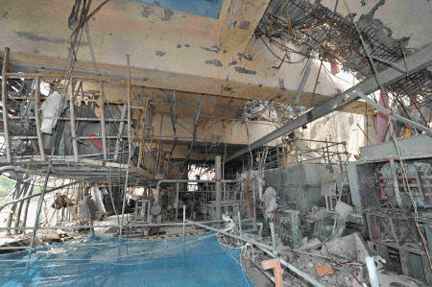
Radio Forum #72, May 24, 2014 — Translated by DISSENSUS JAPAN, June 10, 2014:
- Jiro Ishimaru, host: About the current progress of decommissioning…
- Hiroaki Koide, professor at Kyoto University Research Reactor Institute: […] In November 2013, they started with Reactor #4 because it was the most accessible pool, and the most dangerous. The floor that housed the Used Fuel Pool in Reactor #4 was hugely damaged and it has been feared that the pool might collapse in any time. This is a very dangerous job. Any scale of accident is possible. But they have to do it. […]
- Translation of complete interview available here
WBUR — Here and Now, June 9, 2014:
- Ken Buesseler, senior scientist at Woods Hole Oceanographic Institution: Maybe there’s some side effects [to the ice wall] that might also creep into this game, that they really haven’t considered here… if you stop the flow of water into certain soil, you can get things like settling — Buildings can move, so these are very precarious situation anyways, so we don’t want to have shifting.
- Full WBUR broadcast available here
Melted reactor cores might now be exposed, as water levels fall in Fukushima nuclear reactors
Japan TV ‘News Flash’: Officials fear melted reactor fuel is now exposed at Fukushima — Tepco: We don’t know at this point if fuel is uncovered — Large drop in water level — Experts ‘struggling’ to find condition of nuclear cores, http://enenews.com/tv-officials-fear-melted-fuel-from-reactor-2-is-now-exposed-at-fukushima-tepco-we-dont-know-at-this-point-if-fuel-is-uncovered-water-level-drops-dramatically-experts-struggling-to-fin?utm_source=feedburner&utm_medium=email&utm_campaign=Feed%3A+ENENews+%28Energy+News%29nothing is known for all 3 reactors (VIDEO)
NHK WORLD, June 9, 2014: TEPCO: Water in reactor half expected level— Officials with the operator of the damaged Fukushima Daiichi nuclear plant say the water level inside the No.2 reactor’s containment vessel is about half what they had estimated. […] They found the water was around 30 centimeters [11.8 inches] deep. TEPCO officials […] say they don’t know whether the fuel is entirely submerged. […] They believe then flowing out of the reactor building through holes in the chamber.
NHK WORLD, June 10, 2014: TEPCO officials are struggling to find […] the condition of the melted fuel […] Officials believe that at reactor number 2, water is leaking […] at the bottom of the containment vessel, but do not know exactly from where. [At] reactors 1 and 3, the utility has found the sources of some leaks, but suspects there are other breaches […] Nothing is known about the condition of the melted fuel in all 3 reactors. TEPCO is considering various forms of surveys, including a plan to send a camera-mounted robot […]
Kyodo News, June 9, 2014: TEPCO confirms water level of Fukushima No. 2 reactor container […] A TEPCO official [said] the detailed condition of the melted fuel remains unknown.
NHK Transcript, June 9, 2014:
- Officials at Tepco are facing another setback.
- They don’t know whether [the water] even covers all of the nuclear fuel.
- Officials don’t know about the condition of the melted fuel.
- Officials believe the water level at another reactor is 10 times deeper.
- Teruaki Kobayashi, Tepco official: “We cannot tell at this point if the fuel is entirely submerged or if part of it’s above the water.”
- They believe it’s flowing through the chamber then out of the reactor building.
Corrosion of Fukushima’s melted nuclear cores is releasing more plutonium
Study: Water helps dissolve Fukushima’s melted nuclear cores, accelerates  corrosion — Plutonium concentrates on outer edge of fuel — Poses “a much longer environmental threat” than initial releases — Transport of nuclear material into environment to continue for many years if not isolated http://enenews.com/study-water-helps-dissolve-fukushimas-melted-nuclear-cores-accelerates-corrosion-plutonium-concentrates-outer-edge-fuel-poses-longer-environmental-threat-initial-releases-transport-nuclear-ma?utm_source=feedburner&utm_medium=email&utm_campaign=Feed%3A+ENENews+%28Energy+News%29
‘Nuclear Fuel in a Reactor Accident’ — Peter Burns, Rodney Ewing, Alexandra Navrotsky, 2012: Seawater was injected into the three active reactors […] large amounts of salt may have deposited in the reactor cores. […] Nonuniform burn-up in a fuel pellet gives higher concentrations of 239Pu near the pellet edge […] the major potential pathway for continued release of radionuclides is through flowing water. […] Many radionuclides form aqueous complexes that are soluble in water. Furthermore, water promotes dissolution of the rod/fuel matrix, which releases radionuclides [that] pose a much longer environmental hazard […] The radiolytic breakdown of water creates oxidants (e.g., hydrogen peroxide) that can accelerate the oxidative corrosion of fuel […] If the water is alkaline, soluble nanoscale uranyl peroxo cage clusters are likely to form and persist in solution. […] there is no reliable way of predicting dissolution rates of damaged fuel in water under the conditions of a nuclear accident, especially one like Fukushima Daiichi in which fuel is exposed to hot or boiling seawater […] an understanding of the factors that determine radionuclide release is central to taking appropriate and timely action in order to minimize impacts on the environment and human health. […] Water that interacts with damaged fuel will transport radionuclides that present both short-term and longer-term environmental risk […] potentially continuing for many years if the damaged fuel is not adequately isolated […]
AAAS Science Podcast interview with Peter Burns about study:[…] it’s the interaction of the water and the air with that that is going to control the release of radioactivity to the environment […] what’s different about Fukushima relative to the earlier events is the vast quantities of water that were pumped into the reactor cores […] that created a whole new release pathway for radionuclides out of the reactors into the environment. We don’t know how much radioactivity was released through the water flow, and we don’t know very much about how the water interacted with the fuel and other structure materials. […] we need to take very seriously the development of knowledge about how […] melted nuclear fuel […] interacts with the environment, especially water that we might use in an emergency to cool it. Studies that have been done to date really haven’t looked at the longer-term interactions of water and the atmosphere with these damaged materials. […] as it interacts with water or whatever over time – [fuel] has a potential to release radionuclides that have much longer half-lives and they pose a much longer environmental threat.
1 This Month

of the week – Shut Down Drone Warfare!


Tell the Ukrainian Government to Drop Prosecution of Peace Activist Yurii Sheliazhenko

Petition to revoke the licensing of the Near Surface Nuclear Disposal Facility (NSDF) at Chalk River. https://www.ourcommons.ca/petitions/en/Petition/Details?Petition=e-7247
To see nuclear-related stories in greater depth and intensity – go to https://nuclearinformation.wordpress.com
-
Archives
- April 2026 (19)
- March 2026 (251)
- February 2026 (268)
- January 2026 (308)
- December 2025 (358)
- November 2025 (359)
- October 2025 (376)
- September 2025 (257)
- August 2025 (319)
- July 2025 (230)
- June 2025 (348)
- May 2025 (261)
-
Categories
- 1
- 1 NUCLEAR ISSUES
- business and costs
- climate change
- culture and arts
- ENERGY
- environment
- health
- history
- indigenous issues
- Legal
- marketing of nuclear
- media
- opposition to nuclear
- PERSONAL STORIES
- politics
- politics international
- Religion and ethics
- safety
- secrets,lies and civil liberties
- spinbuster
- technology
- Uranium
- wastes
- weapons and war
- Women
- 2 WORLD
- ACTION
- AFRICA
- Atrocities
- AUSTRALIA
- Christina's notes
- Christina's themes
- culture and arts
- Events
- Fuk 2022
- Fuk 2023
- Fukushima 2017
- Fukushima 2018
- fukushima 2019
- Fukushima 2020
- Fukushima 2021
- general
- global warming
- Humour (God we need it)
- Nuclear
- RARE EARTHS
- Reference
- resources – print
- Resources -audiovicual
- Weekly Newsletter
- World
- World Nuclear
- YouTube
-
RSS
Entries RSS
Comments RSS
 nuclear-news