Spill of tonnes of radioactive water into Fukushima soil
 TEPCO Just Spilled Tonnes Of Radioactive Water Into Fukushima’s Soil http://www.gizmodo.com.au/2013/10/tepco-just-spilled-tons-of-radioactive-water-into-fukushimas-soil/ ADAM CLARK ESTES The operator of Japan’s infamously crippled Fukushima nuclear power plant recently attempted to move some radioactive water from one tank to another. In the process, it spilled four tonnes of deadly sludge.
To be fair, the four tons of water is just a drop in the bucket compared to the 300 tonnes that recently leaked from a nearby tank. And the radiation levels in the newly leaked water are relatively low compared to puddles they found forming outside the tanks about six weeks ago. TEPCO’s not in the clear yet, though. A tropical storm is on the way, which creates the potential for even more radioactive leaks.
It’s also worth remembering that this little leak pales in comparison to Fukushima’s bigger problems. Its primary leak is getting worse, and if something’s not done about it soon, it will continue to spread and contaminate the surrounding area. Recently, Japan’s government agreed to bankroll a massive project to build an underground ice wall to contain the leaked groundwater. Experts seem to agree that the plan is feasible. All TEPCO has to do is stop spilling radioactive water into the ground. [Reuters]
International concern as USA bans food and fish imports from irradiated areas of Japan
 FDA Import Alert: U.S. bans agricultural and fishery products from 14 prefectures in Japan due to Fukushima radionuclides — Top Newspaper: Concern over contamination is spreading to most countries around Pacific http://enenews.com/fda-import-alert-u-s-bans-japans-agricultural-and-fishery-products-from-14-prefectures-due-to-fukushima-radionuclides-concern-over-contamination-is-spreading-to-most-countries-around-pacific
Dong-A Ilbo, Sept. 28, 2013 (Korea’s top newspaper): […] Concerns over Japan’s radioactive contamination and its seafood is spreading to most countries in the  Pacific basin. The United States has recently banned agricultural and fishery imports from 14 prefectures in Japan, up from eight. South Korea puts a similar ban on fishery imports from eight prefectures, while China and Taiwan does so for 10 and five prefectures, respectively. [… The IAEA’s] upcoming probe needs to shed light on the cause and situation of soil and sea water contamination. […] It would be much better if experts from South Korea, the United States and China participate in the investigation. It is natural for a global organization to intervene in an international issue. […] Continue reading
Sharp increase in physical health symptoms in Fukushima residents
Fukushima Mother’s Plea to U.N.: Children and adults are suffering tremendously — Sharp increase in bloody urine, bone pain, more — Doctor says many have similar symptoms with unknown causes — Family’s health deteriorated all at once, recovered soon after moving http://enenews.com/fukushima-mothers-letter-to-u-n-children-and-adults-suffering-tremendously-sharp-increase-in-bloody-urine-bone-pain-low-blood-pressure-more-familys-health-deteriorated-all-at-once-reco
Fukushima City mother’s letter to the United Nations Scientific Committee on the Effects of Atomic Radiation (UNSCEAR), translated by journalist Mari Takenouchi and published by Save Kids Japan on Sept. 24, 2013: […] 2 years after the accident, members of my family had deteriorated health all at once. We continued to have stuffed throat with phelm, could not stop dry coughing […] the doctor couldn’t tell the cause of our symptoms [… he] said that there are many patients who show the same symptom with unknown causes. My child began to complain pain in his foot bones and I heard many people including children and adults have the same […] I myself had bone pains […] After that, my son and I had continued naucea [sic] and headaches. My son had lowered blood pressure and bloody urine, too.
My family moved out of Fukushima in July. One month afterwards, we all became better […] there is a sharp increase of people who show the same symptoms. There is a much increase of children who has prolonged nose bleeding […] people who died of acute myocardial infarction is increasing. […] Both children and adults have been suffering tremendously. […]
Read more at Save Kids Japan here and follow journalist Mari Takenouchi on Twitter here
The gap between official information and the real news about Fukushima
 Nuclear Industry Report: ‘Reduced stability’ of fuel pool in Fukushima Unit 4; Admits there’s damaged fuel inside? — Gundersen: Fuel racks moved and damaged; Fallen debris distorted tops (AUDIO) http://enenews.com/nuclear-industry-report-reduced-stability-of-unit-4-fuel-pool-at-fukushima-admits-some-fuel-inside-is-damaged-gundersen-fuel-racks-moved-from-quake-fallen-debris-distorted-tops-audio
World Nuclear News,Sept. 26, 2013 (Emphasis Added): […] Underwater inspections in the [Unit 4] pond have shown most of the fuel to be undamaged, but the pond contains a lot of dust and debris which will complicate operations. […] Its full core load of fuel, plus used fuel from previous operation, was being stored in a fuel pool at the top of the reactor building. […] The stability of the pool was then reduced by major structural damage to the building caused by the ignition of hydrogen […]
World Nuclear News is funded by the World Nuclear Association. The WNA represents the interests of the international nuclear industry. -Source
Bridging the News Gap, with Professor Matt Noyes
Fairewinds Energy Education Podcast, Sept.. 26, 2013 (at 21:15 in) – Arnie Gundersen, Fairewinds Chief Engineer: These racks [in the Unit 4 fuel pool] have moved, they’ve been distorted by the earthquake, there’s junk that’s fallen on top of them and distorted the tops. […] One of two things is going to happen. They’re either going to pull too hard and snap the bundle, or they’re going to be unable to pull all of the fuel out of the pool. Full podcast available here
Damaged underwater radiation barrier at Fukushima
NHK: Typhoon approaching Fukushima plant — Underwater fences breached — Tepco: No ‘immediate’ effect (VIDEO) http://enenews.com/nhk-typhoon-approaching-fukushima-plant-underwater-fences-breached-tepco-no-immediate-effect-video
Xinhua, Sept. 26, 2013: The operator of the crippled Fukushima Daiichi nuclear plant, Tokyo Electric Power Co., (TEPCO), said Thursday that damage was found on an underwater curtain under the stricken complex, according to local media. […] Local reports said that a worker found a cut in the fence Thursday morning, adding the TEPCO did not provide more details and is checking the impact of the crack. […] The TEPCO said it plans to repair the fence after an upcoming typhoon, according to Japan’s Kyodo News. […]
SOURCE: NASA
Fukushima News 9/26/13: Typhoon Damage-Underwater Barrier
NHK WORLD, Sept. 26, 2013: The operator of the crippled Fukushima Daiichi nuclear plant says underwater barriers in the facility’s port have been breached. […] The silt fences are to stop contaminated sea-bed soil from near the damaged No. 1, 2, 3 and 4 reactors polluting water near the still-intact No. 5 and 6 reactors. […] It plans to repair the fences once high waves triggered by an approaching typhoon subside. The Nuclear Regulation Authority instructed the power company to measure radiation levels […]
RT: “The fence is also designed to prevent radioactive material emerging from damaged units 1, 2, 3 and 4″
Tepco: “We don’t think this situation will have any immediate effect”
Fukushima workers spot hole in radiation barrier
Hole in Fukushima anti-radiation fence Sky News, 26 Sept 13 Workers at Japan’s crippled Fukushima nuclear plant have spotted a hole in one of the barriers intended to keep radioactive particles contained in the harbour, the operator says.
Tokyo Electric Power set up silt fences in the harbour next to the plant, including one covering each outlet at reactor units 1-4, which were damaged in the 2011 tsunami, and another on the egress of reactors 5-6 which remain intact.
A silt fence is a device to trap sediment before water flows into the sea.
The fence around the undamaged reactors was found to be holed, a TEPCO spokesman said…….. Radioactive contamination of the sea has emerged as one of the major concerns after the nuclear accident, with TEPCO using thousands of tonnes of water to tame the reactors and keep them cool.
The utility says they are now stable but need more water every day to keep them cool and to prevent them running out of control again.
Much of that now-contaminated water is being stored in temporary tanks at the plant, and TEPCO has so far revealed no clear plan for its disposal. Some of the tanks have sprung leaks.
Prime Minister Shinzo Abe insisted at a meeting of Olympic chiefs this month that adverse effects from contamination were limited to the 0.3-square-kilometre harbour.
His reassurances, given at the meeting of the International Olympic Committee in Buenos Aires, were seen as key to Tokyo’s successful bid to host the 2020 Olympic Games. http://www.skynews.com.au/world/article.aspx?id=909741
Japan finally accepting foreign help in Fukushima crisis
 AUDIO Japan agrees to foreign help with Fukushima ww.abc.net.au/worldtoday/content/2013/s3855960.htm Mark Willacy reported this story on Wednesday, September 25, 2013
PETER LLOYD: To nuclear issues of another kind now, and Japan has finally accepted international help to sort out the mess at the Fukushima nuclear plant. It’s agreed to let the French help decommission and dismantle it. Our Tokyo correspondent Mark Willacy says it’s a climb-down that signals how little success Japan has had stopping the spread of contaminant since the earthquake two and a half years ago. Continue reading
Fukushima radiation leaks an international crisis
 The water flowing through the site is also undermining the remnant structures at Fukushima, including the one supporting the fuel pool at Unit Four.
The immediate bottom line is that those fuel rods must somehow come safely out of the Unit Four fuel pool as soon as possible.
Spent fuel must somehow be kept under water. It’s clad in zirconium alloy which will spontaneously ignite when exposed to air.
Each uncovered rod emits enough radiation to kill someone standing nearby in a matter of minutes. A conflagration could force all personnel to flee the site and render electronic machinery unworkable.
Fukushima Radiation Leaks Totally Out of Control – Threatening Human Survival http://www.marketoracle.co.uk/Article42434.html Harvey Wasserman writes: We are now within two months of what may be humankind’s most dangerous moment since the Cuban Missile Crisis. 25 Sept 13
There is no excuse for not acting. All the resources our species can muster must be focussed on the fuel pool at Fukushima Unit 4. Fukushima’s owner, Tokyo Electric (Tepco), says that within as few as 60 days it may begin trying to remove more than 1300 spent fuel rods from a badly damaged pool perched 100 feet in the air. The pool rests on a badly damaged building that is tilting, sinking and could easily come down in the next earthquake, if not on its own.
Some 400 tons of fuel in that pool could spew out more than 15,000 times as much radiation as was released at Hiroshima.
The one thing certain about this crisis is that Tepco does not have the scientific, engineering or financial resources to handle it. Nor does the Japanese government. The situation demands a coordinated worldwide effort of the best scientists and engineers our species can muster.
Why is this so serious? Continue reading
Damning verdict on Japan’s ability to stop radioactive groundwater leak
Former US nuclear chief’s damning Fukushima report http://www.radioaustralia.net.au/international/radio/program/asia-pacific/former-us-nuclear-chiefs-damning-fukushima-report/1195596 25 September 2013,
The former chief nuclear regulator in the United States has delivered a damning verdict on Japanese authorities’ ability to stop contaminated groundwater from the crippled Fukushima nuclear plant flowing into the sea. Gregory Jaczko was responding to comments by the Japanese Prime Minister that the situation at Fukushima was under control.
Mr Jaczko told foreign journalists in Tokyo that the surging groundwater “was beyond human control”, warning that a planned underground ice wall around the site would also fail to stop the sea becoming contaminated.
Reporter: Mark Willacy
Speakers: Shinzo Abe, Japanese Prime Minister; Gregory Jaczko, former United States Nuclear Regulatory Commission chairman
WILLACY: It was a last ditch guarantee from a prime minister fighting to win the Olympics for his country. Continue reading
The world must help in unprecedented crisis of Fukushima
 Japan Professors: “Problem of such unprecedented magnitude” at Fukushima — International consequences — Fuel rods melted through reactor floors? http://enenews.com/japan-professors-problem-of-such-unprecedented-magnitude-at-fukushima-international-consequences-fuel-rods-melted-through-reactor-floors
Thomas Snitch, Senior Professor of Science at Institute for Advanced Studies (United Nations University, Tokyo), ), Japan Times, Sept. 23, 2013: Let the world help at Fukushima No. 1 […] It would be useful if the government of Japan would avail themselves of the assistance and technology that could be provided by foreign corporations with experience in the decommissioning of nuclear plants. […] The consequences of the continued delay in addressing the real challenges at Fukushima have international consequences. So, why not allow the international nuclear community the opportunity to help?
Colin P. A. Jones is a professor at Doshisha Law School in Kyoto Japan Times, Sept. 17, 2013: : […] If anything called for a nation’s government to quickly intervene actively on a massive scale and assume direct responsibility for a situation, it would be the crisis that continues to unfold 200 km from Tokyo. […] here we are 2½ years later, learning highly radioactive water has been leaking into the groundwater and the ocean and that storage tanks full of even more radioactive water are starting to fail. Surely it is a basic fact of life in nuclear power that fuel rods need to be kept cool whether sitting in a containment pool or melted through the reactor floor? The accumulation of radioactive water at the Fukushima plant was an utterly predictable problem almost from the day things first started to explode. Tepco gets a failing grade here for sure, but what about the people expecting a single company to deal with a problem of such unprecedented magnitude in the first place? […]
See also: BBC: Fukushima plant in “unprecedented crisis” and it’s getting worse, says Japan nuclear official
Fukushima’s nuclear reactor No 4 poses an apocalyptic danger
We’re in very apocalyptic territory, with a wide and unknown range of outcomes. Take that for what it’s worth — little could go wrong, or much
Risky repair of Fukushima could spill 15,000x radiation of Hiroshima, create 85 Chernobyls, America Blog 9/23/2013 by Gaius Publius Does the planned November 2013 removal of the spent fuel rods stored at Fukushima’s heavily damaged Reactor 4 need a global intervention, or should TEPCO (Tokyo Electric Power Co., a for-profit company) be allowed to go it alone?
So far, the Japanese government is allowing TEPCO to handle it. Why should you care? Read on………
Reactor No 4 today. Notice that it has no roof. The spent fuel rods (and about 200 “fully loaded” unspent rods — remember that “reactor 4 had been de-fueled” prior to the accident) are stored in a water-containing chamber high off the ground in a crumbling room and building without a roof. Below – Unit 4 today
How will “they” get the damaged fuel rods out of that crumbling room?
This is the problem today. There are about 1300 fuel rods stored in that room, packed together vertically in racks. Think of a pack of cigarettes standing upright with the top of the pack removed. Normally, the movement of fuel rods is done by a computer-driven machine that reaches into the room from above and removes or replaces a fuel rod by drawing it upward or lowering it downward.
The machine knows to the millimeter where each fuel rod is located. Also, the rods are undamaged — perfectly straight.
The problem is that this pack of cigarettes is crumpled, and the process must done manually. Therefore, the likelihood that some of the fuel rods will break is high. If that happens and fuel rods are exposed to the air — BOOM. What does “boom” look like?
Fukushima’s owner, Tokyo Electric (Tepco), says that within as few as 60 days it may begin trying to remove more than 1300 spent fuel rods from a badly damaged pool perched 100 feet in the air. The pool rests on a badly damaged building that is tilting, sinking and could easily come down in the next earthquake, if not on its own.
Some 400 tons of fuel in that pool could spew out more than 15,000 times as much radiation as was released at Hiroshima.
Meanwhile, at the rest of the site: Continue reading
Huge project to make Fukushima area habitable again may be doomed
 Fukushima clean-up may be doomed http://www.irishtimes.com/news/world/asia-pacific/fukushima-clean-up-may-be-doomed-1.1537702 24 Sept 13
Critics say Japan’s government is engaged in a vast, duplicitious and fruitless campaign Across much of Fukushima’s rolling green countryside they descend on homes like antibodies around a virus, men wielding low-tech tools against a very modern enemy: radiation. Power hoses, shovels and mechanical diggers are used to scour toxins that rained down from the sky 30 months ago. The job is exhausting, expensive and, say some, doomed to failure. Continue reading
Ice wall around Fukushima nuclear plant might increase the risk
 Video: Recriticality Concerns at Fukushima — BBC: Professor warns underground ice walls could become ‘neutron reflectors’ and cause nuclear chain reaction Title: Jaczko, Johnson & Tsutsui, The Ongoing Fukushima Daiichi Crisis
Title: Jaczko, Johnson & Tsutsui, The Ongoing Fukushima Daiichi Crisis
Source: Foreign Correspondents’ Club of Japan
Date: September 24, 2013
Martin Kölling, reporter at Handelsblatt (German financial newpaper): Regarding this frozen wall […] some are concerned that this ice wall could work as a neutron reflector and increase the risk of recriticality in the reactor cores. Have you heard about this concern and what do you think about it?
Gregory Jaczko, Former Chairman of the U.S. Nuclear Regulatory Commission: I have not heard of the issue of neutron reflection. My gut reaction is that that would not necessarily be an issue. You have water at the site. So I would be skeptical that that would be an issue to be concerned about. But certainly I’m sure it’s something that should be looked at if there is a possibility of that, but I would not initially think that that’s something that would be of concern.
BBC, Sept. 4, 2013: Dr. Komei Hosokawa from Kyoto Seika University, Japan, warns that in some respects, the ice wall idea could make matters worse: “Underground ice walls surrounding the reactor basement may work as neutron reflectors, which might make an easier condition for the melted fuel debris to go back to criticality (i.e. chain reaction).” Watch the FCCJ event here
Should TEPCO, should Japan, be allowed to attempt this on its own?
We are now within two months of what may be humankind’s most dangerous moment since the Cuban Missile Crisis. There is no excuse for not acting. All the resources our species can muster must be focused on the fuel pool at Fukushima Unit 4. … Neither Tokyo Electric nor the government of Japan can go this alone. There is no excuse for deploying anything less than a coordinated team of the planet’s best scientists and engineers. …
We have two months or less to act. For now, we are petitioning the United Nations and President Obama to mobilize the global scientific and engineering community to take charge at Fukushima and the job of moving these fuel rods to safety.
Risky repair of Fukushima could spill 15,000x radiation of Hiroshima, create 85 Chernobyls, America Blog 9/23/2013 10:00am by Gaius Publius
Should TEPCO be allowed to attempt this on its own?
Should Japan be allowed to attempt this on its own?
This is the heart of today’s problem. In reality, the events that are about to unfold at Fukushima in the next 60 days will affect much of the world. They could in fact change life in the northern hemisphere, if the worst of the worst occurs.
The Japanese government has ceded control of the next phrase — removing more than 1300 fuel rods from Reactor 4 — to TEPCO. (Seems that Japan has a “corporate capture of government” problem similar to our own.) Reuters (quoted here):
Tokyo Electric Power Co (Tepco) is already in a losing battle to stop radioactive water overflowing from another part of the facility, and experts question whether it will be able to pull off the removal of all the assemblies successfully.
“They are going to have difficulty in removing a significant number of the rods,” said Arnie Gundersen, a veteran U.S. nuclear engineer and director of Fairewinds Energy Education, who used to build fuel assemblies.
The operation, beginning this November at the plant’s Reactor No. 4, is fraught with danger, including the possibility of a large release of radiation if a fuel assembly breaks, gets stuck or gets too close to an adjacent bundle, said Gundersen and other nuclear experts. … The utility says it recognizes the operation will be difficult but believes it can carry it out safely.
Nonetheless, Tepco inspires little confidence. Sharply criticized for failing to protect the Fukushima plant against natural disasters, its handling of the crisis since then has also been lambasted.
Who has sovereignty here? Who has control? Better, who should have sovereignty and control? Continue reading
Research indicates Fukushima’s atmospheric release of 210 quadrillion becquerels of cesium-137
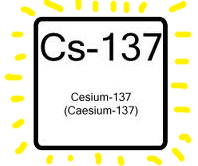 EU-funded Research: Fukushima atmospheric release of 210 quadrillion becquerels of cesium-137 used as upper bound in simulation — Chernobyl estimated at 70 to 85 quadrillion http://enenews.com/eu-funded-research-fukushima-atmospheric-release-210-petabecquerels-cesium-137-upper-bound-simulation-chernobyl-estimated-70-85-petabecquerels
Title: Modelling the global atmospheric transport and deposition of radionuclides from the Fukushima Dai-ichi nuclear accident
Source: Atmospheric Chemistry and Physics
Authors: T. Christoudias and J. Lelieveld
Date: 2013
Emphasis Added
We modeled the global atmospheric dispersion and deposition of radionuclides released from the Fukushima Dai-ichi nuclear power plant accident. […]
We obtained good agreement with measurements of 133Xe, at both T255 and T106 resolution. The comparison for 137Cs is less favorable, though not systematically biased based on the 137Cs emission estimate of 36.7 (20.1–53.1) PBq [petabecquerels (quadrillion becquerels)] by Stohl et al. (2012). This is equivalent to somewhat less than half the 137Cs source by Chernobyl (85 PBq, International Atomic Energy Agency (IAEA) (2006)). The estimate of 13 PBq by Chino et al. (2011) (revised to 8.8 PBq by Terada et al. (2012) and confirmed as a lower bound of 12 PBq by Winiarek et al. (2012), with an upper bound of 210 PBq, was also included in our comparison.
[…] Although the prevailing wind direction during the accident was in easterly direction, some of the atmospheric radioactivity was transported toward the west and southwest, and deposited in Japan and to a lesser extent reached the Philippines. Based on the above mentioned emission estimates, we calculated that an area of Japan of 34,000 km2 was contaminated by more than 40 kBqm−2 of 137Cs and 131I, to which 9.4 million people were exposed. Our model results indicate that a surface area of 60,000 km2 received a total deposition greater than 10 kBqm−2, a region inhabited by 46 million people.
[…] The research leading to these results has received funding from the European Research Council under the European Union’s Seventh FrameworkProgramme.
Nuclear Energy Agency’s 2002 assessment of the Chernobyl disaster: The total 137Cs release was estimated to be 70 petabecquerels (PBq)
1 This Month

of the week – Shut Down Drone Warfare!


Tell the Ukrainian Government to Drop Prosecution of Peace Activist Yurii Sheliazhenko

Petition to revoke the licensing of the Near Surface Nuclear Disposal Facility (NSDF) at Chalk River. https://www.ourcommons.ca/petitions/en/Petition/Details?Petition=e-7247
To see nuclear-related stories in greater depth and intensity – go to https://nuclearinformation.wordpress.com
-
Archives
- March 2026 (244)
- February 2026 (268)
- January 2026 (308)
- December 2025 (358)
- November 2025 (359)
- October 2025 (376)
- September 2025 (257)
- August 2025 (319)
- July 2025 (230)
- June 2025 (348)
- May 2025 (261)
- April 2025 (305)
-
Categories
- 1
- 1 NUCLEAR ISSUES
- business and costs
- climate change
- culture and arts
- ENERGY
- environment
- health
- history
- indigenous issues
- Legal
- marketing of nuclear
- media
- opposition to nuclear
- PERSONAL STORIES
- politics
- politics international
- Religion and ethics
- safety
- secrets,lies and civil liberties
- spinbuster
- technology
- Uranium
- wastes
- weapons and war
- Women
- 2 WORLD
- ACTION
- AFRICA
- Atrocities
- AUSTRALIA
- Christina's notes
- Christina's themes
- culture and arts
- Events
- Fuk 2022
- Fuk 2023
- Fukushima 2017
- Fukushima 2018
- fukushima 2019
- Fukushima 2020
- Fukushima 2021
- general
- global warming
- Humour (God we need it)
- Nuclear
- RARE EARTHS
- Reference
- resources – print
- Resources -audiovicual
- Weekly Newsletter
- World
- World Nuclear
- YouTube
-
RSS
Entries RSS
Comments RSS
 nuclear-news