Fukushima’s children and cleanup workers at cancer risk
Fukushima Doctor: Cancer found in over 40 children… We believe it’s related to the nuclear disaster — Physician: Leukemia cases to increase in next few months?(AUDIO) http://enenews.com/fukushima-doctor-thyroid-cancer-found-in-over-40-children-this-is-related-to-the-nuclear-disaster-physician-leukemia-cases-to-increase-in-next-few-months-audio October 11th, 2013
 TVR, Oct. 10, 2013: Belarusian therapists help Japanese colleagues to fight radiation […] Japanese doctors continue to struggle with radiation and the consequences of the Fukushima accident with the help of their Belarusian colleagues. Brest endocrinologists are among the best diagnosticians in Belarus. The first and mobile laboratory for thyroid cancer detection appeared in this region. […] Yuko Yanagisawa, therapist, Fukushima Prefecture (Japan): “The Fukushima accident took place two and a half years ago. But we have found thyroid cancer in more than forty children. The official medical community believes that this situation is not related to the radiation effects from the accident, but we disagree with this. Therefore, we came to Belarus to consult local specialists”.
See also: Japan Professor: Fukushima crisis is leading to surge in thyroid cancers… First signs of health catastrophe — NHK: Trend seen in new cancer tests is ‘suspicious’ (VIDEO)
Journal Tribune,, Oct. 1, 2013: [Yuki N. Karakawa, International Association of Emergency Managers] said the disaster at Fukushima will be felt in Japan for a  longtime, and that there will be long-term medical effects – something he claims the country hadn’t put into their planning systems.
Underestimation of radiation exposure to Fukushima workers
Radiation estimates for No. 1 workers likely 20% too low: U.N .Japan Times 13 Oct 13 KYODO NEW YORK – THE RADIATION DOSES WORKERS RECEIVED IN THE INITIAL PHASE OF THE FUKUSHIMA DISASTER MAY HAVE UNDERESTIMATED BY 20 PERCENT, A REPORT BY A U.N. PANEL SAYS.
The U.N. Scientific Committee on the Effects of Atomic Radiation said in a summary report on its website that the Japanese government and Tokyo Electric Power Co., known as Tepco, used tests that failed to take into account some types of radiation released by the three meltdowns at the Fukushima No. 1 power plant in March 2011……http://www.japantimes.co.jp/news/2013/10/13/national/radiation-estimates-for-no-1-workers-likely-20-too-low-u-n/#.UlxMO9JJMgs
Higher radiation levels in sea near Fukushima
 Radiation levels in harbour off Fukushima hit two-year high Australia Network News 10 Oct 2013 Radiation levels in harbour seawater beside one of the damaged Fukushima reactors spiked this week to the highest level in two years.
The operator of the crippled Japanese nuclear plant, TEPCO, says Cesium-134 and Cesium-137 readings on Wednesday jumped 13 times the previous day’s reading.
The readings were taken in the harbour right next to the Fukushima plant, hundreds of meters from the port entrance that connects to the Pacific Ocean.
Radiation from water leaking from the facility is mostly confined to the harbour around the plant, officials have said……http://www.abc.net.au/news/2013-10-10/an-radiation-levels-in-harbour-off-fukushima-hit-two-year-high/5015082
High radiation levels remain in parts of Fukushima’s evacuated areas
 Greenpeace critical of Japan radiation Sky News, 10 Oct 13 Japan’s efforts to scour areas around Fukushima have been insufficient, pressure group Greenpeace said Thursday, as the government considers letting some residents return to homes near the crippled nuclear plant.
The environmental group said tests it had carried out inside the original 20-kilometre no-go zone around the plant showed that high levels of radiation remain.
Local and national officials are mulling lifting the exclusion order in parts of Tamura city, allowing people to return to homes they abandoned more than two and a half years ago. They cite lowered pollution levels in the wake of large cleaning operations.
A recent Greenpeace survey found that decontamination programmes have been effective for houses and many parts of major routes in the city.
But some lesser-used public roads, large areas of farmland and mountain areas still have high contamination levels, said Jan Vande Putte, Greenpeace radiation protection adviser.
He said the cleaned houses and roads were like ‘islands’ and ‘corridors’ in an otherwise polluted region.
It would be ‘unrealistic’ to ask residents to stay off contaminated roads and farmland, he said.
‘They can be exposed to high levels of radiation’ if they returned home, he said.
Decontamination ‘is a sticky problem. It is very difficult’, he told a press briefing……. http://www.skynews.com.au/world/article.aspx?id=913978
2 holes leaked radioactive water from bottom of Fukushima tank
[Photo] 2 holes found in the bottom of 300m3 leakage tank / Entirely deteriorated http://fukushima-diary.com/2013/10/photo-2-holes-found-in-the-bottom-of-300m3-leakage-tank-entirely-deteriorated/ by Mochizuki on October 8th, 2013
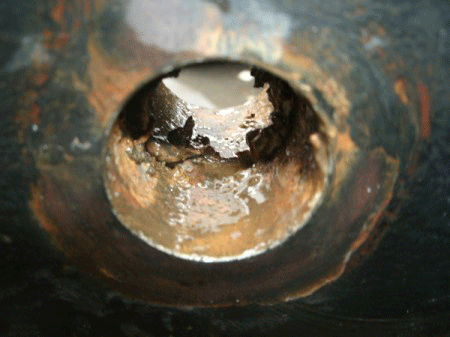
Tepco has been dismantling the tank since yesterday that experienced the 300m3 of leakage. The structural flaw may cause other tanks of the same type to leak commonly. Tepco is investigating the potential leaking points.
From their inspection, they found 2 holes around the bolt parts, which are 3mm × 11mm and 3mm × 22mm.
The flange parts were rusting inside and outside. The bottom parts of the tank were found severely deteriorated.
http://www.tepco.co.jp/nu/fukushima-np/handouts/2013/images/handouts_131008_03-j.pdf
http://photo.tepco.co.jp/date/2013/201310-j/131008-01j.html
News is not the truth. It’s a virtual reality that the sponsor wants us to live in.
Yuki Karakawa speaks on radiation emergency management
Japan Expert: Second explosion was “more like a bomb” at Fukushima — Spent nuclear fuel flew 30 kilometers away, pellets collected by military — Very strange materials like europium were found — Should have evacuated out to 300 kilometers (VIDEO) http://enenews.com/japan-expert-second-explosion-more-like-a-bomb-at-fukushima-nuclear-fuel-flew-30-kilometers-away-pellets-collected-by-japan-military-should-have-evacuated-300-kilometer-zone-150-years-t
October 7th, 2013
Title: Lessons from Fukushima
Source: Journal Tribune
Author: Tammy Wells
Date: Oct. 1, 2013
An ambassador to an international emergency management organization and a former minister of defense in Japan stopped by the York County Emergency Management Agency Monday […]
Yuki N. Karakawa, of the Karakawa Foundation and ambassador to the International Association of Emergency Managers, along with Kazuo Aichi, Japan’s defense minister in the 1990s, are both members of the Japan Resilience Initiative. […]
He said the disaster at Fukushima will be felt in Japan for a long time, and that there will be long-term medical effects – something he claims the country hadn’t put into their planning systems. […]
He estimated it will take 150 years for decontamination around Fukushima to be complete.
Yuki Karakawa – Lessons from Japan
Former York County Emergency Management Agency Director Bob Bohlmann said he’d known Karakawa for 15 years, and that he’s done a lot to spread the word about emergency management globally. […]
Yuki Karakawa’s presentation to InfraGard (“a partnership between U.S. businesses and the Federal Bureau of Investigation… dedicated to prevent hostile acts against the United States”), Published February 2013 (At 7:30 in): “300 kilometers should be evacuated, but we did not, Japan did not evacuate. […] In some areas, we can find very strange material like europium and so on. Now Self Defense Forces is collecting all materials. Also spent fuel flew because of a second explosion; it’s more like a bomb, exploded and flew like 30 kilometers. So government, or Self Defense, is now collecting all spent fuel pellets.” Watch Karakawa’s presentation here
See also: New Book: Nuclear explosion may have occurred at Fukushima Unit 3 after ‘supercritical condition’ — Sudden increase in plutonium, uranium recorded by U.S. at several EPA stations
PHOTOS: broken support braces on 400-foot tower near Fukushima reactors
New report shows support braces completely severed on 400-foot tower near Fukushima reactors (PHOTOS) http://enenews.com/new-report-shows-support-braces-completely-severed-on-400-foot-tower-near-fukushima-reactors-photos
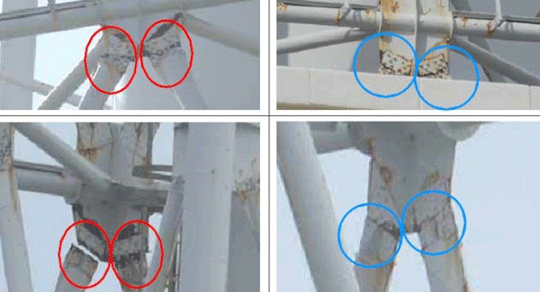
Title: (Systran Translation) Fukushima No. 1 nuclear power plant — Safety appraisal for the component damage of the machine chimney
Source: Tepco
Date: Oct. 7, 2013
h/t Fukushima Diary
Just the bare 6,700 times higher than the legal limit – Fukushima’s latest radioactive spill
 Water 6,700 times more radioactive than legal limit spills from Fukushima By Arata Yamamoto and Alexander Smith, NBC News TOKYO 4 Oct 13 — Japan’s crippled Fukushima nuclear plant has suffered yet another leak, spilling out 430 liters of contaminated water thousands of times more radioactive than legal limits, its operator said Thursday. Tokyo Electric Power Company, or TEPCO, said the water which spilled from the storage tanks had radiation readings as high as 200,000 becquerels per liter — almost 6,700 times higher than the legal limit of 30 becquerels.
Although sandbags have been placed to prevent further spread of the leak, some of that water may have already reached the plant’s harbor on the Pacific Ocean through a drainage trench, TEPCO said.
The leak comes one day after Japanese fast food company Yoshinoya Holdings announced plans to grow vegetables on a farm just 60 miles from the nuclear plant…… http://worldnews.nbcnews.com/_news/2013/10/03/20797895-water-6700-times-more-radioactive-than-legal-limit-spills-from-fukushima?lite
Japan’s Nuclear Regulator not happy with Fukushima Plant’s Operator
Japanese Nuclear Agency Scolds Fukushima Plant’s Operator NYT, By MARTIN FACKLER October 4, 2013TOKYO — In an unusually public scolding, Japan’s nuclear watchdog agency criticized the operator of the crippled Fukushima nuclear plant on Friday for making mistakes that allowed radioactive water to leak into the Pacific Ocean, and ordered it to quickly fix the problems. The agency, the Nuclear Regulation Authority, summoned the president of the operator, the Tokyo Electric Power Company, to explain the accidents and spills that have plagued the cleanup of the Fukushima Daiichi plant since it suffered a triple meltdown two years ago……
In a public hearing, an official at the regulatory agency, Katsuhiko Ikeda, dressed down Tepco’s president, saying the problems raised serious questions about the company’s ability to operate its other nuclear plants, like the huge Kashiwazaki-Kariwa facility, which Tepco wants to restart……
Critics have faulted the government for leaving the plant in the hands of the same operator that many blame for failing to sufficiently fortify it before the huge earthquake and tsunami that struck in March 2011, knocking out vital reactor cooling systems. http://www.nytimes.com/2013/10/05/world/asia/fukushima-nuclear-plant-in-japan.html?_r=0
Fukushima’s latest radioactive water leak
New leak of radioactive water at Fukushima nuclear plant may have flowed into Pacific Ocean: TEPCO Radio Australia 3 October 2013, 13:50 AEST By North Asia correspondent Mark Willacy, wires
More radioactive water is leaking at Fukushima and it may be flowing into the Pacific.The operator of the crippled Fukushima nuclear plant says it has found a new leak of radioactive water that might have flowed into the Pacific Ocean.
The leak from the 450-tonne storage tank is the second of its kind in as many months, and involved water with high concentrations of radioactive strontium and caesium.
Fukashima operator Tokyo Electric Power (TEPCO) says it does not know how much water leaked, adding that it could have flowed from an adjoining drainage ditch into the sea.
TEPCO has apologised for causing anxiety…….http://www.radioaustralia.net.au/international/2013-10-03/new-leak-of-radioactive-water-at-fukushima-nuclear-plant-may-have-flowed-into-pacific-ocean-tepco/1199662
Fukushima’s small level of radiation in fish can still cause cancers
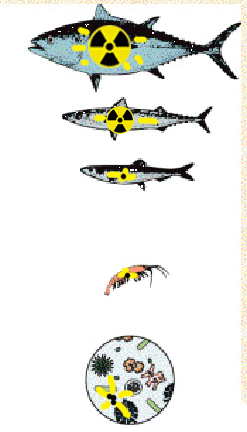 the radiation detected can still cause cancer, according to the U.S. Environmental Protection Agency’s cancer-risk formula, a leading international standard for forecasting cancer risks from radiation.
Cancer risk linked to radiation levels in fish species after Fukushima http://www.straight.com/life/497651/cancer-risk-linked-radiation-levels-fish-species-after-fukushima
In July this year, a sea bass caught in Japan had 1,000 becquerels per kilogram of radioactive cesium—10 times Japan’s ceiling of 100 becquerels per kilo in food. It was the second-highest amount found in a sea bass since the disaster occurred. Continue reading
Japan’s Nuclear Regulator’s doubt Tepco’s radiation measurements
 JP Gov doubts the reliability of Tepco’s radiation measurement / Nuclear Regulatory Agency to send inspectors http://fukushima-diary.com/2013/10/jp-gov-doubts-the-reliability-of-tepcos-radiation-measurement-nuclear-regulatory-agency-to-send-inspectors/ by Mochizuki on October 1st, 2013 Following up this article..
On 9/30/2013, Nuclear Regulation Authority commented they are planning to send inspectors to Tepco’s radiation measurement site in the working group meeting for the contaminated water in Fukushima nuclear plant.
NRA has been doubting the reliability of Tepco’s nuclide analysis. Also, in mid September, Tepco discharged the “rainwater” retained in the tank areas due to the Typhoon. However, they took only 5 minutes to analyze Cesium-134/137 of the sample to check if it’s really rainwater, which NRA found questionable about the quality.
NRA commented the inspectors from Nuclear Regulatory Agency are going to see them analyzing the samples actually. http://www.youtube.com/watch?v=B8eT6fe8WSk
Rapid increase in thyroid cancer in Fukushima kids – cover-up of causes
Fukushima Cover-Up: Extraordinary amount of kids have thyroid cancer — Officials say NOT caused by Fukushima since Chernobyl’s cancers took 4-5 yrs to appear — Yet data shows it started soon after ’86 meltdown… number of cases still rising 25 years later http://enenews.com/fukushima-cover-up-extraordinarily-high-thyroid-cancer-rates-in-kids-officials-not-related-to-nuclear-disaster-since-it-took-4-or-5-years-to-show-up-after-chernobyl-yet-data-shows-it-appe
September 29th, 2013
Kyodo,, June 5, 2013: Researchers at Fukushima Medical University […] said they do not believe that the most recent cases are related to the nuclear crisis. They point out that thyroid cancer cases were not found among children hit by the 1986 Chernobyl nuclear accident until four to five years later. […]
Asahi Shimbun, August 21, 2013: A Fukushima prefectural government official said, “It is likely (the 44 children) developed tumors or lumps before the nuclear accident.” […] In the case of the Chernobyl disaster in 1986, thyroid cancer cases started to soar four to five years later […] A number of residents have expressed strong dissatisfaction with the Fukushima prefectural government over its interpretation of the effects of radiation exposure, the accuracy of its thyroid testing and the way it discloses information.
Wikipedia:: As of August 2013, there have been more than 40 children newly diagnosed with thyroid cancer and other cancers in Fukushima prefecture as a whole, but these cancers are not attributed to radiation from Fukushima […] if Chernobyl is anything to go by the increase in thyroid cancer rates won’t begin until approximately 4–5 years after the accident.
Thyroid cancer found in 18 Fukushima children NHK WORLD English
Hiroshima to Fukushima – Data on Fukushima,, Eiichiro Ochiai (2014): “12 out of 174.000 children” […] is much higher than that seen in the Chernobyl incident […] If 15 more likely cases were taken account of, the thyroid cancer incident rate among Fukushima children would be about 7.8/100.000/year, extraordinarily a high rate. (Note: this number is still an underestimate. This number would he 21/100,0110/y if the data is more properly analyzed). The authority denies that they were caused by the radiation released from the TEPCo NPP on the basis that thyroid cancer would emerge only 4-5 years after such an incident. However, the data on the Chernobyl incident show that thyroid cancer did show up even just one year later (see Fig. 14.4) […]
Hiroshima to Fukushima – Data on Chernobyl, Eiichiro Ochiai (2014): […] a few cases of thyroid cancer seem to have occurred almost immediately within 1 year. In children, the incidence […] has kept increasing, even after 25 years. A similar trend has been observed for the groups aged 15 years or more (Ukraine report 2011). This continuous rise suggests that radiation sources other than the short-lived I-131, such as I-129 and Cs-137 may also be involved. In a highly contaminated area. Gomel of Belams, the annual incidence of thyroid cancers among children 2-18 years of age in 1998 was 58 times higher than that in 1973 […]
See also: Japan Professor: Fukushima crisis is leading to surge in thyroid cancers… First signs of health catastrophe — NHK: Trend seen in new cancer tests is ‘suspicious’ (VIDEO)
Acute danger of huge radiation release in TEPCO’s work on Fukushima Nuclear reactor no 4

 A Mistake Now Could Release 14,000 Times More Radiation than Hiroshima http://oilprice.com/Latest-Energy-News/World-News/A-Mistake-Now-Could-Release-14000-Times-More-Radiation-than-Hiroshima.html By James Burgess | Sat, 28 September 2013 Lately the bad news emanating from Japan is that the reactors at the Fukushima nuclear power plant have been leaking thousands of gallons of water ever since the earthquake that struck it in 2011. There is a high chance that the radioactive water could hit Korea, China, and the West Coast of North America, and it is only likely to get worse with time as Tepco, the Japanese utility and operator of the power plant, is unsure how to stop the leaks.
Now however there is worse news that could prove dangerous to much of the world, and again Tepco could be responsible.
At Fukushima, used nuclear fuel rods are stored in pools and, especially at reactor 4, some of these pools are damaged and at risk of completely breaking open in the event of another earthquake. If one of the pools were to collapse or catch fire, then the impacts would affect the world. Arnie Gunderson, a nuclear expert, and Helen Caldicott, a physician, have even suggested that if this occurs then people should evacuate the Northern Hemisphere. And Akio Matsumura, a former advisor for the UN, has called the situation “an issue of human survival.”
Tepco could be responsible for unleashing this devastation on the world as starting in November they have decided to begin an operation to remove 400 tonnes of fuel rod assemblies, on their own. Aworkforce of thousands is preparing to work on the fuel rod pools at the instable reactor 4 in order to relocate them to a safer location.
The spent fuel, which contains plutonium, one of the most deadly substances in the universe, will prove to be a very delicate procedure. If a fuel rod is broken, cracked, or dropped whilst being removed, then it could cause an explosion, a meltdown, or a fire; all of which would release radionuclides into the atmosphere, and result in the evacuation of Tokyo and much of Japan.
The more than 1,300 fuel rod assemblies tightly packed into the building at reactor 4 contain enough radiation equivalent to 14,000 times the radiation released during the atomic bomb dropped on Hiroshima in 1945.
Each fuel rod assembly weighs close to 300kg and measure 4.5 metres long. The reactor 4 building contains 1,331 of spent assemblies and 202 unused assemblies.
Working completely underwater, the fuel assemblies will be pulled off their racks where they are currently stored, and then inserted into a heavy steel chamber, which shields the radiation. Then they will be removed from the pool, lowered to ground level and transported across the plant to a storage pool in an undamaged building.
Toshio Kimura, a former technician at Tepco, said that “previously Previously it was a computer-controlled process that memorized the exact locations of the rods down to the millimeter and now they don’t have that. It has to be done manually so there is a high risk that they will drop and break one of the fuel rods.”
Whilst aware of the inherent dangers, Tepco is confident that it can carry out the operation safely.
Tepco doesn’t measure radiation accumulated on the bottom of the sea
Tepco doesn’t measure radiation accumulated on the bottom of the sea http://fukushima-diary.com/2013/09/tepco-doesnt-measure-radiation-accumulated-on-the-bottom-of-the-sea/ by Mochizuki on September 29th, 2013 Following up this article.. Tepco “We don’t see Tokyo bay contamination” [URL]
Regarding the Pacific contamination, Tepco stated they analyze seawater but they take the samples only from the surface of the sea on 9/27/2013.
They commented when they collect seawater samples outside of Fukushima nuclear plant port, the samples are not taken from near the bottom of the sea.
Cesium-134/137 is assumed to be accumulated on the bottom of the sea, but Tepco doesn’t and is not planning to analyze it.
Even inside of the plant port, they collect the seawater samples mostly from the surface of the sea.
Tepco explained the measurement means was not decided by only Tepco, but also with the Fisheries Agency, Fukushima prefectural government and Ministry of Education, Culture, Sports, Science and Technology.
Also, Strontium-90 is water-soluble, so even if they analyze only the surface water, they can detect the marine contamination level.
According to Tepco and Japanese government, they don’t measure high level of radiation in their sampling points of the Pacific.
1 This Month

of the week – Shut Down Drone Warfare!


Tell the Ukrainian Government to Drop Prosecution of Peace Activist Yurii Sheliazhenko

Petition to revoke the licensing of the Near Surface Nuclear Disposal Facility (NSDF) at Chalk River. https://www.ourcommons.ca/petitions/en/Petition/Details?Petition=e-7247
To see nuclear-related stories in greater depth and intensity – go to https://nuclearinformation.wordpress.com
-
Archives
- March 2026 (237)
- February 2026 (268)
- January 2026 (308)
- December 2025 (358)
- November 2025 (359)
- October 2025 (376)
- September 2025 (257)
- August 2025 (319)
- July 2025 (230)
- June 2025 (348)
- May 2025 (261)
- April 2025 (305)
-
Categories
- 1
- 1 NUCLEAR ISSUES
- business and costs
- climate change
- culture and arts
- ENERGY
- environment
- health
- history
- indigenous issues
- Legal
- marketing of nuclear
- media
- opposition to nuclear
- PERSONAL STORIES
- politics
- politics international
- Religion and ethics
- safety
- secrets,lies and civil liberties
- spinbuster
- technology
- Uranium
- wastes
- weapons and war
- Women
- 2 WORLD
- ACTION
- AFRICA
- Atrocities
- AUSTRALIA
- Christina's notes
- Christina's themes
- culture and arts
- Events
- Fuk 2022
- Fuk 2023
- Fukushima 2017
- Fukushima 2018
- fukushima 2019
- Fukushima 2020
- Fukushima 2021
- general
- global warming
- Humour (God we need it)
- Nuclear
- RARE EARTHS
- Reference
- resources – print
- Resources -audiovicual
- Weekly Newsletter
- World
- World Nuclear
- YouTube
-
RSS
Entries RSS
Comments RSS
 nuclear-news