Cover-ups and lies about Fukushima radiation amazed Australian reporter
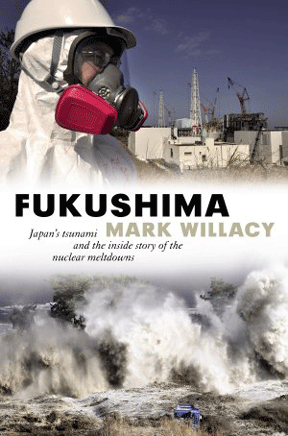 Reporter in Japan: I’m stunned by brazen cover-up and lies over effects of Fukushima radiation; An epic, unfolding tragedy — Physician: Response has been ‘unthinkable’ (VIDEO) http://enenews.com/reporter-in-japan-im-stunned-by-brazen-cover-up-and-lies-over-effects-of-fukushima-radiation-physician-response-has-been-unthinkable-video
Title: Japan – The Next Wave – Foreign Correspondent – ABC
Source: ABC’s Foreign Correspondent
Date: Nov. 5, 2013
Transcript Excerpts
Mark Willacy, reporter: I’ve been stunned by the brazen and often clumsy efforts to cover-up and lie about the effects and extent of the radiation damage. […] It’s abundantly clear many aspects of this epic, unfolding tragedy are yet to be written — the nuclear fallout will see to that.
Tomoko Koike. mother of 2 and 4 year old in Fukushima Precture: We do not know the real situation. We don’t know whats going on. I can’t trust them. […] My children had never contracted influenza before, even without vaccination. But they contracted it last year. Their vulnerability to illness has increased. […]
Willacy: Her children have already been screened and cleared in tests run by the Fukushima local government. But a follow up screening here at the private Hirata hospital revealed cysts on the thyroid gland of 4 year old Saki.
Koike: A couple of cysts were found. I was very shocked. I don’t know whether the examination by the prefecture was sloppy, or that she wasn’t examined properly.
Dr. Minoru Kamata: It was disclosed that the Fuksuhima health investigation committee was having several secret meetings. I feel the response to this issue has been unthinkable for a democratic nation.
Watch the broadcast here
With Fukushima’s emergency cleanup – it’s no time to be advocating new nuclear power!
nothing short of a full-on global presence will do. The bring-down of the fuel rods from Unit Four is a terrifying unknown. There’s no precedent for an operation of this scope, precision or potential fallout.
At very least it demands fullest possible attention from all the world’s best scientists and engineers. The global media must power through the Abe Administration’s crack-down on the flow of information. And we must all direct our full awareness to what is about to happen at Fukushima.
before anyone advocates MORE nuclear power, they should take a good long look at what’s going at Fukushima. And if they are claiming atomic expertise, maybe they should jump in to help.
 Global Warming vs Global Nuclear Radiation: Climate Scientists Dismiss Fukushima, Lobby for Nuclear Energy Global Research 4 Nov 13 Four climate scientists have made a public statement claiming nuclear power is an answer to global warming. Before they proceed, they should visit Fukushima, where the Tokyo Electric Power Company has moved definitively toward bringing down the some 1300 hot fuel rods from a pool at Unit Four.
Which makes this a time of global terror.
In response more than 150,000 petition signatures from www.nukefree.org and others will be delivered at the United Nations this Thursday, November 7, asking for a global response to this disaster.
Since March 11, 2011, fuel assemblies weighing some 400 tons, containing more than 1500 extremely radioactive fuel rods, have been suspended 100 feet in the air above Fukushima Daiichi’s Unit Four. “If you calculate the amount of cesium 137 in the pool, the amount is equivalent to 14,000 Hiroshima atomic bombs,” says Hiroaki Koide, assistant professor at Kyoto University Research Reactor Institute. Former US Department of Energy official Robert Alvarez, an expert on fuel pool fires, calculates potential fallout from Unit Four at ten times greater than what came from Chernobyl.
Tokyo Electric Power says it may start moving these fuel rods as early as November 8. Continue reading
Public and scientists do not believe Shinzo Abe’s statement that Fukushima nuclear radiation is controlled
For former nuclear engineer Michael Friedlander, who describes himself as “an avid supporter of responsible nuclear power,” these comments are damaging to the atomic industry.
“It’s a very Japanese way of handling the situation, the authorities telling everybody that everything’s OK, don’t worry, we’re in control,” Friedlander said in an interview from Hong Kong.
Abe’s comments haven’t persuaded the Japanese public. A Kyodo News poll conducted Oct. 26 and Oct. 27 found that 83 percent of respondents said they didn’t believe his “under control” statement.
The residents of Namie, a town 8 kilometers from the Fukushima nuclear station that was evacuated, said that Abe is making “irresponsible comments.
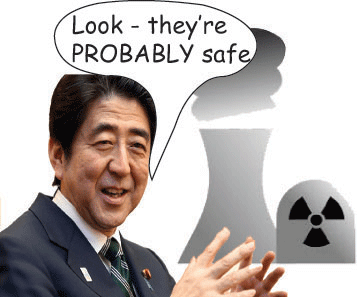 Abe’s stance on Fukushima water fuels skepticism Claim radioactivity contained scoffed at by public, scientists The Columbian, By Tsuyoshi Inajima and Yuriy Humber, Bloomberg News November 2, 2013, TOKYO — Japan’s Prime Minister Shinzo Abe says radioactive water flowing into the sea from the crippled Fukushima atomic station is being contained within the plant’s harbor, a view maintained by operator Tokyo Electric Power Co.
Marine scientists, Fukushima residents and Japan’s general public don’t agree. Continue reading
Lawmaker tells Japan’s Emperor the truth about Children affected by Fukushima radiation
Lawmaker warns emperor of reality facing Japan: “Children are suffering from health problems” — Another official reveals “the incidence of cancer in children has been increasing” and is heckled (VIDEO) http://enenews.com/lawmaker-warns-emperor-of-reality-facing-japan-children-are-suffering-from-health-problems-another-official-reveals-the-incidence-of-cancer-in-children-has-been-increasing-and-is-heckled
Kyodo News, Nov. 1, 2013: “I wrote the letter because I wanted the emperor to know the situation of children who have suffered from radiation exposure, the appalling labor conditions for workers at the nuclear plant, and the poor way radiation (exposure) is being managed,” [Japanese lawmaker Taro] Yamamoto said. When the emperor came near him, Yamamoto expressed fear that the children are suffering from health problems, saying, “The future of the children is in danger” and gave the letter to the emperor […]
Asahi Shimbun, Nov. 1, 2013: “I, as an individual, only wanted to tell the emperor the truth about the health hazard posed to children and the workers who are exposed to radiation and being abandoned” […] “I wanted to explain the plight of children exposed to radiation […] From a common sense point of view, handing a letter to His Majesty may be rude. However, even though it is, I could not contain my desire to have him understand what is happening,” the lawmaker said.
Asahi Shimbun, Nov. 2, 2013: “I wanted to explain the plight of children exposed to radiation released after the nuclear accident and the health condition of people who are working at the facility in the worst conditions”
Reuters, Nov. 1, 2013: “I wanted him to know about the children who have been contaminated by radiation”
Jiji Press,, Nov. 2, 2013: […] he wanted to inform the Emperor of the real situation facing the nation following the March 2011 nuclear crisis […]
Watch footage of Yamamoto handing the letter to the emperor here
MP Katsumasa Suzuki, Oct. 17, 2013: “In Fukushima, the incidence of cancer in children there has been increasing.” Watch Suzuki’s speech at the Diet here
Fukushima workers speak out on conditions and criminal connections
Workers include people sent here by yakuzas for their debts and down and out yakuzas themselves. The site is full of yakuzas and rank amateurs…
Anonymous Fukushima Workers: We dumped untested water last typhoon, could be criminal — ‘Landmines’ of extremely high radiation at many locations — Very worrying that I’m getting sick more now — “Site full of yakuza & rank amateurs” http://enenews.com/anonymous-fukushima-workers-dumped-untested-water-during-last-typhoon-could-be-criminal-landmines-extremely-high-radiation-many-locations-very-worrying-im-getting-sick-site-full-yakuza-rank October 31st, 2013
Excerpts from an Oct. 22, 2013 report in Shukan Gendai with translation by EX-SKF:
Worker A, man in his 30s from Kanagawa Prefecture, volunteered to work at Fukushima I NPP right after the accident
The skilled workers […] work closer to the reactors, and they exceed the limit in one to two weeks.
Worker B, man in his 40s from Osaka Prefecture, commutes to the plant from his dorm in Iwaki City
I’m working with […] a former worker at a pub in Shinjuku, a life guard at a swimming pool, a cram school teacher, a truck driver. In other words, rank amateurs. There is no skilled worker. […] Continue reading
The smallest slip up could trigger nuclear catastrophe
VIDEO and AUDIO Fukushima decommissioning slip-up could trigger monumental chain reaction, expert warns One slip-up in the latest step to decommission Japan’s crippled Fukushima nuclear plant could trigger a “monumental” chain reaction, experts warn. ABC NewsWithin days, Fukushima nuclear plant operators will begin what is being described as the most dangerous phase of the decommissioning process so far.
In an operation never before attempted, the Tokyo Electric Power Company (TEPCO) will start removing 1,331 highly radioactive used fuel assemblies from a deep pool which sits high above the ground in a shattered reactor building.
The Fukushima nuclear plant’s reactors were sent into meltdown by an earthquake and tsunami in 2011 in the world’s worst nuclear accident since Chernobyl. Experts around the world have warned ever since that the fuel pool is in a precarious state – vulnerable to collapsing in another big earthquake.Yale University professor Charles Perrow wrote about the number 4 fuel pool this year in the Bulletin of Atomic Scientists.He said one pool contains 10 times the amount of radioactive caesium present in the Chernobyl disaster and warned one slip-up with the removal could trigger a chain reaction.
“This has me very scared,” he told the ABC. ”Tokyo would have to be evacuated because [the] caesium and other poisons that are there will spread very rapidly. ”Even if the wind is blowing in the other way, it’s going to be monumental.”….. http://www.abc.net.au/news/2013-10-31/fukushima-nuclear-meltdown-tepco-tokyo/5059514
Pregnant women offered free houses if they return to Fukushima

 Japan Professor: Pregnant women get free new houses if they move back to Fukushima — Physician/Mayor: Children being severely harmed, must be evacuated; World has never come across situation like this (VIDEO)
Physician Akira Sugenoya, mayor of the city of Matsumoto interviewed by VoR,, Oct. 30, 2013: “Immediately following the accident at the Fukushima nuclear power plant, I started saying that children should not be allowed to live on the contaminated territory [it] weakens children’s immune system and severely harms their health […] Children are a lot more vulnerable to radiation than adults. […] I want to repeat once again that children should be relocated to clean, radiation-free areas at least temporarily. […] is it feasible to quickly and effectively do away with radioactive pollution? I am absolutely certain that it is unfeasible. […] Compared to Chernobyl, the situation in Japan is further aggravated by radioactive water leakages. The world has never ever come across this kind of situation. […] We should admit that radioactive water is a grave problem. The threat that children may have been contaminated with radioactive materials still looms large. We shouldn’t remain indifferent to the challenges we are facing.”
Hiroko Goto, Professor at Chiba University School of Law & Vice President of Human Rights Now, , Published June 29, 2013 (At 10:00 in): The second one is very problematic — New residential support plan for evacuees from outside Fukushima — this mainly focuses on the pregnant women and the children. If the pregnant women or children decide to go back to Fukushima, Fukushima Prefecture will offer a new, very good house without payment. And this kind of policy they introduce means that the local government wants the people back to their area. So this is a very not good situation for the women’s and children’s health. Watch Professor Goto’s presentation here
Fukushima’s 3 radioactive cores burned through reactor bottoms
 “We’ve opened a door to hell” at Fukushima plant, and may never be able to close it — Radio Host: You mean that even with robots they don’t know where the 3 reactor cores are? (AUDIO) http://enenews.com/radio-weve-opened-a-door-to-hell-at-fukushima-plant-and-may-never-be-able-to-close-it-host-you-mean-that-even-with-robots-they-dont-know-where-3-reactor-cores-are-audio
Title: Discussing Fukushima
Source: Art Bell’s Dark Matter
Date: Oct. 29, 2013
Paul Gunter, nuclear power industry watchdog at Beyond Nuclear:r: We’ve got 3 reactors, the cores have left the vessel. They’ve burned through the bottom of the vessel. We don’t really know where they are, because the radioactive environment even fries robots that Tepco’s been trying to send in there. They have been sending very innovative robotic machinery and sensors in there to get a picture, to get a reading, and these things don’t return. We have opened a door to hell that cannot be easily closed — if ever. We’ve got those 3 cores that are melting, they could be somewhere in the concrete base mat burning their way through, they could have already burned through and entered into the ground. They hopefully have formed a huge solid ‘elephant’s foot’ of highly radioactive material.
Art Bell, host: You mean that even with robotic help, they don’t know where the cores are?
Gunter: Correct. We’ve got 3 molten cores that we don’t have a status report on.
Fear of earthquakes may be prompting the speed up on clearing Fukushima Unit 4
Why are they ‘speeding up’ at Unit 4? — Expert in 2010: Megathrust quake to hit Fukushima ~Nov. 2013… Recurrence interval of 75 years with last rupture Nov. 1938 — Planet’s most powerful type of seismic event — WSJ: Top official concerned quake to destabilize fuel pool http://enenews.com/theyre-rushing-start-unit-4-expert-2010-megathrust-quake-hit-fukushima-nov-2013-recurrence-interval-75-years-last-rupture-nov-1938-planets-powerful-type-seismic-event-wsj-top-official-concern

Wall St. Journal,l, October 30, 2013 (Emphasis Added): Tepco will remove about 1,300 spent fuel rods and 200 new fuel rods […] the 4 meter-long rods will be pulled out of the pool at a time, is considered unprecedented in its scale. Shunichi Tanaka, chairman of the Nuclear Regulation Authority, has expressed concerns about the fragile state of the nuclear fuel left in three reactors and the spent fuel pool in the No.4 building. If improperly handled or destabilized by another major earthquake at the site, the fuel could discharge large amounts of radiation into the environment. […] Continue reading
Mounting radioactive debris reaching West Coast of North America
Those who still say that the Chernobyl disaster was worse than Fukushima may also want to consider that a Woods Hole Oceanographic Institution study conducted in October 2011 concluded that Fukushima had already released up to 100 times more radiation into the environment than Chernobyl at that time. Today, this amount is likely astronomically higher, especially when you take into account all the airborne radioactive plumes that have been detected billowing across the ocean and over U.S. soil.
Radioactive Debris in Pacific Ocean: Fukushima Radiation is Tearing up the West Coast of the US and Canada http://www.globalresearch.ca/radioactive-debris-on-pacific-ocean-fukushima-radiation-is-tearing-up-the-west-coast-of-the-us-and-canada/5355919 By Ethan A. Huff
Global Research, October 28, 2013 As cleanup crews gear themselves up to begin the treacherous task of removing 400 tons of spent fuel from the Fukushima Daiichi Reactor No. 4 in the coming weeks, reports continue to flood in showing that radiation from the stricken plant is still causing major environmental damage all over the world.
Particularly on the West Coast of the U.S., a multitude of strange animal deaths, high radiation readings and other recent anomalies suggest that the Fukushima disaster is far from over. It is simply ludicrous, in other words, for anyone to suggest at this point that these Fukushima woes are dwindling, as fresh evidence suggests that quite the opposite is true. Continue reading
Fukushima nuclear fuel removal may start Nov 8 – a dangerous exercise
Warning from Japan’s Top Nuclear Official: I am “much more worried” about fuel in Fukushima Unit 4 — Rods may break open and release highly radioactive material — Beware risks from debris, a disaster if damaged — Removal may start Nov. 8 http://enenews.com/warning-from-japans-top-nuclear-official-i-am-much-more-worried-about-fuel-in-unit-4-rods-may-break-open-and-release-highly-radioactive-material-beware-risks-from-debris-disaster-if-dama
Associated Press,, Oct. 30, 2013: Japanese regulators on Wednesday gave final approval for the removal of fuel rods [to] start in November […] About 200 of the rods that are unused and safer are expected to be the first […] Nuclear regulatory chairman Shunichi Tanaka, however, warned that removing the fuel rods from Unit 4 would be difficult because of the risk posed by debris that fell into the pool during the explosions. “It’s a totally different operation than removing normal fuel rods from a spent fuel pool,” Tanaka said at a regular news conference. “They need to be handled extremely carefully and closely monitored. You should never rush or force them out, or they may break.” He said it would be a disaster if fuel rods are pulled forcibly and are damaged or break open when dropped from the pool, located about 30 meters (100 feet) above ground, releasing highly radioactive material. “I’m much more worried about this than contaminated water,” Tanaka said. […]
Channel 4 (UK), Oct. 15, 2013: The worst case scenario is if the fuel assemblies are dropped, which could ultimately lead to a partial meltdown […]
VoA News,, Oct. 15, 2013: That hydrogen explosion […] left the inside of the pool littered with debris. […] TEPCO’s first task is to remove the debris. […] The fuel rods must be kept submerged and must not touch each other or break. Nuclear experts warn any mishaps could cause an explosion many times worse than in March 2011.
NHK WORLD,, Oct 30, 2013: […] The firm hopes to begin the removal at the facility’s Number 4 reactor on November 8th. Tokyo Electric plans to check whether the rods are damaged by debris that fell into the pool in March 2011, and to ensure that they do not get caught in the debris during the removal process. […]
Japan’s nuclear regulator OKs removal of fuel rods from Unit 4 Fukushima
 Japan OKs fuel removal from pool at nuclear plant Mail.com, TOKYO (AP) October 30, 2013 — Japanese regulators on Wednesday formally approved the removal of fuel rods from an uncontained cooling pool at a damaged reactor building considered the highest risk at a crippled nuclear plant.
Removing the fuel rods from the Unit 4 cooling pool is the first major step in a decommissioning process that is expected to last decades at the Fukushima Dai-ichi plant, where three reactors melted down after the March 2011 earthquake and tsunami. The Nuclear Regulation Authority said at its weekly meeting that the proposal by the plant’s operator, Tokyo Electric Power Co., is appropriate and that the removal can start in November as planned, following an on-site inspection by regulators. Japanese public broadcaster NHK said the removal would start as early as Nov. 8, but TEPCO said it may not announce the date in advance, citing security reasons…… TEPCO has reinforced the structure around the pool and says the Unit 4 building can survive a major earthquake, but the unenclosed pool on the unit’s top floor, which contains 1,533 fuel rods, has caused international concern. About 200 of the rods that are unused and safer are expected to be the first to be removed……. it would be a disaster if fuel rods are pulled forcibly and are damaged or break open when dropped from the pool, located about 30 meters (100 feet) above ground, releasing highly radioactive material. “I’m much more worried about this than contaminated water,” Tanaka said.
TEPCO has prepared a massive steel structure that comes with a remote-controlled crane to remove the fuel rods, which will be placed into a protective cask and transferred to a joint cooling pool inside a nearby building. To make room for the Unit 4 fuel rods, the company has been moving those already in the joint pool to safer storage in dry casks at a separate plant location.
The utility plans to empty the Unit 4 pool by end of 2014, and remove fuel rods from other pools at three other wrecked reactors over several years before digging into their melted cores around 2020. The Fukushima plant has had a series of mishaps in recent months, including radioactive contaminated water leaks from storage tanks, adding to concerns about TEPCO’s ability to safely close down the plant. http://www.mail.com/news/world/2427376-japan-oks-fuel-removal-pool-nuclear-plant.html
Unemployed Japanese tricked into dangerous jobs at Fukushima
‘Nuclear Slaves’ at Fukushima: Workers have debts paid off, forced to stay as ‘indentured servants’ — Foreign workers may soon be needed at plant, official reveals http://enenews.com/nuclear-slaves-at-fukushima-workers-have-debts-paid-off-forced-to-stay-as-indentured-servants-foreign-workers-may-soon-be-needed-at-plant-reveals-tepco-vp
Voice of Russia, Oct. 27, 2013: “Nuclear slaves” discovered at Fukushima […] An in-depth journalistic investigation uncovered that thousands of unemployed Japanese were tricked into working underpaid and highly dangerous jobs on the site of Fukushima’s nuclear disaster. […] Yakuza act as enforcers who keep the “nuclear slaves” from complaining or leaving their jobs. […] Reuters reports that “labor brokers” […] resort to “buying” laborers by paying off their debts and then forcing them to work in hazardous conditions until their debt to the “labor broker” is paid off. Such “employment schemes” are commonly referred to as “indentured servitude” and are a form of slavery […] Lake Barrett, a former US nuclear regulator and an advisor to Tepco, told the news agency that existing practices won’t be changed for Fukushima decontamination: “There’s been a century of tradition of big Japanese companies using contractors, and that’s just the way it is in Japan. You’re not going to change that overnight just because you have a new job here, so I think you have to adapt.”
Asahi Oct. 28, 2013: TEPCO President Naomi Hirose […] explained that it is getting difficult for the utility to secure sufficient manpower at the plant and that it was grappling with tasks the company was not familiar with.
AP,, Oct. 28, 2013: Hirose acknowledged that TEPCO is having trouble finding a stable pool of workers at the plant […] TEPCO Vice President Zengo Aizawa said […] that uncertainty remains over the long-term decommissioning process. “We are not sure about our long-term staffing situation during the upcoming process of debris removal, which requires different skills,” Aizawa told a news conference. Asked if the company may have to consider hiring foreign workers, he said TEPCO is open to that idea even though it’s not an immediate option. […] [Shunichi Tanaka, chairman of the NRA] called on Hirose to implement sweeping steps to safeguard workers from high doses of radiation and other troubles […]
‘Bold and drastic’ action essential at Fukushima
Japan’s nuclear watchdog urges ‘bold and drastic’ action at Fukushima Raw Story, By Agence France-Presse Monday, October 28, 2013 Japan’s nuclear watchdog on Monday urged “bold and drastic” action to fix problems with radioactive water at Fukushima, as it warned of the growing risks over coming months.
Shunichi Tanaka, chairman of the Nuclear Regulation Authority, told the president of operator Tokyo Electric Power (TEPCO) that no expense should be spared in getting to grips with the water leaks that have beset the plant over the last half-a-year.
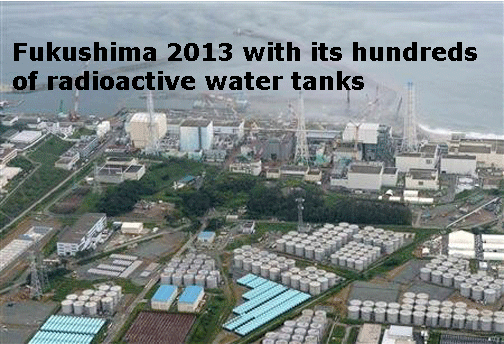
He also told Naomi Hirose that the removal of spent nuclear fuel rods from a cooling pool, which is due to begin next month, would be a difficult and complicated task……. Tanaka also urged TEPCO to exercise the utmost caution when it starts taking used nuclear fuel rods from a cooling pool at Reactor No.4.
In what is widely acknowledged to be the trickiest operation since the overheating reactor cores were stabilized in December 2011, TEPCO plans to take more than 1,000 fuel assemblies (bundles of rods) from the pool using a crane.
The assemblies must be moved one at a time and have to be kept in water to prevent them from spontaneously heating up. “Once a problem occurs, the risks will grow,” Tanaka told the TEPCO chief, according to Ikeda. “I would like you to do it very carefully.”
Hirose said he was fully aware of the possible dangers surrounding the operation, saying the firm would closely work with expert companies on site.
The full decommissioning of Fukushima is likely to take decades and include tasks that have never been attempted anywhere in the world, such as the removal of reactor cores that have probably melted beyond recognition.
Meanwhile, villages and towns nearby remain largely empty, their residents unable or unwilling to return to live in the shadow of the leaking plant because of the fear of radiation. http://www.rawstory.com/rs/2013/10/28/japans-nuclear-watchdog-urges-bold-and-drastic-action-at-fukushima/
Fukushima’s radiation leaks – a slowly unfolding environmental misery

”There is no precedent for what is happening, so we are on untrodden ground.”
The Fukushima plant’s tainted water continues to contaminate the sea, Canberra Times, Martin Fackler and Hiroko Tabuchi, 28 Oct 13, FOR MONTHS now, it has been hard to escape the continuing deluge of bad news from the devastated Fukushima nuclear power plant.
Even after the company that operates the plant admitted this summer that tonnes of contaminated groundwater were leaking into the Pacific Ocean every day, new accidents have added to the uncontrolled releases of radioactive materials. Last month, newly tainted rainwater overflowed dykes. Two weeks before that, workers mistakenly disconnected a pipe, dumping 10 more tons of contaminated water onto the ground and dousing themselves in the process.
Those accidents have raised questions about whether the continuing leaks are putting the environment, and by extension the Japanese people, in new danger more than 2½ years after the original disaster – and long after many had hoped natural radioactive decay would have allowed healing to begin.
Interviews with scientists suggest they are struggling to determine which effects – including newly discovered hot spots on a wide swath of the ocean floor near Fukushima – are from recent leaks and which are leftovers from the original disaster. But evidence collected by them and the plant’s operator, the Tokyo Electric Power Co, or TEPCO, shows worrying trends.
The latest releases appear to be carrying much more contaminated water than before into the Pacific. And that flow may not slow until at least 2015, when an ice wall around the damaged reactors is supposed to be completed. Beyond that, although many Japanese believed that the plant had stopped spewing radioactive materials long ago, they have continued to seep into the air.
”This has become a slowly unfolding environmental misery,” said Atsunao Marui, a geochemist at the Geological Survey of Japan who has studied contaminated groundwater flowing from the plant. ”If we don’t put a stop to the releases, we risk creating a new man-made disaster.”…… Continue reading
1 This Month

of the week – Shut Down Drone Warfare!


Tell the Ukrainian Government to Drop Prosecution of Peace Activist Yurii Sheliazhenko

Petition to revoke the licensing of the Near Surface Nuclear Disposal Facility (NSDF) at Chalk River. https://www.ourcommons.ca/petitions/en/Petition/Details?Petition=e-7247
To see nuclear-related stories in greater depth and intensity – go to https://nuclearinformation.wordpress.com
-
Archives
- March 2026 (237)
- February 2026 (268)
- January 2026 (308)
- December 2025 (358)
- November 2025 (359)
- October 2025 (376)
- September 2025 (257)
- August 2025 (319)
- July 2025 (230)
- June 2025 (348)
- May 2025 (261)
- April 2025 (305)
-
Categories
- 1
- 1 NUCLEAR ISSUES
- business and costs
- climate change
- culture and arts
- ENERGY
- environment
- health
- history
- indigenous issues
- Legal
- marketing of nuclear
- media
- opposition to nuclear
- PERSONAL STORIES
- politics
- politics international
- Religion and ethics
- safety
- secrets,lies and civil liberties
- spinbuster
- technology
- Uranium
- wastes
- weapons and war
- Women
- 2 WORLD
- ACTION
- AFRICA
- Atrocities
- AUSTRALIA
- Christina's notes
- Christina's themes
- culture and arts
- Events
- Fuk 2022
- Fuk 2023
- Fukushima 2017
- Fukushima 2018
- fukushima 2019
- Fukushima 2020
- Fukushima 2021
- general
- global warming
- Humour (God we need it)
- Nuclear
- RARE EARTHS
- Reference
- resources – print
- Resources -audiovicual
- Weekly Newsletter
- World
- World Nuclear
- YouTube
-
RSS
Entries RSS
Comments RSS
 nuclear-news