Girls most affected by Fukushima radiation – World Health Organisation
Japan to Begin Restarting Idled Nuclear Plants, Leader Says NYT By MARTIN FACKLER and HIROKO TABUCHI Matthew L. Wald contributed reporting from Washington. February 28, 2013 ”……..According to the study, girls exposed as infants to radioactivity in the most contaminated regions of Fukushima Prefecture faced a 70 percent higher risk of developing thyroid cancer than would be expected normally. The report pointed out, however, that the normal risk of thyroid cancer was just 0.75 percent, and that the additional lifetime risk would raise that to 1.25 percent.
 Girls exposed to radioactivity as infants in the most heavily contaminated areas also had a 6 percent higher risk of developing breast cancer, and a 4 percent higher risk of developing cancers that cause tumors. Meanwhile, boys exposed as infants had a 7 percent higher chance of developing leukemia.
The study also said that about a third of the emergency workers who remained to try to stabilize the Fukushima Daiichi plant were estimated to have a slightly increased risk of developing leukemia, thyroid cancer and other types of cancer.
The analysis was based on data available as of September 2011, and takes into account airborne contamination as well as contaminated food, water and other sources of contamination, the WH.O. said. http://www.nytimes.com/2013/03/01/world/asia/japan-to-begin-restarting-idled-nuclear-plants.html?_r=0
High increase in radiation in soil near Fukushima river
 Radiation level offshore Fukushima river increased to be 95 times much as 1 month before http://fukushima-diary.com/2013/02/radiation-level-offshore-fukushima-river-increased-to-be-95-times-much-as-1-month-before/
According to Tepco, the radiation level of sea ground soil jumped up by 950% from November to December in 2012.
The sampling location was 2km offshore of Ukedogawa in Namie machi, where is in 4~5 km north from Fukushima plant.
It was 25Bq/Kg in November, it was 2,370Bq/Kg in December.
Radiation situation at Fukushima is unimaginably bad
 No workers were visible around the No. 3 reactor building. An unmanned crane was removing debris on the roof.
It is hazardous to human health to work in the reactor building where
radiation levels range from 20 to 100 millisieverts per hour.
 The amount of radioactive water stored in tanks and other facilities
rose to 230,000 tons this month, up from 10,000 tons in July 2011.
In addition, an estimated 100,000 tons of water have accumulated in
the basements of buildings.
Decommissioning will not be completed for the next 30 to 40 years
High radiation bars decommissioning of Fukushima plant Asahi  Shimbun,
February 21, 2013
By HISASHI HATTORI/ Senior Staff Writer
Preparations for the mammoth task of decommissioning crippled reactors
at the Fukushima No. 1 nuclear power plant are being stymied by
continued high levels of radiation from the triple meltdowns there two
years ago.
Tokyo Electric Power Co., operator of the plant, has had to install
more tanks to store radioactive water, which continues to swell by
several hundreds of tons daily.
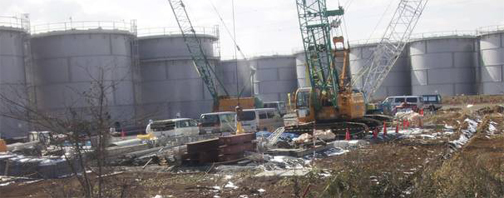
Asahi Shimbun reporters entered the No. 4 reactor building on Feb. 20,
accompanied by inspectors from the secretariat of the Nuclear
Regulation Authority, to assess the situation….. Continue reading
No costs for nuclear firms that built Fukushima reactors, but residents must pay back compensation
 the firms that helped design and build the Fukushima reactors, such as General Electric, Toshiba and Hitachi, are not required to pay a cent in compensation.
Aslihan Tumer, Greenpeace’s international nuclear project leader, says some of the companies are continuing to profit from the reactor.
“Nuclear suppliers are completely protected from accepting any liability or being held accountable in case of an accident,” he said.
Residents paying back Fukushima compensation ABC News, By North Asia correspondent Mark Willacy Feb 19, 2013 Nearly two years on from the meltdowns at the Fukushima nuclear plant, there are accusations the nuclear industry is evading its responsibilities.
The disaster has mostly dropped out of the news in Japan and its victims remain largely hidden after being placed in tiny, so-called temporary apartments across the country.
The ABC has learned that TEPCO, the operator of the Fukushima plant, is handing out what are called “temporary compensation” payments – money handed out to victims of the meltdowns, but which must be repaid….. Continue reading
Tepco demands that Fukushima nuclear victims pay back compensation money!
 AUDIO Company asking Fukushima victims to repay compensation: Greenpeace http://www.radioaustralia.net.au/international/radio/program/connect-asia/company-asking-fukushima-victims-to-repay-compensation-greenpeace/1090696
Title: Company asking Fukushima victims to repay compensation: Greenpeace
Source: ABC Radio Australia
Author: Mark Willacy, North Asia correspondent
Date: February 19, 2013
h/t Pu239
[…] A report by the environmental activist group Greenpeace, to be released later today, points out that the firms that helped design and build the Fukushima reactors [such as General Electric, Toshiba and Hitachi] are not required to pay a cent in compensation and are profiting from the disaster.
Meanwhile, the ABC program AM has learned that the operator – TEPCO – is handing out what’s called ‘temporary’ compensation which victims of the meltdown have to repay.
“We had that money deducted from our compensation. I was surprised, so I called TEPCO and said that they were using dirty tricks, that they were using fraud. Why did they give it to us to if we had to pay it back?” -Yukiko Kameya of Futaba
full broadcast here
Ocean near Fukushima still getting radiation leakage, blue fin tuna with radiation

“…The answer was yes. (See below for the PDF of the study.) That means, ultimately, that there is still a high level of radiation in the waters near the Fukushima plant most likely because, as marine chemist, Ken Buessler, asserts, the plant is still leaking radiation into the ocean nearly two years later….”
Bluefin Tuna From The Fukushima Nuclear Meltdown Still Have Traces Of Radiation, Forbes, Monte Burke, 20 Feb 13,
Last May I wrote a piece about Bluefin tuna caught off the coast of southern California that carried radiation from the Fukushima,Japan, nuclear plant that was damaged in the March 2011. The fish were caught in August 2011 as they migrated east 6,000 miles from their spawning grounds in Japan in search of prey….
Last week one of the authors of the study from last year, Daniel J. Madigan from Stanford University’s Hopkins Marine Station—along with five other scientists— published a new follow-up study. The main question that this new study wanted to answer: Would the migratory Bluefin tuna show up again a year later off the coast of California carrying radiation from Fukushima? Bluefin Tuna Study http://www.forbes.com/sites/monteburke/2013/02/20/bluefin-tuna-from-the-fukushima-nuclear-meltdown-still-have-traces-of-radiation/
44% of Fukushima children have thyroid abnormalities – report released
Report: Now over 44% of Fukushima children have thyroid abnormalities in latest tests http://enenews.com/report-now-over-44-of-fukushima-children-tested-have-thyroid-abnormalities February 14th, 2013 a
Title: Fukushima Thyroid Examination Part 4
Source: FukushimaVoice
Date: Feb. 13, 2013
The Tenth Report of Fukushima Prefecture Health Management Survey was released on February 13, 2013. […]
The results compiled up to January 21, 2013 revealed that 41,947 (44.2%) of 94,975 children had thyroid ultrasound abnormalities. Together with 38,114 children (13,645 or 35.8% had thyroid ultrasound abnormalities) tested in the last half of Fiscal Year Heisei 23 (FYH23) from October 2011 through March 2012, a total of 55,592 (41.8%) of 133,089 Fukushima children have been found to have ultrasound abnormalities.
 The Fukushima Prefecture Health Management Survey Planning Committee revealed that 10 of 186 eligible for the secondary examination from FYH23 were suspected of having thyroid cancer as a result of the examination. They reported that three of them were confirmed to have papillary carcinoma of thyroid gland and already had surgery. The remaining seven have 80% chance of having cancer based on their biopsy results. […]
The percentage of abnormalities from FYH24 at 44.2% is higher than previous results of 42.7% and 43.1%, and the overall abnormality rate, for FYH23 and FYH24 combined, of 41.8% is higher than the last result of 40%. The proportion of children with nodules equal to and larger than 5.1 mm and any size cysts have increased. […]
See also: Kyodo: 10 Fukushima children believed to have cancer — 70% female — Several already had surgery for thyroid
AUDIO: Medical issues of US navy sailors affected by Fukushima radiation
AUDIO “I’ve got people who are bleeding from their behinds, who have sores all over their bodies” -Attorney for U.S. Navy sailors exposed to Fukushima radiation (AUDIO) http://enenews.com/ive-people-bleeding-behinds-sores-all-bodies-attorney-navy-sailors-exposed-fukushima-radiation
February 12th, 2013
Title: 70,000 US Service Personnel Exposed To Radiation: Operation Tomodachi 3/11
Source: Nuked Radio with RadChick
Date Published: Feb 9, 2013
Attorney Paul C. Garner, representing U.S. service members who were in Japan after 3/11: Kim Geiseking who was on the Reagan, and she was pregnant at the time and didn’t know it.
Her fetus, her baby is now a couple of years old and doesn’t speak.
I’m not an expert, but experts say the fetus takes up most of the radiation, more than the mother does.
Then I’ve got people who are bleeding from their behinds, who have sores all over their bodies.
More from the U.S. service members:
-
Navy Sailors After Fukushima: They’ve got leukemia, testicular cancer, growths… They’ve had surgery to remove brain lesions and lost sight in eye (VIDEO)
-
Report: Many U.S. servicemembers’ kids in Japan developed medical issues after 3/11 — “My son went on a vomiting fit of about 3 months… 15-20 times a day” (VIDEO)
-
Attorney to Tepco: Please help us, we have troops who are dying, need medical care after 3/11 — Bone marrow transplant at NIH — Another bleeding incessantly (AUDIO)
Detection of radioactivity in Fukushima child
Video: Fukushima child has radioactivity of 6,000 disintegrations per second inside body http://enenews.com/video-fukushima-child-has-radioactivity-of-6000-disintegrations-per-second-inside-body
February 12th, 2013
Follow-up to: Top Radiation Expert: 50 Bq/kg in humans leads to irreversible lesions in vital organs (VIDEO)
Title: 福島県伊達市の子供のWBCの結果 6000 Bq/Body 検出
Source: FFTV
Author: matufuji1216 さんのチャンネル
Date: Feb 10, 2013
Video Description (Google Translation)
It is a video of a program meeting to consider the aging Fukushima nuclear power plant on February 10, is doing. (Kai radioactivity measurement project to consider the aging Fukushima nuclear power plant) Mr. Kazumasa Aoki is a result of the child’s WBC Date City, Fukushima Prefecture, 6000 Bq* / body is around 7 minutes and 37 seconds talking to have been detected.
Summary Translation by Fukushima Diary
According to citizen’s organization for Fukushima effect, 6,000 Bq/body was measured from a child in Da-te city. The child has been living in Da-te city since 311.
Da-te city government conducted whole body counter test for children. […]
*1 becquerel [Bq] represents a rate of radioactive decay equal to 1 disintegration per second
Fukushima nuclear crisis documents to be available on the web
Nuclear crisis info to be put on Web / About 900,000 pages of documents to be digitized, available in about 2 years The Yomiuri Shimbun, 11 Feb 13,The Nuclear Regulation Authority plans to digitize about 900,000 pages of documents related to the Fukushima nuclear crisis, with an eye to making them publicly available online in about two years, it has been learned.
According to NRA officials, some of the material has not been released before, and includes radioactivity monitoring results, how people were irradiated and evacuation plans worked out by local governments.
The project is intended to bring together–and make accessible–the masses of documents stored by ministries and agencies on the crisis at the Fukushima No. 1 nuclear power plant.
The digitization will not include material compiled by the plant’s operator, Tokyo Electric Power Co. The officials said these documents do not belong to the government…… http://www.yomiuri.co.jp/dy/national/T130210002924.htm
Fukushima survivors to file class action lawsuit against Japanese govt, plant operator
A TEPCO spokesman admitted that the utility gave inaccurate information to the parliamentary commission but claims it did not intentionally lie about conditions within the structure.
In July a parliamentary report said Fukushima was a man-made disaster stemming from Japan’s culture of “reflexive obedience.”

 Published: 08 February, 2013, 20:10
Edited: 09 February, 2013, 02:51
RT
At least 350 people affected by the 2011 Fukushima nuclear meltdown will file a class action lawsuit against the Japanese government and the plant’s operator, Tokyo Electric Power Co (TEPCO) on the second anniversary of the disaster.

This handout picture, taken by Tokyo Electric Power Co (TEPCO) on March 18, 2011 and released on February 1, 2013 shows water discharged against unit 3 reactor building at the Fukushima Dai-ichi nuclear plant at Okuma town in Fukushima prefecture. (AFP Photo/TEPCO)
Lawyers representing residents whose homes and farms were hit by radiation in the wake of the disaster said it was the largest suit on the issue filed against the government.
The plaintiffs will further seek some US$535 each in compensation from TEPCO for every month they have been displaced as a result of the accident.
They also plan to seek a court injunction that will require both the government and TEPCO to reduce radiation levels in the affected area to pre-disaster levels.
The suit will be filed on March 11, the two-year anniversary of the world’s worst nuclear accident since the 1986 Chernobyl disaster. Several other similar class-action suits against both the government and TEPCO will be filed with the Tokyo District Court on the same day.
“The government promoted nuclear power as a national policy and has been closely involved with it,” lawyer Izutaro Managi told AAP news agency.
“Being fully aware of the danger of losing power due to a tsunami, the government neglected its duty to prevent such an event,” he said. “This is a suit to recover a Fukushima with neither radiation nor nuclear power,” he continued.
The Fukushima Daiichi nuclear disaster occurred after a 9.0-magnitude earthquake and a subsequent tsunami crashed into the power station and knocked out its cooling system leading to the meltdown of three reactor cores. Tens of thousands were forced to flee the area and many are still unable to return.
TEPCO ‘lies’ to government
With residents preparing to sue the government and TEPCO for their role in the worst nuclear disaster in a generation, on Thursday the power company found itself in hot water for allegedly misleading a government panel over possible quake damage to its reactor building.
TEPCO said that radiation levels were “dreadfully high” in order to prevent an onsite inspection of its crippled nuclear plant, according to Mitsuhiko Tanaka, a former member of the now-disbanded Diet commission, which had been tasked with uncovering the cause of the nuclear crisis.
The commission had hoped to determine to see if the isolation condensers – key safety components at nuclear plants – had been damaged in the earthquake.
The National Diet is Japan’s bicameral legislature. It consists of a lower house, called the House of Representatives, and an upper house, called the House of Councilors.
TEPCO had denied they were damaged in the quake and falsified actual conditions within the plant to keep inspectors out, Tanaka said in a statement submitted to the chiefs of the two Diet chambers on Thursday.
Toshimitsu Tamai, then chief of TEPCO’s corporate planning department, urged Tanaka not to carry out the probe in light of major safety concerns, saying “If you got lost, you would run into areas with dreadfully high levels of radiation,” The Asahi Shimbun newspaper reports.
TEPCO tried to cover up evidence that earthquake, not tsunami, caused nuclear disaster
“(TEPCO’s explanation) was absolutely false and seriously obstructed the investigation,” Mitsuhiko Tanaka, a former member of the now-disbanded Diet commission, said in a statement submitted to the chiefs of the two Diet chambers on Feb. 7.
 TEPCO suspected of false account to Diet panel http://www3.nhk.or.jp/daily/english/20130207_19.html
Title: TEPCO ‘blocked’ nuclear accident investigation: panel member
Source: Kyodo
Date: February 07, 2013
[Tepco] blocked an attempt by a Diet-appointed panel to enter the No. 1 reactor building at the Fukushima Daiichi complex for an accident investigation last year, saying the unit was “in complete darkness,” which was not true, a member of the panel said Thursday.
The panel members were seeking to determine whether important equipment of the No. 1 reactor had suffered damage as a result of the earthquake on March 11, 2011, before ensuing tsunami ravaged the plant […] Continue reading
Fukushima evacuation zone – all 47 cows tested had radioactive silver
Study: Radioactive silver found inside all 47 cows tested from Fukushima evacuation zone http://enenews.com/study-radioactive-silver-found-inside-every-cow-tested-fukushima-evacuation-zone
Title: Distribution of Artificial Radionuclides in Abandoned Cattle in the Evacuation Zone of the Fukushima Daiichi Nuclear Power Plant
Source: PLoS One. 2013; 8(1): e54312
Published Online: January 23, 2013
[…] Between August 29 and November 15, 2011, we collected 79 cattle in total, 27 of which were from Minami-soma city located north and 52 from Kawauchi village located southwest of the FNPP. […]
In the liver (100%: 47/47 animals) and PB [whole peripheral blood] (9.8%: 5/51 animals), 110mAg (half-life: 249.8 d) was detected (Table 1). […]
Although Silver and Tellurium […] were efficiently captured by the mother’s organs and were not delivered to the fetus. […]
We detected 110mAg in the liver of all of the cattle except for fetuses examined (Table 1 and Figure 3A). […]
See also: CNN: Scientists surprised by high levels of radioactive silver in fish off Japan coast
Plutonium in ocean near Fukushima
 Study: Fukushima plutonium in Pacific Ocean from ‘liquid direct releases’? http://enenews.com/study-plutonium-could-be-pacific-ocean-liquid-direct-releases-fukushima
Title: Should we measure plutonium concentrations in marine sediments near Fukushima?
Source: Journal of Radioanalytical and Nuclear Chemistry
Author: R. Periáñez, Kyung-Suk Suh, Byung-Il Min
Date: February 2013
Excerpt
Much less information is available in the case of plutonium isotopes. Trace amounts of Pu isotopes originating from the accident have been identified in soil samples. While it is known that atmospheric releases of Pu were several orders of magnitude lower than that from Chernobyl accident, no information on Pu isotopes in the liquid direct releases to the sea is available. Pu isotopes have been measured in marine sediments outside a 30 km radius circle around Fukushima. Results do not show any contamination due to the accident. Instead Pu isotopes here detected are attributed to global fallout.
However, the situation inside the 30 km zone remains unknown. It could be possible that Pu isotopes entered this coastal area from the direct release of contaminated water in early April 2011. The objective for this work consists of showing, by means of numerical modelling, that, if Pu contamination originating from the accident would be present in sediments of the close area to Fukushima, contamination would not reach areas far from the plant. Contamination would be restricted to the close area because of the low mobility of Pu. Thus, it would not be detected if samples are not collected there. Consequently, further studies on the determination of Pu isotopes in seawater and sediments within the 30 km zone would be required.
Note the objective: “The objective for this work consists of showing […] that, […] Pu contamination […] would not reach areas far from the plant.”
Criminal gangs in the money again in Japan – now in “nuclear waste disposal”
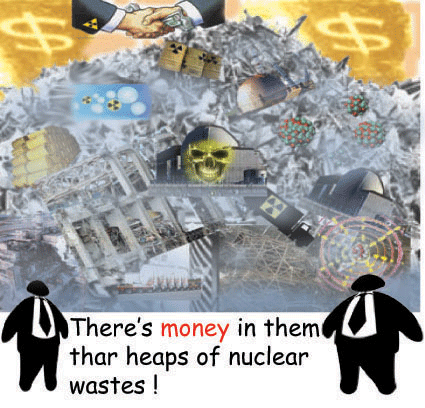 Asahi: Gangsters cashing in on Fukushima disaster — Involved in “disposal of waste” http://enenews.com/asahi-gangsters-cashing-fukushima-disaster-involved-disposal-waste
Title: Gangster illegally hired workers for decontamination projects
Source: AJW by The Asahi Shimbun
Author: KENJI OGATA
Date: January 31, 2013
Criminal organizations are cashing in on the disaster that shook Japan nearly two years ago by sinking their claws into all aspects of recovery operations to skim off handsome profits.
Police have just turned up an instance of a gang member brazenly providing laborers to help clean up contaminated areas in Fukushima Prefecture, and pocketing part of their wages. […]
“The recovery operations involve a lot of money, so they are a godsend for gangs that have trouble making money due to a police crackdown on gang activities,” a gang insider said.
The man said these groups have been involved in the demolition of buildings and the disposal of waste in devastated areas. […]
See also: Police make arrest over cleanup workers at Fukushima Daiichi — Crime syndicate “allegedly participated in containment work for the damaged facilities”
1 This Month

of the week – Shut Down Drone Warfare!


Tell the Ukrainian Government to Drop Prosecution of Peace Activist Yurii Sheliazhenko

Petition to revoke the licensing of the Near Surface Nuclear Disposal Facility (NSDF) at Chalk River. https://www.ourcommons.ca/petitions/en/Petition/Details?Petition=e-7247
To see nuclear-related stories in greater depth and intensity – go to https://nuclearinformation.wordpress.com
-
Archives
- April 2026 (68)
- March 2026 (251)
- February 2026 (268)
- January 2026 (308)
- December 2025 (358)
- November 2025 (359)
- October 2025 (376)
- September 2025 (257)
- August 2025 (319)
- July 2025 (230)
- June 2025 (348)
- May 2025 (261)
-
Categories
- 1
- 1 NUCLEAR ISSUES
- business and costs
- climate change
- culture and arts
- ENERGY
- environment
- health
- history
- indigenous issues
- Legal
- marketing of nuclear
- media
- opposition to nuclear
- PERSONAL STORIES
- politics
- politics international
- Religion and ethics
- safety
- secrets,lies and civil liberties
- spinbuster
- technology
- Uranium
- wastes
- weapons and war
- Women
- 2 WORLD
- ACTION
- AFRICA
- Atrocities
- AUSTRALIA
- Christina's notes
- Christina's themes
- culture and arts
- Events
- Fuk 2022
- Fuk 2023
- Fukushima 2017
- Fukushima 2018
- fukushima 2019
- Fukushima 2020
- Fukushima 2021
- general
- global warming
- Humour (God we need it)
- Nuclear
- RARE EARTHS
- Reference
- resources – print
- Resources -audiovicual
- Weekly Newsletter
- World
- World Nuclear
- YouTube
-
RSS
Entries RSS
Comments RSS
 nuclear-news