Youtube: ground under Fukushima Unit 4 is sinking
 http://www.youtube.com/watch?feature=player_detailpage&v=-LCTv65aqgA#t=101s Japan Diplomat: Ground underneath Fukushima Unit 4 is sinking — More than 30 inches in some areas — Now in danger of collapse (VIDEO)
Tweet from former Fukushima worker @Happy11311 translated by Fukushima Diary:
[…] the plant area may have a land subsidence depending on the volume of water to pump up. I think Tepco knows that…
More from @Happy11311: Fukushima worker concerned about ground settlement at plant — What will happen when Tepco starts pumping up 100s of tons of groundwater?
See also: Japan Diplomat: Ground underneath Fukushima Unit 4 is sinking — More than 30 inches in some areas — Now in danger of collapse (VIDEO)
See also: Japan Diplomat: Ground underneath Fukushima Unit 4 is sinking — More than 30 inches in some areas — Now in danger of collapse (VIDEO)
Continued flooding will damage Fukushima reactors’ structures
NBC News: Fears that Fukushima plant could “break apart” during cleanup process http://enenews.com/nbc-news-fears-that-fukushima-plant-could-break-apart-during-cleanup-process

Title: ‘A very fragile situation’: Leaks from Japan’s wrecked nuke plant raise fears
Source: NBC News
Author: Arata Yamamoto and Ian Johnston
Date: May 1, 2013
Like the persistent tapping of a desperate SOS message, the updates keep coming. Day after day, the operators of the wrecked Fukushima Dai-ichi nuclear power plant have been detailing their struggles to contain leaks of radioactive water.
The leaks, power outages and other glitches have raised fears that the plant — devastated by a tsunami in March 2011 — could even start to break apart during a cleanup process expected to take years. […]
“Until you can stop that transfer, you will not contain the radioactivity. That will go on for years and years until they contain it,” [Independent nuclear expert John Large] said. “The structures of containment start breaking down. Engineered structures don’t last long when they are put in adverse conditions.” […]
See also: Fears have also emerged that the Dai-ichi plant could break apart during cleaning, NBC News reports –
NY Daily News
The Fukushima radiation clean up is failing
Time: Fukushima nuclear struggles “would be the stuff of comedy” — “It’s not funny, not really” — “Not sure things could be much worse if Wile E. Coyote were Tepco’s CEO” http://enenews.com/time-fukushima-nuclear-struggles-would-be-the-stuff-of-comedy-its-not-funny-not-really-not-sure-things-could-be-much-worse-if-wile-e-coyote-were-tepcos-ceo
Title: Japan: Why the Fukushima Daiichi Nuclear Plant’s Cleanup Is Faltering
Source: Time.com
Author: Bryan Walsh
Date: May 01, 2013

Honestly, if the consequences weren’t potentially so dire, the ongoing struggles to clean up the Fukushima Daiichi nuclear plant in northern Japan would be the stuff of comedy. […] I’m not sure things could be much worse if Wile E. Coyote were TEPCO’s CEO.
But it’s not funny, not really, because the consequences of the meltdown and TEPCO’s mismanagement are very real. […] More than two years after the tsunami, TEPCO is still racing against time — and just barely staying ahead.
[…] the fact that the company is still running the Fukushima cleanup seems like a worse idea with each passing day.
[…] As the groundwater debacle demonstrates, TEPCO has been making things up as it goes along since the beginning — and the Japanese government has let them.
[…] And while Japan is unique, collusion between the tightly closed nuclear industry and the government elsewhere isn’t.
More from Time’s Bryan Walsh: Time.com: Fukushima dangers “may not be as grave as we first feared” — Only 10 people surveyed had high levels of radiation, says study — Only 10% of Chernobyl release
Fukushima nuclear power plant is very unstable
Nuclear Safety Expert: “Many experts are extremely concerned we could have additional releases” at Fukushima plant — “Very, very unstable facility” (AUDIO) http://enenews.com/nuclear-safety-expert-many-experts-are-extremely-concerned-we-could-have-additional-releases-at-fukushima-plant-very-very-unstable-facility-audio
Title: Workers at Fukushima nuclear plant struggle to contain rush of contaminated water
Source: FSRN
Date: May 1, 2013
Dan Hirsch, a nuclear safety expert, president of the Committee to Bridge the Gap, and lecturer at the University of California, Santa Cruz: Many experts are extremely concerned that we could have additional releases.
This is a very, very unstable facility.
Very, very damaged with people working in extraordinary high radiation fields trying to repair it.
Full broadcast here
 AUDIO Workers at Fukushima nuclear plant struggle to contain rush of contaminated water, 30 April 13 http://fsrn.org/audio/workers-fukushima-nuclear-plant-struggle-contain-rush-contaminated-water/11929
At the damaged Fukushima Daiichi nuclear plant in Japan, workers are struggling to contain a rush of highly radioactive wastewater. It’s flowing at the rate of 75 gallons per minute, according to the New York Times. Officials with the Tokyo Electric Power Company say they are considering clearing a nearby forest site in order to make more room for storage tanks. It’s the latest in a series of ongoing issues at the site. Earlier this month operators had to shut down the cooling of a spent fuel pool after rodents damaged an electrical line.
The International Atomic Energy Agency now estimates it will take more than 40 years to clean up the site. For more, we’re joined by Dan Hirsch, a nuclear safety expert and president of the Committee to Bridge the Gap, a nuclear policy group. He’s also a lecturer at the University of California, Santa Cruz.
Fukushima nuclear buildings getting flooded with radioactive water
 Radioactive water floods Fukushima buildings http://www.globalpost.com/dispatch/news/regions/asia-pacific/japan/130430/radioactive-water-floods-fukushima-buildings 1 May 13,
Workers have been struggling to contain radioactive wastewater left over from the Fukushima disaster. Radioactive groundwater is pouring into the buildings of the Fukushima Daiichi nuclear power plant at the rate of 75 gallons a minute, the New York Times reported. Worse, the flooding is not new. It’s been a constant headache since the nuclear disaster two years ago, forcing a small army of workers to continuously struggle to contain the endless flow of water.
“The water keeps increasing every minute, no matter whether we eat, sleep or work,” Masayuki Ono, a general manager with the Tokyo Electric Power Company, told the Times. “It feels like we are constantly being chased, but we are doing our best to stay a step in front.”
More from GlobalPost: On Location Video: The dirty work of cleaning up Fukushima
According to the Times, the workers use massive tanks sprawling over 42 acres to hold the water, and even that isn’t enough.
In an interview with the Associated Press, Ono’s description of the tanks was not exactly reassuring: “We admit that the underground tanks are not reliable. But we must keep using some of them that are relatively in good shape while monitoring them closely.”Earlier this month, TEPCO admitted that one of those holding tanks may have leaked up to 120 tons of contaminated water.
Huge jump in Fukushima radiation OUTSIDE of reservoir No1
 [Leakage] Radiation level jumped up over 10 times much as 2 days before OUTSIDE of reservoir No.1 http://fukushima-diary.com/2013/04/leakage-radiation-level-jumped-up-over-10-times-much-as-2-days-before-outside-of-reservoir-no-1/ by Mochizuki April 28th, 2013
It’s on the South West side of the reservoir. The sample is drain hole water.
At 12:05 of 4/26/2013 (JST), they measured 41,000 Bq/Kg of the total β nuclide.
At 12:05 of 4/28/2013, it jumped up to be 1,100,000 Bq/Kg, which is over 10 times much as the previous reading.
Tepco hasn’t verified the reason yet. http://www.tepco.co.jp/nu/fukushima-np/f1/smp/2013/images/chosui_13042706-j.pdf
http://www.tepco.co.jp/nu/fukushima-np/f1/smp/2013/images/chosui_13042601-j.pdf
Radioactive water accumulating daily at stricken Fukushima nuclear plant
NYTimes: Alarming reality at Fukushima Daiichi — Plant faced with new crisis — “Tepco is clearly just hanging on day by day” http://enenews.com/nytimes-alarming-reality-at-fukushima-daiichi-plant-faced-with-new-crisis-tepco-is-clearly-just-hanging-on-day-by-day
Title: Radioactive Water Imperils Fukushima Plant
Author: MARTIN FACKLER (Makiko Inoue and Matthew L. Wald)
Date: April 29, 2013
[…] the Fukushima Daiichi nuclear power plant is faced with a new crisis: a flood of highly radioactive wastewater that workers are struggling to contain. Groundwater is pouring into the plant’s ravaged reactor buildings at a rate of almost 75 gallons a minute. It becomes highly contaminated there, before being pumped out to keep from swamping a critical cooling system. […]
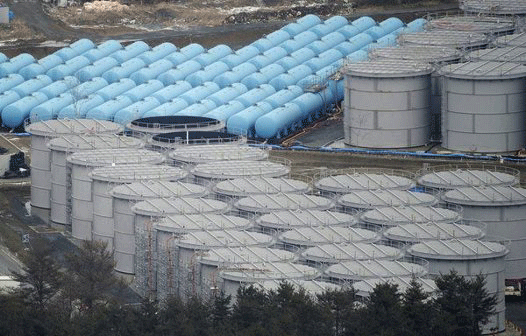
That quandary along with an embarrassing string of mishaps — including a 29-hour power failure affecting another, less vital cooling system — have underscored an alarming reality: two years after the meltdowns, the plant remains vulnerable to the same sort of large earthquake and tsunami that set the original calamity in motion. […]
“Tepco is clearly just hanging on day by day, with no time to think about tomorrow, much less next year,” said Tadashi Inoue, an expert in nuclear power who served on a committee that drew up the road map for cleaning up the plant. […]
See also: NYTimes: Fukushima plant unstable says official, concern another accident can’t be prevented — “Vulnerable… Very dangerous”
Huge underground wall for Fukushima?
‘Great wall of Fukushima’ to be built underground? — Structure around reactors proposed http://enenews.com/great-wall-fukushima-be-built-underground-structure-around-reactors-proposed
Source: Kyodo
Date: April 27, 2013
Great wall of Fukushima?
A government panel has begun studying ways to prevent more radioactive water from accumulating at the Fukushima No. 1 power plant, including a plan to build underground walls around the damaged reactor buildings to stop groundwater from entering. […]
Proposals made by Taisei Corp. and Kajima Corp. Friday included building a subterranean wall around the reactor buildings using a claylike material.
Tepco considered building a wall on the mountain side of the plant after the March 2011 earthquake and tsunami, but abandoned the plan because of the risk that radioactive water flooding the buildings might be leaking into the soil. […]
See also: Japanese professor: Melted fuel has gone through containers and is on concrete foundations sinking into ground below, as far as I can tell — Underground dam was being prepared, but TEPCO resisting
International Atomic Energy Agency not facing up to the facts on Fukushima
 IAEA Gives Little Insight To Fukushima Disaster Cleanup http://www.simplyinfo.org/?p=10267 April 24th, 2013 The IAEA visited the Fukushima Daiichi disaster site after multiple failures ended up in the news. They made very few comments from the trip and reaffirmed they think TEPCO can handle the disaster.
 What they did mention:
- It will take more than 40 years to clean up the disaster
- Technology still needs to be created to deal with the task of removing the melted fuel
- Problems and failures at the plant will continue to be an issue
- TEPCO should replace temporary systems with something more permanent and safer
- Contaminated water is expected to seep outside the plant after “decades”
The Japanese government is still intent on sending everyone back to the area as soon as possible.
Sources:
Apparently uncontrolled continual leakage of Fukushima radiation into the ocean
 Fukushima’s Catastrophic Aftermath: The Dangers of Worldwide Nuclear Radiation, Global Research, By Stephen Lendman 28 April 13,“……..In early April, around 120 tons of contaminated water leaked from Fukushima’s No. 1′s underground storage tank. It contained an estimated 710 billion becquerels of radioactivity.
Water around the affected tank is highly radioactive. It’s about 800 meters from the Pacific. Government and Tokyo Electric (Tepco) claimed it won’t likely reach it. Numerous previous reports suggest otherwise.
Tepco general manager Masayuki Ono said “(w)e cannot deny the fact that our faith in the underwater tanks is being lost.”
In November 2012, Nature.com headlined “Ocean still suffering from Fukushima fallout,” saying:
“Radioactivity is persisting in the ocean waters close to Japan’s ruined nuclear power plant at Fukushima Daiichi.”
New data show high contamination levels. “The Fukushima disaster caused by far the largest discharge of radioactivity into the ocean ever seen.”
Radiation levels aren’t dropping. “The implications are serious for the fishing industry.”………http://www.globalresearch.ca/fukushimas-catastrophic-aftermath-the-dangers-of-worldwide-nuclear-radiation/5333138
17,000 tons of radioactive rice still stored in Fukushima prefecture
 “It would bedifficult to find an option other than disposal.”
Fukushima’s ‘contaminated’ rice still in storage two years, Asahi
Shimbun, April 25, 2013 By TETSUYA KASAI/ Staff Writer
FUKUSHIMA–-Officials are still struggling to dispose of some 17,000
tons of contaminated rice produced in Fukushima Prefecture after the
nuclear disaster there two years ago. Most of the rice, called
“kakurimai” (rice separated for disposal), was produced in 2011.
The central government wants to incinerate the rice, but disposal
facility operators have been reluctant to do so for fear that harmful
rumors could start circulating if they handle contaminated material. Continue reading
Man made corium lava – from Fukushima, toxic for centuries
Wired: ‘Healthy debate’ about location of Fukushima corium — Lava can melt a foot of concrete per hour — Cooling with water may not stop corium flow Title: The Most Dangerous (Man-Made) Lava Flow http://enenews.com/wired-healthy-debate-about-where-fukushima-coriums-are-lava-can-melt-a-foot-of-concrete-per-hour-cooling-with-water-may-not-stop-corium-flow
Source: Wired
Author: Erik Klemetti
Date: April 18, 2013 at 11:45a ET
h/t Room101
Title: The Most Dangerous (Man-Made) Lava Flow
[…] researchers at the Argonne National Lab have created corium in the laboratory […] They found that corium lava can melt upwards of 30 cm (12″) of concrete in 1 hour! This is why it is so important to know if a nuclear reactor accident has gone into true “meltdown” as the corium lava will rapidly melt its way through the inner containment vessels (or more) in a matter of hours unless it can be cooled again.
However, results from these CCI (core-concrete interaction) experiments, suggest that cooling with water may not be sufficient to stop corium from melting the concrete. One thing to remember — much of the melting of concrete during a meltdown occurs within minutes to hours, so keeping the core cool is vital for stopping the corium for breaching that containment vessel.
[…] TEPCO, the Japanese energy company who ran Fukushima Dai’ichi, claims that the corium didn’t breach the outer wall of the containment vessel (although there is a healthy debate about this). […]
So, why is corium so dangerous? Well, even long after the flow has stopped, that lava will be highly radioactive for decades to centuries (along with the surrounding countryside if radioactive material made it out of the containment vessel) as the various radioactive materials in the lava decay. In fact, we don’t even have pictures of the corium lava from Fukushima Dai’ichi due to the high levels of radioactivity near the reactor. […]
For the Pacific Ocean? – 400 tons daily of Fukushima radioactive water
Bloomberg: Radioactive water from Fukushima reactors to be dumped in Pacific? “It’s obvious they can’t keep storing it forever”http://enenews.com/bloomberg-tepco-to-dump-radioactive-water-from-fukushima-reactors-into-pacific-its-obvious-they-cant-keep-storing-it-forever
Title:Title: Tepco Faces Decision to Dump Radioactive Water in Pacific Ocean
Source: Bloomberg
Author: Tsuyoshi Inajima
Date: Apr 11, 2013
[Tepco]’s discovery of leaks in water storage pits at the wrecked Fukushima atomic station raises the risk the utility will be forced to dump radioactive water in the Pacific Ocean.
Leaks were found in three of seven pits in the past week, reducing the options for moving contaminated water from basements of reactor buildings. […]
Not Ruled Out
Officials at the utility known as Tepco, including President Naomi Hirose, have said the company will not “easily” release radiated water into the ocean, indicating it’s not ruling out the possibility if it runs out of storage.
“It’s obvious Tepco cannot keep storing water forever as it increases by 400 tons a day,” said Hideyuki Ban, co-director of the antinuclear group Citizens’ Nuclear Information Center. That’s why the company won’t rule out discharge into the sea, Ban said in a telephone interview. […]
See also: Tepco: It’s ‘really impossible’ for us to keep storing liquid from Fukushima reactors — We need to think about discharging it into ocean (VIDEO)
Fukushima nuclear plant is NOT stable
 NYTimes: Fukushima plant unstable says official, concern another accident can’t be prevented — “Vulnerable… Very dangerous” http://enenews.com/nytimes-fukushima-plant-unstable-says-official-concern-another-accident-cant-be-prevented-vulnerable-very-dangerous April 11th, 2013
Title: Fukushima Nuclear Plant Is Still Unstable, Japanese Official Says
Source: New York Times
Author: HIROKO TABUCHI
Date: April 10, 2013
[…] a series of recent mishaps — including a blackout set off by a dead rat and the discovery of leaks of thousands of gallons of radioactive water — have underscored just how vulnerable the plant remains.
Increasingly, experts are arguing that [Tepco] cannot be trusted to lead what is expected to be decades of cleanup and the decommissioning of the plant’s reactors without putting the public, and the environment, at risk. […]
“It’s become obvious that Tepco is not at all capable of leading the cleanup. It just doesn’t have the expertise, and because Fukushima Daiichi is never going to generate electricity again, every yen it spends on the decommissioning is thrown away. That creates an incentive to cut corners, which is very dangerous. The government needs to step in, take charge and assemble experts and technology from around the world to handle the decommissioning instead.” -Muneo Morokuzu, a nuclear safety expert at the Tokyo University Graduate School of Public Policy
“The Fukushima Daiichi plant remains in an unstable condition, and there is concern that we cannot prevent another accident.” -Shunichi Tanaka, chairman of Japan’s Nuclear Regulation Authority
See also: Tepco: “Losing faith” in leaking Fukushima tanks — But we don’t have anywhere else to put the radioactive water
Fukushima’s radioactive water problem – still unmanageable
Japan Plant Forced to Move Tainted Water, WSJ, 10 April 13 Disclosure of Plan to Close Massive Storage Pools Over Leaks Is Latest Problem at Nuclear Facility, Rousing Safety Fears TOKYO—The operator of the Fukushima Daiichi nuclear-power plant on Wednesday said it has to move tens of thousands of tons of radioactive water out of leaky underground reservoirs—the latest in a string of problems and missteps that has spurred a rebuke from regulators and amplified fears that the heavily damaged plant isn’t fully under control.
Tokyo Electric Power Co. 9501.TO +9.47% said it would abandon seven massive underground storage pools where it had been keeping 26,600 tons of contaminated water, after finding that three of the pools had likely sprung leaks.
The discovery of those leaks, which Tepco estimates have spilled more than a hundred tons of radioactive water into the ground, came less than a month after a power outage shut a cooling system for used nuclear fuel, and a few days before two underwater barriers separating the most contaminated parts of the plant from the sea were found to have split….. Continue reading
1 This Month
10 March A LIVE WEBINAR THE REAL EFFECTS OF NUCLEAR POWER
What the Industry Isn’t Telling Us
1:00 PM Mountain, 2 pm Central, 3 pm Eastern. Live on the Keepers of the Water Facebook page



18 March Webinar @ 1 PM EST: An Assessment of SMR Projects: The Case of Canada
register for the zoom:
https://us02web.zoom.us/webinar/register/WN_o8BIIOUvQ2ONJR1nta65DQ#/registration


of the week – STOP SMALL MODULAR REACTORS IN CANADA
To see nuclear-related stories in greater depth and intensity – go to https://nuclearinformation.wordpress.com
-
Archives
- March 2026 (109)
- February 2026 (268)
- January 2026 (308)
- December 2025 (358)
- November 2025 (359)
- October 2025 (376)
- September 2025 (258)
- August 2025 (319)
- July 2025 (230)
- June 2025 (348)
- May 2025 (261)
- April 2025 (305)
-
Categories
- 1
- 1 NUCLEAR ISSUES
- business and costs
- climate change
- culture and arts
- ENERGY
- environment
- health
- history
- indigenous issues
- Legal
- marketing of nuclear
- media
- opposition to nuclear
- PERSONAL STORIES
- politics
- politics international
- Religion and ethics
- safety
- secrets,lies and civil liberties
- spinbuster
- technology
- Uranium
- wastes
- weapons and war
- Women
- 2 WORLD
- ACTION
- AFRICA
- Atrocities
- AUSTRALIA
- Christina's notes
- Christina's themes
- culture and arts
- Events
- Fuk 2022
- Fuk 2023
- Fukushima 2017
- Fukushima 2018
- fukushima 2019
- Fukushima 2020
- Fukushima 2021
- general
- global warming
- Humour (God we need it)
- Nuclear
- RARE EARTHS
- Reference
- resources – print
- Resources -audiovicual
- Weekly Newsletter
- World
- World Nuclear
- YouTube
-
RSS
Entries RSS
Comments RSS
 nuclear-news