As Fukushima radioactive water grows, situation hopeless for fishermen
 Fukushima fishermen forced to test fish for radiation REUTERS, 31 May 13“….The fishermen of Hisanohama, forced out of work by the disaster, have had no choice but to take the only job available – checking contamination levels in fish just offshore from the destroyed nuclear reactor buildings. ”We used to be so proud of our fish. They were famous across Japan and we made a decent living out of them,” said 80-year-old Yaoita, who survived the tsunami by taking on the waves and sailing the six-person True Prosperity out to sea.”Now the only thing for us is sampling.”…..
The fishermen and Tepco are in dispute over the utility’s plans to dump 100 tons of groundwater a day from the devastated plant into the sea. The complicated clean-up plan for Fukushima could take 30 years or more. Tepco’s challenge is what to do with the contaminated water that has been pooling at the plant at a rate of 400 tons a day – enough to fill an Olympic-size swimming pool in a week.
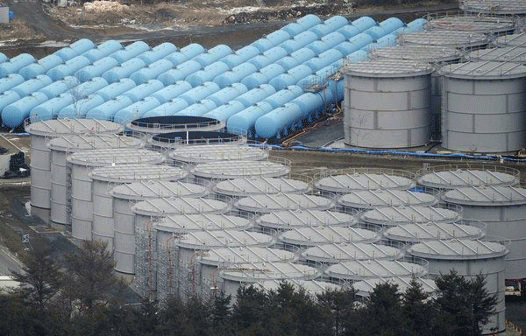
So far it has been racing to build tanks to store the contaminated water on the grounds of the plant, in which all the water is kept at the moment.It has also asked fishermen to support a plan to build a “by-pass” that would dump groundwater into the sea before it becomes contaminated by flowing under the reactor’s wreckage.
“We are staunchly against it,” said Tatsuo Niitsuma, 71, who fishes with Yaoita.
MORE CONTAMINATION, LESS HOPE Representatives from fishing cooperatives met Tepco officials on Thursday to discuss the proposal, with Trade Minister Toshimitsu Motegi to instruct Tepco on what to do, although no final plans were announced. In addition to the “by-pass” Motegi, who also holds the energy portfolio, told Tepco to create “protective walls” in the ground by freezing the soil around the reactors to create an underground barrier to stop groundwater from flowing in and mixing with contaminated water inside the reactor building.
The fishermen, however, worry the “by-pass” plan risks more contamination and delays, possibly ending any hope for the only job they know.
Tepco officials have said it may take as long as four years to fix the problem, but have said they do not need outside help.
The uncertainty and stress have become problems. Many former fishermen live in temporary homes next to people they barely know after losing not only their jobs, but also family members…….. http://www.reuters.com/article/2013/05/31/us-fukushima-fishermen-idUSBRE94U0D620130531
Desperate radioactive water problem at Fukushima – attempt to freeze surrounding soil
 Soil around Fukushima to be frozen to stop groundwater leaking in http://www.abc.net.au/news/2013-05-31/operator-ordered-to-freeze-soil-around-crippled-nuclear-plant/4724554 By North Asia correspondent Mark Willacy, The Japanese government has ordered the operator of the Fukushima nuclear plant to freeze the soil around its crippled reactor buildings to stop groundwater seeping in and becoming contaminated.
Every day another 400 tonnes of groundwater forces its way into the plant, becomes contaminated with radioactivity and needs to be stored onsite. Plant operator Tokyo Electric Power Company (TEPCO) already has a quarter of a million tonnes of radioactive water stored in tanks at Fukushima. (below Fukushinma Daichi reactor No 6)

Fearing the nuclear plant is running out of space to store contaminated water, the Japanese government has ordered TEPCO to take the drastic step. The government hopes these frozen walls of soil will stop huge amounts of groundwater leaking into the buildings and it wants the system to be in place within two years.
According to a report compiled by a government panel on Thursday, there are no previous examples of using walls created from frozen soil to isolate groundwater being used for longer than a few years.
This means the project at the Fukushima plant poses “an unprecedented challenge in the world”.
Latest earthquake caused leak from Fukushima Daiichi Units 5-6
Tepco: M6 quake caused leak at Fukushima Daiichi — Water coming from pipe of Units 5, 6 http://enenews.com/m6-quake-caused-leak-at-fukushima-daiichi-water-coming-from-pipe-of-units-5-6
Title: Earthquake Occurred on May 18, 2013 (Fukushima Daiichi and Daini Nuclear Power Stations) (Follow-up Information No.2)
Source: Tepco Press Release
Date: May 20, 2013
h/t Anonymous tip
This is a follow-up report on the statuses of Fukushima Daiichi and Daini Nuclear Power Stations after the earthquake occurred in the offshore of Fukushima Prefecture (M5.9) at around 2:48 PM on May 18.
At around 4:10 PM in Fukushima Daiichi Nuclear Power Station, a TEPCO employee found water dropping from an overflow pipe of Units 5-6 RO treated water tank (D7 tank) where the leakage was found yesterday on the site patrol after the earthquake. […]
Regarding the treated water dropping from an overflow pipe of Units 5-6 RO treated water tank, the leakage area is estimated to be about 2 m x about 2 m and the leakage amount is estimated to be about 4 liters. […]
The water dropping is assumed to be caused by the earthquake occurred at around 2:48 PM today since the treated water tank was at full capacity from yesterday. […]
See also: Strong M6 quake hits near Fukushima nuclear plant — Intensity 5+ on JMA scale — Officials: “No reports of damage so far”
Perpetual water needed to nuclear reactors – will end up in Pacific Ocean
Japan Times: Discharges of Fukushima nuclear material into Pacific “have effectively contaminated the sea” — Melted reactor cores will burn again if water not perpetually poured in — “Tepco proposing some of it be dumped into ocean” http://enenews.com/japan-times-discharges-of-nuclear-material-into-the-pacific-from-fukushima-have-effectively-contaminated-the-sea-melted-reactor-cores-will-burn-again-if-water-not-perpetually-poured-in-t
Title: Fukushima No. 1 can’t keep its head above tainted water
Source: The Japan Times
Author: Reiji Yoshida
Date: May 21, 2013
[…] Tepco must perpetually pour water over the melted cores of reactors 1, 2, and 3 via makeshift systems to prevent the fuel from melting and burning again. […]
Tepco is proposing some of the water be dumped into the sea after processing it to remove most, but not all, radioactive isotopes. […]
Previous discharges into the Pacific have effectively contaminated the sea. Failure to store it means it will probably flood the whole compound and end up in the ocean anyway. […]
Will the processed water pose health or environmental risks?
According to Tepco, the processed water could theoretically be safe […]
Tritium is the exception, however. Tepco says the tritium level in the contaminated water is between 1 million and 5 million becquerels per liter. The legal limit is 60,000. […]
See also: Gundersen: “Liquid releases” of nuclear material into ocean will continue for years and years at Fukushima Daiichi — Already 10 times Chernobyl (VIDEO)
Rice being planted within 20 km of Fukushima No 1 nuclear power plant
Rice planted 10 miles from Fukushima Daiichi — Residents can’t stay in town overnight — “Intended for sale” http://enenews.com/jiji-rice-being-planted-about-10-miles-from-fukushima-daiichi-intended-for-sale
Title: Rice planted in former no-go zone
Source: JIJI
Date: May 20, 2013
Farmers in the city of Tamura, Fukushima Prefecture, have begun planting rice in a district once designated a no-go zone because of radioactive fallout ejected by the disaster-hit Fukushima No. 1 power plant.
It is the first time since the March 2011 core meltdowns that rice intended for sale has been planted in any former hot zone within 20 km of the power plant.
Saturday’s rice planting was carried out in Tamura’s Miyakojimachi district, about 15 km [9.4 miles] from the plant […]
Residents can enter without permission during the daytime but aren’t allowed to stay overnight […]
See also: Japan Times: Radiation level in Fukushima town 400 times higher than in Tokyo — 10 kilometers from Daiichi
Fishermen testing fish for radiation, in South Fukushima waters
Fishermen net fish in Fukushima waters to measure radiation levels
http://ajw.asahi.com/article/0311disaster/recovery/AJ201305210005 May 21, 2013 By HIROSHI KAWAI/ Staff Writer
A fishing vessel from Fukushima Prefecture caught fish in waters south
of the crippled Fukushima No. 1 nuclear power plant on May 20 to test
them for levels of radiation contamination, as local fishing
cooperatives hope to soon resume fishing in the area.
The No. 12 Akira Maru belonging to the Iwaki fishermen’s cooperative
trawled plenty of flatfish and other species.
Due to ocean currents, the concentration of radioactive materials has
been found to be higher in waters to the south of the plant, than to
the north.
Of the Akira Maru’s catch, nine species of fish were kept as samples
to measure radiation levels in them. The fishermen tested about 10
kilograms of each type and threw the rest back into the sea.
“It feels hollow to have to throw fish back into the sea, considering
that they could fetch high prices,” Captain Akiyoshi Abe said.
Before the nuclear accident triggered by the Great East Japan
Earthquake and tsunami in March 2011, waters off the prefecture were
known as a good fishing area where more than 100 species could be
caught.
Many local fisheries cooperatives have had to suspend operations since
the nuclear accident.
10 Km from Fukushima nuclear plant radiation levels 400 times higher than in Tokyo
 Japan Times: Radiation level in Fukushima town 400 times higher than in Tokyo — 10 kilometers from Daiichi http://enenews.com/japan-times-radiation-level-fukushima-town-400-times-higher-tokyo
Title: Fukushima photos focus on what can’t be seen
Source: Japan Times
Author: Ken Kawashima
Date: May 19, 2013
[…] Returning to the base of [Mount Higakure] overlooking the manmade lake behind the [Sakashita] dam, we find a public radiation-monitoring post indicating a reading of 0.44μSv/hour — roughly 40 times the level in Tokyo on the same day.
Moving on from there, before heading back to Tokyo we decide to drop by the abandoned tsunami-ravaged town of Tomioka, which had been off-limits until just recently. There, a mere 10 km from the nuclear plant, we were chastened to find the radiation readings were almost 10 times those by the dam — some 400 times Tokyo levels at the same time on the same day. […]
Full report here
Fukushima to California – the path of nuclear radiation along Latitude 40
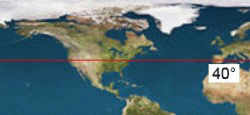 Study: Concentrated Fukushima radioactive plume staying on narrow path toward U.S. — Moving with surface water along 40 N — Same latitude as Northern California(MAP) http://enenews.com/study-concentrated-fukushima-radioactive-plume-staying-along-narrow-path-moving-surface-water-along-40-same-latitude-northern-california-map
Title: Surface pathway of radioactive plume of TEPCO Fukushima NPP1 released 134Cs and 137Cs
Source: Biogeosciences
Authors: M. Aoyama, M. Uematsu, D. Tsumune, and Y. Hamajima
Date: May 7, 2013
[…] The main body of radioactive surface plume of which activity exceeded 10 Bq m−3 travelled along 40° N and reached the International Date Line on March 2012, one year after the accident. A distinct feature of the radioactive plume was that it stayed confined along 40° N when the plume reached the International Date Line. […]
A distinct feature of the radioactive plume was that it stayed confined along 40 N when the plume reached the International Date Line, as stated in Sect. 3.2. The radioactive plume travelled 1800 km (from 160 E to 178 E) for 270 days (9 months) (Fig. 5); therefore, an average zonal speed (u) of the surface radioactive plume was calculated to be about 8 cm s−1 which was consistent with the speed of the reported surface current of 4–16 cm s−1 in the region (Maximenko et al., 2009). […]
We can also assume that the Fukushima radioactive plume moved with surface water […]
Full study here
Saving the irradiated animals of Fukushima
 PROMETHEUS TRAP/ The disaster and animals (8): Woman repeatedly rescued pets in the Fukushima off-limits zoneAsahi Shimbun May 08, 2013 By MISUZU TSUKUE/ Staff Writer
Editor’s note: This is the eighth part of a new series that has run in the past under the title of The Prometheus Trap. This series deals with how pets and livestock fared in the evacuation zone around the Fukushima No. 1 nuclear power plant. The series will appear on Mondays, Wednesdays and Fridays.
After the government on April 22, 2011, banned entry into a 20-kilometer radius from the disaster-stricken Fukushima No. 1 nuclear power plant, declaring it to be an evacuation zone, many people still began to enter the area illegally to rescue pets left behind.
One of them was Mieko Yoshida, a 63-year-old cram school teacher who lived in Odaka Ward in the city of Minami-soma…….
Yoshida started a one-woman campaign for the rescue and protection of pets left behind in the no-go zone. When she stood in front of the city office, carrying a placard reading, “Give me back my family,” many pet owners approached her, saying, “The same here.”
Yoshida compiled a list of some 80 houses in the off-limits zone where pets had been left behind. She secretly went to these houses to feed and rescue the animals. Her concern for the lives of these vulnerable animals outweighed her fear of radiation.
Police kept bolstering the barricades erected to keep people from entering the zone, but that didn’t deter Yoshida from her stealth animal rescue mission…… http://ajw.asahi.com/article/0311disaster/life_and_death/AJ201305080006
THE ONGOING THREAT OF FUKUSHIMA FALLOUT

 WHAT ABOUT THE ONGOING THREAT OF FUKUSHIMA FALLOUT ?, Veterans Today, 14 May 13 The Washington Blog posed that same question on April 13, 2013 ~ Is Fukushima Leaking … Or Are the Reactors Wholly Uncontained?
“You may have heard that Tepco ~ the operator of the stricken Fukushima nuclear power plants ~ announced alarge leak of radioactive water….. You may have heard that the cooling system in the spent fuel pools at Fukushima has failed for a second time in a month.
This is newsworthy stuff … but completely misses the big picture. Associated Press notes: ” Experts suspect a continuous leak into the ocean through an underground water system, citing high levels of contamination in fish caught in waters just off the plant. (Tepco graphics of the Fukushima plants even appear to show water directly flowing from the plant to the ocean. And see this.) In fact, Japanese experts say that Fukushima is currently releasing up to 93 billion becquerels of radioactive cesium into the ocean each day. ”
How much radiation is that? Continue reading
Dumping tons of Fukushima radioactive water into ocean is not illegal?
‘Absurd’: Intentionally dumping Fukushima nuclear material into ocean from land “is not considered dumping” — Allowed under international law? http://enenews.com/absurd-intentionally-dumping-fukushima-nuclear-material-ocean-land-considered-dumping-allowed-international-law
Source: Oceanus
Author: David Pacchioli
Date: May 6, 2013 The Fukushima disaster is without precedent and will have unprecedented impacts on future policies governing the ocean, both Japanese and international.
[…] the Fukushima accident has revealed some key shortcomings in international law, said Kentaro Nishimoto, who teaches law of the sea at Tohoku University. To illustrate, he used an incident that has brought sharp criticism from Japan’s neighbors: the intentional release of radioactive water into the sea.
[…] Nishimoto said, the relevant international laws proved to be nonbinding. In particular, he noted, the London Convention on marine pollution, although it expressly prohibits ocean dumping of radioactive material, limits these restrictions to vessels at sea. Release of materials from land is not considered dumping.
“When I tell this to people outside the field of international law, the reaction I get is, ‘This is absurd,’ ” Nishimoto acknowledged. […]
See also: Bloomberg: Increasing risk that Fukushima radioactive waste being dumped into Pacific Ocean
Highly radioactive material accumulating in areas in Fukushima City
 ‘Emergency decontamination’ needed in places used by Fukushima kids — Highly radioactive material accumulating — City Official: Many times higher than previous record for urban areas http://enenews.com/emergency-decontamination-needed-places-childrens-activities-highly-radioactive-material-accumulating-official-many-times-higher-anything-previously-found-urban-area-fukushima Title: Fukushima closes 2 parking lots for emergency decontamination work
Source: Asahi
Author: MASAKAZU HONDA
Date: May 08, 2013
Two parking lots in the city of Fukushima were declared off-limits to the public on May 7 after high concentrations of radioactive cesium were detected […]
“It’s the first time that soil with cesium levels exceeding 100,000 becquerels was found on the grounds of an urban area, not in sludge accumulated in ditches,” said a city official in charge of decontamination work. […]
The exposed soil had accumulated to a height of 1 to 3 centimeters around the edges of the parking lots or in sunken parts of the surface, mixed with fragments of dead leaves and other material.
The survey at the Matsuki parking lot found radioactive cesium concentrations of 220,000 or more becquerels per kilogram of soil, with the highest level at 433,772 becquerels. […]
In addition to visitors to the facilities, local residents, including students, usually enter the sites for walking and extracurricular activities. […]
See also: Nuclear material in pools at Fukushima schools exceed 100,000 Bq/kg — Level nearly doubled since last year
Dumping of Fukushima radioactive water into Pacific Ocean
Report: Tepco now dumping contaminated water from Fukushima plant into ocean — 200 tons of radioactive groundwater “pumped out” http://enenews.com/report-tepco-begins-dumping-contaminated-water-into-ocean-200-tons-of-radioactive-groundwater-pumped-out
Kyodo News: Tokyo Electric Power Co. plans to discharge some groundwater that has flowed into the premises of the crippled Fukushima Daiichi nuclear power plant […] As a trial, TEPCO has pumped out about 200 tons of groundwater using the wells. Its density of radioactive substances was “the same as rivers in surrounding areas,” according to company officials. […] The utility hopes to hold a meeting with local fishermen Monday to seek approval of the groundwater release […]
SimplyInfo: TEPCO B Begins Dumping Contaminated Water Into The Sea […] TEPCO has begun dumping groundwater pumped out of a set of wells inland from the reactors into the Pacific. TEPCO dumped 200 tons of groundwater yesterday as a test. […]
From Yesterday: Asahi: Tepco to dump groundwater from Fukushima nuclear plant into Pacific Ocean — Trying to “avoid a total collapse” of system for handling radioactive water (PHOTO)
Fukushima nuclear reactor 1 to have its cover removed
 Cover over Reactor No. 1 to be removed at Fukushima plant — Radiation levels expected to rise http://enenews.com/cover-reactor-1-be-removed-fukushima-plant-radiation-levels-expected-rise
Title: TEPCO to take off cover of No. 1 reactor building for fuel removal
Source: Kyodo News
Date: May 9, 2013
The operator of the crippled Fukushima Daiichi nuclear power plant said Thursday it plans to temporarily take off a cover placed around the damaged No. 1 reactor building to prepare for the removal of fuel in the spent fuel pool.
Tokyo Electric Power Co. installed the cover in October 2011 to prevent the further release of radioactive substances into the air […]
A TEPCO official said that dismantling the cover — work which will start in the fall — is expected to lead to a “slight rise” in the radiation level but the impact will be “little.” […]
UPDATE: Tepco to demolish makeshift cover at Fukushima Reactor No. 1 — Trying to remove “radioactive material” — Will take 4 years for new one (PHOTO)
Discrimination as well as radiation, for Fukushima’s children
Fukushima activist fights fear and discrimination based on radiation, Japan Times, BY MIZUHO AOKI MAY 9, 2013 Sachiko Banba aches for children in Fukushima Prefecture, who worry whether they can lead a normal life.
“Three frequently asked questions from children are whether they are OK to live in Fukushima after they get married, whether they can give birth to a baby, and whether their baby will be healthy,” said Banba, 52, who runs a cram school in Minamisoma, Fukushima, less than 30 km from the Fukushima No. 1 nuclear plant.
Although tens of thousands of people fled their homes in Fukushima Prefecture following the March 2011 reactor meltdowns, many, including children, still remain. Most heartbreaking to Banba is the discrimination they face based on ignorance, and the likelihood it will follow them the rest of their lives.
Children catch snatches of the adult debates over the health risks of radiation exposure, and sense something bad might happen.“It’s due to people’s ignorance. There are still people who think radiation is something contagious,” Banba said. “By gaining correct knowledge, I hope children in Fukushima will be able to talk about radiation (exposure) when they are asked about it.”
Since last year, Banba and Dr. Masaharu Tsubokura have hosted more than 40 radiation study sessions for 1,500 children and adults, supplying people with the necessary information to counter the arguments of those who would discriminate against them.
Many locals have tales to tell, such as the Fukushima woman whose engagement was broken off due to the strong opposition of her fiance’s family.
Banba herself has felt the sting of intolerance many times outside the prefecture…..
citizens and medical experts like Tsubokura, who has been checking Minamisoma residents’ internal radiation exposure levels at Minamisoma Municipal General Hospital for nearly two years, are also holding study sessions in Fukushima and other prefectures to pass on basic knowledge as well as the latest findings.
Tsubokura said people outside Fukushima know little about radioactive materials. About half his audience at a lecture in Nagoya didn’t know that radioactive substances from Fukushima No. 1 fell to Earth in rain.
“Many thought a beam was emitted directly from the power plant,” Tsubokura said.
Similar discrimination was seen after the 1945 atomic bombings of Hiroshima and Nagasaki. Many people believed survivors were contagious and that marrying hibakusha or their descendants would produce babies with birth defects.
According to a 2008 survey of about 27,000 A-bomb survivors conducted by the city of Hiroshima, the main source of their emotional suffering after their exposure to radioactive “black rain” was discrimination, prejudice and anxiety over long-term health effects.
Even more than 60 years later, they are still haunted by discrimination, said Terumi Tanaka, secretary general of Nihon Hidankyo, an atomic bomb victims’ organization. Speaking at the Japan National Press Club in August 2011, he said the issue of radiation exposure is raised even today when their grandchildren try to marry…… http://www.japantimes.co.jp/news/2013/05/09/national/fukushima-activist-fights-fear-and-discrimination-based-on-radiation/#.UYwbmKJwpLs
1 This Month

of the week – Shut Down Drone Warfare!


Tell the Ukrainian Government to Drop Prosecution of Peace Activist Yurii Sheliazhenko

Petition to revoke the licensing of the Near Surface Nuclear Disposal Facility (NSDF) at Chalk River. https://www.ourcommons.ca/petitions/en/Petition/Details?Petition=e-7247
To see nuclear-related stories in greater depth and intensity – go to https://nuclearinformation.wordpress.com
-
Archives
- March 2026 (244)
- February 2026 (268)
- January 2026 (308)
- December 2025 (358)
- November 2025 (359)
- October 2025 (376)
- September 2025 (257)
- August 2025 (319)
- July 2025 (230)
- June 2025 (348)
- May 2025 (261)
- April 2025 (305)
-
Categories
- 1
- 1 NUCLEAR ISSUES
- business and costs
- climate change
- culture and arts
- ENERGY
- environment
- health
- history
- indigenous issues
- Legal
- marketing of nuclear
- media
- opposition to nuclear
- PERSONAL STORIES
- politics
- politics international
- Religion and ethics
- safety
- secrets,lies and civil liberties
- spinbuster
- technology
- Uranium
- wastes
- weapons and war
- Women
- 2 WORLD
- ACTION
- AFRICA
- Atrocities
- AUSTRALIA
- Christina's notes
- Christina's themes
- culture and arts
- Events
- Fuk 2022
- Fuk 2023
- Fukushima 2017
- Fukushima 2018
- fukushima 2019
- Fukushima 2020
- Fukushima 2021
- general
- global warming
- Humour (God we need it)
- Nuclear
- RARE EARTHS
- Reference
- resources – print
- Resources -audiovicual
- Weekly Newsletter
- World
- World Nuclear
- YouTube
-
RSS
Entries RSS
Comments RSS
 nuclear-news