Scrap all Fukushima prefecture nuclear reactors, says Governor

Fukushima Governor Seeks Scrapping Of All Nuke Reactors RTT News6/12/2013 The Japanese government has been asked to scrap all nuclear reactors in the Fukushima prefecture, where one of the two nuclear power plants had a disastrous accident two years ago, displacing tens of thousands of residents.
Fukushima Governor Yuhei Sato met with Economy, Trade & Industry Minister Toshimitsu Motegi in Tokyo on Wednesday and handed over a letter raising the demand, Japanese media reported.
Sato said Fukushima was aiming for sustained regional development without relying on nuclear power, and it wanted the government to take responsibility in decommissioning all reactors at the Fukushima Daiichi and Daini nuclear plants….. http://www.rttnews.com/2134682/fukushima-governor-seeks-scrapping-of-all-nuke-reactors.aspx?type=gn&utm_source=google&utm_campaign=sitemap
Groundwater radiation problems at Fukushima No 1 nuclear complex
Tepco again corrects water radiation level JAPAN TIMES , 14 JUNE 13 KYODO Tokyo Electric Power Co. has issued another correction for groundwater radiation at the Fukushima No. 1 nuclear complex and now says that it’s only a tenth of what it announced earlier this month.
The correction Wednesday was the second the beleaguered utility has issued for groundwater data. Tepco is locked in a battle with water and is desperately seeking fishermen’s consent to divert or dump the least-tainted portions of it into the Pacific Ocean to prevent it from mixing with highly radioactive water accumulating in the reactor buildings.
When it runs out of storage space, the tainted water will flood the premises and the environment, making the decommissioning process incredibly difficult.
Tepco said in May that the level of radioactive cesium in a sample of Fukushima No. 1 groundwater was so low it could not be detected. On June 3, however, the utility said the sample contained 0.61 becquerel per liter. This was then reversed Wednesday to a maximum of 0.055 becquerel. Other radioactive substances were not mentioned.
All of the figures are below Tepco’s upper limit for releasing groundwater: 1 becquerel per liter.
But the latest correction could deal another blow to Tepco’s efforts to dump the water by further damaging its already low credibility.
The radioactive water accumulating at the plant is a natural result of the makeshift cooling apparatus set up to keep the fuel from melting again. The water perpetually injected into the three reactors is leaking through holes created by the crisis and flooding each building.
Attempts to drain the water will be limited by Tepco’s rapidly shrinking storage space, and the penetration of the groundwater is only exacerbating the situation. …. http://www.japantimes.co.jp/news/2013/06/14/national/tepco-again-corrects-water-radiation-level/#.Ubu_mudwo6I
Fukushima’s nuclear reactors – still on the brink of disaster

Australia’s very right wing and pro nuclear newspaper made a little mistake in publishing this one. Perhaps the editors didn’t read it properly. The headline is completely misleading!
Fukushima nuclear reactor back from the brink BY:RICK WALLACE, TOKYO CORRESPONDENT , THE AUSTRALIAN June 13, 2013 ”……..More than 1500 radioactive spent fuel rods sit immersed in water in the open-air pool, which is located about 30m above the ground in what’s left of the reactor No 4 building.
The rods are extremely volatile and, unlike the fuel in the reactors, are not surrounded by any containment structure. If exposed, they can spontaneously combust, creating a tragedy nuclear workers say would put 2011 – the worst nuclear disaster since Chernobyl in 1986 – in the shade.
Asked about other risks and challenges to the recovery process at Fukushima, Mr Takahashi cited removal of the melted nuclear fuel from the reactors and the ongoing build-up of contaminated water. “There are many difficult processes and among all of them the removal of the damaged fuel is the most difficult because no country has experience in doing this,” he said.
“The other main difficulty is treatment of the water and preventing the inflow of incoming water, and then we need to treat and dispose of the waste from that water.” Fukushima Daiichi is dotted with more than 300 giant tanks to store this water, each one holding some 1000 tonnes. TEPCO says it wants to expand its storage capacity to 700,000 tonnes and is digging underground tanks, too.
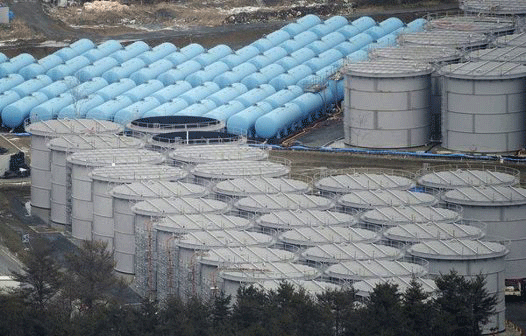
The company is also trying to lower the water table around the plant by digging wells to stem the entry of groundwater into the subterranean spaces of the reactors and minimise the outflow of contamination.
Each day, more than 3000 workers travel to Fukushima Daiichi to work, braving high radiation levels. Much of the debris at the plant has been cleared, although crumpled cars and trucks still dot the side that fronts the ocean. Pumps, and pipes that snake throughout the site, are keeping the situation stable for now but it’s readily apparent a huge amount of decontamination work remains before workers can turn to the task of decommissioning the reactors themselves.
Readings during yesterday’s press visit peaked at 1500 microsieverts near the reactor No 3 building. Standing in this spot for about 13 hours would give a person the 20 millisievert dose deemed as the trigger for evactuating civilians on an annual basis…..
The tour follows a series of embarrassing episodes for TEPCO, including a blackout that shut down cooling to the fragile plant for several hours.The company also recently revealed there had been a leak in one of the steel tanks storing radioactive water, and it had found radioactive cesium leaking into the groundwater near the plant. .http://www.theaustralian.com.au/news/world/fukushima-nuclear-reacto
Uncertainty over the location of melted nuclear fuel in Fukushima reactors
 Asahi: Locations and condition of melted Fukushima fuel unknown — Mainichi: 450 tons of scattered radioactive rods… unknown where holes in reactors are… plans may be delayed http://enenews.com/asahi-locations-and-condition-of-melted-fukushima-fuel-rods-unknown-mainichi-450-tons-of-scattered-radioactive-material-unknown-where-holes-in-reactors-are-plans-may-be-delayed-further
Asahi Shimbun, June 11, 2013: The workers have yet to gain a grasp of the locations and condition of the fuel debris. They have yet to develop extraction equipment and determine removal methods.
Mainichi,, June 11, 2013: Uncertainty over the location of melted fuel inside the crisis-hit Fukushima No. 1 Nuclear Power Plant continues to cast a shadow over plans to remove the fuel at an early date […] Reactor Nos. 1-3 at the plant contained a total of 1,496 rods of nuclear fuel in their cores. […] Each fuel rod weighs about 300 kilograms, and a high level of technical expertise would be required when undertaking a remote control operation to cut up and retrieve clumps of scattered radioactive materials weighing a combined 450 tons or thereabouts. […] the cores of reactors at the Fukushima plant have holes, and the task at hand is finding which parts have been damaged […] In a news conference on June 10, a representative of the Ministry of Economy, Trade and Industry’s Agency for Natural Resources and Energy said that bringing forward the plans would be dependent on developing technology, and suggested that the plans might even end up being delayed. […]
State of melted fuel at Fukushima plant unknown — Worker: “We opened the Pandora’s box” — Journalist: “We’re headed toward a real crisis”
Decommissioning Fukushima nuclear reactors will take 50 years at the very least
Stricken nuke plant struggles on, Yahoo 7 Finance, AAP Jun 10, 2013 “……Experts, including even the most optimistic government officials, say decommissioning Fukushima Dai-ichi will take nearly a half-century.
TEPCO acknowledges that the exact path to decommissioning remains unclear because an assessment of the state of the melted reactor cores has not yet been carried out. Since being brought under control following the disaster, the plant has suffered one setback after another.
A dead rat caused a power blackout, including temporarily shutting down reactor-cooling systems, and leaks required tons of water to be piped into hundreds of tanks and underground storage areas.
The process of permanently shutting down the plant hasn’t gotten started yet and the work up to now has been one makeshift measure after another to keep the reactors from deteriorating.
Thousands of spent nuclear fuel rods that are outside the reactors also have to be removed and safely stored. Taking them out is complex because the explosions at the plant have destroyed parts of the structure used to move the rods under normal conditions. The process of taking out the rods, one by one, hasn’t even begun yet. The spent rods have been used as fuel for the reactors but remain highly radioactive…….”.http://au.finance.yahoo.com/news/stricken-nuke-plant-struggles-000105277.html
Crisis developing as shortage of Fukushima clean-up workers gets worse
“We’re headed toward a real crisis “
Under the worst scenario, experienced workers capable of supervising the work will be gone as they reach their radiation-exposure limits
Stricken nuke plant struggles on, Yahoo 7 Finance, AAP Jun 10, 2013 Keeping the meltdown-stricken Fukushima nuclear plant in north-eastern Japan in stable condition requires a cast of thousands.
Increasingly the plant’s operator is struggling to find enough workers, a trend that many expect to worsen and hamper progress in the decades-long effort to safely decommission it.
Tokyo Electric Power Co (TEPCO), the utility that runs the Fukushima Dai-ichi plant that melted down in March 2011 after being hit by a tsunami, is finding that it can barely meet the headcount of workers required to keep the three broken reactors cool while fighting power outages and leaks of tons of radiated water, said current and former nuclear plant workers and others familiar with the situation at Fukushima…….less risky, better paid decontamination projects in the region irradiated by the Fukushima meltdown are another draw.
Some Fukushima veterans are quitting as their cumulative radiation exposure approaches levels risky to health, said two long-time Fukushima nuclear workers who spoke to The Associated Press.
They requested anonymity because their speaking to the media is a breach of their employers’ policy and they say being publicly identified will get them fired………….. Continue reading
Radioactive cesium greatly increased in Fukushima coastal areas
 Study: Huge spike in cesium outside Fukushima long after 3/11 — “Incorporation into sediments was almost irreversible”http://enenews.com/study-huge-spike-in-cesium-outside-fukushima-long-after-311-incorporation-into-sediments-was-almost-irreversible
Title: Sedimentation and remobilization of radiocesium in the coastal area of Ibaraki, 70 km south of the Fukushima Dai-ichi Nuclear Power Plant
Source: Environmental Monitoring and Assessment
Author: Shigeyoshi Otosaka, Takuya Kobayashi
Date: July 2013, Volume 185, Issue 7, pp 5419-5433
Sedimentation and remobilization processes of radiocesium were investigated from time-series observations at nine stations in the coastal area of Ibaraki, 70–110 km south of the Fukushima Dai-ichi Nuclear Power Plant (1FNPP). Sediment samples were collected four times between June 2011 and January 2012, and concentrations of radiocesium as well as sediment properties such as grain size and elemental compositions were analyzed. […] The incorporation of radiocesium into sediments was almost irreversible […] Full study here
Suicide of Fukushima farmer: TEPCO admits culpability
Fukushima operator admits culpability by: Shingo Ito From: AAP June 06, JAPAN’S Tokyo Electric Power has conceded the Fukushima disaster played a part in a farmer’s suicide, lawyers said, its first admission of culpability in such a case.
The utility, known as TEPCO, has reached an out-of-court settlement with the bereaved family of Hisashi Tarukawa, a Fukushima farmer who took his own life days after the Fukushima Daiichi nuclear power plant went into meltdown.
It was the first time the company has accepted in a settlement that the nuclear disaster at its plant was a factor in a suicide, the lawyers said, adding that terms of the settlement package were not being made public. The 64-year-old hanged himself from a tree in a vegetable field after authorities banned shipments of some farm produce from Fukushima because of fears it was contaminated by radiation.
“I just didn’t want TEPCO to keep saying no one was killed because of the nuclear accident,” said Kazuya Tarukawa, the dead man’s 37-year-old son.He said he still wanted the company to make an official apology for his father’s suicide.
“Does TEPCO think everything is finished if money is paid?” he said.”I want them to come to my house under the name of the company and bow to my father’s altar. My fight is not over yet.”
TEPCO refused to comment on the details of the settlement. http://www.news.com.au/breaking-news/world/fukushima-operator-admits-culpability/story-e6frfkui-1226659001710#ixzz2VZUeJYmy
Radioactive seawater travels towards USA from Fukushima
Are North Americans Already Succumbing to Radiation From Japan? http://www.complex.com/city-guide/2013/06/are-north-americans-already-succumbing-to-radiation-from-japan
BY JULIAN KIMBLE | JUN 5, 2013 We don’t mean to alarm anyone, but there’s reportedly been an increase in radiation levels in food and water thanks to the Japanese earthquake and tsunami that struck in 2011. In addition, children being born with thyroid issues has also been tied to radiation while both the U.S. and Canada are allowing more of specific toxic substances in food being imported from Japan.

The image above shows radiation on the move from the Fukushima nuclear plant following the horrible events of 2011. That was captured in March 2012, meaning it’s probably covered even more ground over the past year and change.
According to World Truth TV, milk samples taken from across the U.S. show that radiation levels are 2000 percent above the EPA maximums. Milk is also used to represent the entire food supply. Furthermore, the Food and Drug Administration and Environmental Deception Protection Agency have responded by raising the “acceptable levels” of radioactive materials that are found in foods.
So apparently water, dairy products, produce, seafood, and meat are all at risk. Great, just great. Remember that when you go grocery shopping this weekend. [via Jeromie Williams]
Leak in Water Tank at Fukushima adds to TEPCO’s woes
 Leak Found in Steel Tank for Water at Fukushima NYT, By MARTIN FACKLER June 5, 2013 TOKYO — The operator of the stricken Fukushima nuclear plant said Wednesday that it had found a leak in one of the hundreds of steel tanks used to store radioactive water at the plant, raising renewed questions about the company’s ability to handle the plant’s cleanup.
The discovery comes a day after the operator, the Tokyo Electric Power Company, or Tepco, admitted that it had found cesium particles in groundwater flowing into the Fukushima Daiichi plant, reversing its earlier assertion that the water was uncontaminated….
Tepco has struggled to deal with tens of millions of gallons of contaminated, toxic water at the plant, which must be stored in the large steel tanks that now occupy virtually every available bit of space there. The amount of radioactive water has continued to grow as groundwater has flowed at a rate of 100,000 gallons per day into the basements of the damaged reactor buildings. This contaminated water must be drawn off every day to prevent it from overwhelming makeshift systems that cool the melted reactors. Continue reading
Tepco now admits that groundwater flowing into Fukushima reactors is radioactive
 Fukushima plant operator reverses claim groundwater not contaminated (Reuters) Reporting by Risa Maeda; Writing by Aaron Sheldrick. 4 June 13- Tokyo Electric Power Co said on Tuesday it had detected radioactive caesium in groundwater flowing into its wrecked Fukushima Daiichi plant, reversing an earlier finding that any contamination was negligible.
The announcement is yet another example of Tokyo Electric initially downplaying a problem, only to revise its findings because of faulty procedures. It casts further doubt over its control over the cleanup of the worst nuclear disaster since Chernobyl in 1986.
“Once again, they’ve missed something they should be aware of,” said Atsushi Kasai, a former researcher of radiation protection at the Japan Atomic Energy Research Institute…… The discovery that groundwater is also being contaminated before it enters the damaged reactor buildings compounds the problems for the company known as Tepco. It has been trying to convince local authorities and fishermen that the groundwater has negligible levels of contamination and is safe enough to be dumped into the ocean.
About 400 tonnes of groundwater flow daily into the reactor buildings only to be mixed with highly contaminated water that comes from cooling the melted fuel.That water has to be stored in tanks and pits. Leaks in the latter in recent weeks have prompted it to scramble to build more tanks.
Tepco on May 30 told fishermen that radioactive caesium in the groundwater was at a level that could not be detected.But the results were false as they were skewed by using procedures that failed to take into account the background radiation at the damaged plant, Tepco told Reuters on Tuesday. The findings were earlier reported by local media.
“We’ll have to correct the way we analyse sample data,” said Mayumi Yoshida, a Tepco spokeswoman.The revised results still show the radiation level to be below what Tepco views as the upper limit for releasing groundwater — one becquerel of caesium 137 per litre. A becquerel is a measure of radioactivity.
Follow up analysis showed the groundwater had 0.22 becquerel of caesium-134 per litre and 0.39 becquerel of cesium-137 per litre rather than an undetectable amount, Yoshida said……http://uk.reuters.com/article/2013/06/04/uk-nuclear-japan-tokyo-electric-idUKBRE95309020130604
27 Fukushima children have suspected or confirmed thyroid cancer
 Kyodo: 27 Fukushima minors with confirmed or suspected thyroid cancer — Almost tripled since last report in February http://enenews.com/kyodo-27-fukushima-minors-with-confirmed-or-suspected-thyroid-cancer-almost-tripled-since-last-report-in-february
Title: Fukushima survey lists 12 confirmed, 15 suspected thyroid cancer cases
Source: Kyodo News
Date: June 5, 2013
An ongoing study on the impact of radiation on Fukushima residents from the crippled atomic power plant has found 12 minors with confirmed thyroid cancer diagnoses, up from three in a report in February, with 15 others suspected to have cancer, up from seven, sources familiar with the matter said Tuesday. […]
Researchers at Fukushima Medical University, which has been taking the leading role in the study, have so far said they do not believe that the most recent cases are related to the nuclear crisis. They point out that thyroid cancer cases were not found among children hit by the 1986 Chernobyl nuclear accident until four to five years later. […] Watch OPTV’s broadcast on Fukushima thyroid testing here
Fukushima children and thyroid abnormalities: predictions of thyroid cancers
“Rates of thyroid problems in children near Fukushima nuclear plant are high” — Expert: Parents have reason to worry — Gov’t accused of cover-up http://enenews.com/rates-of-thyroid-problems-in-children-near-fukushima-nuclear-plant-are-high-expert-parents-have-reason-to-worry-govt-accused-of-cover-up
Source: The Independent
Author: David McNeill
Date: June 1, 2013
h/t Anonymous tip Rates of thyroid problems in children near the nuclear plant are high
[…] Last December, the eldest of the two was diagnosed with adenoidal cysts, the prelude to a type of cancer that often strikes the salivary glands. “I was told by the doctor that it’s very rare,” [Yoji Fujimoto] says. […]
“I’m convinced this is because of the Fukushima accident.” […]
[Steve Wing, an epidemiologist at the University of North Carolina] says that parents like Mr Fujimoto do have reason to worry. “We know that doses to populations are both unquantified by the official agencies, that evidence suggests relatively high doses, and that children and women are more vulnerable to radiation. So the questions and deep concerns for the people in Fukushima will continue for the rest of their lives.” […]
“I expect a growth in the numbers of thyroid cancers in Japan from next year,” [Dr Alexey Yablokov, a Russian biologist] said. […]
Parents accuse government scientists of making their minds up before the [thyroid] survey began – Professor Suzuki’s team said last July that their aim was “to calm the anxiety of the population”.
Yoji Fujimoto
“I have absolutely no faith in what the Fukushima government is saying”
“They want people to go back and live there so they clearly want to keep a lid on the impact of the disaster”
“There is so much information not getting out at the moment — It will be too late for my children when it is eventually released”
See also: UN: “Fukushima nuclear disaster poses no IMMEDIATE health risks” — Unknown if increase in thyroid cancer is due to radioactivity
Compensation for Fukushima evacuees’ radiation anxiety
 Fukushima Evacuees To Get Radiation Uncertainty Compensation http://www.rttnews.com/2128844/fukushima-evacuees-to-get-radiation-uncertainty-compensation.aspx?type=gn&utm_source=google&utm_campaign=sitemap 6/3/2013 A government-backed arbitration body in Japan directed the operator of the tsunami-wrecked Fukushima nuclear power plant to pay compensation to former residents of a district for radiation exposure and future healthuncertainties.
As per a directive issued by the Nuclear Damage Claim Dispute Resolution Center, the Tokyo Electric Power Company (TEPCO) has to pay about $10,000 each to pregnant women and those aged below 18 years. The other residents of Nagadoro district would get $5,000 each, Japanese media reported on Sunday.
Nagadoro is near the Fukushima plant where radiation levels remain high and it is the only district that the government declared uninhabitable for a long period.
An evacuation order for the area was issued more than a month after the nuclear accident on March 11, 2011. The arbitrators accepted the residents’ claim of fear and anxiety as they had lived without any protection against high radiation doses because of their delayed evacuation. The residents had already received compensation for having to evacuate, but the amount did not cover health anxieties. Lawyers representing the residents said it was for the first time that compensation for health anxietywas granted.
The massive tsunami severely damaged four reactors at the Fukushima plant north of Tokyo, knocking out its cooling systems and triggering meltdowns and radiation leaks. Tens of thousands of people fled their homes in the worst atomic disaster since the 1986 Chernobyl nuclear accident.
Another try to fix Fukushima reactor – inject cement-like grout
Cement-like grout to be injected into Fukushima reactor? (PHOTO) http://enenews.com/cement-like-grout-to-be-injected-into-fukushima-reactor-photo Tepco Handout, May 30, 2013 (Summary translation of page 26 by Fukushima Diary): […] the […] the committee of experts suggested Tepco to fill the torus room with grout. […] Tepco plans to conduct the feasibility study with United States Department of Energy this year. […] They assume it takes 1.5 years to make planning, and 2 years to inject the grout material. […] The committee points out the benefit of using grout is it doesn’t directly touch the molten fuel. However, it hasn’t been confirmed that the fractured molten fuel is not really in the torus rooms.
Department of Energy: Grouting—Grout is a promising option to stop water leakage that’s occurring between reactor and turbine buildings at Fukushima Daiichi’s reactor units, and could be a key step toward facilitating decommissioning of units 1-4. SRNL has extensive experience in grout development and also has operating experience with grouting components reactors and other facilities.
Reuters: The company may resort to pouring a cement-like material into the rectors’ suppression chambers to plug leaks it has not been able to locate, Suzuki said. “One approach we are considering is putting grout, like cement,” he said. “In other words, filling it in. That would block all the holes.”
See also: “Too many holes” in Fukushima reactors? May have to fill up suppression chambers with cement -Tepco
1 This Month

of the week – Shut Down Drone Warfare!


Tell the Ukrainian Government to Drop Prosecution of Peace Activist Yurii Sheliazhenko

Petition to revoke the licensing of the Near Surface Nuclear Disposal Facility (NSDF) at Chalk River. https://www.ourcommons.ca/petitions/en/Petition/Details?Petition=e-7247
To see nuclear-related stories in greater depth and intensity – go to https://nuclearinformation.wordpress.com
-
Archives
- March 2026 (244)
- February 2026 (268)
- January 2026 (308)
- December 2025 (358)
- November 2025 (359)
- October 2025 (376)
- September 2025 (257)
- August 2025 (319)
- July 2025 (230)
- June 2025 (348)
- May 2025 (261)
- April 2025 (305)
-
Categories
- 1
- 1 NUCLEAR ISSUES
- business and costs
- climate change
- culture and arts
- ENERGY
- environment
- health
- history
- indigenous issues
- Legal
- marketing of nuclear
- media
- opposition to nuclear
- PERSONAL STORIES
- politics
- politics international
- Religion and ethics
- safety
- secrets,lies and civil liberties
- spinbuster
- technology
- Uranium
- wastes
- weapons and war
- Women
- 2 WORLD
- ACTION
- AFRICA
- Atrocities
- AUSTRALIA
- Christina's notes
- Christina's themes
- culture and arts
- Events
- Fuk 2022
- Fuk 2023
- Fukushima 2017
- Fukushima 2018
- fukushima 2019
- Fukushima 2020
- Fukushima 2021
- general
- global warming
- Humour (God we need it)
- Nuclear
- RARE EARTHS
- Reference
- resources – print
- Resources -audiovicual
- Weekly Newsletter
- World
- World Nuclear
- YouTube
-
RSS
Entries RSS
Comments RSS
 nuclear-news