Shortage of workers at Fukushima – TEPCO fudges the numbers
NHK – TEPCO over-reports number of Fukushima workers http://www.youtube.com/watch?feature=player_embedded&v=Voqq-DYQ48k
NHK: Concerns rising at Fukushima plant — 16,000 workers have quit, ‘severe working conditions’ blamed (VIDEO) http://enenews.com/nhk-concerns-rising-at-fukushima-plant-16000-workers-have-quit-severe-working-conditions-blamed-video
November 5th, 2012
Title: TEPCO over-reports number of Fukushima workers
Source: NHK
Date: Nov. 5, 2012
“Concerns are rising over whether Tepco has secured enough workers to decommission the Fukushima Daiichi nuclear power plant”
[…] NHK found through an interview with TEPCO officials that only 8,000 workers are registered for the job, as of last month.
Earlier, the utility said there would be no manpower shortage as it had secured about 24,000 workers.
But this figure represents the total number of people who have worked at the crippled plant since the accident on March 11 last year.
16,000 workers have already quit the job. Many of them left due to severe working conditions. […]
By 2014, Fukushima victims lose right to claim for compensation
 Tepco has the right to reject compensation in 2014 http://fukushima-diary.com/2012/11/tepco-has-the-right-to-reject-compensation-in-2014/ by Mochizuki November 2nd, 2012 · Fukushima governor Sato asked Tepco not to claim for the right of extinctive prescription for compensation.
According to the civil code, Fukushima victims will lose the right to claim for the compensation from Tepco 3 years after 311 if Tepco claims for extinctive prescription.
Tepco president Hirose commented, it is difficult to make a statement about that yet.
In Chernobyl, major symptoms started appearing 4 years later after the accident…Tepco paid only 30,000 yen for 200 million yen of compensation claim
Nuclear worker takes legal action against TEPCO, for radiation negligence
 “So I decided I’ve had enough of this unjust treatment. That’s why I decided to come forward,”

 Plant worker: Radiation injuries during crisis at Japan nuke plant not mishap, files complaint Fox News,October 31, 2012 Associated Press IWAKI, Japan – The operator of a Japanese nuclear plant that went into a tsunami-triggered meltdown knew the risks from highly radioactive water at the site but sent in crews without adequate protection or warnings, a worker said in a legal complaint. Continue reading
Fukushima cooling water might be released into ocean
 Tepco: Water used to cool Fukushima reactors could be released into ocean — Outside experts worried http://enenews.com/tepco-water-cool-fukushima-reactors-could-be-released-ocean-experts-worried-about-lasting-impact
October 25th, 2012 Title AP Interview: Japan Nuke Plant Water Worries Rise (PHOTOS)
Source: Associated Press
Author: MARI YAMAGUCHI (Malcolm Foster contributed to this report)
Date: October 25, 2012
Japan’s crippled nuclear power plant is struggling to find space to store [… a]bout 200,000 tons of radioactive water […]
TEPCO is close to running a new treatment system that could make the water safe enough to release into the ocean. […]
Outside experts worry that if contaminated water is released, there will be lasting impact on the environment. […]
TEPCO claims the treated water from this new system is clean enough to be potentially released into the ocean, although it hasn’t said whether it would do that. […]
Tepco building wall between Fukushima nuclear plant and ocean
100 foot deep wall at Fukushima plant still being built, says Tepco — Trying to keep underground contamination from ocean — Years from completion? http://enenews.com/tepco-100-foot-deep-underground-wall-being-built-to-try-and-stop-water-from-seeping-out-of-plant-and-into-ocean-will-take-until-mid-2014 October 25th, 2012

Title: Fish Off Fukushima, Japan, Show Elevated Levels of Cesium
Source: New York Times
Author: HIROKO TABUCHI
October 25, 2012
To stop water from seeping out of the plant, Tokyo Electric is building a 2,400-foot-long wall between the site’s reactors and the ocean. But [Yoshikazu Nagai, a spokesman for Tepco] said the steel-and-concrete wall, which will reach 100 feet underground, will take until mid-2014 to build.
Fukushima radioactive water could fill 50 Olympic sized swimming pools
To deal with the excess tainted water, the utility has channeled it to more than 300 huge storage tanks placed around the plant.
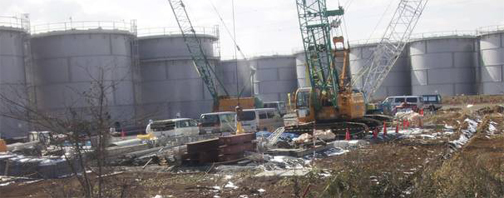
 Fukushima Nuclear Disaster: Plant’s Contaminated Water Storage Running Out Of Space HUFFINGTON POST, By MARI YAMAGUCHI 10/25/12 TOKYO — Japan’s crippled nuclear power plant is struggling to find space to store tens of thousands of tons of highly contaminated water used to cool the broken reactors, the manager of the water treatment team said.
About 200,000 tons of radioactive water – enough to fill more than 50 Olympic-sized swimming pools – are being stored in hundreds of gigantic tanks built around the Fukushima Dai-ichi plant. Operator Tokyo Electric Power Co. has already chopped down trees to make room for more tanks and predicts the volume of water will more than triple within three years. Continue reading
Inedible for years to come – fish near Fukushima coast
 Fukushima fish ‘may be inedible for a decade’ Fiona Harvey, environment correspondent guardian.co.uk 25 October 2012 Marine scientist finds levels of radioactivity in fish near stricken Fukushima nuclear plant are higher than expected
Fish from the waters around the Fukushima nuclear plant in Japan could be too radioactive to eat for a decade to come, as samples show that radioactivity levels remain elevated and show little sign of coming down, a marine scientist has warned.
According to a paper published in the journal Science on Thursday, large and bottom-dwelling species carry most risk, which means cod, flounder, halibut, pollock, skate and sole from the waters in question could be off limits for years, .
Sample fish caught in waters near the stricken reactors suggest there is still a source of caesium either on the seafloor or still being discharged into the sea, perhaps from what is left of the cooling waters. As the levels of radioactive isotopes in the fish are not declining as fast as they should have, the outlook for fishing in the area is likely to be poor for the next 10 years, the paper’s author told the Guardian.
“These fish could have to be banned for a long time. The most surprising thing for me was that the levels [of radioactivity] in the fish were not going down. There should have been much lower numbers,” said Ken Buesseler, senior scientist at the Woods Hole Oceanographic Institution in the US, who wrote the paper titled Fishing For Answers Off Fukushima.
He said his findings – taken in part from Japanese research and sampling of fish in the area – showed how difficult it was to predict the outcome of a nuclear incident such as that at Fukushima. ….. http://apps.facebook.com/theguardian/environment/2012/oct/25/fukushima-fish-inedible-decade-radioactivity
Outside Fukushima’s evacuation zone, but kindergarten still not safe
NHK: Kindergarten outside evacuation zone closed because of Fukushima radiation threat — “No one can deny the reality” (VIDEO) http://enenews.com/nhk-fukushima-kindergarten-evacuation-zone-closed-because-radiation-threat-one-deny-reality-contamination-away-video October 24th, 2012 at
 Watch the NHK report here http://www.youtube.com/watch?feature=player_detailpage&v=6scs7iE02Vg#t=145s
Source: NHK NewsWatch 9
Published by: Missingsky101
Date Aired: February 2012
Date Published: Oct 23, 2012
[The head of a kindergarten in Minamisoma city, Fukushima Prefecture] decided to close the kindergarten indefinitely […] a history of 60 years […]
[He] says, “No one can deny the reality that the community is exposed to radiation” […]
The director was forthright about lingering concerns of radiation that never went away no matter how hard the school tried to decontaminate the premises […]
Japan’s nuclear regulator warns that Fukushima’s situation is still precarious
Fukushima situation stable but still precarious: regulator (Reuters) Fredrik Dahl. 24 Oct, – The situation at Japan’s stricken Fukushima nuclear power plant has been stabilized but is still precarious, more than a year and a half after disaster struck, a senior Japanese regulatory official said on Wednesday.. Continue reading
Radiation hotspots in schools, playgrounds near Fukushima
 AFP: Some school facilities in Fukushima city exceeding radiation limit by 1,000% — Many hot spots around playground equipment are especially disturbing – http://enenews.com/afp-school-facilities-fukushima-city-exceed-radiation-limit-1000-many-hot-spots-around-playground-equipment-especially-disturbing-greenpeaceGreenpeace
Title: Japan’s radiation monitoring unreliable: Greenpeace
Source: AFP
Author: Kyoko Hasegawa
Date: Oct 23, 2012
Government radiation monitoring in areas near Japan’s crippled Fukushima nuclear plant is unreliable, Greenpeace charged on Tuesday, w, with heavily populated areas exposed to 13 times the legal limit.
The environmental group said authorities were wasting time cleaning up evacuated areas and should prioritise decontamination efforts in places where people live, work and play.
Greenpeace found that in some parks and school facilities in Fukushima city, home to 285,000 people, radiation levels were above three microsieverts per hour. Japan’s recommended radiation limit is 0.23 microsieverts per hour. […]
Rianne Teule, Greenpeace’s radiation expert
“We also found that official monitoring posts placed by the government systematically underestimate the radiation levels”
Some machines are shielded from radiation by surrounding metal and concrete structures
“Official monitoring stations are placed in areas the authorities have decontaminated. However, our monitoring shows that just a few steps away the radiation levels rise significantly”
“Decontamination efforts are seriously delayed and many hot spots that were repeatedly identified by Greenpeace are still there”
“It is especially disturbing to see that there are many hot spots around playground equipment, exposing children who are most vulnerable to radiation risks”
No solution to Fukushima’s melted nuclear fuel
Filmed: Oct. 18, 2012
Published: Oct. 21, 2012
Translation: Fukushima Diary
Hiroaki Koide, Kyoto University Reactor Research Institute: There are a lot of problems and Tepco and Japanese government state they are going to pick the melted fuel up someday, somehow. I personally think it’s impossible.


A HOAX about new Fukushima crisis should not make us think it is now SAFE
 Nuclear Perceptions Fight Reality OpEd News, By William Boardman, 22 Oct 12, FUKUSHIMA FREAKOUT OBSCURES REAL ACCIDENT THAT GOES ON AND ON An early morning flurry of internet reports carried scary – but false – headlines aboutFukushima nuclear power plant’s fuel pools exploding and burning, and releasing massive amounts of radiation on October 22. Many readers expressed skepticism, as the reports seemed to come from a single, unconfirmed source and by later the same afternoon more responsible websites were labeling the story a hoax .
The Fukushima accident in Japan continues nonetheless, at a slower pace for now, even though one of the more dangerous damaged units has cracks in its walls and is sinking into the ground, as affirmed by nuclear engineer Arnie Gunderson in his October 21 podcast .
Unit 4 at Fukushima is perhaps the most threatening part of the damaged plant because the unit’s fuel rods are outside the containment where further mishap could lead to the release massive amounts of radiation directly into the environment.
At the time of the earthquake in March 2011, about 100 miles of Japan’s coastline, including the area around Fukushima, dropped about three feet, increasing the impact of the tsunami that destroyed the nuclear power plant, which continues to deteriorate.
In recent weeks it’s become increasingly clear that Fukushima Unit 4, with its unprotected fuel rods is continuing to sink into the ground, and is sinking asymmetrically, creating the possibility that the building will begin to tilt. The unit sank about 36 inches in March 2011 and has sunk another 30 inches since then, as confirmed by Gunderson.
How Safe Is a Buckled, Sinking Building?…….. http://www.opednews.com/articles/Nuclear-Perceptions-Fight-by-William-Boardman-121022-931.html
“Sleeping dragon” Fukushima reactor No 4 nuclear fuel pool
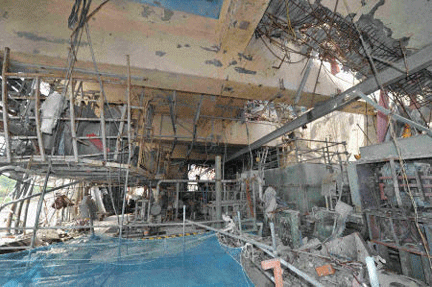 Nuclear Perceptions Fight Reality OpEd News, By William Boardman, 22 Oct 12, FUKUSHIMA FREAKOUT OBSCURES REAL ACCIDENT THAT GOES ON AND ON These buildings are supposed to be seismically and structurally secure and, you know, if the ground sinks under them, that suddenly changes a lot of people’s perception,” Gunderson said, underscoring the assurances of the nuclear industry that reactors are constructed to survive earthquakes intact. The Japanese “seismic calculations were wrong all along,” he added.
Unit 4 was first damaged by the earthquake/tsunami event, and then suffered several explosions during the aftermath. Tokyo Electric (TEPCO) acknowledged that the building was damaged and went in during the spring of 2011 to structurally reinforce the elevated fuel pool, to keep the bottom of the pool from breaking and dumping fuel rods uncontrollably.
Today the Unit 4 building is buckled, and is two inches wider at the bottom than at the top. There is at least one crack in its foundation.
Of the four Fukushima reactors and fuel pools, Unit 4 has the most nuclear fuel in the fuel pool, and no fuel in its reactor within the containment. All the fuel in Unit 4 is outside the relative safety of the containment. And part of that fuel is the entire hot nuclear core that used to be in the reactor. That’s why the fuel pool steams on colder days.
“There is dozens of times more Cesium in the nuclear fuel pool at Unit 4 than was ever released in all the above ground [nuclear bomb] testing that ever occurred, so if that pool were to face structural damage from another earthquake, it would likely devastate Japan,” Gunderson said, “It’s a sleeping dragon.”
He added that until Tepco gets the fuel out of the pool, the world needs to keeps its fingers crossed that there’s not another earthquake, because Tepco is moving too slowly and methodically to make the site safe any time soon…… http://www.opednews.com/articles/2/Nuclear-Perceptions-Fight-by-William-Boardman-121022-931.html
Authorities keeping quiet about Fukushima reactor 4’s dire situation
Fukushima Daiichi’s Reactor 3 and 4 are waterlogged, cracked and just one major earthquake jolt away from a catastrophe that one expert said could be “of biblical proportions.”
Fukushima’s Hot Water: Now Fallout in Our Kitchens? On The Issue, by Kimberly Robertson, 21 Oct 12, Information about radioactive fallout from Japan has been in very short supply since the unprecedented triple nuclear meltdowns at Fukushima Daiichi on March 11, 2011.
“Nuclear meltdown” is a term for a catastrophic reaction in a nuclear reactor that has overheated. The uncontrolled heat damages the reactor itself, causing an uncontrolled release of life threatening radioactive material, also known as “radioactive fallout” into the environment.
At Fukushima this happened three times, an unprecedented catastrophe.With the 67th anniversary of the atomic bombing of Hiroshima in August 2012, it was strange to realize that Japan unwittingly dropped an even deadlier bomb on itself. Fukushima contained over 100 times more cesium-137 alone than Hiroshima, and there are literally hundreds of dangerous radionuclides in the “mix.” Continue reading
Sinking ground under Fukushima nuclear reactor 4 brings catastrophic risk
 Fukushima threatens Global Human Survival The Canadian, 21 OCTOBER 2012 : BY SUBRATA “…..is Fukushima still a threat? It seems that it is, and on a potentially devastating level. Mitsuhei Murata, who served his country as Ambassador to both Senegal and
Switzerland, explained in a recent interview that far from the situation at the Fukushima Daiitsu plant improving, it is actually worsening in an alarming way: the ground beneath the plant’s number 4 reactor is sinking.
Mr Murata implied that the whole structure is on the verge of collapse. He wrote to the Secretary General of the United Nations stating unequivocally that the fate, not only of Japan, but of the rest of the world depends on the No. 4 reactor.
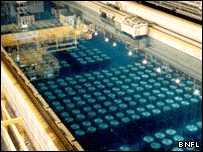
The cooling pool still contains more than fifteen hundred spent fuelrods. The collective power of these “spent” rods is 37 million curies. By comparison, the release of nuclear material at Three Mile Island, Pennsylvania (an INES level 5 event) amounted to approximately
2.5 million curies. In other words, there are nearly 15 Three Mile Islands sitting in the severely compromised Unit 4.
The ground beneath Unit 4 has sunk by about 31.5 inches already. Further sinking, or a minor earthquake could cause the entire structure to collapse, draining the pool and causing a meltdown of potentially catastrophic proportions. Some scientists predict that
his would mean the ruin of Japan and a serious threat to the rest of the world. http://www.agoracosmopolitan.com/news/nature/2012/10/19/4621.html
1 This Month

of the week – Shut Down Drone Warfare!


Tell the Ukrainian Government to Drop Prosecution of Peace Activist Yurii Sheliazhenko

Petition to revoke the licensing of the Near Surface Nuclear Disposal Facility (NSDF) at Chalk River. https://www.ourcommons.ca/petitions/en/Petition/Details?Petition=e-7247
To see nuclear-related stories in greater depth and intensity – go to https://nuclearinformation.wordpress.com
-
Archives
- April 2026 (68)
- March 2026 (251)
- February 2026 (268)
- January 2026 (308)
- December 2025 (358)
- November 2025 (359)
- October 2025 (376)
- September 2025 (257)
- August 2025 (319)
- July 2025 (230)
- June 2025 (348)
- May 2025 (261)
-
Categories
- 1
- 1 NUCLEAR ISSUES
- business and costs
- climate change
- culture and arts
- ENERGY
- environment
- health
- history
- indigenous issues
- Legal
- marketing of nuclear
- media
- opposition to nuclear
- PERSONAL STORIES
- politics
- politics international
- Religion and ethics
- safety
- secrets,lies and civil liberties
- spinbuster
- technology
- Uranium
- wastes
- weapons and war
- Women
- 2 WORLD
- ACTION
- AFRICA
- Atrocities
- AUSTRALIA
- Christina's notes
- Christina's themes
- culture and arts
- Events
- Fuk 2022
- Fuk 2023
- Fukushima 2017
- Fukushima 2018
- fukushima 2019
- Fukushima 2020
- Fukushima 2021
- general
- global warming
- Humour (God we need it)
- Nuclear
- RARE EARTHS
- Reference
- resources – print
- Resources -audiovicual
- Weekly Newsletter
- World
- World Nuclear
- YouTube
-
RSS
Entries RSS
Comments RSS
 nuclear-news