Role of Fukushima insects in spreading radiation?
 Are radioactive insects spreading Fukushima contamination from lake bottoms across the land? Scientist: They grow underwater then fly out & die everywhere http://enenews.com/are-radioactive-insects-spreading-cesium-from-lake-bottoms-out-across-the-land-scientist-they-grow-underwater-then-fly-out-and-die-everywhere
November 21st, 2012
Title: Fukushima Update: Radioactive Fish, Conflicts of Interest, and Filtered Vents
Source: ScienceBlogs (A National Geographic partner)
Author: Greg Laden
Date: Nov. 21, 2012
Highly Radioactive Fish Have Been Found…
I have a hypothesis that explains many of these observations. Fish like trout, salmon, and char eat, among other things, insects on the surface, gorging on hatches. A hatch is a large number of insects flying around and spending time over water, or often, just falling into the water, after emerging from a body of water where they spent an aquatic phase. I’ve written before about the role that insects such as dragonflies and lake flies serve the role of moving nutrients from their “final” resting place at the bottom of ponds and lakes, out across the landscape. These animals start off as an egg, and then turn into their adult form underwater, accumulating nutrients …. and cesium? …. as they grow. Then they fly out of the water and die everywhere. Or, are eaten by selected species of fish. From clay-rich lake bottom, where radioactive cesium can accumulate in sufficient density to disqualify bottom feeders from human consumption, to the mouths of trout, salmon and char. I don’t know if the Japanese researchers are thinking about it this way, but I hope it is given some thought.
See also: Japan Times: Time bomb in Tokyo metropolitan area — Experts warn of accumulating Fukushima contamination — Potential disaster at Japan’s 2nd largest lake
Failure of Japan’s new Fukushima clean-up robot
 Japan’s new nuclear-proof robot gets stage fright
  http://ajw.asahi.com/article/economy/technology/AJ201211220024 November 22, 2012 REUTERS YOKOHAMA--A Japanese robot designed to withstand high levels of radiation and extreme heat at damaged nuclear plants such as Fukushima froze on its first public demonstration.
Despite being home to the largest number of industrial robots in the world, Japan did not have a device capable of entering the damaged Fukushima nuclear facility after last year’s devastating earthquake and tsunami.
Instead, Japan brought in U.S. robots to survey the extent of the damage inside the reactor buildings.
Toshiba Corp. unveiled Japan’s own nuclear-proof robot on Oct. 21, a four-legged device able to carry up to 20 kg of equipment and capable of lifting itself up if it falls over on uneven surfaces and amid debris.
During the demonstration, the robot experienced a case of stage fright. The shuffling Tetrapod locked up and suddenly froze after it tried to balance itself, forcing technicians to carry it away. It is the second time such Japanese robotic technology has experienced problems. Last October, a crawling robot developed by the Chiba Institute of Technology lost connection with operators and was abandoned inside Fukushima’s No. 2 reactor building.
Thyroid disorders in 42% of Fukushima’s children
German TV: 42% of Fukushima children now with thyroid disorders — Official blames too much seafood? (VIDEO) http://enenews.com/german-tv-42-of-fukushima-children-now-with-thyroid-disorders-official-blames-too-much-seafood-video German TV channel ZDF’s segment on the Fukushima Health Survey translated by SimplyInfo:
November 19th, 2012 More than 42% of 57,000 tested children have nodules or cyst, reports Dr. Suzuki who leads the examinations. In Chernobyl they found only 0.1 – 1%. nobody of the experts asks for the reasons. […] He explains the results mainly by improved diagnosis methods, but people don’t believe him. […] There are no refererence [sic] studies, Dr. Suzuki tells us, and maybe the children simply took too much iodine or seafood. He doesn’t know if this has something to do with radiation. “We are mainly here to inform the parents of the results of our study.” But what do such results mean to parents without proper explanations? The official handling of the disaster is more than questionable. Many people have completely lost trust in government and believe that the disaster is played down to protect the mighty nuclear industry of Japan.
seawater off Fukushima containing plutonium
 Pu-239/240 was measured in sea water from 15km offshore Fukushima plant
by Mochizuki on November 21st, 2012 ·
(4.7±1.5)E-6 Bq/L of Pu-239/240 was measured from the upper layer of
15km offshore from Fukushima plant….
http://fukushima-diary.com/2012/11/pu-239240-was-measured-in-sea-water-from-15km-offshore-fukushima-plant/
AUDIO: Damaged Fukushima reactor No 3 cannot support cover
 Gundersen: Cover at Fukushima Unit 3 looks like a mall superstore — Reactor building so severely damaged it can’t support structure (AUDIO)
http://www.fairewinds.org/content/fairewinds-podcast http://enenews.com/gundersen-cover-fukushima-unit-3-looks-like-mall-superstore-reactor-building-severely-damaged-support-structure-audio November 19th, 2012
Follow-up to: Tepco to construct bulbous cover over Fukushima Daiichi Unit 3 (PHOTO)Fairewinds Podcast, Nov. 18, 2012:
Nuclear Expert Arnie Gundersen, Fairewinds Energy Education: Unit 3 is entirely different than Unit 4 […] they built something that looks like a superstore in a mall, it could easily look like a retail outlet […]
It’s not connected at all to the reactor building or the containment building […]
The real problem is Unit 3 is so severely damaged that it can’t handle the weight of the 100 ton canister, there’s no place in Unit 3 that would be strong enough to brace that heavy crane […] I think Tepco is going to say that the reactor building on Unit 3 has been so damaged that we can’t find a place to brace the heavy duty cranes, and therefore we have to span the whole structure […] Now it’s absolutely obvious that Unit 3 has been so damaged by the explosion that it can’t handle the weight of the larger cask. Now, they’re not telling people that, but clearly that’s what the drawings show.
Host Kevin Hurley: Is this going to slow down the removal of fuel?
Gundersen: Absolutely.
 Japan Experts: Contamination from Fukushima “is almost irreversible” in coastal sediments http://enenews.com/japan-experts-contamination-is-almost-irreversible-in-coastal-sediments November 17th, 2012
Title: Sedimentation and remobilization of radiocesium in the coastal area of Ibaraki, 70 km south of the Fukushima Dai-ichi Nuclear Power Plant
Authors: Shigeyoshi Otosaka and Takuya Kobayashi, Research Group for Environmental Science, Japan Atomic Energy Agency
Date: 13 November 2012
[…] it can be inferred that dissolved radiocesium advected southward from the region adjacent to the 1FNPP and was deposited to the sediment of the study area in the early stage after the accident. The incorporation of radiocesium into sediments was almost irreversible, and higher concentrations of 137Cs were obtained from the finer-grained fraction of sediments. […]
137Cs levels in sediment decreased considerably between June and August, and then remained at the same level until January 2012. This trend indicates that the initial deposition of 137Cs to the sediment had almost ceased by August, and that the incorporation of 137Cs into sediments was almost irreversible. […]
In conclusion […] it can also be inferred that the remarkable decrease in 137Cs level between June and August 2011 (Table 3) was not caused by dissolution of labile 137Cs but by a physical transport (export) of irreversibly bound 137Cs.
[…] Most of radiocesium in the coastal sediments is incorporated into lithogenic fractions, and this incorporation is almost irreversible. Accordingly, the biological availability of sedimentary radiocesium is relatively low, but continuous monitoring of radiocesium inmarine biota is highly recommended because significant amounts of radiocesium have been accumulated in the sediment.
Highly radioactive trout caught in Fukushima river
Kyodo: Radioactive trout over 100 times gov’t limit caught in Fukushima river http://enenews.com/kyodo-radioactive-trout-over-100-times-govt-limit-caught-in-fukushima-river November 16th, 2012
(Subscription Only) Title: Fukushima trout log radioactivity level over 100 times gov’t limit
Source: Kyodo
Date: Nov. 17, 2010
A mountain trout caught in a Fukushima Prefecture river [Niida River in Minamisoma city] returned a radioactive cesium reading of 11,400 becquerels per kilogram, more than 100 times the government-set limit for food items, a survey by the Environment Ministry said Friday. […]
The survey conducted in June and July also found 4,400 becquerels of radioactive cesium in a smallmouth bass and 3,000 becquerels in a catfish in Mano Dam in Iitate village, another municipality heavily affected by the crisis at the Fukushima Daiichi nuclear power plant run by Tokyo Electric Power Co. […]
See also: Asahi: Gov’t worried about highly radioactive fish — Why are radiation readings still 100s of times over official safe
Rip in lining of spent nuclear fuel pool at Fukushima Unit 3 ?
Nuclear Engineer: To me it means Tepco knows about a rip in spent fuel pool liner at Fukushima Unit 3 AUDIO http://enenews.com/nuclear-engineer-curing-material-unit-3-means-tepco-about-tear-rip-spent-fuel-pool-liner-video
November 16th, 2012 Interview with Nuclear Engineer Chris Harris
Nutrimedical Report
Nov. 15, 2012 Chris Harris, former licensed Senior Reactor Operator and engineer: One of the Tepco releases that really intrigued me was that there is something called ‘curing material’.
Now that means, to me it means they know about a tear or a rip in the spent fuel pool liner.
And they don’t come out and say — a lot of this stuff you have to read between the lines — there’s something called ‘curing material’ […] what it means to me is they tried to repair with some sort of epoxy and something that needs to cure or cure time on it before they can proceed. Which means that water’s actually being held in not by the stainless steel liner, but by the concrete structure around, that’s not really a great situation to be in.
They didn’t come flat out and say it but I’m going to stick my neck out and say if they’re trying to seal up cracks and everything else, that’s how I would do it too. And so that’s happening now, we’ll see where that comes and I’ll stay on top of it.
Follow-up to: Tepco to try and remove steel debris on top of fuel racks in No. 3 pool — Concern about liner? (PHOTOS)
Radiation levels not decreasing in seas around Fukushima
Radiation Still High Around Fukushima http://www.the-scientist.com/?articles.view/articleNo/33275/title/Radiation-Still-High-Around-Fukushima/,
Continued leaks, run off from land, and contaminated sediment on the ocean floor are causing radioactivity levels to remain high in the seas around Fukushima. By Dan Cossins | November 15, 2012 Levels of radiation in the seas surrounding the ruined Fukushima Daiichi power plant in Japan are showing no signs of dropping off as expected, according to new data presented last week (November 12-13) at a conference in Tokyo. Scientists believe that continued leaks from the plant in addition to run off from contaminated land and radiation-soaked sediment on the sea floor are responsible. Continue reading
Plan to cover Fukushima Daiichi Unit 3
Tepco to construct bulbous cover over Fukushima Daiichi Unit 3 (PHOTO) http://enenews.com/tepco-construct-bulbous-cover-fukushima-unit-3-photo Enformable, Nov. 14, 2012: TEPCO has released designs for a cover to construct around the crippled Unit 3 reactor building in order to allow the utility to remove fuel rods from the spent fuel pool by crane.
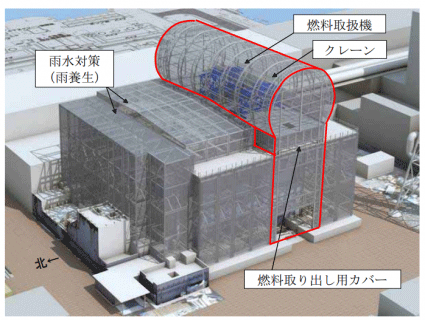
[…] The building will also house ventilation to reduce the radioactive materials being released into the atmosphere.
Fukushima is not a city where people can live: Video
 http://www.youtube.com/watch?v=Ko1t92IM44A Mother: I want the world to know Fukushima is in a state of dying — I reaffirmed severe radioactive contamination — I alone can’t do anything, I tried (VIDEO) http://enenews.com/mother-world-fukushima-state-dying-alone-anything-severe-radioactive-contamination-video
November 11th, 2012
Title: Fukushima is not a city where people can liveWatch the video here http://www.youtube.com/watch?v=Ko1t92IM44A
By: 148 Production
Date: November 10, 2012
If you do not want to die, run away from Fukushima.
[…]
Fukushima Mother: Since the government was hiding information about radioactive contamination has paralyzed our crisis management. […] I reaffirmed severe radioactive contamination […] I alone cannot do anything I tried to help Fukushima. So, I want to know in world, Fukushima is in a state of dying.
Worsening working conditions at Fukushima – Video
 NHK Documentary: Recently deteriorating working conditions at Fukushima plant causing workers to quit — Company hasn’t been able to recruit a single employee (VIDEO) http://enenews.com/nhk-documentary-working-conditions-deteriorating-fukushima-plant-many-workers-leaving-company-hasnt-able-recruit-single-worker-video
November 13th, 2012
Title: WANTED: Workers for Fukushima Decommission
Source: NHK
Uploaded by: MissingSky101
Date: Nov 12, 2012
NHK Narrator: This company that manages and maintains nuclear plant
instruments hasn’t been able to recruit a single worker for the plant
since the accident.
Yukiteru Naka, Chairman: If nothing changes there will be no young
workers at the plant in future. I think that’s very clear.
[…]
NHK Reporter: Many workers in areas with high radiation levels are
quitting. They have to leave in around 3 months when their level of
exposure is at the safety limit.
Recently deteriorating working conditions are also making others leave.
Tons of radioactive water around Fukushma nuclear plant
http://www.youtube.com/watch?v=jDsSgVoJhuw Japan Nuclear Engineer: “Mind-blowing… truly outrageous” — Many massive pools of contaminated water are spread around Fukushima plant http://enenews.com/japan-nuclear-engineer-mind-blowing-truly-outrageous-many-massive-pools-of-contaminated-water-are-spread-around-fukushima-plant
November 12th, 2012
Title: Japanese tread radioactive water, attempt damage control
Source: The Guilfordian
Author: Haejin Song
Date: Nov. 12, 2012
[…] “Water works well for this system since it has a very high capacity … and can be treated if it is contaminated,” said Angie Moore, associate professor of geology. “However, when there is a reactor accident like at the Fukushima, the systems that prevent nuclear contamination of the cooling water have failed and there is direct contact between the water and the radioactive material.”
Masashi Goto (Credit: Shunji Iwai)
[…]
“There are pools of some 10,000 or 20,000 tons of contaminated water in each plant, and there are many of these,” said nuclear engineer Masasahi Goto to news source Al Jazeera.
“To bring all these to one place would mean you would have to treat hundreds of thousands of tons of contaminated water which is mind-blowing in itself,” continued Goto. “It’s an outrageous amount, truly outrageous.” […]
Watch Goto’s presentation at the Foreign Correspondent’s Club of Japan here http://www.youtube.com/watch?v=jDsSgVoJhuw
Women of Fukushima speak out
Filmmaker: Hope is hard to come by in Fukushima — To this day women having abortions for fear of genetic damage, families breaking up http://enenews.com/fukushima-filmmaker-to-this-day-women-having-abortions-for-fear-of-genetic-damage
November 6th, 2012 Title: Production Notes
Source: ‘Women of Fukushima’ website
The full ramifications of the aftermath of the disaster that occurred at the Fukushima Daiichi Nuclear Power Plant in March 2011 will take decades to unfold. Having shifted from the initial visceral drama to a more long-term, almost invisible threat, there is a real risk that the situations faced by residents of Fukushima Prefecture will simply vanish from the radar screens of the world’s media (or, in the case of Japanese media, remain non-existent). To this day, as a result of the meltdowns, children can’t play outside, families are breaking up, and women are even having abortions for fear of genetic damage to their unborn children. Hope is hard to come by in Fukushima.
However, after meeting a group of outspoken local women, we were compelled to capture their spirit and stories. […]
One month after the explosion, Kazue Morizono of Koriyama, fell sick with symptoms of vomiting, cold sores, diarrhea and joint pain. She was bedridden for months, but upon recovery she was out in full force, speaking up at public meetings and making heartfelt appeals to government and electric company officials— all of which fell on deaf ears. Vibrant, compassionate, angry and hurt, Morizono, like all of the Women of Fukushima, bears the burden of keeping the children safe.
“The government is 80-90% men and they are making all the decisions. It’s time for them to become enlightened to the fact that they are wrong. I want them to listen to us women; the women need to speak up, I feel that very strongly.”
$125 billion and decades to clean up Fukushima – says TEPCO
The clean-up is expected to take decades, with scientists warning that some settlements may have to be abandoned.
The company said it would need more government help to meet the colossal figure
Fukushima operator warns clean-up ‘may cost $125 bn’ By Kyoko Hasegawa (AFP) 7 Nov 12 TOKYO — The cost of the clean-up and compensation after Japan’s Fukushima nuclear power plant disaster may double to $125 billion, the plant’s operator warned Wednesday. Tokyo Electric Power Company (TEPCO) said decontamination of irradiated areas and compensating those whose jobs or home lives have been affected would cost much more than the five trillion yen it estimated in April. Continue reading
1 This Month

of the week – Shut Down Drone Warfare!


Tell the Ukrainian Government to Drop Prosecution of Peace Activist Yurii Sheliazhenko

Petition to revoke the licensing of the Near Surface Nuclear Disposal Facility (NSDF) at Chalk River. https://www.ourcommons.ca/petitions/en/Petition/Details?Petition=e-7247
To see nuclear-related stories in greater depth and intensity – go to https://nuclearinformation.wordpress.com
-
Archives
- April 2026 (57)
- March 2026 (251)
- February 2026 (268)
- January 2026 (308)
- December 2025 (358)
- November 2025 (359)
- October 2025 (376)
- September 2025 (257)
- August 2025 (319)
- July 2025 (230)
- June 2025 (348)
- May 2025 (261)
-
Categories
- 1
- 1 NUCLEAR ISSUES
- business and costs
- climate change
- culture and arts
- ENERGY
- environment
- health
- history
- indigenous issues
- Legal
- marketing of nuclear
- media
- opposition to nuclear
- PERSONAL STORIES
- politics
- politics international
- Religion and ethics
- safety
- secrets,lies and civil liberties
- spinbuster
- technology
- Uranium
- wastes
- weapons and war
- Women
- 2 WORLD
- ACTION
- AFRICA
- Atrocities
- AUSTRALIA
- Christina's notes
- Christina's themes
- culture and arts
- Events
- Fuk 2022
- Fuk 2023
- Fukushima 2017
- Fukushima 2018
- fukushima 2019
- Fukushima 2020
- Fukushima 2021
- general
- global warming
- Humour (God we need it)
- Nuclear
- RARE EARTHS
- Reference
- resources – print
- Resources -audiovicual
- Weekly Newsletter
- World
- World Nuclear
- YouTube
-
RSS
Entries RSS
Comments RSS
 nuclear-news