Report points to earthquake as cause of Fukushima nuclear catastrophe
The 641-page report criticized Tepco as being too quick to dismiss earthquake damage as a cause of the fuel meltdowns at three of the plant’s six reactors, which overheated when the site lost power.

 Inquiry Declares Fukushima Crisis a Man-Made Disaster,
 NYT, By HIROKO TABUCHI, July 5, 2012 TOKYO — The nuclear accident at Fukushima was a preventable disaster rooted in government-industry collusion and the worst conformist conventions of Japanese culture, a parliamentary inquiry concluded Thursday. Kyodo News, via Associated Press
The report, released by the Fukushima Nuclear Accident Independent Investigation Commission, challenged some of the main story lines that the government and the operator of the Fukushima Daiichi Nuclear Power Plant have put forward. Most notably, the report said the plant’s crucial cooling systems might have been damaged in the earthquake on
March 11, 2011, not only in the ensuing tsunami.
That possibility raises doubts about the safety of all the quake-prone country’s nuclear plants just as they begin to restart after a pause ordered in the wake of the Fukushima crisis…… Continue reading
Fukushima nuclear reactor No.1 cleanup stalled by lethal levels of radiation
 Fukushima radiation at record high RECORD amounts of radiation have been detected at the Fukushima nuclear reactor, further hampering clean-up operations. http://www.heraldsun.com.au/ipad/fukushima-radiation-at-record-high/story-fn6s850w-1226410635366 28 June 12 TEPCO, the operator of Japan’s crippled nuclear plant, took samples from the basement of reactor number 1 after lowering a camera and surveying instruments through a drain hole in the basement ceiling.
Radiation levels above radioactive water in the basement reached up to 10,300 millisievert an hour, a dose that would kill humans within a short time after making them sick within minutes. The annual allowed dose for workers at the stricken site would be reached in only 20 seconds.
“Workers cannot enter the site and we must use robots for the demolition,” said TEPCO.
The Fukushima operator said that radiation levels were 10 times higher than those recorded at the plant’s two other crippled reactors, number two and three. This was due to the poor state of the nuclear fuel in the reactor compared to that in the two others.
The meltdown at the core of three of Fukushima’s six reactors occurred after the March 11, 2011 earthquake and ensuing massive tsunami shut off the power supply and cooling system.
Demolition of the three reactors as well as the plant’s number 4 unit is expected to take 40 years and will need the use of new technologies.
Golden farewell for Fukushima nuclear plant directors and auditors as they leave for other lucrative jobs

 VIDEO : . http://www.radioaustralia.net.au/international/2012-06-27/tepco-directors-quit-with-golden-parachute/968572 TEPCO directors quit with ‘golden parachute’, Radio Australia 28 June 2012, Directors and auditors at the Japanese operator of the Fukushima nuclear plant have used the company’s annual general meeting to resign. In theory, the TEPCO directors and auditors are doing so to take responsibility for last year’s disaster, but the ABC can confirm nearly half of those who have resigned will take up lucrative posts with other TEPCO group companies.
Some of the executives are also facing the biggest lawsuit in Japanese history – a $67 billion compensation claim from shareholders for what they describe as unforgivable negligence. Outside the company’s meeting on Wednesday, activists – most of them middle-aged women – handed out anti-nuclear leaflets to shareholders making their way in.
Among them was Yui Kimura, who bought TEPCO shares so she could attend and vote at meetings. She is one of 42 shareholders suing 27 company directors for failing to heed repeated warnings about the threat of a giant tsunami.
She is fighting for TEPCO to pay compensation for those affected by the Fukushima nuclear meltdowns.
About 100,000 Fukushima residents still cannot return home……
High radiation levels in Fukushima fish
Fukushima fish still hard to stomach http://www.radioaustralia.net.au/international/2012-06-25/fukushima-fish-still-hard-to-stomach/967258, 26 June 2012 Japanese fishermen are facing a struggle for their livelihoods.An ABC report shows that many fish caught in the oceans around Fukushima contain dangerous levels of radioactive material. Continue reading
Extremely high radiation found by robots, above Fukushima Reactor No.2
 High Radiation Detected On Floor Above Crippled Fukushima Reactor http://www.rttnews.com/1907046/high-radiation-detected-on-floor-above-crippled-fukushima- 6/15/2012 (RTTNews) – Extremely high level of radiation has been detected on a floor just above the No.2 reactor at the crippled Fukushima nuclear power plant in Japan, the plant operator said on Thursday The Tokyo Electric Power Company (Tepco) said a reading of 880 millisieverts per hour of radiation was detected on the fifth floor, which is 4.5 meters above the reactor containment vessel. The reading was taken by a robotwhich the company deployed in the reactor building on Wednesday.
Tepco suspects that radioactive substances leaked from the No.2 reactor moved through the location. It could not find the exact route the radioactive substances moved even after analyzing the images taken by the robot, Japanese media reported.
The No.2 reactor is believed to have released the largest amount of radioactive substances during the Fukushima nuclear accident caused by the disastrous earthquake and the massive tsunami it unleashed on Japan’s north-east on March 11, 2011. But the overall route they took has not been determined. Residents in 20 kilometer radius of the stricken plant had been evacuated following the accident, the second biggest after Chernobil.
Tepco needs to find and repair the damaged parts of the reactor to recover melted nuclear fuel before starting to decommission the reactor. But it says high radiation often stops workers from entering the building.
Japan’s nuclear hosting towns addicted to the drug of nuclear subsidies
Genkai’s dependence on nuclear subsidies to fund 34% of its budget is the highest among the municipalities hosting nuclear plants, only matched by the town of Futaba next to the Fukushima Daiichi plant, according to a survey by the Yomiuri newspaper released in May.
Radiation levels in Futaba are so high that the government doesn’t expect the town to be habitable for decades.
Nuclear-related money “is like a drug: you get addicted once you receive it,”
Fukushima Watch: Looking for New Nuclear Revenue — A Spent Fuel Tax?, WSJ, By Mari Iwata, 15 June 12, The town of Genkai on Japan’s western island of Kyushu is one of many in this country whose livelihood depends on the nuclear reactors it hosts. Since those reactors have been shut down for nearly six months, with no restart in sight, the town is proposing another way of squeezing revenue from the power plant: tax it. That at least was the idea proposed by Hideo Kishimoto, Genkai’s mayor, in a municipal parliament session on Monday. One specific suggestion: a tax on the storage of the Genkai plant’s spent nuclear fuel rods.
“We can’t avoid a future drop in revenue, so we have to think of new taxes in order to maintain services for residents,” Mr. Kishimoto was quoted as saying in local media. Genkai’s revenue problem is acute. Continue reading
Fukushima Daiichi – a global disaster still only in its infancy
There is every reason to suspect that the vital information about the full extent of the nuclear disaster in Japan is still being kept from the public; that the life-threatening damage to Japan’s nuclear infrastructure does not end with Fukushima #1.
The Fukushima Debacle is Only in Its Infancy The growing realization that the worst of the Fukushima debacle lies in the future rather than in the past puts in sharp relief the pertinence of Einstein’s observation.
 Fukushima Daiichi: From Nuclear Power Plant to Nuclear Weapon Global Research, by Prof. Anthony Hall , 13 June 12, “Our world is faced with a crisis that has never before been envisaged in its whole existence… The unleashed power of the atom has changed everything save our modes of thinking, and thus we drift towards unparalleled catastrophe.” Albert Einstein, Bulletin of the Atomic Scientists, May, 1946
Albert Einstein’s Warning and the Ominous Fate of Fukushima Daiichi
As the bad news gradually spreads that the debacle at Fukushima nuclear power plant #1 is becoming more perilous rather than less so, the words of Albert Einstein come to mind. Recall that the legendary physicist, Einstein, helped to set in motion the Manhattan Project whose personnel designed and built the first atomic bombs dropped on Hiroshima and Nagasaki in 1945…..
Albert Einstein worried that human ways of thinking could not be made to adapt to the changes brought to the world by the tapping the enormous energy sources emanating from the molecular constitution of inner space.
Japan as Laboratory Continue reading
Charge nuclear officials under criminal law, say Fukushima residents
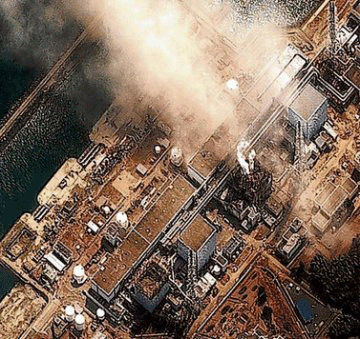 Fukushima residents call for criminal charges against nuclear officials http://articles.cnn.com/2012-06-11/asia/world_asia_japan-nuclear-complaint_1_fukushima-daiichi-nuclear-plant-fukushima-residents-tepco?_s=PM:ASIA June 11, 2012|By Kyung Lah, CNN The executives of the Japanese utility that owns the stricken Fukushima Daiichi nuclear plant and a number of the country’s government officials should go to jail, according to a complaint filed by more than 1,000 local residents on Monday.
A total of 1,324 people lodged the unusual criminal complaint with the Fukushima prosecutor’s office, naming Tsunehisa Katsumata, the chairman of Tokyo Electric Power Co. (TEPCO) and 32 others.
The complaint argues that the 33 TEPCO executives and government officials are responsible for causing the nuclear disaster that followed the March 11 earthquake and tsunami and exposing the people of Fukushima to radiation.
Japan’s secrecy over the true extent of Fukushima radiation
Japan Used Claims of Inaccuracy To Divert Release of Critical Radioactive Material at Fukushima Nuclear Plant, Spy Ghana 12 June 12, Japanese officials have failed to justify why it took them over a month to disclose large-scale releases of radioactive material in mid-March at the crippled Fukushima Daiichi nuclear power plant. Continue reading
World Health Organisation dancing to nuclear lobby’s tune on Fukushima radiation?
 Dr. Caldicott says the WHO only focuses on
  thyroid cancer and ignores all other cancers and other radiation related diseases.
“There is a substantially increased incidence of thyroid tumors among exposed children, up to 50 percent of those tested by ultrasound. But instead of biopsying these tumors, they are ‘following’ them, i.e. doing nothing, which means they are
not being diagnosed and many of these children are therefore destined to die, because almost certainly
many of the tumors will be malignant,” …. She is far from alone in her views.
The Fukushima Battleground Over Science, By Aron Lamm, Epoch Times, 8 June 12, More than a year after the Fukushima nuclear incident, there is still much disagreement about many aspects of its actual consequences. A recent example is a report by the World Health Organization, which estimates radiation doses and cancer risks in the wake of the disaster.
Its findings are being criticized by other medical professionals who use different assumptions and different science, and accuse the WHO of downplaying the gravity of the health risks for people living in the affected area…… Continue reading
Fukushima radiation worse than we’ve been told
The meltdown at Fukushima is releasing far more radiation into the atmosphere [than the Nagasaki A bomb] and if unit 4 were to tumble, it would have the same effect as 1,100 A-bombs….. much more radiation than we’ve been led to believe has made its way to the American shores.
Fukushima forum: Dr. John Apsley says U.S. is feeling the effects of radiation, Donna Anderson Coast to Coast Radio Examiner 10 June 12, Dr. John Apsley appeared on the Fukushima forum on Coast to Coast AM on Saturday, June 9, 2012 .
For more than 30 years Dr. Apsley , author of “Fukushima Meltdown & Modern Radiation: Protecting Ourselves and Our Future Generations ” has specialized in cell regeneration and accelerated wound repair. He appeared on the show to deliver his findings on the effects of
Fukushima radioactive fall-out on the Japanese people, as well as Americans. Continue reading
Fukushima nuclear disaster remains a problem for the whole world
324 Civic organizations from all over the world have submitted a petition called “An Urgent Request for UN Intervention to Stabilize the Fukushima Unit 4 Spent Nuclear Fuel”, Mr. Murata said noting that those organizations are also demanding a moratorium on Japan’s nuclear reactors.
”the nuclear village and nuclear dictatorship is exposed, and public opinion and their movements are strong.”Nuclear village is a term for the Japanese distorted social structure in which the pronuclear politicians, scholars and companies have more power than those who are skeptical of nuclear energy. Anti-nuclear protests have been ignored for more than 40 years.
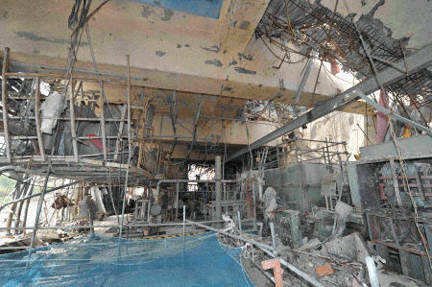 Fukushima Reactor Global Security Issue: Japanese Former Diplomat http://www.panorientnews.com/en/news.php?k=1784, June 7, 2012 Tokyo- (PanOrient News)The Fukushima Daiichi Nuclear Plant Number 4 reactor presents a security problem for the entire world, Mitsuhei Murata, Japan’s former ambassador to Switzerland said.
Fukushima Daiichi plants are “not under control at all… and the situation with nuclear reactors in Japan is like vehicles being driven without a license,” Mr. Murata told a news conference at the foreign correspondents’ club of Japan on June 5. Continue reading
Perilous state of spent nuclear fuel rods pool at Fukushima reactor No. 4
The worries gained new traction in recent days after the operator of the plant, Tokyo Electric Power Co., or TEPCO, said it had found a slight bulge in one of the walls of the reactor building
questions about whether Japan’s all-out effort to convince its citizens that nuclear
power is safe kept the authorities from exploring other – and some say safer – options for storing used fuel rods.
Radioactive waste at Fukushima threatens second nuclear catastrophe
http://www.watoday.com.au/environment/radioactive-waste-at-fukushima-threatens-second-nuclear-catastrophe-20120527 1zcxu.html#ixzz1wgpRdAiv Hiroko Tabuchi, Matthew Wald May 28, 2012 TOKYO: What passes for normal at the Fukushima Daiichi nuclear plant today would have caused shudders among even the most sanguine of experts before an earthquake and tsunami set off the world’s second most serious nuclear crisis after Chernobyl.
Fourteen months after the accident, a pool brimming with used fuel rods and filled with vast quantities of radioactive caesium still sits on the top floor of a heavily damaged building, covered only with plastic.
The public’s fears about the pool have grown in recent months as some scientists have warned that it has the most potential for setting off a new catastrophe. The three nuclear reactors that suffered meltdowns are in a more stable state, but frequent quakes continue to rattle the
region.
The worries gained new traction in recent days after the operator of the plant, Tokyo Electric Power Co., or TEPCO, said it had found a slight bulge in one of the walls of the reactor building, stoking fears over the building’s safety. Continue reading
Radiation released right after Fukushima accident was much more than first estimated
Fukushima radiation higher than first estimated, By Kevin Krolicki TOKYO May 24 (Reuters) – The radiation released in the first days of the Fukushima nuclear disaster was almost 2-1/2 times the amount first estimated by Japanese safety regulators, the operator of the crippled plant said in a report released on Thursday. Continue reading
Nuclear fuel rods at Fukushima’s reactor no. 4 – highly dangerous
The workers are like Samurai warriors, they’re like suicide workers. They know they are getting huge amounts of radiation going to the site. They can only go in, seconds to minutes, at a time doing work and then the next batch has to come in.
Chernobyl had a half a million workers who worked minutes at a time. Here we have a situation much worse than Chernobyl simply because we have basically five reactors that could go up. One reactor setting off the next reactor, that’s a huge amount of radiation, over ten times the radiation inventory found in Chernobyl.
“People don’t realize that the Fukushima reactor (Number 4) is on a knife’s edge; it’s near the tipping point.
includes videos and audio http://deathby1000papercuts.com/2012/05/large-crack-on-south-wall-of-fukushima-nuclear-reactor-number-four-photo/ Large  Crack on South Wall of Fukushima Nuclear Reactor Number Four? DBKP. May 20, 2012 By LBG1 We could have adisaster much worse, many times worse than Chernobyl.” Dr. Michio Kaku on the precarious state of the spent fuel rods in the severely damaged Fukushima nuclear reactor Unit Number Four building Continue reading
1 This Month
10 March A LIVE WEBINAR THE REAL EFFECTS OF NUCLEAR POWER
What the Industry Isn’t Telling Us
1:00 PM Mountain, 2 pm Central, 3 pm Eastern. Live on the Keepers of the Water Facebook page



18 March Webinar @ 1 PM EST: An Assessment of SMR Projects: The Case of Canada
register for the zoom:
https://us02web.zoom.us/webinar/register/WN_o8BIIOUvQ2ONJR1nta65DQ#/registration


of the week – STOP SMALL MODULAR REACTORS IN CANADA
To see nuclear-related stories in greater depth and intensity – go to https://nuclearinformation.wordpress.com
-
Archives
- March 2026 (109)
- February 2026 (268)
- January 2026 (308)
- December 2025 (358)
- November 2025 (359)
- October 2025 (376)
- September 2025 (258)
- August 2025 (319)
- July 2025 (230)
- June 2025 (348)
- May 2025 (261)
- April 2025 (305)
-
Categories
- 1
- 1 NUCLEAR ISSUES
- business and costs
- climate change
- culture and arts
- ENERGY
- environment
- health
- history
- indigenous issues
- Legal
- marketing of nuclear
- media
- opposition to nuclear
- PERSONAL STORIES
- politics
- politics international
- Religion and ethics
- safety
- secrets,lies and civil liberties
- spinbuster
- technology
- Uranium
- wastes
- weapons and war
- Women
- 2 WORLD
- ACTION
- AFRICA
- Atrocities
- AUSTRALIA
- Christina's notes
- Christina's themes
- culture and arts
- Events
- Fuk 2022
- Fuk 2023
- Fukushima 2017
- Fukushima 2018
- fukushima 2019
- Fukushima 2020
- Fukushima 2021
- general
- global warming
- Humour (God we need it)
- Nuclear
- RARE EARTHS
- Reference
- resources – print
- Resources -audiovicual
- Weekly Newsletter
- World
- World Nuclear
- YouTube
-
RSS
Entries RSS
Comments RSS
 nuclear-news