Lengthy and dangerous process to remove nuclear fuel rods
The pool at No. 4 was behind the secret worst-scenario mapped out by the government, which warned millions of people might have to flee from spewing radiation, including parts of the Tokyo area, which has a population of 35 million people. U.S. authorities have also repeatedly expressed worries about the spent-fuel pool at reactor No. 4.
“If we are asked whether things are completely safe, we cannot say that,” “If there is another major earthquake, we don’t know what may happen,
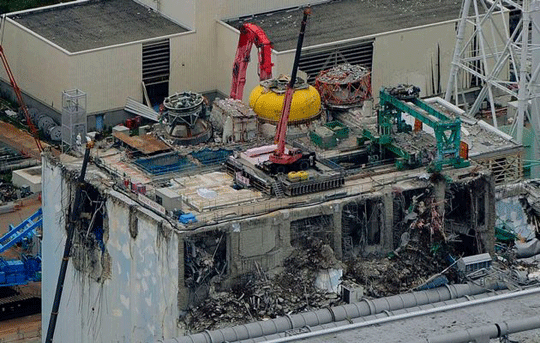
Japan removes two nuclear fuel rods from Fukushima plant Times Live Sapa | 18 July, 2012 A giant crane removed two rods packed with nuclear fuel from the Fukushima nuclear plant. This is the beginning of a delicate and long process to deal with a remaining risk of more radiation escaping from the disaster-struck plant.
All of the 1,535 rods next to reactor No. 4 at the crippled Fukushima Dai-ichi plant in northeastern Japan must eventually be removed from a spent-fuel pool to safer storage – an effort expected to take through the end of next year, according to the government. Continue reading
In last 24 hours – 3 earthquakes hit Fukushima
M4.5 quake hits Fukushima — Third M4 in last 24 hours July 19th, 2012 By ENENews Title: : Earthquake Information
Source: Japan Meteorological Agency Date: July 20, 2012 http://enenews.com/m4-5-quake-hits-fukushima-third-m4-in-last-24-hours
TEPCO covering seafloor with enormous amounts of concrete. Why?
Tepco completes covering seafloor with layers of cement mix — More coating used at Reactors 5 & 6 than for Reactors 1, 2, 3 & 4 combined (PHOTOS &  VIDEOS) July 19th, 2012 By ENENews http://enenews.com/tepco-completes-covering-seafloor-with-layers-of-cement-mix-more-coating-used-outside-reactors-5-6-than-for-reactors-1-2-3-4-combined-photos-videos
And all those funny looking black containers which were placed/dropped into the water..just COVER those things up with LAYERS of CONCRETE. Next generation can worry about it. Sadly, Mr. TEPCOman, one has to ask WHAT next generation will be healthy enough to work the problem?
One question to ask..what happened at Reactors 5 and 6 to require as much concrete or MORE than Reactors 1-4? Were more containers dumped into the ocean? More meltdown corium heading for the ocean..or is the ground so unstable..I hope its not the last. Subsidence(loss of ground HEIGHT) could be raising its ugly head. That is bad– almost as bad as Reactor 1-4 “payloads.”
Also note the non-concern of “radiation” going out into the OCEAN. What do they think the ocean is? An endless pit? Its not.
Safecast providing impartial information on Fukushima radiation
 visit Safecast at blog.safecast.org .
Local governments in Fukushima are linking up with Safecast to get additional readings, for example in schools, and are sharing data with residents. More volunteers are joining, including Europeans and Japanese as well as other nationalities.
U.S. group supplying radiation data Japan Times, 18 July 12By YURI KAGEYAMA People seeking information on radiation levels from the Fukushima crisis are turning to a volunteer group founded in the U.S. that has created a detailed and constantly updated visual database online. Continue reading
Study on cancer from Fukushima, but they didn’t count internal emitters of radiation

Christina Macpherson’s websites & blogs
Note that this study – like so many touted in the media – counts only “external emitters” – not the cancers caused by “internal emitters” . Internal emitters are the sources of radioactive material that lodge inside a person’s body – the lungs or the gut – and will cause cancer later on – perhaps years after they have been taken in by the body, through eating or breathing. They can be taken in long after the actual radioactive release, as they are the particles that have settled somewhere – on the ground, on plants, in water.
Japan’s Fukushima nuclear disaster may cause 1,300 deaths: report Radio Australia 18 July 2012 US researchers have released a study warning that radiation from the Fukushima nuclear disaster in Japan may eventually cause up to 1,300 deaths….. And they forecast anywhere between 24 and 2,500 thousand cases of cancer.
While the estimates have a large range, they do contrast with a UN prediction that the meltdowns would cause no severe health effects…. The study relied on a 3-D atmospheric model to predict the spread of radioactive material, and then calculated the estimated exposure to people in the path of the contamination…
http://www.radioaustralia.net.au/international/2012-07-18/japans-fukushima-nuclear-disaster-may-cause-1300-deaths-report/981808
Japanese medical authorities quiet about high thyroid nodules in Fukushima’s children
the rate of thyroid nodules in children 5 to 10 years after the Chernobyl accident was 1.74%. The results in Fukushima are merely one year after the accident. This is a much faster progression

 Just 0.8% of children in 2001 Japanese control group had thyroid cysts or nodules — 36% in Fukushima study
Fukushima Children’s Thyroid Examination: How Shunichi Yamashita would like doctors to deal with the results. Introduction Fukushima Voice May 2012,
This is a letter sent from Shunichi Yamashita, M.D., from Fukushima Medical University to the members of Japan Thyroid Association, of which he is the president. The letter “asks” or rather “instructs” the members, who are likely to be the thyroid specialists, on how to
deal with the thyroid ultrasound results of Fukushima children. Continue reading
High radiation stalls efforts to close down Fukushima nuclear reactor No.3
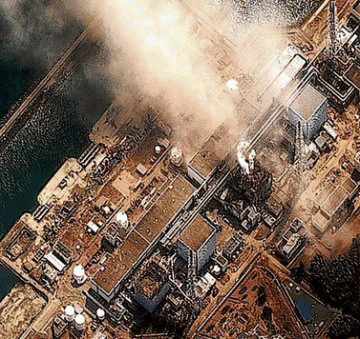 VIDEO Robot probe detects high radiation at No.3 reactor http://www3.nhk.or.jp/daily/english/20120713_10.html The operator of the Fukushima Daiichi nuclear plant has detected high levels of radiation in the basement of the No. 3 reactor, with a maximum dose of 360 millisieverts per hour.
Tokyo Electric Power Company sent in a robot on Wednesday to the room where the suppression chamber is located. It was the first robot to probe this area of the plant. TEPCO released video taken inside. They show that a door on the southwestern side is broken. There is no other apparent damage or sign of water leakage.
But high levels of radiation were detected. Readings exceeded 100 millisieverts per hour in a number of locations. Average levels were higher than those in the No.2 reactor.
Engineers lost control of the remote-controlled robot after around 3 hours of operation. They say there are problems with the connecting cable and they’ve been unable to regain control.
TEPCO officials say they have no option but to leave the robot where it is for the time being.
This may pose a problem to the utility’s efforts to decommission the reactor. The operators are in a hurry to identify and repair damage to the reactor’s suppression chamber and containment vessel. They want to pump in water in order to remove the melted fuel lying at the bottom.
Unusual number of birth deformities at Fukushima hospital
Evacuee: Fukushima hospital worker says 5 out of 7 babies were born with birth defect, Down’s syndrome, or lost by miscarriage — After this, husband agreed to evacuate July 13th, 2012 By ENENews Original published June 13, 2012 by a Fukushima evacuee, translated by Dissensus Japan:
Someone I know finally moved out of Fukushima to Mie (middle west of Japan). I wasn’t close to her, but she told me a major incident occurred that inspired her to be scared of radiation.At a hospital in Fuksuhima where she was working in, 5 babies out of 7 were born with birth defect, Down’s syndrome or lost by miscarriage.
- 2 Down’s syndrome
- 1 born with 6 fingers
- 1 anencephalia
- 1 miscarriage
- 2 other infants were 4 months old old at the time. They have been followed over time.
Speaking in terms of probability, it’s hardly possible this happens in a same hospital. This terrified her. With experts’ knowledge and experiences, it reached the conclusion that this was associated with radiation.
After this, her husband finally agreed and her family evacuated home.
Dangerous experimental process to remove fuel rods from Fukushima’s No.4 nuclear reactor
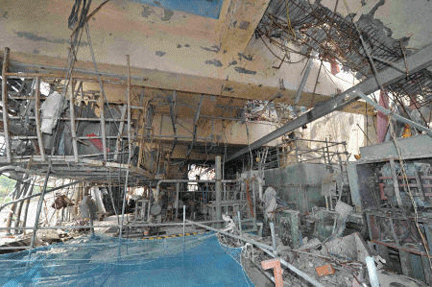 Fuel rods to be removed from No. 4 fuel pool Ene News — Concerns about sea water damage — Special container so fuel doesn’t going critical — Test date not revealed ‘for security reasons’ July 13th, 2012 the Fukushima Daiichi nuclear power plant will soon start test runs for removing fuel rods from a storage pool of the No. 4 reactor.
Removal Procedure A crane will be used to pull each of the 2 rods out of the pool, and then place them in a special container on the 5th floor of the reactor building.
The container will prevent the fuel from going critical.
Another crane will lower the container to the ground, where a truck will take it to a facility called a “common pool.”
Four cables will be used to prevent the container from falling.
Damage to Metal Container? TEPCO will also check if there’s any damage to the metal container used to store the fuel rods. This is a concern because seawater was used to cool the reactor after last year’s accident.
Security Reasons TEPCO says it cannot reveal the date of the test for security reasons.
http://enenews.com/fuel-rods-to-be-removed-from-no-4-fuel-pool-concerns-about-sea-water-damage-special-container-so-fuel-doesnt-going-critical-date-not-revealed-for-security-reasons
Some Fukushima children have “lifetime” radiation dose to thyroid glands
Several children were judged to have received an equivalent lifetime dose to the thyroid.
But the government says it does not plan to notify the parents out of fear of creating anxiety.
Fukushima kids cop ‘lifetime’ radiation dose http://www.radioaustralia.net.au/international/2012-07-12/fukushima-kids-cop-lifetime-radiation-dose/978786 12 July 2012, A Japanese study has found some children who live near the Fukushima nuclear plant have received “lifetime” doses of radiation to their thyroid glands. Continue reading
Fukushima children did receive high radiation to thyroid glands
Study finds lifetime thyroid doses of radiation in Fukushima children July 11, 2012 By YURI OIWA/ Staff Writer Children in Fukushima Prefecture likely received thyroid gland doses of internal radiation, despite earlier government assurances that the levels of such doses were zero, according to an independent study…… subscription only
http://ajw.asahi.com/article/0311disaster/fukushima/AJ201207110058
Earthquake danger for nuclear power plants
 Earthquakes are a fairly common occurrence in Japan, and so, if the earthquake was indeed the cause of the accident, it would call into question the safety of much of Japan’s nuclear fleet, including, presumably, the reactors at the Ohi plant.
The Nuclear Power Conundrum, Bill Chameides Dean, Duke University’s Nicholas School of the Environment HUFFINGTON POST, 07/06/20 “…. a report released on Thursday by the Fukushima Nuclear Accident Independent Investigation Commission concluded that last year’s accident in northeastern Japan at the Fukushima Daiichi power plant operated by the Tokyo Electric Power Company (Tepco) was “profoundly a man-made disaster — that could and should have been foreseen and prevented.”
While the official story has been that the accident was caused by the “once-in-a-millennium” tsunami, the report concludes that damage resulting from the earthquake (before the tsunami struck) could have been liable as well. Continue reading
People’s welfare the last priority – damning report on Fukushima nuclear catastrophe
FINAL REPORT (2) : Concern for people’s lives was not a priority July 06, 2012 THE ASAHI SHIMBUN Concern for people’s lives seemed to be the last thing on the minds of officials at Tokyo Electric Power Co. or the central government as they scrambled to contain the nuclear disaster in Fukushima Prefecture last year.
This is one of the grim assessments that emerge from the final report issued July 5 by a Diet task force that investigated the accident at the Fukushima No. 1 nuclear power plant. The Diet’s Fukushima Nuclear Accident Independent Investigation Commission suggested that health and safety concerns simply were not a priority.
The commission was especially critical of the lack of safety measures taken in the past as well as the initial response to the disaster triggered by the magnitude-9.0 Great East Japan Earthquake on March 11, 2011. It concluded that plant operator TEPCO and the central government showed an utter lack of responsibility in doing everything possible to protect the lives of those most affected.
Delay in implementing measures proved to be costly The final report pointed to problems that arose after TEPCO and the Nuclear and Industrial Safety Agency (NISA) failed to implement safety measures even though they knew the plant was dangerously vulnerable to a major earthquake and tsunami crashing into the coast.
“The accident cannot be said to have been totally unexpected and there is no way that responsibility can be avoided,” the report stated. http://ajw.asahi.com/article/0311disaster/fukushima/AJ201207060088
Fukushima disaster workers forced to do cleanup without safety precautions
 there was never any health supervision or monitoring of radiation doses. I am worried about the amount of radioactive substances that may have built up in my body.”
FINAL REPORT (4) : TEPCO failed to warn nuke plant workers after 3/11 http://ajw.asahi.com/article/behind_news/social_affairs/AJ201207060070, THE ASAHI SHIMBUN Workers who remained in the Fukushima No. 1 nuclear plant even after it was hit by the huge earthquake and tsunami to deal with the fast-moving crisis were praised as heroes dubbed the “Fukushima 50.”
But the reality was that most were forced to do the dangerous work without vital information and safety precautions, the report by the Diet’s investigation panel has revealed.
The final report by the Diet’s Fukushima accident investigation panel has revealed that workers at the nuclear plant after the onset of the disaster were forced to tackle the accident without adequate information and or safety precautions.
The report, issued by the National Diet of Japan Fukushima Nuclear Accident Independent Investigation Commission on July 5, also reveals what Tokyo Electric Power Co. employees and subcontractors experienced and felt during operations after the Great East Japan Earthquake and tsunami hit the Fukushima No. 1 nuclear plant on March 11, 2011. Continue reading
Most Fukushima evacuees did not know of the nuclear accident for days
much of the public remained unaware of the crisis for days.
FINAL REPORT (3) : 80% of evacuees did not know about Fukushima crisis on 3/11 http://ajw.asahi.com/article/0311disaster/fukushima/AJ201207060051 July 06, 2012 THE ASAHI SHIMBUN More than eight out of 10 people in the evacuation zone around the Fukushima No. 1 nuclear power plant had no idea there was anything wrong on March 11, 2011, according to the Diet investigation into the accident. Continue reading
1 This Month

of the week – Shut Down Drone Warfare!


Tell the Ukrainian Government to Drop Prosecution of Peace Activist Yurii Sheliazhenko

Petition to revoke the licensing of the Near Surface Nuclear Disposal Facility (NSDF) at Chalk River. https://www.ourcommons.ca/petitions/en/Petition/Details?Petition=e-7247
To see nuclear-related stories in greater depth and intensity – go to https://nuclearinformation.wordpress.com
-
Archives
- April 2026 (68)
- March 2026 (251)
- February 2026 (268)
- January 2026 (308)
- December 2025 (358)
- November 2025 (359)
- October 2025 (376)
- September 2025 (257)
- August 2025 (319)
- July 2025 (230)
- June 2025 (348)
- May 2025 (261)
-
Categories
- 1
- 1 NUCLEAR ISSUES
- business and costs
- climate change
- culture and arts
- ENERGY
- environment
- health
- history
- indigenous issues
- Legal
- marketing of nuclear
- media
- opposition to nuclear
- PERSONAL STORIES
- politics
- politics international
- Religion and ethics
- safety
- secrets,lies and civil liberties
- spinbuster
- technology
- Uranium
- wastes
- weapons and war
- Women
- 2 WORLD
- ACTION
- AFRICA
- Atrocities
- AUSTRALIA
- Christina's notes
- Christina's themes
- culture and arts
- Events
- Fuk 2022
- Fuk 2023
- Fukushima 2017
- Fukushima 2018
- fukushima 2019
- Fukushima 2020
- Fukushima 2021
- general
- global warming
- Humour (God we need it)
- Nuclear
- RARE EARTHS
- Reference
- resources – print
- Resources -audiovicual
- Weekly Newsletter
- World
- World Nuclear
- YouTube
-
RSS
Entries RSS
Comments RSS
 nuclear-news