Freezing weather causes 8 tons of water leakage at Fukushima nuclear plant
Freezing Fukushima Nuclear Plant Leaks Water TOKYO, Japan, January 30, 2012 (ENS) – The temperature fell to minus 8.7 degrees Celsius on Sunday morning near Japan’s crippled nuclear power plant, causing water pipes and valve seals to rupture, leaking tons of water.
Workers at the Fukushima Daiichi nuclear plant discovered Sunday that the damaged pipes spilled nearly eight tons of water from 14 locations. Two additional water leaks were discovered today, according to plant operator Tokyo Electric Power Company……
http://www.ens-newswire.com/ens/jan2012/2012-01-30-01.html
New report on the continuing nuclear disaster at Fukushima
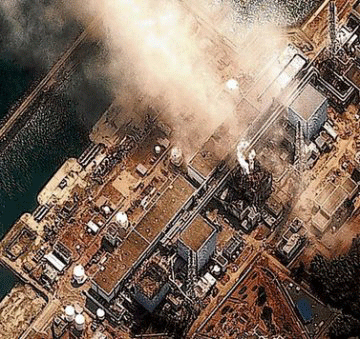 Nuclear disaster response failed: report 9 News Dec 26 2011 Yuri Kageyama Japan’s response to the nuclear crisis that followed the March 11 tsunami was confused and riddled with problems, a report revealed on Monday. The response included an erroneous assumption that an emergency cooling system was working and a delay in disclosing dangerous radiation leaks.
The disturbing picture of harried and bumbling workers and government officials scrambling to respond to the problems at Fukushima Dai-ichi nuclear power plant was depicted in the report detailing a government investigation……
Sadder still was how the government dallied in relaying information to the public, such as using evasive language to avoid admitting serious meltdowns at the reactors, the report said.
The government also delayed disclosure of radiation data in the area, unnecessarily exposing entire towns to radiation when they could have evacuated, the report found.
The government recommended changes so utilities will respond properly to serious accidents.
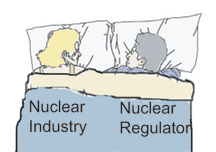
It recommended separating the nuclear regulators from the unit that promotes atomic energy, echoing frequent criticism since the disaster, which left 20,000 people dead or missing.
Japan’s nuclear regulators were in the same ministry that promotes the industry, but they will be moved to the environment ministry next year to ensure more independence.
The report acknowledged people were still living in fear of radiation spewed into the air and water, as well as radiation in the food they eat. Thousands have been forced to evacuate and have suffered monetary damage from radiation contamination, it said.
“The nuclear disaster is far from over,” the report said.
http://news.ninemsn.com.au/world/8395190/japan-probe-finds-nuclear-disaster-respons
Working at Fukushima nuclear plant likely to be a death sentence?
Government was likely avoiding the huge task of evacuating major cities like Iwaki and Fukushima.
He also expressed concern for those working to recover the plant. He said: “Working at Fukushima is equivalent to being given an order to die”…..
Fukushima nuclear shutdown: ‘No progress is being made’ ZDNet By Hana Stewart-Smith | December 16, 2011, Summary: The Japanese government says that troubled nuclear plant
Fukushima is under control. But an undercover journalist suggests that no progress is being made towards recovery.
The Japanese government announced publicly today that the troubled Fukushima plant is now under control, having achieved a ‘cold shutdown‘….This is reassuring news for the public after the reactor sprung a leak earlier this month, pouring out an estimated 45 tonnes
of radioactive water, which may have reached the sea….
However, freelance journalist Tomohiko Suzuki, who worked undercover at Fukushima for over a month, disputed this news. Suzuki spoke to reporters at a Foreign Correspondents’ Club of Japan conference yesterday, telling a very different story to the one officially given
by the Government. Continue reading
The term “cold shutdown” is not appropriate to the Fukushima nuclear reactors
Japanese Government speeds rezoning of contaminated areas. Paul Langley’s nuclear history blog 18 Dec 11 The appropriateness of the use of the term “cold shutdown” in relation to the Fukushima reactors in meltdown has been discussed in an editorial by the Mainichi Daily News, Japan, 17 Dec 2011. It is term applicable to a reactor in normal mode, not disaster failure meltdown mode.
The pressure vessels are essentially in a vastly abnormal state, and although the Japanese Government states venting of radionuclides has “significantly” stopped, things are still very abnormal in the Fukushima reactors. Neither TEPCO nor the Japanese Government understands the true state of the escaped fuel, nor how much the reactor vessels have been eroded. Continue reading
Unreliable claim that Fukushima nuclear plant is now ‘stable’
 TEPCO has not been able to take direct measurements of the temperatures at the bottoms of the containment vessels, and the site is still too radioactive for the fuel rods’ status to be visually confirmed.
Radiation levels are too high for people to get close to the reactors, leaving engineers and scientists to make important judgments using computer simulations, scattered bits of data and guesses.

 Skeptics cast doubt on Fukushima status, even as Japan declares nuclear reactors ‘stable’ Christian Science Monitor, By Arthur Bright, December 16, 2011 Japan’s government declared that the damaged reactors from the Fukushima disaster were ‘stable.’ Not everyone is convinced. The Japanese government announced that the Fukushima nuclear complex, heavily damaged by the March 11 tsunami in the world’s worst nuclear disaster since Chernobyl, is now stable. But serious doubts remain about Fukushima’s status, as officials remain unable to confirm the status of the reactors’ fuel and an undercover report impugns the clean-up efforts’ efficacy.

Prime Minister Yoshihiko Noda told a government nuclear emergency meeting that “The reactors have reached a state of cold shutdown” and are “stable,”
reports Reuters. Mr. Noda and his environment and
nuclear crisis minister, Goshi Hosono, both said that the situation at
the plant is under control , though the clean-up may still take decades. The Tokyo Electric Power Co. (TEPCO), which operates the reactor and has been leading the clean-up, had been attempting to achieve cold shutdown before the end of the year. Continue reading
White polyester box covers Unit 1 of Japan’s stricken Fukushima Daiichi nuclear plant
A Circus Tent for Fukushima Daiichi? WSJ, DECEMBER 15, 2011, The polyester cover erected over Unit 1 of Japan’s stricken Fukushima Daiichi nuclear power station was fashioned in the shape of atight-fitting, non-descript, white box. Continue reading
Japan’s growing problem of radioactive water – to be dumped into ocean?

 TEPCO mulls nuclear-contaminated water Sky News, December 8, 2011 Japan’s embattled Tokyo Electric Power Co says it is considering dumping more nuclear-contaminated water from the Fukushima power plant into the sea. If TEPCO goes ahead with the plan it would be the second time it has deliberately released radiation-tainted water into the ocean since reactors began melting down at Fukushima in the wake of the March 11 tsunami.
‘We have stored processed water in tanks, which are expected to become full by March next year,’ said a TEPCO spokesman on Thursday. He said no final details – such as when, how much, or how dirty the water would be – have been established, but stressed the water would be filtered to reduce levels of radioactivity before it was dumped.
Thousands of tonnes of water have been pumped into reactors at Fukushima in an effort to cool the molten nuclear fuel and bring the plant to a safe shutdown.
‘We are studying a variety of measures to cope with it,’ he said, including the possibility of building more storage tanks. ’The company has consulted with the Japan Fisheries (JF) Cooperatives about the possibility of a water release.’ A group of fishermen immediately lodged a protest with TEPCO and the Economy, Trade and Industry Ministry on Thursday, demanding the plan be shelved.
‘Many local fishermen still cannot go out to sea due to regulations or voluntary decisions and the now-poor safety reputation of the area has scared off consumers,’ JF official Shinji Ogawa told AFP. ’We cannot possibly let TEPCO do this again.’ Within weeks of the world’s worst nuclear crisis since Chernobyl, TEPCO dumped more than 10,000 tons of low-level radioactive water into the Pacific.
Ogawa said the water release plan was outrageous, especially after the power company had to apologise this week for accidentally leaking highly radioactive waste water into the Pacific….. TEPCO said Monday that it believed 150 litres of waste water including highly harmful strontium, a substance linked to bone cancers, has found its way into the open ocean. … http://www.skynews.com.au/finance/article.aspx?id=694474&vId=
TEPCO admits complete meltdown of nuclear fuel rods in Fukushima reactor No.1
 Tepco Details Nuclear Fuel Damage, WSJ, By MITSURU OBE, 30 Nov 11 TOKYO—The stricken Fukushima Daiichi nuclear-power plant came a lot closer to a full “China Syndrome” meltdown than previous company analyses had indicated, though there is no danger of further damage now, plant operator Tokyo Electric Power Co. said Wednesday.
The nuclear-fuel rods in reactor No. 1 likely melted completely, Tepco and the Japanese government said for the first time—burning a hole through one surrounding vessel and eating through up to three-quarters of the concrete base at the bottom of a second containment vessel meant as a last barrier between the radioactive core and the outside
world. Continue reading
Fukushima: 11 evacuated cities and towns, but their people will vote in elections
All of the parties and groups involved in the Fukushima assembly election said last month that they wanted nuclear power to be phased out……
For as long as they remain uninhabitable and their residents dispersed, the future of the contaminated areas will be clouded by uncertainty. …
 Japan’s nuclear disaster towns hold remote local elections Guardian UK, 20 Nov 11 Evacuated residents from Okuma and Futaba in Fukushima plant exclusion zone ballot for regional assemblies from afar They have been deserted for eight months, and could stay that way for years, their former inhabitants now scattered around north-east Japan.
But the towns of Okuma and Futaba, located in the shadow of the Fukushima Daiichi nuclear power plant, have shown that civic life must go on, even in the wake of a major nuclear accident. In one of the more surreal episodes of world democracy, tens of thousands were eligible to vote on Sunday for regional assemblies and mayors in towns that have all but ceased to exist. Continue reading
Fukushima nuclear disaster: how it was for the workers when it happened
Report Details Initial Chaos at Stricken Nuclear Plant, NYT By MATTHEW L. WALD November 11, 2011 Fukushima Daiichi Unit 1 was stuck in darkness, and everyone on site feared that the reactor core was damaged. It was the day after a devastating earthquake and a towering tsunami had hit the plant, and the workers knew that they were the only hope for halting an unfolding nuclear disaster. Continue reading
8 months after Fukushima nuclear disaster, dangerous radiation level
Tepco Finds Dangerous Level of Radiation at Fukushima Station, , Bloomberg, By Chris Cooper, Nov. 6 — Tokyo Electric Power Co. found a dangerous level of radiation at its wrecked Fukushima nuclear plant, eight months after the March 11 earthquake and tsunami that caused the worst atomic crisis in 25 years.
Workers at the company usually called Tepco detected 620 millisieverts of radiation an hour on the first floor of Reactor 3 on Nov. 3, the highest level found in that unit, it said.
The level of radiation is more than the 500-millisievert short-term dose recommended as the maximum for emergency workers in live-saving situations, according to the World Nuclear Association. The company and government officials are trying to contain the worst nuclear crisis since Chernobyl in 1986 after the March 11 earthquake and tsunami caused a loss of cooling and the meltdowns of three reactors.
Tepco will today start taking radiation out of water used to cool spent fuel rods, spokesman Hiroki Kawamata said today by phone…..http://www.businessweek.com/news/2011-11-06/tepco-finds-dangerous-level-of-radiation-at-fukushima-station.html
New bursts of fission at the crippled Fukushima power plant
The three reactors — together with spent fuel rods stored at a fourth damaged reactor — have been leaking radioactive material since the initial disaster, and new episodes of fission would only increase their dangers.
 Fears of Fission Rise at Stricken Nuclear Plant in Japan, NYT, By HIROKO TABUCHI November 2, 2011 TOKYO — Nuclear workers at the crippled Fukushima power plant raced to inject boric acid into the plant’s No. 2 reactor early Wednesday after telltale radioactive elements were detected there, and the plant’s owner admitted for the first time that fuel deep inside three stricken plants was probably continuing to experience bursts of fission. Continue reading
$13 billion or more to decontaminate Japan’s radiation from Fukushima nuclear disaster
Japan: Radiation Cleanup Will Cost at Least $13 Billion, Premier Says, NYT, By REUTERS, October 21, 2011 Prime Minister Yoshihiko Noda, left, said the government would spend at least $13 billion to clean up vast areas contaminated by radiation from the world’s worst nuclear disaster since Chernobyl…..
Some slightly better news on Fukushima radiation
Tepco: radiation from Fukushima plant declines further, By Shinichi Saoshiro TOKYO Oct 17 (Reuters) – The operator of Japan’s tsunami-hit Fukushima nuclear power plant on Monday said the amount of radiation being emitted from the complex has halved from a month ago, in the latest sign that efforts to bring the plant under control are progressing.. Continue reading
Earthquake, after shocks continue in Fukushima area
Fukushima nuclear plant stable despite new earthquake, :Herald Sun, October 10, 2011 AN EARTHQUAKE hit Japan’s Fukushima area today, but officials say the region’s crippled nuclear plant remains stable.
The 5.5-magnitude offshore quake struck at 11.45am (1345 AEDT) off Fukushima prefecture in the country’s north, at a depth of 30.2km, the US Geological Survey said…. Hundreds of powerful aftershocks have shaken the region since the March quake. http://www.heraldsun.com.au/news/world/fukushima-nuclear-plant-stable-despite-new-earthquake/story-e6frf7lf-1226163131977
1 This Month
10 March A LIVE WEBINAR THE REAL EFFECTS OF NUCLEAR POWER
What the Industry Isn’t Telling Us
1:00 PM Mountain, 2 pm Central, 3 pm Eastern. Live on the Keepers of the Water Facebook page



18 March Webinar @ 1 PM EST: An Assessment of SMR Projects: The Case of Canada
register for the zoom:
https://us02web.zoom.us/webinar/register/WN_o8BIIOUvQ2ONJR1nta65DQ#/registration


of the week – STOP SMALL MODULAR REACTORS IN CANADA
To see nuclear-related stories in greater depth and intensity – go to https://nuclearinformation.wordpress.com
-
Archives
- March 2026 (99)
- February 2026 (268)
- January 2026 (308)
- December 2025 (358)
- November 2025 (359)
- October 2025 (376)
- September 2025 (258)
- August 2025 (319)
- July 2025 (230)
- June 2025 (348)
- May 2025 (261)
- April 2025 (305)
-
Categories
- 1
- 1 NUCLEAR ISSUES
- business and costs
- climate change
- culture and arts
- ENERGY
- environment
- health
- history
- indigenous issues
- Legal
- marketing of nuclear
- media
- opposition to nuclear
- PERSONAL STORIES
- politics
- politics international
- Religion and ethics
- safety
- secrets,lies and civil liberties
- spinbuster
- technology
- Uranium
- wastes
- weapons and war
- Women
- 2 WORLD
- ACTION
- AFRICA
- Atrocities
- AUSTRALIA
- Christina's notes
- Christina's themes
- culture and arts
- Events
- Fuk 2022
- Fuk 2023
- Fukushima 2017
- Fukushima 2018
- fukushima 2019
- Fukushima 2020
- Fukushima 2021
- general
- global warming
- Humour (God we need it)
- Nuclear
- RARE EARTHS
- Reference
- resources – print
- Resources -audiovicual
- Weekly Newsletter
- World
- World Nuclear
- YouTube
-
RSS
Entries RSS
Comments RSS
 nuclear-news