Prevention of nuclear meltdown causes radioactive water problem
Cleaning the water could take many years, if not decades to complete. The cost could run into tens of billions of dollars..
 Containing a calamity creates another nuclear nightmare, Sydney Morning Herald, Julie Makinen, Ralph Vartabedian April 9, 2011, TOKYO: For nearly four weeks, Japanese emergency crews have been spraying water on the damaged Fukushima nuclear reactors in a desperate attempt to avert the calamity of a full meltdown.The improvised solution to one nuclear nightmare is spawning another: what to do with the millions of litres of water that has become highly radioactive as it washes through the plant. Continue reading
Continuing danger of explosion at Fukushima nuclear plant
The nitrogen injection was the latest in a series of efforts to prevent another nuclear catastrophe in Japan,…..Radioactive particles have settled in the area around the plant, contaminating water, vegetables, dairy products and other food. More explosions could spread the poisonous material farther.
But the nitrogen injection itself carries risk, since it could disperse radioactive vapour into the environment………
Explosion still a risk at Japan nuclear plant Workers inject nitrogen gas to reduce chances of blow-up but are running out of space to store radioactive water. Al Jazeera: 07 Apr 2011 After stopping the leak of highly radioactive water from a crippled nuclear plant north of Tokyo, Japanese authorities have begun injecting nitrogen into part of the facility in order to prevent a hydrogen explosion. Continue reading
Authorities just don’t have accurate data on Fukushima nuclear crisis
nuclear fuel in the core of one of the stricken reactors had probably leaked from its thick steel pressure vessel, its most important protective barrier. If that proved to be accurate, it would raise the prospect of continuing fuel leaks and high levels of radioactive releases that would vastly complicate containment and the cleanup
 Lack of Data Heightens Japan’s Nuclear Crisis, New York Times, By HIROKO TABUCHI and KEITH BRADSHER April 8, 2011 TOKYO — Nearly one month after Japan’s devastating nuclear accident, atomic energy experts, regulators and politicians around the world are still puzzling over a basic question: How much danger is still posed by the Fukushima Daiichi nuclear power plant? Continue reading
Food imports from 12 Japanese areas now banned in China
China bans farm produce imports from 12 areas of Japan because of radiation worries Canadian Business Online, 9 April 11, BEIJING (AP) – China has banned imports of farm produce from 12 areas near Japan’s stricken nuclear power plant. Continue reading
The fearful town of Minamisoma.
by far the biggest problem is the Fukushima reactors. I think the accident shows we have to stop building nuclear plants. The radiation doesn’t stop in Japan: it goes all around the world.”
A city left to fight for survival after the Fukushima nuclear disaster – The Irish Times , Apr 09, 2011“……A common plot sees a modern city reduced overnight to a ghostly husk as fears of nuclear contamination empty it of people. Businesses shut and food, water and petrol run out. Old people left behind begin to die. The city mayor makes a desperate televised appeal for help. Such is real life in Sakurai’s city of Minamisoma. Continue reading
USA sending huge concrete pumps to Fukushima nuclear plant
Massive pumps departing U.S. for Japan nuclear plant, By Vivian Kuo, April 8, 2011 Atlanta (CNN) –– Two of the world’s largest concrete pumps will depart the United States later this week as part of the effort to resolve the crisis at Japan’s Fukushima Daiichi nuclear power plant, officials said.
Each pump weighs 190,000 pounds and has a boom reach of over 227 feet, and can pump water and concrete at massive rates. They will be loaded aboard enormous Russian cargo jets Friday.
The pumps’ manufacturer, Putzmeister, said in a release the devices are normally used to pour concrete for bridges and high-rise construction projects, but can offer pinpoint accuracy “to directly target hotspots within the reactors” and help with cooling.
There are only three such pumps in the world, said Putzmeister spokeswoman Mary Roberts……Massive pumps departing U.S. for Japan nuclear plant – CNN.com
Unprecedented problems face Japanese workers at Fukushima
“The fact they have to handle two spent fuel pools and three reactor cores with kid gloves, (they) don’t have any margin for error,”
Nuclear experts: Many challenges, few options for Japanese By Jim Barnett, CNN Senior Producer,April 7, 2011 Washington (CNN) — Nuclear experts at the Union of Concerned Scientists said again Thursday there are many challenges ahead and few options left to Japanese workers trying to ease the crisis at the Fukushima Daiichi plant. Continue reading
High radiation levels at Minamisoma
 “While the Japanese government’s data is not necessarily incorrect, it is neither telling the full story, nor being adequately used to protect the health of people in Minamisoma…“Our measurements, taken between government monitoring points, show elevated levels of contamination outside the official 20 km mandatory evacuation zone that indicate a risk to health, yet people in Minamisoma are only being advised to stay indoors or leave on a voluntary basis. This is unacceptable.”
 Greenpeace Team Identifies “High Contamination Levels“ in Minamisoma Vegetables, April 6, 2011 Yonezawa, Japan- (PanOrient News) Greenpeace said in a statement today that its radiation experts investigating impacts from the Fukushima nuclear crisis have discovered high levels of contamination in crops grown on the outskirts of Minamisoma city, raising further concerns over health risks to residents and a lack of official information outside the 20 km evacuation zone. Continue reading
No one knows how to deal with Fukushima’s radioactive water
 international law forbids Japan from dumping contaminated water into the ocean if there are viable technical solutions available down the road….So Tepco is considering bringing in barges and tanks, including a “megafloat” that can hold about 2.5 million gallons….Yet even using barges and tanks to temporarily handle the water creates a future problem of how to dispose of the contaminated vessels.
Cleaning up Japan’s radioactive water could take decades, latimes.com, 7 April 11, No one is sure how to safely dispose of millions of gallons of highly radioactive water at the Fukushima Daiichi nuclear plant. ‘There is nothing like this, on this scale, that we have ever attempted to do before,’ a U.S. expert says. Continue reading
Radioactive Cesium can travel up the food chain, in fish
 Power company back pedals over reactor plans, Sydney Morning Herald, Andrew Higgins April 7, 2011, FUKUSHIMA:”…….After unsuccessful attempts with concrete, and even newspapers and sawdust, engineers used sodium-silicate to stop the leak, but radioactivity in fish exceeding health guidelines has been detected for the first time off northern Japan.Caesium radioactivity in sand lance caught south of the Fukushima Daiichi plant was 526 becquerel per kilogram, compared with a health ministry standard of 500 becquerel.With a radioactive half-life of 30 years, caesium can build up in the meat of marine predators as they eat smaller animals…..Power company back pedals over reactor plans
Risk of new explosion at Fukushima, -gas being pumped in
Experts say the risk of a detonation could rise as the nuclear fuel rods cool and as the steam inside the containment vessel condenses into water, reducing pressure inside the unit and drawing air in through cracks.
Japan using gas to avoid explosion at nuclear plant, THE STRAITS TIMES, Apr 7, 2011 Japan using gas to avoid explosion at nuclear plantTOKYO – WORKERS at Japan’s stricken nuclear plant on Thursday pumped nitrogen gas into a crippled reactor in a bid to contain the world’s worst atomic accident for 25 years and prevent a possible explosion. Continue reading
Fish off Japan found to contain radioactive Cesium
Toxic caesium found in fish off Japan, ABC News (Australian Broadcasting Corporation), By North Asia correspondent Mark Willacy, 7 April 11 Traces of radioactive caesium have been found for the first time in fish off Japan’s east coast.
It is believed the contamination came from overheated fuel rods at the crippled Fukushima nuclear plant. Continue reading
Growing volumes of radioactive water entering the ocean from Fukushima nuclear plant
 Chief Cabinet Secretary Yukio Edano said officials were growing concerned about the sheer volume of radioactive materials spilling into the Pacific. It is not clear how much water has leaked in addition to what is being dumped purposely…….”Even if they say the contamination will be diluted in the ocean, the longer this continues, the more radioactive particles will be released and the greater the impact on the ocean,..”
Japan nuke plant dumps radioactive water into sea – seattlepi.com, MARI YAMAGUCHI, YURI KAGEYAMA, April 4, 2011“………More water keeps pooling because TEPCO has been forced to rely on makeshift methods of bringing down temperatures and pressure by pumping water into the reactors and allowing it to gush out wherever it can. It is a messy process, but it is preventing a full meltdown of the fuel rods that would release even more radioactivity into the environment. Continue reading
Desperate efforts to cool stricken nuclear plant, and stem radioactive leak
 Government sources and TEPCO say that the water in the pit almost certainly came from the reactor core in Unit 2 where the fuel rods have apparently melted down, at least in part.
A Sense of Desperation as Nuclear Workers Fight to Plug Radioactive Leak, Forbes, Osha Gray Davidson , Apr. 4 2011 “……The water being dumped comes from different sources, including runoff from water sprayed on the reactors to cool fuel rods, newly-found contaminated groundwater near the turbine building at Unit No. 1, and runoff from Units No. 5 and 6 (two units that had previously been termed “safe”). Continue reading
Years to deal with damage and radioactivity at Fukushima nuclear plant
The task at Fukushima Daiichi is especially complicated because it involves at least three damaged reactors and apparent damage to nuclear waste pools……the situation will become much more complicated if workers find fuel melted in the reactor core.
Nuclear Plant Cleanup Will Take Years, Not Months – WSJ.com, 1 April 11, By REBECCA SMITH As Japanese officials struggle to stabilize damaged reactors at Fukushima Daiichi complex, an international team already is assembling to help them tackle the next big task: the cleanup…… Continue reading
1 This Month
To see nuclear-related stories in greater depth and intensity – go to https://nuclearinformation.wordpress.com/
12 February – Webinar The Big Push: New Nuclear Projects in Canada
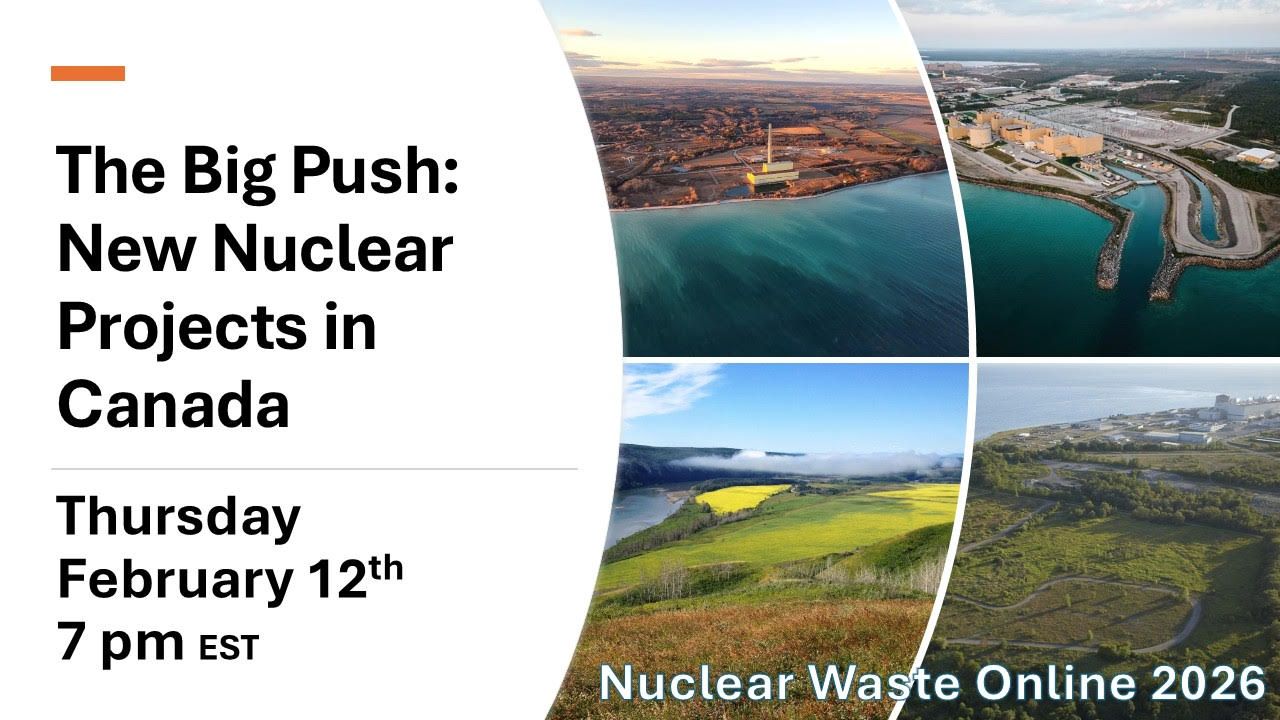
Thursday, February 12, 7 pm Eastern | 2nd of 4 sessions in the 2026 Nuclear Waste Online webinar series
Join a webinar on the push for new nuclear generation in Canada. Go to Northwatch.org to register or use the registration link https://us02web.zoom.us/webinar/register/WN_ZfWOf1GITqSRIZX8CB-A9w
-
Archives
- February 2026 (127)
- January 2026 (308)
- December 2025 (358)
- November 2025 (359)
- October 2025 (376)
- September 2025 (258)
- August 2025 (319)
- July 2025 (230)
- June 2025 (348)
- May 2025 (261)
- April 2025 (305)
- March 2025 (319)
-
Categories
- 1
- 1 NUCLEAR ISSUES
- business and costs
- climate change
- culture and arts
- ENERGY
- environment
- health
- history
- indigenous issues
- Legal
- marketing of nuclear
- media
- opposition to nuclear
- PERSONAL STORIES
- politics
- politics international
- Religion and ethics
- safety
- secrets,lies and civil liberties
- spinbuster
- technology
- Uranium
- wastes
- weapons and war
- Women
- 2 WORLD
- ACTION
- AFRICA
- Atrocities
- AUSTRALIA
- Christina's notes
- Christina's themes
- culture and arts
- Events
- Fuk 2022
- Fuk 2023
- Fukushima 2017
- Fukushima 2018
- fukushima 2019
- Fukushima 2020
- Fukushima 2021
- general
- global warming
- Humour (God we need it)
- Nuclear
- RARE EARTHS
- Reference
- resources – print
- Resources -audiovicual
- Weekly Newsletter
- World
- World Nuclear
- YouTube
-
RSS
Entries RSS
Comments RSS
 nuclear-news