Fukushima nuclear plant on a disaster tightrope
“The slightest disturbance could set off a full-scale meltdown at three nuclear power stations, far beyond what we saw at Chernobyl… you’re looking at basically a ticking time bomb.”……now you have these Japanese samurai warriors. They know that this is potentially a suicide mission.
Fukushima Daiichi Is a ‘Ticking Time Bomb’ HUFFINGTON POST, 04/14/11 “……”Radiation is continuing to leak out of the reactors. The situation is not stable at all,” says Dr. Michio Kaku, professor of theoretical physics at the City University of New York and the City College of New York, in an interview with Democracy Now! April 13. Continue reading
Rescuers risk radiation to save Fukushima dogs
Dog-lovers brave Fukushima nuclear danger zone to save abandoned pets | Mail Online, By Daily Mail Reporter 14th April 2011 Rescuers have been risking their lives in the nuclear swamp around tsunami-hit Japan’s stricken power plant – to save abandoned dogs.Thousands of animals have starved to death or been abandoned by their owners after the earthquake and tsunami shattered Japan on March 11.
A 20km exclusion zone was put in place around the damaged Fukushima nuclear power plant as deadly radiation spilled into the atmosphere…..In the early hours of Sunday morning, seven volunteers left Tokyo and drove over broken roads and past demolished houses to meet three other volunteers in the ghost town which Minami Soma has become. Some had prepared radiation suits and others wore simple vinyl raincoats…..Japan nuclear crisis: Dog-lovers brave Fukushima danger zone to save abandoned pets | Mail Online
New surge of radiation above Fukushima reactor No 4
 Tepco said the fuel rods in the Unit 4 pool had released cesium-134 and -137 in the process of being damaged. Cesium-137 has a half-life of 30 years. “Contaminated water leaked From the Unit 2 may have gathered as a lump and drifted offshore,”
Radiation surges above 4’s fuel pool The Japan Times Online By KANAKO TAKAHARA STAFF WRITER, 14 April 11, Radiation has risen to high levels above the spent-fuel pool at reactor No. 4 and its temperature is rising, the nuclear safety agency said Wednesday, indicating the fuel rods have been further damaged and are emitting radioactive substances. Continue reading
Nuclear financial disaster – even without Fukushima
 Energy policy professor Steve Thomas points out that the scale of problems at newbuild reactors in Finland and France has taken even sceptics by surprise. Originally priced at €3bn, the Finnish reactor’s cost is estimated to be at least €5.7bn, and the French reactor is doing just as badly. Britain’s nuclear waste bill is still growing too: liability estimates have grown from £50bn in the mid-2000s to as much as £80bn at present.
Who to trust on nuclear? | Paul Dorfman The Guardian 14 April 11, Even without Fukushima sceptics might wonder why Britain ignores the German lead on energy In the continuing disaster at Fukushima, Japan’s nuclear safety agency has now raised the crisis level to seven: the highest category of nuclear accident. The government is widening the evacuation zone. The unpalatable truth is that the legacy of Fukushima will be with us for a long time to come.
The numbers are staggering. Latest information from nuclear consulting engineer John Large tells us the six reactor cores held 487 tonnes of uranium (of which 95 tonnes includes 230kg of plutonium, an even nastier substance, from the Mox assemblies), with a further 1,838 tonnes of stored spent fuel, including 1,097 tonnes in the central pool store. There is no question there have been very significant and “ongoing” releases of this radioactive inventory.
But even away from this disaster, facts about the industry’s cost and scope to meet Europe’s energy needs should be enough to give nuclear supporters pause. For instance, government figures state that a very ambitious new nuclear-build programme will give us only 4% of the energy we need. Electricity provides only 20% of our energy, and at its peak nuclear only provided 20% of electricity.
Energy policy professor Steve Thomas points out that the scale of problems at newbuild reactors in Finland and France has taken even sceptics by surprise. Originally priced at €3bn, the Finnish reactor’s cost is estimated to be at least €5.7bn, and the French reactor is doing just as badly. Britain’s nuclear waste bill is still growing too: liability estimates have grown from £50bn in the mid-2000s to as much as £80bn at present.
In stark contrast to the “measured exit” from nuclear power of Angela Merkel, the German chancellor, the chief executive of EDF insists that new UK reactors “will have to go ahead” – maybe something to do with the £12.4bn they’ve already spent on buying UK nuclear sites. And when Nick Clegg suggested that the next generation of nuclear power stations may never be built because the recommended higher and more costly safety standards would make them too expensive, Chris Huhne launched an astonishing attack on his party leader, accusing him of behaving like a “headless chicken” on the issue.
Who to trust on nuclear? | Paul Dorfman | Comment is free | The Guardian
Fukushima cleanup – unknown cost, unknown magnitude
count on cleanup costing $10 billion. Engineers can break the problem down to the basics, and they know how to do each individual step — but nobody’s ever tried a nuclear cleanup on this scale before….
 AUDIO Cleaning Up Fukushima: A Challenge To The Core : NPR 13 April 2011, “…….Nuclear engineers working at the Japanese plant are dealing with two problems at the same time: They are working to fully stabilize the plant’s reactors, and they are trying to control the release of radioactive material. Continue reading
The spread of radiation from Fukushima
Fish in nearby waters are now being measured at 4,000% above the Codex Alimentarius limits for Iodine-131 and 447% of Caesium-137. Radioactive caesium has a half-life of 30 years. Radiation levels for the isotope are not considered “safe” for 10 to 20 times longer. The caesium released today will remain dangerous six centuries from now.
Radiation Spreads Worldwide. The Poisoning of Mother Earth, Global Reseach Ca,by Freedom Against Censorship Thailand (FACT), 14 April 11, “………Radiation in milk in Hawaii is now at least 2,033% above Federal drinking water safety limits. The US safety limit is 3 pCi/l (picoCuries per litre). Note this is the minimum percentage found over EPA requirements. This figure is reached by adding together the Caesium-134 (800%); −137 (633%); and Iodine-131 (600%) levels und in milk. Continue reading
Residents asked to leave several areas due to radiation
Japan asks residents to leave due to radiation accumulation – Monsters and Critics, 11 April 11, Tokyo – The Japanese government asked Monday residents in some areas near a stricken nuclear power plant to leave due to accumulating radiation.Those who live in Iitate Village, Katsurao Village, Namie Town and part of Minami Soma City and part of Kawamata Town were asked to leave the area within a month amid the protracted crisis at the Fukushima Daiichi Nuclear Power Station….
Japan asks residents to leave due to radiation accumulation – Monsters and Critics
The importance of the nuclear accident rating of Fukushima
The assessed INES level reflects negative impacts on health and the environment. It will be important to carefully monitor the incidence of leukemia and cancer as well as soil contamination. The crisis also could strongly affect the international image of Japan.
Effect of nuclear crisis on health, environment The Yomiuri Shimbun/Asia News Network, Apr 13, 2011 By Kyoichi SasazawaFor an incident to be rated on the International Nuclear and Radiological Event Scale (INES), it is assessed by the nuclear supervisory authorities in the nation where it occurred and is then reported to the International Atomic Energy Agency (IAEA). Continue reading
At least seven nuclear cores or spent fuel pools in trouble at Fukushima
It has been obvious all along this was a 7. There are three reactors that are not being cooled (No. 1, 2 &3) and four fuel pools too (No. 1, 2, 3, and especially 4)…there were at least seven cores or pools that had been in difficulty. He noted that at Chernobyl it was only one reactor that created the problem.
Fire at Japan’s crippled nuclear plant, more aftershocks | Reuters By Shinichi Saoshiro and Kazunori Takada TOKYO Apr 11, 2011 – Engineers were fighting a fire at Japan’s crippled nuclear plant on Tuesday as another major aftershock rocked eastern Japan, swaying buildings in central Tokyo and closing Narita airport runways…… Continue reading
Fukushima nuclear crisis now rated at maximum level 7
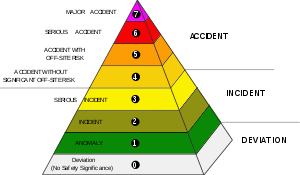 Japan’s reactor crisis hits maximum level, equal to Chernobyl Rick Wallace, Tokyo corresponden The Australian * April 12, 2011 JAPAN will upgrade the rating of the Fukushima nuclear crisis to the same level as the 1986 Chernobyl disaster in the former Soviet Union.
News of the re-rating of the nuclear crisis came as Japan’s main island, Honshu, was battered by another series of strong aftershocks today.
Japan’s chief cabinet secretary Yukio Edano confirmed this morning that the crisis at the Fukushima Daiichi plant would be upgraded from a level 5 to a level 7, which is the maximum, on the international scale…..Japan’s reactor crisis hits maximum level, equal to Chernobyl | The Australian
The difference between radiation emitters – external and internal
The grave effects of internal emitters are of the most profound concern at Fukushima. It is inaccurate and misleading to use the term “acceptable levels of external radiation” in assessing internal radiation exposures. To do so, as Monbiot has done, is to propagate inaccuracies and to mislead the public worldwide (not to mention other journalists) who are seeking the truth about radiation’s hazards.

 How nuclear apologists mislead the world over radiation George Monbiot and others at best misinform and at worst distort evidence of the dangers of atomic energy Helen Caldicott * guardian.co.uk, 11 April 2011
1) Mr Monbiot, who is a journalist not a scientist, appears unaware of the difference between external and internal radiation Continue reading
Off Japan’s coast, radioactive fish found
Radioactive fish found off Japan’s coast Australian Broadcasting CorporationBroadcast: 06/04/2011 Reporter:The Fukushima nuclear emergency in Japan has now led to radiation monitoring in 1,400 schools and a fishing suspension. TONY JONES, PRESENTER: Radiation monitoring has begun at 1,400 schools in Japan because of the Fukushima nuclear emergency.
In seawater close to the facility, the plant’s operator has detected radioactive iodine at 7.5 million times the legal limit. And off Japan’s east coast, radioactive traces have now been found in popular small fish known as young lance. Ten fishing co-operatives in the affected zone have now banned or suspended fishing for that delicacy.
Lateline – 06/04/2011: Radioactive fish found off Japans coast
Dangerously high levels of radiation in northwestern Fukushima Prefecture,
 Radiologist Jan van de Putte told the same news conference that areas with high levels of radioactivity were concentrated in northwestern Fukushima Prefecture, especially in areas between the villages of Iitate and Tsushima, which registered 48 microsieverts per hour.
“This is really dangerous and a very high level,” van de Putte said.
High radiation well past no-go zone: Greenpeace, The Japan Times Online, 12 April 11By JUN HONGO, Staff writer Radiology experts from Greenpeace urged the government to revise their evacuation protocol Monday after they found high levels of radiation around the greater Fukushima area and in the region’s fresh produce.
Fukushima nuclear reactors still not under control
 Engineers at the damaged Fukushima Daiichi plant north of Tokyo said on Sunday they were no closer to restoring the plant’s cooling system which is critical if overheated fuel rods are to be cooled and the six reactors brought under control.
The Japan Times said authorities would soon forcibly close the 20 km zone, stopping people returning to their shattered homes to pick through the rubble for belongings.
Japan set to extend nuclear evacuation zone | Reuters, 11 April 11, – Japan plans to extend the evacuation zone around its crippled nuclear plant because of high radiation levels, local media reported on Monday, with engineers no closer to regaining control of six reactors hit by a giant tsunami one month ago. Continue reading
Psychological impact of Fukushima nuclear crisis
The crisis will likely drag on for months, hindered by a major conundrum: how to keep reactors cool while also disposing of highly radioactive water pooling in and under the plant.
One month on psychological impact is only sinking in – The Irish Times – Mon, Apr 11, 2011 DAVID McNEILL in Tokyo The cherry blossom season is party time in Japan, but this year it has been overshadowed by tragedy and loss…..Lights in Tokyo are dimmed, restaurants are half empty and most cherry blossom parties are a muted affair, overshadowed by the tragedy that befell the northeast on March 11th and the nuclear crisis that it sparked in Fukushima, 250km (155 miles) up the coast from the capital…. Continue reading
1 This Month
10 March A LIVE WEBINAR THE REAL EFFECTS OF NUCLEAR POWER
What the Industry Isn’t Telling Us
1:00 PM Mountain, 2 pm Central, 3 pm Eastern. Live on the Keepers of the Water Facebook page



18 March Webinar @ 1 PM EST: An Assessment of SMR Projects: The Case of Canada
register for the zoom:
https://us02web.zoom.us/webinar/register/WN_o8BIIOUvQ2ONJR1nta65DQ#/registration


of the week – STOP SMALL MODULAR REACTORS IN CANADA
To see nuclear-related stories in greater depth and intensity – go to https://nuclearinformation.wordpress.com
-
Archives
- March 2026 (109)
- February 2026 (268)
- January 2026 (308)
- December 2025 (358)
- November 2025 (359)
- October 2025 (376)
- September 2025 (258)
- August 2025 (319)
- July 2025 (230)
- June 2025 (348)
- May 2025 (261)
- April 2025 (305)
-
Categories
- 1
- 1 NUCLEAR ISSUES
- business and costs
- climate change
- culture and arts
- ENERGY
- environment
- health
- history
- indigenous issues
- Legal
- marketing of nuclear
- media
- opposition to nuclear
- PERSONAL STORIES
- politics
- politics international
- Religion and ethics
- safety
- secrets,lies and civil liberties
- spinbuster
- technology
- Uranium
- wastes
- weapons and war
- Women
- 2 WORLD
- ACTION
- AFRICA
- Atrocities
- AUSTRALIA
- Christina's notes
- Christina's themes
- culture and arts
- Events
- Fuk 2022
- Fuk 2023
- Fukushima 2017
- Fukushima 2018
- fukushima 2019
- Fukushima 2020
- Fukushima 2021
- general
- global warming
- Humour (God we need it)
- Nuclear
- RARE EARTHS
- Reference
- resources – print
- Resources -audiovicual
- Weekly Newsletter
- World
- World Nuclear
- YouTube
-
RSS
Entries RSS
Comments RSS
 nuclear-news