Indonesia wants non-peaceful nuclear submarines to be subject to nuclear non-proliferation treaty (surprise, surprise, Australia doesn’t agree)
Caution over nuclear treaty covering subs, Canberra Times, Dominic Giannini, 29 Oct 21,
Caution over nuclear treaty covering subs, Canberra Times, Dominic Giannini, 29 Oct 21,
Australian officials say they don’t believe there is merit in expanding the nuclear non-proliferation treaty to nuclear-powered submarines.
Indonesian officials have said they would seek a “fourth pillar” to include the non-peaceful usage of nuclear technology, closing a “loophole” exposed by Australia’s nuclear-submarine deal with the US and UK.
They say other countries could seek to follow Australia, which would be the first non-nuclear weapons state to acquire nuclear submarines.
Foreign affairs department officials rejected the need to expand the treaty, saying the acquisition of nuclear-propelled submarines was in accordance with Australia’s non-proliferation requirements……
The Indonesians raised concerns about the potential for an arms race in the region after Australia announced its plans to acquire nuclear-powered submarines through the AUKUS partnership…….. https://www.canberratimes.com.au/story/7488125/caution-over-nuclear-treaty-covering-subs/
Shoddy, shoddy, shoddy: How they built the Bataan Nuclear Power Plant
Shoddy, shoddy, shoddy: How they built the Bataan Nuclear Power Plant, rappler.com, KELVIN S. RODOLFO 21 July 21, There is not enough space to list the multitude of construction errors inspector William Albert found at the Bataan Nuclear Power Plant
The following is the tenth in a series of excerpts from Kelvin Rodolfo’s ongoing book project Tilting at the Monster of Morong: Forays Against the Bataan Nuclear Power Plant and Global Nuclear Energy.Some history A thoughtful congressman, Roilo Golez, once cautioned that the Bataan Nuclear Power Plant’s (BNPP) risks were magnified by a “national lack of a culture of safety that is observed in Japan, the United States, and Western Europe.” The BNPP has been accursed with that lack from the very beginning, and remains so today…………. https://www.rappler.com/voices/thought-leaders/opinion-shoddy-how-
Euphoria about nuclear costs, especially about decommissioning – Institute for Energy Economics and Financial Analysis (IEEFA) warns Indonesia.

IEEFA: Nuclear power euphoria in Indonesia is all smoke and mirrors with no current technical, financial or market viability,
Renewables should be the focus of Indonesia’s net-zero pledge. (IEEFA Indonesia): In growing energy markets like Indonesia, decision makers are facing a barrage of pro-nuclear media coverage as the nuclear industry floods the market with panels and webinars focused on the potential of nuclear power.
A new report from the Institute for Energy Economics and Financial Analysis (IEEFA) highlights that while nuclear is promising as a baseload substitute for coal power, it currently has no technical, financial, or market viability in the Indonesian context. Author of IEEFA’s report Elrika Hamdi says that Indonesian nuclear power supporters often promise that nuclear will be an affordable, safe and sustainable solution for the problem of over-reliance on fossil fuel.
Yet, 70 years after the first nuclear power developments were announced, the technology is quickly losing market share as global power markets pivot toward more cost-competitive renewables and storage solutions.
“Despite the steady erosion of nuclear power’s competitive potential, key Southeast Asian energy ministries continue to be lobbied by nuclear advocates. Many of these lobbyists are international backers of new small modular reactor (SMR) technologies, who are actively engaging with governments and utilities around the region,” says Hamdi.

As old generation large-scale nuclear units face decommissioning, there is little consensus about how long it will take for newer small-scale nuclear technologies to be economically viable or how long-standing safety and waste disposal risks will be addressed.
“Determining the suitability of nuclear for the Indonesian power market will be a challenging task that will require honest and deep engagement by senior policymakers to ensure there is a high degree of accountability as Indonesians need to know the real cost of having nuclear in the power system as well as how the government will handle the problem of nuclear waste.”
Hamdi says that the short-list of nuclear power issues includes technology reliability, safety and safeguards, the geographic conditions of Southeast Asia, the prospects for decommissioning, waste treatment and permanent disposal, fuel availability, affordability, and the risk of persistent cost overruns and frequently overlooked shut-down costs.
Research has shown that an estimated 97% (175 out of 180 projects examined) of nuclear power projects exceed their initial budgets. The average cost overrun for a nuclear power plant was US$1.3 billion per project with construction delays adding 64% more time than initially projected.
Nuclear waste disposal costs also complicate the cost estimation process—typically raising project costs as political risk factors crystallize. The inability of leading nuclear nations to find safe and affordable solutions for permanent high-level nuclear waste disposal leaves expensive back-end cost issues on the table.
The economics of nuclear power in Indonesia is also blurred by the fact that under existing regulations, nuclear accident liabilities for nuclear owners/operators are capped at a maximum of IDR 4 trillion (US$276 million) for power plants with a capacity of more than 2000MWe. It is cut in half as the capacity decreases. This means smaller nuclear reactors would be liable for only a fraction of potential accident costs.
“These open-ended cost issues make it hard to evaluate claims about the market viability of nuclear power in Indonesia’s cost-sensitive market. This is particularly true when most established nuclear nations are pivoting away from commitments to new nuclear power facilities as more flexible renewable plus storage options reshape power sector economics,” says Hamdi.
“If a decision is reached to move ahead with pilot stage nuclear projects, policymakers and the government will need to do a lot of policy work including the technical evaluation, the regulatory preparation and the financial support, including preparation of the currently non-existent third-party liability insurance framework.
“This will place a serious burden on a government already taxed by the response to the COVID-19 pandemic and efforts to revitalize the financially constrained PT Perusahaan Listrik Negara (PLN), Indonesia’s national power company.”
PLN also recently pledged to become carbon neutral by 2060. However, the plan released shows nuclear only entering the energy mix in 2040. This demonstrates that PLN is realistic about the technical, financial, and market challenges that need to be overcome if nuclear power is to successfully integrate into Indonesia’s future energy mix.
Hamdi says that until these issues have been acknowledged and fully addressed, the safe path for Indonesia, for now, would be to pause and set realistic goals for its power development strategy.
This includes taking advantage of Indonesia’s abundance of renewable energy resources and market viability.
“Currently only 2.5% of Indonesia’s 400GW renewable energy potential has been utilized. That means that new technology options such as nuclear must compete with the deflationary cost curve in evidence with increasingly low-cost and low-risk renewable power solutions.
“New innovations to support grid flexibility such as demand response and storage are providing a cost-effective alternative to baseload-heavy planning disciplines. This trend raises questions about how small-scale nuclear reactors will fit into a more diverse power market where more cost-competitive renewable options could under-cut untested technologies that are years away from realizing economies of scale.
“The smaller, easily dispatchable, and walk-away safe promise of the new Gen-IV SMR technology offer is promising, IF and when the technology reaches commercial stage. But until such technology is proven to be technically and financially feasible, Indonesia’s safest option is to pause and set a more realistic net-zero scenario with resources and technologies that are already readily available with less cost, less risk, and less future liabilities.”
Read the report: Tackling Indonesia’s Nuclear Power Euphoria
Indonesia’s nuclear ambitions could prove disastrous for the Southeast Asian region
More dangerously, Indonesia’s nuclear stakeholders have traditionally run into trouble selling the idea of nuclear energy to their constituents given widespread fear over Indonesia being prone to earthquakes and volcanic activity given its unique position within the Pacific’s ‘Ring of Fire’.
|
Will Indonesia become a nuclear power? https://www.trtworld.com/magazine/will-indonesia-become-a-nuclear-power-43025 6 Jan 21, In spite of its nuclear ambitions, Indonesia does not yet have the capacity to manage its nuclear waste disposal, which could prove disastrous for the Southeast Asian region.
Indonesia may be taking steps to revive its nuclear ambitions under President Joko Widodo’s government. In February 2020, Luhut Binsar Pandjaitan, Indonesian minister of maritime affairs and former chief of staff to Widodo, publicly proclaimed that powerful nations like the United States do not see Indonesia as a serious international player due to its lack of nuclear weapons. His statement quickly captured local news headlines. The retired four-star army general turned political heavyweight is a major proponent behind recent interest in acquiring nuclear reactor technology to capitalize on Indonesia’s wealth of mineral resources. If Indonesia takes the nuclear track, it would be a major departure from its traditional foreign policy footing. Historically, Indonesia organised the Bandung Conference in 1955 which gave rise to a global Non-Aligned Movement (NAM) of African and Asian states who collectively opted out of aligning with either the United States or Russia during the dawn of the cold war. Nuclear pivot Continue reading |
In Indonesia – small nuclear reactors as a prelude to nuclear weapons?
Call to Indonesia to ratify UN Nuclear Weapons Ban Treaty
 “Indonesia running in circles in bid to ratify anti-nuclear weapons treaty”. Dian Septiari The Jakarta Post Jakarta / Fri, October 2, 2020
Indonesia is still dragging its feet in the ratification of an international treaty to prohibit nuclear weapons that it signed more than three years ago, even as its neighbors have one by one made good on their commitments. Malaysia was the latest to submit its instrument of ratification of the Treaty on the Prohibition of Nuclear Weapons (TPNW) on Wednesday, making it the 46th country to pass the treaty into law. Malaysian Foreign Minister Hishammuddin Hussein said the country’s ratification brought the international community one step closer to amassing the 50 national endorsements needed to bring the treaty into force, Bernama reports.
Adopted on July 7, 2017, the treaty prohibits all activities related to nuclear weapons, including their development, testing, manufacturing, acquisition, possession, stockpiling, use and stationing. In Southeast Asia, Thailand was the first nation to sign and ratify the treaty, only a few months after it was adopted. Vietnam ratified it the following year, followed by Laos in 2019. Indonesian Foreign Ministry spokesperson Teuku Faizasyah said Indonesia was one of the first 50 countries to sign the treaty in 2017, but the ratification itself was still ongoing. “Of course, ratification cannot be done instantly, because it involves many stakeholders and progress is currently a bit constrained by the COVID-19 pandemic,” he said on Wednesday.
………. As the de facto leader of ASEAN, Indonesia is expected to shore up resources against global nuclear proliferation, which the bloc collectively agrees to oppose through the Southeast Asia Nuclear Weapon-Free Zone (SEANWFZ) treaty. As a member of the Non-Aligned Movement (NAM) and a coordinator of its working group on disarmament and nonproliferation since 1994, Indonesia was among cosponsors of the 2017 United Nations General Assembly resolution to enforce the Nuclear Weapons Ban Treaty. Various observers have since called on Indonesia to make good on its
Indonesia: strong objections to nuclear and “new” fossil fuel technologies being called ”green” energy
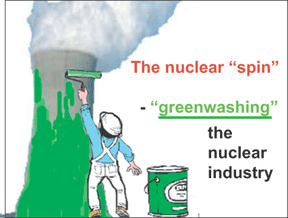 Tug of war: Stakeholders clash over nuclear, fossil fuel addition to green energy bill Norman Harsono, The Jakarta Post Jakarta / Fri, September 25, 2020 Green energy businesses and watchdogs are up in arms over the House of Representatives’ decision to add nuclear and “new” fossil fuel technologies into a landmark green energy bill. Industry players have issued statements and held public hearings with lawmakers over the past two weeks to protest such an addition in the long-awaited New and Renewables Energy (EBT) bill, which promises legal certainty and incentives for listed industries. Nuclear energy, liquefied coal and coal gas – the latter product being pioneered by state-owned coal miner PT Bukit Asam – are all categorized as “new” but not “renewable” in the draft bill, a copy of which was obtained by The Jakarta Post.
Thorium nuclear plan with USA firm – a dubious deal for Indonesia
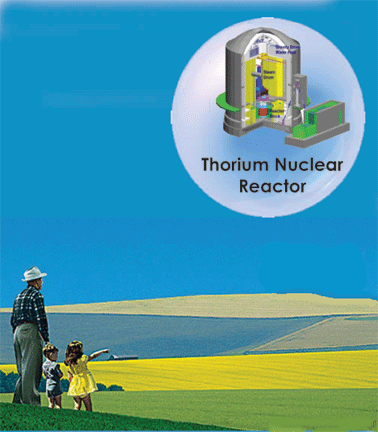 Thorcon, Defense Ministry to cooperate on thorium nuclear reactor, Norman Harsono, The Jakarta Post Thorcon, Defense Ministry to cooperate on thorium nuclear reactor, Norman Harsono, The Jakarta PostJakarta / Tue, July 28, 2020 United States-based nuclear company Thorcon International Pte Ltd and Indonesia’s Defense Ministry signed a deal on Jul. 22 to study developing a thorium molten salt reactor (TMSR) for either power generation or marine vehicle propulsion.Thorcon said it would provide technical support to the ministry’s research and development (R&D) body to develop “a small-scale TMSR reactor under 50 megawatts (MW)”, the company wrote in a statement on Friday, Jul. 24,
“[This will] strengthen national security in the outermost, frontier and least developed regions,” reads the company’s statement……… “We hope Thorcon may be more open toward providing technical support for the Defense Ministry’s R&D body in making the designs and technical preparations for when we enter the construction phase,” the ministry’s statement reads. At 50 MW, the Defense Ministry’s “small-scale” reactor would become the biggest nuclear reactor in Indonesia. The country’s current largest reactor – a non-commercial facility – is the 30 MW GA Siwabessy reactor in Serpong, Banten. …… Thorium nuclear technology is also unready for commercial application, National Nuclear Energy Agency (Batan) director Dandang Purwadi told The Jakarta Post earlier this year. “We have to wait around 10 years for the technology to mature, then it takes 10 years to build the facility”, he said, commenting on Thorcon’s planned commercial plant. Energy experts speaking at a discussion on Jul. 1 pointed out that nuclear plants were losing popularity and were much more costly than renewables, despite improvements in nuclear plant safety, following headline grabbing meltdowns. … “Usage of nuclear power plants is entering a sunset phase,” said Herman Ibrahim, country chairman of the Paris-based International Council on Large Electric Systems (CIGRE). https://www.thejakartapost.com/news/2020/07/28/thorcon-defense-ministry-to-cooperate-on-thorium-nuclear-reactor.html |
|
Nuclear Agency employee accused of illegally storing radioactive waste at his home
Jakarta. An employee of the National Nuclear Energy Agency, or Batan, was named suspect for illegally storing radioactive waste at his home in Batan Indah housing complex in South Tangerang, Banten, police have said.
The news came a month after nuclear authorities launched decontamination operation at the housing complex, followed by criminal investigation by the National Police.
The cleanup, that took weeks to complete, was called after the Batan and the Nuclear Energy Regulatory Agency (Bapeten) detected radiation in the area. Around 100 drums of soil and grass containing radioactive substance have been removed from the area.
The suspect, identified by initials S.M., is accused of storing radioactive substance called Cesium-137 and dumping toxic waste at the housing complex, National Police’s special crimes director Brig. Gen. Agung Budijono said on Friday.
“We named S.M. as suspect after we conducted the crime scene investigation,” Agung told Jakarta Globe’s sister publication Beritasatu.com.
“At least 26 witnesses, including Batan and Bapeten officials, have been questioned by the police and it was learned that S.M. has no license for storing and processing radioactive waste,” he said.
The suspect is alleged to have run illegal decontamination services for money at his home. He is charged under the 1997 law on nuclear energy, which carries a sentence of up to two years’ imprisonment.
His position at Batan was not disclosed.
A joint investigation involving Batan, Bapeten and police was formed last month after radiation was detected and nine resident had to undergo medical examination for fear of exposure to Cesium-137, which may pose serious risks to human health including cancer and death.
Nuclear agencies ban companies who hold license to use Cesium-137 from storing or managing radioactive waste themselves. They must send it to Batan’s Center for Radioactive Waste Technology in South Tangerang.
The Batan facility is located around 45 kilometers from the housing complex.
Indonesia warned on dangers of nuclear power, advantages of renewable energy
|
Indonesia should focus on renewable energy, not nuclear, activists say
A. Muh. Ibnu Aqil, The Jakarta Post, Jakarta / Fri, March 13, 2020
Activists are warning the government to steer clear of building nuclear power plants, citing safety concerns and urging Indonesia to focus on renewable energy instead. A Greenpeace Indonesia official, Satrio Swandiko, said Indonesia should heed the lessons of the Fukushima Daiichi nuclear power plant disaster in Japan, which was caused by an earthquake and tsunami in March 2011. Greenpeace’s Japan chapter surveyed Fukushima city, as well as the nearby towns of Naraha and Okuma in Fukushima prefecture in October and November 2019. In Fukushima’s city center, Greenpeace found at least 45 radioactive hot spots — 11 of which had radiation levels equal to and even above the Japanese government’s decontamination target of 0.23 microSieverts per hour. It showed that the impact of the nuclear meltdown continued years after the incident. “Indonesia has a high risk of… (subscribers only) https://www.thejakartapost.com/news/2020/03/12/indonesia-should-focus-on-renewable-energy-not-nuclear-activists-say.html |
|
Illegal radioactive substances found in South Tangerang house, Jakarta
|
Nuclear agency finds radioactive substances in South Tangerang house, News Desk. The Jakarta Post Jakarta / Tue, February 25, 2020 A joint team from the Nuclear Energy Regulatory Agency (Bapeten) and the National Police has discovered illegally owned radioactive substances in a house in the Batan Indah housing complex in South Tangerang, Banten.
“The radioactive sources contain caesium-137 and other radioactive isotopes,” Bapeten spokesperson Indra Gunawan said in a press release on Monday. Indra said the team would further investigate the matter to ascertain whether the illegally owned substances were linked to the recent discovery of caesium-137 radioactive waste in the complex. Bapeten first detected high levels of radiation in the Batan Indah complex during a routine check at the end of January. Between Feb. 7 and Feb. 8, a joint Bapeten and National Nuclear Energy Agency (Batan) team discovered several radioactive fragments in a vacant lot next to a volleyball court in the housing complex. The fragments contained caesium-137, which is commonly used for industrial purposes. ….. https://www.thejakartapost.com/news/2020/02/25/nuclear-agency-finds-radioactive-substances-in-south-tangerang-house.html |
|
Positive tests for Caesium-137 in some South Tangerang residents
Indonesian authorities investigate suspected nuclear waste dumping at housing estate
|
Indonesia probes suspected nuclear waste dumping at housing estate, MONGABAY, by Barita News Lumbanbatu, Basten Gokkon on 19 February 2020
Indonesian authorities have launched an investigation into radioactive contamination at a housing estate near a nuclear research reactor outside Jakarta. Officials first discovered elevated radiation levels at the site in late January during a routine check, and suspect the caesium-137 was dumped there from the nearby reactor. Authorities say a cleanup of soil and vegetation from the site has brought radiation levels down; they are also carrying out medical exams of residents living in the area. Environmental activists have renewed their calls for the Indonesian government to refrain from developing nuclear power in the country, given the inability of regulators to police even a research facility.JAKARTA — Authorities in Indonesia have launched an investigation following the discovery of radioactive contamination in an empty lot in a housing complex near a nuclear research facility. The Nuclear Energy Regulatory Agency, or Bapeten, recorded elevated levels of the radioactive isotope caesium-137 from a routine test at the estate in South Tangerang, a satellite city of Jakarta. The agency has since 2013 conducted regular checks in the estate, which is part of a complex that includes a research reactor run by the National Nuclear Energy Agency, or Batan. Radiation levels in the empty lot showed 680 millisieverts (mSv) per hour when experts checked at the end of January. That’s about the same as the maximum level of radiation that workers responding to the Fukushima nuclear plant meltdown in Japan in 2011 were exposed to. The normal level determined by Indonesian regulators is 0.03 mSv per hour. “We found it in the form of shards, so we need to examine it in our laboratory to identify the source of the radioactivity,” said Heru Umbara, a Batan spokesman……. Bapeten said it suspected that radioactive material had been deliberately dumped in the lot, likely from the research reactor some 3 kilometers (1.9 miles) away. Indonesia’s nuclear program is limited to research at three reactors. ….https://news.mongabay.com/2020/02/indonesia-probes-suspected-nuclear-waste-dumping-at-housing-estate/ |
|
Nuclear lobby’s keen propaganda campaign in Indonesia
 Nuclear tourism experience in Bandung to be launched in October https://www.thejakartapost.com/travel/2019/09/18/nuclear-tourism-experience-in-bandung-to-be-launched-in-october.html, THE JAKARTA POST, Jakarta / Wed, September 18, 2019
The National Nuclear Energy Agency (Batan) is set to launch a nuclear tourism experience on Oct. 30, aiming to introduce nuclear technology to the public.
“We will have an open house to present the results of our research and development team from 2015 to 2019,” said Jupiter Sitorus Pane, head of the Science and Applied Nuclear Technology Center of Batan in Bandung on Wednesday to Antara news agency.
Jupiter said travelers can visit a number of places related to Batan in Bandung, such as reactors, isotopes production lab, the reactor conversion lab and Applied Nuclear Technology Center.
“Our target market is students and those interested in nuclear sciences. As this is a nuclear facility and considered a vital object, visitors must be at least 18 years old,” he said, adding that the tour will be free of charge.
Strong rejection of nuclear power for Indonesia
 Idea to develop nuclear energy receives strong opposition in Indonesia, The Jakarta Post
Jakarta / Fri, July 19, 2019 A lawmaker’s revival of an idea to build a nuclear power plant in Indonesia has triggered public debate over the pros and cons of the technology, particularly about its safety and efficiency.The proposal came from Kurtubi, a member of House of Representatives Commission VII for energy affairs, among others, who demanded the government include that type of energy generation in the 2019 to 2038 National Electricity General Plan (RUKN)……..
In response, Jonan said the government would be very cautious when considering the idea, while there were still many other energy resources in the country that had lower development costs than a nuclear power plant. “The prices of electricity from nuclear energy is less competitive,” he added. …….
Greenpeace Asia Tenggara’s climate change and energy head Tata Mustafa expressed his rejection of the idea, stressing that the country needed to focus on the development of other renewable energy resources.
“The potential of solar energy is 207 gigawatts (GW), while the potential of wind farm energy reached 66 GW,” he said as quoted by kontan.co.id, adding that he doubted the safety of nuclear energy, particularly because of the country’s position on the Ring of Fire that was frequently hit by earthquakes.
Institute for Essential Services Reform executive director Fabby Tumiwa also opposed the plan. He said he was particularly concerned about the management of radioactive waste. “The life span of a nuclear power plant is only 50 years, but radioactive waste will exist for thousands of years. Who will be responsible?” he asked. (bbn) https://www.thejakartapost.com/news/2019/07/18/idea-to-develop-nuclear-energy-receives-strong-opposition-in-indonesia.html
1 This Month

of the week – Shut Down Drone Warfare!


Tell the Ukrainian Government to Drop Prosecution of Peace Activist Yurii Sheliazhenko

Petition to revoke the licensing of the Near Surface Nuclear Disposal Facility (NSDF) at Chalk River. https://www.ourcommons.ca/petitions/en/Petition/Details?Petition=e-7247
To see nuclear-related stories in greater depth and intensity – go to https://nuclearinformation.wordpress.com
-
Archives
- March 2026 (237)
- February 2026 (268)
- January 2026 (308)
- December 2025 (358)
- November 2025 (359)
- October 2025 (376)
- September 2025 (257)
- August 2025 (319)
- July 2025 (230)
- June 2025 (348)
- May 2025 (261)
- April 2025 (305)
-
Categories
- 1
- 1 NUCLEAR ISSUES
- business and costs
- climate change
- culture and arts
- ENERGY
- environment
- health
- history
- indigenous issues
- Legal
- marketing of nuclear
- media
- opposition to nuclear
- PERSONAL STORIES
- politics
- politics international
- Religion and ethics
- safety
- secrets,lies and civil liberties
- spinbuster
- technology
- Uranium
- wastes
- weapons and war
- Women
- 2 WORLD
- ACTION
- AFRICA
- Atrocities
- AUSTRALIA
- Christina's notes
- Christina's themes
- culture and arts
- Events
- Fuk 2022
- Fuk 2023
- Fukushima 2017
- Fukushima 2018
- fukushima 2019
- Fukushima 2020
- Fukushima 2021
- general
- global warming
- Humour (God we need it)
- Nuclear
- RARE EARTHS
- Reference
- resources – print
- Resources -audiovicual
- Weekly Newsletter
- World
- World Nuclear
- YouTube
-
RSS
Entries RSS
Comments RSS
 nuclear-news