Prawns, sneakers and spices: What we know about Indonesia’s radioactive exports
Thu 27 Nov, https://www.abc.net.au/news/2025-11-27/indonesia-radiation-contamination-explained/106057730
Indonesian authorities are conducting a criminal investigation into the cause of radioactive contamination in a number of its exports.
It comes amid growing concern from the country’s trading partners, after traces of radiation were found in items such as prawns, spices and even sneakers.
So how does a radioactive element end up in such a variety of items?
Here’s what we know.
What has been affected?
Concerns about contamination first surfaced after Dutch authorities detected radiation in shipping containers from Indonesia earlier this year.
A report stated that several boxes of sneakers were found to be contaminated.
That was followed by a safety alert from the US Food and Drug Administration (FDA) in August, urging consumers not to eat certain imported frozen prawns from a company known as PT Bahari Makmur Sejati.
The FDA later found the same radioactive compound in a sample of cloves from PT Natural Java Spice.
In all three cases, the products were recalled.
The FDA also banned products from the two Indonesian companies until they were able to demonstrate they had resolved issues that allowed the contamination to occur.
What has been detected?
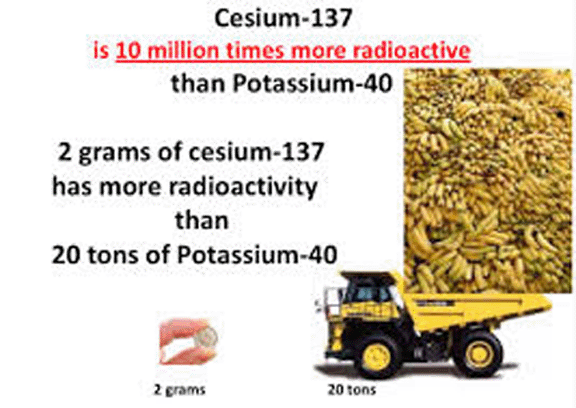
Both Dutch and American authorities say they found a radioactive element known as caesium-137.
The US Federal Drug Administration says long-term, repeated low-dose exposure to caesium-137 increases health risks.
But the agency adds that the levels detected in the Indonesian products posed no acute risk to health.
The radioactive isotope, which is created via nuclear reactions, is used in a variety of industrial, medical and research applications.
What is the source of radioactive contamination?
Investigations have so far centred on a metal-processing factory at the Cikande Industrial Estate, in Banten province on the island of Java.
The smelting company, called PT Peter Metal Technology, is believed to be China-owned, according to investigators.
Around 20 factories linked to the Cikande industrial estate are affected, including facilities that process shrimp and make footwear, authorities say.
Nine employees working on the industrial estate were detected to have been exposed to caesium-137. They have been treated at a government hospital in Jakarta and all contaminated facilities in the industrial area have been decontaminated.
In August, Indonesian authorities said the government would impose a restriction on scrap metal imports, which were reportedly a source of the contamination.
What is being done about it?
Indonesia’s nuclear agency last month said the sprawling industrial estate would be decontaminated.
On Wednesday, Indonesian authorities scaled up their probe into the suspected source of the contamination.
“The police have launched the criminal investigation,” said Bara Hasibuan, a spokesperson for the investigating task force.
Indonesian authorities have had difficulty conducting investigations as the management of PT Peter Metal Technology — which produces steel rods from scrap metal — has returned to China, Setia Diarta, director general of the Metal, Machinery, Transportation Equipment, and Electronics at Indonesia’s Ministry of Industry, told a hearing with politicians earlier this month.
In addition, Indonesian authorities say they are preventing goods contaminated with caesium-137 from entering Indonesia.
At one port, authorities said they detected and stopped eight containers of zinc powder from Angola that were contaminated with caesium-137.
After being re-exported, containers of the mineral were last month reported as being stranded off the Philippine coast amid a stoush between Jakarta and Manila over what to do with them.
Is fishmeal from Fukushima-affected fish the source of Indonesian shrimp’s radioactive contamination?

J. P. Unger, 8 Sept 25
It just hit me earlier, while thinking about the recently exposed case of radioactive shrimp being recalled in the US, and in particular why one Indonesian shrimp farming business’s harvests would be contaminated with radioactive Cesium and not those from other Indonesian shrimp farms: it’s probably the feed they used!
Cheap, radioactive fishmeal, perhaps made from fish impacted by contamination from Fukushima, I suspect could well be the source. This is why:
Shrimp farming has traditionally used fishmeal as a high-protein source to feed the shrimp -with fishmeal normally consisting of smaller fish, fishing “by-catch” and fish-processing byproducts, all shredded and ground to a texture like coarse sand or pellets to feed farm animals and aquaculture operations.
As ocean fish populations become increasingly strained and global demand for fish keeps increasing, fishmeal has become increasingly expensive and in shorter supply
Therefore, it’s quite likely that fishmeal from contaminated fisheries -for example, with high levels of radioactive pollution- would be offered at a comparatively low price. That would be quite attractive for a business that’s more concerned with profit margins than with what happens to consumers down the line.
If this was the case, and given that many businesses around the world likely prioritize profit margins over long-term effects in far-removed consumers (or might not even be aware of the contamination of the feed), this case could be the tip of a very worrisome iceberg and open up a big can of worms….
It certainly demands a careful inspection of food imports AND of food “precursors”, in particular imported fishmeal and food from animals raised on it. Also, international cooperation and vigilance, to know who might be selling contaminated fishmeal and where, who has been buying and using it, and what land- or water-farmed meat production it might be affecting.
Unless I hear concerns or suggestions to the contrary, I’ll prepare and send a slightly different articulation of these thoughts to a handful of government officials and media here and in the US who might be interested in investigating, as precautions should probably be ramped up for a variety of food products…
This would not be the first time radioactively contaminated foodstuff circulates at bargain prices… When I was starting as a science and environment journalist in Peru in the 1980’s I wrote about the post-Chernobyl arrival of radioactive powdered milk from Europe (a “generous” 12,000 ton donation from the European Community…), and radioactive meat from Germany (sold at a bargain price!). I received brush-offs, threats and warnings from corrupt government officials profiting from it, as well as ignorance and disinterest among other journalists and the general population, all with other “more immediate concerns” at the time, as the country faced five-digit inflation and the expansion of a brutally violent Maoist insurgency -nobody wanted to hear about yet more dangers then, and everywhere I was met by a frustrating fatalistic denial or avoidance mantra along the lines of “one has to die from something anyway.” Anyways… JPU
Indonesia Bets On Thorcon’s Molten Salt Reactor, But History Suggests Trouble Ahead.
Indonesia has none of the ingredients that historically led to nuclear success. It has no prior nuclear fleet, no experience operating reactors, no large-scale nuclear workforce, no plans to build nuclear weapons and no tradition of standardized reactor builds.
Michael Barnard, Clean Technica, 27 Aug 25
Indonesia has taken a bold and likely problematic step with the announcement of its first, early stage regulatory approval for a nuclear power project. Thorcon International, a Singapore-based developer of molten salt reactors, has received permission from Indonesia’s regulator to evaluate a site for a demonstration plant on Kelasa Island. For a country of more than 270 million people with electricity demand that is still growing rapidly, this might appear to be a turning point. Yet if one examines history, technology, and the context in which this project is being launched, the chances of it succeeding look vanishingly small.
Indonesia is the world’s largest archipelago, stretching across more than 17,000 islands, with only about 6,000 of them inhabited. This geography creates enormous challenges for the national grid, which is fragmented into multiple regional systems rather than a single interconnected backbone. Java and Sumatra host most of the country’s transmission infrastructure, while many outlying islands depend on small isolated grids. Remote communities often rely on diesel generators for electricity, which are expensive to operate and create significant local pollution…………………………………………………………….
the government has announced a target of 10 GW of nuclear capacity by 2040, marking its first commitment to nuclear power.
If delivered, these additions would lift renewables to roughly 35% of the national mix while also introducing nuclear into the system for the first time. Looking further ahead, Indonesia targets 75 GW of new renewable capacity by 2035, supported by more than 10 GW of storage, reflecting the scale of investment needed to diversify away from coal and meet climate commitments.
Nuclear power has only succeeded when certain conditions were in place. In the mid-twentieth century, large economies aligned nuclear energy programs with nuclear weapons programs. They standardized on one design, built dozens of gigawatt-scale plants in sequence, trained workforces through government-led programs, and maintained focus for decades. Those programs were not efficient by today’s standards, but they were coherent and well-resourced.
Countries that did not follow that formula, such as Canada’s stop-start approach with CANDUs or the the last couple of decades of western nuclear reactor builds, ended up with mixed results and rising costs. Even China, which has mastered megaproject delivery, is struggling with nuclear because it has spread effort across too many designs and has not locked into the necessary standardization. While nuclear advocates in the west point to China’s build out as impressive, it is years behind on targets and falling further behind. It only achieved its 2020 target in 2024, is still well under its 2% of grid capacity target for 2025 and its scheduled construction through 2030 will leave it tens of GW off that target.
Indonesia has none of the ingredients that historically led to nuclear success. It has no prior nuclear fleet, no experience operating reactors, no large-scale nuclear workforce, no plans to build nuclear weapons and no tradition of standardized reactor builds. It’s not building dozens of standard and proven GW-scale reactors, but only 10 GW in total, starting with a 500 MW unproven design, and not necessarily repeating that one solution multiple times. So far they appear to have little political opposition to nuclear, but that doesn’t mean the bipartisan support required for a two to four decade strategic national construction program. The country is signatory to the nuclear Non-Proliferation Treaty and has eliminated highly enriched uranium that might be transferable to nuclear weapons from the countyr, so there is military strategic alignment and discipline to call upon.
The choice of a molten salt reactor adds another layer of difficulty. Molten salt designs were first tested at Oak Ridge in the 1960s. They worked in the lab but ran into issues with corrosion, material embrittlement, plugging of salt lines, and complex chemistry that had to be actively managed. They never scaled beyond a few megawatts of thermal output. In recent years, startups from North America to Scandinavia have revived the concept, promising walk-away safety and lower costs. Yet not a single one has delivered a commercial plant. Thorcon itself has never built or operated a reactor, anywhere. It is proposing to build large sealed modules in shipyards and tow them to Indonesia, an approach that exists only on paper.

……………………………..Germany tried thorium in its pebble-bed reactor, and India built an entire nuclear strategy around its domestic thorium reserves, planning a three-stage cycle that would eventually rely on advanced heavy water reactors fueled with uranium-233 bred from thorium. Yet in every case, thorium stopped short of commercial deployment. The complexity of fuel handling, the need for an initial fissile inventory of uranium or plutonium, and the sheer momentum of the uranium-fueled reactor fleet kept thorium in the category of “promising but not delivered.”
Thorcon’s original vision was built on thorium’s promise. Its very name, short for “Thorium Concept,” signaled an intention to commercialize molten salt reactors running on a thorium cycle. Early designs envisioned dissolving thorium in molten fluoride salt, breeding uranium-233 in situ, and demonstrating the fuel’s long-touted advantages. But as the company moved from concept to trying to build an actual plant in Indonesia, pragmatism set in. For a first-of-a-kind power reactor, relying on thorium would mean untested chemistry, uncertain licensing pathways, and even greater risk.
Indonesia’s proposed demonstration plant is therefore designed to run on conventional low-enriched uranium fuel dissolved in molten salt, not thorium. Thorium remains a potential long-term option in the design, but the Indonesian reactor will take the easier, more familiar path to get the project off the ground. In other words, while Thorcon began as a bet on thorium, its first potential real-world deployment has been scaled back to uranium, underscoring how thorium continues to hover at the edge of nuclear power rather than forming its core.
Bent Flyvbjerg’s work on megaprojects should be a warning. He has shown repeatedly that nine out of ten large projects go over budget and over schedule, and nuclear projects are consistently among the very worst. The average nuclear build is more than 100% over budget and about a decade late. Add in the fact that this is a first-of-a-kind reactor by a company with no track record, in a country with no nuclear infrastructure, and the probability of delivering on time, on budget, and at promised cost of electricity falls close to zero. Even if the project is eventually completed, it will almost certainly take much longer and cost much more than advertised, and the benefits to Indonesia will not match the rhetoric.
The alternative paths are clearer and less risky. Indonesia sits on some of the world’s richest geothermal resources and has significant hydro potential. Solar costs continue to fall and the archipelago has ample land and rooftops for deployment. With investment in storage, interconnections, and grid modernization, these resources could supply reliable and cheap electricity without the risks of nuclear. International partnerships like the Just Energy Transition Partnership are already funneling billions into renewables and grid upgrades. Building out this system is not trivial, but it does not carry the weight of unproven technologies, uncertain regulation, and the specter of megaproject failure that Thorcon does.
……………………..A better bet would be to double down on renewables, expand storage, and build the transmission backbone to connect islands and balance supply. That path has its own challenges but rests on proven technologies already delivering results worldwide. Indonesia has made a bold gesture toward nuclear. The sober assessment is that it will not pay off. https://cleantechnica.com/2025/08/26/indonesia-bets-on-thorcons-molten-salt-reactor-but-history-suggests-trouble-ahead/
How did cs137, a fission product get into the Indonesian shipping container?
Dennis LENEVEU, 22 Aug 25,
Re: [Nuclear Waste Watch] US FDA guidance on health impacts of cesium exposure.
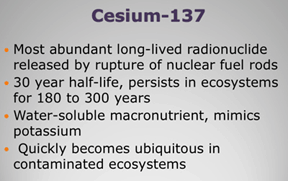
Indonesia has only research reactors. If the cs137 contamination came from these small reactors what about all the large reactors such as CANDUs that have continual measured stack releases of beta gamma particulate that would contain cs137 that is volatile?
CANDUs emit large amounts of carbon 14 that has been measured at elevated levels in tree rings around Pickering. Cs137 would also be expected to be in tree rings wood. Wood is used as shipping containers and many other uses such as furniture and interior housing lumber and wood.
Both carbon 14 and cs147 are known to off gass. C14 is particularly a problem being a beta emitter that would never be measured. Cs137 is a gamma emitter that is easily measured with a Geiger counter. Carbon 14 off gassing has been documented in the Bruce low and intermediate level waste facility but is not routinely measured.
Huge amounts of carbon 14 has been deposited around reactors for years. Carbon14 accumulates in the biosphere. With a half life of 5730 years it’s all still around gradually building up in the environment. The stack releases allowed for reactors are based on airborne exposure only. The carbon 14 is greatly dispersed in the air but settles out and deposits in the environment. Gradual bioaccumulation is ignored in regulations for emission standards.
Earthquake-prone Indonesia considers nuclear power plan as 29 possible plant sites revealed
ABC News, By Natasya Salim, Tri Ardhya and Sally Brooks, 28 Dec 24
In short:
Indonesia’s energy council has proposed 29 sites for nuclear power plants in a bid to secure reliable energy sources and reduce carbon emissions.
Environmental groups say the plan is “dangerous”, partly because the country is prone to earthquakes.
What’s next?
The energy council is searching for foreign investors to back the plan.
…………………………………………………………………………………………………………………….. The new detail on plant site locations has renewed safety concerns among environmental advocates in part because Indonesia is prone to natural disasters.
The archipelago mostly sits along the Pacific Ring of Fire where tectonic plates frequently collide and cause earthquakes and other disasters.
Twenty years ago, a magnitude-9.1 earthquake struck off the coast of Indonesia’s Aceh province and triggered the 2004 Boxing Day tsunami, that killed some 230,000 people across Indonesia, Sri Lanka, India, Thailand, and nine other countries.
Hendrikus Adam, from environmental not-for-profit organisation WALHI, said authorities needed to learn from past nuclear power disasters, including those caused by earthquakes and tsunamis like the Fukushima accident in Japan in 2011.
“We think nuclear plants are risky, dangerous and harmful for humans and the environment,” said Mr Adam.
“The development of a nuclear plant itself is also very expensive and hazardous.”
……………………………………………. Last month, National Development Planning Deputy Minister Vivi Yulaswati said Indonesia was in talks with the US and Russia about acquiring technology to develop nuclear power plants.
Separately, Indonesia’s state-owned electricity firm PLN has reportedly signed agreements with companies in the US and Japan to build small modular reactors, Coordinating Economic Minister Airlangga Hartarto said earlier this month……….
Details of the agreements are scarce and PLN declined to comment for this story………….
Currently none are in commercial operation in any Organisation for Economic Co-operation and Development (OECD) country….. https://www.abc.net.au/news/2024-12-27/earthquake-prone-indonesia-plans-for-nuclear-power/104758008
Indonesia’s nuclear energy push pits growth against safety concerns

SCMP, Resty Woro Yuniar, 1 Dec 2024
In a move that could reshape Indonesia’s energy landscape, President Prabowo Subianto is advocating for nuclear power as a solution to the country’s growing energy demands. While supporters hail the initiative as a transformative step for Southeast Asia’s largest economy, critics sound alarms about radioactive waste and high costs.
Prabowo’s brother and top adviser, Hashim Djojohadikusumo, outlined the administration’s ambitious goal during Cop29 in Baku on November 19: to add over 100 gigawatts of power in the next 15 years, with at least 75 per cent sourced from renewable and [?]clean energy, including nuclear. The country aims for net zero emissions by 2060………
Hashim had previously said that the government plans to build two nuclear plants with varying capacities, including a larger facility in western Indonesia capable of producing up to 2GW. The country currently operates two nuclear reactors, primarily for research purposes.
“What needs to be looked for is the safest place [for the plants], one that is earthquake-resistant. Don’t build it in areas where there is a high risk of earthquakes, there could be an accident,” Hashim said on November 12.
…………………………………………………………….. ‘Fake solutions’
While proponents argue nuclear power is a reliable source of clean energy, many environmentalists and concerned Indonesians have opposed plans to build nuclear plants in the past, typically citing safety or security concerns and recalling disasters like Chernobyl and Fukushima.
“We are actually bucking the global trend. Developed countries like Germany have abandoned their nuclear power plants two years ago, and now we are planning to build one,” said Hadi Priyanto, a climate and renewable energy activist.
“At Cop28 last year, we called for the government to triple our use of renewable energy, and we made the same call this year. Instead of doing that, the government was peddling nuclear power and other fake [energy transition] solutions.”
He raised concerns about the government’s budget for managing radioactive waste, questioning whether Indonesia has the financial capacity to handle such challenges.
“If it is not managed properly … it will pollute water and soil. In the Fukushima case, they stored hundreds of thousands of tonnes of its radioactive waste for 13-15 years, and they only released it last year. Do we have the financial strength to manage waste like that?” he said.
Deon Arinaldo, an energy transition programme manager at Jakarta-based Institute for Essential Services Reform, said that while nuclear was a “reliable” energy source, construction of nuclear plants would be “problematic” as it would be expensive and time-consuming.
“What is very unfortunate is that Indonesia has high renewable energy potential, from the data of the Ministry of Energy and Mineral Resources there is more than 3,600GW of renewable energy potential, especially solar and wind, which can be deployed at a cheaper price and [produced] faster, so that it can support economic growth,” Deon said.
Both Hadi and Deon argued that nuclear plants would also make Indonesia dependent on foreign energy providers, as the country currently lacks the technology to build and operate the plants – or enrich uranium, a key nuclear fuel…………….. https://www.scmp.com/week-asia/economics/article/3288703/indonesias-nuclear-energy-push-pits-growth-against-safety-concerns
Progress is Slow in ASEAN’s Anti-Nuclear Pact: Indonesia
Jayanty Nada Shofa, July 25, 2024, https://jakartaglobe.id/news/progress-is-slow-in-aseans-antinuclear-pact-indonesia
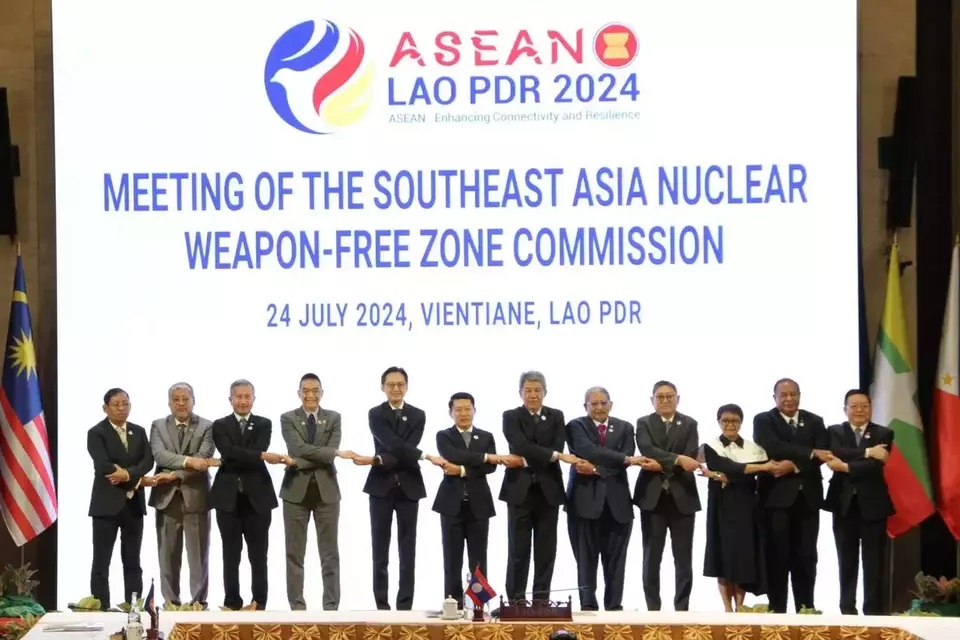
Jakarta. The progress is slow in bringing nuclear-possessing countries to promise that they would keep the Southeast Asian region nuke-free, Indonesia told fellow ASEAN members.
Foreign Affairs Minister Retno Marsudi is currently in Laos to discuss the bloc’s matters with her ASEAN counterparts. The group’s Southeast Asia Nuclear Weapon-Free Zone (SEANWFZ) pact became one of the major themes in the discussions.
The treaty aims to create a peaceful Southeast Asia region that is free from nuclear weapons. The pact has legally binding protocols for the five nuclear-weapon states — China, France, Russia, the UK, and the US — to sign and ratify. By signing, these five countries would promise to not use or threaten to use nukes in the region. Although the SEANWFZ dates back to 1995, no nuclear weapon state has signed the protocol so far.
“There has not been any significant progress from the nuclear-weapon states in regards to the SEANWFZ protocol,” Retno said in a press statement on Wednesday evening.
Amidst the sluggish progress, Indonesia thinks it is about time that ASEAN should involve experts in their efforts.
“Indonesia suggests that we should appoint experts, including legal experts from every ASEAN country, to give their inputs in the next SEANWFZ Commission meeting with a clear and measurable timeline,” Retno said.
Of all five nuclear-weapon states, China appears to be the one who is the closest to signing the pact. Last year, Malaysia’s then-Foreign Affairs Minister Zambry Abdul Kadir said that China had given its word to sign the protocol “unconditionally”.
Kadir made the remarks on the sidelines of an ASEAN foreign ministerial meeting in Jakarta last July. Not long after Kadir’s statement, Secretary-General Kao Kim Hourn also dropped a similar hint that Beijing had shown a “strong desire” to sign the SEANWFZ protocol. But again, China has yet to keep its promise.
Indonesia civil society groups raise concerns over proposed Borneo nuclear reactor

by Irfan Maulana on 14 May 2024, https://news.mongabay.com/2024/05/indonesia-civil-society-groups-raise-concerns-over-proposed-borneo-nuclear-reactor/
- Indonesia’s largest environmental advocacy group, Walhi, staged demonstrations in Jakarta and West Kalimantan province to raise awareness about a proposed nuclear power plant in West Kalimantan’s Bengkayang district.
- In 2021, a U.S. agency signed a partnership agreement with Indonesia’s state-owned power utility to explore possibilities for a reactor in the province. Survey work is currently being conducted to determine the project’s viability and safety.
- Some environmental groups have questioned the merit of the plan on safety grounds and the availability of alternative renewable sources.
JAKARTA — Civil society organizations in Indonesia staged protests in late April to raise awareness of a planned nuclear plant near Pontianak, capital of West Kalimantan province on the island of Borneo.
“We are advocating that West Kalimantan be kept away from the threat of a nuclear radiation disaster. Indonesia is not Chernobyl,” said Hendrikus Adam, executive director of the West Kalimantan chapter of the Indonesia Forum for the Environment, a national NGO known as Walhi, referring to the site of a notorious 1986 nuclear meltdown in the Ukrainian Soviet Socialist Republic.
Indonesia’s first experimental nuclear reactor, the TRIGA Mark II, opened in the city of Bandung in February 1965. Since then, however, the world’s fourth-largest country has yet to open a full-fledged nuclear power station.
In March 2023, Indonesia and the U.S. Trade and Development Agency (USTDA) signed a partnership agreement to develop small modular reactor technology for the archipelago’s power network. The agreement included a $1 million grant to PLN, the state-owned power utility, to carry out feasibility studies on a nuclear reactor.
PLN has proposed a 462-megawatt facility in West Kalimantan, which would use technology supplied by NuScale Power OVS, a publicly traded company based in Oregon in the U.S.
In capacity terms, that represents almost one-tenth of the giant Paiton coal-fired complex in East Java province, a mainstay of the Java-Bali power grid.
NuScale says the modular design of its technology has additional resilience to earthquakes — a significant consideration for civil engineering projects in Indonesia, one of the most seismically active countries in the world.
However, the technology encountered controversy after John Ma, a senior structural engineer with the U.S. Nuclear Regulatory Commission (NRC), questioned the commission’s approval of the design’s earthquake resistance. That “differing professional opinion” was subsequently dismissed on review.
In 2021, Indonesia’s national research agency, known as BRIN, carried out a seismic study on a prospective site in the West Kalimantan district of Bengkayang.
That early work is part of research under the internationally agreed Probabilistic Seismic Hazard Assessment, which is recommended by the International Atomic Energy Agency as part of its safety regimen.
Risk assessment
At Walhi’s demonstration on April 26 in Jakarta, volunteers with the environmental group unfurled banners stating “Indonesia is not Chernobyl.” Lessons from the Chernobyl incident, as well as the 2011 Fukushima Daiichi nuclear plant meltdown in Japan — the latter triggered by an earthquake — inform much of the civil society campaign in Indonesia.
“The number of human and environmental tragedies shows that human-created technology such as nuclear power plants cannot be completely controlled,” Adam said.
He also questioned the government’s choice of Indonesian Borneo, known locally as Kalimantan, on the basis that it isn’t as seismically active as islands like Java, Sumatra and Sulawesi.
“The assumption that Kalimantan is safe from this disaster is of course not true,” Adam said. “Kalimantan has earthquake sources, such as the Meratus Fault, Mangkabayar Fault, Tarakan Fault, Sampurna Fault and Paternoster Fault.”
Walhi also pointed to slow uptake of solar and other renewable energy sources in Indonesia, which haven’t received the kinds of subsidies seen in other countries transitioning to clean energy.
“We have so many choices for energy transition, why do we have to choose technology that is actually dangerous?” said Fanny Tri Jamboree Christianto, Walhi’s energy campaign lead.
Who decides whether Bataan should go nuclear?
The plant is located near to not one but four volcanoes, in an area prone to earthquakes’
Rappler.com, AUG 13, 2023 LOLITA CASTILLO
Bataan, a beautiful peninsula located west of the Philippine capital, Manila, is most famous for a couple of things. One, it was where the Death March began following the defeat of the allied forces of American and Filipino soldiers led by Gen. Douglas McArthur against the Japanese Imperial Army during World War II. Two, it is where the mothballed Bataan Nuclear Power Plant (BNPP) with a price tag of $2.3 billion idly resides, unoperated for nearly four decades.
Bataan residents did not have any sort of control or say in these two circumstances that brought their province to prominence. The former, BNPP’s construction amid opposition, was decided without their consent, and the latter a byproduct of the irrationalities of war and the fight for democracy.
Bataan is my birthplace and remains dear to my heart. Although I have been away for a few decades, I keep abreast of the potential threats to its security and stability. BNPP’s construction began when I was in grade school, and most people in Bataan were not even aware of it until cause-oriented groups outside of Bataan and the local informal leaders bravely protested against its operation in a militarized, political climate. Now, it’s an issue that has resurfaced, and it will test how democracy is manifested and mediated in local and national settings, and how crucial decisions and trade-offs will be made regarding safety, equity, and sustainable development.
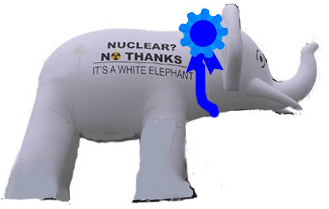
Each year, the government allocates more than $1 million for the BNPP’s upkeep and maintenance. It remains a losing and wasteful investment that does not give back. It is important that a decision is made about the white elephant as delays in the decision come with opportunity costs.
The plant, the first of its kind in Southeast Asia, was designed to provide 620 megawatts of electricity, and was completed in 1984 in response to the oil crisis in the ’70s – but has never produced any single watt of electricity due to a combination of factors. The biggest of these factors are safety concerns.
The administration of Aquino and Ramos had ordered it mothballed in spite of its extremely high costs based on the findings from the technical audit conducted by the National Union of Scientists (NUS) in 1986, 1988, and 1990, citing over 4,000 technical defects concerning cover design, construction, quality assurance, workmanship, etc.
The plant is located near to not one but four volcanoes, in an area prone to earthquakes. Fear and uncertainty about the location, and the wake of the Three Mile Island accident in the US in 1979, the Chernobyl disaster in 1986, and the more recent 2011 Fukushima nuclear disaster restrained efforts to revive it.
As the Philippines seeks to retire its coal plants to meet its pledge and climate goals, as the impact of climate change around the globe, especially among the most vulnerable island countries, intensifies, and as demand for electricity increases, the discussions and debates whether to revive the BNPP or not, or whether to repurpose it, continues.
Nuclear energy is depicted as “cleaner” than coal, and Bataan’s power plants that send electricity to the Luzon grid rely heavily on fossil fuel. As of November 30, 2022, the total capacity of existing power plants in Bataan equals 3,676.7 MW. Renewable energy accounts only for 92.4 MW while fossil fuel-fired plants account for 3,528 MW. More solar and wind farms are slated for construction and operation by 2026, which will increase the output to 4,920.7 MW.
……………………………………… there are compelling dangers or risks as well: the plant is nearly 40 years old and would need substantial rehabilitation that require further spending. Rigorous safety protocols are imperative to ensure safety, as it is sitting on earthquake-prone area. It generates radioactive waste, and the disposal of waste is expensive, as well as poses potential environmental risks. The cost of repair, maintenance, and operation might be higher than if the government were to build and operate renewable sources of energy. In 2017, a South Korean firm estimated that rehabilitation and upgrade of BNPP would be up to $1.19 billion.
………………………….The residents of Bataan must always be included in decision-making on the path to development, as they are the ones who directly suffer from the consequences of bad economic and environmental policies. Moreover, Bataan is already disproportionally carrying the heavy burden of supplying energy to Luzon. It will be unequitable to force it to host an old nuclear plant that faces considerable uncertainties.
Whatever Bataan decides, the following questions loom: Would the national government respect its decision and local autonomy? Would it allow Bataan the right to self-determination? If Bataan were to demand the national government to fund the rapid expansion of renewable sources of energy and repurpose BNPP, would the current president support it or would he follow the path of his father? – Rappler.com https://www.rappler.com/voices/imho/opinion-who-decides-whether-bataan-should-go-nuclear/
Indonesia Warns Nuclear Weapons Put Southeast Asia a ‘Miscalculation Away’ From Disaster

Indonesia’s Foreign Minister Retno Marsudi urged nuclear weapons states to join ASEAN’s regional nuclear-free zone.
The Diplomat, By Edna Tarigan and Niniek Karmini, July 12, 2023
Indonesia’s top diplomat warned Tuesday of the threat posed by nuclear weapons, saying that Southeast Asia is “one miscalculation away from apocalypse” and pressing for world powers to sign a treaty to keep the region free from such arms.
Indonesian Foreign Minister Retno Marsudi raised the alarm ahead of a two-day summit of the Association of Southeast Asian Nations (ASEAN), which started later Tuesday in Jakarta. The agenda would spotlight Myanmar’s deadly civil strife, continuing tensions in the South China Sea, and efforts to fortify regional economies amid the global headwinds set off by Russia’s invasion of Ukraine.
Later in the week, the 10-nation bloc will meet Asian and Western counterparts, including U.S. Secretary of State Antony Blinken, Russian Foreign Minister Sergey Lavrov, and Chinese foreign policy overseer Wang Yi.
The U.S.-China rivalry is not formally on ASEAN’s agenda but looms large over the meetings of the bloc, an often-unwieldy collective of democracies, autocracies, and monarchies, with some members split over allegiances either to Washington or Beijing.
“We cannot be truly safe with nuclear weapons in our region,” Marsudi told fellow ASEAN ministers. “With nuclear weapons, we are only one miscalculation away from apocalypse and global catastrophe.
In 1995, ASEAN states signed a treaty that declared Southeast Asia’s commitment to be a nuclear weapon-free zone, one of five in the world. However, Marsudi lamented that none of the world’s leading nuclear powers have signed on to the pact and called for renewed efforts to convince those states to sign up. “The threat is imminent, so we can no longer play a waiting game,” she said………………………………………………………………….more https://thediplomat.com/2023/07/indonesia-warns-nuclear-weapons-put-southeast-asia-a-miscalculation-away-from-disaster/
Indonesia calls for destruction of the world’s nuclear arsenals.
THE ASAHI SHIMBUN, by Yoshiaki Kasuga, Naoko Handa and Tadao Onaga. Rizki Akbar Hasan contributed to this story. May 19, 2023
BOGOR, Indonesia–Indonesian President Joko Widodo will call on the nuclear powers at the Group of Seven summit being held in Japan to destroy their nuclear arsenals.
In an exclusive interview with The Asahi Shimbun at Bogor on May 18, Joko said: “The Indonesian position is clear and firm. Nuclear weapons must be destroyed because they are a threat in the world.”
Joko and leaders of seven other non-member nations were invited to the G-7 summit that began May 19 in Hiroshima.
“Hiroshima is the symbol of peace,” Joko said. “I’m very happy that the G-7 is held in Hiroshima. This is very important.”
Joko was due to arrive May 19 for his first visit to this western Japan city. He expressed an interest in visiting the Hiroshima Peace Memorial Museum….
Indonesia, along with the other ASEAN nations, has signed the Treaty on the Southeast Asia Nuclear Weapon-Free Zone……..
Indonesia’s foreign policy is non-alignment and neutrality, which the government describes as “free and active.” For example, Jakarta has refused to take sides in the war between Russia and Ukraine, and Joko himself has met with both Ukrainian President Volodymyr Zelenskyy and Russian President Vladimir Putin to promote dialogue between the two nations.
Joko became the first Asian leader to visit the two nations in June 2022.
Indonesia’s neutral stance means it has not gone along with economic sanctions against Russia pushed by the United States and adopted by Western allies.
“The war (has been in place) one year already and (sanctions have not proved) effective to stop the war,” Joko said. “Dialogue is very important, and it must continue to be maintained.”
He added that Indonesia was prepared to serve as a bridge between Russia and Ukraine.
“Indonesia stands ready to contribute to bridge the differences and the collective leadership required to end the war,” Joko said. “Peace must be reached as soon as possible because in the end, the people are the victims.”
Indonesia was invited to the G-7 summit because it is considered one of the leaders of the Global South, mainly developing nations located in the Southern Hemisphere……………..
Referring to growing confrontation between the United States and China in the Asia-Pacific region, Joko emphasized that Indonesia continues with its “non-bloc” stance.
“Many said that Indonesia is close with the United States,” the Indonesian president said. “Many also said that Indonesia is close with China. I want to say that both statements are correct. The United States and China are important partners of Indonesia, just like Japan.” ……………………… https://www.asahi.com/ajw/articles/14911780
Just another U.S. nuclear front group, marketing to Indonesia (never mind about the volcanoes)
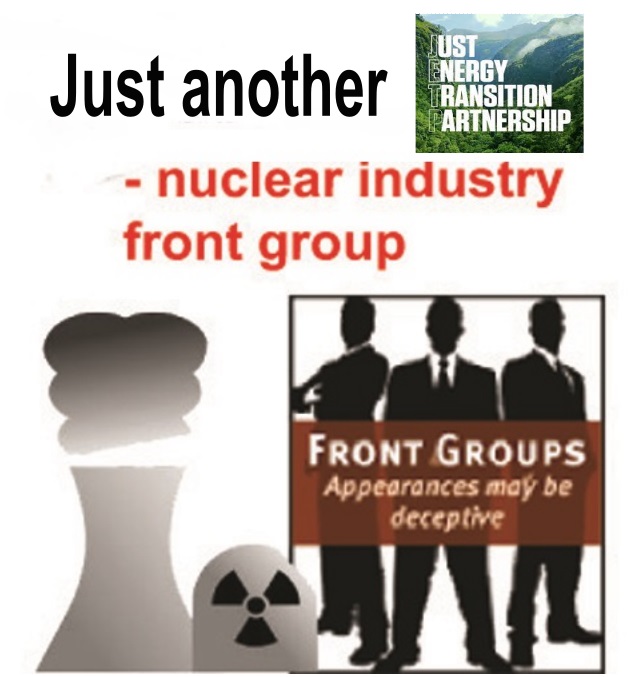
USA, Indonesia announce partnership on SMRs
WNN, 20 March 2023
The USA and Indonesia have announced a strategic partnership to help Indonesia develop its nuclear energy programme, supporting Indonesia’s interest in deploying small modular reactor (SMR) technology to meet its energy security and climate goals.
A Memorandum of Agreement, as well as affiliated grants and contracts, was signed during the Indo-Pacific Business Dialogue in Bali, Indonesia. The agreement advances the goals of the Just Energy Transition Partnership (JETP) and will strengthen Indonesia’s leadership in the ASEAN region on the deployment of advanced, safe and secure nuclear energy technologies, working toward the goal of net-zero emissions in Indonesia by 2060.
Under the agreement, the US Trade and Development Agency (USTDA) has awarded a grant to PLN Indonesia Power to provide assistance to assess the technical and economic viability of a proposed nuclear power plant, to be located in West Kalimantan. It will include a site selection plan, power plant and interconnection system design, preliminary environmental and social impact assessment, risk assessment, cost estimate and regulatory review.
Indonesia Power selected NuScale Power to carry out the assistance in partnership with a subsidiary of Fluor Corporation and Japan’s JGC Corporation. The proposed 462 MWe facility would utilise NuScale’s SMR technology…………………………………..
In August 2019, Indonesia’s National Atomic Energy Agency (Batan) signed a Memorandum of Understanding with utility Indonesia Power to cooperate in the use of nuclear technology in the energy sector. One area of cooperation will be a feasibility study on the use of nuclear power plants. https://world-nuclear-news.org/Articles/USA,-Indonesia-announce-partnership-on-SMRs
U.S. government marketing nuclear power to Indonesia
Indonesia plans to develop a nuclear power plant with a potential capacity
of 462MW in West Kalimantan with funding and technological support from the
United States government.
Infrastructure Journal 20th March 2023
https://www.ijglobal.com/articles/171053/indonesia-plans-nuclear-plant-with-us-support
Studies on nuclear radiation’s impact on people necessary: BRIN
https://en.antaranews.com/news/258613/studies-on-nuclear-radiations-impact-on-people-necessary-brin 4 Nov 22, Jakarta (ANTARA) – Environmental and health studies on the impact of radiation exposure on people living in areas of high natural radiation, such as Mamuju, West Sulawesi, are necessary, the National Research and Innovation Agency (BRIN) has said.
A researcher from BRIN’s Research Center for Metrology Safety Technology and Nuclear Quality, Eka Djatnika Nugraha, said that in some places in Indonesia, such as Mamuju, people have been exposed to natural radiation that is several times higher than the global average at around 2.4 millisieverts per year.
“This situation may pose a health risk to the public due to chronic external and internal exposure,” Nugraha said in a statement received on Friday.
Mamuju is an area of high natural background radiation due to the high concentration of uranium and thorium in the rocks and soil, he observed.
Thus, studies on the health of people living in such areas could serve as a potential source of information about the effects of chronic low-dose exposure, he added.
In order to obtain scientific evidence on the effects of chronic low-dose radiation exposure on health, it is necessary to conduct a comprehensive environmental assessment of the exposure situation in areas of high natural radiation, he elaborated.
Meanwhile, head of BRIN’s Nuclear Energy Research Organization, Rohadi Awaludin, said that it is important to know and understand the safety and protection measures against nuclear radiation technology, especially for everyone involved or in contact with it.
“Nuclear radiation technology, including ionization, has been used and applied to various aspects, including industry and health, food, and others. This technology is the answer to the problems we have, but there are also risks that (one) must be (aware of) from this technology,” he added.
France’s Foreign Minister in Indonesia, raises concerns about AUKUS, nuclear submarines, and risks of weapons proliferation.
the theme of ‘betrayal’ in terms of both being ‘cheated’ out of a deal and being deceived by NATO allies and, in Australia’s case, a historical ally.

AUKUS was about ‘pressing a sense of confrontation with China’
if tomorrow Australia has some nuclear-powered submarines, why not, some other countries could ask for similar technology, it could be Indonesia, why not?’
Australia needs an entente cordiale with Indonesia over nuclear propulsion and non-proliferation, The Strategist, 29 Nov 2021, |David Engel However relaxed and comfortable Indonesian Defence Minister Prabowo Subianto might be about Australia’s plans to acquire nuclear-powered submarines (SSNs), the visit to Jakarta of French Foreign Minister Jean-Yves Le Drian has probably validated the very different view of Le Drian’s counterpart, Retno Marsudi.
……………………………………………. the most striking moment of the visit came during Le Drian’s address to Indonesia’s leading international affairs think tank, the Centre for Strategic and International Studies (CSIS). While his speech focused on issues such as multilateralism and the EU’s position on the Indo-Pacific, his response to a question on ‘minilateralism’—specifically, AUKUS and the Quad—took on a very different tone.
Ignoring the Quad, he levelled his remarks at AUKUS, stressing four points. The first two reiterated the theme of ‘betrayal’ in terms of both being ‘cheated’ out of a deal and being deceived by NATO allies and, in Australia’s case, a historical ally. He talked about American efforts to restore trust through various US commitments to France. He didn’t mention Australia in this context.
More significantly, his third point was that AUKUS was about ‘pressing a sense of confrontation with China’ (as the simultaneous translation put it). He said that, while France was not oblivious to China’s military threats and risks, he believed that the best way to respond to these threats was to ‘develop an alternative model rather than to first of all oppose’.
Perhaps his most significant point for Australian interests was his fourth, which went to the transfer of nuclear technology for submarine propulsion. He pointed out that until now no nuclear-weapon state had done this. But ‘if tomorrow Australia has some nuclear-powered submarines, why not, some other countries could ask for similar technology, it could be Indonesia, why not?’ He continued that, even though this technology was not covered by the Nuclear Non-Proliferation Treaty (NPT), the risk the arrangement posed of starting a trend was nonetheless of concern.
Irrespective of Le Drian’s intentions in answering the question in this manner—and it’s noteworthy that he didn’t cover AUKUS in his formal address—he would surely have known that his words would resonate powerfully with his audience, both at CSIS and more generally among Indonesia’s foreign policy establishment. While his depiction of Australia as duplicitous was evidently personal and heartfelt, it would also have struck a chord with those Indonesians who have characterised Canberra the same way over such issues as East Timor, Papua and spying allegations, irrespective of how justified that judgement might be.
Le Drian’s last point went directly to concerns about nuclear proliferation—issues that Indonesia highlighted in its official statement on AUKUS and the planned submarines. It corresponds closely ‘in spirit’ with subsequent official commentary to the effect that Indonesia was considering advocating a change to the NPT aimed at preventing non-nuclear-weapon states from acquiring SSNs………
whoever governs in Canberra now and into the future should at least make a priority of assuaging Jakarta’s worries on this subject, however overstated and unbalanced they are. While Indonesia’s prospects of changing the NPT and precluding Australia from having SSNs look remote at best—not least because several of its ASEAN colleagues do not share its views of Australia’s ambitions—the sooner the two countries can put this latest irritant to rest the better.
In the circumstances, the onus for doing so must primarily rest with Canberra………https://www.aspistrategist.org.au/australia-needs-an-entente-cordiale-with-indonesia-over-nuclear-propulsion-and-non-proliferation/
1 This Month
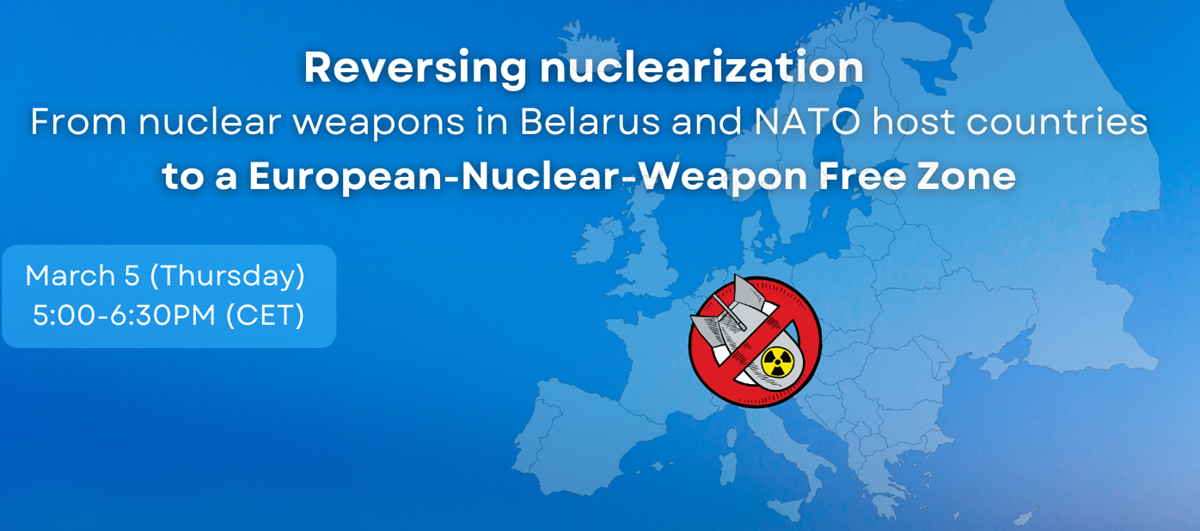
5 March -Online – Reversing nuclearization:
From nuclear weapons in Belarus and NATO host countries to a European-Nuclear-Weapon Free Zone
11am-12:30pm Eastern Time USA / 5pm-6:30pm CET

of the week – Advocating for a
nuclear free beach – https://www.samuellawrencefoundation.org/
The Samuel Lawrence Foundation advocates for a Nuclear Waste Free Beach at San Onofre, join us and take action!

10 March A LIVE WEBINAR THE REAL EFFECTS OF NUCLEAR POWER
What the Industry Isn’t Telling Us
1:00 PM Mountain, 2 pm Central, 3 pm Eastern. Live on the Keepers of the Water Facebook page


18 March Webinar @ 1 PM EST: An Assessment of SMR Projects: The Case of Canada
register for the zoom:
https://us02web.zoom.us/webinar/register/WN_o8BIIOUvQ2ONJR1nta65DQ#/registration

of the week – STOP SMALL MODULAR REACTORS IN CANADA
To see nuclear-related stories in greater depth and intensity – go to https://nuclearinformation.wordpress.com
-
Archives
- March 2026 (37)
- February 2026 (268)
- January 2026 (308)
- December 2025 (358)
- November 2025 (359)
- October 2025 (376)
- September 2025 (258)
- August 2025 (319)
- July 2025 (230)
- June 2025 (348)
- May 2025 (261)
- April 2025 (305)
-
Categories
- 1
- 1 NUCLEAR ISSUES
- business and costs
- climate change
- culture and arts
- ENERGY
- environment
- health
- history
- indigenous issues
- Legal
- marketing of nuclear
- media
- opposition to nuclear
- PERSONAL STORIES
- politics
- politics international
- Religion and ethics
- safety
- secrets,lies and civil liberties
- spinbuster
- technology
- Uranium
- wastes
- weapons and war
- Women
- 2 WORLD
- ACTION
- AFRICA
- Atrocities
- AUSTRALIA
- Christina's notes
- Christina's themes
- culture and arts
- Events
- Fuk 2022
- Fuk 2023
- Fukushima 2017
- Fukushima 2018
- fukushima 2019
- Fukushima 2020
- Fukushima 2021
- general
- global warming
- Humour (God we need it)
- Nuclear
- RARE EARTHS
- Reference
- resources – print
- Resources -audiovicual
- Weekly Newsletter
- World
- World Nuclear
- YouTube
-
RSS
Entries RSS
Comments RSS
 nuclear-news